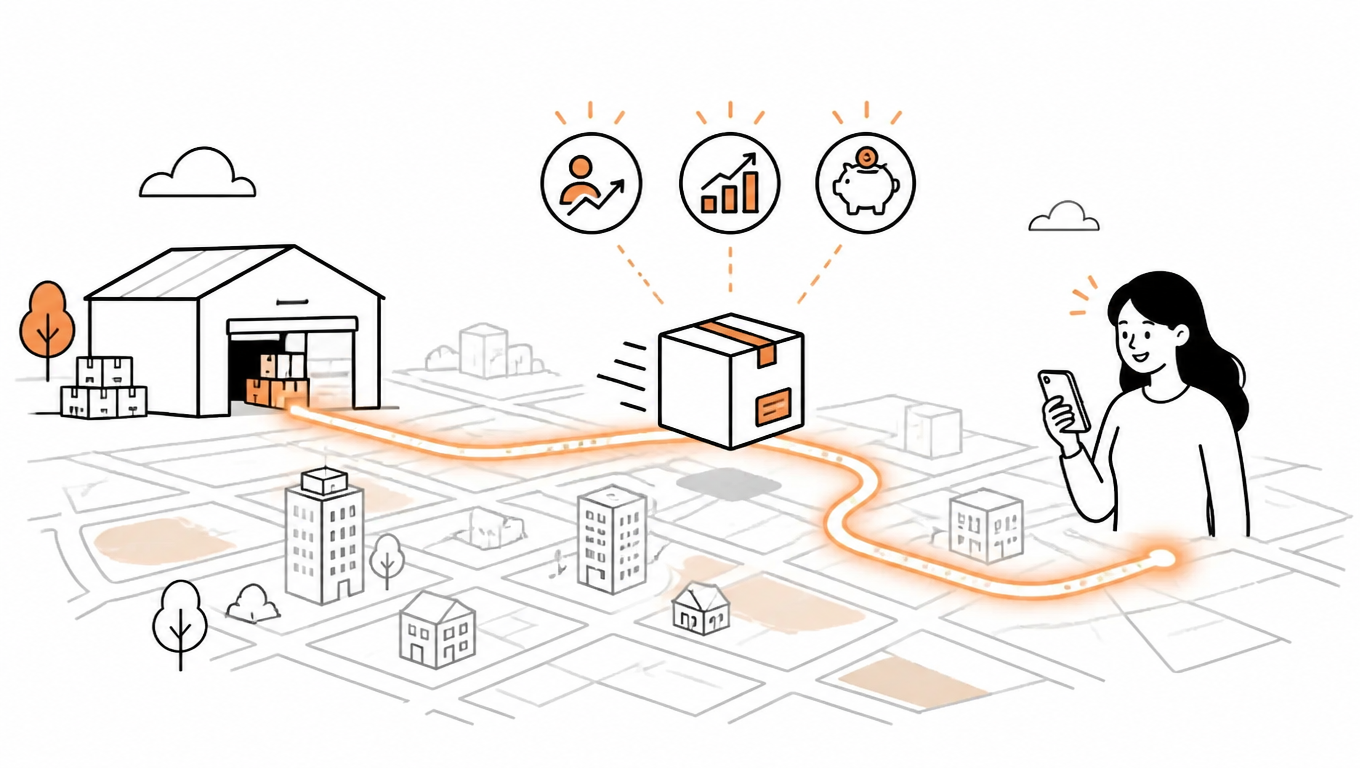
你在物流上省下的每一分钱,可能正在烧掉你的获客预算。Every dollar you shave off shipping might be burning a hole in your customer acquisition budget.
这不是危言耸听。高单量品牌有一个共同的思维惯性:把物流当成纯成本项来看。每个月出几千到几万单,每单省 0.5 美元,一年能"省"出六位数。这种算术看起来很踏实,但它的盲区大得惊人。它只看到了运费账单上的数字,完全没有看到因为物流体验差而悄悄流走的利润。This isn't alarmist thinking. High-volume brands share a deeply ingrained reflex: treating logistics as pure cost. Ship a few thousand orders a month, save 50 cents a unit, and you've "saved" six figures a year. The math feels solid. But it has a blind spot the size of a warehouse: it sees nothing beyond the freight invoice. It misses entirely the profit quietly leaking out the back door because of a lousy delivery experience.
这篇文章是写给谁看的?如果你的品牌月发货量超过 3000 单,需要更系统的梳理;如果你的团队里有人坚持"物流就是比价",请把这一篇转给他。如果你是一家 3PL 或海外仓的负责人,正在想办法让品牌客户跳出价格战的死循环,这篇文章就是你下一次提案的弹药。Who is this for? If your brand ships more than 3,000 orders a month, this is your playbook. If someone on your team keeps insisting that "shipping is just about rates," forward this to them. And if you run a 3PL or fulfillment center and you're tired of racing to the bottom on price, consider this paper your next pitch deck.
我们一层一层地拆,看看"便宜物流"的真实成本到底是多少。Let's peel back the layers and see what "cheap shipping" actually costs.
1. 你压的是运费单价,烧的是获客预算1. You're Squeezing Freight Rates. You're Burning Your Acquisition Budget.
先看一个已经被反复验证的商业常识:获取一个新客户的成本,是留住一个老客户的 5 到 25 倍。这个结论最早来自贝恩公司的客户经济学研究,至今仍是客户经营的基石。Let's start with a piece of business math that's been validated so many times it's practically gospel: acquiring a new customer costs 5 to 25 times more than keeping an existing one. That finding traces back to Frederick Reichheld at Bain & Company, published in Harvard Business Review in 1990, and it remains the bedrock of customer economics.
为什么这个数字跟你选承运商有关系?What does that have to do with which carrier you pick?
因为劣质物流是推走老客户的最高效方式之一。哈佛商业评论的数据还告诉我们,仅仅提高 5% 的客户留存率,就能让利润增长 25% 到 95%。而物流体验是留存率的一个核心变量。消费者调研机构在 2025 年的一项报告显示,70% 的消费者在经历两次负面体验后就会放弃一个品牌,将近四分之一的消费者一次就够了。Bad logistics is one of the most efficient ways to push existing customers out the door. The same body of HBR research shows that raising customer retention by just 5% can boost profits by 25% to 95%. And delivery experience is a core driver of retention. According to a 2025 report from consumer research firm Emplifi, 70% of consumers will abandon a brand after just two negative experiences. Nearly a quarter will leave after one.
链条是这样的:你为了省运费选了便宜的承运商 → 时效变长、追踪不透明、包裹破损率上升 → 消费者体验变差 → 他们不再回来 → 你只好继续烧广告拉新客 → 获客成本居高不下。你省下来的那点运费差价,在获客成本面前不值一提。The chain works like this: you pick a cheap carrier to save on freight → transit times stretch, tracking goes dark, packages show up damaged → the customer has a bad experience → they don't come back → you keep burning ad dollars chasing new customers → your CAC stays sky-high. The few cents you saved per shipment? A rounding error next to your acquisition costs.
更残酷的是,这些流失的客户不会告诉你原因。他们不会填问卷说"我因为物流太慢所以再也不买了"。他们只是安静地走了。你在数据看板上看到的是"复购率下降",却很难把它跟三个月前换的那家低价承运商联系到一起。Here's the cruel part: those lost customers won't tell you why they left. They won't fill out a survey saying "your shipping was too slow so I'm done." They just disappear. You'll see "repeat purchase rate declining" on your dashboard and never connect it to the budget carrier you switched to three months ago.
2. 第一笔隐性账:退货率不是"行业平均值",是你的物流在投票2. Hidden Cost #1 — Your Return Rate Isn't "Industry Average." Your Logistics Is Casting the Vote.
很多品牌把退货率当成一个不可控的行业常数。"服装嘛,退货率就是高。"这个想法只对了一半。A lot of brands treat return rates like the weather: something that just happens. "Apparel always has high returns." That's half true.
根据美国零售联合会和退货服务机构联合发布的报告,2024 年电商平均退货率为 16.9%。这意味着每 100 单里有将近 17 单被退回来。某些品类,比如服装和鞋履,退货率可以冲到 20% 甚至 30%。According to a joint report from the National Retail Federation (NRF) and Happy Returns, the average e-commerce return rate in 2024 was 16.9%. That's nearly 17 returns for every 100 orders. In categories like apparel and footwear, it can hit 20% or even 30%.
但"行业平均"是一个危险的概念。它掩盖了一个关键事实:你的退货率中有一部分跟产品质量无关,纯粹是物流端的失误造成的——包裹破损、送错地址、超出承诺时效、货损导致消费者体验差而退货。这些退货不是产品的问题,是你的物流在替你"投票"。But "industry average" is a dangerous phrase. It buries a critical fact: a portion of your returns has nothing to do with product quality. Damaged packaging, wrong address, missed delivery windows, product damage in transit — these returns aren't about what you made. They're about how it got there. Your logistics is voting on your behalf, and the results show up in your returns column.
每一单退货的成本远不止逆向物流的运费。商品折损、重新质检入库、包装耗材、人工处理,加起来远超你当初省下的那几毛钱运费差价。而且退回来的商品未必能全价再卖出去。And each return costs a lot more than the reverse shipping label. Product depreciation, re-inspection, restocking labor, packaging materials: add it all up and it dwarfs the freight savings you were chasing. Plus, returned inventory rarely resells at full price.
场景化算一笔账:一个月发 5000 单的品牌,如果因为物流体验差把退货率推高了 3 个百分点(比如从 17% 到 20%),一年多出 1800 单退货。如果每单退货的综合处理成本是 12 美元,一年多烧 21600 美元。而你当初可能只是为了每单省 0.3 美元,一年不过"省"了 18000 美元。Let's run a real scenario: a brand shipping 5,000 orders a month. If poor logistics pushes the return rate up 3 percentage points — from 17% to 20% — that's an extra 1,800 returns a year. At a conservative $12 per return in total processing costs, you're burning an extra $21,600 annually. And what did you save? Maybe $0.30 a shipment, which comes out to $18,000.
省了 18000,多花了 21600。这笔账,你的财务负责人算过吗?Saved $18,000. Lost $21,600. Has your CFO seen that math?
3. 第二笔隐性账:查单客服成本是你花钱回答"货到哪了"3. Hidden Cost #2 — WISMO. You're Paying People to Answer "Where's My Stuff?"
"我的订单在哪里"是电商客服最老、最烦、最贵的问题。WISMO — "Where Is My Order" — is the oldest, most annoying, and most expensive question in e-commerce.
在正常运营期间,查单类问询占客服总量的 10% 到 25%。到了旺季(黑五、圣诞),这个比例能飙到 40%。每一次查单问询的处理成本在 5 到 22 美元之间,取决于你是不是用了人工客服、响应时间多长、需不需要跨系统查信息。During normal operations, WISMO inquiries eat up 10% to 25% of all customer service volume. During peak season — Black Friday, Christmas — that number can spike to 40%. Each WISMO interaction costs between $5 and $22 to resolve, depending on whether you're using human agents, how long they spend digging through carrier portals, and how many systems they have to cross-reference.
来算一笔账:一个月发 10000 单的品牌,如果 15% 的订单会引发查单问询,那就是 1500 次。按平均每次 5 美元的最低成本算,每月 7500 美元,一年 90000 美元。这笔钱没有产生任何价值——它不是在解决问题,只是在弥补信息缺失。Now do the math: a brand shipping 10,000 orders a month, at a 15% WISMO rate, generates 1,500 inquiries. At the low end of $5 per ticket, that's $7,500 a month. $90,000 a year. That money creates zero value. It doesn't solve a problem — it compensates for missing information.
而查单压力的根源恰恰是物流信息不透明。消费者看不到包裹的实时状态、不知道预计送达时间、没有任何主动通知,只能自己来找你。你花的这 7500 美元一个月,本质上是物流追踪基础设施不足的代价。And the root cause is painfully obvious: opaque tracking. When customers can't see where their package is in real time, don't know the estimated delivery window, and receive no proactive updates, they come looking for you. That $7,500 a month is, at its core, the price of inadequate tracking infrastructure.
换一个物流伙伴,把全链路追踪拉通,让消费者在品牌官网就能看到包裹实时位置和预计送达时间,查单率可以大幅下降。这笔省下来的客服预算,是不是比你死磕每单运费单价来得更快?Switch to a logistics partner that delivers end-to-end visibility — where your customer can pull up real-time tracking and an accurate ETA right on your brand's website — and your WISMO rate drops sharply. The customer service savings alone probably beat whatever freight-rate concession you've been negotiating for.
4. 第三笔隐性账:物流差评在悄悄杀死你的转化率4. Hidden Cost #3 — Shipping Reviews Are Quietly Killing Your Conversion Rate
这条最容易被忽略,也最致命。This one is the easiest to overlook. And the most devastating.
产品页面如果积累了超过四条差评,销量可能下降 70%。注意,是 70%,不是一个边际数字。在社交证明主导购买决策的直营电商世界里,差评就是转化率黑洞。A product page with more than four negative reviews can see sales drop by 70%. Seventy percent. Not a marginal dip. In a DTC world where social proof drives every purchase decision, bad reviews are a conversion black hole.
而物流差评是所有差评中最"冤"的一种。产品本身没问题——面料、做工、功能全是好的——但消费者因为等了 14 天、包裹到手时外箱压瘪了、或者追踪号五天没更新,在评论区打了一星。And shipping-related reviews are the most unfair kind. The product itself was fine. The fabric, the build quality, the functionality — all good. But the customer waited 14 days, the box arrived looking like it went through a war zone, or the tracking number sat frozen for five days. So they left a one-star review.
这些差评会长久地留在你的产品页面上。它们不会标注"这是一条物流差评"。新来的消费者看到"发货太慢,等了两周",不会细想这是承运商的问题还是品牌的问题。他们只会关掉页面,去隔壁买。Those reviews live on your product page forever. They don't come with a disclaimer saying "this was the carrier's fault." A new shopper reading "took two weeks to arrive, never again" won't pause to wonder whether it was the brand or the courier. They'll close the tab and buy from someone else.
复购率被压低、客户终身价值缩水、推荐意愿归零——每一个因为物流差评而流失的潜在客户,背后是数月甚至数年的复购价值和口碑传播价值。省下那点运费差价,在这种损失面前连零头都算不上。Repeat purchase rate drops. Lifetime value shrinks. Referral potential evaporates. Every customer lost to a shipping review is months or years of repeat revenue and word-of-mouth value gone. The freight savings that caused it? A rounding error in comparison.
调研显示,79% 的消费者表示,经历一次糟糕的购后体验后可能不会再从同一个品牌购买。物流就是购后体验的核心环节。Consumer research shows that 79% of shoppers say they're unlikely to buy from a brand again after a single bad post-purchase experience. And shipping is the core of the post-purchase experience.
5. 供应链端:库存错配比运费贵一个数量级5. Supply Chain — Inventory Distortion Costs an Order of Magnitude More Than Freight
前面的账都在消费者体验端。现在我们拉开镜头,从供应链端再看一遍。So far we've stayed on the customer experience side. Now let's pull the lens back and look at the supply chain.
全球零售业每年因库存失真损失 1.77 万亿美元。库存失真包括两个方向:缺货和积压。其中缺货造成的损失约 1.2 万亿,积压约 5620 亿。Global retail loses $1.77 trillion annually to inventory distortion. That's the combined cost of out-of-stocks and overstocks — roughly $1.2 trillion from not having enough, and $562 billion from having too much.
高单量品牌尤其脆弱。当你的库存分散在多个海外仓、多个销售渠道(独立站、电商平台和内容电商渠道),而各仓和各渠道之间的数据不互通时,库存错配几乎是必然的。A 仓爆仓、B 仓空置,旺季断货、淡季压货,跨仓调拨消耗物流预算——这些问题每天都在发生。High-volume brands are especially vulnerable. When your inventory is spread across multiple fulfillment centers and multiple sales channels (your own site, Amazon, Walmart, TikTok Shop) and none of those systems talk to each other, misallocation is practically guaranteed. Warehouse A is overflowing while Warehouse B sits half-empty. You're out of stock during peak and drowning in excess during the off-season. Cross-warehouse transfers devour your logistics budget. These problems play out every single day.
品牌和 3PL 之间的数据断层还制造了一个隐形成本黑洞:对账。很多品牌团队每周要花 15 到 20 个小时手动对账,核对各个仓库的入库、出库、库存余额。这个时间成本折算下来,可能比你谈下来的运费折扣还大。The data gap between brands and their 3PLs also creates a silent cost sink: reconciliation. Many brand teams spend 15 to 20 hours a week manually reconciling inbound, outbound, and inventory balances across warehouses. Convert that time to dollars and it may exceed whatever freight discount you negotiated.
更可怕的是断货的连锁反应。一个消费者想买你的产品,发现缺货,他不会等。他会直接买竞品。而一旦他试了竞品觉得还行,你永久损失的不只是这一单,是这个客户。缺货导致的客户流失率远高于正常履约。And stockouts carry a multiplier effect. A customer wants to buy your product and finds it unavailable. They won't wait. They'll buy from a competitor. And if they try the competitor and it works fine, you haven't just lost that order — you've lost that customer. Permanently. The churn rate from stockouts far exceeds normal fulfillment scenarios.
6. 重新算账:物流是资产,不是成本6. Recalculate. Shipping Is an Asset, Not a Cost.
把前面五层账摊开来看,结论很清楚:便宜的物流很贵。Lay out all five layers and the conclusion is hard to ignore: cheap shipping is expensive.
贵的不是运费单价,贵的是它带来的退货、客服、差评、库存错配和客户流失。这些隐性成本分散在不同的部门预算里(客服部、市场部、运营部、财务部),各自看起来都不大,加在一起就是一座冰山。Expensive not in freight rates, but in the returns, customer service tickets, bad reviews, inventory misallocation, and customer churn it triggers. These hidden costs are scattered across different department budgets — customer service, marketing, operations, finance — each looking small on its own. Stack them together and you're staring at an iceberg.
反过来看,优质的物流不是在"花你的钱",是在帮你"赚更多的钱"。环形逻辑很清楚:可预测的时效 + 全链路透明追踪 → 退货率更低、查单更少、差评可控 → 复购率更高 → 客户终身价值拉长 → 获客成本被复购摊薄 → 利润空间打开。Flip the lens. Quality logistics isn't "spending money." It's making more of it. The virtuous cycle is straightforward: predictable delivery times plus end-to-end transparent tracking → fewer returns, fewer WISMO inquiries, fewer bad reviews → higher repeat purchase rates → longer LTV → acquisition costs spread across more orders → wider margins.
这不是成本优化,是资产配置。你在物流上的投入,本质上是投资客户留存率和品牌口碑。而这个投资的回报率,比你烧在广告平台上的钱高得多。This isn't cost optimization. It's asset allocation. What you invest in logistics is fundamentally an investment in customer retention and brand reputation. The return on that investment runs circles around what you're getting from your Facebook and Google ad spend.
品牌真正需要的物流能力只有三样:可预测的时效、消费者侧全链路可追踪、以及一套能反哺运营决策的统一数据面板。这三样东西合在一起,就能把物流从财务表上的费用项,变成增长引擎的燃料。High-volume brands really only need three things from their logistics: predictable delivery windows, end-to-end tracking the customer can actually see, and a unified data dashboard that feeds back into operational decisions. Those three together transform shipping from a line item on the P&L into fuel for your growth engine.
这就是 EasyShippingX 在做的事。EasyShippingX 的智能线路优选引擎实时对比各承运商的时效和稳定性,帮 3PL 为品牌匹配最优线路;全链路追踪能力让品牌消费者在官网上就能看到包裹的每一步状态;统一数据面板则是拉通多仓、多渠道库存的关键基础设施。有了这套能力,3PL 可以向品牌交付的不再是"仓库 + 运力",而是"可量化的物流投资回报"。That's what EasyShippingX delivers. Its intelligent route optimization engine compares carrier performance in real time, helping 3PLs match every brand to the best lane. Its end-to-end tracking gives brand customers full visibility into every step of their shipment, right on the brand's own website. And its unified data dashboard is the infrastructure that connects multi-warehouse, multi-channel inventory into a single pane of glass. With these capabilities, a 3PL no longer delivers "warehouse space plus carrier capacity." It delivers quantifiable logistics ROI.
7. 给 3PL 伙伴:这篇白皮书是你的销售武器7. For 3PL Partners — This Paper Is Your Sales Weapon
如果你是一家 3PL 或海外仓的负责人,正在跟高单量品牌谈合作,你可能很熟悉这个场景:对方开口第一句是"你们一公斤多少钱?"If you run a 3PL or fulfillment center and you're pitching high-volume brands, you know the scene. The first question out of their mouth is: "What's your rate per kilo?"
这篇文章就是帮你把对话升级的武器。当品牌方还在纠结运费单价时,你可以把这篇白皮书放到桌上,带他算一遍隐性成本的全貌。你不是在卖仓储和运力,你是在帮他发现他已经在流失的利润。This paper is how you change that conversation. When a brand is stuck in freight-rate tunnel vision, put this white paper on the table. Walk them through the full picture of hidden costs. You're not selling warehouse space and carrier contracts. You're showing them profit they're already losing and don't even know it.
计算器比价目表更有说服力。帮品牌算清楚:你现在每个月因为物流体验差烧掉了多少隐性成本?用了我们的方案之后,退货率能降多少?查单客服成本能砍多少?差评少了之后转化率能拉多少?把这些数字摊开,价格就不再是唯一的变量。A calculator beats a rate card every time. Help them work through the numbers: how much are you burning each month on hidden logistics costs right now? With our solution, how much does your return rate drop? How much do your WISMO tickets fall? What does conversion look like with fewer shipping complaints on your product pages? Lay those numbers out and price stops being the only variable.
价格战没有赢家。但帮客户赚钱的合作伙伴,永远有议价权。物流可以是你客户的成本中心,也可以是你帮他打造的利润引擎。选择权在你怎么讲这个故事。Nobody wins a price war. But a partner who helps their clients make more money never loses negotiating power. Shipping can be your client's cost center. Or it can be the profit engine you helped them build. The difference is in how you tell the story.