电商物流指南Ecommerce Shipping Guide

订单状态 vs 发货状态 vs 追踪状态:为什么电商系统总是对不上Order Status vs. Shipment Status vs. Tracking Status: Why Ecommerce Systems Disagree

每个电商卖家都经历过这一幕:发货通知刚发出去十分钟,客户就来信问「我的订单到哪了?」,因为追踪页还停留在「面单已生成」。订单系统说包裹已发货,仓库系统说包裹已离库,承运商系统说它从未见过这个包裹。三套系统说的都是真话,而问题恰恰出在这里。这篇文章梳理每个电商运营中并存的四层状态,指出它们在哪些环节会错位,并给每个角色一套具体策略:通知、SLA、争议处理时,到底该信哪一层。Every ecommerce seller has lived this scene: a customer emails "where is my order?" ten minutes after the shipping notification went out, because the tracking page still says "label created". The order system says the package shipped. The warehouse system says it left the building. The carrier system says it has never seen it. All three are telling the truth, and that is exactly the problem. This article maps the four status layers that coexist inside every ecommerce operation, shows where they drift apart, and gives each role a concrete policy for deciding which layer to trust for notifications, SLAs, and dispute resolution.

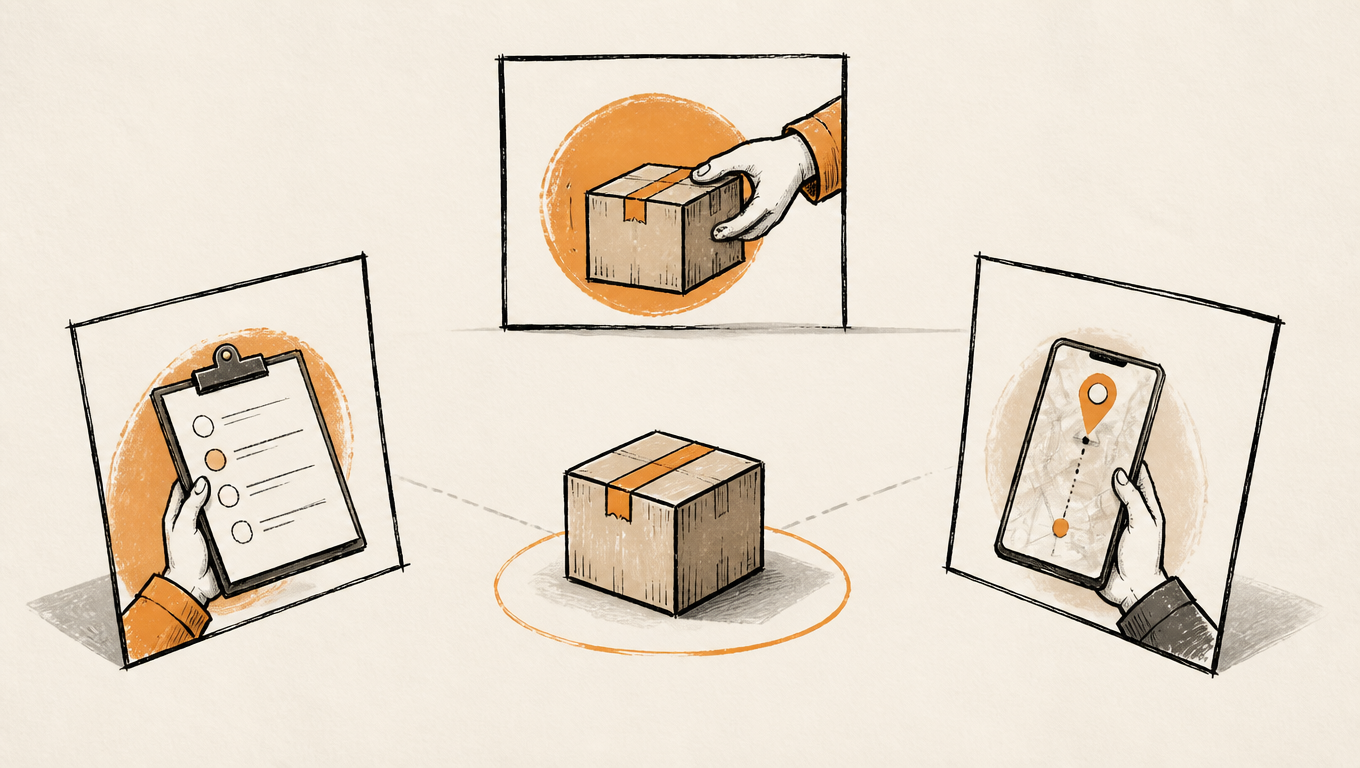
编辑插画:一个瓦楞纸箱立在画面中央,周围三块歪斜的状态牌各写各的阶段,黑墨线稿带不均匀的手压笔触,橙色填充点缀,纸纹可见,构图不对称,留白充足
同一个包裹,三块状态牌各说各话One package, three status boards that disagree

为什么三套系统会各说各话Why three systems disagree

一个包裹在到达客户手里之前,至少要经过四套系统:接单的电商平台、拣货的仓库系统、打印面单的发货集成,以及真正搬运它的承运商。每套系统都维护着自己的状态字段,由自己的操作者、按自己的节奏更新。A single package passes through at least four systems before it reaches a customer: the commerce platform that took the order, the warehouse system that picked it, the shipping integration that printed the label, and the carrier that actually moves it. Each of these systems keeps its own status field, updated by its own operator, on its own schedule.

状态是局部视图,不是共享真相。仓库内部发生了什么,电商平台要等事件同步回来才知道;承运商有没有接收包裹,仓库要等扫描数据进来才知道;客户被承诺了什么,承运商一概不知。每套系统都从自己的角落渲染世界,而这些角落并不在同一时刻更新。Status is a local view, not a shared truth. The commerce platform does not know what happens inside the warehouse until an event is synced back. The warehouse does not know whether the carrier accepted the package until a scan comes in. The carrier does not know what the customer was promised. Every system renders the world from its own corner, and the corners do not update at the same moment.

这些不一致不是 bug,而是通过异步事件通信的分布式系统的可预期结果。一旦接受这一点,问题就不再是「它们为什么对不上」,而是「每个决策我该信哪一层」。这正是这篇文章要回答的问题。The disagreements are not bugs. They are the predictable result of distributed systems that communicate through asynchronous events. Once you accept that, the question stops being "why do they disagree?" and becomes "which layer should I trust for each decision?" That is the question this article answers.

四层状态模型The four-layer status model

把状态想象成四层堆叠,每一层由不同的系统拥有。弄清楚每一层归谁拥有、由什么事件更新,是理解后面一切内容的地基。Think of status as four stacked layers, each owned by a different system. Knowing who owns each layer, and what updates it, is the foundation for everything else in this article.

第 1 层,订单状态(commerce order status),归平台或 OMS 所有:Shopify、Amazon、eBay、Etsy、ERP,或无头电商后端。典型状态是 unfulfilled、partially fulfilled、fulfilled、refunded。[^4] 当下层同步回履约和追踪事件时,它才更新。客户在订单历史里看到的就是这一层,市场平台做绩效评分用的也是这一层。Layer 1, commerce order status, is owned by the platform or OMS: Shopify, Amazon, eBay, Etsy, an ERP, or a headless commerce backend. Its states are things like unfulfilled, partially fulfilled, fulfilled, and refunded.[^4] It updates when fulfillment and tracking events sync back from the layers below. This is the layer customers see in their order history, and the layer marketplaces use for performance scoring.

第 2 层,仓库履约状态(warehouse/fulfillment status),归 WMS 或 3PL 所有。典型状态是 received、allocated、picked、packed、shipped。它在仓库扫描和人工操作时更新,驱动拣货单、打包台和 3PL 自己的报表。客户很少看到这一层,所以它的不准之处一直隐身,直到出事才暴露。Layer 2, warehouse/fulfillment status, is owned by the WMS or the 3PL. Its states are things like received, allocated, picked, packed, and shipped. It updates on warehouse scans and user actions, and it drives pick lists, packing stations, and the 3PL's own reporting. Customers rarely see it, which is why its inaccuracies stay invisible until something goes wrong.

第 3 层,发货交易状态(shipping transaction status),归发货集成所有:面单 API、多承运商平台,或承运商自己的发货门户。典型状态是 label created、manifested、in carrier possession。它在面单购买、manifest 上传或取件确认时更新。「已发货」这个词在这一层用得最随意,因为面单可以比包裹真正移动早很久就存在。Layer 3, shipping transaction status, is owned by the shipping integration: the label API, the multi-carrier platform, or the carrier's own shipping portal. Its states are things like label created, manifested, and in carrier possession. It updates when a label is purchased, a manifest is transmitted, or a pickup is confirmed. This is where the word "shipped" is used most loosely, because a label can exist long before a package moves.

第 4 层,承运商追踪状态(carrier tracking status),归承运商的追踪系统所有。典型状态是 acceptance scan、in transit、out for delivery、delivered。它在收件点、分拣中心和门前的扫描时更新。[^6] 这是唯一能证明包裹物理移动过的层,因此它是「移动」这个事实的基准。Layer 4, carrier tracking status, is owned by the carrier's tracking system. Its states are things like acceptance scan, in transit, out for delivery, and delivered. It updates on scans at drop-off points, sort facilities, and doorsteps.[^6] This is the only layer that proves a package physically changed location, which makes it the ground truth for movement.

层级Layer 谁更新Who updates it 何时变化When it changes 典型状态Example states 客户可见?Customer-visible?
1 订单状态1 Commerce order status平台 / OMSPlatform / OMS订单与履约事件On order and fulfillment eventsunfulfilled、fulfilled、refundedunfulfilled, fulfilled, refunded是(订单历史)Yes (order history)
2 仓库履约状态2 Warehouse/fulfillment statusWMS / 3PLWMS / 3PL仓库扫描与操作On warehouse scans and actionspicked、packed、shippedpicked, packed, shippedNo
3 发货交易状态3 Shipping transaction status发货集成Shipping integration面单、manifest、取件事件On label, manifest, pickup eventslabel created、manifested、in carrier possessionlabel created, manifested, in carrier possession有时(通过门户)Sometimes (via portal)
4 承运商追踪状态4 Carrier tracking status承运商系统Carrier systems物理扫描On physical scansaccepted、in transit、deliveredaccepted, in transit, delivered是(追踪页)Yes (tracking page)

核心洞察是:事件才是真相,状态只是投影。状态字段不过是「最近已知事件」渲染成的一个简短标签。系统之所以对不上,是因为每个系统投影了不同的事件切片,或者在同一事件上接收的时间不同。这篇文章里的每一条对账策略,都从这一句话推出来。The core insight is that an event is the truth and a status is just a projection. A status field is nothing more than the latest known event rendered as a short label. Systems disagree because each one has projected a different slice of events, or received the same events at a different time. Every reconciliation strategy in this article follows from that one sentence.
错位发生在哪里Where the disconnects happen

四条断层线解释了大多数状态不一致。Four fault lines explain most status disagreements.

第一,「订单已发货」往往只意味着「面单已生成」。履约记录一同步,电商平台就立刻把订单标记为 fulfilled,而同步通常发生在面单生成时,不是包裹移动时。箱子还躺在仓库货架上,客户的通知已经发出去了。First, "Order shipped" often means nothing more than "label created". The commerce platform marks the order fulfilled the moment a fulfillment record is synced, which usually happens when the label is generated, not when the package moves. The customer gets a notification while the box still sits on a warehouse shelf.

第二,manifested 不等于 accepted。manifest 是一份意图声明:发货系统告诉承运商「这些包裹要来了」。承运商只在第一次物理扫描时才真正接管。在 manifest 和 acceptance 之间有一个窗口,发货层说「承运商已接管」,承运商说「从未见过」。Second, manifested does not equal accepted. A manifest is a declaration of intent: the shipping system tells the carrier "these packages are coming". The carrier only takes possession at the first physical scan. Between manifest and acceptance there is a window where the shipping layer says "in carrier possession" and the carrier says "never seen it".

第三,客户看到的追踪可能不是承运商的原始事件流。很多平台和店铺 App 展示的是聚合后的追踪流,由多个来源拼装而成。聚合器可能延迟、丢事件或打乱顺序。客户盯着的那个页面,本身就是一个二手投影。Third, the tracking the customer sees may not be the carrier's raw stream. Many platforms and shop apps show an aggregated tracking feed assembled from several sources. Aggregators can lag, drop events, or reorder them. The customer stares at a page that is itself a third-hand projection.

第四,时区和批量同步带来延迟。承运商在东部时间晚上 11 点扫描,平台每天同步两次追踪,客户早上 9 点查看时看到的还是昨天的状态。包裹没有问题,是状态迟到了。Fourth, timezones and batch syncs add delay. A carrier scans at 11 pm Eastern, the platform syncs tracking twice a day, and the customer checks at 9 am and sees yesterday's state. The package is fine, the status is late.

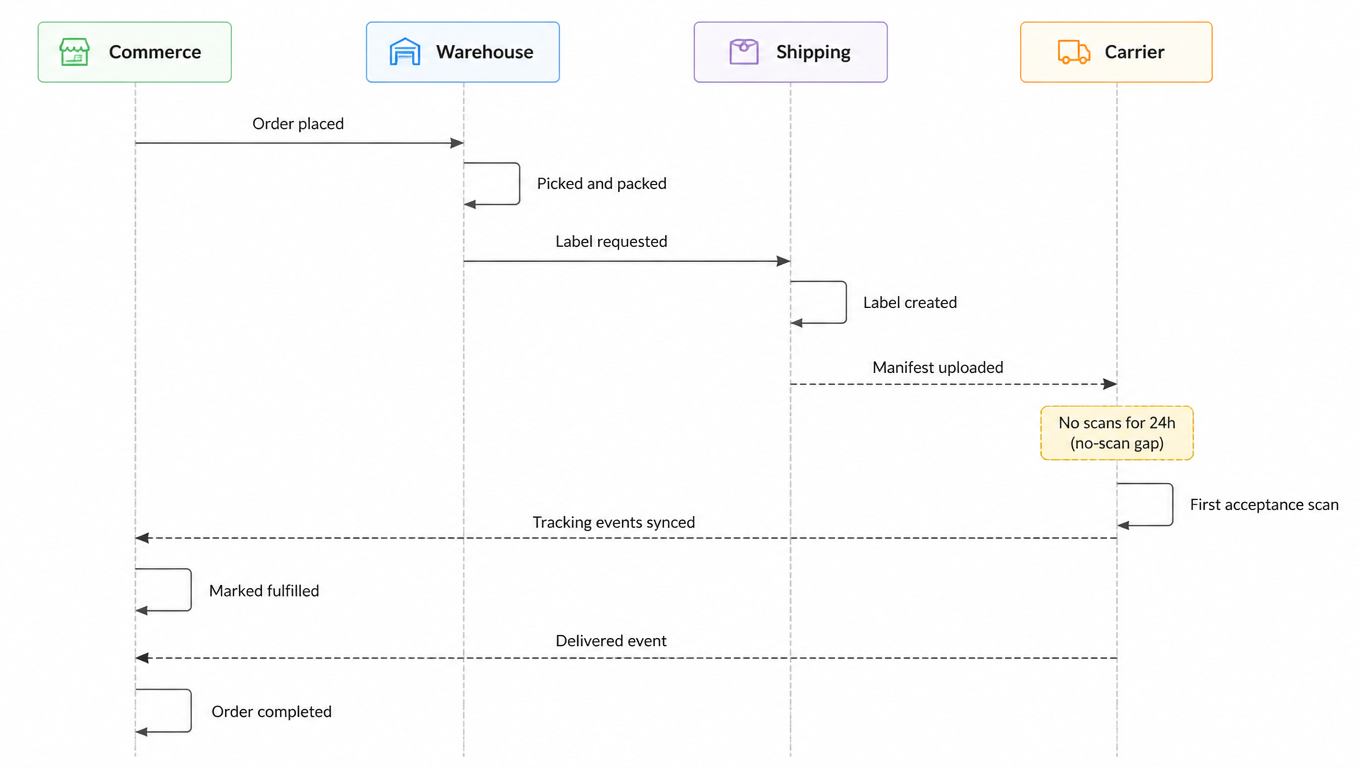
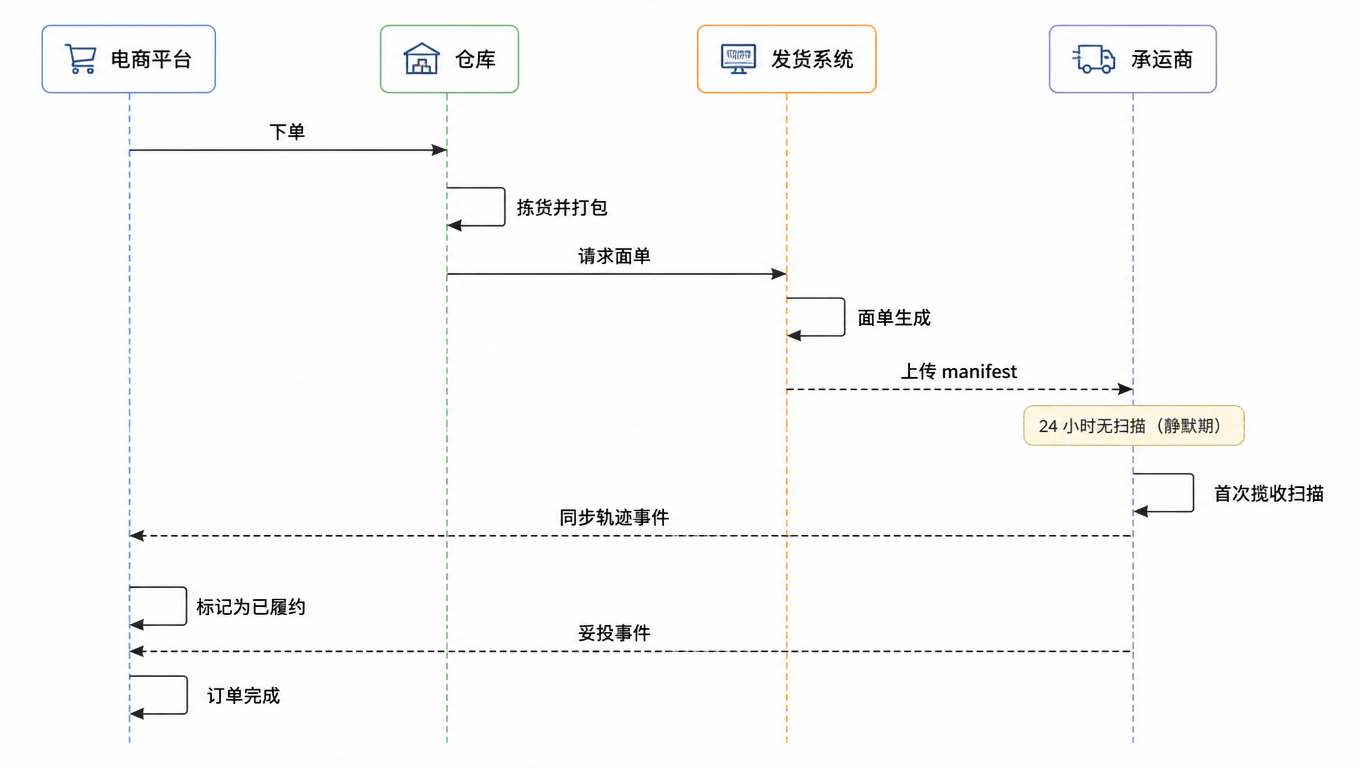
下面的时序图展示一个包裹穿过全部四层的过程,包括最经典的无扫描静默期:The sequence below shows one package passing through all four layers, including the classic no-scan gap:

时序图:下单 → 拣货打包 → 请求面单 → 面单生成 → 上传 manifest → 24 小时无扫描(静默期)→ 首次揽收扫描 → 同步轨迹事件 → 标记已履约 → 妥投事件 → 订单完成Sequence diagram: Order placed, Picked and packed, Label requested, Label created, Manifest uploaded, 24h no-scan gap, First acceptance scan, Tracking events synced, Marked fulfilled, Delivered event, Order completed
通知发出时,承运商可能一次都还没扫到包裹By the time the notification fires, the carrier may not have scanned the package once

等客户的通知触发时,承运商可能一次都还没扫到包裹。没有任何环节出了故障,四层只是暂时对不上,而最先注意到的是客户。By the time the customer's notification fires, the carrier may not have scanned the package once. Nothing malfunctioned. The layers simply disagree for a while, and the customer is the one who notices.

状态错位会带来什么后果What goes wrong when they disagree

状态漂移的代价很具体,而且会叠加。The costs of status drift are concrete, and they compound.

过早的发货通知。以面单生成为触发点的通知告诉客户「您的订单已在路上」,而追踪页还停在「面单已生成」。客户刷新、什么都没有、信任的缺口从包裹离库之前就开始了。Premature shipping notifications. A notification keyed to label creation tells the customer "your order is on its way" while the tracking page still reads "label created". The customer refreshes, finds nothing, and the trust deficit starts before the package leaves the building.

手绘漫画:客户身体前倾盯着笔记本电脑,屏幕上是转圈加载图标和问号,桌上放着咖啡杯,线条简单传达出焦虑等待,黑墨线稿加橙色填充,平视构图,留白充足
「我的订单到哪了」工单,是同一问题的客服面The "where is my order" ticket is the customer-service face of the same problem

WISMO 工单激增。「我的订单到哪了」(Where Is My Order)工单是同一个问题的客服表现。每一小时的状态延迟都会变成进线的聊天、邮件和电话,而所有工单都共用同一句回答:「其实还没发出去。」这份人力有成本,而且随单量线性增长。WISMO spikes. "Where is my order" tickets are the customer-service symptom of the same problem. Every hour of status lag converts into inbound chats, emails, and phone calls, all answerable with the same script: "it actually hasn't shipped yet". That labor has a cost, and it scales with order volume.

错误的 SLA 计算。如果履约 SLA 从面单生成起算,那么承运商取件延迟在整个 SLA 烧完之前都不会进入时钟。品牌为从未在任何物理意义上延误的履约被扣款,3PL 为包裹离开自家月台之后才开始的延误背锅。Wrong SLA calculations. If the fulfillment SLA starts at label creation, a carrier pickup delay is invisible to the clock until the SLA has already burned down. Brands get charged for late fulfillment that was never late by any physical measure, and 3PLs get blamed for delays that started after the package left their dock.

平台绩效风险。市场平台按延迟发货率、有效追踪率、订单缺陷率等指标给卖家打分。[^1] 这些分数由平台自己的状态事件计算,所以一个把「shipped」记在面单生成时刻的平台,会惩罚那些承运商扫描偏晚的卖家,哪怕仓库完全准时。Marketplace performance risk. Marketplaces score sellers on things like late dispatch rate, valid tracking rate, and order defect rate.[^1] Those scores are computed from the platform's own status events, so a platform that counts "shipped" at label creation will punish a seller whose carrier scans late, even when the warehouse was on time.

过早退款或补发。追踪流一安静,客服团队就开始猜。一个只是在等首次扫描的包裹,看起来和一个丢件一模一样;一位大方的客服会在第三天就退款或补发。如果承运商随后妥投了,品牌就要承担双份履约。Premature refunds and replacements. When the tracking stream goes quiet, support teams guess. A package that is simply waiting for its first scan looks identical to a lost package, and a generous rep will refund or reship on day three. If the carrier then delivers, the brand owns a double fulfillment.

3PL 与品牌互相甩锅。状态层对不上时,责任就变成了可以谈判的东西。品牌说仓库发晚了,3PL 说承运商接晚了,承运商说 manifest 根本没按时收到。没有一份共享的事件记录,每一场争议都靠谁嗓门大来裁决。3PL vs brand blame games. When status layers disagree, responsibility becomes negotiable. The brand says the warehouse shipped late, the 3PL says the carrier accepted late, and the carrier says it never received the manifest on time. Without a shared event record, every dispute is decided by whoever argues louder.

事件到动作的策略映射A policy map: from event to action

修法不是强迫四层实时一致,而是把每个决策指派给对那个决策而言可信的那一层。下表把关键事件映射到它们应该(或不应该)触发的动作。The fix is not to force all four layers to agree in real time. It is to assign each decision to the layer that is trustworthy for that decision. The table below maps the events that matter to the actions they should (or should not) trigger.

事件Event 触发客户通知?Trigger customer notification? 启动 SLA 计时?Start SLA clock? 确认承运商接管?Confirm carrier possession? 需要人工复核?Needs human review?
下单Order placedNo视情况(承诺送达日)Maybe (promise date)NoNo
面单生成Label createdNoNoNoNo
manifest 上传Manifest transmittedNoNoNoNo
首次承运商扫描(揽收)First carrier scan (acceptance)YesYesYesNo
运输中In transitNoNo已确认Already confirmedNo
派送中Out for delivery可选(派送时段)Optional (delivery window)NoNoNo
已妥投Delivered是(送达确认)Yes (delivery confirmation)NoNoNo
超过阈值仍无扫描No scan longer than threshold否(预警,非通知)No (alert, not notification)NoNoYes
延误 / 地址更正 / 拒收 / 破损Delayed / address correction / refused / damagedNoNoNoYes
状态回退(已妥投退回运输中)Status rollback (delivered back to in transit)NoNoNoYes

有三条规则值得强调。Three rules deserve emphasis.

通知以承运商接管为准,而不是面单生成。唯一能证明包裹在物理移动的事件是首次承运商扫描。更早发通知,你通知的其实是一张面单。面单生成事件只留给它擅长的事:当承运商在承诺窗口内没有扫描时,触发取件延迟预警。Notifications key off carrier possession, not label creation. The only event that proves a package is physically moving is the first carrier scan. If you notify earlier, you are notifying about a label. Use the label-created event only for what it is good for: a late-pickup alert when the carrier has not scanned within a promised window.

SLA 时钟从你能辩护的那个接管点起算。也就是首次承运商扫描,或者平台承诺的送达日,以合同写的为准。绝不要从面单生成起算。如果非要这么做,就把这条写进合同并为它定价,因为你在把承运商的取件风险揽到自己账上。The SLA clock starts at the possession point you can defend. That is the first carrier scan, or the platform's promise date, whichever your contract names. Never start the clock at label creation. If you must, name it in the contract and price for it, because you are taking carrier pickup risk onto your own books.

异常是人工活。无扫描静默期、延误、地址更正、拒收、破损和状态回退,是自动化结束、判断开始的地方。把它们送进带升级 SLA 的工单队列,而不是让它们躺在状态字段里。Exceptions are human work. No-scan gaps, delays, address corrections, refusals, damage, and status rollbacks are where automation ends and judgement begins. Route them to a queue with an escalation SLA instead of letting them sit in a status field.

各平台如何定义「已发货」How platforms define "shipped" differently

同一个仓库动作,在不同市场平台上会带来完全不同的后果,因为每个平台都自己决定「已发货」是什么意思、哪些指标挂在它后面。The same warehouse action produces different consequences in every marketplace, because each platform decides for itself what "shipped" means and which metrics hang off it.

Shopify 把履约当作一条记录,而不是物理事件。履约事件(通常由 App 或 3PL 集成注册)一登记,订单就进入 fulfilled 状态,Shopify 自己不追踪承运商扫描。[^4] 通知内容完全取决于履约 App 怎么定义,这就是为什么两个用同一承运商的 Shopify 店铺,发货行为可以看起来完全不同。Shopify treats fulfillment as a record, not a physical event. The order moves to fulfilled when a fulfillment event is registered, typically by an app or a 3PL integration, and Shopify does not itself track carrier scans.[^4] The notification is whatever the fulfillment app says it is, which is why two Shopify stores can have visibly different shipping behavior on the same carrier.

Amazon 把 shipped 绑定到承运商证据。订单状态和有效追踪率、延迟发货率等绩效指标,都由追踪上传和承运商扫描驱动。一个没有有效追踪号就标记发货、或者承运商扫描偏晚的卖家,账号健康会直接受损。[^1]Amazon ties shipped to carrier evidence. Order status and performance metrics such as valid tracking rate and late dispatch rate are driven by tracking uploads and carrier scans. A seller who marks an order shipped without a valid tracking number, or whose carrier scans late, takes a direct hit to account health.[^1]

eBay 把 shipped 系在发货时限和追踪上传上。延迟发货率按卖家声明的发货时限衡量,上传追踪号是把「处理中」变成「已发货」的关键,无论对买家视图还是卖家指标都是如此。[^2]eBay keys shipped to handling time and tracking upload. The late shipment rate is measured against the seller's stated handling time, and uploading tracking is what turns "handling" into "shipped" in the buyer's view and in seller metrics.[^2]

Etsy 用发货日期和追踪上传衡量准时发货,并把它喂给 Star Seller 徽章。发货时钟从卖家承诺的日期起算,追踪号就是证据。[^3]Etsy uses shipping date and tracking upload for its on-time dispatch measurement, which feeds the Star Seller badge. The dispatch clock runs from the date the seller commits to, and the tracking number is the evidence.[^3]

Temu 和 TikTok Shop 把平台物流管控推得更远。在半托管和平台模式里,平台同时监控面单生成和真实承运商扫描,「虚拟仓里已出面单」和「第一次真实扫描」之间的空档,正是卖家处罚和发货时效目标落地的位置。[^5][^7]Temu and TikTok Shop push platform logistics control further. In semi-managed and marketplace models, the platform monitors both label generation and actual carrier scans, and the gap between "label created in the virtual warehouse" and "first real scan" is exactly where seller penalties and shipping-time targets are decided.[^5][^7]

道理处处相同:在设计通知或 SLA 之前,先读平台自己对 shipped 的定义。这是一个合同选择,不是技术选择。The lesson is the same everywhere: before you design a notification or an SLA, read the platform's own definition of shipped. It is a contractual choice, not a technical one.

平台Platform 「已发货」由什么触发"Shipped" is triggered by 主要绩效杠杆Main performance lever
ShopifyShopify履约记录(App / 3PL 同步)Fulfillment record (app/3PL sync)店铺层面,默认无Store-level, none by default
AmazonAmazon追踪上传 + 承运商扫描Tracking upload + carrier scan有效追踪率、延迟发货率Valid tracking rate, late dispatch rate
eBayeBay发货时限内的追踪上传Tracking upload within handling time延迟发货率Late shipment rate
EtsyEtsy发货日期 + 追踪上传Shipping date + tracking upload准时发货、Star SellerOn-time dispatch, Star Seller
Temu / TikTok ShopTemu / TikTok Shop面单 + 真实承运商扫描均被监控Label + real carrier scan monitored卖家处罚、发货时效Seller penalties, shipping time

工程化对账Engineering the reconciliation

对负责搭建管道的团队来说,四项工程实践能堵住大部分缺口。For teams building the plumbing, four engineering practices close most of the gap.

去重。承运商和平台会重发事件。Webhook 重试、轮询重叠,同一个扫描可能从两个来源到达两次。每个事件都需要稳定的 ID,每个消费者都需要幂等:同一事件应用两次,必须产生同样的结果。否则投影会自己漂移。Deduplication. Carriers and platforms resend events. Webhooks retry, polling overlaps, and the same scan can arrive twice from two sources. Every event needs a stable id, and every consumer needs idempotency: applying the same event twice must produce the same result. Otherwise the projection drifts on its own.

乱序处理。事件到达的顺序是乱的。Webhook 队列一积压,妥投事件可能比揽收扫描先到。按事件自带的时间戳排序,而不是按到达时间,并用带水印(watermark)的缓冲,只在先序事件到达后才提交后续事件。绝不要允许「我先看到」赢过「它先发生」。Ordering. Events arrive out of order. A delivered event can land before the acceptance scan when a webhook queue backs up. Sort by the event's own timestamp, not by arrival time, and use a buffer with a watermark so you only commit events whose predecessors have arrived. Never let "I saw it first" win over "it happened first".

归一化。四个承运商给同一个时刻起四个名字:「已取件」「揽收」「起运地扫描」「已收件」。把一切映射进一个固定词表的统一事件模型;当平台的聚合流和承运商的原始流冲突时,信原始流。聚合也是投影。Normalization. Four carriers will name the same moment four different things: "picked up", "acceptance", "origin scan", "collected". Map everything into one canonical event schema with a fixed vocabulary, and when a platform's aggregate feed disagrees with the carrier's raw stream, trust the raw stream. Aggregates are projections too.

事件溯源的状态机。状态从事件推导,而不是直接赋值。把事件日志当作真相源,每一层的状态都作为日志上的投影来计算。这样回退、重放和争议解决都变得微不足道:客户或市场平台质疑某个状态时,你拿出事件,而不是标签。Event-sourced state machines. Derive status from events instead of assigning it. Keep the event log as the source of truth and compute each layer's status as a projection over the log. That makes rollback, replay, and dispute resolution trivial: if a customer or a marketplace questions a status, you show the events, not the label.

最后用一份可以按订单、按天或按争议运行的对账清单收尾:Finish with a reconciliation checklist you can run per order, per day, or per dispute:

  • 四层对账:订单、仓库、发货、承运商四层状态对「哪些事件已经发生」达成一致。Four layers reconciled: commerce, warehouse, shipping, and carrier states agree on which events have occurred.
  • 通知规则绑定承运商接管,面单生成只保留给取件延迟预警。Notification rules keyed to carrier possession, with label-created reserved for late-pickup alerts.
  • SLA 时钟在合同写明的接管点定义并执行。SLA clock defined and defended at the possession point named in the contract.
  • 异常(无扫描静默期、延误、地址更正、拒收、破损、回退)送人工复核,并带升级 SLA。Exceptions (no-scan gaps, delays, address corrections, refusals, damage, rollbacks) routed to human review with an escalation SLA.
  • 管道幂等、按 occurred_at 排序、归一化到统一模型,原始承运商事件为真相源。Pipeline idempotent, ordered by occurred_at, normalized to a canonical schema, with raw carrier events as the source of truth.

这一切并不会让四套系统变得一样,而是让它们在不同方面变得可信,这正是重点。订单系统是客户的视图,仓库系统是你的运营视图,发货系统是你的交易视图,承运商系统是物理世界。决定每个问题由哪一层来回答,约定跨边界的那些事件,不一致就会停止烧钱。None of this makes the four systems identical. It makes them trustworthy in different ways, and that is the whole point. The order system is the customer's view, the warehouse system is your operations view, the shipping system is your transaction view, and the carrier system is the physical world. Decide which one answers each question, agree on the events that cross the boundaries, and the disagreements stop costing you money.

常见问题FAQ

因为每一层都由不同系统拥有,由不同事件、按不同节奏更新。平台拥有订单状态,仓库拥有履约状态,发货集成拥有发货交易状态,承运商拥有追踪状态。状态只是投影,事件才是真相:系统对不上,是因为各自投影了不同的事件切片,或者接收同一事件的时间不同。Because each layer is owned by a different system, updated by different events on different schedules. The platform owns order status, the warehouse owns fulfillment status, the shipping integration owns transaction status, and the carrier owns tracking status. Status is a projection; the event is the truth. Systems disagree because each has projected a different slice of events, or received the same events at a different time.
以承运商接管为准,也就是首次承运商扫描。如果以面单生成为触发点,客户会刷新一个还停在「面单已生成」的追踪页,信任从包裹离库之前就开始流失。面单生成事件只用于取件延迟预警。Key it to carrier possession, which means the first carrier scan. If you notify at label creation, the customer refreshes a tracking page that still says "label created", and trust erodes before the package leaves the building. Reserve the label-created event for late-pickup alerts.
首次承运商扫描,或者合同写明的平台承诺送达日。绝不要从面单生成起算,因为面单可以比包裹移动早很久存在,那样等于把承运商取件风险揽到自己账上。The first carrier scan, or the platform's promise date named in your contract. Never from label creation, because a label can exist long before a package moves, and you would be taking carrier pickup risk onto your own books.
只在第一次物理扫描时。manifest 是意图声明,不是接管。在 manifest 上传和首次扫描之间有一个窗口,发货系统说「承运商已接管」,承运商说「从未见过」。唯一的接管证据是首次承运商扫描。Only at the first physical scan. A manifest is a declaration of intent, not possession. Between manifest upload and the first scan there is a window where the shipping system says "in carrier possession" and the carrier says "never seen it". The only evidence of possession is the first carrier scan.
因为平台绩效基于平台自己的状态事件计算。Amazon 的有效追踪率和延迟发货率、eBay 的延迟发货率、Etsy 的准时发货,都以追踪上传或承运商扫描为证据。平台把 shipped 记在面单生成或追踪上传时刻时,即使仓库完全准时,承运商扫描偏晚也会伤到你的指标。Because marketplace scores are computed from the platform's own status events. Amazon's valid tracking rate and late dispatch rate, eBay's late shipment rate, and Etsy's on-time dispatch all use tracking upload or carrier scan as evidence. When a platform counts shipped at label creation or tracking upload, a carrier that scans late hurts your metrics even when the warehouse was on time.
三个实践:用稳定事件 ID 加幂等消费去重;按事件自带时间戳排序、用带水印的缓冲处理乱序;把所有承运商事件归一化到统一模型,并让状态从事件日志推导(事件溯源),这样回退、重放和争议核查都变得简单。Three practices: deduplicate with a stable event id and idempotent consumers, handle out-of-order arrivals by sorting on the event's own timestamp with a watermark buffer, and normalize every carrier event into one canonical schema. Derive status from the event log (event sourcing) so rollback, replay, and dispute review become trivial.

想让四层状态各归其位?Want the four layers to stop disagreeing?

EasyShippingX 工作在承运商执行层(费率、面单、追踪)。多承运商实时追踪把每个承运商的原始扫描事件归一化到统一视图,让你把通知绑定在首次揽收扫描、把 SLA 时钟锚定在承运商接管、用带幂等的事件管道做对账。四层状态模型和事件到动作的策略映射,正是把「到底到哪了」变成有据可答的问题所需的基础设施。EasyShippingX operates in the carrier execution layer (rates, labels, tracking). Multi-carrier real-time tracking normalizes every carrier's raw scan events into one view, so you can key notifications to the first acceptance scan, anchor the SLA clock to carrier possession, and reconcile through an idempotent event pipeline. The four-layer status model and the event-to-action policy map are exactly the infrastructure that turns "where is my order" into a question you can answer with evidence.

Get Rate Comparison
Get Rate Comparison