电商物流指南Ecommerce Shipping Guide

谁对配送承诺负责?电商品牌、3PL、承运商与物流软件的 RACIWho Owns the Delivery Promise? A RACI for Ecommerce Brands, 3PLs, Carriers, and Shipping Software

每个店铺页面都展示着一个数字:「下午 2 点前下单,周五送达。」客户读到它、点击购买,然后拿它来要求你。这个数字是一个承诺,而承诺属于品牌。不属于拣货的 3PL,不属于运输的承运商,也不属于打印面单的软件。客户是从品牌那里买的,包裹迟到时,客户发邮件给的是品牌。这篇指南给你一件把这条简单事实变成可执行流程的工具:一张贯穿履约全程的 RACI 矩阵,把谁干活、谁对结果负责、谁被征询、谁只需知会,逐环节分配清楚。Every storefront shows a number: "Order by 2 PM, get it Friday." The customer reads it, clicks buy, and holds you to it. That number is a promise, and the promise belongs to the brand. Not to the 3PL that picks the order, not to the carrier that moves it, not to the software that prints the label. The customer bought from the brand, and when the package is late, the customer emails the brand. This guide gives you the one tool that makes that simple fact operational: a RACI matrix that assigns who does the work, who answers for the outcome, who gets consulted, and who just needs to know, across every leg of delivery.

插画:贴着配送承诺面单的包裹在仓库传送带上移动,旁边是码放的纸箱,暖色实用光线
品牌对客户负责,3PL 与承运商对包裹负责The brand answers to the customer; the 3PL and carrier answer for the parcel

承诺是承诺,不是交接The Promise Is a Promise, Not a Handoff

结账关闭了销售。接下来发生的是一连串交接:订单进入仓库,仓库把包裹交给承运商,承运商把它送到客户门口。每一次交接都转移了工作,但没有任何一次转移承诺。品牌对客户做出了承诺,而客户对这份承诺只有一个地址:品牌的收件箱、聊天窗口和服务热线。如果你运营 3PL 或承运商,你服务的品牌对其店铺上的承诺负责,这意味着你的工作是交付成果与证据,而不是替它们承担 accountability。Checkout closes the sale. What happens next is a series of handoffs: the order moves to the warehouse, the warehouse hands the parcel to a carrier, and the carrier hands it to the customer's door. Every handoff transfers work. None of them transfer the promise. The brand made a commitment to a customer, and the customer has exactly one address for that commitment: the brand's inbox, chat widget, and support line. If you run a 3PL or a carrier, the brands you serve are accountable for the promises on their storefronts, which means your job is to give them the work product and the evidence, not to absorb their accountability.

RACI 给四方玩家一套共同语言。Responsible 干活,Accountable 对结果负责,且每一行只有一个 A[1]。Consulted 在决策前被征询意见,Informed 在事后收到通知。让 RACI 对配送有用的规则简单到值得贴在运营墙上:Accountable 永远留在品牌手里,Responsible 可以委派给 3PL 或承运商。委派工作不是委派关系,而配送承诺是关系的一部分。当品牌说「我们的 3PL 拥有履约」,它真正能表达的只是「我们的 3PL 拥有履约工作」,accountability 留在内部。RACI gives the four players a common language. Responsible does the work. Accountable answers for the outcome, and there is exactly one A per row.[1] Consulted gives input before the decision is made. Informed gets notified after the fact. The rule that makes RACI useful for delivery is simple and worth writing on the ops wall: Accountable always stays with the brand. Responsible can be delegated to a 3PL or a carrier. Delegating the work is not delegating the relationship, and the delivery promise is part of the relationship. When a brand says "our 3PL owns fulfillment," what it can actually mean is "our 3PL owns the fulfillment work." The accountability stays in-house.

这件事之所以重要,是因为经济账。甩锅游戏很贵:3PL 怪承运商,承运商怪地址,软件怪 API,客户等一个永远不来的答案。每一单悬而未决的「我的包裹在哪」,都是一次流失的复购,而复购收入正是电商利润所在[2]。一份签署过的 RACI 不能阻止延误,它阻止延误变成纠纷,因为在任何时刻都只有一方对结果负责,并且有一份明确的清单规定谁必须提供证据。The reason this matters is economic. Blame games are expensive: the 3PL blames the carrier, the carrier blames the address, the software blames the API, and the customer waits for an answer that never comes. Every unresolved "where is my package" is a lost repeat purchase, and repeat revenue is where ecommerce margins live.[2] A signed RACI does not prevent delays. It prevents the delay from becoming a dispute, because at any moment there is exactly one party that answers for the outcome and a defined list of parties that must produce evidence.
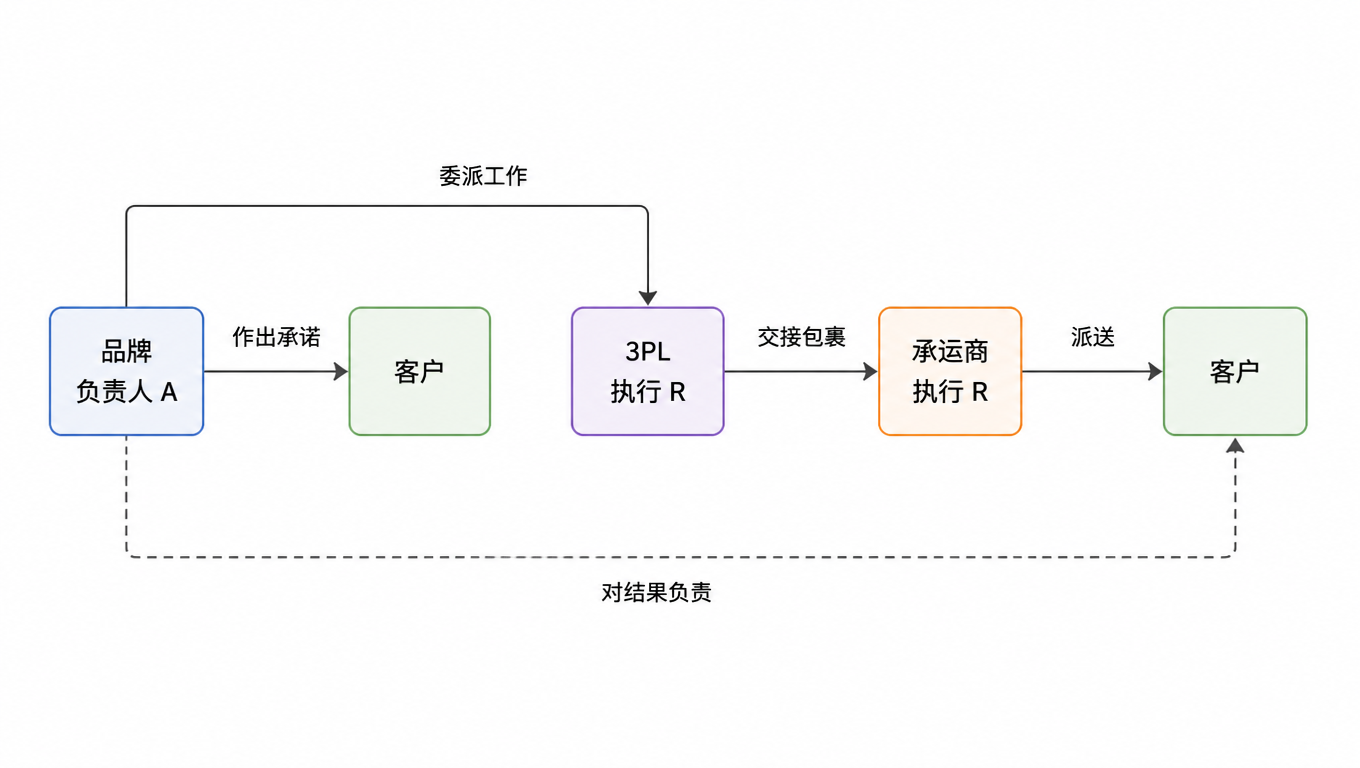
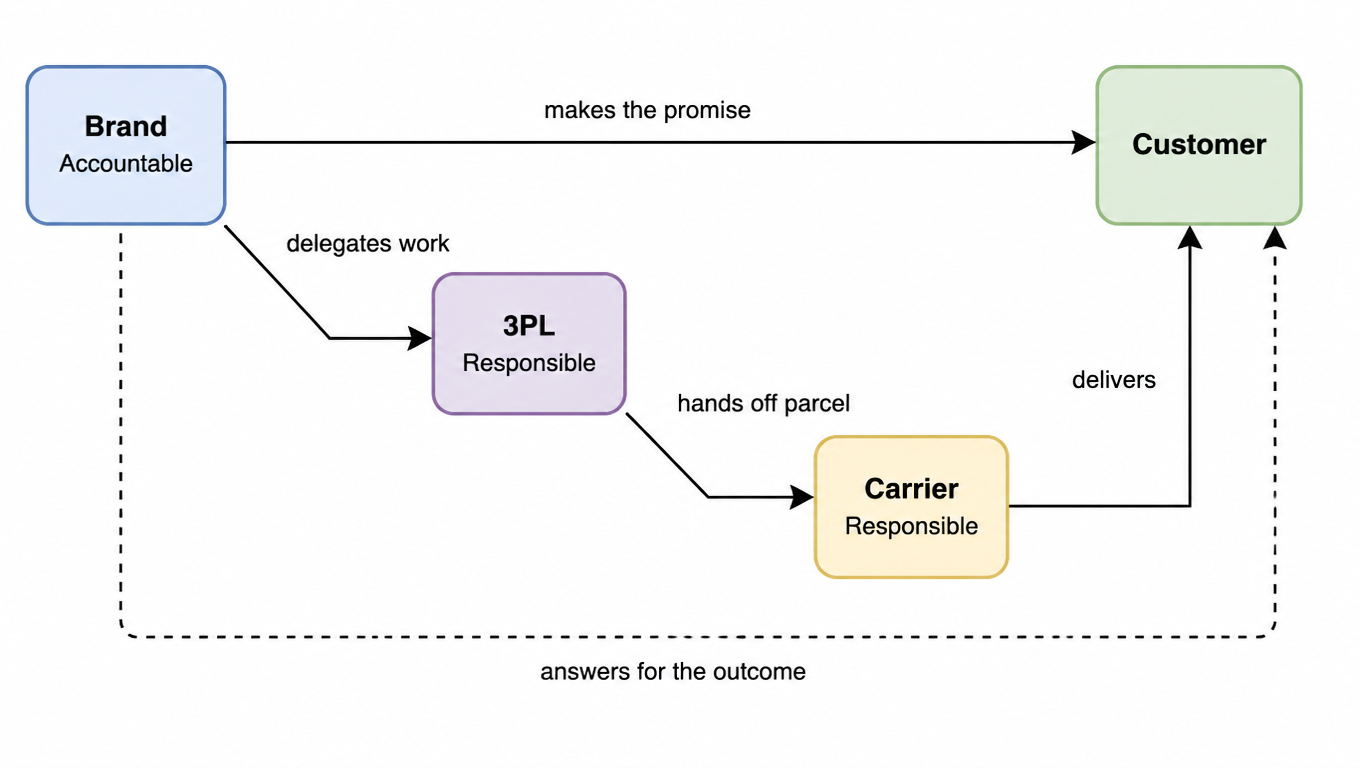
流程图:品牌向客户作出承诺并对结果负责,品牌向 3PL 委派工作,3PL 把包裹交接给承运商,承运商派送给客户Flowchart: brand makes the promise to the customer and answers for the outcome, brand delegates work to the 3PL, the 3PL hands off the parcel to the carrier, and the carrier delivers to the customer
责任沿链路向下委派,承诺向上归属品牌Responsibility delegates down the chain; the promise answers up to the brand

履约 RACI 矩阵The Delivery RACI Matrix

下面的矩阵覆盖完整履约生命周期,从库存变得可用,到退款关闭退货。列是四方玩家:品牌、3PL、承运商,以及物流软件层,我们把它定义为 OMS、WMS、ERP 与费率面单工具。请带着第一节的规则读它:一行可以有多个 R,但只能有一个 A,而且在所有面向客户的行里,那个 A 都是品牌。The matrix below covers the full fulfillment lifecycle, from the moment inventory becomes available to the refund that closes a return. Columns are the four players: the brand, the 3PL, the carrier, and the shipping software layer, which we define as OMS, WMS, ERP, and rate and label tools. Read it with the Section 1 rule in mind: a row can carry several R's, but exactly one A, and on every customer-facing row that A is the brand.

履约环节Fulfillment stage 品牌Brand 3PL / 仓库3PL / warehouse 承运商Carrier(s) 物流软件Shipping software
库存可用时间Inventory availability timeARIR
仓库截单Warehouse cutoffARIC
订单路由 / 履约指派Order routing / fulfillment assignmentACIR
承运商服务与费率选择Carrier service & rate selectionACCR
面单生成Label generationARIR
拣货与打包Picking & packingARII
承运商揽收 / 交接Carrier pickup / handoffARRI
干线运输与尾程Linehaul & last mileAIRI
追踪事件Tracking eventsAIRI
EDD 计算与展示EDD computation & displayACCR
派送尝试Delivery attemptAIRI
异常处理Exception handlingARRR
承诺调整Promise adjustmentACCR
Promise 复盘与路由更新Promise-miss review & routing updatesACCR
退货与退款Returns & refundsARRR

注意这个规律:品牌在每一行面向客户的行里都握着 A,3PL 握着物理始发作业的 R,承运商握着运输环节的 R,软件层握着数据环节的 R。团队吵得最多的行是库存可用时间、仓库截单和 EDD,因为在这几行里,店铺页面上的一个数字依赖一条没人端到端拥有的管线。下一节为这条管线里的每一个输入指定所有者。Note the pattern: the brand holds A on every single customer-facing row, the 3PL holds R on the physical origin operations, the carrier holds R on the transit rows, and the software layer holds R on the data rows. The rows teams argue about most are inventory availability, warehouse cutoff, and EDD, because those are the ones where a number on the storefront depends on a pipeline that nobody owns end to end. The next section names an owner for every input in that pipeline.

承诺背后的数据契约The Data Contract Behind the Promise

店铺页面上每一个面向客户的数字,都是一条数据管线的输出:库存馈送、截单时钟、承运商服务表、追踪 webhook。矩阵只有在喂给它的数据是真实的时候才有效,所以每一个输入都需要一个具名所有者和一份签署过的期望。把这一节当作让 RACI 可执行的数据契约。Every customer-facing number on the storefront is the output of a data pipeline: inventory feeds, cutoff clocks, carrier service tables, tracking webhooks. The matrix only works when the data feeding it is real, so each input needs a named owner and a signed expectation. Think of this section as the data contract that makes the RACI executable.

契约一:库存可用时间。3PL 或 WMS 通过库存馈送在库位粒度提供它,品牌作为承诺输入拥有它,OMS 或结账消费它。数字错了,品牌 accountable,3PL 对馈送 responsible。契约应写明馈送节奏、对账窗口,以及馈送过期时由谁被呼叫。Contract 1, inventory availability time: the 3PL or WMS supplies it through an inventory feed at location level, the brand owns it as a promise input, and the OMS or checkout consumes it. If the number is wrong, the brand is accountable and the 3PL is responsible for the feed. The contract should name the feed cadence, the reconciliation window, and who is paged when the feed goes stale.

契约二:仓库截单。3PL 维护它,并把它作为签署承诺发布。「2 点前入库的订单今天发出」是契约,不是习惯。品牌的结账承诺与软件的截单逻辑消费它。错过截单是 3PL 的 R 失败,除非品牌把订单晚路由进来,证据很简单:订单时间戳对比路由时间戳。Contract 2, warehouse cutoff: the 3PL maintains and publishes it as a signed commitment. "Orders in by 2 PM ship today" is a contract, not a habit. The brand's checkout promise and the software's cutoff logic consume it. Missing the cutoff is a 3PL R-failure unless the brand routed the order in late, and the evidence for that is simple: the order timestamp versus the routing timestamp.

契约三:承运商服务与追踪事件。承运商返回服务类型与时效预估,并发出追踪事件。物流软件(如 EasyShippingX)中继这些事件。品牌拥有客户可见的记录。扫描延迟与事件完整性应写进契约作为 SLO,因为面向客户的追踪器只跟喂给它的事件一样好。Contract 3, carrier service and tracking events: carriers return service types and transit estimates and emit tracking events. Shipping software such as EasyShippingX relays those events. The brand owns the customer-visible record. Scan latency and event completeness belong in the contract as SLOs, because a customer-facing tracker is only as good as the events feeding it.

契约四:EDD。OMS 或 EDD 引擎根据库存可用性、仓库截单与承运商服务计算它。店铺展示它,品牌对它 accountable。软件提供输入,绝不在静默中重算这个数字。如果 EDD 错了,你必须能倒推回去:哪个输入错了,可用性、截单还是运输?Contract 4, EDD: the OMS or EDD engine computes it from inventory availability, warehouse cutoff, and carrier service. The storefront displays it, and the brand is accountable for it. The software supplies inputs and never silently recomputes the number. If an EDD is wrong, you must be able to walk it back: which input was wrong, availability, cutoff, or transit?

契约五:旺季、天气与容量异常时的承诺调整。品牌决定修订后的承诺。3PL 与承运商提供容量通知,软件把信号浮出来,品牌通知客户。契约应包括已知高峰事件日历,以及把承诺从「不太可能」移到「已调整」的触发器。Contract 5, promise adjustment in peak season, weather, and capacity anomalies: the brand decides the revised promise. The 3PL and carriers provide capacity notices, the software surfaces the signal, and the brand informs the customer. The contract should include the calendar of known peak events and the trigger that moves a promise from "unlikely" to "adjusted."

契约六:Promise 复盘与路由更新。品牌召集复盘。3PL 带来扫描证据,承运商带来运输事件,软件带来日志。路由规则更新由 3PL 运营与软件配置执行,品牌批准。每一次复盘的产品是一个改变的规则或一份改变的 SLA,绝不只是聊天里的一条备注。Contract 6, promise-miss post-mortem and routing updates: the brand convenes the review. The 3PL brings scan evidence, the carrier brings transit events, and the software brings logs. Routing-rule updates are executed by 3PL ops and software configuration, and approved by the brand. The output of every post-mortem is a changed rule or a changed SLA, never just a note in the chat.

六个甩锅现场,逐一解码Six Blame Games, Decoded

每一场甩锅游戏都是同一个形状:两方各握一半证据,客户握着投诉。解码的方法是点名谁是 R、谁是 A、谁是 C,以及证据交接点在哪里。以下是每个履约运营里都会出现的六场。Every blame game follows the same shape: two parties each hold half the evidence, and the customer holds the complaint. Decode the game by naming who is R, who is A, who is C, and where the evidence handoff point sits. Here are the six that come up in every fulfillment operation.

插画:两位运营经理在仓库码头门口用平板核对包裹扫描历史,派送司机拿着包裹在旁等候
证据交接点决定了哪一方输了 RThe evidence handoff point decides which party lost the R

甩锅一:晚到。承运商怪 3PL 的截单,3PL 怪承运商的运输 SLA,包裹晚了一天。证明哪段失败的证据是揽收扫描:如果揽收扫描落在承诺截单之后,3PL 承担 R 失败;如果揽收扫描准时、派送仍然错过承诺,承运商承担 R 失败。无论哪种情况 A 都在品牌,因为客户不在乎是哪段失败了。Blame game 1, late delivery. The carrier blames the 3PL's cutoff, the 3PL blames the carrier's transit SLA, and the package is a day late. The evidence that proves which leg failed is the pickup scan. If the pickup scan lands after the promised cutoff, the 3PL owns the R-failure. If the pickup scan is on time and the delivery still misses the promise, the carrier owns the R-failure. A stays with the brand either way, because the customer does not care which leg failed.

甩锅二:丢件。3PL 说已经交接,承运商说从没收到。交接点是第一条承运商扫描:如果最后一条扫描是「面单已创建」或 3PL 码头,3PL 是 R,证据是缺失的揽收扫描;如果最后一条扫描是承运商分拨中心、包裹再无动静,承运商是 R。品牌是 A 并负责理赔。Blame game 2, lost package. The 3PL says it handed the parcel over, the carrier says it never received it. The handoff point is the first carrier scan: if the last scan is "label created" or the 3PL dock, the 3PL is R and the evidence is the missing pickup scan; if the last scan is a carrier facility and the parcel never moves again, the carrier is R. The brand is A and runs the claim.

甩锅三:破损。打包质量是 3PL 的 R,搬运是承运商的 R,事后很容易混淆。证据是照片:3PL 的打包照片、门口的派送照片。品牌向承运商开理赔,3PL 提供打包证据,理赔结果决定哪个 R 失败。Blame game 3, damaged goods. Packing quality is the 3PL's R, handling is the carrier's R, and the two are easy to confuse after the fact. The evidence is photographic: packing photos at the 3PL, delivery photos at the door. The brand opens the claim with the carrier, the 3PL produces the packing evidence, and the claim outcome decides which R failed.

甩锅四:地址错误。结账时的数据录入是品牌的 R,地址校验是软件的 R,重新打单是 3PL 的 R。交接点是面单生成:面单一旦打印,上面的地址就是品牌的记录。软件应该在面单存在之前抓住明显错误,3PL 应该在包裹离开码头前抓住贴错标的包裹。A 属于品牌,因为地址是客户在品牌的结账页里输入的。Blame game 4, wrong address. Data entry at checkout is the brand's R, address validation is the software's R, and re-labeling is the 3PL's R. The handoff point is label generation: once the label prints, the address on it is the brand's record. The software should catch obvious errors before the label exists, and the 3PL should catch a mislabeled parcel before it leaves the dock. A belongs to the brand, because the customer typed the address into the brand's checkout.

甩锅五:系统与 API 故障。费率错了、面单失败、webhook 掉了。软件层是证据层,不是 accountable 的所有者。品牌对客户结果持 A,软件对修复与日志持 R:幂等面单调用、webhook 重试、带时间戳的审计轨迹,是五分钟修复与一周甩锅的区别。Blame game 5, system and API failures. A rate is wrong, a label fails, a webhook drops. The software layer is the evidence layer, not the accountable owner. The brand holds A for the customer outcome, and the software holds R for the fix and the log: idempotent label calls, webhook retries, and timestamped audit trails are the difference between a five-minute fix and a week-long blame game.

甩锅六:退货与退款。RMA 流程是软件的 R,退货段是承运商的 R,收货是 3PL 的 R,退款是品牌的 A。客户的退款体验属于品牌,所以契约需要一个数字:退货包裹在仓库被扫描后 X 小时内发出退款。扫描之前的每一件事都是其他人的工作。Blame game 6, returns and refunds. The RMA flow is the software's R, the return leg is the carrier's R, receiving is the 3PL's R, and the refund is the brand's A. The customer's refund experience belongs to the brand, so the contract needs one number: refund issued within X hours of the returned parcel being scanned at the warehouse. Everything before that scan is everyone else's work.

落地:SLO、SLA 与可视性Making It Stick: SLOs, SLAs, and Visibility

wiki 页面上的 RACI 改变不了任何事。把它变成带数字的契约:拣货 SLA(95% 的订单在截单后 4 小时内拣完)、截单 SLA(已发布、已签署)、运输 SLA(承运商的服务标准)、异常 SLA(24 小时内确认)、退款 SLA(收货扫描后 48 小时内发出)。每个 SLA 都写明谁上报指标、谁在未达标时 accountable。A RACI on a wiki page changes nothing. Turn it into contracts with numbers: a pick SLA (95 percent of orders picked within four hours of cutoff), a cutoff SLA (published, signed), a transit SLA (the carrier's service standard), an exception SLA (acknowledged within 24 hours), and a refund SLA (issued within 48 hours of receipt scan). Each SLA names the party that reports the metric and the party that is accountable when it misses.

升级需要一条排练过的路径,而不是临场发挥。软件发出异常信号,品牌分诊,3PL 与承运商应要求提供证据,品牌通知客户。无论异常是延误、破损还是丢失,都走同一条路径,这样团队不必在旺季晚上 9 点临时发明流程。Escalation needs a rehearsed path, not an improvisation. The software signals the exception, the brand triages it, the 3PL and carrier produce evidence on request, and the brand informs the customer. The same path should run whether the exception is a delay, a damage, or a loss, so that the team does not have to invent the loop at 9 PM during peak season.

数据所有权是这张矩阵里隐藏的责任。追踪数据、扫描事件与送达证明属于品牌的客户记录,即使它们由承运商或软件供应商生成。契约应写明谁持有数据、谁能导出、保留多久、合同结束时发生什么。一家在退出时无法把扫描历史还给品牌的 3PL,是在扣留客户记录。Data ownership is the hidden responsibility in this matrix. Tracking data, scan events, and delivery proof belong to the brand's customer record, even when a carrier or a software vendor generates them. The contract should state who holds the data, who can export it, how long it is retained, and what happens at contract end. A 3PL that cannot return scan history to the brand on exit is holding the customer record hostage.

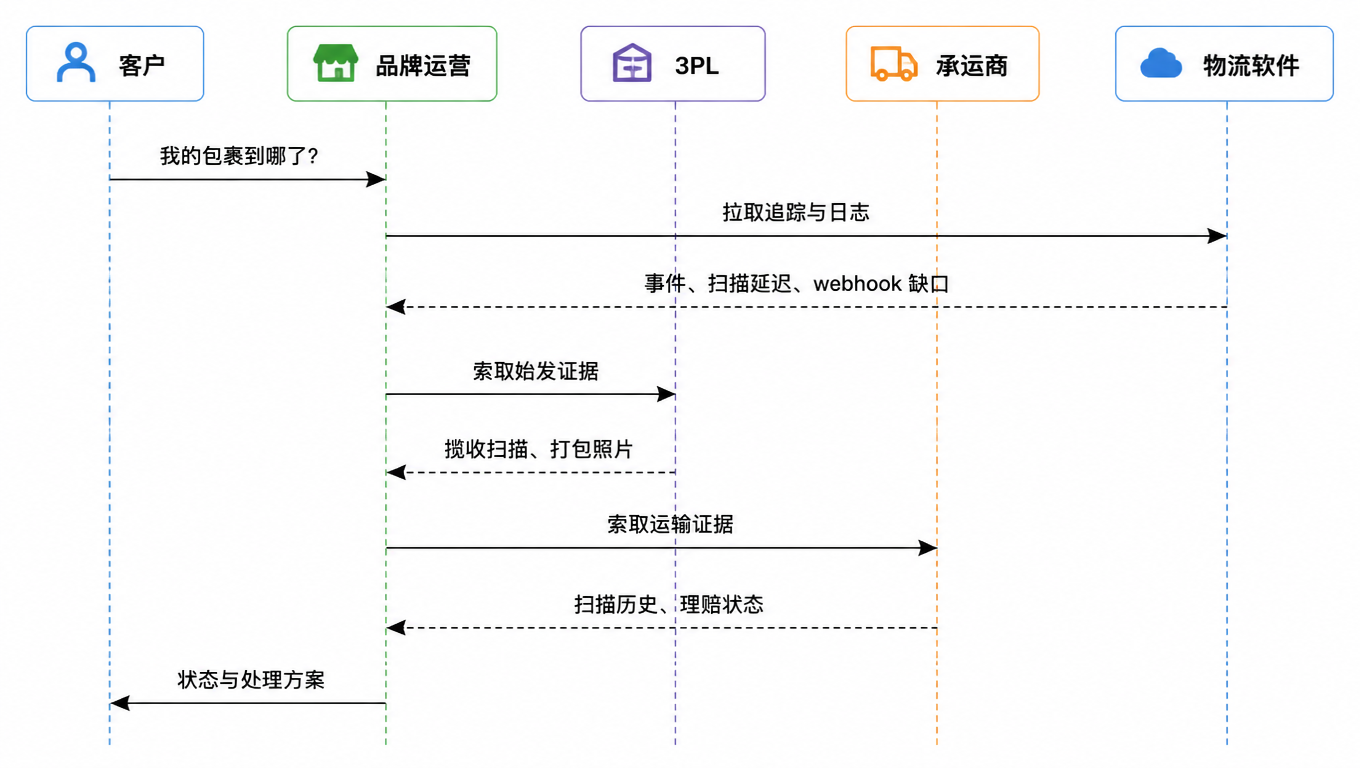
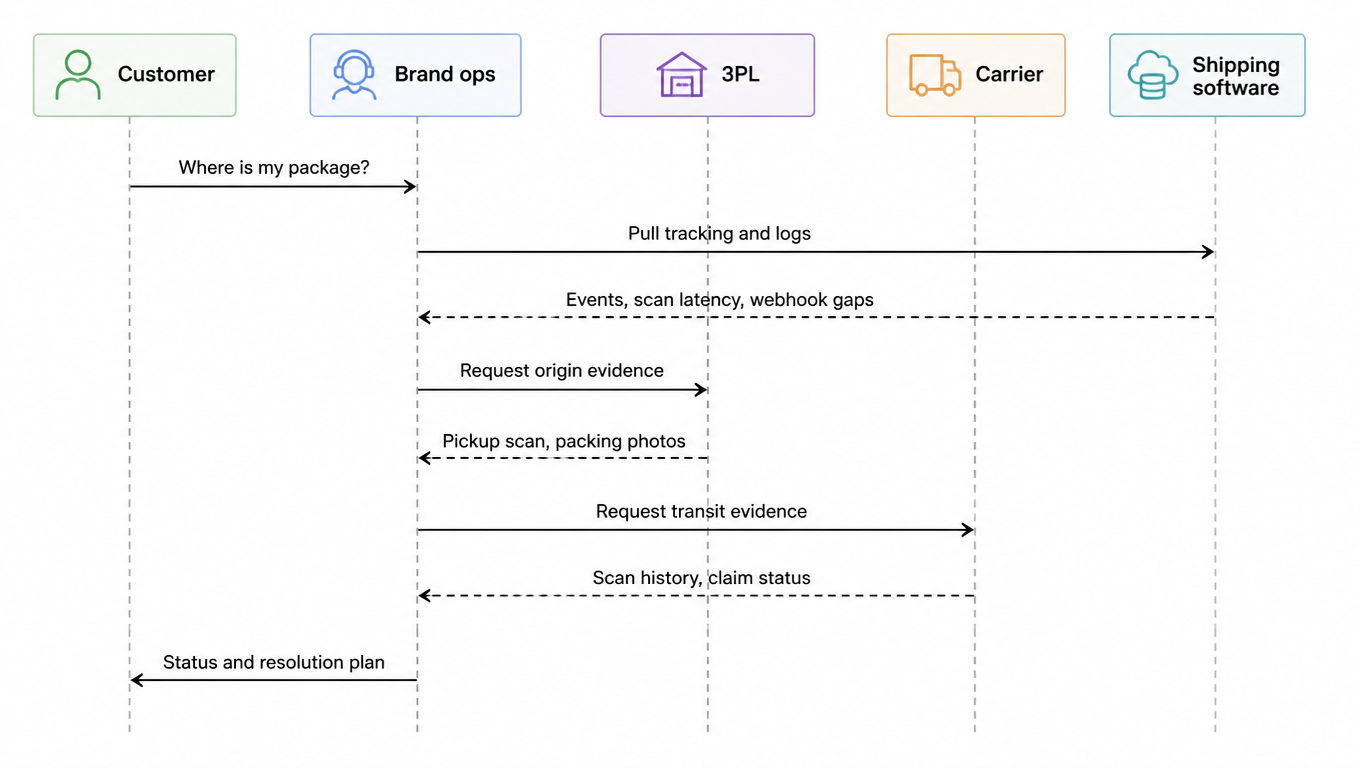
时序图:客户询问包裹位置,品牌运营拉取追踪与日志,向 3PL 索取揽收扫描和打包照片,向承运商索取扫描历史与理赔状态,最后回复客户状态与处理方案Sequence diagram: customer asks where the package is, brand ops pulls tracking and logs, requests origin evidence from the 3PL (pickup scan, packing photos), requests transit evidence from the carrier (scan history, claim status), then replies to the customer with a status and resolution plan
异常升级路径:信号、证据、客户通知,各归其位The escalation path: signal, evidence, customer notification, each in its place

矩阵弯曲的时候When the Matrix Bends

多承运商拆分。路由决策随着订单在服务间切换而把 R 移来移去,但品牌仍然对面向客户的承诺持 A。每一次路由规则变更都需要品牌在复盘环里批准,软件需要记录哪条规则把哪一单发给了哪家承运商,因为当下一次承诺落空时,这份日志就是证据。Multi-carrier splits. Routing decisions move R around as orders shift between services, but the brand still holds A for the customer-facing promise. Every routing-rule change needs the brand's approval in the review loop, and the software needs to log which rule sent which order to which carrier, because that log is the evidence when the next promise misses.

国际件与 DDP。关税、税费与税务责任以境内矩阵无法捕捉的方式转移责任。落地成本承诺属于品牌,因为客户在结账时只付了一个数字。清关由经纪商或承运商 R,软件 R 于在结账时准确展示 DDP 费用。税费错了,就像倒推 EDD 一样倒推:哪个输入错了?International and DDP shipments. Customs, duties, and tax liability shift responsibility in ways the domestic matrix does not capture. The landed-cost promise belongs to the brand, because the customer paid one number at checkout. The broker or carrier is R for clearance, and the software is R for displaying the DDP fee accurately at checkout. When duties are wrong, walk it back the same way you walk back an EDD: which input was wrong?

尾程交接给区域承运商。很多品牌把包裹交给全国性承运商,再由它转给区域派送网络完成最后几英里。转移点就是承运商 R 变化的地方,也正是证据必须被捕获的那一刻:区域枢纽的交接扫描。如果契约没有点名这个扫描,两家承运商会各自假设对方拥有尾程。Last-mile handoff to regional carriers. Many brands hand the parcel to a national carrier that transfers it to a regional delivery network for the final miles. The transfer point is where carrier R changes, and it is the exact moment the evidence must be captured: the handoff scan at the regional hub. If the contract does not name that scan, the two carriers will each assume the other owns the last mile.

3PL 换仓与迁移。切换期间,品牌对每一个做出的承诺持 A,旧 3PL 对退出窗口 R,新 3PL 对进入窗口 R。并行发货、审计交接扫描,并在切换路由规则之前让迁移窗口的承诺在结账页可见。矩阵在迁移期间不会暂停,它只是多了几行。3PL migration and warehouse switching. During cutover, the brand holds A for every promise made, the old 3PL is R for its exit window, and the new 3PL is R for its entry window. Run parallel shipments, audit the handoff scans, and make the transition-window promises visible in the checkout before you switch the routing rules. The matrix does not pause during migration; it just gets more rows.

运营团队与软件层The Ops Team and the Software Layer

对电商运营与 3PL 老板,执行清单有四条:写下 RACI 并与每个伙伴签署;给每个 R 挂上一个 SLA 数字;每周对照矩阵审计扫描;每季度排练一次升级路径。熬过旺季的团队,是那些在 7 月、在风险还很低的时候就跑过一遍流程的团队。For ecommerce ops and 3PL owners, the execution checklist has four items: write the RACI and sign it with every partner, attach an SLA number to every R, audit scans weekly against the matrix, and rehearse the escalation path quarterly. The teams that survive peak season are the ones that ran the loop in July, when the stakes were low.

对 OMS、WMS、ERP 与 SaaS 产品经理和开发者:软件层从来不是 accountable 的一方,但它是让 accountability 成为可能的证据层。为它而构建:幂等面单 API、带重试与死信日志的 webhook 投递、与承运商扫描对齐的事件时间戳、可导出的审计轨迹。纠纷落地时,日志最干净的一方赢,而你想让赢的那方是你的客户,也就是品牌。For OMS, WMS, ERP, and SaaS product managers and developers: the software layer is never the accountable party, but it is the evidence layer that makes accountability possible. Build for it: idempotent label APIs, webhook delivery with retries and dead-letter logs, event timestamps that match carrier scans, and exportable audit trails. When a dispute lands, the party with the cleanest log wins, and you want that party to be your customer, the brand.

诚实的定位。因为我们自己就做这样的工具,所以诚实一点。EasyShippingX 活在承运商执行层:费率、面单与追踪事件。它不计算也不拥有 EDD,也不假装拥有。真正的 EDD 需要库存可用性、仓库截单与承运商时效数据,而这些活在品牌的承诺栈里,不在面单打印机里。如果一件工具自称 EDD 产品却看不到你的库存或截单,它就是在猜,而一个猜出来的 EDD 是一个你迟早要负责的承诺。Honest product positioning. Because we build one of these tools. EasyShippingX lives in the carrier execution layer: rates, labels, and tracking events. It does not compute or own EDD, and it does not pretend to. A true EDD needs inventory availability, warehouse cutoff, and carrier transit data, and those live in the brand's promise stack, not in a label printer. If a tool claims to be an EDD product but cannot see your inventory or your cutoff, it is guessing, and a guessed EDD is a promise you will have to answer for.

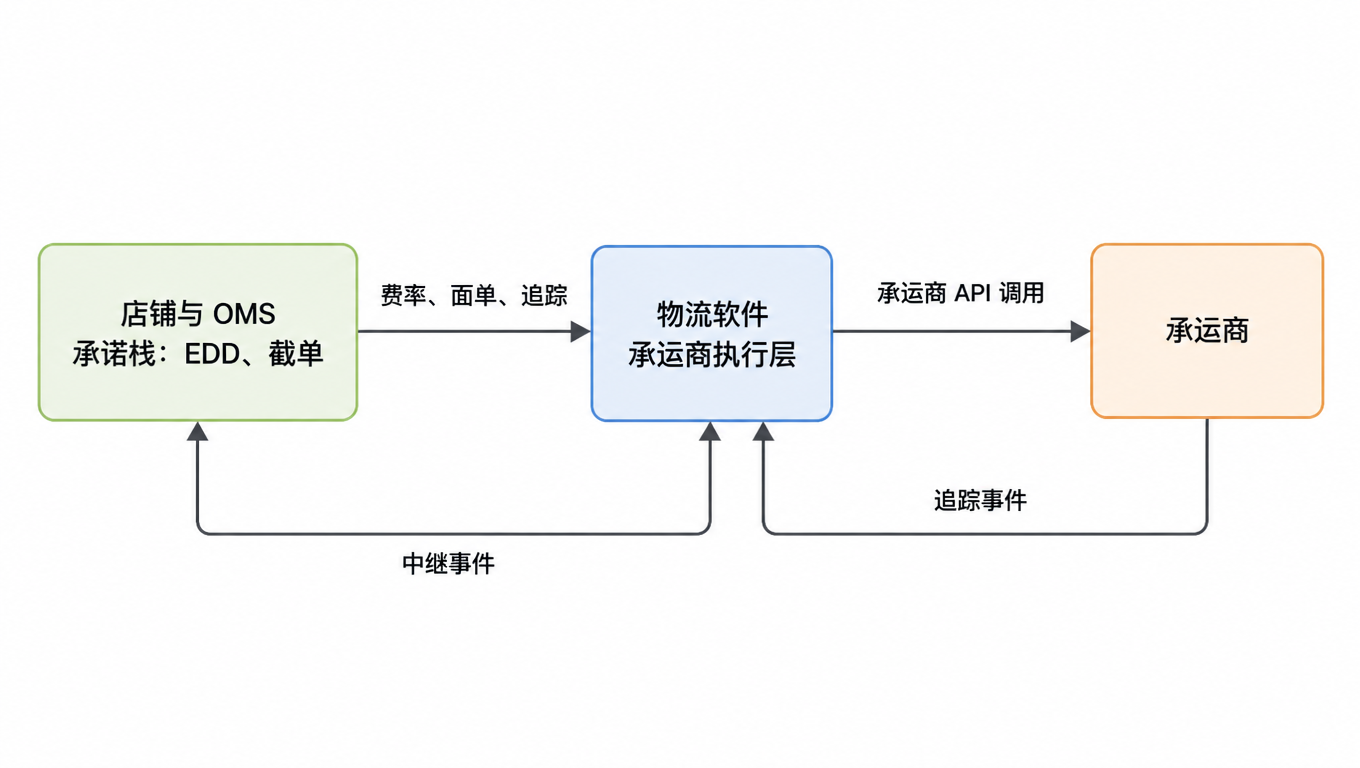
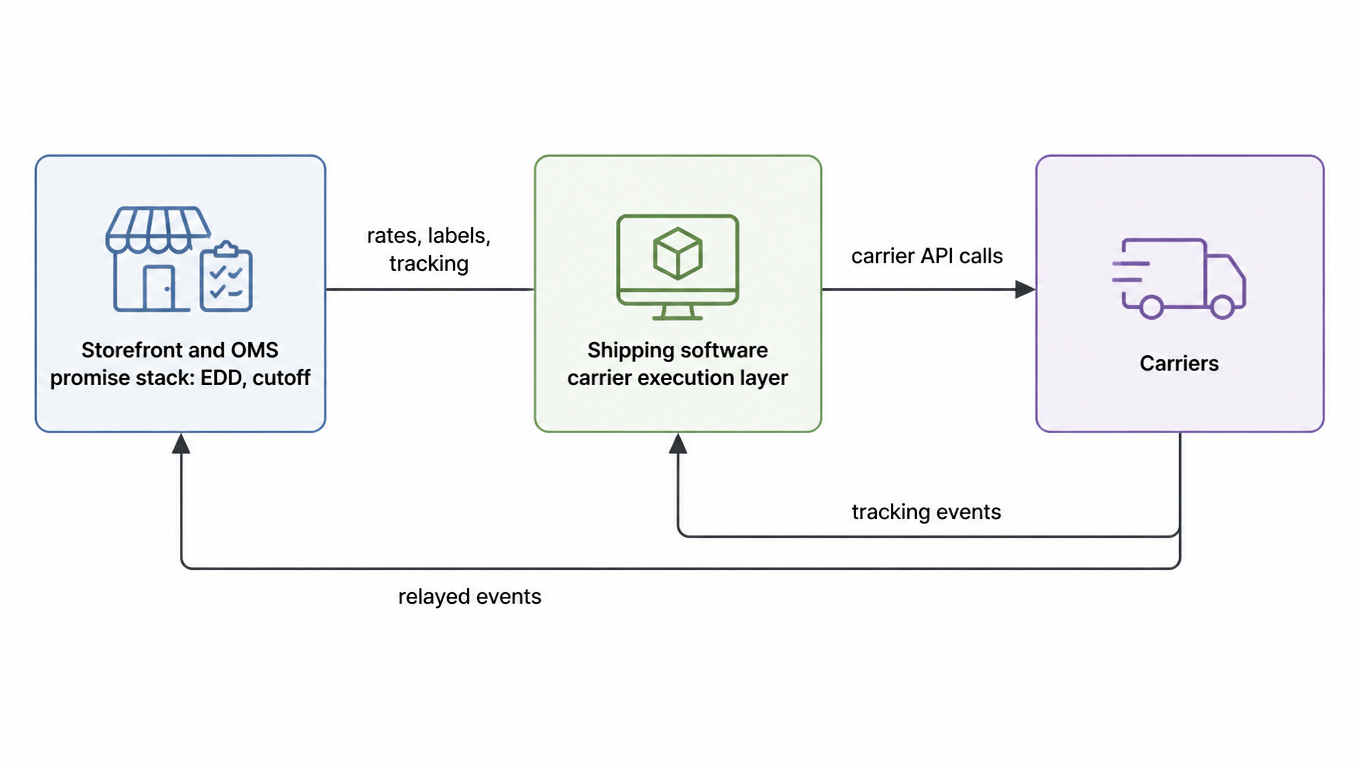
架构图:店铺与 OMS 承诺栈(EDD、截单)向物流软件(承运商执行层)传费率、面单、追踪,物流软件调用承运商 API,承运商回传追踪事件,软件中继事件回承诺栈Architecture diagram: the storefront and OMS promise stack (EDD, cutoff) sends rates, labels, and tracking to the shipping software (carrier execution layer), which calls carrier APIs, carriers return tracking events, and the software relays events back to the promise stack
软件层中继数据,承诺栈拥有承诺The software layer relays data; the promise stack owns the promise

可复制的契约语言。每段一句话,双方签署:「3PL 对已发布的截单与始发扫描负责;品牌对结账承诺 accountable。」「承运商对运输扫描与服务标准负责;品牌对客户看到的东西 accountable。」「物流软件对如实中继费率、面单与追踪数据负责;它不对面向客户的承诺 accountable。」签下这三句话,这篇文章里的大部分甩锅游戏就停止发生。Contract language to copy. One sentence per leg, signed by both parties: "The 3PL is responsible for the published cutoff and for origin scans; the brand is accountable for the checkout promise." "The carrier is responsible for transit scans and the service standard; the brand is accountable for what the customer sees." "The shipping software is responsible for relaying rate, label, and tracking data faithfully; it is not accountable for the customer-facing promise." Sign those three sentences and most of the blame games in this article stop happening.

一页速查卡The Quick-Reference Card

谁对客户负责:品牌,永远。店铺上的每一个承诺、每一个追踪器、每一笔退款,都对品牌负责。Who answers to the customer: the brand, always. Every promise on the storefront, every tracker, every refund, all of it answers to the brand.

谁对包裹负责:始发段的 3PL、运输中的承运商、退货段的 3PL 或承运商,各自在自己扫描定义的窗口内。Who answers for the package: the 3PL at origin, the carrier in transit, and the 3PL or carrier on the return leg, each within their scan-defined window.

谁对数据负责:品牌拥有记录。3PL 提供可用性与截单,承运商与物流软件提供服务与追踪事件。Who answers for the data: the brand owns the record. The 3PL supplies availability and cutoff, and the carrier and shipping software supply service and tracking events.

谁对异常负责:品牌拥有闭环,运营者拥有修复,软件拥有信号。Who answers for exceptions: the brand owns the loop, the operators own the fix, and the software owns the signal.

配送承诺住在品牌那里。其他所有人都是借用来的:3PL、承运商、软件,全都是。给每一个一行、一个字母、一份 SLA,承诺就从「只能道歉的东西」变成「可以运营的东西」。The delivery promise lives with the brand. Everyone else is on loan: the 3PL, the carrier, the software, all of it. Give each of them a row, a letter, and an SLA, and the promise becomes something you can operate instead of something you can only apologize for.

常见问题FAQ

品牌,永远是品牌。客户是从品牌结账页买的东西,包裹晚了、丢了、破损了,客户找的是品牌,不是 3PL 或承运商。RACI 里的说法是:Accountable 永远留在品牌手里,Responsible(拣货、打包、运输这些活)可以委派给 3PL 与承运商。委派工作不是委派关系。The brand, always. The customer bought from the brand's checkout, and when a package is late, lost, or damaged, the customer comes to the brand, not the 3PL or the carrier. In RACI terms: Accountable always stays with the brand, while Responsible (the picking, packing, and moving) can be delegated to the 3PL and carrier. Delegating the work is not delegating the relationship.
因为承诺是对客户做的,而客户只有一个追责地址:品牌的服务热线与收件箱。3PL 对始发扫描负责,承运商对运输负责,软件对数据中继负责,但「周五前送达」这句对客户的承诺只有品牌能回答。这也是经济账:一单悬而未决的「包裹在哪」就是一次流失的复购,而复购收入是电商利润所在。Because the promise is made to the customer, and the customer has exactly one address for it: the brand's support line and inbox. The 3PL answers for origin scans, the carrier for transit, the software for data relay, but only the brand can answer for "arrives by Friday." It is also an economic argument: every unresolved where-is-my-package is a lost repeat purchase, and repeat revenue is where ecommerce margins live.
默认是 3PL 的 R 失败。「2 点前入库的订单今天发出」是一份签署过的契约,不是习惯。唯一的例外是品牌把订单晚路由进来,证据很简单:订单时间戳对比路由时间戳。晚到纠纷也一样:揽收扫描落在承诺截单之后,3PL 输;揽收准时但派送仍晚,承运商输。A 永远是品牌。By default it is a 3PL R-failure. "Orders in by 2 PM ship today" is a signed contract, not a habit. The only exception is the brand routing the order in late, and the evidence is simple: the order timestamp versus the routing timestamp. Late-delivery disputes work the same way: pickup scan after the promised cutoff means the 3PL loses; pickup on time but delivery still late means the carrier loses. A is always the brand.
不是。EDD 由 OMS 或 EDD 引擎根据三个输入计算:库存可用性、仓库截单、承运商时效。品牌对展示给客户的 EDD accountable,软件只负责提供输入,绝不在静默中重算。EDD 错了,倒推回去:是可用性、截单还是运输数据错了?如果一件工具自称 EDD 产品却看不到你的库存与截单,它就是在猜。No. The EDD is computed by the OMS or EDD engine from three inputs: inventory availability, warehouse cutoff, and carrier transit. The brand is accountable for the EDD shown to the customer, and the software only supplies inputs, never silently recomputing the number. When an EDD is wrong, walk it back: was it availability, cutoff, or transit data? If a tool claims to be an EDD product but cannot see your inventory and cutoff, it is guessing.
迁移期间品牌对每一个承诺持 A,旧 3PL 对退出窗口 R,新 3PL 对进入窗口 R。并行发货、审计交接扫描,切换路由规则之前让迁移窗口的承诺在结账页可见。矩阵不会暂停,它只是多了几行。多承运商拆分同理:路由把 R 移来移去,A 始终在品牌,每次规则变更都要品牌批准并留日志。During cutover the brand holds A for every promise made, the old 3PL is R for its exit window, and the new 3PL is R for its entry window. Run parallel shipments, audit the handoff scans, and show the transition-window promises at checkout before switching routing rules. The matrix does not pause, it just gets more rows. Multi-carrier splits work the same way: routing moves R around, A stays with the brand, and every rule change needs brand approval plus a log.

想守住结账页上的每一个配送承诺?Want to keep every delivery promise your checkout makes?

EasyShippingX 在承运商执行层(费率、面单、追踪)把责任链的每一环都变成可审计的证据,让品牌、3PL 与承运商各归其位,承诺不再靠运气兑现。EasyShippingX operates in the carrier execution layer (rates, labels, tracking) and turns every link of the responsibility chain into auditable evidence, so the brand, the 3PL, and the carrier each stay in their lane, and promises stop depending on luck.

Get Rate Comparison
Get Rate Comparison