电商物流指南Ecommerce Shipping Guide

经济件、标准件与加急件:如何把结账承诺映射到承运商服务Economy vs. Standard vs. Expedited Shipping: How to Map Checkout Promises to Carrier Services

几乎每个 Shopify 店铺都见过同一个下拉框:Economy、Standard、Expedited。这些标签看起来不言自明,背后却是一团承运商服务、分区时效表、截单时间和周末黑名单的纠缠。结账标签与承运商服务之间的那道缝,正是配送承诺悄悄破裂的地方,也是退款、客服工单和流失的复购诞生的地方。这篇指南教你用一套可重复的映射框架把这到缝补上,并在你的 OMS、费率引擎和结账页里把它落地。Every Shopify storefront has seen the same dropdown: Economy, Standard, Expedited. The labels feel self-explanatory, yet behind them sits a tangle of carrier services, zone tables, cutoff clocks, and weekend blackouts. The gap between a checkout label and a carrier service is where delivery promises quietly break, and where refunds, support tickets, and lost repeat purchases are born. This guide shows you how to close that gap with a repeatable mapping framework, and how to implement it in your OMS, rate engine, and checkout.

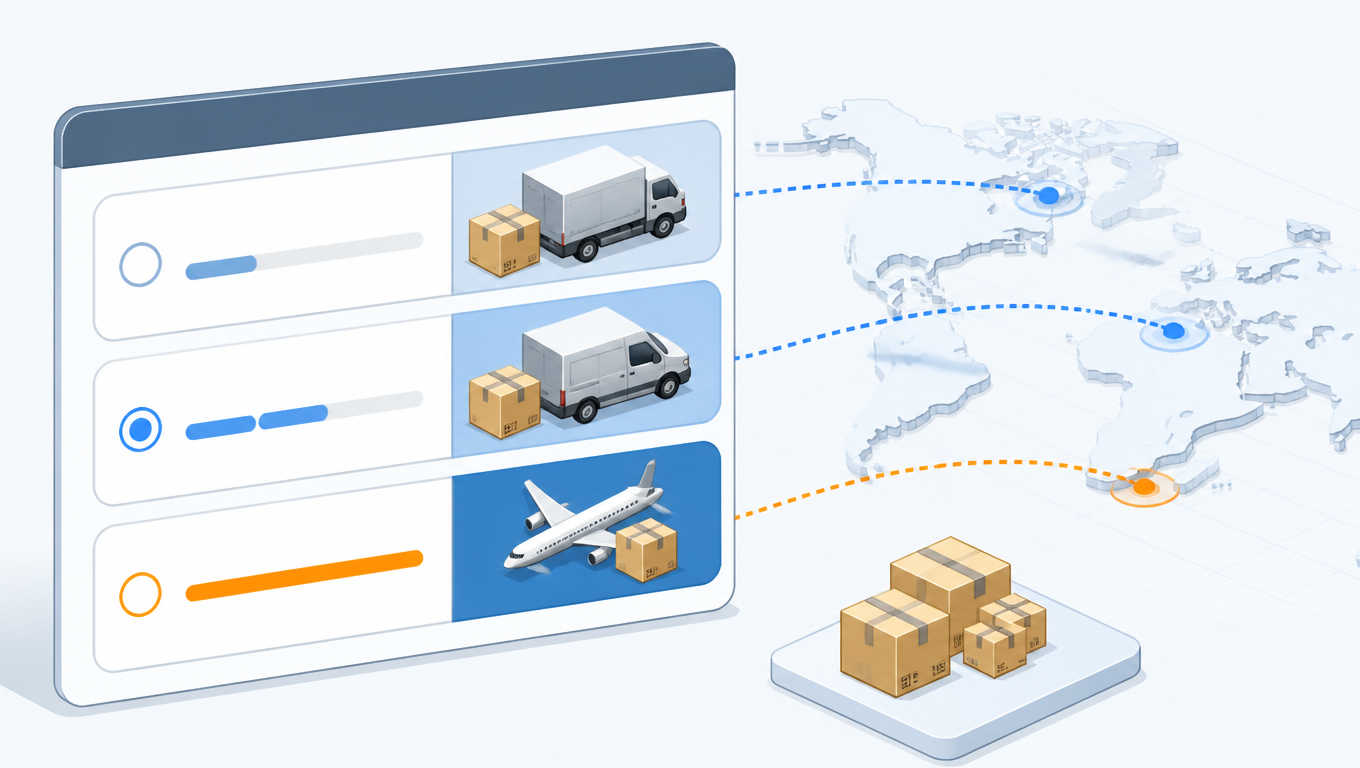
扁平插画:电商结账配送面板,左侧是三个速度档位,右侧分别对应货车、厢式车、飞机的包裹配送图标
结账档位描述的是客户感受,承运商服务描述的才是网络实际做了什么Checkout tiers describe what the customer should feel; carrier services describe what the network actually does

静态承诺映射为什么会失效Why Static Promise Mapping Breaks

「Economy 就是发 Ground」是电商里最常见的发货规则,也是最脆弱的。结账词汇(Economy、Standard、Expedited)描述的是客户应该感受到什么;承运商服务(Ground、3 Day Select、2nd Day Air、Next Day Air)描述的才是网络实际做了什么。把两者一对一静态映射,等于假设每一单都一样。但订单并不一样,错位会以五种反复出现的失效模式暴露出来:"Economy means we ship Ground" is the most common shipping rule in e-commerce, and the most fragile. The checkout vocabulary (Economy, Standard, Expedited) describes what the customer should feel. Carrier services (Ground, 3 Day Select, 2nd Day Air, Next Day Air) describe what the network actually does. A static one-to-one map between the two assumes every order is the same. It is not, and the mismatch shows up in five recurring failure modes:

  • 跨区漂移。同一个承诺日期,对不同目的邮编需要不同的服务。3 天的 Standard 承诺,对 zone 3 的客户是 Ground,对 zone 6 的客户就需要 3 Day Select 或 2nd Day Air。静态映射到处发 Ground,远的区就漏了。Cross-zone drift. The same promise date needs different services for different destination ZIPs. A Standard promise of 3 days is Ground for a zone 3 customer, but for zone 6 it needs 3 Day Select or 2nd Day Air. Static mapping ships Ground everywhere and misses the far zones.
  • 截单时间。晚上 7:02 下单的订单,错过了承运商揽收截单,会悄悄顺延到第二天的揽收,送达日期整体后移一天。结账时展示的承诺不会跟着动。Cutoff time. An order placed at 7:02 pm after the carrier pickup cutoff silently inherits the next day's pickup, moving the delivery date by a full day. The promise shown at checkout does not move with it.
  • 周末与节假日。周五揽收的 Ground 件要在网络里躺到周一。按自然日计算的承诺,遇到第一个假期周末就塌了。Weekends and holidays. Ground picked up on a Friday sits in the network until Monday. A promise computed in calendar days collapses on the first holiday weekend.
  • 多仓库存。真正履约的库位可能离客户很远。库存放在西部、客户在东海岸,即使店铺页面说了能做 3 天承诺,Ground 也做不到。Multi-warehouse inventory. The stock location that actually fulfills the order may be far from the customer. If inventory sits in the west while the customer is in the east, Ground cannot make a 3-day promise even though the storefront said it could.
  • 承运商绩效漂移。目录 SLA 不等于实际准时送达率。一个承诺 2 个工作日的服务,在某条线路上可能只有 88% 的兑现率。静态映射对绩效没有记忆。Carrier performance drift. Catalog SLA is not the same as delivered on-time rate. A service that promises 2 business days may only hit that 88% of the time on a specific lane. Static mapping has no memory of this.

这篇文章的核心论点:目标从来不是最便宜的面单,而是在承诺日期内真正能送达的最低成本路径。成本最小化是一个带约束的优化问题,约束就是承诺。静态映射把承诺当成贴在订单上的固定档位;动态 promise 则把它当成品类、发货仓、目的地址、库存可用性与承运商服务的函数。指南接下来的部分,就是构建这个函数。The core thesis of this article: the goal is never the cheapest label. It is the lowest-cost path that can actually deliver by the promised date. Cost minimization is a constrained optimization, and the constraint is the promise. Static mapping treats the promise as a fixed tier bolted onto an order. A dynamic promise treats it as a function of product category, ship-from warehouse, destination address, inventory availability, and carrier service. The rest of this guide builds that function.
美国境内承运商工具箱The US Domestic Carrier Toolkit

映射承诺之前,先备好原材料:境内承运商服务,以及真正决定时效的那几个变量。Before mapping promises, you need the raw materials: the domestic carrier services and the variables that actually determine their transit time.

USPS 有三个相关服务。Ground Advantage 在 2 到 5 个工作日内送达[1],是轻量包裹的默认预算选项。Priority Mail 在 1 到 3 个工作日内送达[2],含固定费率箱。Priority Mail Express 是隔夜服务,带退款保证,也是 USPS 唯一正式保证送达日期的产品[3]USPS runs three relevant services. Ground Advantage delivers in 2 to 5 business days[1] and is the default budget option for lightweight parcels. Priority Mail delivers in 1 to 3 business days[2] and includes flat-rate boxes. Priority Mail Express is the overnight service with a money-back guarantee, and it is the only USPS product that formally guarantees a date.[3]

UPS 按速度分层。Ground 视分区在 1 到 5 个工作日内送达[4],其上还有三个时效确定档位:3 Day Select、2nd Day Air 和 Next Day Air(Saver 变体用几小时的派送窗口换取更低费率)[5]FedEx 与之对应:Ground(1 到 5 天)[6]、Express Saver(3 个工作日)、2Day 和 Overnight(Priority 或 Standard)[7]UPS layers its network by speed. Ground delivers in 1 to 5 business days depending on zone.[4] Above it sit three time-definite tiers: 3 Day Select, 2nd Day Air, and Next Day Air (with Saver variants that trade a few hours of delivery window for a lower rate).[5] FedEx mirrors this: Ground (1 to 5 days),[6] Express Saver (3 business days), 2Day, and Overnight (Priority or Standard).[7]

真正决定哪个服务能兑现承诺的,不是目录名称,而是四个运营变量:What actually decides which of these services can make a promise is not the catalog name, it is four operational variables:

  • 分区距离表。始发地与目的邮编之间的分区数,决定地面时效和每一档快递费率。zone 2 是隔壁,zone 8 是横跨全美。Zone distance tables. The number of zones between origin and destination ZIP drives ground transit time and every express rate. Zone 2 is next door, zone 8 is cross-country.
  • 截单时间。商业件揽收截单通常在当地晚上 6 到 7 点,偏远地区有时更早。过了截单的订单,明天才发货,没有商量。Cutoff times. Commercial pickup cutoffs typically run 6 to 7 pm local time, sometimes earlier for remote areas. An order past cutoff ships tomorrow, full stop.
  • 揽收日程。不是每条线路都有每日揽收。走 5 天揽收日程的仓库,周六入库直接泡汤。Pickup schedules. Not every lane gets a daily pickup. A warehouse on a 5-day pickup schedule loses Saturday injection entirely.
  • 周末与节假日排除。Ground 和快递服务都是工作日产品。联邦节假日和承运商专属黑名单日期,会把每一张时效表往后推。Weekend and holiday exclusions. Ground and express services are business-day products. US federal holidays and carrier-specific blackout dates push every transit table forward.

最后,服务可达性边界在任何映射之前就先把工具箱过滤一遍:重量与尺寸限制(体积重规则、最大长宽和周长)、危险品与受限物品、以及能让一个原本便宜的费率翻倍的偏远邮编附加费。这个包裹实际用不了的服务,不是候选,是噪音。Finally, serviceability boundaries filter the toolkit before any mapping happens: weight and size limits (dimension rules, maximum length and girth), hazardous and restricted items, and remote ZIP surcharges that can double an otherwise cheap rate. A service you cannot actually use for this package is not a candidate, it is noise.

动态映射表:候选生成器The Dynamic Mapping Table

有了工具箱,就可以搭经典的映射表:承诺层 × 条件 → 候选承运商服务。表格之前先讲一句诚实的提醒:这张表是候选生成器,不是最终答案。它说的是「这些服务*可能*为这类订单兑现这个承诺」,具体发哪家,由下一节的六步决策序列决定。With the toolkit in hand, you can build the classic mapping table: promise layer by conditions, pointing at candidate carrier services. One honest caveat before the table: this table is a candidate generator, not the final answer. It says "these services could make this promise for this kind of order." Which one actually ships is decided by the six-step decision sequence in the next section.

承诺层Promise layer 条件Conditions 候选承运商服务Candidate carrier services 典型成本档Typical cost band SLA 缓冲SLA buffer
当日达(少见)Same-day (rare)都会区 zone 1-2、本地库存、截单前Metro zone 1-2, local inventory, before cutoff当日达快递、UPS/FedEx 本地Same-day courier, UPS/FedEx local$$$$$$$$无,逐单核验None, verify per order
次日达Next-dayzone 1-2、小件Zone 1-2, small parcelUSPS Priority Mail Express、UPS Next Day Air、FedEx OvernightUSPS Priority Mail Express, UPS Next Day Air, FedEx Overnight$$$$$$0-1 天0-1 day
2 天2-dayzone 3-5、中小件Zone 3-5, small to medium parcelUSPS Priority Mail、UPS 2nd Day Air、FedEx 2DayUSPS Priority Mail, UPS 2nd Day Air, FedEx 2Day$$-$$$$$-$$$0-1 天0-1 day
2 天2-dayzone 6-8、任意包裹Zone 6-8, any parcel仅 UPS 2nd Day Air、FedEx 2DayUPS 2nd Day Air, FedEx 2Day only$$$$$$0-1 天0-1 day
3-5 天3-5 dayzone 2-5、轻件Zone 2-5, lightweightUSPS Ground Advantage、UPS Ground、FedEx GroundUSPS Ground Advantage, UPS Ground, FedEx Ground$$1 天1 day
3-5 天3-5 dayzone 6-8、重件或超大件Zone 6-8, heavy or oversizedUPS Ground、FedEx Ground(核验体积重)UPS Ground, FedEx Ground (verify dim weight)$-$$$-$$1 天1 day

逐行读这张表,规律很明显:同一个承诺层,会因分区、包裹画像和库存位置不同,解析到*不同*的候选服务。对 zone 3 的 2 天承诺是 USPS Priority Mail 的决策;对 zone 7 的同一个承诺,是 UPS 2nd Day Air 的决策。静态映射表达不了这件事;这张表可以,因为它带条件。Read the table row by row and the pattern is obvious: the same promise layer resolves to different candidate services depending on zone, package profile, and inventory location. A 2-day promise to zone 3 is a USPS Priority Mail decision; the same promise to zone 7 is a UPS 2nd Day Air decision. Static mapping cannot express this; the table can, because it is conditioned.

两条护栏让这张表保持诚实。第一,任何候选服务的时效都不得慢于它所映射的承诺:如果某条线路最快的保证服务是 3 天,这一行就不允许出现 2 天承诺。第二,缓冲天数来自观察到的承运商绩效,而不是目录 SLA。如果某条线路实际要 4 天才到、目录却承诺 3 天,缓冲列就写 1 天,候选行把它吸收掉。Two guardrails keep the table honest. First, no candidate service may be slower than the promise it is mapped to: if the fastest guaranteed service on a lane is 3 days, a 2-day promise must not appear in that row. Second, buffer days come from observed carrier performance, not from catalog SLA. If a lane historically delivers Ground in 4 days despite a 3-day catalog promise, the buffer column says 1 day, and the candidate row absorbs it.

最低成本可兑现路径:六步决策序列The Lowest-Cost Deliverable Path: A 6-Step Decision Sequence

这是整套框架的心脏。承诺日期先锁定,之后每一步都在这个硬约束下收窄候选集。输出是每单一个承运商服务:在所有真正能送达的路径里,全包成本最低的那一个。This is the heart of the framework. The promise date is locked first, and every later step narrows the candidate set under that hard constraint. The output is one carrier service per order: the lowest all-in cost among the paths that can actually deliver.

第 1 步:锁定承诺日期。承诺来自产品的 SLA 定义和结账页展示的确切日期。把它写成一个单一日期:「周四 8 月 21 日前送达」。如果店铺展示的是区间(8 月 20-22 日),用区间最晚的那天,因为那才是客户会拿来要求你的日期。后续序列全都是对这个日期的算术。Step 1: Lock the promise date. The promise comes from the product's SLA definition and the exact date shown at checkout. Write it down as a single date: "deliver by Thu, Aug 21." If your storefront shows a range (Aug 20-22), use the latest date in the range, because that is the date the customer will hold you to. The rest of the sequence is arithmetic on this one date.

第 2 步:扣除处理时间与安全缓冲。仓库需要时间拣货、打包、交运,你还需要一层缓冲,来兜住错过揽收或线路表现不佳的那一天。承运商交付截止线 = 承诺日期 − 处理时间 − 缓冲天数:Step 2: Subtract handling time and safety buffer. Your warehouse needs time to pick, pack, and tender the parcel, and you need a buffer against the day when a pickup is missed or a lane underperforms. The carrier delivery deadline is the promise date minus handling time minus buffer:

carrier_deadline = promise_date − handling_time − buffer_dayscarrier_deadline = promise_date − handling_time − buffer_days

周四的承诺、1 天处理、1 天缓冲,意味着承运商最晚周二必须送达。这一条简单的计算,就决定了 Ground 配不配进候选集。大多数店铺低估了这一步:承诺不是「承运商做什么」,而是「你的仓库处理完之后,承运商做什么」。A promise of Thursday, 1 day of handling, and 1 buffer day means the carrier must deliver by Tuesday. That single calculation decides whether a Ground shipment even deserves to be in the candidate set. Most stores underweight this step; a promise is not "what the carrier does," it is "what the carrier does after your warehouse finishes with it."

第 3 步:按 邮编 × 包裹画像 × 可达性 过滤。剔除所有服务不了这单的服务:目的邮编在服务覆盖之外、包裹超过重量与尺寸上限、内容物在受限清单上、以及附加费高到离谱的偏远线路。这是纯资格过滤,应该便宜得可以随便跑,因为它是一组查询,不是费率报价。Step 3: Filter by ZIP x package profile x serviceability. Drop every service that cannot serve this order: destination ZIPs outside a service's footprint, packages over its weight and dimension limits, contents on its restricted list, and lanes with punishing remote surcharges. This is a pure eligibility filter, and it should be cheap to run, because it is a set of lookups, not a rate quote.

第 4 步:按历史「承诺内准时率」过滤。现在上绩效过滤。对这条线路上每个幸存服务,查它过去 90 天观察到的准时率,口径是「按承诺日期送达」,不是承运商目录 SLA。只保留能过你可靠性阈值的路径:Standard 承诺 95% 是合理默认,次日达承诺 98%。某条线路 88% 准时的服务不是候选,是未来的退款。Step 4: Filter by historical on-time-to-promise. Now apply the performance filter. For each surviving service on this lane, look up its observed on-time rate over the trailing 90 days, measured as delivered by the promise date, not by the carrier's catalog SLA. Keep only paths that clear your reliability threshold, 95% is a sane default for a Standard promise, 98% for a Next-day promise. A service that is 88% on-time on this lane is not a candidate, it is a future refund.

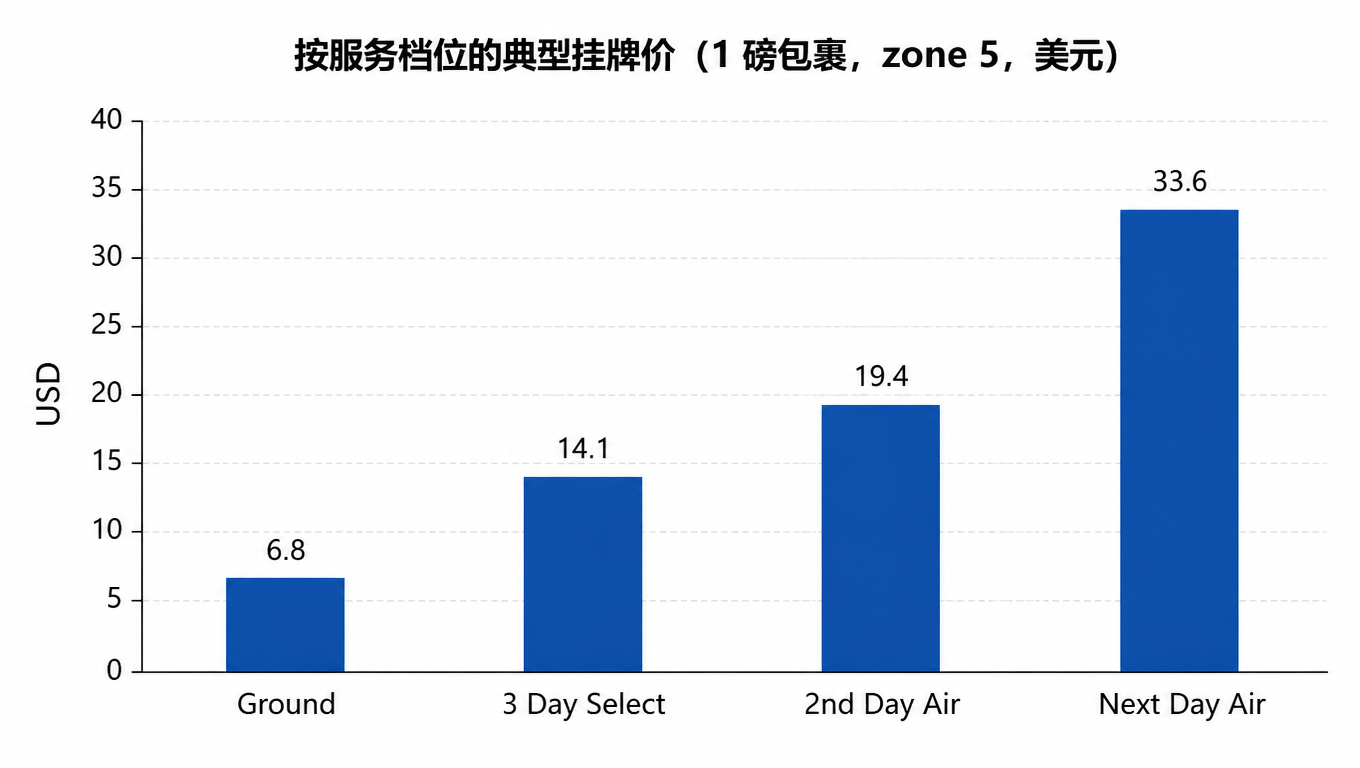
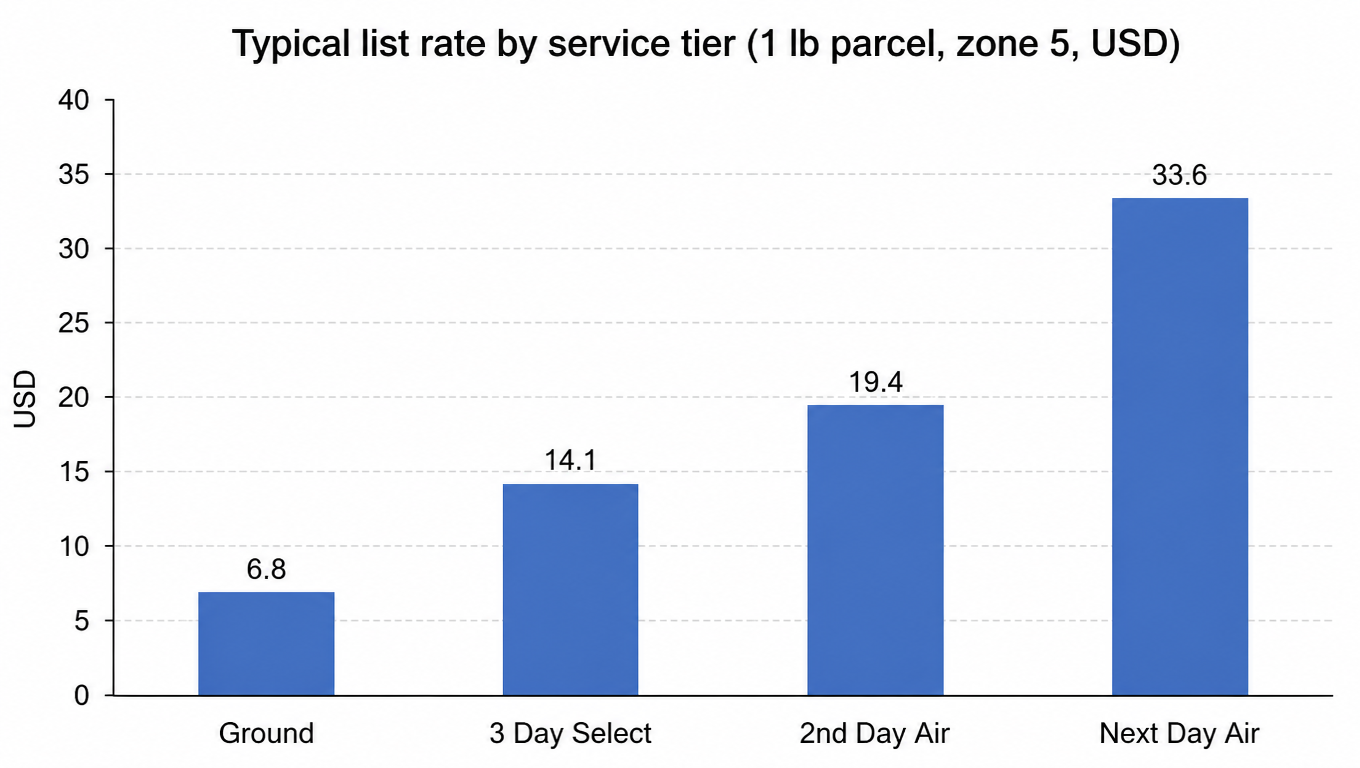
第 5 步:比较全包成本。直到这里才比钱,而且比的是*全包*成本,不是面单价。1 磅包裹发 zone 5 的典型挂牌价,是一条干净的阶梯:Ground 约 6.80 美元、3 Day Select 约 14.10 美元、2nd Day Air 约 19.40 美元、Next Day Air 约 33.60 美元。但面单只是底价。Step 5: Compare all-in cost. Only now do you compare money, and you compare all-in cost, not label price. For a typical 1 lb parcel to zone 5, published list rates form a clean ladder: Ground around $6.80, 3 Day Select around $14.10, 2nd Day Air around $19.40, Next Day Air around $33.60. But the label is only the base.

柱状图:1 磅包裹 zone 5 的典型挂牌价,Ground 6.80 美元、3 Day Select 14.10 美元、2nd Day Air 19.40 美元、Next Day Air 33.60 美元Bar chart: typical list rate by service tier for a 1 lb parcel to zone 5, Ground $6.80, 3 Day Select $14.10, 2nd Day Air $19.40, Next Day Air $33.60
面单只是底价,全包成本才是决策依据The label is only the base; all-in cost is what decides

一票货的全成本 = 面单价 + 体积重附加费 + 包装 + 异常预期成本(改址、地址更正、派送失败重试)+ 破承诺成本。最后那一项是真实的:一单延误的 Standard 件会产生一张客服工单、一次折扣或退款,以及可量化的复购率下降。当两个候选的面单只差几美元时,准时历史更好的那个,把破承诺成本算进去之后通常更便宜。在第 4 步幸存下来的路径里,选全包成本最低的。The full cost of a shipment is label price plus dimensional weight surcharges plus packaging plus the expected cost of exceptions (re-routes, address corrections, failed attempts) plus the cost of a broken promise. That last term is real: a delayed Standard order generates a support ticket, a discount or refund, and a measurable drop in repurchase rate. When two candidates are within a couple of dollars on the label, the one with better on-time history is usually the cheaper one once broken-promise cost is included. Pick the lowest all-in cost among the paths that cleared Step 4.

第 6 步:设置备用与升级规则。没有框架能在黑天鹅线路上幸免。每条线路配置一家备用承运商,让主服务不可用或低于阈值时引擎有第二选择。再定义「*没有*路径合格」时的升级规则:要么升级服务(多花钱守住承诺),要么放宽承诺(结账时展示更晚的日期、保住成本)。大多数品牌的默认是:低量线路升级服务,高量线路放宽承诺。因为对已经报出去的承诺再放宽,是一次客服事故;而在结账*之前*放宽,只是文案。Step 6: Set fallbacks. No framework survives contact with a black-swan lane. Configure a backup carrier per lane so the engine has a second choice when the primary service is unavailable or below threshold. And define the escalation rule for when no path qualifies: either upgrade the service (pay more to keep the promise) or relax the promise (show a later date at checkout and keep the cost). The default for most brands is upgrade the service on a low-volume lane, relax the promise on a high-volume one, because relaxing a promise you already quoted is a customer-service event, while relaxing it before checkout is just copy.

每一步都带一条团队可以照做的规则:一个要锁定的日期、一条减法公式、两个过滤、一次成本比较、一条备用策略。这就是整个序列,它刻意小到可以直接翻译成代码。Each step carries one rule the team can implement as-is: one date to lock, one subtraction formula, two filters, one cost comparison, one fallback policy. That is the whole sequence, and it is deliberately small enough to translate directly into code.

在 OMS 里建模 PromiseModeling Promises in Your OMS

在订单管理系统里,promise 应该是一等对象,而不是贴在订单上的字段。它有独立的生命周期:报价时计算、结账时展示、挂到订单上、与追踪对账、现实不符时重新签发。把它建模成带输入输出的值,整条管线就都可以测试。In the order management system, the promise should be a first-class object, not a field pasted onto the order. A promise has its own lifecycle: computed at quote time, displayed at checkout, attached to the order, reconciled against tracking, and re-issued when reality disagrees. Modeling it as a value with inputs and outputs makes the whole pipeline testable.

输入还是系统里已有的那五个:品类画像(典型重量、尺寸、处理规则)、库存可用性(哪个仓履约)、标准化地址(归一化邮编,不是自由文本)、承运商时效表、以及节假日日历。喂进去,得到一个 promise 出来。The inputs are the same five you already have in the system: the category profile (typical weight, dimensions, handling rules), inventory availability (which warehouse will fulfill), a standardized address (normalized ZIP, not a free-text field), carrier transit-time tables, and the holiday calendar. Feed them in, get a promise out.

六步序列直接翻译成一条纯函数管线:锁日期、扣处理与缓冲、过滤资格、过滤可靠性、比较成本、返回所选服务与日期。纯函数确定性(同样的输入,同样的 promise)、可测试(每一步都有单测和 fixture)、可缓存(某个邮编加仓库的组合不必每单重算)。缓存策略比看起来更重要:同一个客户在同一个结账会话里三次解析同一个 promise,应该命中缓存两次。The 6-step sequence translates directly into a pure-function pipeline: lock date, subtract handling and buffer, filter eligibility, filter reliability, compare cost, return the chosen service and the date. Pure functions are deterministic (same inputs, same promise), testable (every step has a unit test and a fixture), and cacheable (the result for a ZIP-plus-warehouse combination does not need recomputing on every order). The caching strategy matters more than it looks: a checkout session that resolves the same promise three times for the same customer should hit cache twice.

有一个设计决策压倒其他一切:promise 在报价时计算,服务选择也在报价时发生,而不是在打单时。店铺、OMS 和面单打印机必须在客户点击购买前就认同同一个服务。如果允许打单环节之后再换更便宜的服务,它一定会换,承诺就悄悄破了。promise 只决定一次,在最前面。One design decision dominates everything else: promise computation happens at quote time, and service selection happens at quote time too, not at label time. The storefront, the OMS, and the label printer must agree on the same service before the customer clicks buy. If the label printer is allowed to re-pick a cheaper service later, it will, and the promise breaks silently. The promise is decided once, up front.

费率引擎与承运商 APIRate Engine and Carrier APIs

费率引擎是动态 promise 的原料来源。结账时,引擎向 UPS、FedEx、USPS 的 API 请求实时报价,包括你有的协商价。报价以一张服务和价格的平铺列表返回,附送达预估;promise 引擎的职责,是把这张列表变成一个服务。The rate engine is where the dynamic promise gets its raw material. At checkout, the engine requests real-time quotes from the UPS, FedEx, and USPS APIs, including negotiated rates where you have them. The quotes arrive as a flat list of services with prices and delivery estimates; the promise engine's job is to turn that list into one service.

服务选择发生在*承诺约束之下*。费率引擎吐出的每一个候选服务,都要跑一遍六步序列:先资格,再可靠性历史,最后全包成本。费率引擎不选最便宜的报价;promise 引擎选的是*仍然守得住承诺的*最便宜报价。如果店铺没有 promise 引擎,费率引擎就变成事实上的决策者,这就是「最便宜 Ground」成为默认、承诺悄悄死掉的方式。Service selection happens under the promise constraint. Every candidate service from the rate engine runs through the 6-step sequence: eligibility first, then reliability history, then all-in cost. The rate engine does not choose the cheapest quote; the promise engine chooses the cheapest quote that still clears the promise. If the storefront has no promise engine, the rate engine becomes the de facto decision maker, which is how "cheapest Ground" becomes the default and the promise quietly dies.

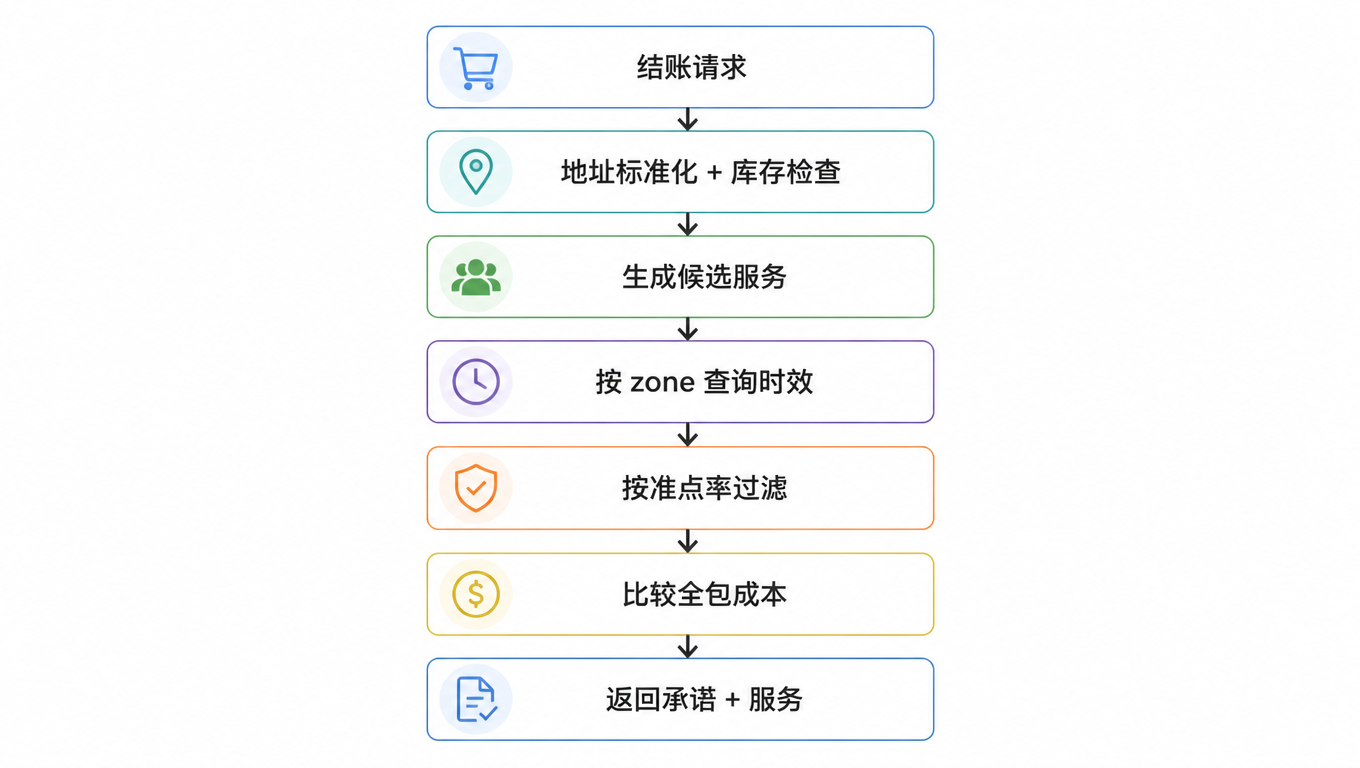
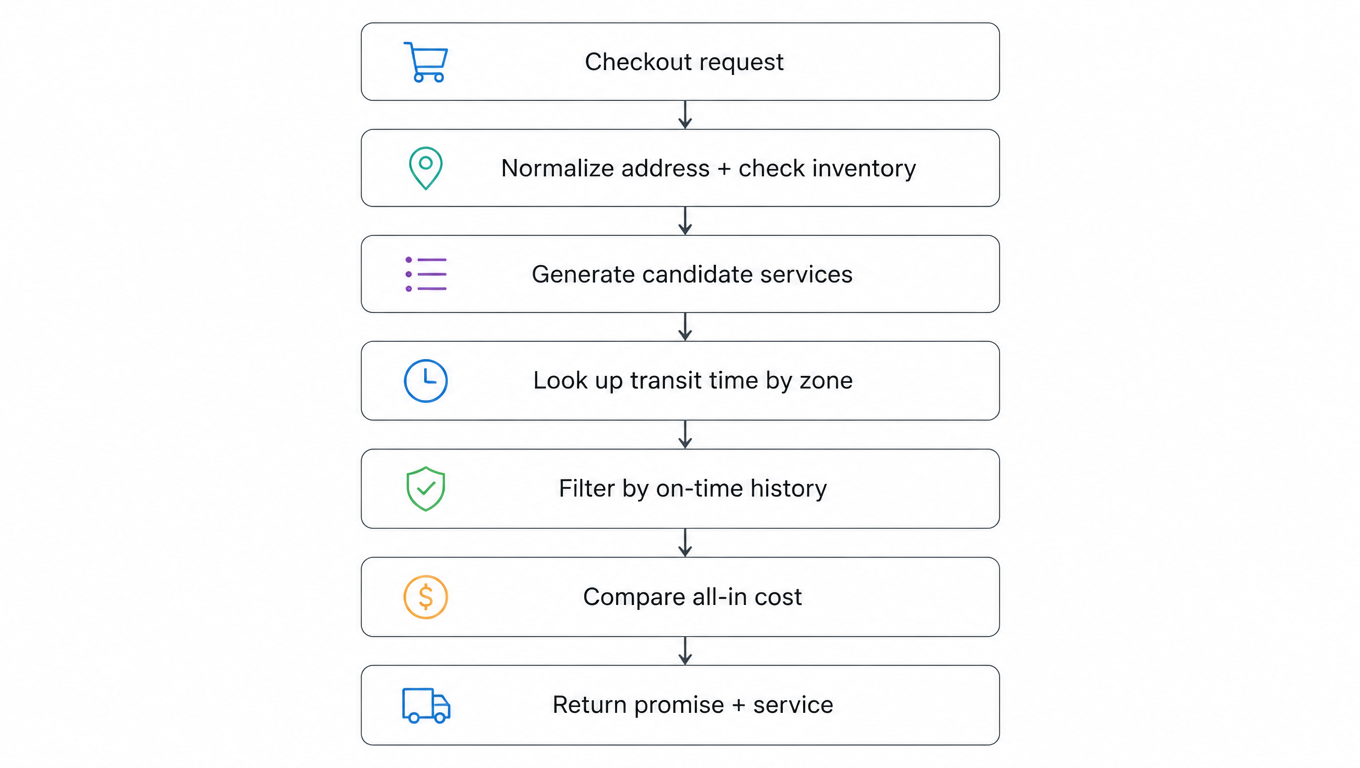
流程图:结账请求 → 地址标准化与库存检查 → 生成候选服务 → 按 zone 查询时效 → 按准点率过滤 → 比较全包成本 → 返回承诺与服务Flowchart: checkout request → normalize address and check inventory → generate candidate services → look up transit time by zone → filter by on-time history → compare all-in cost → return promise and service
管线在开始之前就装配好所有输入,所以流程看起来是线性的The flow looks linear because the inputs are assembled before the pipeline starts

流程看起来是线性的,也应该是,因为输入在管线开始之前就装配好了。截单、揽收日程和节假日日历是引擎的*输入*,不是事后修正。引擎绝不该先算出 promise、再发现揽收已经走了;截单意识属于候选生成那一步,在任何成本比较之前。The flow looks linear, and it should be, because the inputs are assembled before the pipeline starts. Cutoff, pickup schedule, and holiday calendars are inputs to the engine, not corrections applied afterward. The engine should never compute a promise and then discover the pickup already left; cutoff awareness belongs in the candidate-generation step, before any cost comparison.

结账展示与 Promise 回写Checkout Display and Promise Write-Back

结账展示是 promise 在客户面前变真的地方,它有自己的规则。日期区间(「8 月 20-22 日送达」)对冲风险,是最常见的形态。单日承诺(「8 月 21 日周四前到」)是更硬的承诺,只应在底层路径高置信时展示。徽章(「免费 3 日达」)是营销文案,必须从 OMS 算出的同一个 promise 派生,而不是硬编码在静态服务名旁边。The checkout display is where the promise becomes real to the customer, and it has its own set of rules. A date range ("arrives Aug 20-22") hedges risk and is the most common pattern. An arrives-by date ("by Thu, Aug 21") is a harder commitment and should only be shown when the underlying path is high-confidence. Badges ("Free 3-day shipping") are marketing copy and must be derived from the same promise the OMS computed, not hardcoded next to a static service name.

一致性规则没有商量余地:结账展示的 promise 和 OMS 算出的 promise 来自同一个源。同一套逻辑的两份实现必然漂移,漂移就是把 3 天徽章变成 5 天现实的东西。一个 promise 引擎、一个展示渲染器、一个事实来源。The consistency rule is non-negotiable: the promise shown at checkout and the promise computed in the OMS come from the same source. Two implementations of the same logic will drift, and drift is what turns a 3-day badge into a 5-day reality. One promise engine, one display renderer, one source of truth.

售后,闭环。面单打印时记录实际承运商服务,把它与承诺日期对比追踪 ETA。准时说明回路健康;提前说明可以收紧缓冲、省下钱;延误说明承诺破了。延误与异常时主动 re-promise:用实时追踪事件算出新 ETA,在客户开口前通知他。每一次破承诺都回流进准时率基线,而这正是第 4 步消费的数据。系统逐线路自我改进。Post-purchase, the loop closes. When the label prints, the actual carrier service is recorded, and its tracking ETA is compared against the promised date. On-time means the loop is healthy; early means you can tighten the buffer and save money; late means the promise broke. For delays and exceptions, re-promise proactively: compute the new ETA from the live tracking event and notify the customer before they ask. Every broken promise feeds back into the on-time baseline, which is exactly the data Step 4 consumes. The system improves itself, lane by lane.

动态 Promise 落地清单The Dynamic Promise Playbook

这份清单,是把上面所有东西从框架推进到生产的启动清单:The playbook is the launch checklist for taking all of this from a framework into production:

  • 给承运商绩效建立基线。拉取每条线路、每个服务过去 90 天的实际送达日期。不知道 95% 到底要花多少钱,就设不了可靠性阈值。Baseline carrier performance. Pull 90 days of delivered dates per lane, per service. You cannot set a reliability threshold until you know what 95% actually costs you.
  • 把数据备齐。分区表、包裹画像、节假日日历、标准化地址管线。垃圾地址产生垃圾 promise。Get the data ready. Zone tables, package profiles, holiday calendar, and a standardized address pipeline. Garbage addresses produce garbage promises.
  • 逐步上线。先从一个品类、一个仓库开始,那里数据最干净、爆炸半径最小。证明闭环,再铺开。Roll out gradually. Start with one category at one warehouse, where the data is cleanest and the blast radius is smallest. Prove the loop, then widen.
  • 建「承诺内准时率」看板。按承诺档位、承运商、线路拆分。这是公司里仅次于收入的最重要报表:它是你实际在兑现的承诺。Build the on-time-to-promise dashboard. Break it down by promise tier, carrier, and lane. This is the single most important report in the company after revenue: it is the promise you are actually keeping.
  • 迭代缓冲。盯住承诺与送达之间的差距。某条线路持续提前,就削掉一个缓冲日,把可靠性换成钱;掉队了,就加回去。Iterate on the buffer. Watch the gap between promised and delivered. If a lane is consistently early, shave a buffer day and convert reliability into cost. If it slips, add one back.

收尾的话:配送承诺是产品承诺,不是配送选项。客户选的不是承运商,是一个日期,而日期才是品牌为之负责的东西。动态映射它、报价时只算一次、让整个组织为它负责。把 promise 当产品对待的店铺会兑现它;把 promise 当面单对待的店铺会为它退款。The closing thought: a delivery promise is a product commitment, not a shipping option. The customer is not choosing a carrier, they are choosing a date, and the date is what your brand is on the line for. Map it dynamically, compute it once at quote time, and hold the whole organization to it. The storefront that treats the promise as a product will keep it; the storefront that treats it as a label will refund it.

常见问题FAQ

它们是结账层的承诺档位,描述客户应该感受到的时效,而不是具体的承运商服务。同一个承诺档位,会因目的分区、包裹画像和库存位置映射到不同的承运商服务:3 天的 Standard 承诺对 zone 3 客户是 Ground,对 zone 6 客户则需要 3 Day Select 或 2nd Day Air。真正的区别不是「哪个服务」,而是「这个承诺怎么才能兑现」。They are checkout-level promise tiers that describe the delivery speed the customer should feel, not specific carrier services. The same tier maps to different carrier services depending on destination zone, package profile, and inventory location: a 3-day Standard promise is Ground for a zone 3 customer but needs 3 Day Select or 2nd Day Air for zone 6. The real difference is not "which service" but "how this promise can actually be kept."
不是。目标是最低价,但约束是承诺必须能兑现:先锁定承诺日期,扣除处理时间与缓冲,再按邮编、包裹画像、可达性和历史准点率过滤,最后在幸存路径里比全包成本(面单 + 体积重 + 包装 + 异常 + 破承诺成本)。一个便宜但准点率只有 88% 的服务不是省钱,是未来的退款。No. The goal is the lowest cost, but the constraint is that the promise must be deliverable: lock the promise date, subtract handling time and buffer, filter by ZIP, package profile, serviceability, and historical on-time rate, then compare all-in cost (label + dim weight + packaging + exceptions + broken-promise cost) among the survivors. A cheap service with an 88% on-time rate is not a saving, it is a future refund.
缓冲天数不是拍脑袋定的,而是从观察数据里来:某条线路过去 90 天的实际送达分布,对比目录 SLA 的差距就是缓冲。线路稳定提前,就削缓冲换成本;持续掉队,就加缓冲保兑现。常见起步是 0 到 1 天,Standard 承诺的可靠性阈值建议 95%,次日达建议 98%。Buffer days come from observed data, not gut feel: compare each lane's actual 90-day delivery distribution against the catalog SLA, and the gap is your buffer. If a lane is consistently early, shave buffer to save cost; if it slips, add buffer to protect the promise. A common starting point is 0 to 1 day, with a 95% reliability threshold for Standard promises and 98% for next-day.
分线路决策。低量线路默认升级服务,多花钱守住承诺;高量线路默认放宽承诺,结账时展示更晚的日期、保住成本。关键区别在时机:对已经报出去的承诺再放宽,是一次客服事故;在结账之前放宽,只是文案。Decide lane by lane. On low-volume lanes, default to upgrading the service and paying more to keep the promise; on high-volume lanes, default to relaxing the promise and showing a later date at checkout. The key is timing: relaxing a promise you already quoted is a customer-service event, while relaxing it before checkout is just copy.
可以,而且不必一步到位。六步序列每一步都小到可以直接翻译成代码:一个日期、一条减法公式、两个过滤、一次成本比较、一条备用策略。建议先从一个品类、一个仓库开始,把 90 天准时率数据做出来,跑通闭环再铺开。没有 promise 引擎的店铺,费率引擎会变成事实上的决策者,默认「最便宜 Ground」,承诺悄悄死掉。Yes, and it does not have to happen all at once. Each of the six steps is small enough to translate directly into code: one date, one subtraction formula, two filters, one cost comparison, one fallback policy. Start with one category at one warehouse, build the 90-day on-time data, prove the loop, then widen. Without a promise engine, the rate engine becomes the de facto decision maker, defaults to "cheapest Ground," and the promise quietly dies.

想守住结账页上的每一个配送承诺?Want to keep every delivery promise your checkout makes?

EasyShippingX 用多承运商比价、准时率数据与统一 API,把「最低成本可兑现路径」固化到你的发货流程里,让结账承诺不再靠运气兑现。EasyShippingX bakes the lowest-cost deliverable path into your shipping flow with multi-carrier rate comparison, on-time data, and a unified API, so checkout promises stop depending on luck.

Get Rate Comparison
Get Rate Comparison