发货技术栈Shipping Stack

美国电商发货的完整技术栈The Complete US Ecommerce Shipping Stack

问任何一个普通卖家「发货是怎么回事」,你听到的答案通常很简单:订单进来,有人打一张面单,承运商取走,客户收到。四步,一个方向,结束。但这个故事描述的是一台打单机,而不是一个发货体系。一家每天通过多个渠道、多个仓库、多家承运商发出几千单的美国电商公司,靠的是更庞大的东西:一个完整的发货技术栈。Ask a typical seller how shipping works and you will hear a simple story: the order comes in, someone prints a label, a carrier picks it up, and the customer receives it. Four steps, one direction, done. That story describes a label printer, not a shipping operation. A modern US ecommerce business that fulfills thousands of orders a day across multiple channels, warehouses and carriers runs on something much bigger: a complete shipping stack.

这篇指南把整个发货体系拆成十层:订单、订单管理(OMS)、库存与仓库(WMS)、发货平台、承运商交接、追踪、派送、退货、账单对账与分析优化。每一层做什么、由谁负责、数据怎么流动,读完你就能看懂自己公司的发货体系,也知道钱和风险藏在哪。This guide breaks the entire shipping operation into ten layers: order, order management (OMS), inventory and warehouse (WMS), shipping platform, carrier handover, tracking, delivery, returns, billing and reconciliation, and analytics. Read it and you will know what each layer does, who owns it, and where the money and risk hide in your own operation.

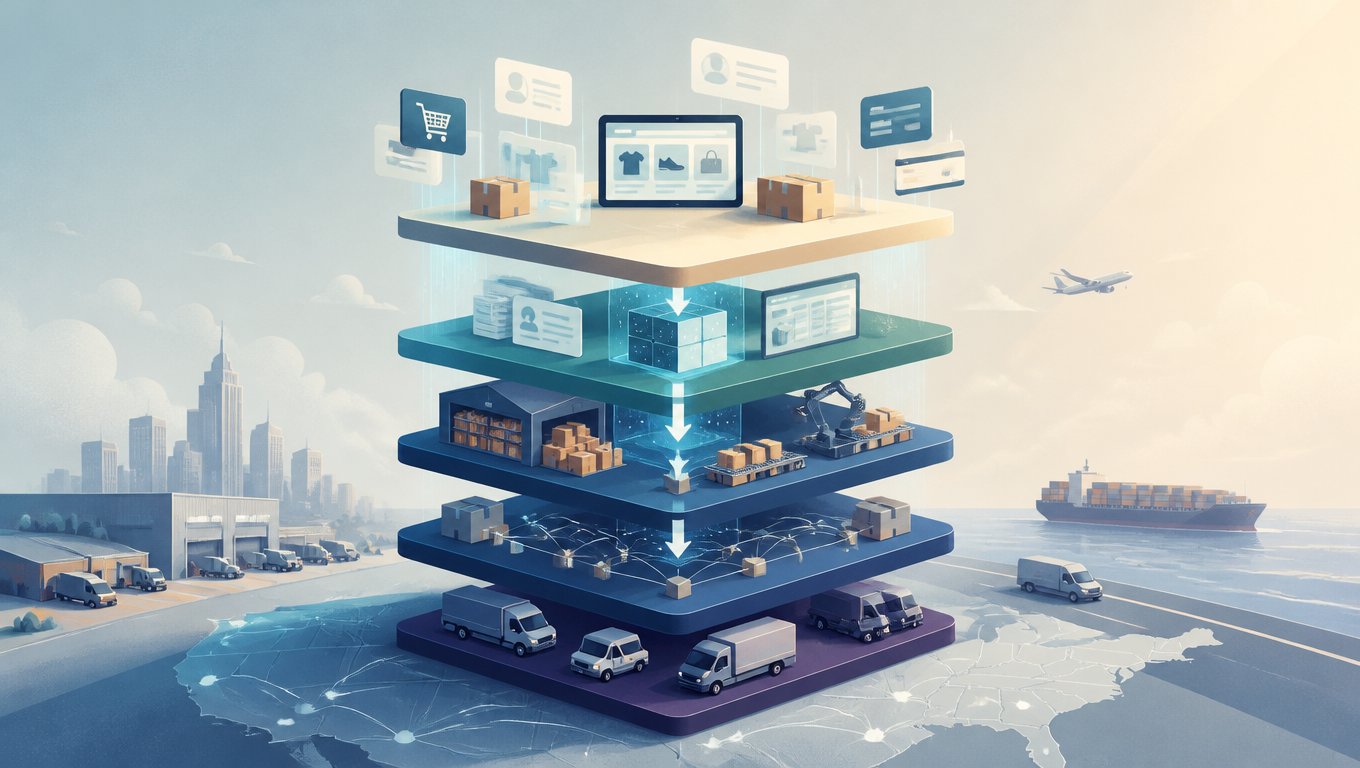
一张抽象插图:现代电商发货体系如同一座分层技术栈,订单依次流过订单管理、仓库、发货平台和承运商网络
一张订单要走过的路,比「打单发货」四个字长得多The path an order takes is far longer than "print a label and ship"

为什么这很重要:技术栈,而不是打单机Why This Matters: A Stack, Not a Label Printer

天真的心智模型看起来像一根管道:订单进去,面单出来,剩下的事交给承运商。The naive mental model looks like a single pipe. Order goes in, label comes out, the carrier does the rest.
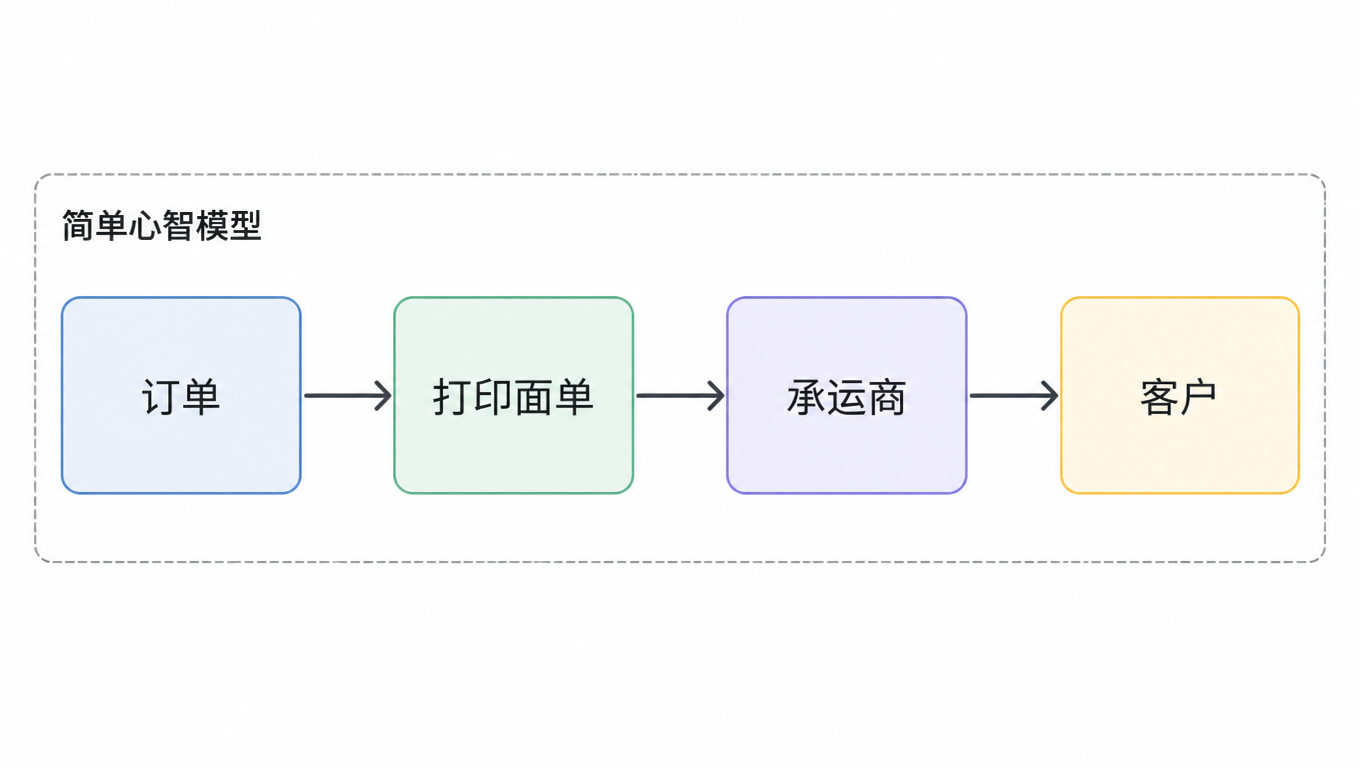
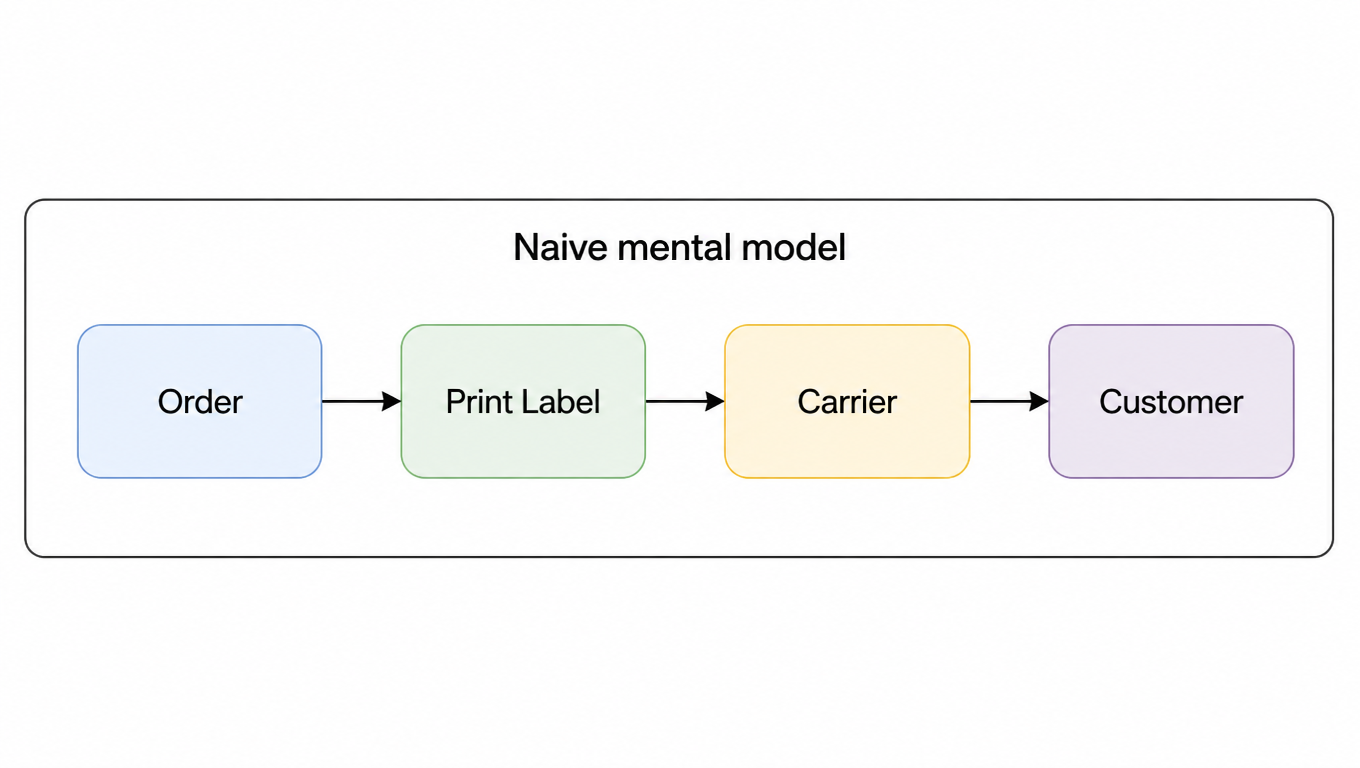
流程图:天真的心智模型,订单到打印面单到承运商到客户Flow: the naive mental model, order to print label to carrier to customer
天真的心智模型:订单 → 打印面单 → 承运商 → 客户The naive mental model: order, print label, carrier, customer

实际上,管道是个错觉。现代发货体系是一整套由系统、人、流程和数据组成的技术栈,覆盖整个订单生命周期:从产生订单的销售渠道,到告诉你哪家承运商真正帮你赚到钱的分析层。每一层都有明确的职责、持有不同的数据、由不同的决策者负责。In reality, the pipe is a lie. A modern shipping operation is a stack of systems, people, workflows and data that spans the whole order lifecycle, from the sales channel where the order is created to the analytics that tell you which carrier actually made you money. Each layer has a distinct job, holds different data, and is owned by different decision makers.

技术栈视角之所以重要,有一个很实际的原因:成本和事故往往藏在层与层之间的缝隙里。一个包裹变贵,很少是因为某张面单打错了,而是因为没人核对发票上的 DIM 附加费,或者因为路由规则悄悄把一个 3 磅的包裹交给了全国承运商,而区域承运商能便宜 40%。当你看到整座技术栈时,你才看得见钱和风险到底在哪里流动。The stack view matters for a practical reason: costs and failures hide at the seams. A package is not expensive because of one bad label; it gets expensive because nobody reconciled the DIM surcharge on the invoice, or because the routing rule quietly sent a 3-pound parcel through a national carrier when a regional one was 40% cheaper. When you can see the whole stack, you can see where the money and the risk actually move.
第 1-2 层:订单与订单管理(OMS)Layers 1-2: Order & Order Management (OMS)

每一件货都始于一张订单。在现代美国电商业务里,订单同时来自很多渠道:Shopify、Amazon、Walmart、TikTok Shop 和 eBay,还有批发、门店 POS 和直接的 B2B 订单。每张订单都携带一份不大但关键的数据载荷:客户、地址、SKU、数量和支付信息。这份载荷是下游所有层工作的原材料,所以第一步怎么采集、清洗和路由,决定了后面所有环节的天花板。Every shipment starts as an order. In a modern US ecommerce business, orders arrive from many sources at once: Shopify, Amazon, Walmart, TikTok Shop and eBay, plus wholesale, POS and direct B2B flows. Each order carries a small but critical data payload: customer, address, SKU, quantity and payment. That payload is the raw material every downstream layer works with, so how it is captured, cleaned and routed at this first step sets the ceiling for everything after it.

订单管理层(OMS)决定订单应该怎么履约。这是原始订单第一次变成结构化、可路由指令的地方。核心职责包括:The order management layer (OMS) decides how the order should be fulfilled. It is the first place where a raw order becomes a structured, routable instruction. Its core responsibilities are:

  • 拆分/合并订单。一张订单里的商品行可以从不同仓库、在不同时间发出;发往同一地址的多张订单可以合并,减少包裹数。Split/merge orders. Line items on one order can ship from different warehouses or at different times, and multiple orders to the same address can be consolidated to save on parcel count.
  • 库存预留。OMS 检查可用库存并预留单位,避免两张订单同时承诺同一个「最后一箱」。Inventory reservation. The OMS checks available stock and reserves units so two orders do not promise the same last box.
  • 仓库分配。根据库存位置、收货地址和成本,OMS 决定由哪个履约中心来拣货打包。Warehouse assignment. Based on stock location, shipping address and cost, the OMS picks which fulfillment center should pick and pack the order.
  • 履约优先级。订单不是平等的:加急件、VIP 客户、平台 SLA 期限的订单会被推到队列最前面。Fulfillment priority. Not all orders are equal: expedited orders, VIP customers and marketplace SLA deadlines get pushed to the front of the queue.

这里的决策者是商品和订单运营团队。这一层很少上头条,但一个混乱的 OMS 会污染下游的一切:错误的仓库分配造成拆单,未预留的库存造成超卖,超卖变成取消订单和愤怒的客户。The decision makers here are the merchandising and order operations teams. This layer rarely grabs headlines, but a sloppy OMS corrupts everything downstream: wrong warehouse assignments create split shipments, and unreserved inventory creates oversells that turn into cancels and angry customers.

第 3 层:库存与仓库(WMS)Layer 3: Inventory & Warehouse (WMS)

WMS 层是数字订单变成实体包裹的地方。仓库系统管理库存、拣货、打包和发货就绪状态:它知道哪个库位放哪个 SKU、哪个拣货员该走哪条路线、哪个打包台能打出一个经得起运输的箱子。The WMS layer is where the digital order becomes a physical parcel. Warehouse systems manage inventory, picking, packing and shipping readiness: they know which bin holds which SKU, which picker should walk which route, and which pack station can produce a box that survives transit.

物理上,订单走一条可预测的路径:查库位、出拣货单、在打包台称重量方、在暂存区等待承运商取货。WMS 通过实时记录库存流动让这条物理流程保持真实,让 OMS 预留的数量与实际拣出的单位对得上。Physically, the order moves through a predictable path: a location lookup, a pick list, a pack station where it is weighed and measured, and a staging area where it waits for carrier pickup. The WMS keeps that physical flow honest by tracking inventory movement in real time, so the count the OMS reserved matches the units actually picked.

这一层还产出发货平台赖以工作的数据交接:重量、尺寸、SKU、目的地和承诺的服务等级。这个交接任何一边出错,下游每个决策都建立在错误输入上。重量报少了,会在承运商的地秤上被纠正,变成一张账单调整;报多了,则为自己根本没用的运力付费。This layer also produces the data handoff the shipping platform depends on: weight, dimensions, SKU, destination and the promised service level. Get that handoff wrong, in either direction, and every downstream decision is built on bad input. An understated weight gets corrected at the carrier's scale with an invoice adjustment; an overstated one pays for capacity it never used.

第 4 层:发货平台Layer 4: The Shipping Platform

发货平台是决策层:发货选择真正在这里做出。每一件离开仓库的货都要经过这里的比价和面单生成决策,这让它成为整个技术栈最接近「大脑」的东西。核心职责:The shipping platform is the decision layer: it is where shipping choices actually get made. Every parcel that leaves the building passes through a rate shopping and label generation decision here, which makes this layer the closest thing the stack has to a brain. Its core responsibilities are:

  • 比价。针对具体的包裹、起运地和目的地,向多家承运商查询实时价格。Rate shopping. Querying live rates across carriers for the exact parcel, origin and destination.
  • 承运商选择。在成本、时效和可靠性之间做权衡,通常通过业务一次性配置好的路由规则自动完成。Carrier selection. Applying cost, transit time and reliability trade-offs, usually through routing rules the business configures once.
  • 面单生成。生成符合承运商要求的面单,含正确的服务、条码和邮资。Label generation. Producing carrier-compliant labels with the right service, barcode and postage.
  • 路由规则。自动化「哪个包裹给哪家承运商」的决策,例如:1 磅以下一律 USPS,5 磅以上比较 UPS 和 FedEx,西海岸本地路向用区域网。Routing rules. Automating the "which carrier for which package" decision, for example: under 1 lb always USPS, over 5 lb compare UPS vs FedEx, west coast regional network for local zones.
  • Manifest(汇总交接单)。把一次取件或投递的所有面单批量向承运商确认。Manifest. Batch-confirming all labels of a pickup or drop-off with the carrier.
  • DIM 体积重计算。把长宽高换算成计费重量,让轻货装大箱的包裹为占用的空间付费,而不只是为实际重量付费。DIM weight calculation. Converting length, width and height into billable weight, so a light box in a big carton pays for the space it occupies, not just its scale weight.

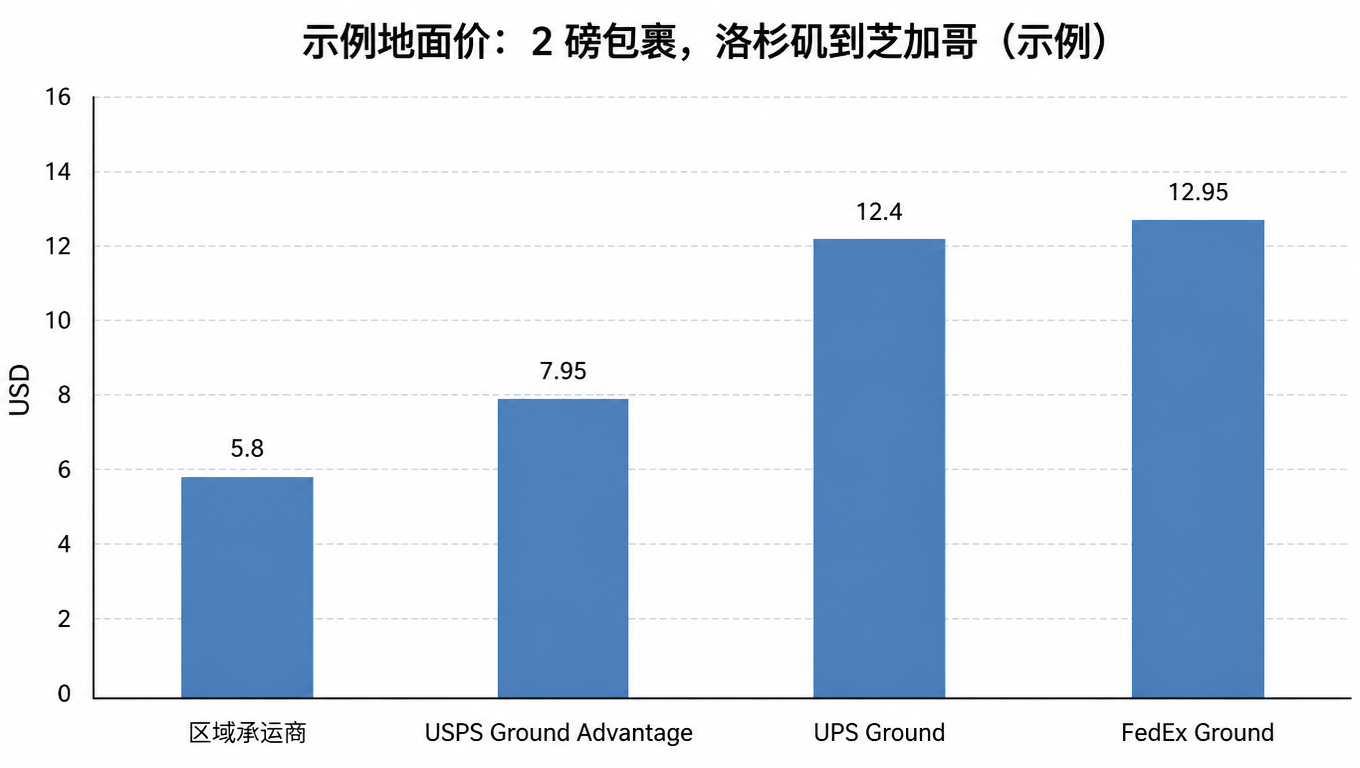
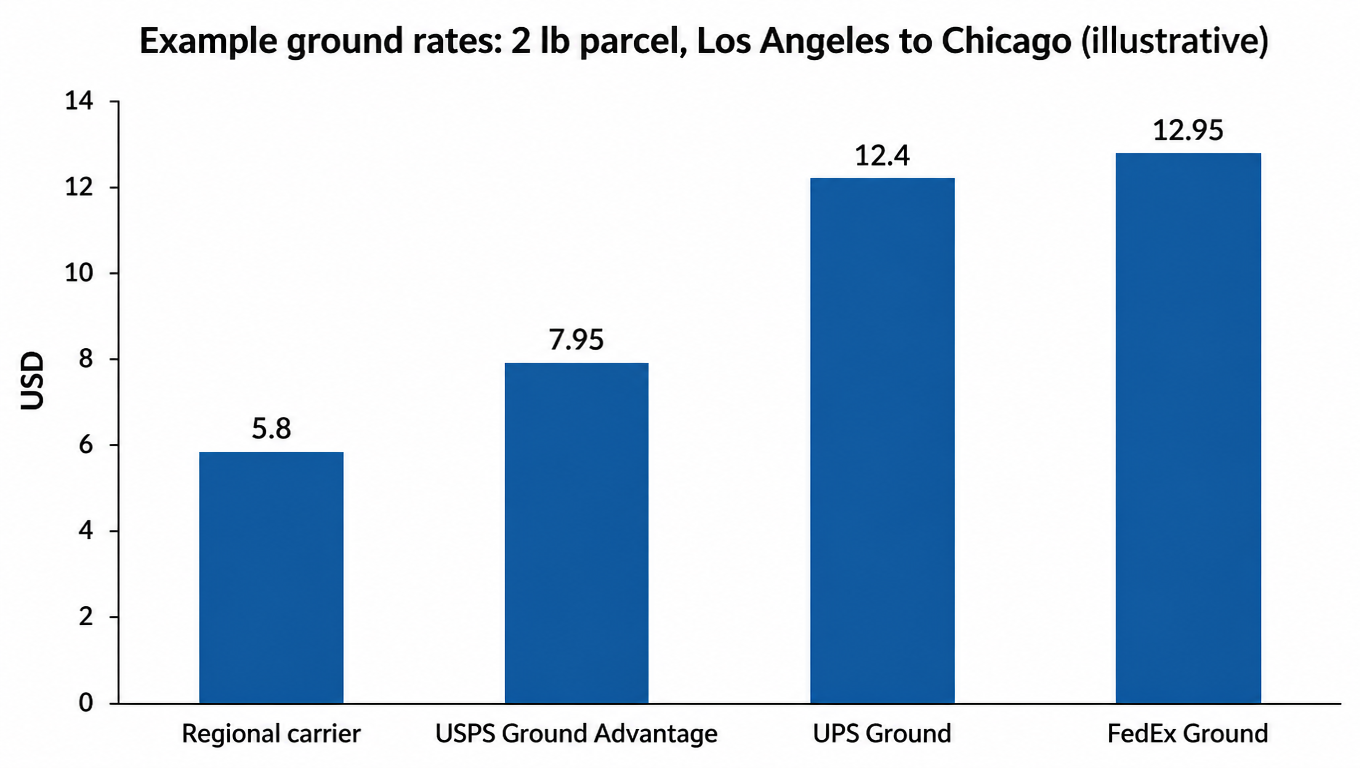
要看比价为什么重要,举个具体例子:2 磅的包裹,洛杉矶发芝加哥,地面服务。示例门市价大致是这样:区域尾程承运商约 5.80 美元,USPS Ground Advantage 约 7.95 美元,UPS Ground 约 12.40 美元,FedEx Ground 约 12.95 美元。To see why rate shopping matters, take a sample parcel: 2 pounds, Los Angeles to Chicago, ground service. Illustrative list rates look roughly like this: a regional last-mile carrier at about $5.80, USPS Ground Advantage around $7.95, UPS Ground about $12.40 and FedEx Ground around $12.95.

柱状图:2 磅包裹洛杉矶到芝加哥的示例地面价,区域承运商 5.8 美元、USPS Ground Advantage 7.95 美元、UPS Ground 12.4 美元、FedEx Ground 12.95 美元Bar chart of example ground rates for a 2 lb parcel from Los Angeles to Chicago: regional carrier 5.8, USPS Ground Advantage 7.95, UPS Ground 12.4, FedEx Ground 12.95 USD
同一个包裹,示例地面价从约 5.80 美元到 12.95 美元(示例数据)The same parcel ranges from about $5.80 to $12.95 in example ground rates (illustrative)

同一个包裹,同样的时效承诺,最便宜和最贵之间相差一倍还多。这个差距正是发货平台存在的意义:一个包裹一个包裹地把差价抓回来。这也是 DIM 体积重重要的原因:一个 2 磅的商品装进 18×12×8 英寸的箱子,按 18×12×8/139 计费,约合 12.4 磅,所以一个马虎的打包动作,就能悄悄把一票便宜货变成一票贵货。The same parcel, the same transit promise, and the range from cheapest to most expensive is more than double. That gap is exactly what the shipping platform exists to capture, package by package, and why DIM weight matters: a 2-pound item shipped in an 18 x 12 x 8 in box bills at 18 x 12 x 8 / 139, about 12.4 pounds, so a sloppy pack job can silently turn a cheap shipment into an expensive one.

这一层的产品,比如 EasyShippingX、Shippo 和 EasyPost,都从不同角度做同一件核心的事:把各家承运商 API 归一化成统一接口,套用你的业务规则,成为面单数据和成本的唯一事实来源。这也是为什么这一层夹在 WMS 和承运商之间:它是翻译层,让一个仓库不必维护十几个对接,就能和很多家承运商对话。Products in this layer, such as EasyShippingX, Shippo and EasyPost, all do the same core job from different angles: they normalize carrier APIs into one interface, apply your business rules, and become the single source of truth for label data and cost. That is why this layer sits between the WMS and the carriers: it is the translation layer that lets one warehouse talk to many carriers without maintaining a dozen integrations.

第 5 层:承运商交接Layer 5: Carrier Handover

到了承运商交接这一步,包裹离开你的控制,进入承运商网络。美国市场这张网络由两类截然不同的承运商组成。全国网络,USPS、UPS 和 FedEx,覆盖全美,价格按分区可预测,服务菜单齐全。区域和本地网络,比如 UniUni、GOFO 和 SpeedX,覆盖人口密集的走廊和特定地理区域,单件成本往往更低,因为他们的司机只跑一小块地盘。At the carrier handover, the package leaves your control and enters the carrier network. In the US market that network is a mix of two very different kinds of carriers. The national networks, USPS, UPS and FedEx, cover the whole country with predictable zone pricing and broad service menus. The regional and local networks, such as UniUni, GOFO and SpeedX, cover dense corridors and specific geographies, often at lower cost per parcel because their drivers only work a tight area.

成熟的公司把承运商当作一个组合来管理,而不是单一供应商。打法看的是分区经济学和尾程密度:全国承运商跑长途和低密度线路,区域承运商跑密度高的走廊,那里他们的单件投递成本更低、时效常常更快,具体怎么分由发货平台里的路由规则自动决定。A mature operation treats carriers as a portfolio, not a single vendor. The play is zone economics and last-mile density: national carriers take the long-haul and low-density lanes, regional carriers take the dense corridors where their cost per stop is lower and their transit is often faster, and the routing rules in the shipping platform decide the split automatically.

交接本身是关键时刻。包裹的入库扫描、取件 manifest 和承运商的服务承诺(SLA)都诞生在这条边界上。这也是责任转移的地方:一个从没被扫描过的包裹,就是你无法证明发出去过的包裹。运营团队会像鹰一样盯住这一层,因为交接是发货平台的承诺和承运商现实碰面的地方。The handover itself is a moment of truth. Package acceptance scans, pickup manifests and the carrier's service commitment (SLA) are all created at this boundary. This is also where liability passes: a parcel that was never scanned in is a parcel you cannot prove you shipped. Operations teams watch this layer like hawks, because the handover is where the shipping platform's promises meet the carrier's reality.

仓库月台交接:工人在下午的阳光下扫描面单、把包裹装上传送车
交接是责任转移的时刻:扫描、交接单和 SLA 都诞生在这条边界上The handover is where liability passes: scans, manifests and SLAs are all born at this boundary

第 6-8 层:追踪、派送与退货Layers 6-8: Tracking, Delivery & Returns

包裹进入承运商网络后,追踪事件开始流动。每一次扫描(取件、分拣、派送中、已签收)都是数据,一个成熟的技术栈会把这份数据同时同步给三类人:商家内部系统、客户的收件箱或 App,以及回答「我的包裹到哪了」的客服团队。最好的运营不只展示追踪,还监控异常,在客户开口之前主动提醒。Once the parcel is in the carrier network, tracking events start flowing. Each scan (pickup, sort, out for delivery, delivered) is data, and a good stack synchronizes that data with three audiences at once: the merchant's internal systems, the customer's inbox or app, and the customer support team that answers "where is my package?" The best operations don't just display tracking, they monitor it for exceptions and proactively alert the customer before the customer has to ask.

派送是整个技术栈为之努力的那一刻:承运商完成最后一站,生成派送确认,也就是签收凭证(POD)。POD 的意义不止于客户满意度:它是拒付、理赔和争议的证据链,也为交接时承运商承诺的 SLA 画上句号。Delivery is the moment the whole stack has been working toward: the carrier completes the final stop and generates delivery confirmation, or proof of delivery (POD). The POD matters beyond customer satisfaction: it is the evidence trail for chargebacks, claims and disputes, and it closes the loop on the SLA the carrier promised at handover.

退货是大多数技术栈最薄弱的一层,而它其实就是物流生命周期重新走一遍。一次退货会触发 RMA、退货面单、入库扫描、质检(决定重新上架、维修还是报废),以及一笔 WMS 必须入账的新库存变动。退货也会回流到分析里:某个 SKU 或某条承运商线路的高退货率是信号,不是噪音。Returns are the layer most stacks under-build, and they are simply the logistics lifecycle starting again. A return kicks off an RMA, a return label, an inbound scan, an inspection that decides restock vs repair vs dispose, and a new inventory movement that the WMS must book. Returns also flow back into analytics: a high return rate on a specific SKU or a specific carrier lane is a signal, not noise.

闭环才是技术栈和一堆工具的区别:追踪数据回流进承运商绩效评分,下个月的路由规则建立在上个月真实的准点率、破损率和异常之上,而不是建立在销售话术之上。Closing the loop is what separates a stack from a collection of tools: tracking data feeds back into carrier performance scoring, so next month's routing rules are built on last month's actual on-time percentages, damage rates and exceptions, not on sales pitches.

第 9-10 层:账单、对账与分析Layers 9-10: Billing, Reconciliation & Analytics

技术栈的顶端是钱结算清楚、运营变聪明的地方。账单与对账是最不起眼、却让承运商保持诚实的一层:每一张承运商发票都要与实际生成的面单对账,还要对掉悄悄抬高账单的调整项、DIM 争议、附加费和附加服务费。跳过这一层的企业,通常要比合同价多付 3-5%。The top of the stack is where the money gets settled and the operation gets smarter. Billing and reconciliation is the unglamorous layer that keeps carriers honest: every carrier invoice is reconciled against the labels that were actually created, and against adjustments, DIM disputes, accessorials and surcharges that quietly inflate the bill. Businesses that skip this layer routinely pay 3-5% more than their contracted rates.

再往上是分析与优化:持续改进发货成本、承运商绩效和客户体验。哪些承运商在你的线路上真的达到了 SLA?哪些 SKU 破损率最难看?按渠道、仓库和分区看,单件成本长什么样?这些问题之所以能回答,只因为下面每一层都产出了结构化数据。Above that sits analytics and optimization: continuous improvement of shipping cost, carrier performance and customer experience. Which carriers actually hit their SLA on your lanes? Which SKUs have the worst damage rate? What does cost per parcel look like by channel, warehouse and zone? These questions are only answerable because every layer below generated structured data.

这就是关键结论:现代电商发货体系不是一家承运商,也不是一个软件产品。它是一套协调运转的技术栈,每一层有不同的职责、不同的数据、不同的决策者,从拆分订单的订单运营团队,到核对发票的财务团队。真正理解整座技术栈的企业,能降低成本、提升派送表现,而最重要的是,能搭建一套订单增长时也跟着规模化的发货体系。And that is the key takeaway: a modern ecommerce shipping operation is not one carrier, and it is not one software product. It is a coordinated stack in which each layer has different responsibilities, different data and different decision makers, from the order ops team that splits orders to the finance team that reconciles invoices. Businesses that understand the entire stack reduce costs, improve delivery performance and, most importantly, build a shipping operation that scales when the orders do.

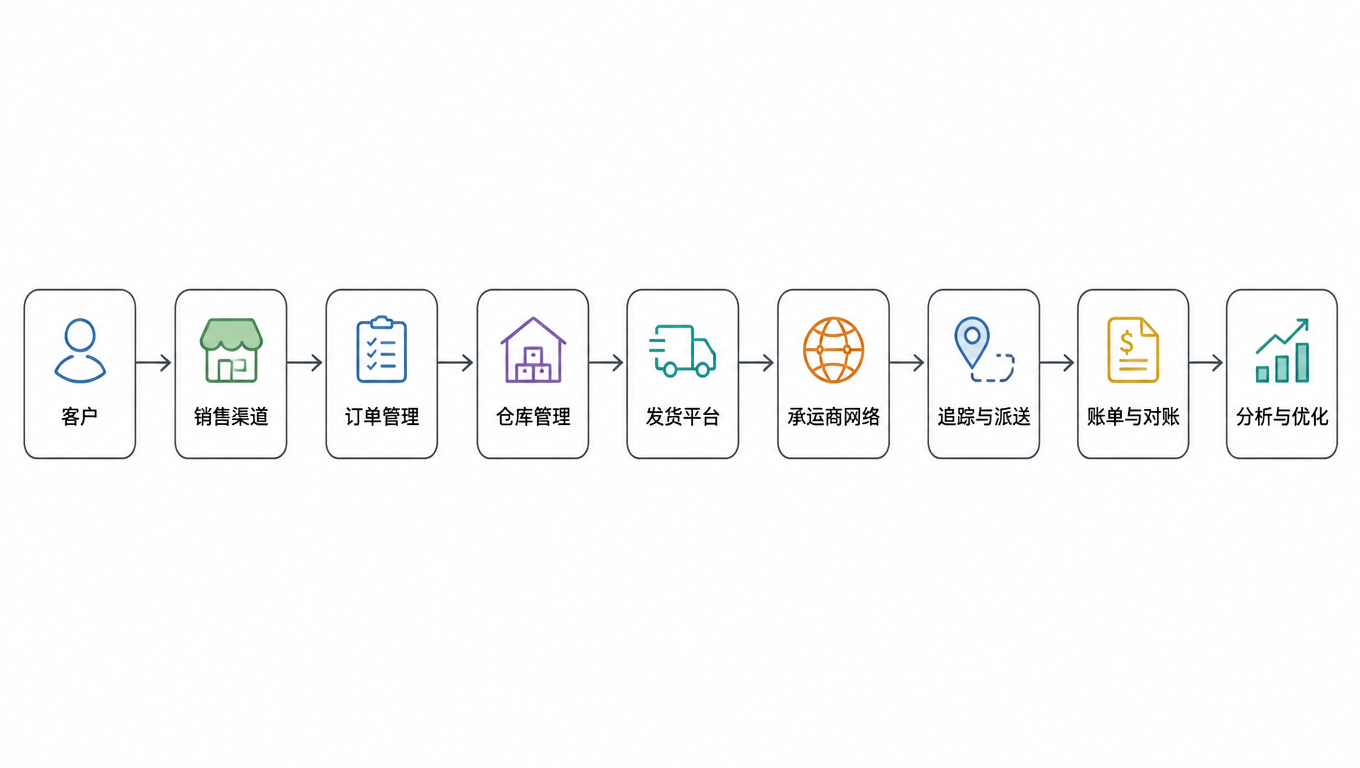
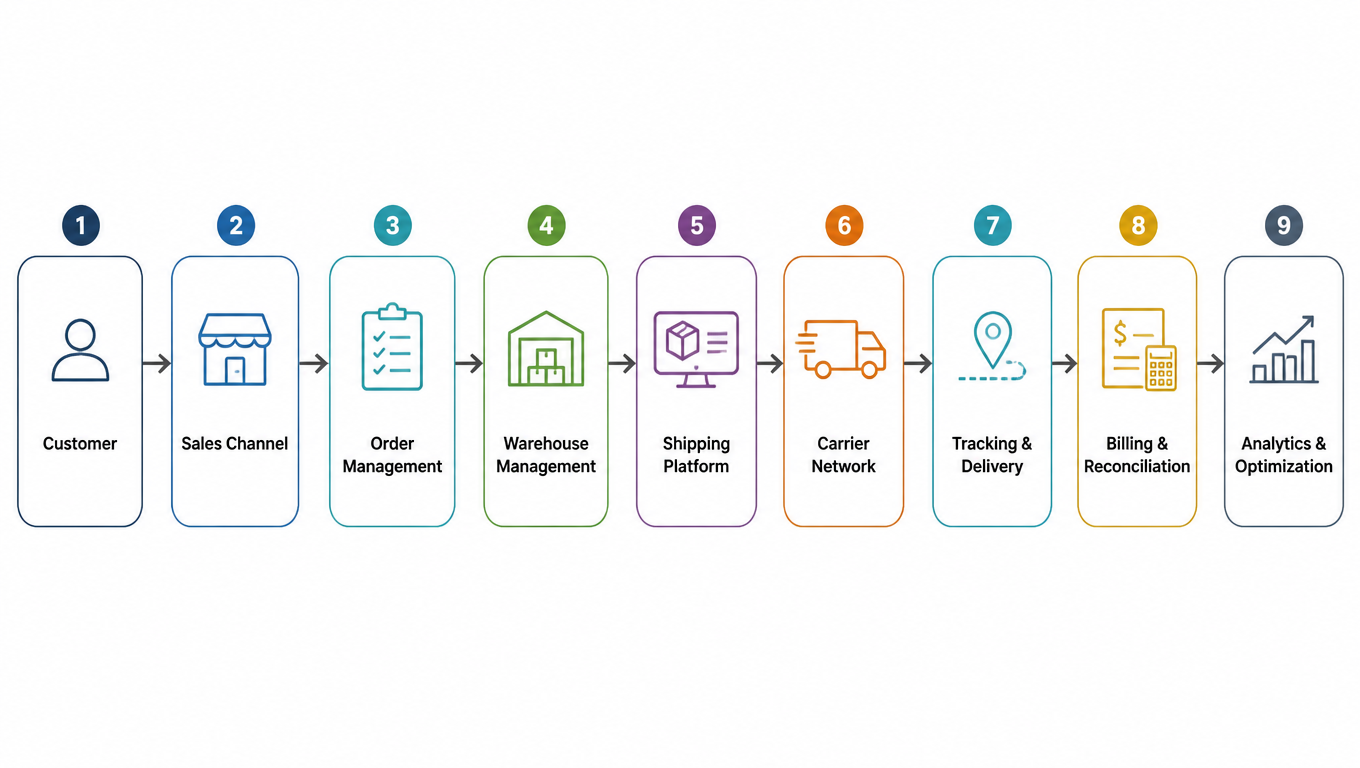
流程图:从客户、销售渠道、订单管理、仓库管理、发货平台、承运商网络、追踪与派送、账单与对账到分析与优化Flow: customer, sales channel, order management, warehouse management, shipping platform, carrier network, tracking and delivery, billing and reconciliation, analytics and optimization
端到端发货技术栈:从客户到分析与优化The end-to-end shipping stack: from customer to analytics and optimization

要点清单Key Takeaways

  • 现代电商发货体系不是一家承运商、也不是一个软件产品,而是一套协调运转的技术栈,每一层有不同职责、不同数据和不同负责人。A modern shipping operation is a coordinated stack, not one carrier or one software product; each layer has different responsibilities, different data and different owners.
  • 成本和事故藏在层与层之间的缝隙里:没人核对的 DIM 附加费、悄悄把包裹交给贵价承运商的路由规则、WMS 与发货平台之间的数据交接错误。Costs and failures hide at the seams: unreconciled DIM surcharges, routing rules that quietly send parcels to expensive carriers, and bad data handoffs between the WMS and the shipping platform.
  • 发货平台是决策层:比价、承运商选择、路由规则、Manifest 和 DIM 计算,把承运商选择从拍脑袋变成可重复的决策。The shipping platform is the decision layer: rate shopping, carrier selection, routing rules, manifests and DIM calculation turn carrier choice from guesswork into a repeatable decision.
  • 把承运商当组合管理:全国网络跑长途和低密度线路,区域网络吃高密度走廊,由路由规则自动拆分。Treat carriers as a portfolio: national networks take long-haul and low-density lanes, regional networks take dense corridors, split automatically by routing rules.
  • 追踪、POD 和退货把链路闭环:追踪数据回流进承运商评分,退货带着 RMA、质检和处置重新走一遍生命周期。Tracking, POD and returns close the loop: tracking data feeds carrier scoring, and returns restart the lifecycle with RMA, inspection and disposition.
  • 对账让承运商保持诚实(跳过它通常多付 3-5%),分析把每一层产出的结构化数据变成持续的成本与服务改进。Reconciliation keeps carriers honest (skipping it usually costs 3-5%), and analytics turns the structured data every layer produces into continuous cost and service improvement.

常见问题FAQ

发货技术栈是一整套相互协调的系统、人、流程和数据,把订单从销售渠道送到客户门口(以及必要时送回仓库):订单来源、订单管理(OMS)、库存与仓库(WMS)、发货平台、承运商交接、追踪、派送、退货、账单对账与分析优化。每一层有不同的数据、不同的决策和不同的负责人;只看单点,就看不见钱和风险在层与层之间怎么流动。A shipping stack is the coordinated set of systems, people, workflows and data that moves an order from the sales channel to the customer's doorstep and, when needed, back again: order sources, order management (OMS), inventory and warehouse (WMS), shipping platform, carrier handover, tracking, delivery, returns, billing and reconciliation, and analytics. Each layer holds different data, makes different decisions, and has different owners; looking at any single point hides how money and risk flow between the layers.
大多藏在层与层之间的缝隙里:没人核对的发票上的 DIM 体积重附加费、把 3 磅包裹悄悄交给全国承运商的路由规则、WMS 与发货平台之间报错的重量和尺寸交接,以及被跳过的对账(不做对账的企业通常比合同价多付 3% 到 5%)。这也是为什么「看得到整座栈」本身就值钱。Mostly at the seams between layers: DIM surcharges on invoices nobody reconciles, routing rules that quietly send a 3-pound parcel through a national carrier, wrong weight and dimension handoffs between the WMS and the shipping platform, and skipped reconciliation (businesses that skip it typically pay 3-5% more than their contracted rates). That is why seeing the whole stack is itself worth money.
不是所有线路都适合。区域承运商(如 UniUni、GOFO、SpeedX)在高密度走廊上单件成本更低、时效常常更快;全国承运商(USPS、UPS、FedEx)在长途和低密度线路上更有优势。成熟的做法是把承运商当组合管理,让发货平台里的路由规则按包裹逐票决定分给谁。Not on every lane. Regional carriers such as UniUni, GOFO and SpeedX win on dense corridors where their cost per stop is lower and transit is often faster; national networks such as USPS, UPS and FedEx win on long-haul and low-density lanes. A mature operation treats carriers as a portfolio and lets the shipping platform's routing rules decide the split parcel by parcel.
有,因为没有一家承运商在每条线路、每个重量段都是最便宜的。本文的例子:2 磅包裹洛杉矶到芝加哥,示例地面价从区域承运商的约 5.80 美元到 FedEx Ground 的约 12.95 美元,最便宜和最贵相差一倍多。比价的意义就是一件包裹一件包裹地抓回这个差价。Yes, because no single carrier is cheapest on every lane and weight. In this guide's example, a 2-pound parcel from Los Angeles to Chicago ranges from about $5.80 with a regional carrier to about $12.95 with FedEx Ground, more than double. Rate shopping exists to capture that gap, package by package.
从数据最干净、决策最可重复的地方开始:先把订单和库存收进同一套系统(OMS/WMS),再把发货平台放在中间,统一各承运商 API、套用路由规则,成为面单数据和成本的唯一事实来源;追踪、退货和对账等货量增长后再逐层补上。Start where the data is cleanest and the decisions most repeatable: get orders and inventory into one place (OMS/WMS), then put a shipping platform in the middle to normalize carrier APIs, apply routing rules, and become the single source of truth for label data and cost; add tracking, returns and reconciliation as volume justifies each layer.
Get Rate Comparison
Get Rate Comparison