3PL 指南3PL Guide

3PL 多承运商发货:一家承运商不够用的时候Multi-Carrier Shipping for 3PLs: When One Carrier Is No Longer Enough

在 3PL 里,只用一家承运商是最舒服的配置。一个集成、一张账单、一套理赔流程、一条客服线。团队把一套系统用到烂熟,货量折扣每季度都在加深。感觉像一台运转顺畅的机器。实际上,这是把整个网络押在同一个赌注上。Relying on a single carrier is the most comfortable setup in 3PL. One integration, one invoice, one claims process, one support line. The team knows one portal cold, and volume discounts deepen every quarter. It feels like a well-oiled machine. It is actually a single bet with your entire network riding on it.

对 3PL 来说,承运商依赖首先是风险管理问题,然后才是成本问题。折扣是真实、可量化的;风险则是延迟显现、复利累积的。这篇文章讲清楚单一承运商依赖会在三个方面拖垮一家 3PL:费率上涨与附加费侵蚀、旺季瘫痪、政策与劳资冲击;然后说明这些风险如何成倍传导给你的客户,给你一套诊断自身依赖度的框架,并勾勒出修复它的多承运商运营模型。For a 3PL, carrier dependence is a risk-management problem before it is a cost problem. The discounts are real and measurable; the risks are deferred and compound. This article walks through the three ways single-carrier dependence breaks a 3PL: rate hikes and surcharge creep, peak-season paralysis, and policy or labor shocks. It then shows how those risks multiply through to your customers, gives you a framework for diagnosing your own dependence, and sketches the multi-carrier operating model that fixes it.

A busy 3PL distribution hub at dusk with parcel vans from several different carriers lined up at the loading docks, warm warehouse lights glowing
黄昏时分,多品牌货车在 3PL 枢纽装卸,多承运商是常态而不是例外Parcel vans from several carriers at a 3PL hub at dusk: multi-carrier is the norm, not the exception

一、为什么一家承运商让人如此舒服1. Why One Carrier Feels So Comfortable

这种舒服不是错觉。把货量集中到一家承运商,换来的是最深的费率层级、一张周账单、一个要维护的关系。员工只需精通一个后台、一套异常流程、一种揽收节奏。异常更少,因为整个运营都调优到一套规则上。对小 3PL 来说,这份简单值真金白银。The comfort is not imaginary. Consolidating volume with one carrier buys the deepest rate tier, a single weekly invoice, and one relationship to manage. Your staff master one portal, one exception process, one pickup cadence. Exceptions are rarer because the operation is tuned to a single set of rules. For a small 3PL, that simplicity is worth real money.

问题在于,这些好处每一种都是一种被提前关闭的选择权。折扣越深,货量越集中。运营越顺,团队对其他承运商的规则、标签和理赔流程越生疏。舒服在悄悄累积,每个季度都让退出变得更贵。你不是在优化运营,你是在积累依赖,然后管它叫效率。The problem is that every one of those benefits is a form of foreclosed optionality. The deeper the discount, the more volume is concentrated. The smoother the operation, the less experience your team has with any other carrier's rules, labels, and claim processes. The comfort compounds quietly, and each quarter makes the exit more expensive. You are not optimizing operations; you are building a dependence and calling it efficiency.
二、风险一:费率上涨与附加费侵蚀2. Risk 1: Rate Hikes and Surcharge Creep

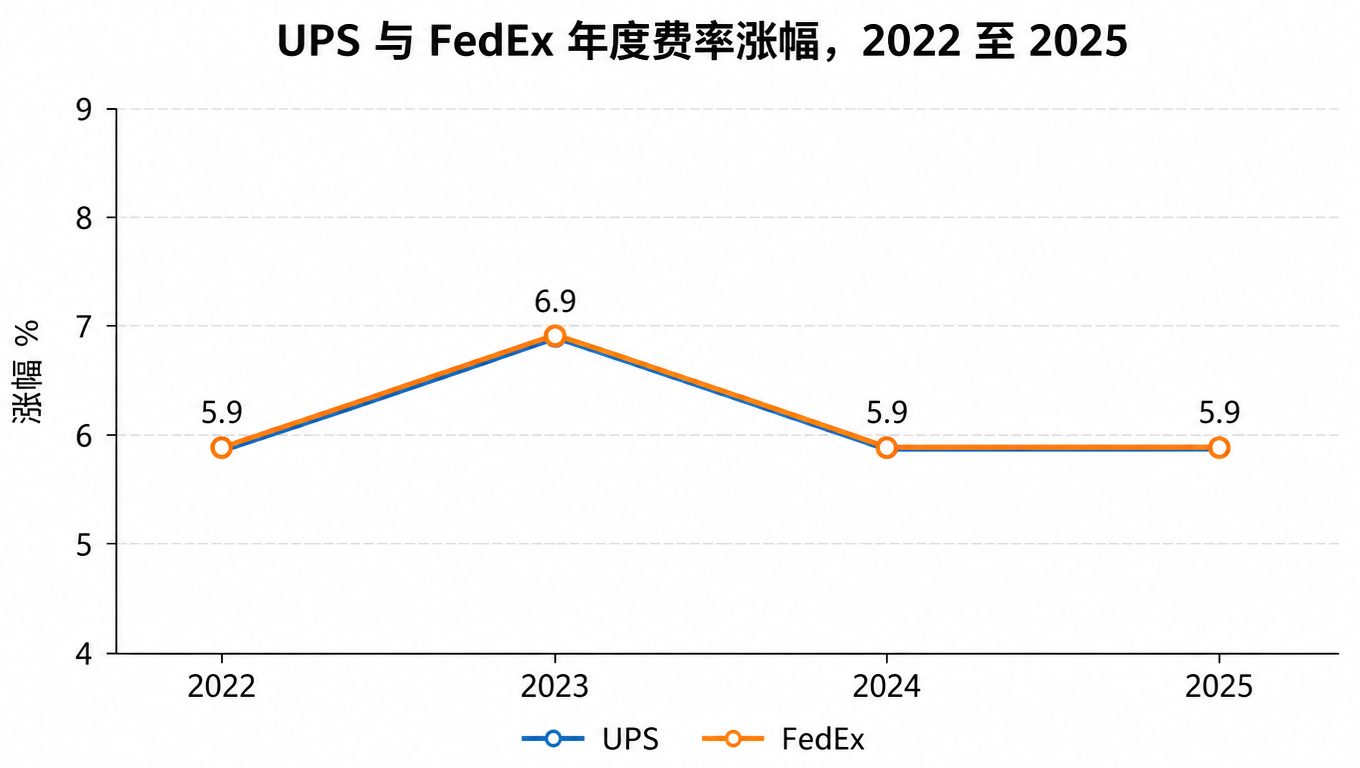
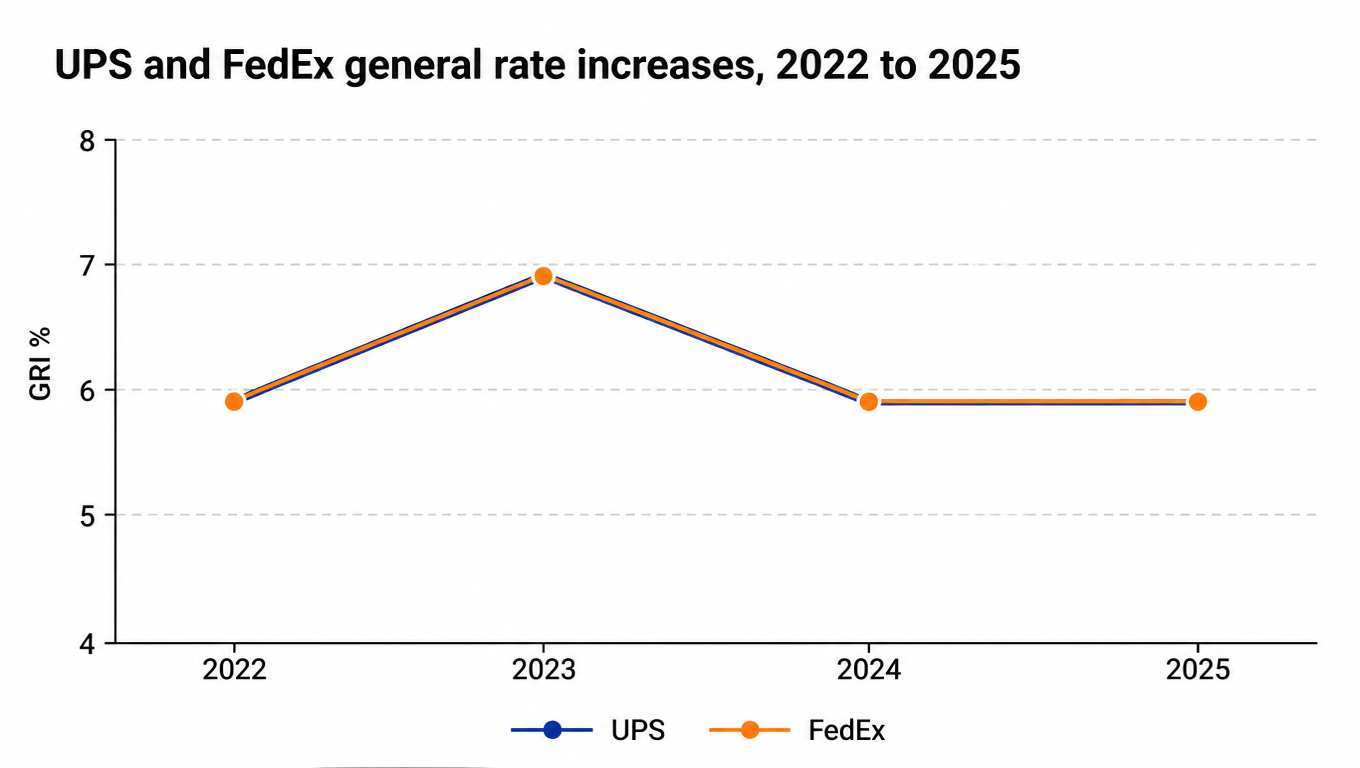
第一个风险最可预测,也最腐蚀利润。每年一月,全国性承运商都会上调基础费率。UPS 和 FedEx 在 2022 年都把费率上调了 5.9%,2023 年 6.9%,2024 和 2025 年又是 5.9%。注意这句话里缺了什么:两家之间没有任何实质差别。双头垄断步调一致地重新定价,所以同时用两家全国性承运商,对这个风险毫无分散作用。The first risk is the most predictable, and the most corrosive. Every January, the national carriers raise base rates. UPS and FedEx both raised general rate increases of 5.9% for 2022, 6.9% for 2023, then 5.9% again for 2024 and 2025. Note what is missing from that sentence: any meaningful difference between the two. The duopoly reprices in lockstep, so holding two national carriers does not diversify this risk at all.

折线图:2022 至 2025 年 UPS 与 FedEx 年度费率涨幅(%)Line chart: UPS and FedEx general rate increases 2022 to 2025 (percent)
2022 至 2025 年 UPS 与 FedEx 的 GRI 步调一致,双头垄断并不会分散涨价风险UPS and FedEx GRI moved in lockstep from 2022 to 2025; the duopoly does not diversify rate risk

年度涨幅之上还有旺季附加费:只在规定旺季窗口内收取的每件费用,按货量层级从几美分到几美元不等。再往下是各种附加费:体积重重新计价、地址更正、住宅派送、燃油。每一项都不大,但叠在一起,累积速度比你的客户合同重新定价还快。On top of the annual increase come peak surcharges: per-package fees applied only during defined peak windows, ranging from fractions of a dollar to several dollars per package depending on volume tier. Then come the accessorials: dimensional weight repricing, address correction, residential delivery, fuel. Each is small; together they compound faster than your client contracts reprice.

这就是挤压:承运商成本在 1 月 1 日上调,客户报价要等合同到期才能动,中间剩下的才是利润。单一承运商的 3PL 对这些毫无还手之力,因为没有可信的替代方案可以威胁。承运商很清楚这一点,定价也反映了这一点。That is the squeeze: your carrier cost moves up on January 1, your client pricing moves when contracts expire, and margin is whatever is left in between. A 3PL running on a single carrier cannot push back on any of it, because there is no credible alternative to threaten. The carrier knows it, and the pricing reflects it.

三、风险二:旺季瘫痪3. Risk 2: Peak-Season Paralysis

旺季是单一承运商依赖从定价问题变成运营问题的时刻。2020 年旺季是典型案例。USPS 在 2020 年 4 月暂停了派送时效保证,到 12 月 UPS 开始限制货量,并暂时停止从 Nike、Gap、Macy's 等大零售商揽收,以保护自身网络。没有第二条路的发货商,就是走不掉自己的货。Peak season is when single-carrier dependence stops being a pricing problem and becomes an operational one. The 2020 peak is the canonical case. USPS suspended its delivery service guarantees in April 2020, and by December UPS was capping volume and temporarily pausing pickups from major retailers like Nike, Gap, and Macy's to protect its network. Shippers who had no second path simply could not move their volume.

网络一限流,3PL 独自吞下后果。包裹堆在月台,发车窗口一再错过,SLA 违约越积越多,客户的怒火电话打到你的运营经理头上,而不是承运商那里。承运商的时效保证早已暂停,没有赔偿额度可索赔。失败的代价 100% 由你承担。When the network throttles, the 3PL absorbs the failure. Packages sit at the dock, dispatch windows slip, SLA breaches pile up, and the client's angry phone call lands on your operations manager, not on the carrier. The carrier's service guarantee was already suspended, so there is no credit to claim. The cost of the failure is 100% yours.

旺季才是对你业务的真正考验,也正是单一承运商 3PL 考砸的时刻。与此同时,风险一的附加费还在运营痛苦之上层层加码。你付着溢价,买来的是被限流的待遇。Peak is the moment your business is actually tested, and it is the moment single-carrier 3PLs fail the test. Meanwhile the surcharges from Risk 1 are stacking on top of the operational pain. You are paying a premium for the privilege of being throttled.

四、风险三:政策与劳资冲击4. Risk 3: Policy and Labor Shocks

第三个风险是无法提前安排的那类。2023 年,UPS 与国际卡车司机兄弟会(Teamsters)的谈判涉及 34 万名工人,罢工截止日是 8 月 1 日;双方在截止前几天,也就是 7 月 25 日达成临时协议,勉强避免了一场原本会成为美国历史上最大规模的单一雇主罢工。此前的数周,每个有 UPS 货量的发货商都在制定应急预案,争抢溢出货量的承运商趁恐慌抬价。The third risk is the one nobody can schedule around. In 2023, the UPS-Teamsters negotiations covered 340,000 workers with a strike deadline of August 1; a tentative deal was reached only days earlier, on July 25, narrowly averting what would have been the largest single-employer strike in US history. For the weeks before that, every shipper with UPS volume was building contingency plans, and carriers competing for overflow raised rates into the panic.

USPS 本身就是一类政策风险源。Delivering for America 十年计划推动了一轮又一轮的费率上调与网络合理化,在品类之间迁移包裹货量,并关闭处理设施。而在边境上,关税变化和 de minimis 小额免税门槛的调整,可以在一个晚上重新给整条线路定价,而当你只接一家承运商时,根本没有替代路由。USPS is its own source of policy risk. The Delivering for America plan has driven repeated rate increases and network rationalization, shifting package volume between classes and closing processing facilities. And at the border, tariff changes and de minimis threshold shifts can reprice an entire lane overnight, with no alternate routing when you are wired to one carrier.

这些事件有一个共同属性:本质上不可预测,这正是它们无法在单一承运商合同内管理的原因。你没法靠谈判躲过一场你没预见到的罢工。唯一的对冲是组合:一家在冲击到来之前就已经完成集成、经过测试、并有真实货量支撑的第二承运商。These events share one property: they are unpredictable by nature, which is precisely why they cannot be managed inside a single-carrier contract. You cannot negotiate your way out of a strike you did not see coming. The only hedge is a portfolio, a second carrier that is already integrated, tested, and funded with volume before the shock arrives.

五、客户放大器:你的风险变成他们的风险5. The Customer Multiplier: When Your Risk Becomes Their Risk

卖家搭在你选的承运商上。当你唯一的承运商出问题,你的停摆就是他们的停摆,再往下就是他们客户的停摆。一次延迟派送会快速连锁:退款申请、拒付、差评、平台绩效处罚;对给零售渠道供货的卖家,还有零售商按天卡派送窗口的 OTIF 罚款。Sellers ride on your carrier choices. When your one carrier stumbles, your outage becomes their outage, and theirs becomes their customers'. A delayed delivery cascades fast: refund requests, chargebacks, negative reviews, marketplace performance penalties, and for sellers shipping into retail, OTIF fines from retailers that enforce delivery windows to the day.

单一承运商依赖对卖家是不可见的,直到它变成他们的问题。他们看不到你的货量集中度、你的旺季附加费、你续约时的议价杠杆。他们只看到 12 月停住不动的跟踪号,或者季中突然重新报价的合同。这时你的客户就危险了,而这偏偏是你最输不起的季度里最输不起的客户。Single-carrier dependence is invisible to the seller until it is their problem. They cannot see your concentration, your peak surcharges, or your renewal leverage. They only see the tracking number that stops moving in December, or the contract repriced mid-season. That is when the account is at risk, and it is the account you least want to lose in the quarter you can least afford it.

这正是为什么 3PL 层面的分散,就是卖家层面的去风险。你每接入一家承运商,就多一种可以在客户听说之前就绕开的故障模式。你的选择权,就是他们的服务水平。This is why diversification at the 3PL level is de-risking at the seller level. Every carrier you add to your network is a failure mode you can route around before your client ever hears about it. Your optionality is their service level.

六、承运商依赖度诊断框架6. A Framework for Diagnosing Carrier Dependency

动手搭建之前,先用四个维度诊断你的依赖度。第一,货量集中度:单一承运商占你总货量的多少,头部线路又占多少。第二,旺季弹性:你的网络能否承受 2 倍峰值日而不掉服务,还是运力恰好在你最需要的时候被限?第三,SLA 历史:过去 12 个月里,承运商在你的线路上有多少次没达到它自己公布的服务标准。第四,议价杠杆:续约时如果你转身就走会怎样,承运商知不知道你走得了。Diagnose your dependence with four dimensions before you build anything. First, volume concentration: what share of your total volume sits on one carrier, and on the top lane specifically. Second, peak elasticity: can your network absorb a 2x peak day without service degradation, or is capacity capped exactly when you need it? Third, SLA history: how many times in the last 12 months did the carrier miss its own published service standard on your lanes. Fourth, negotiation leverage: what happens at renewal if you walk away, and does the carrier know it.

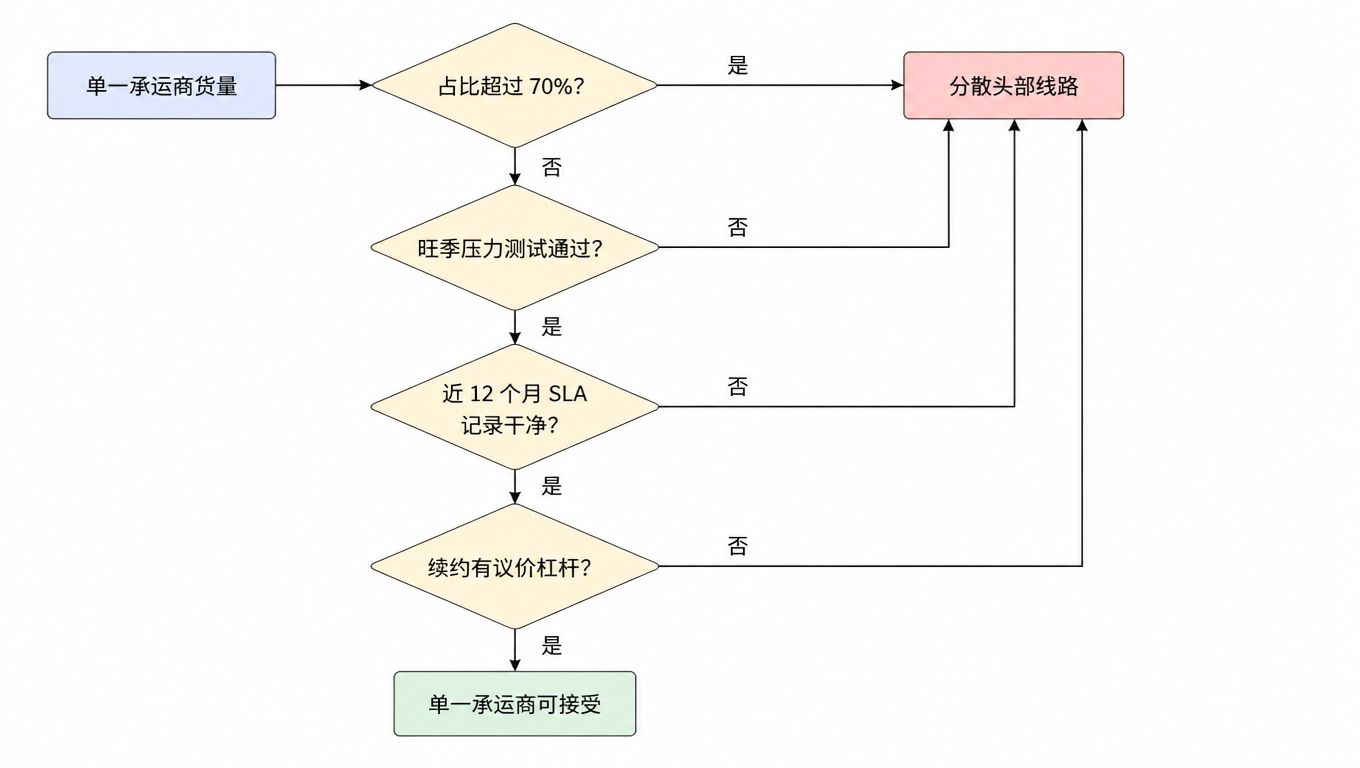
阈值是实操的,不是理论的。如果一家承运商承载了你超过 70% 的货量,你就是集中的。如果旺季压力测试不过,无论集中度多少你都是脆弱的。如果 SLA 历史干净,你的集中度是一张折扣;如果不干净,你的集中度就是一笔贴着折扣的负债。The thresholds are practical, not theoretical. If one carrier carries more than 70% of your volume, you are concentrated. If your peak stress test fails, you are fragile regardless of your concentration ratio. If your SLA history is clean, your concentration is a discount; if it is not, your concentration is a liability with a discount attached.

承运商依赖诊断流程图:货量占比、旺季压力测试、SLA 历史、续约杠杆Carrier dependency diagnosis flowchart: volume share, peak stress test, SLA history, renewal leverage
依赖度诊断:70% 集中度、旺季压力测试、SLA 历史、续约杠杆,四项逐层判断Dependency diagnosis: concentration above 70%, peak stress test, SLA history, and renewal leverage, checked in sequence

框架的落点是一个经过权衡的答案:有些线路确实不需要第二家承运商。一条货量低、波动小的线路,交给 SLA 记录干净的承运商,单一承运商完全没问题。目标不是为了分散而分散,而是找出依赖有危险的线路,先修这些。The framework ends with a deliberate answer: some lanes genuinely do not need a second carrier. A low-volume, low-variance lane on a carrier with a clean SLA record is fine single-carrier. The goal is not diversification for its own sake. It is finding the lanes where dependence is dangerous, and fixing those first.

七、搭建多承运商运营模型7. Building the Multi-Carrier Operating Model

多承运商运营不是各凭本事的大乱斗。它是分层结构:每条线路上一家主承运商作为默认,一家经过测试的次级承运商用于比价和比运力,还有一个你定期演练、永远不会生疏的备用承运商。只存在于纸上的备用不是备用,那是一份文件。A multi-carrier operation is not a free-for-all. It is a tiered structure: a primary carrier as the default on each lane, a tested secondary for rate and capacity competition, and a backup that you exercise regularly enough that it is never untested. The backup that only exists on paper is not a backup; it is a document.

路由规则必须可执行,而不是停留在愿望。成本优先的规则把每个包裹发给满足时效要求的最便宜承运商。时效优先的规则保护那些晚到比快送更贵的优质线路。恢复优先的规则在承运商网络劣化时自动触发,在 SLA 违约之前把货量转走。规则必须写进系统,而不是存在某个人脑子里,因为它们只在最关键的时刻起作用,而那一刻,懂规则的人往往正站在堆满包裹的月台另一头。Routing rules need to be executable, not aspirational. Cost-first rules send each package to the cheapest carrier that meets the service requirement. Speed-first rules protect the premium lanes where late delivery costs more than fast shipping. Recovery-first rules kick in automatically when a carrier's network degrades, diverting volume before SLAs breach. The rules have to be in the system, not in someone's head, because they only matter at the moment when the person who knows them is on the other end of a dock full of packages.

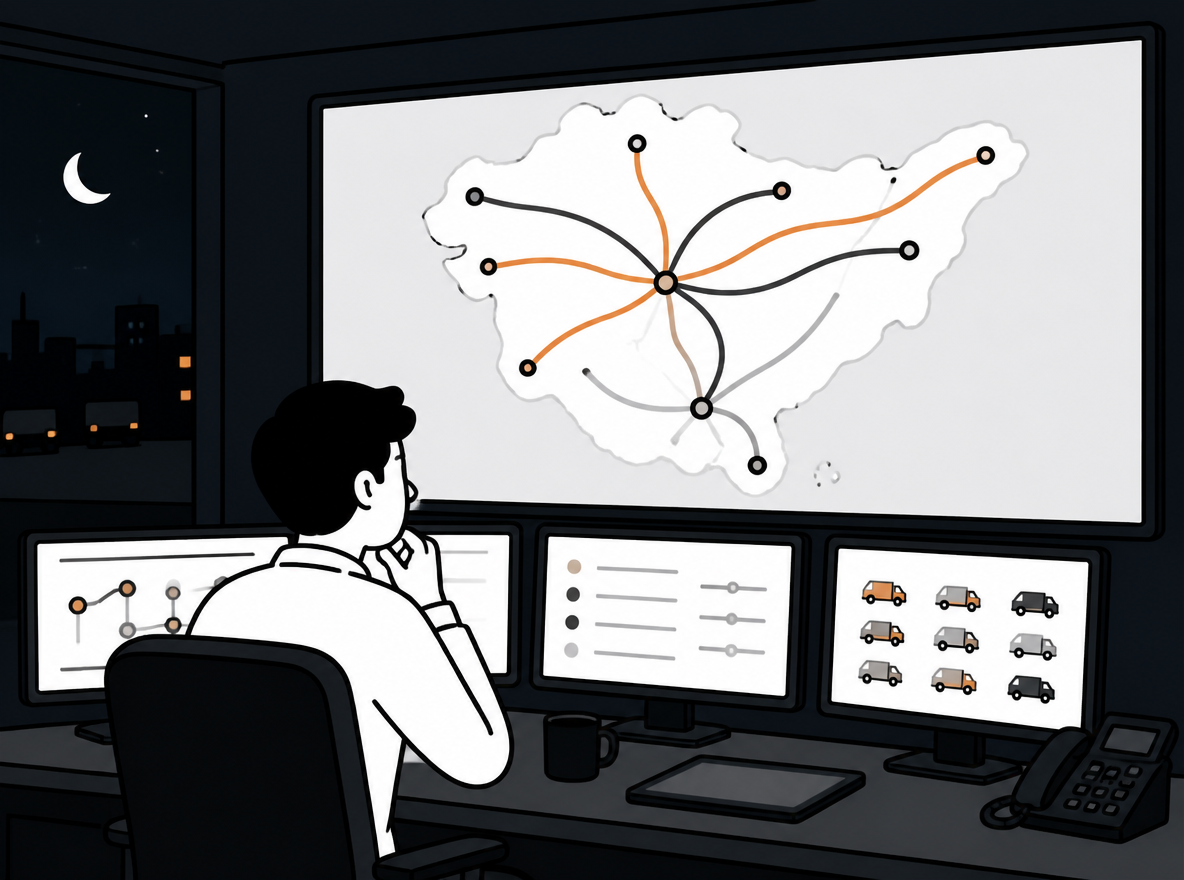
A logistics control room at night, an operator studying a large wall screen showing colored route lines converging on a map of the country
多承运商运营需要一套能实时看到所有线路的控制台Multi-carrier operations need a console that shows every lane in real time

这个模型的真实成本是集成复杂度:跨多家承运商的标签、费率、跟踪和理赔,各有各的格式和故障模式。大多数 3PL 留在单一承运商,实际上是在用脚投票反对这份复杂度。务实的答案是从小处开始:先分散货量最大的头部线路,第二步接入一家经过测试的承运商承接旺季溢出,让集成先证明自己,再铺到每一条线路。选择权是一条线路一条线路建起来的,不是一次到位。The real cost of this model is integration complexity: labels, rates, tracking, and claims across multiple carriers, each with different formats and failure modes. That complexity is what most 3PLs are actually choosing against when they stay single-carrier. The pragmatic answer is to start small: diversify the top volume lane first, add a tested carrier for peak-season overflow second, and let the integration prove itself before it touches every lane. Optionality is built lane by lane, not all at once.

八、结论:从一家承运商到一个承运商组合8. Conclusion: From One Carrier to a Carrier Portfolio

真正重要的是目标的重构。多承运商发货不是每个季度换一遍承运商去省几分钱,而是持有一个组合:一个用表现挣来你货量的稳定主力,一个让主力不敢懈怠的次级,一个在出事那天随时可用的备用。关键是选择权,而选择权的价值在它被行使的时刻兑现,那些时刻稀少且昂贵。The reframe that matters is the goal. Multi-carrier shipping is not about churning carriers every quarter to shave a few cents. It is about holding a portfolio: a stable primary that earns your volume through performance, a secondary that keeps the primary honest, and a backup that is ready the day something breaks. The point is optionality, and optionality is priced in the moments it is exercised, which are rare and expensive.

分散不是免费的。它要付出集成投入、货量分流,以及最深折扣的终结。但单一承运商的风险在显形之前完全不被计价,而一旦显形,它按旺季费率结算:丢客户、违约罚款、一个发不出货的季度。每个 3PL 都应该在每年一月,在 GRI 落地、旺季窗口打开之前问自己一个问题:如果我的唯一承运商明天停止运送我的包裹,我的网络会怎样?Diversification is not free. It costs integration effort, split volume, and the end of the deepest discount. But single-carrier risk is not priced at all until it materializes, and when it does, it bills at peak rates: lost accounts, breach penalties, and a season you cannot ship. Every 3PL should ask itself one question each January, before the GRI lands and the peak window opens: if my one carrier stops moving my packages tomorrow, what happens to my network?

一家在唯一承运商掉链子时就发不出货的 3PL,其实不是真正的 3PL。它只是单一承运商运力的转售商,扛着承运商的所有风险,却没有承运商的任何议价能力。A 3PL that cannot ship when its one carrier stumbles is not really a 3PL. It is a reseller of one carrier's capacity, with all the risk of the carrier and none of the leverage.

常见问题FAQ

当一家承运商承载你超过 70% 的货量、旺季压力测试不过、承运商在你线路上的 SLA 历史不干净,或续约时毫无议价杠杆。接入第二家承运商最便宜的时机是在你需要它之前:趁主力承运商还在正常表现时完成集成、测试,并给它真实货量。When one carrier carries more than 70% of your volume, when your peak stress test fails, when the carrier's SLA history on your lanes is not clean, or when you have no leverage at renewal. The cheapest time to add a second carrier is before you need it: integrate, test, and fund it with volume while your primary is still performing.
两家承运商在 2022 年都把基础费率上调 5.9%,2023 年 6.9%,2024 和 2025 年又是 5.9%,步调完全一致。之上还有每件从几美分到几美元的旺季附加费,以及体积重重新计价、地址更正、住宅派送、燃油等附加费。因为双头垄断同步调价,同时用两家全国性承运商并不能分散这个风险,只有接入定价独立的替代选项才能真正对冲。Both carriers raised general rates 5.9% for 2022, 6.9% for 2023, and 5.9% for 2024 and 2025, in lockstep. On top of that come peak surcharges of fractions of a dollar to several dollars per package, plus accessorials like dimensional weight repricing, address correction, residential delivery, and fuel. Because the duopoly reprices together, holding both national carriers does not diversify the risk; only a mix that includes alternatives with independent pricing does.
跑四项检查:货量集中度(是否有一家承运商占货量超过 70%,尤其是头部线路?)、旺季弹性(能否承受 2 倍峰值日?)、SLA 历史(过去 12 个月承运商有多少次没达到自己的标准?)、续约杠杆(如果你转身就走会怎样?)。前三项任何一项不过关,你就是依赖的。Run four checks: volume concentration (is one carrier above 70% of volume, especially on the top lane?), peak elasticity (can you absorb a 2x peak day?), SLA history (how often did the carrier miss its own standard in the last 12 months?), and renewal leverage (what happens if you walk away?). Fail any of the first three and you are dependent.
2023 年 UPS 与国际卡车司机兄弟会的谈判覆盖 34 万名工人,罢工截止日是 8 月 1 日。双方在截止前几天,即 7 月 25 日达成临时协议,勉强避免了一场原本会成为美国史上最大规模的单一雇主罢工。此前数周,有 UPS 货量的发货商纷纷制定应急预案,争抢溢出的承运商趁机涨价。这是任何单一承运商合同都无法管理的劳资冲击的教科书案例。The UPS-Teamsters negotiations covered 340,000 workers with a strike deadline of August 1, 2023. A tentative deal was reached on July 25, days before the deadline, narrowly averting what would have been the largest single-employer strike in US history. In the weeks before, shippers with UPS volume built contingency plans and competing carriers raised rates on the overflow. It is the textbook case of a labor shock no single-carrier contract can manage.

想在不做集成项目的前提下完成承运商分散?Ready to diversify without the integration project?

EasyShippingX 一个平台接通多家承运商:USPS 折扣费率与 UniUni、GOFO、SwiftX、SpeedX 等随时可用,按线路路由、自动回退开箱即用,把多承运商运营从项目变成配置。EasyShippingX connects multiple carriers on one platform: USPS discount rates plus UniUni, GOFO, SwiftX, and SpeedX, ready to go, with lane-based routing and automatic fallback as configuration, not a project.

Get Rate Comparison
Get Rate Comparison