3PL 指南3PL Guide

如何为电商履约中心构建承运商策略How to Build a Carrier Strategy for an Ecommerce Fulfillment Center

对 3PL 和独立履约中心的运营经理来说,运费通常是仅次于人工的第二大成本,甚至可能是第一大。可多数人的做法是:承运商给什么折扣就签什么,货量凭习惯分配,旺季被临时加价,出了问题靠电话和运气。这篇文章给一套端到端的方法:从包裹画像开始,设计承运商组合,用评分卡选承运商,谈出多级费率与合同条款,按规则分配货量,持续管理绩效,最后串成一年一轮的例行机制。每一环都配可以直接抄用的模板。For operations managers at 3PLs and independent fulfillment centers, freight is usually the second-largest cost after labor, sometimes the largest. Yet most run it passively: sign whatever discount the carrier offers, allocate volume by habit, eat surprise peak surcharges, and settle problems by phone and luck. This article lays out an end-to-end method: start from your parcel profile, design the carrier mix, select carriers with a scorecard, negotiate tiered rates and contract terms, allocate volume by rule, manage performance continuously, and tie it all into an annual cycle. Every step comes with a template you can copy.

为什么值得读:这篇文章把「用哪家承运商、怎么谈价、怎么分货量」从拍脑袋变成一套可复用、可交接的运营机制。跑完第一轮,第二年就是微调。Why this is worth reading: it turns the choices of which carriers to use, how to negotiate, and how to split volume from guesswork into a reusable operating mechanism your team can run and hand over. After the first full cycle, year two is fine-tuning.

Inside a modern fulfillment center, an operations manager studying carrier KPI dashboards on a large monitor with conveyor belts and packing stations behind, bright realistic scene
承运商策略的落点,是运营经理每天在监控屏前看到的那些数字A carrier strategy ultimately lands on the numbers an operations manager watches every day

一、为什么承运商策略直接决定毛利1. Why Carrier Strategy Is a Margin Decision

在履约中心的成本结构里,人工之外最大的可变成本项几乎总是运费。对大多数 3PL 和独立履约中心来说,承运商支出是仅次于人工的第二大可变成本;在以轻小件为主的中心,它甚至可能超过人工,成为第一。[^1] 这意味着运费上每省一个点,几乎直接变成毛利。可奇怪的是,很多运营经理对人工成本精打细算,对承运商账单却相当被动。In a fulfillment center's cost structure, freight is almost always the largest variable cost after labor. For most 3PLs and independent fulfillment centers, carrier spend is the second-largest variable cost; in centers dominated by lightweight parcels it can even overtake labor and become the largest.[^1] That means every point saved on shipping lands almost directly in margin. Yet oddly, many operations managers are meticulous about labor costs and passive about carrier bills.

没有策略的时候,成本是这样漂移的:费率完全按承运商的报价单来,对方给什么折扣就签什么折扣;货量分散在好几家,但没有一家愿意为这点份额让利;旺季被临时加价[^3],燃油附加费跟着油价起伏[^4],一年下来成本比预算高出不少;出了问题,时效谁负责、破损谁赔偿,全凭电话沟通和运气。这不是运营问题,是策略缺位。Without a strategy, this is how costs drift: rates come straight off the carrier's tariff, and you sign whatever discount they offer; volume is scattered across several carriers, but none of them has an incentive to discount for a small share; peak season brings surprise surcharges[^3], fuel surcharges ride the oil price[^4], and the year ends well over budget; when something goes wrong, who owns transit time and who pays for damage is settled by phone calls and luck. This is not an operations problem, it is a missing strategy.

有策略的样子完全不同:谈价有数据依据,你的包裹画像就是谈判桌上的底牌;货量分配有规则,哪条线路给谁、什么时候切换,白纸黑字写清楚;绩效可考核,每家承运商的时效、破损、账单准确率都有数可查;成本可预测,年度预算不再是拍脑袋。With a strategy, it looks completely different: negotiation is grounded in data, and your parcel profile is the hand you play at the table; volume allocation follows rules, with which lane goes to whom and when to switch written down in black and white; performance is measurable, with transit, damage, and billing accuracy tracked per carrier; and costs are predictable, so the annual budget is not a guess.

这篇文章给 3PL 和独立履约中心的运营经理一套端到端的方法:从摸清包裹画像开始,设计承运商组合,用评分卡选承运商,谈出费率与合同,按规则分配货量,再持续管理绩效,最后把这些串成一年一轮的例行机制。每一环都配可以直接抄用的模板。This article gives operations managers at 3PLs and independent fulfillment centers an end-to-end method: start by knowing your parcel profile, design the carrier mix, select carriers with a scorecard, negotiate rates and contracts, allocate volume by rule, then manage performance continuously, and finally tie it all into an annual cycle. Every step comes with a template you can copy directly.
二、先摸清包裹画像2. Know Your Parcel Profile First

一切从画像开始。承运商折扣不是谈判谈出来的,是你的货量结构换出来的。在走进任何一场谈判之前,先回答一个问题:你的货到底是什么样?如果连自己的包裹画像都说不清,谈判桌上就没有筹码,分配规则也无从谈起。Everything starts with the profile. Carrier discounts are not negotiated into existence; they are earned by your volume structure. Before you walk into any negotiation, answer one question: what does your freight actually look like? If you cannot describe your own parcel profile, you have no leverage at the table and no basis for allocation rules.

需要统计的字段清单:The fields to measure:

  • 寄达区域:按州或邮编前三位分组的件量占比,圈出你的核心线路Destination regions: share of volume by state or 3-digit ZIP, which marks your core lanes
  • 重量分档:每个重量档的件量占比,决定按重量谈阶梯折扣的空间Weight bands: share of volume per weight band, which sets your room for tiered discounts by weight
  • 尺寸档:标准件、大件、超尺寸件的占比,决定是否需要专业承运商Size classes: share of standard, large, and oversize parcels, which decides whether you need specialty carriers
  • 时效承诺:你对客户承诺的派送时效分布(地面 2-3 天、2-Day、次日达)Service commitments: the transit promise distribution you sell to customers (ground 2-3 days, 2-Day, overnight)
  • 货量节奏:日/周/月件量、周内波动、旺季倍率Volume rhythm: daily, weekly, and monthly volume, within-week variance, peak multiplier
  • 附加费暴露:住宅地址占比、偏远邮编占比,这些直接决定燃油和住宅附加费的谈判空间Surcharge exposure: residential share and remote ZIP share, which directly set your negotiation room on fuel and residential surcharges

下面是一张月度包裹画像表示例(数值仅供说明):Here is a sample monthly parcel profile (figures are illustrative):

数据项Dimension 分布 / 数值(示例)Distribution / value (example)
区域分布Regions西海岸 38% / 中西部 22% / 南部 25% / 东北部 15%West Coast 38% / Midwest 22% / South 25% / Northeast 15%
重量分布Weight bands0-1 磅 35% / 1-5 磅 40% / 5-10 磅 15% / 10 磅以上 10%0-1 lb 35% / 1-5 lb 40% / 5-10 lb 15% / over 10 lb 10%
住宅占比Residential share62%(住宅附加费是大头)62% (residential surcharge is the big one)
时效承诺Service commitments地面 2-3 天 70% / 2-Day 20% / 次日达 10%Ground 2-3 days 70% / 2-Day 20% / overnight 10%
月均件量Monthly volume4.2 万件,11 月为平时的 2.3 倍42,000 parcels, November at 2.3x the normal level

画像直接驱动后面的每一个决策:西海岸占比高,就该引入覆盖该区域的区域承运商;轻小件占比高,就按重量档去谈阶梯折扣;住宅占比高,就要把住宅附加费的减免写进合同[^5];旺季倍率高,就得提前锁定旺季运力和附加费上限。画像在先,策略在后,顺序不能反。The profile drives every decision that follows: a high West Coast share argues for a regional carrier covering that region; a high lightweight share means negotiating tiered discounts by weight band; a high residential share means writing residential surcharge relief into the contract[^5]; a high peak multiplier means locking in peak capacity and surcharge caps early. Profile first, strategy second, the order cannot be reversed.

三、设计承运商组合3. Designing the Carrier Mix

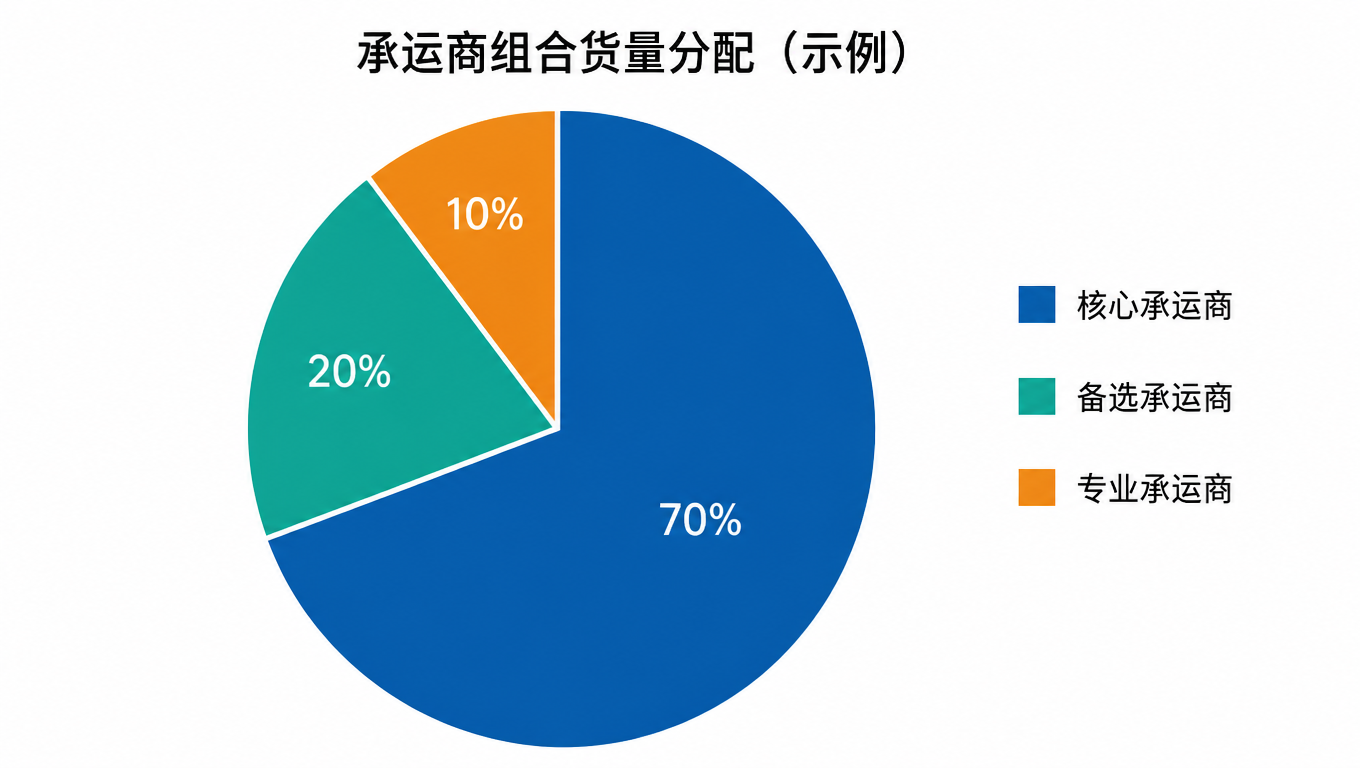
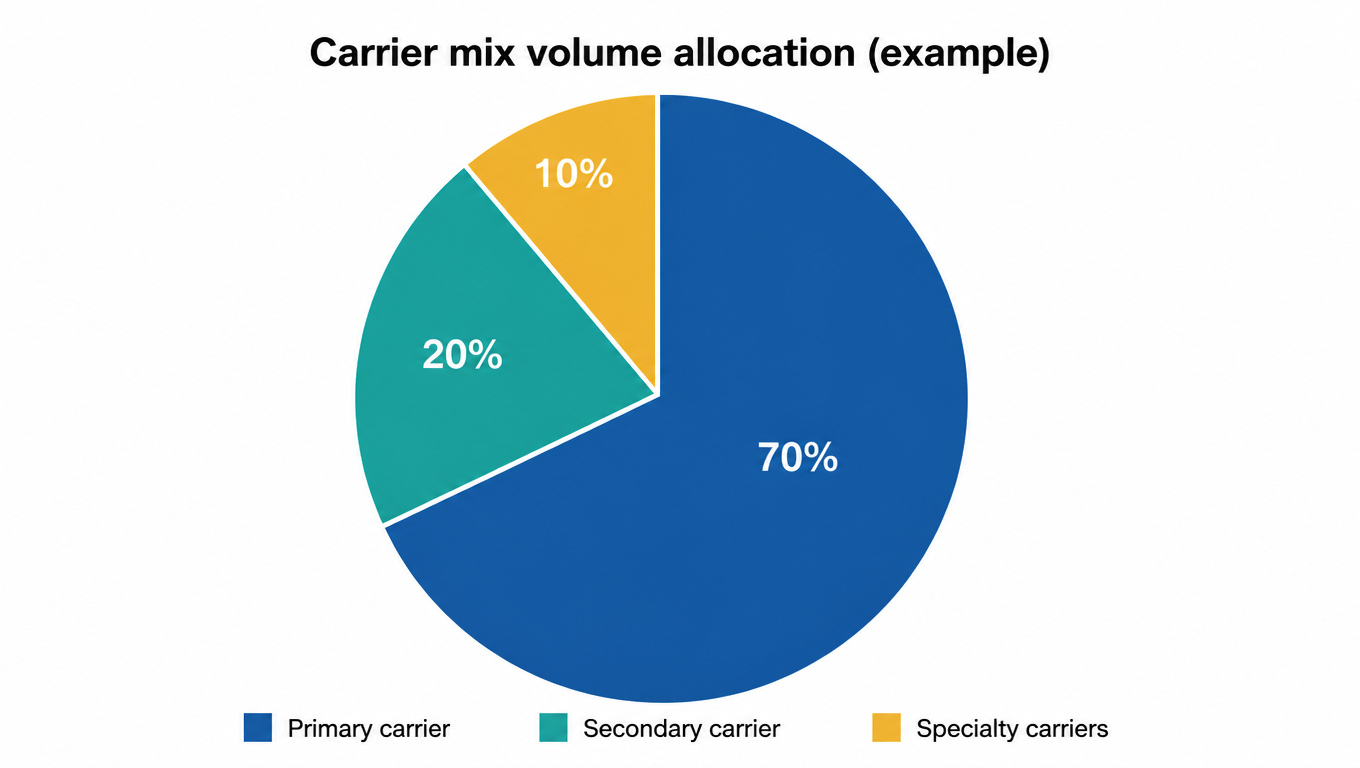
有了画像,下一步是设计承运商组合。最稳妥的结构是三层:核心承运商承接主力货量,提供全网络覆盖和长期合同折扣;备选承运商承接一到两成货量,既是应急备份,也是谈判时让核心承运商认真报价的筹码;专业承运商覆盖核心网络覆盖不到或成本不优的线路,比如区域地面、超大件和跨境。With the profile in hand, the next step is designing the carrier mix. The most robust structure has three tiers: the primary carrier takes the main volume and provides full-network coverage plus long-term contract discounts; the secondary carrier takes 10 to 20 percent of volume, serving as an emergency backup and as the leverage that keeps the primary honest in negotiations; specialty carriers cover lanes the primary network cannot serve well or cheaply, such as regional ground, oversize, and cross-border.

为什么不能只押一家?风险有三层:断供风险,一次罢工、一次系统故障就能让你的中心停摆[^2];议价权流失,份额越大越换不动,续约时对方知道你没退路;区域短板,全国性网络在某些区域可能时效和价格都不如区域承运商。组合的意义不是把货拆碎,而是让每一家都在它最擅长的地方赚钱,同时让你永远保有选择。Why not bet everything on one carrier? There are three layers of risk: supply interruption, where one strike or one system outage can stop your center cold[^2]; lost bargaining power, where the bigger the share the harder it is to move, and the carrier knows you have no exit at renewal; and regional blind spots, where a national network's transit and price can lose to a regional carrier. The point of a mix is not to fragment volume; it is to let every carrier earn money where it is best while you always keep your options open.

一个常见的起步配比是 70/20/10:核心承运商 70%,备选承运商 20%,专业承运商 10%。它不是铁律,但符合大多数履约中心的实际情况。A common starting split is 70/20/10: 70 percent to the primary carrier, 20 percent to the secondary, 10 percent to specialty. It is not a law, but it fits how most fulfillment centers actually run.

饼图:核心承运商 70%、备选承运商 20%、专业承运商 10%Pie chart: primary carrier 70%, secondary 20%, specialty 10%
70/20/10 是大多数履约中心的合理起步配比70/20/10 is a sensible starting split for most fulfillment centers

匹配原则只有一条:从画像出发,把每条线路和每个重量档的需求映射到承运商的能力上,再决定它属于哪一层。画像是因,组合是果。先想清楚货要去哪、怎么去最划算,再决定谁来做,而不是反过来让承运商的报价单决定你的运营。There is one matching principle: start from the profile, map each lane's and each weight band's needs onto carrier capabilities, then decide which tier it belongs to. The profile is the cause, the mix is the effect. Decide where the freight should go and how to move it most cheaply first, then decide who does it, not the other way around, letting a carrier's tariff decide your operation.

四、承运商选择与评分卡4. Carrier Selection and Scorecard

新承运商上车之前,先过资质审核。审核清单至少覆盖六项:网络覆盖,目标区域的实际派送能力和时效地图是否真实;时效 SLA,各服务等级的承诺时效和历史达成数据;追踪能力,扫描节点密度和 API 数据质量;赔付政策,每磅或每件的赔付上限、索赔时效窗口;财务稳定性,要求提供审计财报或偿付能力证明;系统对接,API、标签规范、对账格式是否与你的 WMS 兼容。Before a new carrier goes live, run it through due diligence. The checklist covers at least six items: network coverage, whether the actual delivery capability and transit map for your target regions are real; transit SLA, the committed transit per service class and historical attainment data; tracking capability, scan node density and API data quality; claims policy, the per-pound or per-piece liability cap and the claim window; financial stability, audited statements or proof of solvency; and system integration, whether the API, label specs, and reconciliation formats are compatible with your WMS.

审核不是看感觉,要打分。下面是一张承运商评分卡模板,权重按你的业务特点调整:Due diligence is not a gut check; it is scored. Here is a carrier scorecard template; adjust the weights to your business:

打分项Criterion 权重Weight 评分要点(1-5 分)Scoring guide (1-5)
时效达成率Transit attainment25%25%5 分 = 历史达成 ≥ 98%;3 分 = 95%-97%;1 分 = 低于 92%5 = historical attainment ≥ 98%; 3 = 95%-97%; 1 = below 92%
网络覆盖Network coverage20%20%目标区域覆盖率、时效地图与实际是否一致Coverage of target regions, transit map matching reality
价格竞争力Price competitiveness15%15%与核心承运商基准价的差距Gap vs primary carrier benchmark rates
追踪与数据Tracking and data15%15%扫描节点数量、API 稳定性与延迟Scan node count, API stability and latency
赔付与售后Claims and support15%15%赔付上限、索赔时效、响应速度Liability cap, claim window, response speed
系统对接System integration10%10%对接成本、对账自动化程度Integration cost, reconciliation automation

及格线建议设为加权总分 ≥ 4.0,并且设几条一票否决的红线:无全程追踪能力、赔付上限过低、区域覆盖造假、拒绝提供历史时效数据。任何一条踩线,总分再高也直接出局,因为这些都是上了量以后才会爆的雷。Set the pass line at a weighted total of 4.0 or higher, and add a few veto red lines: no end-to-end tracking, too-low liability caps, fabricated regional coverage, refusal to share historical transit data. Hitting any one of them is an immediate disqualification no matter the total score, because these are the mines that only detonate at scale.

正式上量之前,先做试点。挑一条代表性线路,小批量试跑 4 到 6 周,用真实订单验证三件事:实际时效与 SLA 的差距、追踪数据的完整性、账单的准确率。试点数据直接进评分卡,比承运商销售承诺的任何数字都可信。Before ramping volume, run a pilot. Pick one representative lane, run a small batch for 4 to 6 weeks, and use real orders to verify three things: the gap between actual transit and SLA, the completeness of tracking data, and billing accuracy. Pilot data goes straight into the scorecard and beats any number a carrier's sales rep promises.

五、谈判费率与合同5. Negotiating Rates and Contracts

谈判桌上,你的筹码来自四个地方。第一是货量数据,第二节的画像就是武器,精确到重量档和线路的分布让对方没法含糊。第二是多承运商竞争,评分卡里躺着合格的备选,你就不会怕谈崩。第三是合同期限,三年的承诺通常能换到更低的折扣。第四是旺季承诺量,用确定性的旺季货量换全年折扣,是双方都能接受的交易。At the negotiating table, your leverage comes from four places. First, volume data: the profile from section 2 is the weapon, and a distribution precise down to weight band and lane leaves the carrier no room to blur. Second, multi-carrier competition: with a qualified alternative sitting in your scorecard, you are not afraid to walk away. Third, contract term: a three-year commitment usually buys a deeper discount. Fourth, peak volume commitment: trading predictable peak volume for year-round discounts is a deal both sides can accept.

费率卡是谈判的标的物。下面是一张示例费率卡,注意把附加费单独拆出来看,基础费率再低,附加费也能吃掉全部折扣:The rate card is what you negotiate over. Here is a sample rate card. Note that surcharges are broken out separately: however low the base rate, surcharges can eat the entire discount:

服务等级Service class 基础费率(示例)Base rate (example) 主要附加费(示例)Key surcharges (example)
地面 GroundGround$4.85 / 首磅$4.85 first pound燃油附加费 8.5%、住宅附加费 $3.85Fuel surcharge 8.5%, residential surcharge $3.85
2-Day2-Day$9.20 / 首磅$9.20 first pound燃油附加费 8.5%Fuel surcharge 8.5%
次日达Overnight$18.50 / 首磅$18.50 first pound燃油附加费 8.5%Fuel surcharge 8.5%
区域承运商(西海岸)Regional carrier (West Coast)$3.40 / 首磅$3.40 first pound住宅附加费 $2.10Residential surcharge $2.10

折扣结构要谈成多级的。按件量阶梯:月 3 万件以下 7 折、3 到 6 万件 6.6 折、6 万件以上 6.3 折,让增量货量有明确的价格回报。按重量档阶梯:轻小件档的折扣要重点谈,因为轻小件利润最薄、议价空间也最大。附加费单独谈:燃油、住宅、偏远、超大件,每一项都要有明确费率和封顶。Negotiate discounts as a tiered structure. By volume: 70% off below 30,000 parcels a month, 66% at 30,000 to 60,000, 63% above 60,000, so incremental volume has a clear price reward. By weight band: negotiate the lightweight band hardest, because that is where margin is thinnest and the room to negotiate is largest. Negotiate surcharges separately: fuel, residential, remote, and oversize, each needs a defined rate and a cap.

合同条款清单,逐条核对:Contract clause checklist, check line by line:

  • 涨价条款:燃油调整机制的触发条件和封顶比例Rate change clauses: fuel adjustment trigger and cap
  • 最低货量承诺(MQC):承诺量、违约罚则、与折扣的挂钩方式[^6]Minimum volume commitment (MQC): committed volume, breach penalties, how it ties to discounts[^6]
  • 旺季附加费上限:提前锁死 11-12 月的峰值费率[^3]Peak surcharge caps: lock November-December peak rates in advance[^3]
  • KPI 违约赔偿:时效、破损不达标时的补偿机制KPI breach credits: compensation when transit or damage targets are missed
  • 合同期限与退出机制:提前解约窗口、数据导出义务Term and exit: early termination window, data export obligations

最后一条谈判纪律:先谈结构,再谈价格。折扣阶梯、附加费、条款这些结构性问题定死了,单价才有意义;反过来的话,你会为了一个漂亮的首磅价签下一堆糟糕的条款。还有,一切以书面为准,口头承诺不写进合同,就等于没有。One final negotiation discipline: structure first, price second. Unit price only means something once the structural items, discount tiers, surcharges, and clauses, are nailed down. In reverse order, you will sign a pile of bad clauses for one pretty first-pound rate. And everything in writing: a verbal promise that is not in the contract does not exist.

六、跨承运商分配货量6. Allocating Volume Across Carriers

合同签完,货量怎么分?分配要同时满足三个目标:成本最优,货尽量走最便宜的承运商;风险分散,任何一家出问题都有退路;KPI 可考核,每家拿到的货量要足够支撑对它的绩效评价。Contract signed, how do you split volume? Allocation has to satisfy three goals at once: cost optimality, freight goes to the cheapest carrier that works; risk dispersion, every carrier failing leaves you a way out; and measurable KPIs, each carrier gets enough volume to make its performance evaluation meaningful.

路由方式有三种,可以叠加使用:按线路或区域路由,西海岸的货给区域承运商,全美的货给核心承运商;按重量档路由,轻小件走折扣最高的承运商,超大件走专业承运商;按优先级路由,核心承运商优先接单,备选承运商保底。下面是一张路由表示例:Three routing modes, which can be combined: route by lane or region, West Coast freight to the regional carrier and nationwide freight to the primary; route by weight band, lightweight parcels to the carrier with the deepest discount and oversize to specialty; route by priority, the primary gets first pick and the secondary backstops. Here is a sample routing table:

场景Scenario 首选Primary 备选Fallback 切换条件Switch condition
西海岸地面West Coast ground区域承运商Regional carrier核心承运商Primary carrier区域承运商时效跌破 SLA 连续两周Regional carrier transit misses SLA for two straight weeks
全美地面标准件Nationwide ground, standard parcels核心承运商Primary carrier备选承运商Secondary carrier核心达承载上限或异常涨价Primary near capacity or abnormal rate increase
超大件 / 超尺寸Oversize / oversized专业承运商Specialty carrier核心承运商Primary carrier专业承运商费率上调Specialty carrier raises rates
11-12 月旺季November-December peak核心 60% + 备选 40%Primary 60% + secondary 40%专业承运商补缺口Specialty carrier fills the gap核心旺季附加费触发上限Primary peak surcharge hits the cap

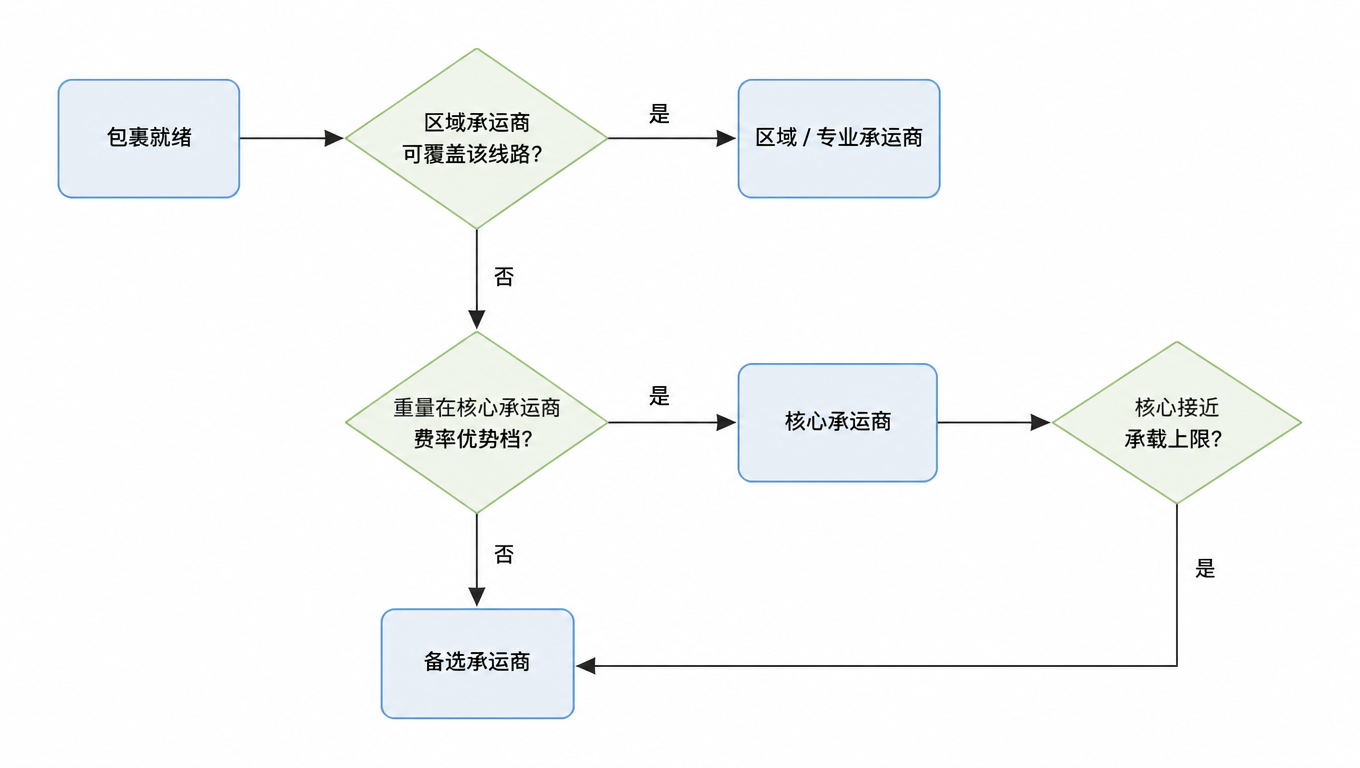
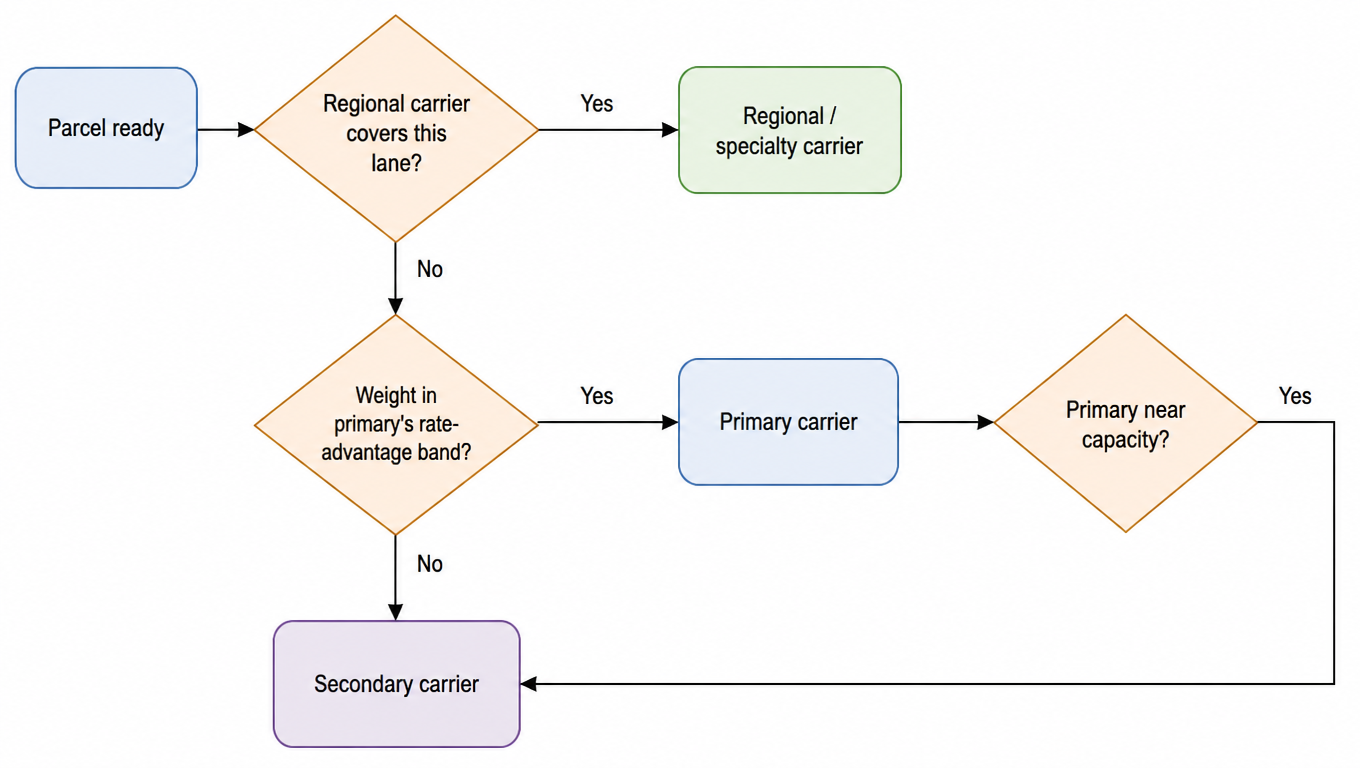
路由规则要固化成系统规则,写进 WMS 的路由配置,而不是留在仓库主管的脑子里。决策逻辑大致是这样:Routing rules must be hardened into system rules, written into the WMS routing configuration rather than kept in the warehouse manager's head. The decision logic looks roughly like this:

路由决策流程图:区域覆盖、重量档、承载上限逐层判断承运商归属Routing decision flowchart: regional coverage, weight band, and capacity checks assign each parcel to a carrier
路由决策:区域覆盖 → 重量档 → 承载上限,层层判断Routing decision: regional coverage, then weight band, then capacity, checked in sequence

分配不是一次定死,要动态再平衡。每月看一次实际 KPI 和账单数据,表现差的降量、表现好的加量,用货量当杠杆持续校正。两个常见坑要避开:一是为凑 MQC 硬塞货,为了保折扣把货量塞给时效差的承运商,省了折扣亏了客户;二是分配规则只在口头,不落文档,主管一离职规则就消失。Allocation is not decided once and frozen; it needs dynamic rebalancing. Every month, look at actual KPIs and billing data, cut volume from underperformers, add volume to strong performers, and keep correcting with volume as the lever. Two common traps: first, force-feeding volume to hit an MQC, stuffing freight to a slow carrier to keep a discount, saving on rates and losing customers; second, keeping allocation rules verbal and undocumented, so the rules disappear the day the manager leaves.

七、上车后的绩效管理7. Managing Performance After Onboarding

上量之后,管理才刚刚开始。先建一套可量化的 KPI 体系,建议至少覆盖五项:时效达成率,目标 ≥ 98%;破损率,目标 ≤ 0.1%;追踪扫描更新,关键节点 100% 有扫描;索赔处理时长,目标 ≤ 10 个工作日;账单准确率,目标 ≥ 99%。每项 KPI 都要有数据来源、统计口径和责任人,否则就是各说各话。Once volume is live, management begins. Build a measurable KPI system first, covering at least five metrics: transit attainment, target ≥ 98%; damage rate, target ≤ 0.1%; tracking scan updates, 100% at critical nodes; claim resolution time, target ≤ 10 business days; billing accuracy, target ≥ 99%. Every KPI needs a data source, a definition, and an owner, otherwise everyone talks past each other.

每月开一次复盘会,固定议程:数据回顾、问题清单、改进项、下月目标。承运商的客户经理必须参加,会议要有书面纪要,问题要有明确的关闭日期。复盘会的意义不是追责,是把问题变成双方都认账的行动项。Run a monthly review meeting with a fixed agenda: data review, issue list, improvements, and next month's targets. The carrier's account manager must attend, minutes must be written, and every issue needs a close date. The point of the review is not blame; it is turning problems into action items both sides own.

每季度做一次承运商积分卡,在评分卡框架上按季度实际表现打分,得分直接决定下季度的货量加减。比如 4.5 分以上加 5% 货量,3.5 分以下减 10%。这样货量分配就有了公开透明的依据,承运商也知道努力的方向。Run a quarterly carrier scorecard, scoring actual quarterly performance on the same scorecard framework, with the score directly driving next quarter's volume changes. For example, above 4.5 adds 5 percent volume, below 3.5 cuts 10 percent. Allocation then has an open, transparent basis, and carriers know exactly where to improve.

违约处理要有一条清晰的升级阶梯:书面警告 → 限期整改(通常 30 天)→ 降量 → 淘汰。每一步都按合同走,书面留痕。淘汰不是吵架,是执行合同里的退出机制;只要你前面签了退出条款、手里有合格的备选,这一步就只是流程,不是灾难。Breach handling needs a clear escalation ladder: written warning, corrective period (usually 30 days), volume reduction, then termination. Every step follows the contract and leaves a paper trail. Termination is not a fight; it is executing the exit mechanism in the contract. As long as you signed the exit clause up front and hold a qualified backup, this step is a process, not a disaster.

八、年度承运商策略循环8. The Annual Carrier Strategy Cycle

到这里,方法已经齐了:画像、组合、评分、谈判、分配、管理。但策略不是做一次就完的事,它应该是一年一轮的例行机制。跑完第一轮,第二年就是微调。At this point the toolkit is complete: profile, mix, scorecard, negotiation, allocation, management. But strategy is not a one-time exercise; it should be an annual recurring mechanism. After the first full cycle, year two is fine-tuning.

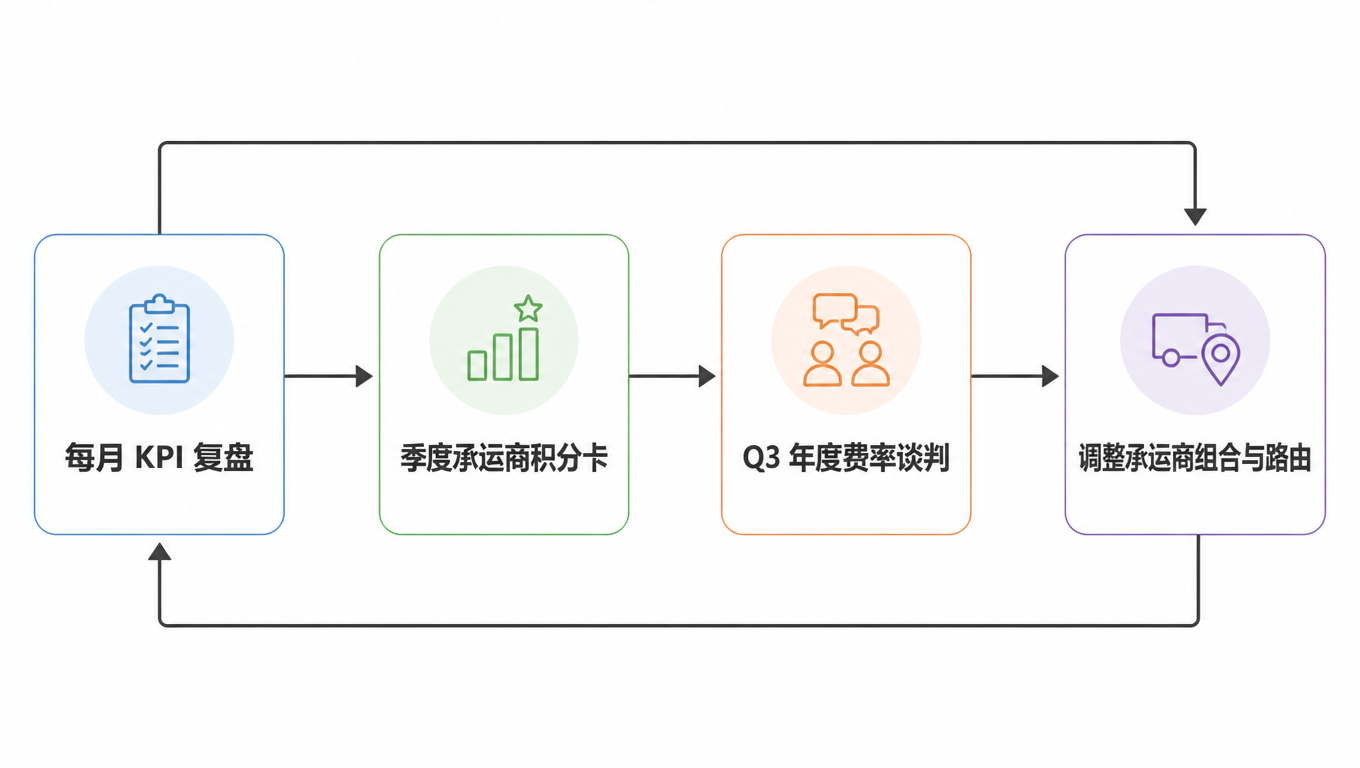
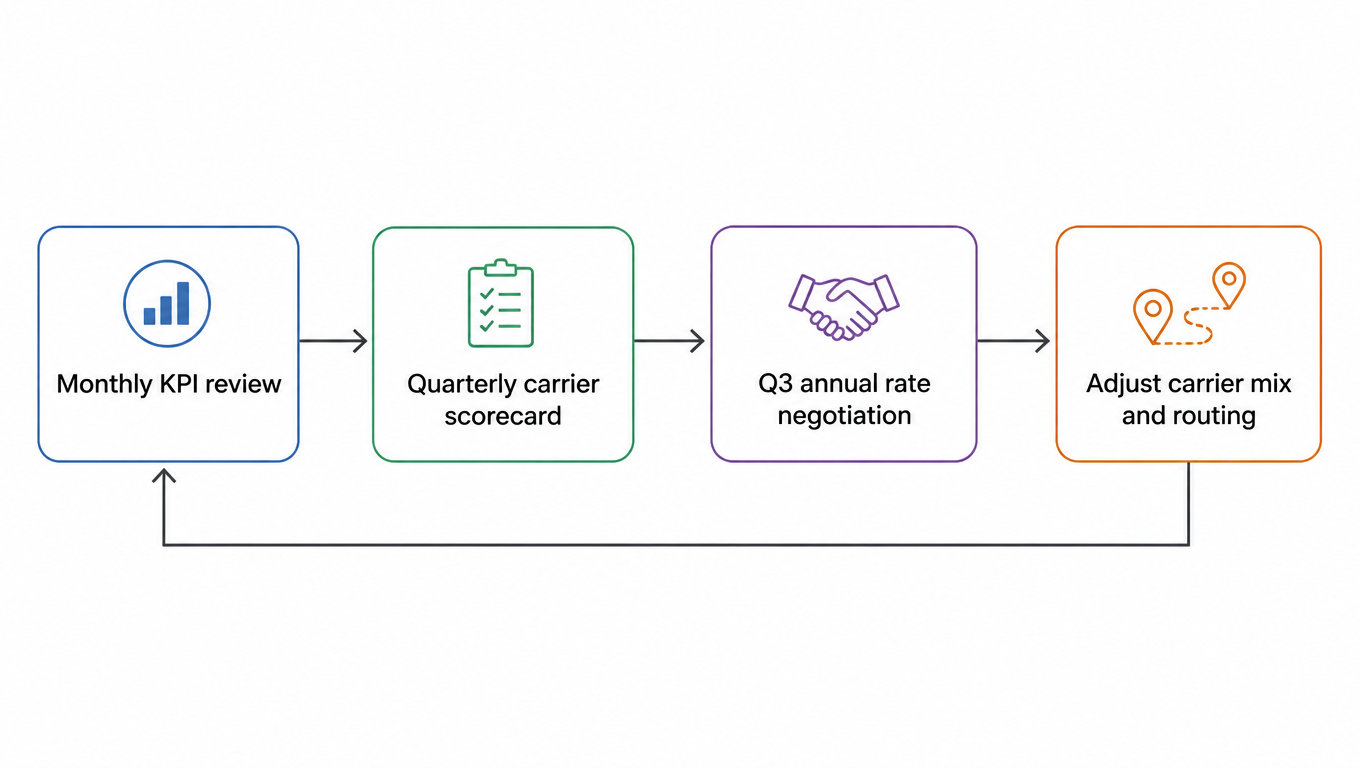
节奏大致是这样:每月做 KPI 复盘,每季度出承运商积分卡并调整货量,每年 Q3(7 到 9 月)在旺季前启动下一年的费率谈判,用当年的实际数据和下一年的预期货量去谈折扣和条款。整个循环可以用一张图表示:The rhythm looks like this: monthly KPI reviews, quarterly carrier scorecards with volume adjustments, and every year in Q3 (July to September), before peak season, launch the next year's rate negotiation, using this year's actuals and next year's expected volume to negotiate discounts and terms. The whole loop can be drawn as one diagram:

年度循环图:每月 KPI 复盘、季度积分卡、Q3 费率谈判、调整组合与路由Annual cycle diagram: monthly KPI review, quarterly scorecard, Q3 rate negotiation, adjust mix and routing
承运商策略是一年滚动迭代的闭环,不是一次性文档A carrier strategy is a loop that rolls forward each year, not a one-time document

所有策略产物要文档化、统一归档:费率卡、评分卡、路由表、合同台账,每次谈判和调整后及时更新。归档的意义在于,任何一个新来的运营经理打开文件夹就能看懂你的承运商策略,而不需要把上一任的脑子挖出来。All strategy artifacts must be documented and archived in one place: rate cards, scorecards, routing tables, and the contract ledger, updated after every negotiation and adjustment. The point of the archive is that any new operations manager can open the folder and understand your carrier strategy without excavating their predecessor's brain.

最后回到开头那句话:承运商策略不是一个文档,而是一年滚动迭代的机制。你的货量结构在变,市场费率在变,承运商的能力也在变,唯一不变的是这套方法本身。把它跑起来,你的运费就从听天由命的成本,变成了可以谈判、可以分配、可以考核、可以预测的经营杠杆。Back to where we started: a carrier strategy is not a document; it is a mechanism that rolls forward year after year. Your volume structure changes, market rates change, and carrier capabilities change. The only constant is the method itself. Run it, and your freight spend turns from a cost you accept into an operating lever you can negotiate, allocate, measure, and predict.

常见问题FAQ

先摸清包裹画像:寄达区域、重量分档、尺寸档、时效承诺、货量节奏、附加费暴露。承运商折扣是用货量结构换出来的,画像说不清,谈判桌上就没有筹码,分配规则也无从谈起。画像在先,策略在后。Know your parcel profile: destination regions, weight bands, size classes, service commitments, volume rhythm, and surcharge exposure. Carrier discounts are earned by your volume structure; without a profile you have no leverage at the table and no basis for allocation rules. Profile first, strategy second.
常见的起步配比是 70/20/10:核心承运商 70%,负责全网络覆盖与合同折扣;备选承运商 20%,既是备份也是让核心认真报价的筹码;专业承运商 10%,覆盖区域地面、超大件和跨境。之后每月按实际 KPI 动态再平衡,表现差的降量、表现好的加量。A common starting split is 70/20/10: 70 percent to the primary carrier for full-network coverage and contract discounts, 20 percent to a secondary that backstops and keeps the primary honest, and 10 percent to specialty carriers for regional ground, oversize, and cross-border. Then rebalance monthly against actual KPIs: cut underperformers, reward strong performers.
每年 Q3(7 到 9 月),在旺季之前启动下一年的费率谈判,用当年的实际数据和下一年的预期货量去谈折扣和条款。纪律是先谈结构再谈价格:折扣阶梯、附加费封顶、MQC、旺季附加费上限、退出机制定死之后,单价才有意义。一切以书面为准。Every year in Q3, July to September, before peak season, launch the next year's negotiation using this year's actuals and next year's expected volume. The discipline is structure first, price second: nail down discount tiers, surcharge caps, MQC, peak surcharge caps, and the exit mechanism before unit price. Everything in writing.
先过六项资质审核:网络覆盖、时效 SLA、追踪能力、赔付政策、财务稳定性、系统对接,用加权评分卡打分,及格线建议 ≥ 4.0,并设几条一票否决红线(无全程追踪、赔付上限过低、区域覆盖造假、拒绝提供时效数据)。再挑一条代表性线路试跑 4 到 6 周,用真实订单验证时效、追踪和账单,试点数据直接进评分卡。Run due diligence on six items first: network coverage, transit SLA, tracking capability, claims policy, financial stability, and system integration. Score them on a weighted scorecard with a 4.0 pass line and veto red lines (no end-to-end tracking, too-low liability caps, fabricated coverage, refusal to share transit data). Then pilot on one representative lane for 4 to 6 weeks, validating transit, tracking, and billing with real orders, and feed the pilot data straight into the scorecard.

想把多承运商运营从项目变成配置?Ready to make multi-carrier operations configuration, not a project?

EasyShippingX 一个平台接通多家承运商:USPS 折扣费率与 UniUni、GOFO、SwiftX、SpeedX 等随时可用,按线路路由、自动回退开箱即用,让你的承运商策略直接落地。EasyShippingX connects multiple carriers on one platform: USPS discount rates plus UniUni, GOFO, SwiftX, and SpeedX, ready to go, with lane-based routing and automatic fallback, so your carrier strategy actually ships.

Get Rate Comparison
Get Rate Comparison