成功妥投成本 · 指标拆解Cost per Successful Delivery · Metric Breakdown

成功妥投成本:戳穿「便宜发货」的电商指标Cost per Successful Delivery: The Ecommerce Metric That Exposes Cheap Fulfillment

一张 $4.50 的面单,能在单个订单上悄悄变成 $18 的运营成本和 $53 的失败负担。成功妥投成本(CPSD)就是把「便宜发货」的真面目照出来的全包指标:它本质上是一个成本转移问题。这篇指南用两本账的公式定义 CPSD,用真实基准数据(首投失败 8%-20%、包裹丢失 0.5%-0.8%)跑完便宜承运商 vs 可靠承运商的算账对比,并给你五个失败信号、一条盈亏平衡规则、一份 30 天试点模板和一个可下载的计算器。A $4.50 label can quietly turn into $18 of operating cost and $53 of failure burden on a single order. Cost per successful delivery (CPSD) is the all-in metric that exposes cheap fulfillment for what it is: a cost-transfer problem. This guide defines CPSD with a two-ledger formula, runs a cheap-vs-reliable carrier comparison on real benchmarks (8-20% first-attempt failure, 0.5-0.8% parcel loss), and hands you the five failure signals, a breakeven rule, a 30-day pilot template, and a downloadable calculator.

前半部分把「面单价」这个错误指标拆开,给出两个分开算的账本和一张逐单记录表。中间用两个假设承运商跑完整套数字,找出盈亏平衡点。最后是一份 30 天试点计划,以及一套可以直接复制的资产:计算器、表格模板和异常处理规则。最便宜的面单,只有在妥投时才便宜。The first part tears down the wrong metric, cost per label, and sets up the two-ledger formula with a per-order tracking sheet. The middle runs two hypothetical carriers through the full math and finds the breakeven point. The end is a 30-day pilot plan plus a stack of copy-ready assets: a calculator, a spreadsheet template, and an exception-handling rule set. The cheapest label is only cheap if it delivers.

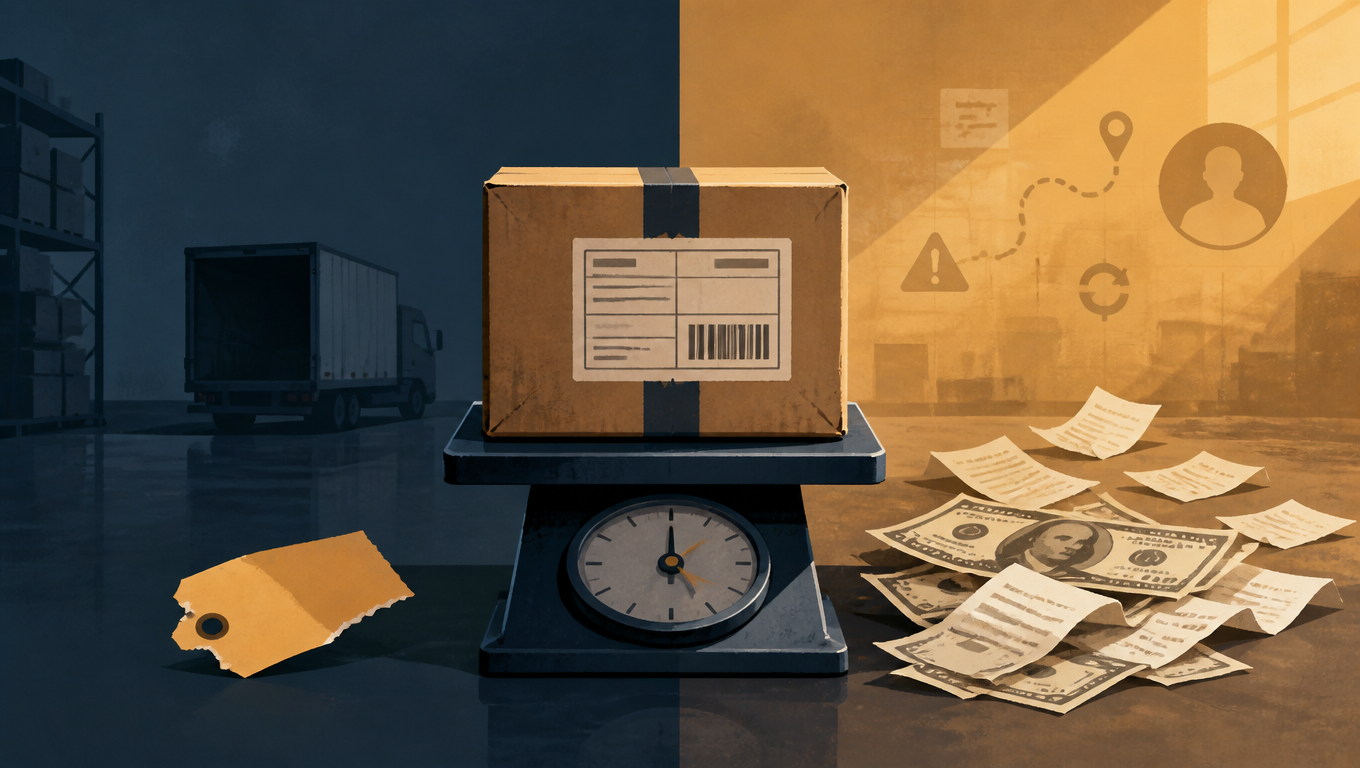
仓库电子秤上放着一只贴了面单的纸箱,一侧是写着 $4.50 的撕下来的价签,另一侧散落着纸币和单据,扁平的编辑风插画,海军蓝与琥珀色
面单上的数字是开始,不是真相The number on the label is the beginning, not the truth

一、一张 $4 的面单,最后花了 $181. The $4 Label That Cost $18

这里有一个假设订单,它刻意普通得不能再普通。一位顾客从你的店铺买了一件 $40 的商品,这件商品的成本是 $8。你选了报价单上最便宜的方案,$4.50,因为顾客不付运费,而每一美元的毛利都算数。Here is a hypothetical order, and it is deliberately ordinary. A customer buys a $40 product from your store. The product costs $8 to make or buy. You pick the cheapest label on offer, $4.50, because the customer is not paying for shipping and every dollar of margin counts.

包裹在揽收 36 小时后才出现第一次扫描。之后追踪信息安静了 72 小时。第一次投递时顾客在上班,投递失败,也没有安排再次投递。顾客开了争议,你为了避免拒付直接退款,然后又因为预算表上写着「便宜」,继续从同一条线路重发。补发的包裹最终在原始订单 11 天后送到。The package gets its first scan 36 hours after drop-off. The tracking feed then goes quiet for 72 hours. The carrier's first delivery attempt fails while the customer is at work, and no reattempt is scheduled. The customer opens a dispute. You refund the order to avoid a chargeback, then reship through the same cheap lane because the budget says so. The replacement eventually arrives, 11 days after the original order.

这一单实际花掉的履约运营成本是:面单 $4.50、退件处理 $1.50、重发面单 $4.50、补发的拣货打包和包装 $2.00、客服三次工单 $5.50,合计 $18.00。失败负担则单独记在一本账里,避免重复计算:$40.00 退款、随退款订单一起发出的 $8.00 补发商品、以及你为了留住顾客发出的 $5.00 折扣,又是 $53.00,没了。Here is what that one order actually cost in fulfillment operating expense: $4.50 for the original label, $1.50 in return-to-sender handling, $4.50 for the reshipment label, $2.00 in pick-and-pack and packaging for the replacement, and $5.50 in customer support across three tickets, for a total of $18.00. And the failure burden, kept in a separate ledger so nothing is counted twice: the $40.00 refund, the $8.00 replacement unit that went out on a refunded order, and the $5.00 discount you issued to keep the customer. Another $53.00, gone.
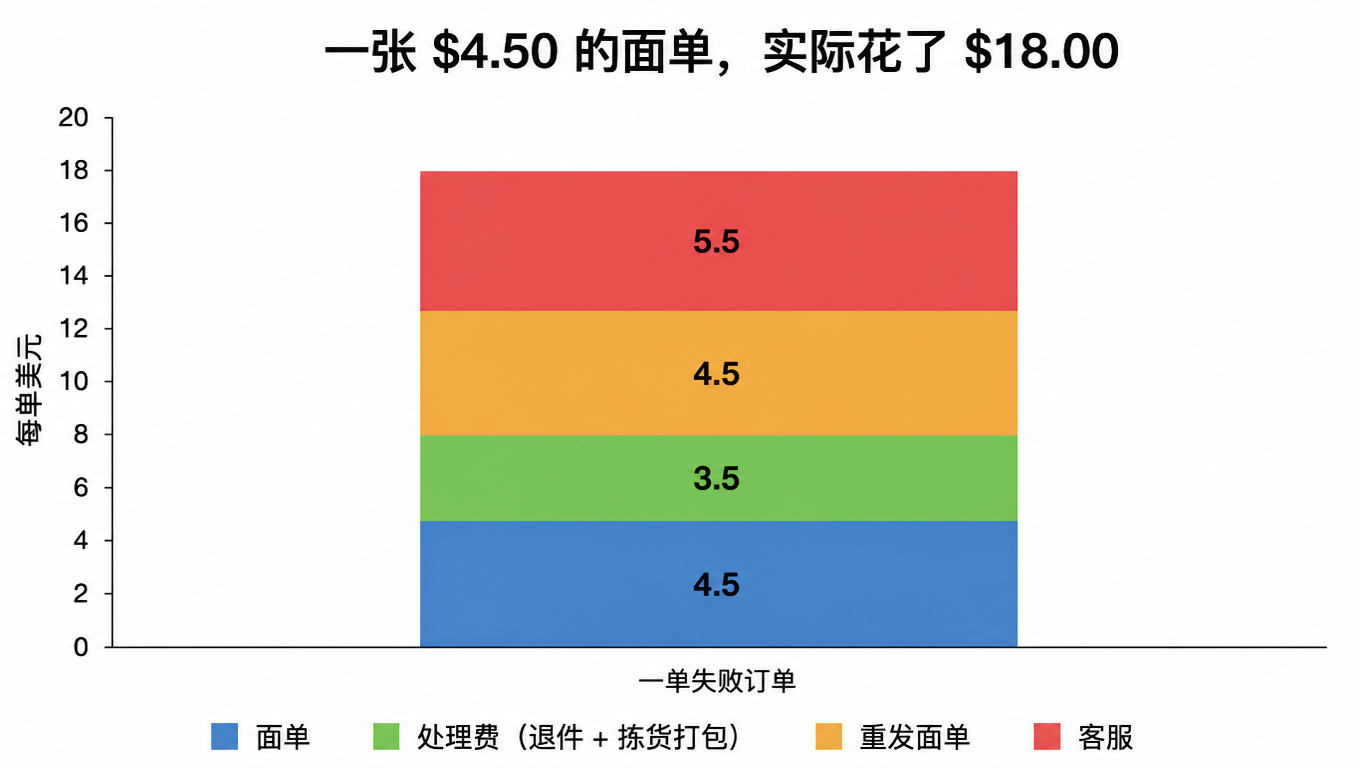
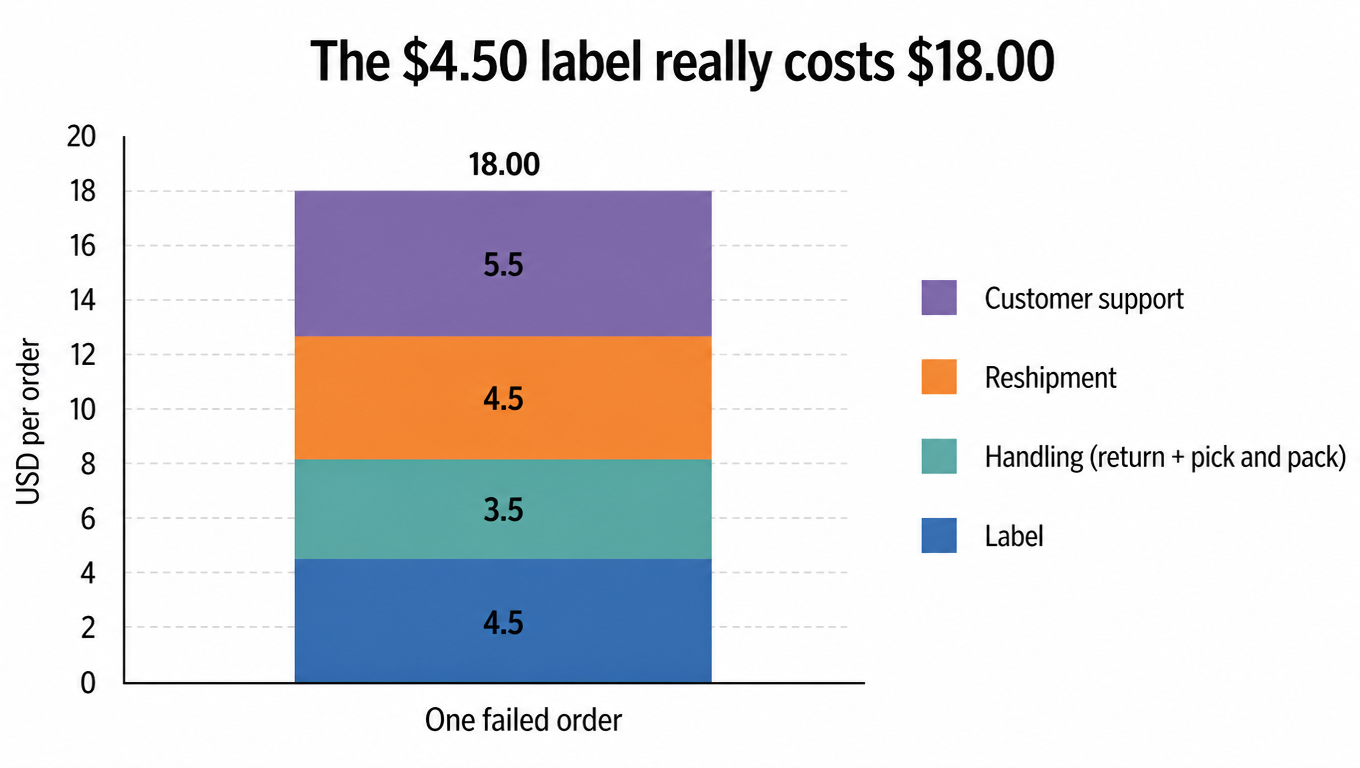
堆叠柱状图:一张失败订单的成本构成,面单 4.5 美元、处理费 3.5 美元、重发面单 4.5 美元、客服 5.5 美元,合计 18 美元Stacked bar chart: cost breakdown of one failed order, label 4.5, handling 3.5, reshipment 4.5, support 5.5, total 18
面单上写着 $4.50,这一单实际花了 $18.00The label said $4.50; the order cost $18.00

这个场景并不少见。行业研究显示首次投递失败占包裹量的 8% 到 20% [^3];Loqate 对 304 位零售高管的调研发现,8% 的国内首次投递会失败,平均每单成本 $17.20 [^4]。结账时最便宜的面单,很少是全程最便宜的订单。This scenario is not exotic. Industry research puts first-attempt delivery failure at 8% to 20% of parcels [^3], and a Loqate study of 304 retail executives found that 8% of domestic first-time deliveries fail, at an average cost of $17.20 per order [^4]. The cheapest label at checkout is rarely the cheapest order end to end.
二、为什么「面单价」是错的指标2. Why Cost per Label Is the Wrong Metric

每一张面单的价格只回答一个问题:把这只箱子交给承运商要花多少钱。它不告诉你箱子会不会到、什么时候到、到不了会怎样。而失败不是免费的。它们把成本搬进更难看见的账户:客服工时、退款、拒付手续费、补发商品,以及你为了留住一个不得不自己追包裹的顾客所付出的善意。Every label price answers exactly one question: how much does it cost to hand this box to a carrier? It says nothing about whether the box arrives, when it arrives, or what happens when it does not. And failures are not free. They move cost into accounts that are much harder to see: customer-support hours, refunds, chargeback fees, replacement units, and the goodwill you spend keeping a customer who had to chase their own package.

这就是成本转移问题。一个报 $4.50 却在自己货量里实打实失败一批的承运商,不是便宜的承运商,而是一个把账单上其余部分都用失败成本开给你的 $4.50 承运商。不同承运商的基础丢失率本来就不同:UPS 和 FedEx 平均丢失或损坏约 0.5% 的包裹,USPS 接近 0.8% [^5]。当你比较面单时,你只比较了一张长得多的账单的第一行。This is the cost-transfer problem. A carrier that quotes $4.50 but fails on a meaningful share of its volume is not a cheap carrier. It is a $4.50 carrier that invoices the rest of your P&L in failure costs. Base loss rates already differ by carrier: UPS and FedEx average around 0.5% of parcels lost or damaged, while USPS runs closer to 0.8% [^5]. When you compare labels, you are comparing only the first line of a much longer bill.

能覆盖整张账单的指标是成功妥投成本(CPSD):把一单成功送到顾客手里的真实全包成本。本文的其余部分会精确定义它,告诉你如何用你几乎肯定已经有的数据算出它,并给你一个 30 天试点方案开始降低它。The metric that captures the whole bill is cost per successful delivery (CPSD): the true, all-in cost of getting one order successfully into a customer's hands. The rest of this article defines it precisely, shows you how to calculate it from data you almost certainly already have, and gives you a 30-day pilot to start lowering it.

三、怎么算成功妥投成本3. How to Calculate Cost per Successful Delivery

为了把账算明白,把两本账分开。运营 CPSD 衡量你的履约运营把多少钱变成妥投订单的效率;失败负担衡量没做对的订单造成的财务损失。如果混在一起,退款和商品成本会被重复计算,数字就不再有任何意义。To keep the math honest, separate two ledgers. Operational CPSD measures how efficiently your fulfillment operation turns money into delivered orders. Failure Burden measures the financial damage of orders that did not go right. If you blend them, you double-count refunds and product costs, and the number stops meaning anything.

运营 CPSD = 履约相关运营成本总额 ÷ 成功妥投订单数。运营成本分子包括:拣货打包、包装耗材、出库运费、重投与重发、退货运费、异常处理人工、客服人工、以及未获赔付的承运商理赔(被拒赔或根本没提交的)。Operational CPSD = total fulfillment-related operating cost ÷ successfully delivered orders. The operating cost numerator includes: pick-and-pack, packaging, outbound shipping, redelivery and reshipment, return shipping, exception-handling labor, customer-support labor, and unrecovered carrier claims (claims that were denied or never filed).

失败负担 = 退款损失 + 拒付手续费 + 未收回的商品成本 + 配送失败后发放的折扣或补偿。退款是一本大到值得单独开一行的账:NRF 估计 2025 年 19.3% 的线上销售会被退回 [^6],而配送失败正是顾客退货或开争议的原因之一。Failure Burden = refund losses + chargeback fees + unrecovered product cost + discounts or credits issued after delivery failures. Refunds are a large enough ledger to deserve their own line: the NRF estimates that 19.3% of online sales will be returned in 2025 [^6], and delivery failures are one of the reasons customers return or dispute.

只有当顾客收到并留下订单时,才算一次成功妥投。试了三次才送到的包裹,只要送到了就算;退款订单不算,哪怕箱子最终送到了。如果你想要一个单一的总览数字,把失败负担加进运营分子再除。但先把两本账分开记,你才能看清到底是哪一本在动。Only count an order as a successful delivery when the customer received it and kept it. A package that took three attempts still counts if it arrived; a refunded order does not, even if the box was eventually delivered. If you want a single headline number, add Failure Burden to the operating numerator before dividing. But track the two separately first, so you can see which one is actually moving.

建一张表,一行一个订单,列包括:订单 ID、承运商、线路、面单成本、首次扫描时间、停滞标记、首次投递结果、最终结果、客服分钟数、退款、拒付、折扣。按线路求和。这一张表就是本文所有数字的引擎。Set up a sheet with one row per order and columns for: order ID, carrier, lane, label cost, first-scan time, stalled flag, first-attempt result, final result, support minutes, refund, chargeback, discount. Sum by lane. That single sheet is the engine for every number in this article.

四、便宜承运商 vs 可靠承运商4. Cheap Carrier vs Reliable Carrier

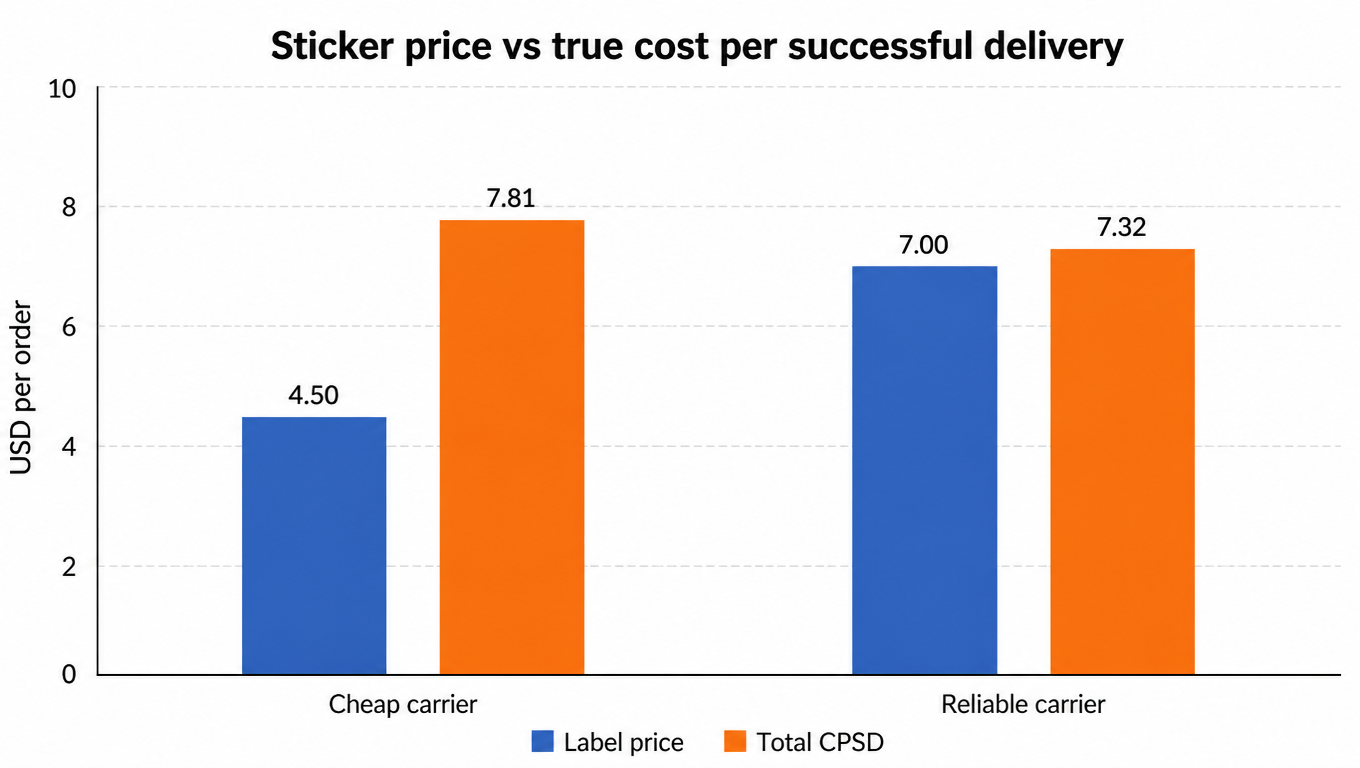
这里有两个假设承运商,同一个月运送同样的 1,000 单:同样的商品($40,成本 $8)、同样的顾客、同样的包装,只有承运商不同。便宜承运商每张面单 $4.50,85% 的包裹在 24 小时内首次扫描,12% 的货量停滞超过 48 小时,首次投递成功 88%,最终妥投 95%。可靠承运商每张面单 $7.00,99% 的包裹在 24 小时内扫描,2% 停滞,首次投递成功 97%,最终妥投 99.5%。Here are two hypothetical carriers moving the same 1,000 orders in the same month: same product ($40, COGS $8), same customers, same packaging. Only the carrier differs. The cheap carrier charges $4.50 per label, gets a first scan within 24 hours on 85% of packages, lets 12% of shipments stall past 48 hours, completes 88% of first attempts, and ultimately delivers 95% of orders. The reliable carrier charges $7.00 per label, scans 99% of packages within 24 hours, stalls on 2%, completes 97% of first attempts, and delivers 99.5% of orders.

数字是典型化的,但落在正确的量级附近:现实中承运商丢失率大约在包裹量的 0.5% 到 0.8% [^5],首次投递失败率则高得多 [^3]。The numbers are stylized but sit in the right neighborhood: real-world carrier loss rates run roughly 0.5% to 0.8% of parcels [^5], and first-attempt failures run far higher [^3].

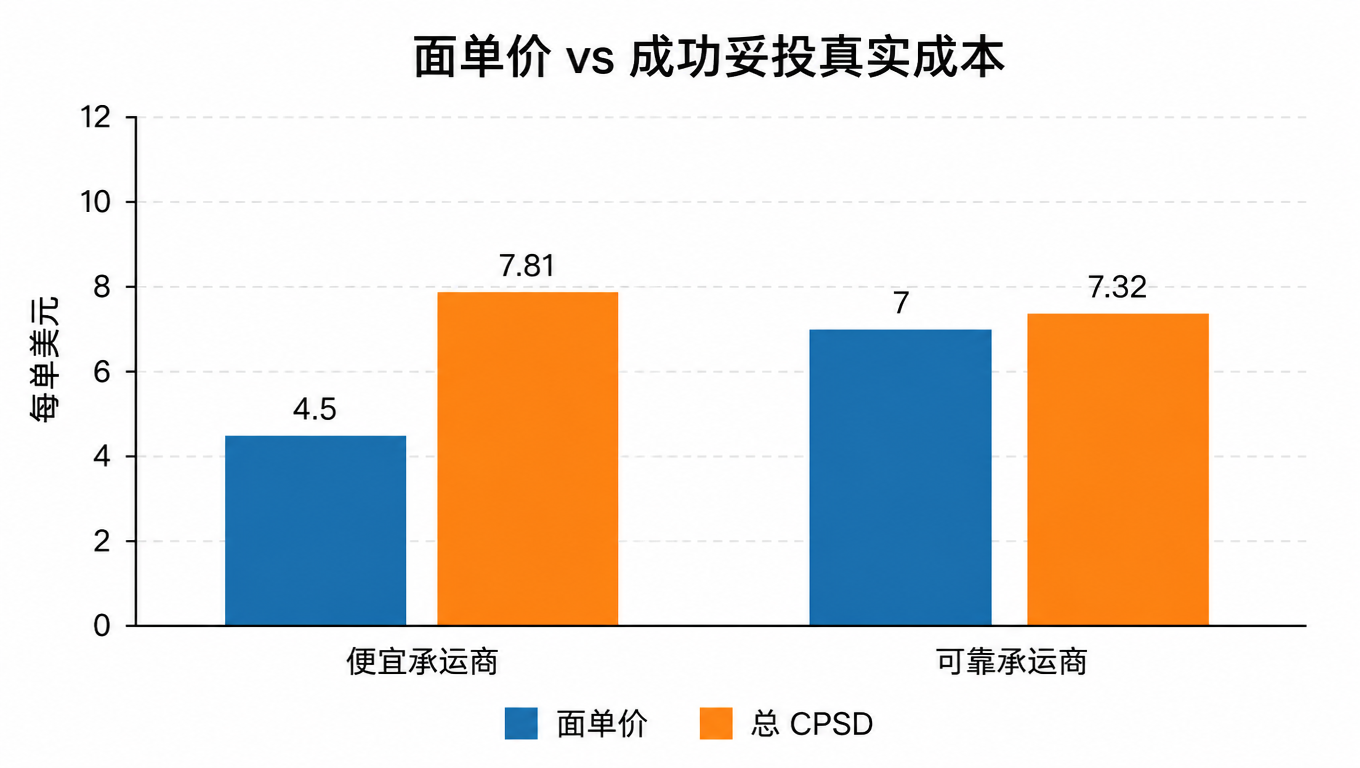
柱状图:便宜承运商与可靠承运商的面单价与总成功妥投成本对比,面单价 4.5 对 7 美元,总 CPSD 7.81 对 7.32 美元Bar chart: label price vs total CPSD for cheap and reliable carriers, 4.5 vs 7 label, 7.81 vs 7.32 total CPSD
面单价是开始,成功妥投成本才是真相The sticker price is the beginning; CPSD is the truth

算下来,便宜承运商才是贵的那一个。每 1,000 单,$4.50 的面单产生 50 个退款订单、15 次重发、大约 60 张客服工单,总 CPSD $7.81。$7.00 的面单只有 5 单失败,单均成功妥投成本 $7.32。每张面单贵 $2.50 的承运商,每次成功妥投反而便宜 $0.49。一年 10,000 单,就是 $4,900 的纯节省,还没算避开的拒付和那些不用追自己包裹的顾客。Run the math and the cheap carrier is the expensive one. Per 1,000 orders, the $4.50 label produces 50 refunded orders, 15 reshipments, roughly 60 support tickets, and a total CPSD of $7.81. The $7.00 label produces 5 failures and lands at $7.32 per successful delivery. The carrier that costs $2.50 more per label is $0.49 cheaper per successful delivery. On 10,000 orders a year, that is $4,900 of pure saving, before you count the chargebacks avoided and the customers who did not have to chase their packages.

五、要盯住的五个失败信号5. The Five Failure Signals to Track

如果你不盯着驱动它的信号,就无法修复一个月的 CPSD 数字。按线路、按周,盯住这五个:You cannot fix a monthly CPSD number if you are not watching the signals that drive it. Track these five, per lane, every week:

  • 没有首次扫描。揽收 24 小时内没有扫描,说明承运商没有把它收进网络。它预示漫长的配送尾部、丢失包裹和重发。任何无扫描率超过 2% 的线路都要调查。No first scan. If a package has no scan within 24 hours of pickup, the carrier has not accepted it into the network. It predicts long delivery tails, lost packages, and reshipments. Investigate any lane above a 2% no-scan rate.
  • 追踪上传延迟。物理扫描和可见扫描之间的时间差。事件晚 12 小时以上才出现的线路,把问题藏到它们变贵为止。Tracking upload latency. The gap between the physical scan and the visible scan. A lane whose events appear 12+ hours late hides problems until they are expensive.
  • 追踪停滞超过 48/72 小时。妥投失败最强的预测信号。48 小时需要升级,72 小时需要决策。每一件停滞的包裹,都是一笔进行中的退款或拒付。Tracking stalled over 48/72 hours. The strongest predictor of a failed delivery. At 48 hours a package needs escalation; at 72 hours it needs a decision. Every stalled package is a future refund or chargeback in progress.
  • 首次投递失败。错过投递、地址问题、拒签。这是影响订单最多的失败,按行业估计占包裹量的 8% 到 20% [^3],也是修起来最便宜的,因为客户沟通和投递偏好能预防其中大部分。First-attempt delivery failure. Missed deliveries, address issues, signature refusals. This is the failure that hits the most orders, 8% to 20% of parcels by industry estimates [^3], and the cheapest to fix, because customer communication and delivery preferences can prevent most of it.
  • 与配送挂钩的退款和拒付率。按原因拆分退款。当配送相关的退款变动时,你的 CPSD 跟着变动。Refund and chargeback rate linked to delivery. Split your refunds by reason. When delivery-related refunds move, your CPSD is moving with them.
履约经理的显示器上是一个包裹追踪看板,一个停滞 72 小时的包裹被红色警示徽章标出,扁平的科技风插画,海军蓝与琥珀色
一件被标记为停滞的包裹,就是一笔进行中的退款A package flagged as stalled is a refund in progress

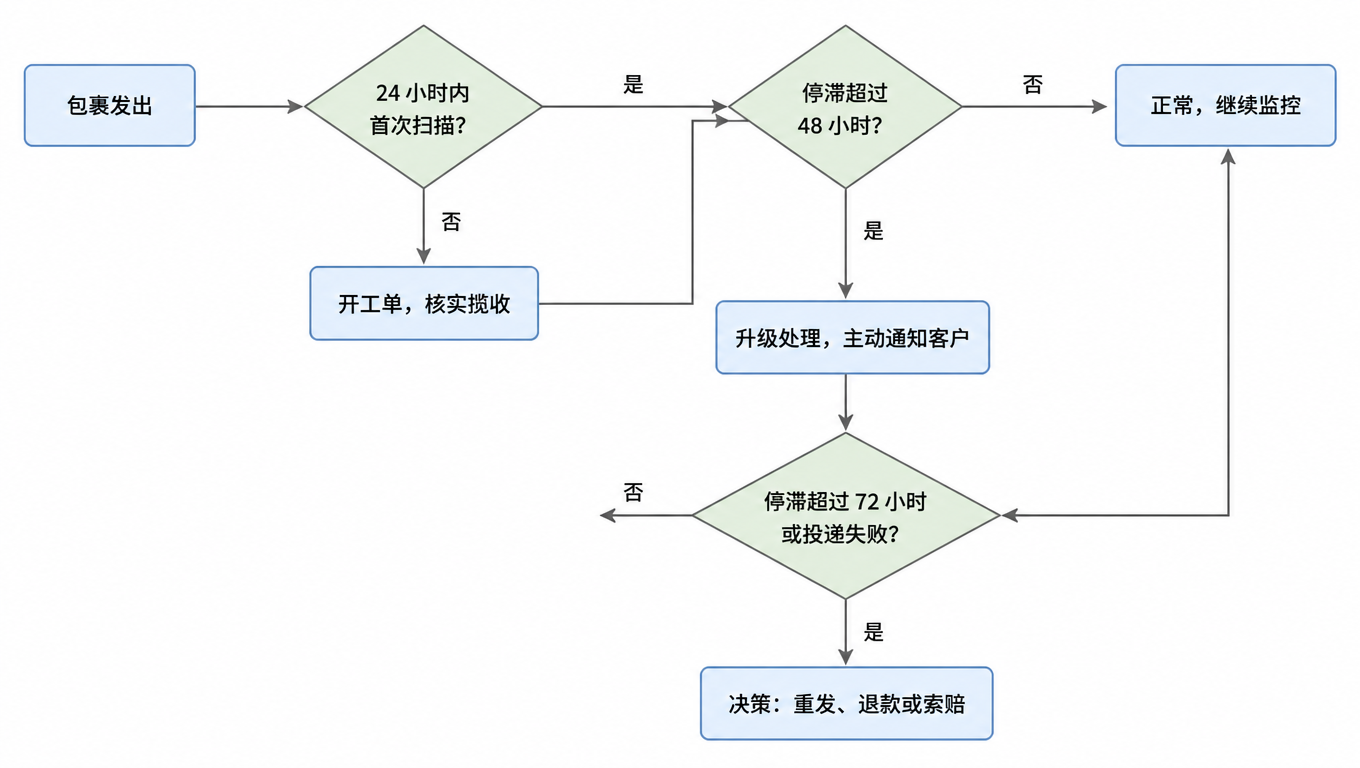
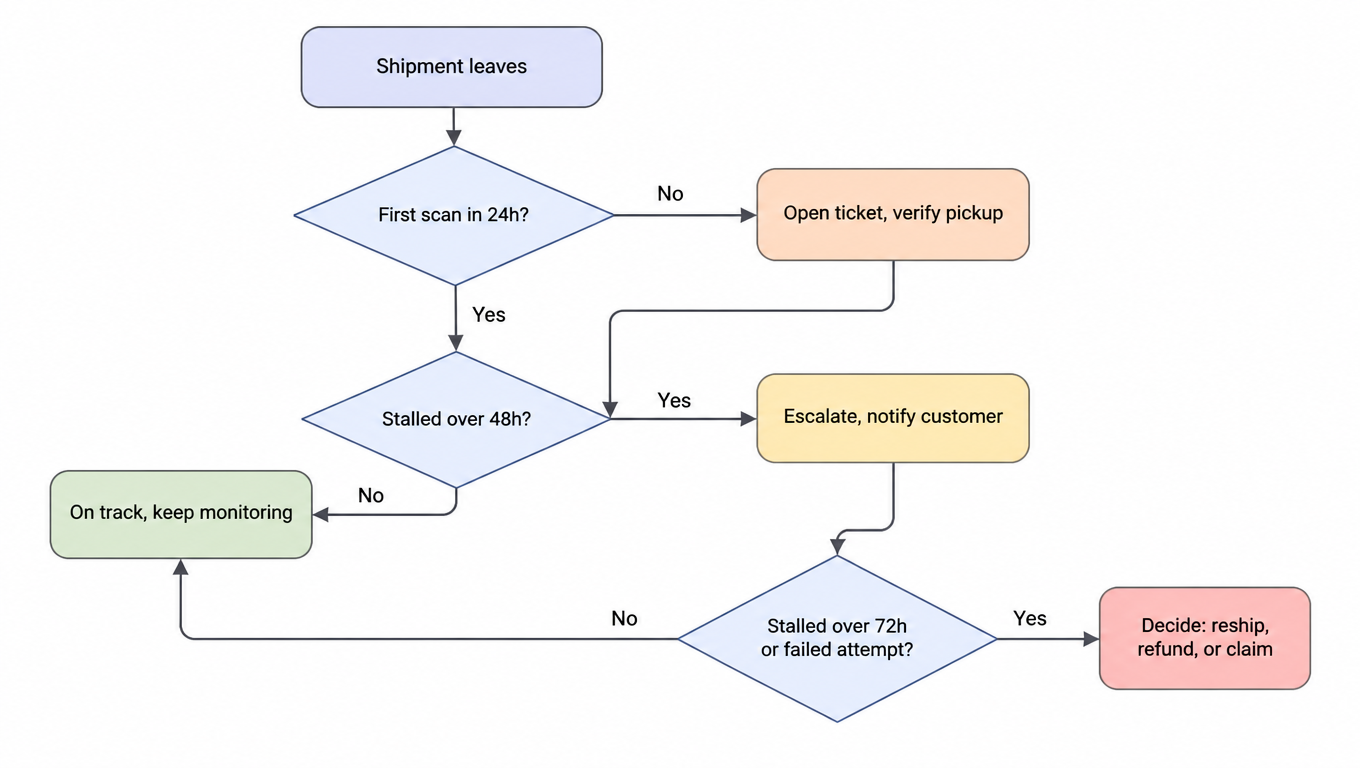
24/48/72 规则把信号 1 到 3 变成你的团队不用想就能跑的决策阶梯:The 24/48/72 rule turns signals 1 through 3 into a decision ladder your team can run without thinking:

决策流程图:包裹发出后 24 小时无首次扫描则开工单并核实揽收,停滞超 48 小时升级并主动通知客户,停滞超 72 小时或投递失败则决策重发、退款或索赔Decision flow: shipment leaves, no first scan in 24h opens a ticket and verifies pickup, stalled over 48h escalates and notifies the customer, stalled over 72h or failed attempt triggers a reship, refund, or claim decision
24 小时开工单,48 小时升级,72 小时做决定Ticket at 24h, escalate at 48h, decide at 72h

24 小时没有首次扫描:向承运商开工单,核实揽收是否发生。48 小时停滞:向承运商升级,并在顾客开口之前主动通知他们。72 小时,或一次投递失败之后:做决定,重发、退款还是索赔。别等顾客来逼你,因为那一刻你已经在为失败额外支付客服时间。At 24 hours without a first scan: open a carrier ticket and verify the pickup happened. At 48 hours stalled: escalate with the carrier and notify the customer proactively, before they ask. At 72 hours, or after a failed delivery attempt: make the call. Reship, refund, or file a claim. Do not wait for the customer to force it, because the moment they do, you are paying support time on top of the failure.

六、贵承运商什么时候反而更便宜?6. When Does the More Expensive Carrier Become Cheaper?

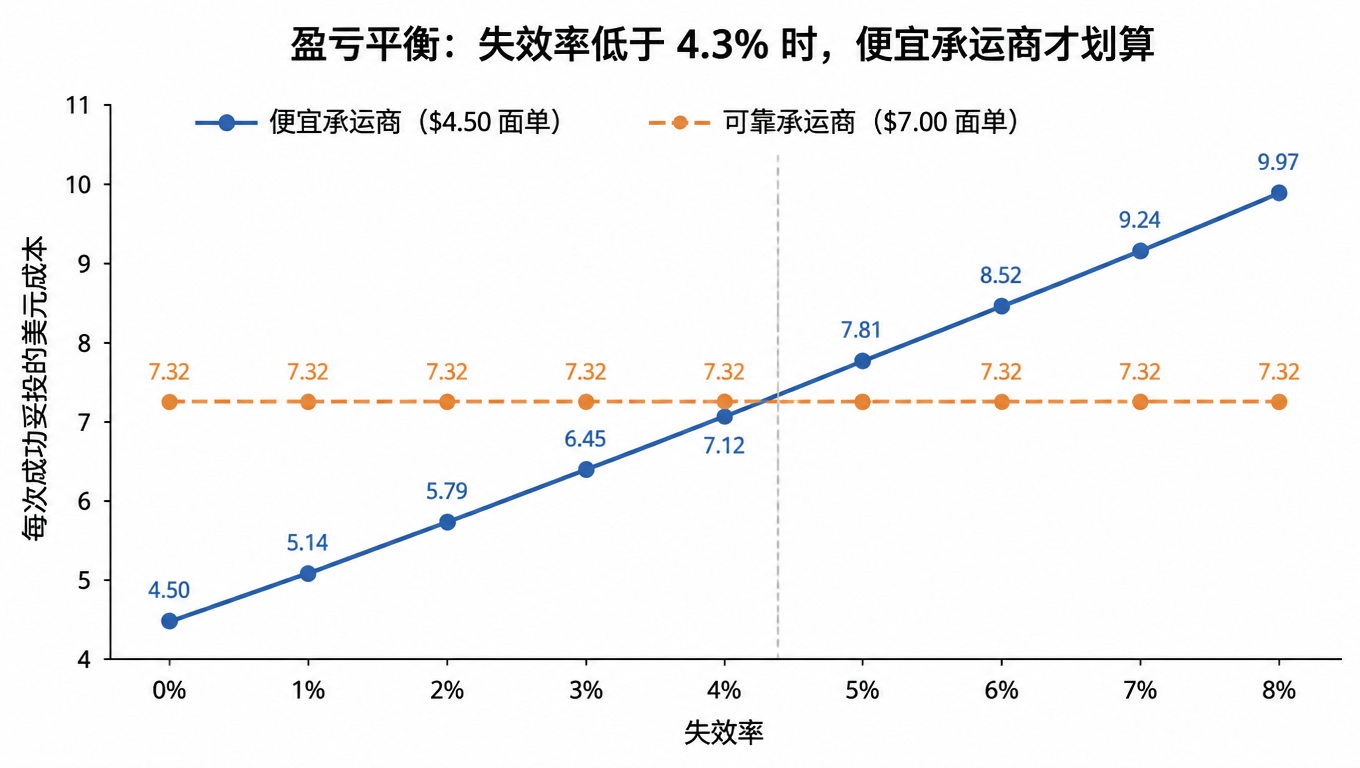
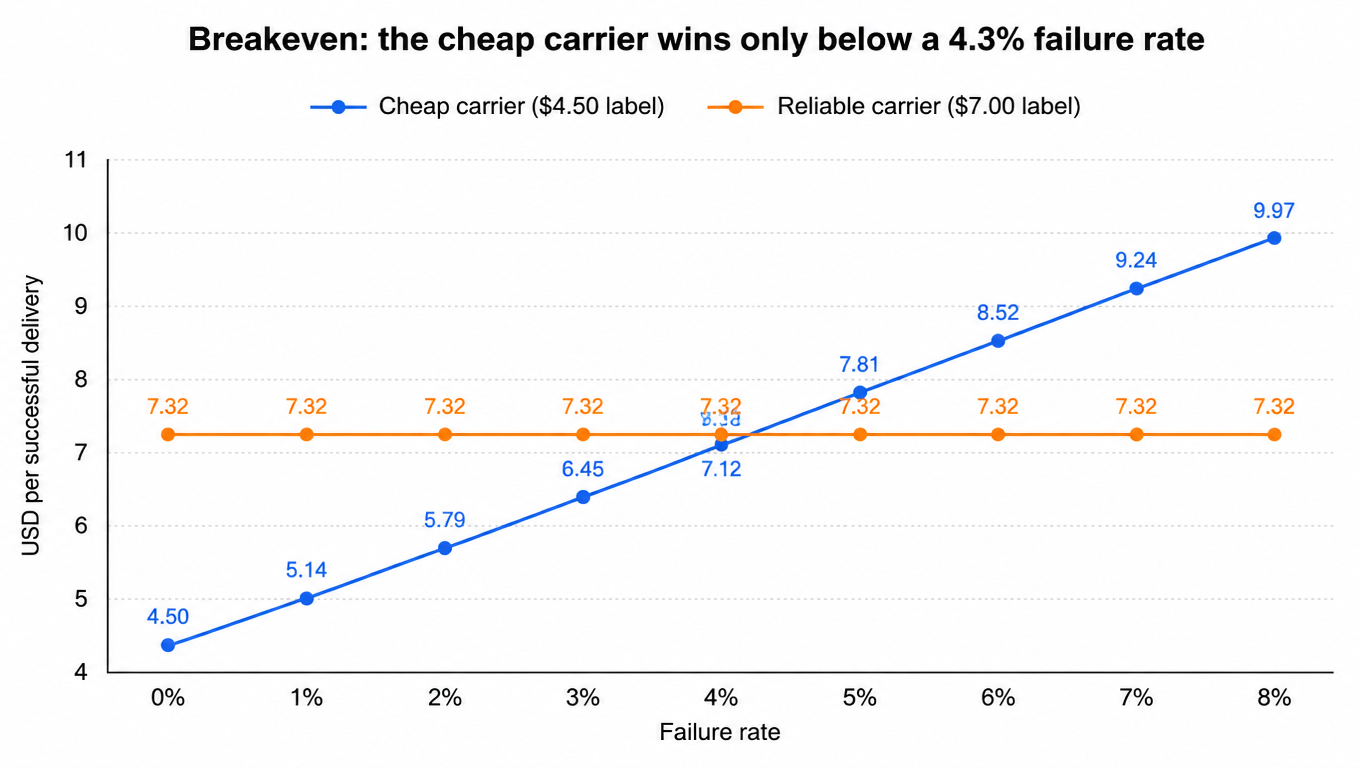
面单上每多花一美元都买到了点什么。问题是买得够不够。下面是上一节两个假设承运商的盈亏平衡:其他变量全部固定,让便宜承运商的失效率从 0% 爬到 8%。Every extra dollar of label price buys something. The question is whether it buys enough. Here is the breakeven for the two hypothetical carriers from the previous section, holding every other variable fixed and letting the cheap carrier's failure rate rise from 0% to 8%.

便宜承运商的 CPSD 从零失败时的 $4.50 起步,随着失败带来重发、客服工时、退款和商品损失而陡峭爬升。可靠承运商的 CPSD 稳定在 $7.32 附近,因为它的失效率几乎不动。两条线在大约 4.3% 的失效率处相交。低于这个点,$4.50 的面单在真实成本上赢;高于这个点,$7.00 的面单才是更便宜的配送。The cheap carrier's CPSD starts at $4.50 with zero failures and climbs steeply as failures add reshipments, support hours, refunds, and lost product. The reliable carrier's CPSD stays flat around $7.32, because its failure rate barely moves. The lines cross at roughly a 4.3% failure rate. Below that, the $4.50 label wins on true cost. Above it, the $7.00 label is the cheaper delivery.

折线图:便宜承运商与可靠承运商的成功妥投成本随失效率上升而变化,两条线在约 4.3% 失效率处相交Line chart: CPSD for cheap and reliable carriers as the failure rate rises, lines cross at roughly a 4.3% failure rate
低于 4.3%,便宜面单赢;高于 4.3%,贵面单才是便宜的Below 4.3% the cheap label wins; above it, the pricier label is the cheap one

大多数店铺从不测量自己的失效率,所以从不知道自己在线的哪一边。这正是重点:在你有数据证明之前,便宜面单不等于便宜配送。让这个权衡对团队更具体的一个办法,是给改进定价。上面的例子里,失效率从 4% 降到 3%,每单避免的 CPSD 大约值 $0.67。如果一条线路的失效率在 4% 以上,多付面单钱不是成本,而是能买到的最便宜的修复。Most stores never measure their failure rate, so they never know which side of the line they are on. That is the whole point: the cheap label is not the cheap delivery until you have the data to prove it. One way to make the trade concrete for your team is to price the improvement. In the example above, moving from a 4% to a 3% failure rate is worth about $0.67 per order in avoided CPSD. If a lane is running above 4%, paying more per label is not a cost, it is the cheapest fix available.

七、30 天承运商试点模板7. A 30-Day Carrier Pilot Template

一夜之间切换承运商,是用一个没测量过的问题换另一个。相反,在单条线路或某个客户群体上跑一个受控的 30 天试点,货量占比 10% 到 20%,让 CPSD 来做决定。Switching carriers overnight is how you swap one unmeasured problem for another. Instead, run a controlled 30-day pilot on a single lane or a customer segment, at 10% to 20% of volume, and let CPSD make the decision.

第 1 到 7 天:基线。拉出每条线路 90 天的历史:面单成本、首次扫描时间、停滞率、首次投递成功率、配送相关的退款和拒付率。算出你今天已有的 CPSD。挑两到三条线路,每条线路配一个挑战者承运商。在第一件试点包裹发出之前把成功指标写下来:这就是退出标准,没有商量余地。Days 1 to 7: baseline. Pull 90 days of history per lane: label cost, first-scan time, stall rate, first-attempt success, and delivery-related refund and chargeback rates. Compute the CPSD you have today. Pick two or three lanes and one challenger carrier per lane. Write the success metrics down before the first pilot shipment goes out: this is the exit criterion, and it is non-negotiable.

第 8 到 21 天:发货试点。把试点线路 10% 到 20% 的货量路由给挑战者。其他一切保持不变,同样的包装、同样的客服流程,唯一的变量是承运商。每周记录五个失败信号,每周结束时按线路算 CPSD。Days 8 to 21: ship the pilot. Route 10% to 20% of each pilot lane's volume to the challenger. Keep everything else identical, same packaging, same support flow, so the only variable is the carrier. Log the five failure signals weekly and compute CPSD per lane at the end of each week.

第 22 到 30 天:用数据决定。在试点线路上计算现役承运商和挑战者的 CPSD。如果挑战者在总 CPSD 上按你预先定义的幅度胜出,把它的货量扩到该线路的 50%,再跑 30 天。如果输了,保留现役承运商。无论哪种结果,你都用几百个包裹的成本学到了东西,这是你跑过的最便宜的承运商调研。Days 22 to 30: decide with data. Compute CPSD for the incumbent and the challenger on the pilot lanes. If the challenger wins on total CPSD by the margin you defined in advance, expand it to 50% of the lane for another 30 days. If it loses, keep the incumbent. Either way you learned something for the cost of a few hundred packages, which is the cheapest carrier research you will ever run.

永远不要在没有先写下退出标准的情况下切换承运商。这个试点就是我们低风险上线新物流流程指南low-risk shipping rollout guide里的低风险模式,应用在单个承运商决策上,而不是整场迁移。Never run a carrier change without an exit criterion written first. This pilot is the low-risk pattern from our 低风险上线新物流流程指南low-risk shipping rollout guide, applied to a single carrier decision instead of a whole migration.

八、计算器 + 可下载表格8. Calculator + Downloadable Spreadsheet

大多数文章以行动号召结尾。这篇以你可以直接复制的资产结尾,因为一个指标只有进了你的电子表格才算数。这篇文章里的一切,开箱即用:Most articles end with a call to action. This one ends with assets you can copy, because a metric only helps once it is in your spreadsheet. Here is everything from this article, ready to use:

  1. 免费成功妥投成本计算器。输入线路成本和失效率,一个视图里得到运营 CPSD、失败负担和该线路的盈亏平衡失效率。Free Cost per Successful Delivery calculator. Input lane costs and failure rates, get operational CPSD, Failure Burden, and your lane's breakeven failure rate in one view.
  2. Google Sheet 模板。计算章节里的逐单日志和线路汇总,公式已预填,你只加数据。Google Sheet template. The per-order log and lane summary from the calculation section, pre-filled with the formulas so you only add data.
  3. 可嵌入的「面单价 vs 真实配送成本」对比图。承运商章节里的对比,直接放进董事会演示、博客文章或给你运营负责人的提案。Embeddable "Cheap Rate vs True Delivery Cost" chart. The comparison from the carrier section, ready to drop into a board deck, a blog post, or a pitch to your operations lead.
  4. 匿名化的样本发货数据。双承运商场景里 1,000 单真实形状的订单,让你在碰自己的数据之前先测公式:折扣区域线路线路 1,000 单、面单支出 $4,500、50 单失败、15 次重发、60 小时客服,总 CPSD $7.81;国家优先线路线路 1,000 单、面单支出 $7,000、5 单失败、2 次重发、6 小时客服,总 CPSD $7.32。Anonymized sample shipping data. One thousand real-shaped orders from the two-carrier scenario above, so you can test the formulas before you touch your own data: the discount regional lane at 1,000 orders, $4,500 label spend, 50 failures, 15 reshipments, and 60 support hours lands at $7.81 total CPSD; the national priority lane at 1,000 orders, $7,000 label spend, 5 failures, 2 reshipments, and 6 support hours lands at $7.32.
  5. 24/48/72 异常处理规则。失败信号章节里的决策阶梯,排版成一页可打印贴在墙上的 SOP。The 24/48/72 exception-handling rules. The decision ladder from the failure-signals section, formatted as a one-page SOP you can print and tape to the wall.
  6. 给团队的一个讨论问题。「你愿意为 1% 更高的妥投成功率多付多少钱?」在大家看到盈亏平衡图之前,让每个人先写下一个数字。答案之间的差距,就是关于更好承运商的真实异议所在。A discussion question for your team. "How much would you pay for 1% higher delivery success?" Have everyone write a number down before they see the breakeven chart. The gap between the answers is where the real objections to better carriers live.

最便宜的面单,只有在妥投时才便宜。测量 CPSD,跑试点,让数据替你选承运商。The cheapest label is only cheap if it delivers. Measure CPSD, run the pilot, and let the data pick your carriers.

九、太长不看版9. TL;DR

  • 面单价格只回答一个问题:把箱子交给承运商要花多少钱。它不回答箱子会不会到、什么时候到。A label price answers one question: what it costs to hand a box to a carrier. Not whether it arrives, or when.
  • 失败把成本搬进看不见的账户:客服、退款、拒付、补发。一张 $4.50 的面单能变成 $18 的运营成本和 $53 的失败负担。Failures move cost into invisible accounts: support, refunds, chargebacks, reshipments. A $4.50 label can become $18 of operating cost and $53 of failure burden.
  • 两本账分开记:运营 CPSD = 履约运营成本 ÷ 成功妥投订单数;失败负担 = 退款 + 拒付 + 未收回商品成本 + 补偿。绝不混算。Keep two ledgers: Operational CPSD = fulfillment operating cost ÷ delivered orders; Failure Burden = refunds + chargebacks + lost product + compensation. Never blend them.
  • 每张面单贵 $2.50 的承运商,每次成功妥投可能反而便宜 $0.49($7.32 vs $7.81)。A carrier $2.50 more per label can be $0.49 cheaper per successful delivery ($7.32 vs $7.81).
  • 盈亏平衡:失效率低于约 4.3% 时便宜承运商赢,高于则贵承运商更便宜。先测量,再下结论。Breakeven: below roughly a 4.3% failure rate the cheap carrier wins; above it, the pricier one is cheaper. Measure before you conclude.
  • 盯住五个失败信号:无首次扫描、追踪延迟、停滞超 48/72 小时、首次投递失败、配送相关退款与拒付率。Watch five signals: no first scan, tracking latency, 48/72-hour stalls, first-attempt failure, and delivery-linked refund and chargeback rates.
  • 切换承运商用 30 天试点:7 天基线、14 天试跑 10-20% 货量、7 天用 CPSD 决策,先写退出标准。Switch carriers via a 30-day pilot: 7 days of baseline, 14 days on 10-20% of volume, 7 days of decision, exit criteria written first.
  • 今天的动作:建一张逐单日志表,按线路算出你的 CPSD,再看自己站在盈亏平衡线的哪一边。One action for today: build the per-order log, compute CPSD by lane, and find out which side of the breakeven line you are on.

常见问题FAQ

CPSD 是把一单成功送到顾客手里的全包成本。它分成两本账:运营 CPSD 等于履约相关运营成本总额除以成功妥投订单数,覆盖拣货打包、包装耗材、出库运费、重投与重发、退货运费、异常处理人工、客服人工和未获赔付的承运商理赔;失败负担等于退款损失加拒付手续费加未收回的商品成本加配送失败后发放的折扣或补偿。两本账分开记,退款和商品成本就永远不会被重复计算。CPSD is the all-in cost of getting one order successfully into a customer's hands. It splits into two ledgers. Operational CPSD equals total fulfillment-related operating cost divided by successfully delivered orders, covering pick-and-pack, packaging, outbound shipping, redelivery and reshipment, return shipping, exception-handling labor, customer-support labor, and unrecovered carrier claims. Failure Burden equals refund losses plus chargeback fees plus unrecovered product cost plus discounts or credits issued after delivery failures. Track the two separately so refunds and product costs are never counted twice.
因为失败会把成本搬进面单价格永远不显示的那些账户:客服工时、退款、拒付手续费、补发商品和顾客好感。一个报 $4.50 却在自己货量里实打实失败一批的承运商不是便宜承运商,而是一个用失败成本向你剩余损益表开票的 $4.50 承运商。本指南的算账示例里,$4.50 承运商每单成功妥投成本 $7.81,$7.00 承运商是 $7.32,每单反而便宜 $0.49。Because failures move cost into accounts the label price never shows: customer-support hours, refunds, chargeback fees, replacement units, and goodwill. A carrier that quotes $4.50 but fails on a meaningful share of volume is not a cheap carrier; it is a $4.50 carrier that invoices the rest of your P&L in failure costs. In this guide's worked example, the $4.50 carrier lands at $7.81 per successful delivery while the $7.00 carrier lands at $7.32, $0.49 cheaper per order.
建一张表,一行一个订单,列包括订单 ID、承运商、线路、面单成本、首次扫描时间、停滞标记、首次投递结果、最终结果、客服分钟数、退款、拒付和折扣,然后按线路求和。运营 CPSD 等于履约运营成本总额除以成功妥投订单数。想要单一总览数字,就先把失败负担加进分子,但两本账分开记,才能看清到底是哪一本在动。Set up a sheet with one row per order and columns for order ID, carrier, lane, label cost, first-scan time, stalled flag, first-attempt result, final result, support minutes, refund, chargeback, and discount, then sum by lane. Operational CPSD is total fulfillment operating cost divided by successfully delivered orders. If you want a single headline number, add Failure Burden to the numerator first, but track both ledgers separately so you can see which one is moving.
当它的失效率低到避开的退款、重发和客服成本超过更高的面单价格时。本指南的盈亏平衡模型里,便宜承运商的 CPSD 从零失败时的 $4.50 起步爬升,可靠承运商稳定在 $7.32 附近,两条线在大约 4.3% 的失效率处相交。低于它,$4.50 的面单在真实成本上赢;高于它,$7.00 的面单才是更便宜的配送。大多数店铺从不测量失效率,所以从不知道自己站在哪一边。When its failure rate is low enough that avoided refunds, reshipments, and support outweigh the higher label price. In this guide's breakeven model the cheap carrier's CPSD climbs from $4.50 at zero failures and the reliable carrier holds flat near $7.32; the lines cross at roughly a 4.3% failure rate. Below it the $4.50 label wins on true cost, above it the $7.00 label is the cheaper delivery. Most stores never measure their failure rate, so they never know which side they are on.
按线路、按周盯住这五个:揽收 24 小时内没有首次扫描、追踪上传延迟、追踪停滞超过 48/72 小时、首次投递失败、与配送问题挂钩的退款和拒付率。24/48/72 规则把它们变成一条决策阶梯:24 小时没有扫描就开工单,48 小时停滞就升级并主动通知顾客,72 小时或一次投递失败之后就做决定:重发、退款还是索赔。Track these per lane every week: no first scan within 24 hours of pickup, tracking upload latency, tracking stalled over 48/72 hours, first-attempt delivery failure, and the refund and chargeback rate linked to delivery issues. The 24/48/72 rule turns them into a decision ladder: open a carrier ticket at 24 hours without a scan, escalate and notify the customer at 48 hours stalled, and decide between reship, refund, or claim at 72 hours or after a failed attempt.
Get Rate Comparison
Get Rate Comparison