尾程配送 · 成本拆解Last-Mile Delivery · Cost Breakdown

尾程配送的真实成本:电商品牌到底为每单付了多少钱The True Cost of Last-Mile Delivery: What Ecommerce Brands Actually Pay

费率表上写着「from $6.50」,你的账单上却写着 $17.25,而且这还是在燃油附加费飙升的那一周到来之前。广告价和实际从你银行账户流出去的钱之间的差距,不是运气不好,而是尾程配送的设计本身:它是电商供应链里最贵的一环,也是大多数品牌悄悄丢掉利润的地方。The rate card says "from $6.50." Your invoice says $17.25, and that is before the week the fuel surcharge spikes. The gap between advertised rates and what actually leaves your bank account is not bad luck. It is the design of last-mile delivery, the single most expensive segment of the ecommerce supply chain, and the place where most brands quietly lose margin.

这篇指南从头到尾走完这个差距。前半部分逐行解码账单,并给出按包裹重量、分区和品类划分的基准数字。后半部分是一套四步行动手册:审计你的账单、像大客户一样谈判、切换多承运商、砍掉隐性成本。最后是一个简单的成本模型,今天下午就能用你自己的数字跑起来。This guide walks through that gap end to end. The first part decodes the invoice line by line and gives you benchmarks by parcel weight, zone, and category. The second part is a four-step playbook: audit your bills, negotiate like a volume shipper, go multi-carrier, and kill the hidden costs. At the end there is a simple cost model you can run on your own numbers this afternoon.

黄昏时分,配送员在美国郊区一户人家门口把一个小包裹递给客户,门口叠着几个贴了标签的箱子,暖色路灯
广告价是开始,账单才是真相The rate card is the beginning; the invoice is the truth

一、全景:为什么尾程吃掉你一半的运费支出1. The Big Picture: Why Last Mile Eats Half Your Shipping Spend

尾程是包裹脱离整柜货运、变成一个人、一辆车、一个门牌号的那一刻。这种「人对人」的经济结构正是它昂贵的原因:每一站都背着人力、车辆、燃油和路线时间这些固定成本,任何合并装载都抹不平。独立研究多年来一直把尾程放在总配送成本的 40% 到 53% [^1],而电商只会把这个占比推得更高,因为电商几乎全是住宅配送,而住宅配送是世上最贵的配送。Last mile is the moment your parcel stops being part of a trailer full of freight and becomes one person, one truck, one doorstep. That person-to-person economics is why it is so expensive: every stop carries fixed costs for labor, vehicle, fuel, and route time that no amount of consolidation can smooth away. Independent studies have put last mile at 40% to 53% of total delivery cost for years [^1], and ecommerce has only pushed the share up, because ecommerce is overwhelmingly residential delivery, and residential delivery is the most expensive delivery there is.

广告上的数字是虚构的。当承运商为一件 3 磅的地面件打出「from $6.50」,这个价格假设的是商业地址、近距分区、什么都不附加。你的真实订单是住宅件,所以你要付大约 $6.50 的住宅附加费 [^2]。它走的分区很少是最便宜的,还背着随周浮动的燃油附加费,通常占基础费率的 15% 到 25% [^3]。再加一个偏远邮编,配送区域附加费就是 $4.80 到 $17 [^4]。大多数 DTC 品牌的单件全包成本落在 $10 到 $15 甚至更高,而到了 11 月和 12 月,每件 $1.55 到 $8.75 的旺季附加费还要叠上去 [^5]。The advertised number is a fiction. When a carrier publishes "from $6.50" for a 3 lb ground parcel, that price assumes a commercial address, a close zone, and nothing attached. Your real order is residential, so you pay the residential surcharge of roughly $6.50 [^2]. It travels at a zone that is rarely the cheapest, and it carries a fuel surcharge that floats at 15% to 25% of the base rate depending on the week [^3]. Add a rural ZIP and the delivery area surcharge lands at $4.80 to $17 [^4]. Most DTC brands end up paying $10 to $15 or more per parcel all-in, and during November and December, peak surcharges of $1.55 to $8.75 per package land on top [^5].

这也是整条链路里唯一会在失败上亏钱的一环。首次投递失败意味着卡车要再跑一趟,那一站的成本大约翻倍 [^6]。一次退货意味着包裹跑两趟。而且附加费的结构决定了:谈判筹码最少的品牌,也就是中小卖家,付的是最高的实际费率。看懂这个结构,是修好它的第一步。This is also the only segment of the chain that loses money on failure. A missed first delivery means the truck comes back, which roughly doubles the cost of that stop [^6]. A return means the parcel makes the trip twice. And the surcharges are structured so that the brands with the least negotiating leverage, the small and mid-size shippers, pay the highest effective rates. Understanding that structure is the first step to fixing it.
二、尾程账单解剖:每一行都代表什么2. Anatomy of a Last-Mile Invoice: Every Line Item, Decoded

打开一张承运商账单,基础费率往往不到你欠款的一半。基础费率下面每一行,都是承运商单独做的一个定价决定,而每一行的可谈程度、可规避程度都不一样。下面逐一说明每一行到底是什么。Open a carrier invoice and the base rate is often less than half of what you owe. Every line below that is a separate pricing decision the carrier made, and each one is negotiable or avoidable to a different degree. Here is what each line actually is.

基础分区与重量费率。按包裹重量和距离区间计算的每磅费率,这是费率表上唯一显示的数字。住宅附加费。每件大约 $6.50,因为送到家里而不是公司 [^2],几乎全部电商货量都要付。燃油附加费。基础费率的一个周浮动百分比,通常 15% 到 25%,挂钩柴油价格 [^3]。你谈不掉它,但你可以预判它。体积重(DIM)。承运商按实际重量和体积重中较大者计费,体积重等于长 × 宽 × 高除以 139(地面件)[^7]。一个过大的箱子能在过秤之前就把账单翻倍。地址修正费。面单地址与有效地址不匹配时,每次大约 $21 到 $25 [^8]。配送区域附加费(DAS)。承运商认为偏远或难送的邮编,$4.80 到 $17 [^4]。旺季附加费。11 月到 12 月窗口期内,每件 $1.55 到 $8.75 [^5]。Base zone and weight rate. The per-pound rate for your parcel's weight and distance band. This is the only number the rate card shows you. Residential surcharge. Roughly $6.50 per parcel for delivery to a home instead of a business [^2]. Nearly all ecommerce volume pays it. Fuel surcharge. A weekly percentage of the base rate, usually 15% to 25%, indexed to diesel prices [^3]. You cannot negotiate it away, but you can see it coming. Dimensional weight (DIM). Carriers bill the larger of actual weight and dimensional weight, where dimensional weight equals length × width × height divided by 139 for ground [^7]. An over-sized box can double your bill before it is even weighed. Address correction. Around $21 to $25 every time the label does not match a valid address [^8]. Delivery area surcharge (DAS). $4.80 to $17 for ZIP codes the carriers consider remote or hard to serve [^4]. Peak surcharges. $1.55 to $8.75 per parcel during the November to December window [^5].

最让品牌意外的账单项目根本不在发出的账单上,而是退货。服饰品牌通常有 20% 到 40% 的订单会退回来 [^9],而每一单退货在检查、重新包装、重新上架之前,就要花掉 $20 到 $30 处理 [^10]。对高退货品类来说,退货悄悄加进你真实单均成本里的钱,可能比所有附加费加起来还多。The line that surprises most brands is not on the outbound invoice at all. It is the return. Apparel brands routinely see 20% to 40% of orders come back [^9], and each return costs $20 to $30 to process [^10], before inspection, repackaging, and restocking add on top. For a high-return category, returns can quietly add more to your true cost per order than every surcharge combined.

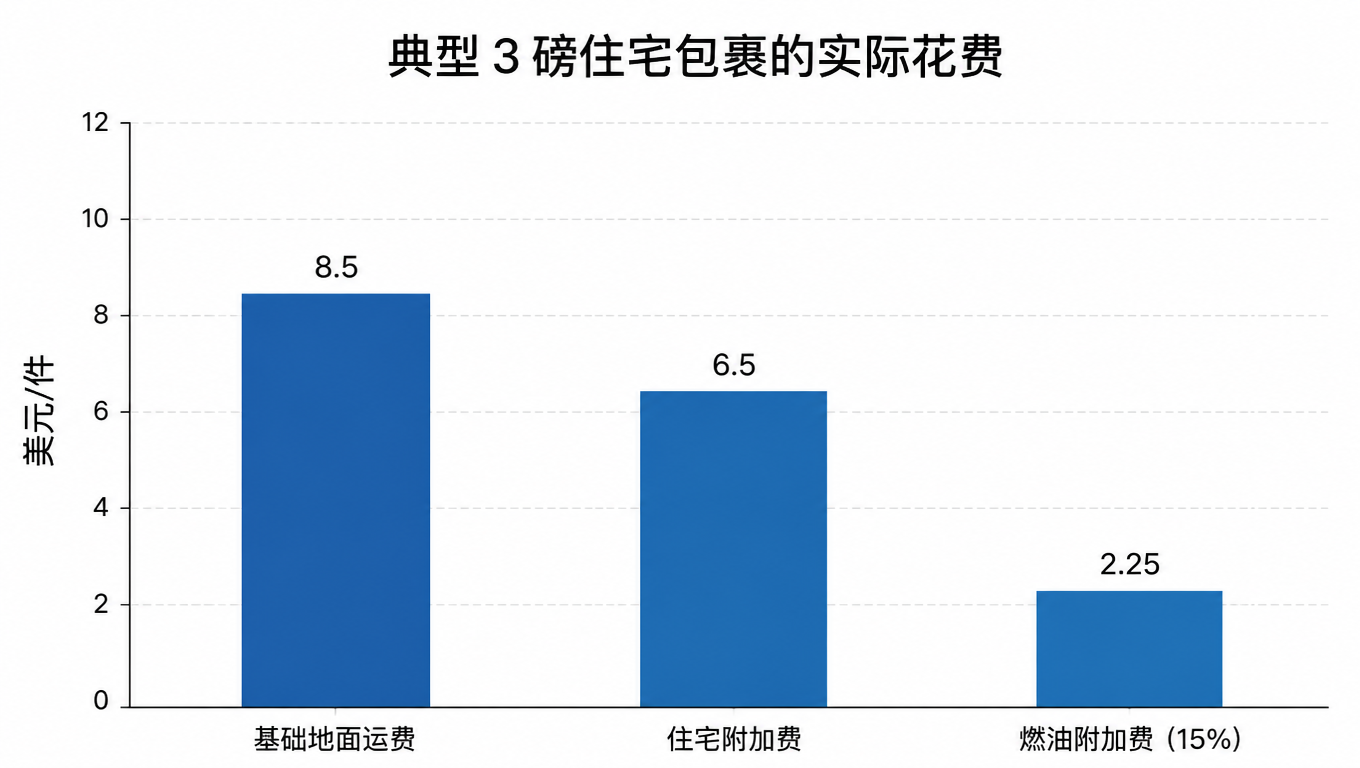
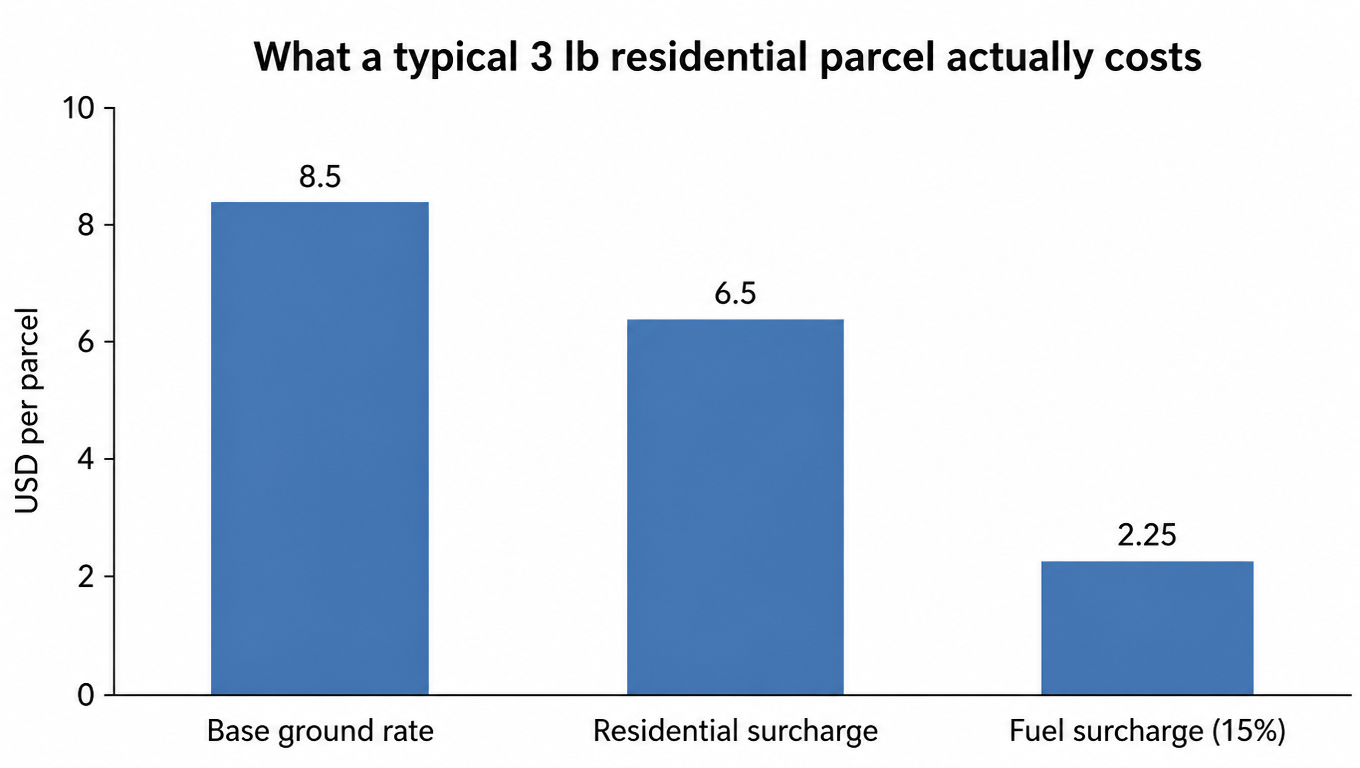
拿一件有代表性的订单:一件 3 磅的包裹,送到 zone 5 的住宅地址,年中走国家承运商。账单拆开是这样:Take a representative order: a 3 lb parcel to a residential address in zone 5, shipped mid-year on a national carrier. The invoice breaks down like this:

柱状图:典型 3 磅住宅包裹的成本构成,基础地面运费 8.5 美元、住宅附加费 6.5 美元、燃油附加费 2.25 美元,合计 17.25 美元Bar chart: what a typical 3 lb residential parcel costs, base ground rate 8.5, residential surcharge 6.5, fuel surcharge 2.25, total 17.25
基础费率不到真实成本的一半The base rate is less than half the real cost

也就是 $8.50 基础费率、$6.50 住宅附加费、15% 燃油折算 $2.25,合计 $17.25。基础费率,也就是你比价时看的那个数字,只占真实成本的一半不到。其余每一美元都是利润流失的地方。That is $8.50 of base rate, $6.50 of residential surcharge, and $2.25 of fuel at 15%, for a total of $17.25. The base rate, the number you compare when you shop for a carrier, is just under half of the real cost. Everything else is where the margin goes.

三、品牌实际付了多少钱:按订单画像的基准数字3. What Brands Actually Pay: Benchmarks by Order Profile

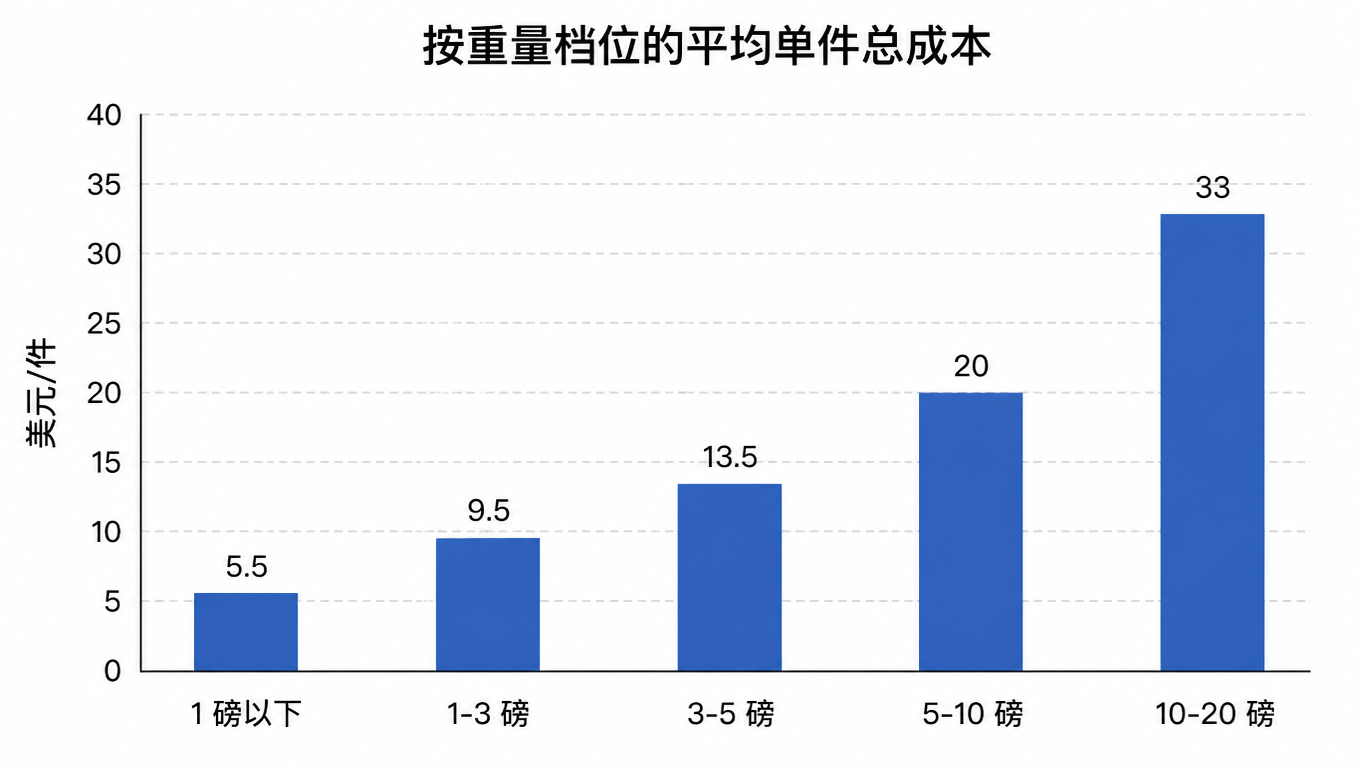
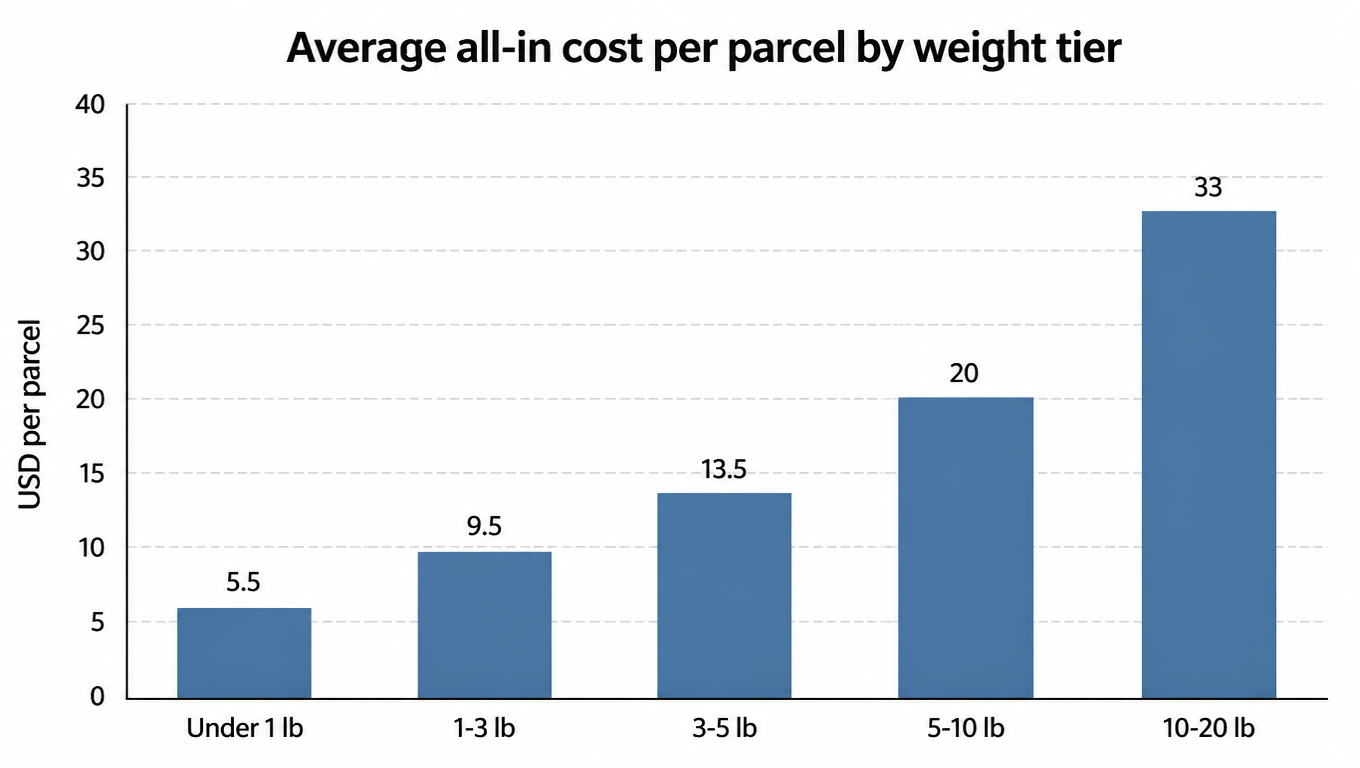
单件全包成本跟着重量走的程度,超过其他任何单一因素。下面这些是 zone 2 到 6、国家承运商住宅配送的年中典型平均值,不含旺季附加费 [^15]:The all-in cost per parcel tracks weight more than any other single factor. These are typical averages across zones 2 to 6 for residential delivery with a national carrier, mid-year, no peak surcharges [^15]:

柱状图:按重量档位的平均单件总成本,1 磅以下 5.5 美元、1-3 磅 9.5 美元、3-5 磅 13.5 美元、5-10 磅 20 美元、10-20 磅 33 美元Bar chart: average all-in cost per parcel by weight tier, under 1 lb 5.5, 1-3 lb 9.5, 3-5 lb 13.5, 5-10 lb 20, 10-20 lb 33
单件总成本几乎完全跟着重量走All-in cost per parcel tracks weight more than anything else

1 磅以下走 USPS 轻小件产品大约 $5.50。1 到 3 磅档,大多数服饰、美妆和配件订单所在的位置,大约 $9.50。3 到 5 磅档大约 $13.50,5 到 10 磅档大约 $20,10 到 20 磅平均 $33 甚至更高。品类差异大多归结于产品落在哪个档:服饰轻但退货重,美妆轻但客单价高,电子产品因为包装而体积重超标,家居类则坐在最贵的重货档里。Under 1 lb runs about $5.50 on USPS light-parcel products. The 1 to 3 lb band, where most apparel, beauty, and accessories orders live, lands around $9.50. The 3 to 5 lb band runs about $13.50, the 5 to 10 lb band about $20, and 10 to 20 lb parcels average $33 or more. Category differences mostly come down to which band the product falls into: apparel is light but return-heavy, beauty is light with high average order value, electronics are DIM-heavy because of packaging, and home goods sit in the expensive heavy tiers.

距离是第二个杠杆。同一件包裹,zone 2 配送比 zone 8 便宜得多,常常便宜 $5 到 $10,因为承运商让卡车离仓库更近。这正是区域承运商能在短途上击败国家网络的原理,也解释了为什么你的分区结构,也就是订单中离履约仓较近的那部分占比,是你成本模型里最重要的数字之一。Distance is the second lever. A zone 2 delivery is dramatically cheaper than a zone 8 delivery, often $5 to $10 less on the same parcel, because the carrier keeps the truck closer to the warehouse. That zone geography is exactly why regional carriers are able to undercut the national networks on short routes, and why your zone mix, the share of orders that stay close to your fulfillment location, is one of the most important numbers in your cost model.

第二部分:可执行的优化路线图Part 2: The Optimization Roadmap

四步走完:先像审计师一样读账单,再像大客户一样谈判,然后把包裹交给对的承运商,最后砍掉那些隐性成本。Four steps: read your invoice like an auditor, negotiate like a volume shipper, match the parcel to the carrier, then cut the hidden costs.

四、第 1 步:像审计师一样读账单4. Step 1: Read Your Invoice Like an Auditor

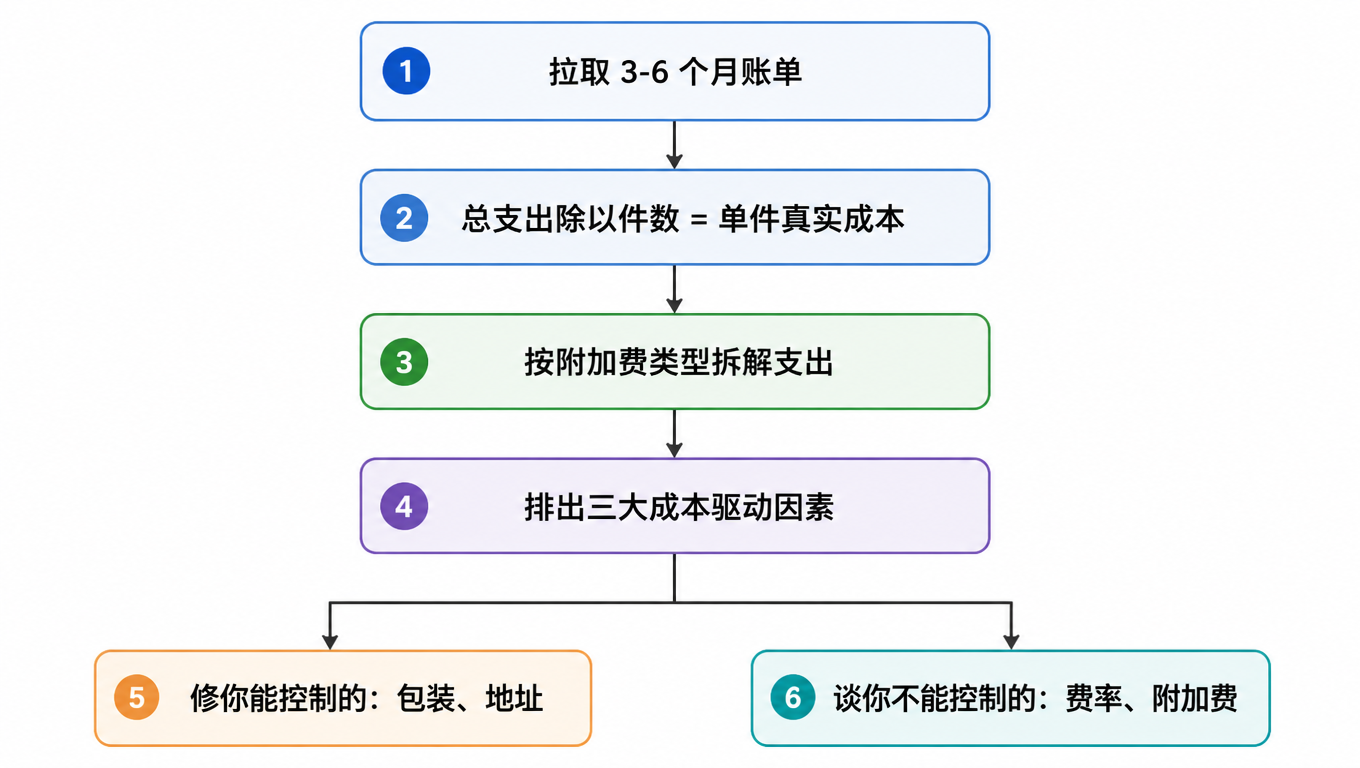
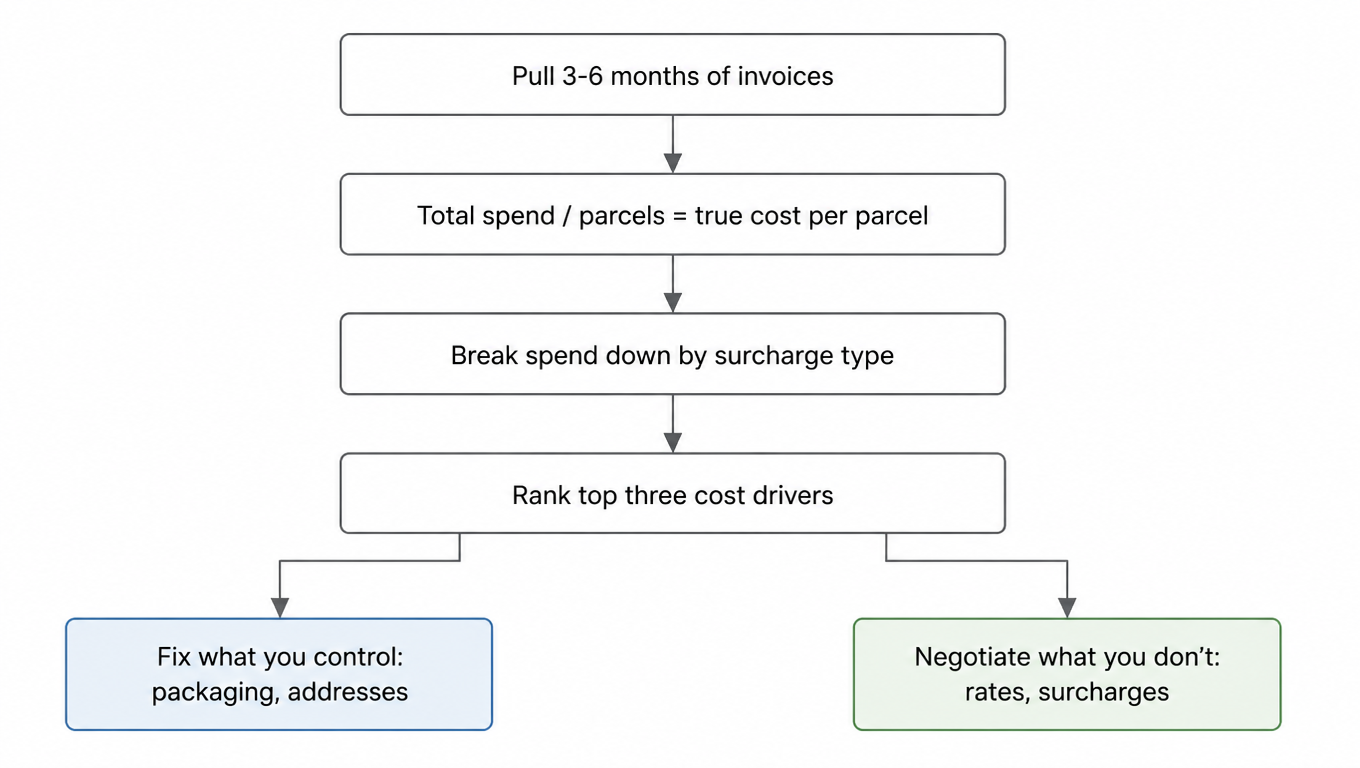
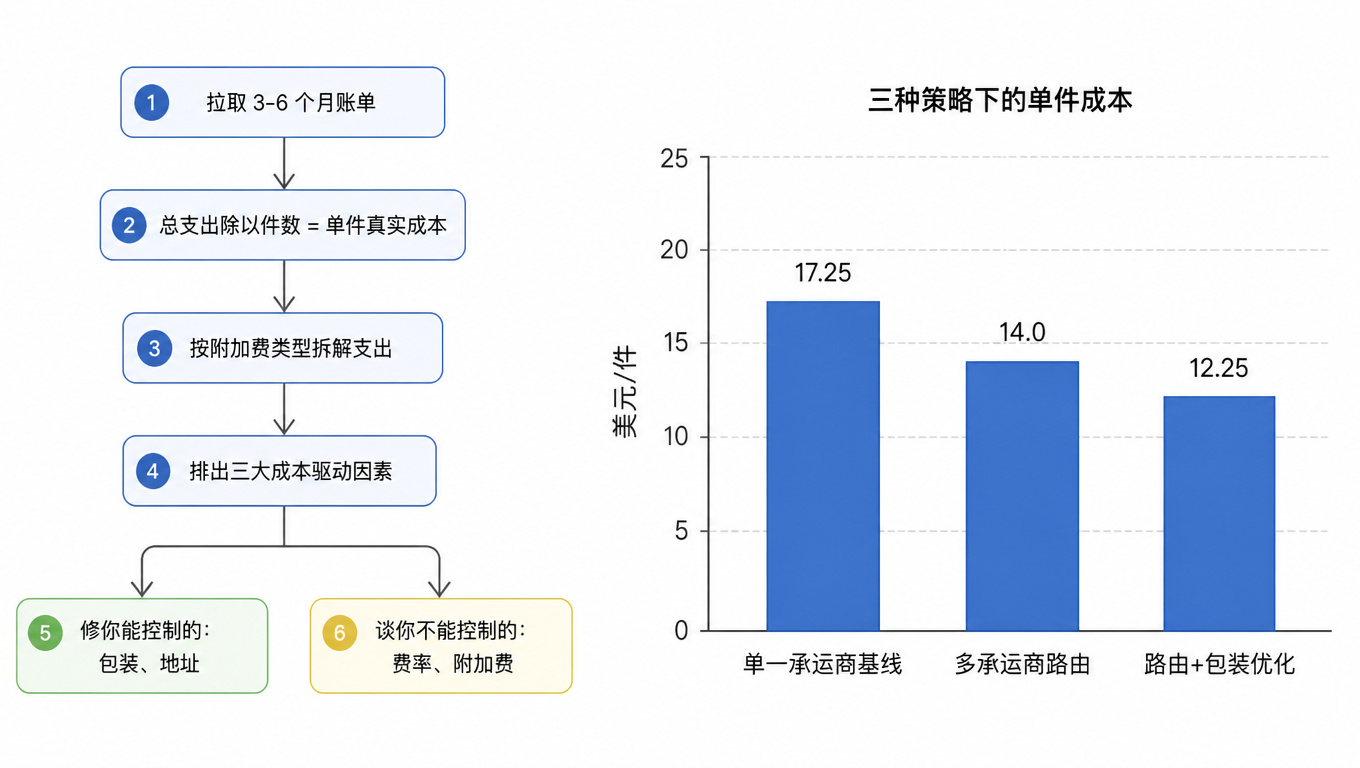
在谈任何东西之前,你需要一个代表现实的数字。拉出最近 3 到 6 个月的承运商账单,算出你的真实单件成本:承运商总支出除以发出件数。不是费率卡上的费率,不是发货软件显示的单件均价,而是账单上的实际总额。对大多数品牌来说,这个数字比他们以为自己在付的高出 30% 到 50%。Before you negotiate anything, you need a number that represents reality. Pull the last 3 to 6 months of carrier invoices and compute your true cost per parcel: total carrier spend divided by parcels shipped. Not the rate card rate, not the per-parcel average your shipping software shows, the actual total from the invoices. For most brands this number is 30% to 50% above what they thought they were paying.

然后把支出按附加费类型拆开。典型的三大成本杀手依次是体积重、地址修正费和燃油,而且每一个的修法都不同。体积重靠改包装解决,地址修正费在结账环节解决,燃油是市场费率,靠路由和时机来管理。账单错误也会在这里现形:费率归类错误、体积重除数错误、以及本应豁免的包裹被加了附加费。承运商犯这类错误的频率,高到一次审计通常能自己回本:审计机构一般能在任意计费周期里,从发票金额中找出 2% 到 8% 可退款的错误 [^11]。Then break that spend down by surcharge type. The typical top three cost killers are dimensional weight, address corrections, and fuel, in that order, and each one has a different fix. DIM is fixed by packaging changes. Address corrections are fixed at checkout. Fuel is a market rate you manage by routing and timing. Billing errors also surface here: rate misclassification, wrong DIM divisors, and surcharges applied to parcels that should be exempt. Carriers make these mistakes often enough that an audit routinely pays for itself: audit firms typically find 2% to 8% of invoice value sitting in refund-eligible errors at any given billing cycle [^11].

审计流程图:拉取 3-6 个月账单,总支出除以件数得到单件真实成本,按附加费类型拆解,排出三大成本驱动因素,分头解决能控制的(包装、地址)和要谈判的(费率、附加费)Audit flow: pull 3-6 months of invoices, total spend divided by parcels equals true cost per parcel, break down by surcharge type, rank top three drivers, fix what you control (packaging, addresses) and negotiate what you don't (rates, surcharges)
先算真实数字,再排驱动因素,最后分头解决Establish the true number, rank the drivers, then fix what you control and negotiate the rest

按这个顺序做审计:先确立真实数字,再排出驱动因素,然后把修复方案分成内部能做的和要拿去跟承运商谈的两类。Work the audit in that order: establish the true number, rank the drivers, then split fixes into the ones you can do internally and the ones you take to the carrier.

五、第 2 步:即使不是大客户,也要像大客户一样谈判5. Step 2: Negotiate Like a Volume Shipper (Even If You're Not)

大多数小品牌以为承运商折扣是每月发 10,000 件的大客户专属。并不是。承运商按账户定价,不按某个公开门槛,一通 20 分钟的电话,哪怕你每月只有几百件,也能推动你的费率。开口要列表价折扣,问下一档货量解锁什么,请对方陪你过一遍最近的账单。光是对账单的过程,就常常能浮出对方会默默冲销的行目。Most small brands assume carrier discounts are reserved for brands shipping 10,000 parcels a month. They are not. Carriers price to the account, not to a public threshold, and a 20-minute call with your account representative can move your rate even at a few hundred parcels a month. Ask for a discount off list, ask what the next tier of volume unlocks, and ask them to walk your last invoice with you. The walkthrough alone often surfaces line items they will quietly credit.

现实能谈到的幅度:小卖家通常谈到列表价 5% 到 10% 的折扣。货量起来后,20% 到 30% 很常见,最大的客户还会在基础折扣之上谈到附加费豁免和封顶。你手里最强的筹码是一份竞品报价。向另一家国家承运商和一家区域承运商各要一份针对你分区结构的报价,然后把三份报价一起摆到你的现有承运商面前。What you can realistically get: small shippers typically negotiate 5% to 10% off list. As volume builds, 20% to 30% is common, and the largest accounts negotiate surcharge waivers and caps on top of base discounts. The strongest leverage you have is a competing quote. Get a rate quote from the other national carrier and from a regional carrier for your zone mix, then bring all three to your incumbent.

如果你太小,引不起承运商的注意,就借用别人的货量。与国家承运商直接谈判,现实上需要专属客户经理和每年数万美元的支出 [^12]。Shippo、ShipStation 这类发货平台把谈好的承运商折扣转售给任何账户,没有货量要求 [^13];3PL 则把成千上万个品牌的货量并进一份合同。代价是每张面单的平台费,但对每月几百件的品牌来说,平台价通常比你自己谈出来的好。旺季附加费是最抗拒谈判的一行,因为它对网络内每个账户一视同仁。可谈的是周围的合同条款:最低货量承诺、账单条款,某些情况下如果你的货量集中在旺季早期,还能拿到部分旺季豁免。先在其他每一行上使劲。If you are too small to command a carrier's attention, borrow someone else's volume. Direct negotiation with the national carriers realistically needs a dedicated account manager and tens of thousands of dollars in annual spend [^12]. Shipping platforms like Shippo and ShipStation resell negotiated carrier rates to any account with no volume requirements [^13], and a 3PL consolidates thousands of brands' volume into one contract. The trade-off is a per-label fee, but for a brand doing a few hundred parcels a month, the platform rate is usually better than anything you can negotiate yourself. Peak surcharges are the one line item that resists negotiation, because they apply to every account in the network. What is negotiable is the surrounding contract: minimum volume commitments, invoice terms, and in some cases a partial peak waiver if your volume is concentrated in the early part of the season. Push on everything else first.

六、第 3 步:多承运商路由:把包裹交给对的承运商6. Step 3: Go Multi-Carrier: Match the Parcel to the Carrier

单一承运商策略是让一套定价模型套在你发的每一件包裹上。轻件按重件计价,短途按长途计价,你为永远不离开本区域的配送付国家网络的费率。多承运商路由就是修这个:把每件包裹交给成本结构最合适的承运商。A single-carrier strategy forces one pricing model onto every parcel you ship. Light parcels get priced like heavy ones, short hops get priced like long ones, and you pay national-network rates for deliveries that never leave your region. Multi-carrier routing fixes that by matching each parcel to the carrier whose cost structure fits it.

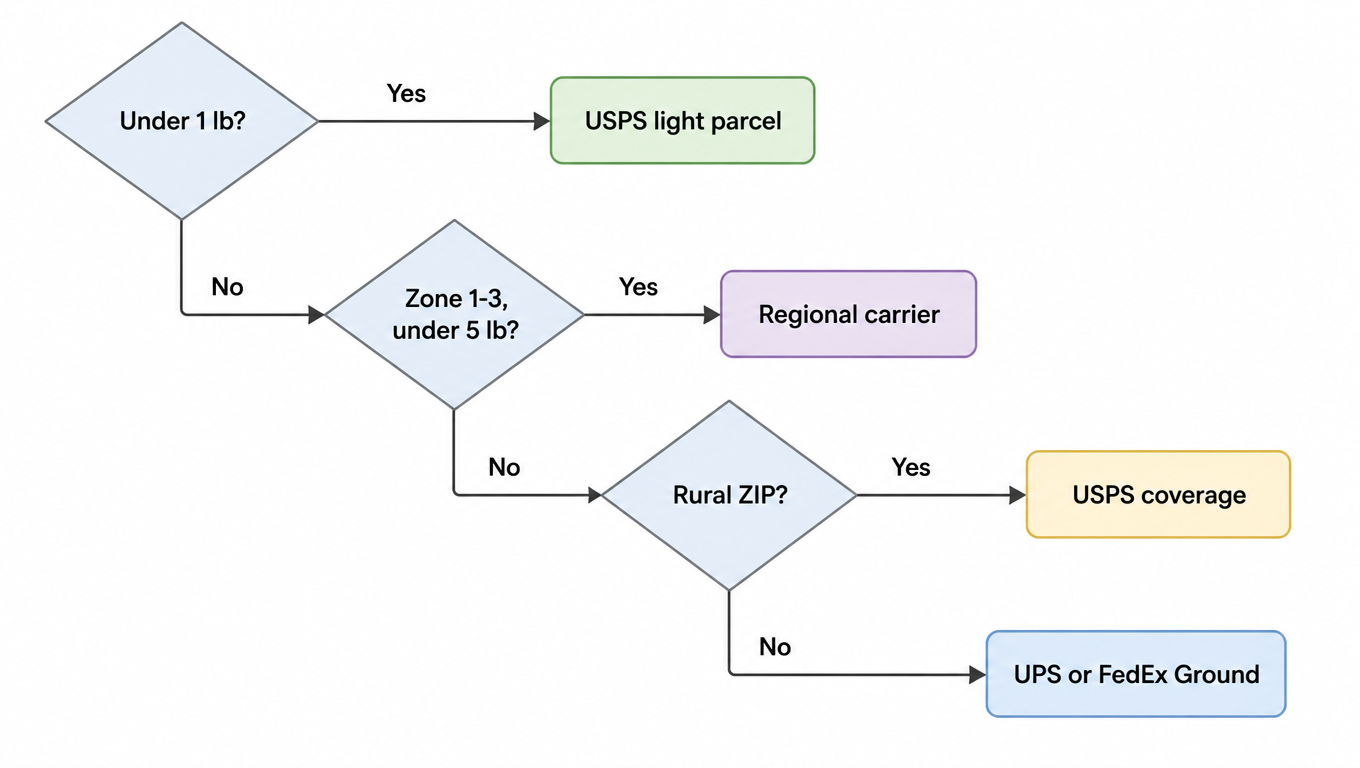
基本逻辑:1 磅以下的轻件走 USPS,它的信件和轻件网络是全美最便宜的选择。重件或长分区件走 UPS 或 FedEx Ground,它们的密度和分拣规模能摊平成本。短分区件走 OnTrac、GLS 这类区域承运商,因为卡车从不离开本区域,它们通常比国家网络便宜 10% 到 30% [^14]。如果你的分区结构偏向仓库周边,区域承运商可能是你现有最大的一笔单项削减。The basic logic: USPS for light parcels under 1 lb, where its letter and light-parcel network is the cheapest option in the country. UPS or FedEx Ground for heavy or long-zone parcels, where their density and sorting scale pay off. And regional carriers such as OnTrac and GLS for short-zone deliveries, where they are typically 10% to 30% cheaper than the national networks because their trucks never leave the region [^14]. If your zone mix skews close to your warehouse, regional carriers can be the single biggest line-item reduction available.

路由决策树:1 磅以下走 USPS 轻小件;Zone 1-3 且 5 磅以下走区域承运商;偏远邮编走 USPS 覆盖;其余走 UPS 或 FedEx GroundRouting decision tree: under 1 lb to USPS light parcel, zone 1-3 under 5 lb to regional carrier, rural ZIP to USPS coverage, otherwise UPS or FedEx Ground
把每件包裹交给成本结构最合适的承运商Match each parcel to the carrier whose cost structure fits it

条件很重要。只有足够多的货量落在区域承运商的覆盖范围内,折扣才成立,所以切换之前先查它们的邮编覆盖。而且多承运商确实增加运营摩擦:面单、轨迹、退货都要跨承运商工作。大多数发货平台原生支持这一点,这也是为什么这个策略对几乎任何规模的品牌都可行。The conditions matter. Regional carriers earn their discount only if enough of your volume sits in their footprint, so check their ZIP coverage before switching anything. And multi-carrier does add operational friction: label generation, tracking, and returns each need to work across carriers. Most shipping platforms handle this natively, which is why the strategy is practical for brands of almost any size.

七、第 4 步:砍掉隐性成本(体积重、地址、退货)7. Step 4: Cut the Hidden Costs (DIM, Address, Returns)

体积重是最容易缩水的大账单,因为它纯粹是个包装问题。一件 1 磅的产品装在 12 × 10 × 8 英寸的箱子里,按 960 立方英寸除以 139 计费,也就是 6.9 磅,于是你为运送一件 1 磅的产品付 7 磅的钱。把箱子改到合适尺寸,产品允许就换 poly 气泡袋,同一订单就掉到 1 到 3 磅档。对每月发 1,000 件的品牌来说,跨两档的降级一年值几千美元,产品没变、承运商没变。Dimensional weight is the easiest large bill to shrink, because it is purely a packaging problem. A 1 lb product shipped in a 12 × 10 × 8 inch box bills at 960 cubic inches divided by 139, or 6.9 lb, so you pay for a 7 lb parcel to move a 1 lb product. Right-size the box, switch to a poly mailer where the product allows, and that same order drops to the 1 to 3 lb band. For a brand doing 1,000 parcels a month, a two-band drop is worth thousands of dollars a year with no change to the product or the carrier.

地址修正费是第二个静默的漏点,每次 $21 到 $25 [^8]。修法在结账环节:发货前用 USPS 数据校验地址,要求邮编和街道匹配,在拼写错误变成面单之前拦住它。一层好的校验通常能消灭大部分修正费,同时还能提高投递成功率。Address corrections are the second silent leak at $21 to $25 every time they happen [^8]. The fix belongs at checkout: validate addresses against USPS data before the order ships, require a ZIP and street match, and catch typos before they become labels. A good validation layer typically eliminates the majority of correction charges, and it improves delivery success rates at the same time.

退货需要策略,而不是默认选项。国家承运商的预付退货面单,把运费和处理费算进去,每单要 $20 到 $30 [^10],这还没算检查和重新上架。驿站回收网络和承运商快递柜能把这笔钱大幅压低,而把客户导向这些选项、而不是默认上门取件的退货政策,同时保护你的毛利和复购经济。对服饰这类高退货品类,这常常就是赚钱和不赚钱的分界线。Returns need a strategy, not a default. A prepaid return label through a national carrier costs $20 to $30 per return once shipping and processing are counted [^10], before the product is inspected and restocked. Drop-off networks and carrier lockers cut that cost sharply, and a return policy that steers customers to those options, rather than the default home pickup, protects both your margin and your repeat-purchase economics. For high-return categories such as apparel, this is often the difference between profitable and unprofitable.

打包台上一小叠退回的电商包裹,旁边是胶带卷、气泡膜和一台显示退货门户的笔记本电脑,仓库暖光
退货是账单之外最大的隐性成本Returns are the biggest hidden cost that never appears on the outbound invoice

八、搭建你自己的尾程成本模型8. Build Your Own Last-Mile Cost Model

你不需要一个数据团队来搭建自己的尾程模型。输入是四个数字:平均包裹重量、你的分区结构(各分区档的订单占比)、你的承运商组合(各承运商承担多少比例)、你的附加费率(住宅占比、燃油百分比、体积重系数)。把它们放进一张简单的电子表格:按重量和分区的基础费率,加上每件附加费,乘以命中每种组合的货量占比,输出就是你的真实单件成本。You do not need a data team to model your own last mile. The inputs are four numbers: average parcel weight, your zone mix (the share of orders in each zone band), your carrier mix (which carriers handle which share), and your surcharge rates (residential share, fuel percentage, DIM factor). Plug them into a simple spreadsheet: base rate by weight and zone, plus surcharges per parcel, times the share of volume that hits each combination, and the output is your true cost per parcel.

然后每个月盯三个数字。单件成本:告诉你模型有没有漂移。运费占平均客单价的百分比:告诉你随着价格和折扣变化,运费有没有在侵蚀毛利。附加费占运费支出的比例:告诉你你的修复有没有生效。如果单件成本持平但附加费占比在爬升,问题是结构性的,不是费率性的。Then watch three numbers every month. Cost per parcel, which tells you whether the model is drifting. Shipping cost as a percentage of average order value, which tells you whether shipping is eating margin as prices and discounts move. And the surcharge share of your shipping spend, which tells you whether your fixes are working. If cost per parcel is flat but surcharge share is climbing, the problem is structural, not rate-based.

谈判要按日程来,而不是凭一时兴起:每年一次,或者货量跳涨 20% 以上的时候立刻谈,因为货量就是你的筹码,一次 20% 的跳涨会让你的谈判位置一夜之间改变。分区结构变化时也是同样的触发条件,比如你开了第二个仓库,因为即使货量不变,路由经济也已经变了。Re-negotiate on a schedule, not on a whim: once a year, or immediately when your volume jumps 20% or more, because volume is your leverage and a 20% jump changes your negotiating position overnight. The same trigger applies when your zone mix changes, for example when you open a second warehouse, because the routing economics change even if volume does not.

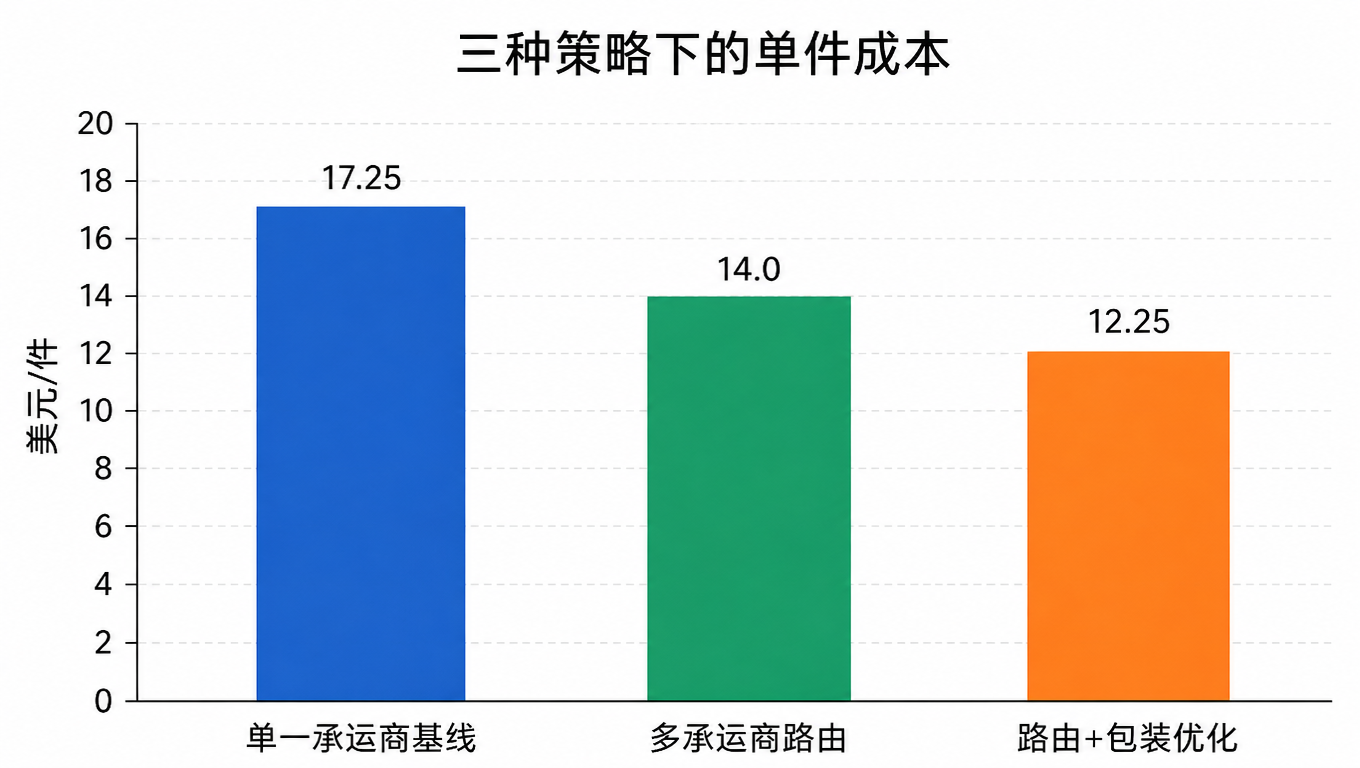
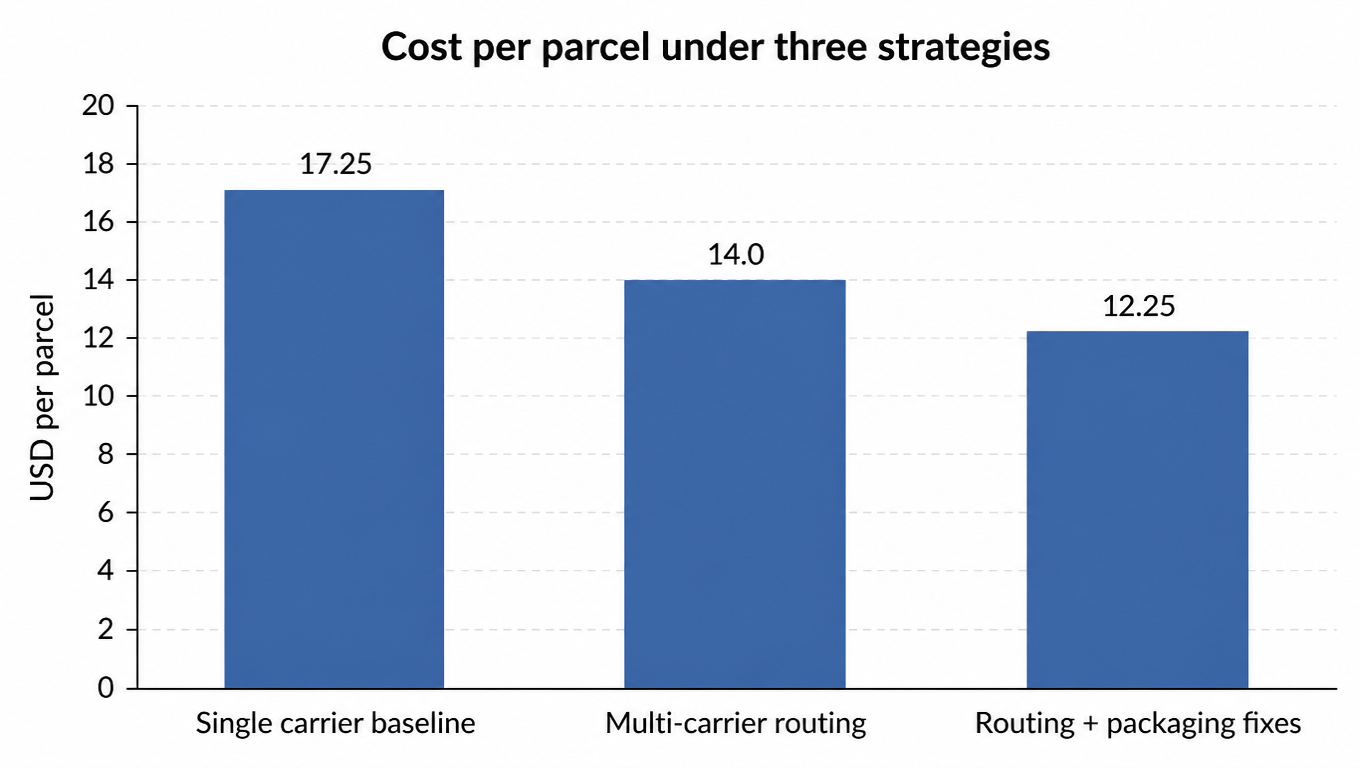
模型通常会显示这样的结果。拿前面那件代表性订单,单一国家承运商每件 $17.25。把轻件路由给 USPS、短分区件路由给区域承运商,混合成本降到大约 $14.00,砍掉 19%。再加上压掉体积重账单的包装改进、消灭修正费的地址校验,同一个订单画像落到大约 $12.25,比基线低 29%:Here is what the model typically shows. Take the representative order from earlier, $17.25 per parcel on a single national carrier. Route light parcels to USPS and short-zone parcels to a regional carrier, and the blended cost drops to about $14.00, a 19% cut. Add packaging fixes that drop DIM bills and address validation that kills correction charges, and the same order profile lands around $12.25, a 29% reduction from baseline:

柱状图:三种策略下的单件成本,单一承运商基线 17.25 美元、多承运商路由 14 美元、路由加包装优化 12.25 美元Bar chart: cost per parcel under three strategies, single carrier baseline 17.25, multi-carrier routing 14.0, routing plus packaging fixes 12.25
多承运商路由加包装优化,单件成本从 17.25 美元压到 12.25 美元Multi-carrier routing plus packaging fixes take cost per parcel from $17.25 down to $12.25

这些步骤都不需要物流部门。它们需要你读自己的账单,而大多数品牌从没读过。None of these steps require a logistics department. They require reading your own invoices, which most brands have never done.

九、太长不看版9. TL;DR

  • 广告价是虚构的:住宅件的真实全包成本要按每件 $10 到 $15+ 预期,而不是费率卡上的「from $6.50」。Advertised rates are fiction: expect $10 to $15+ all-in per residential parcel, not the "$6.50 from" on the rate card.
  • 账单是一叠定价决定:住宅附加费、燃油、体积重、地址修正、DAS、旺季附加费。基础费率往往不到总额的一半。The invoice is a stack of decisions: residential surcharge, fuel, DIM, address corrections, DAS, and peak surcharges. The base rate is often less than half the total.
  • 退货是隐藏行目。高退货品类里,它的成本可能超过所有附加费之和。Returns are the hidden line item. In high-return categories they can cost more than every surcharge combined.
  • 先审计:真实单件成本 = 承运商总支出 ÷ 发出件数。谈任何东西之前,先排出你的三大成本驱动因素。Audit first: true cost per parcel = total carrier spend ÷ parcels shipped. Rank your top three cost drivers before negotiating anything.
  • 小货量也能谈判,需要筹码就借用平台或 3PL 的货量。Negotiate even at small volume, and borrow volume from platforms or a 3PL if you need leverage.
  • 多承运商:轻件走 USPS,短分区走区域承运商,重件长距离走国家承运商。Go multi-carrier: USPS for light, regional carriers for short zones, national carriers for heavy and long.
  • 用包装修体积重,在结账环节修地址,给退货一个策略。Fix DIM with packaging, fix addresses at checkout, and give returns a strategy.
  • 每个月盯三个数字:单件成本、运费占客单价比例、附加费占比。Watch three numbers monthly: cost per parcel, shipping as a share of AOV, and surcharge share.

你今天就能做的动作:拉出最近三个月的承运商账单,算出你的真实单件成本,按金额列出你的三大附加费。这份清单就是你的谈判开场,而大多数品牌从没把它写下来过。Your one action for today: pull the last three months of carrier invoices, compute your true cost per parcel, and list your top three surcharges by dollar amount. That list is your negotiation opening, and most brands have never written it down.

常见问题FAQ

广告价假设的是商业地址、近距分区、什么都不附加。真实住宅订单要加大约 $6.50 的住宅附加费、占基础费率 15% 到 25% 的燃油附加费,偏远邮编还要加 $4.80 到 $17 的配送区域附加费,11 月和 12 月再叠上每件 $1.55 到 $8.75 的旺季附加费。大多数 DTC 品牌的全包成本落在 $10 到 $15 甚至更高,而基础费率往往不到总额的一半。The advertised "from $6.50" assumes a commercial address, a close zone, and nothing attached. A real residential order adds roughly $6.50 in residential surcharge, a fuel surcharge of 15% to 25% of the base rate, a delivery area surcharge of $4.80 to $17 for rural ZIPs, and $1.55 to $8.75 in peak surcharges during November and December. Most DTC brands end up at $10 to $15 or more all-in, and the base rate is often less than half the total.
退货。服饰品牌通常有 20% 到 40% 的订单会退回来,而每单退货在检查、重新包装、重新上架之前就要花掉 $20 到 $30 处理。在高退货品类里,退货加进真实单均成本的钱可能超过所有附加费之和。退货之后,体积重和地址修正费是接下来两个静默漏点。Returns. Apparel brands routinely see 20% to 40% of orders come back, and each return costs $20 to $30 to process before inspection, repackaging, and restocking. In a high-return category, returns can add more to your true cost per order than every surcharge combined. After returns, dimensional weight and address corrections are the next silent leaks.
承运商按账户定价,不按公开门槛。一通 20 分钟的电话,哪怕每月只有几百件也能推动费率;小卖家通常谈到列表价 5% 到 10% 的折扣,货量起来后 20% 到 30% 很常见。太小引不起注意?借用别人的货量:Shippo、ShipStation 这类平台把谈好的折扣转售给任何账户,3PL 则把大量品牌的货量并进一份合同。Carriers price to the account, not to a public threshold. A 20-minute call can move your rate even at a few hundred parcels a month; small shippers typically get 5% to 10% off list, and 20% to 30% as volume builds. Too small to command attention? Borrow volume from a platform like Shippo or ShipStation, or from a 3PL's consolidated contract.
当足够多的货量落在它的覆盖范围内的时候。OnTrac、GLS 这类区域承运商的卡车从不离开本区域,短分区配送通常比国家网络便宜 10% 到 30%。切换之前先查邮编覆盖;如果你的分区结构偏向仓库周边,这可能就是你能拿到的最大一笔单项削减。When enough of your volume sits in its footprint. Regional carriers such as OnTrac and GLS are typically 10% to 30% cheaper than the national networks on short-zone deliveries because their trucks never leave the region. Check their ZIP coverage before switching anything; if your zone mix skews close to your warehouse, this can be the biggest single line-item reduction available.
用最近 3 到 6 个月的账单:承运商总支出除以发出件数。不是费率卡上的费率,也不是发货软件显示的单件均价,而是账单上的实际总额。对大多数品牌来说,这个数字比他们以为自己在付的高出 30% 到 50%。Take your last 3 to 6 months of invoices and divide total carrier spend by parcels shipped. Not the rate card rate, not the average your shipping software shows: the actual total from the invoices. For most brands this lands 30% to 50% above what they thought they were paying.
Get Rate Comparison
Get Rate Comparison