3PL 指南3PL Guide

3PL 与履约平台的白标物流技术:自建还是采购White-Label Shipping Technology for 3PLs and Fulfillment Platforms: Build vs. Buy

每一家 3PL 和履约平台最终都会走到同一个岔路口:自己开发发货软件,还是采购一个白标平台、打上自己的品牌卖给客户。这不是一个功能级决策,它决定你未来几年的工程路线图、销售话术和毛利率。本文给技术负责人和运营决策者一份完整的评估:两条路各自的真实成本估算、按规模分层的决策框架,以及带缓解策略的风险清单,让你用证据而不是直觉来做选择。Every 3PL and fulfillment platform eventually hits the same fork in the road: build your own shipping software, or license a white-label platform and sell it under your own brand. This is not a feature decision. It shapes your engineering roadmap, your sales pitch, and your gross margin for years. This guide gives technical and operations decision makers a complete evaluation: real cost estimates for both paths, a tiered decision framework, and a risk register with mitigations, so you can choose with evidence instead of gut feel.

A fulfillment operations manager reviewing a white-label shipment tracking dashboard on a large monitor in a modern warehouse office, shipping boxes softly blurred in the background
白标物流技术把整套发货软件栈变成 3PL 自己的产品White-label shipping technology turns the whole shipping software stack into the 3PL's own product

一、为什么白标发货会出现在每家 3PL 的路线图上1. Why White-Label Shipping Is on Every 3PL's Roadmap

客户的客户永远看不到你的仓库。他们看到的是跟踪页、派送通知和下单后的客服邮件。今天这些界面越来越被期待印上 3PL 自己的品牌,而不是软件供应商的 logo[^3]。当商家挑选 3PL 时,品牌化跟踪是一种看得见的承诺:「这家公司端到端拥有我的客户体验。」一张来自陌生供应商的通用页面,会悄悄瓦解这个承诺。Your clients' customers never see your warehouse. What they do see is the tracking page, the delivery notifications, and the support emails after checkout. Today those surfaces are increasingly expected to carry the 3PL's own brand, not the software vendor's logo.[^3] When a merchant picks a 3PL, branded tracking is a tangible promise: "this company owns my customer experience end to end." A generic page from an unknown vendor quietly undermines that promise.

与此同时,履约的同质化层已经收敛。各家承运商的运费和时效差距已经小到很少有商家会只因为价格就换 3PL。差异化已经上移到体验层:品牌页面、主动通知、给商家店铺的干净 API。这正是白标物流技术所在的层。At the same time, the commodity layer of fulfillment has converged. Rates and transit times across carriers are close enough that few merchants switch 3PLs on price alone. The differentiator has moved up the stack, to how the experience feels: branded pages, proactive notifications, clean APIs for the merchant's own storefront. That is exactly the layer white-label shipping technology sits on.

这也是为什么这个决策是路线图级的,而不是功能级的。选自建还是采购,押上的是工程产能、销售定位和多年合同,它决定你下个季度、明年能给客户承诺什么。把它当成一次快速采购或副业项目,团队最后往往得到一个半维护的系统和一个停摆的路线图。This is also why the decision is roadmap-level rather than feature-level. Choosing build or buy commits engineering capacity, sales positioning, and multi-year contracts. It changes what your client-facing product can promise next quarter and next year. Treating it as a quick procurement or a side project is how teams end up with a half-maintained system and a stalled roadmap.
二、「白标物流技术」到底覆盖什么2. What "White-Label Shipping Technology" Actually Covers

白标物流技术是完整的物流软件栈,重新打包、以 3PL 自己的名字对外销售。3PL 把它当作自己的产品来运营,自己定价、自己定服务水平,对商家呈现为自己的能力,底层供应商全程不可见。White-label shipping technology is the full shipping software stack, rebranded and resold under the 3PL's own name. The 3PL operates it as its product, sets its own pricing and service levels, and presents it to merchants as its own capability. The vendor stays invisible.

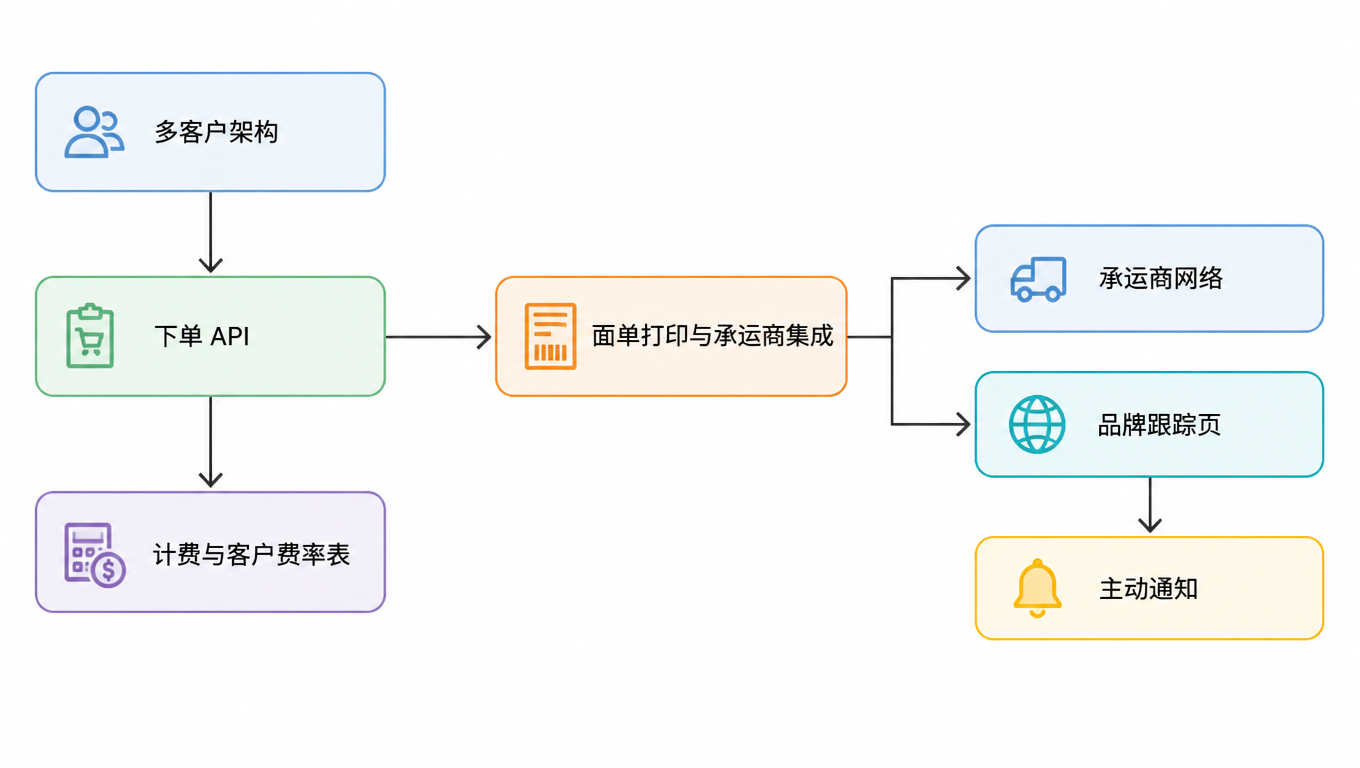
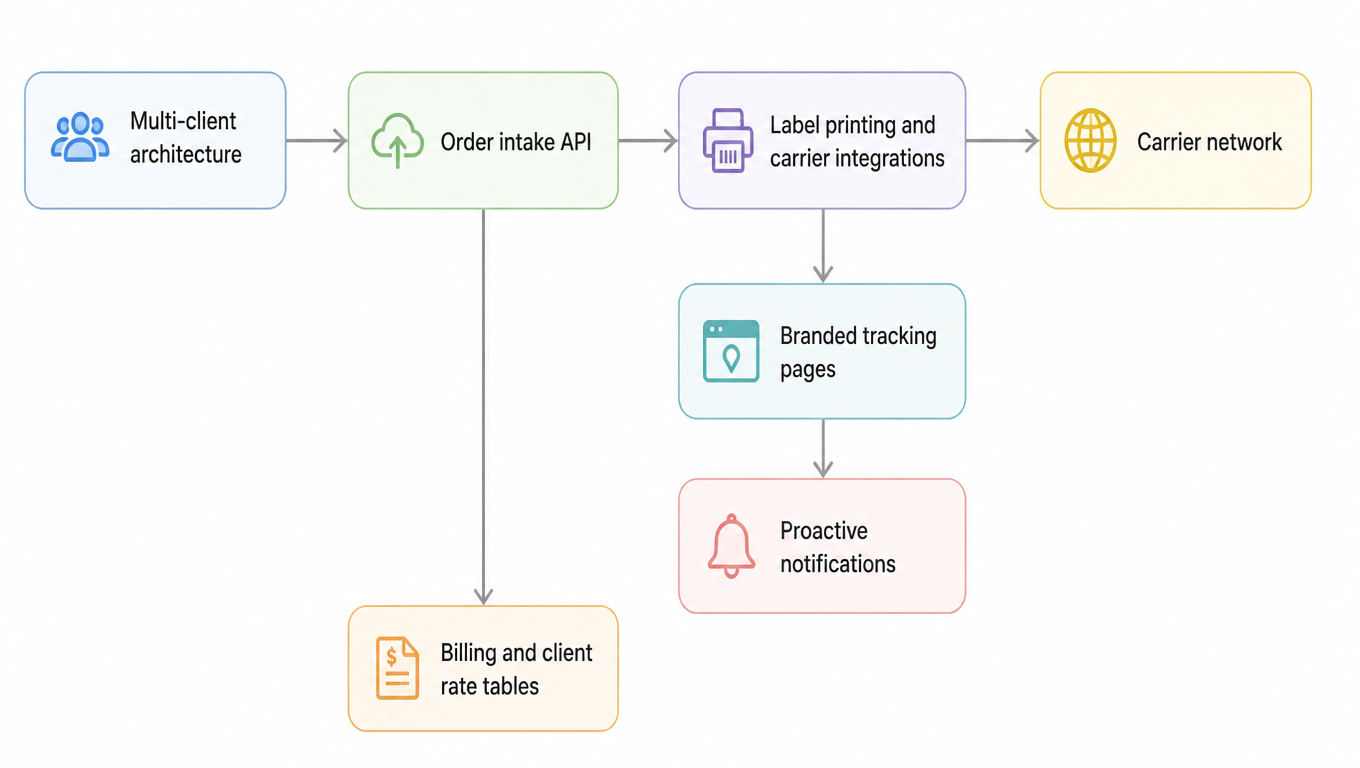
一套完整的栈覆盖六个核心模块:A complete stack covers six core modules:

  • 多客户架构:一个平台、多家商家,每家相互隔离,各有自己的设置和权限Multi-client architecture: one platform, many merchants, each isolated with its own settings and permissions
  • 下单 API:为电商平台和商家店铺提供干净的接入点Order intake API: a clean integration point for ecommerce platforms and merchant storefronts
  • 面单打印与承运商集成:比价、面单生成、交运清单Label printing and carrier integrations: rate shopping, label generation, manifesting
  • 品牌跟踪页:挂在 3PL 自己域名和设计下的实时状态页Branded tracking pages: real-time status pages under the 3PL's domain and design
  • 主动通知:发给商家终端客户的派送更新,全程带品牌Proactive notifications: delivery updates to the merchant's end customers, on-brand
  • 计费与客户级费率表:按商家定价、开票与结算Billing and client-level rate tables: per-merchant pricing, invoicing, and settlement
流程图:多客户架构、下单 API、面单打印与承运商集成、承运商网络、品牌跟踪页、主动通知、计费与客户费率表Flowchart: multi-client architecture, order intake API, label printing and carrier integrations, carrier network, branded tracking pages, proactive notifications, billing and client rate tables
订单经下单 API 进入,面单与跟踪由承运商网络支撑,计费按客户独立进行Orders enter through the intake API, labels and tracking are backed by the carrier network, and billing runs per client

硬性要求是不可见:终端客户绝不能在跟踪页、面单或发票上看到底层供应商的品牌。商家为这些模块付的钱,还包括供应商的承运商网络、合规维护和承运商认证,这些从零开始拼装都极其昂贵。The hard requirement is invisibility: the end customer must never see the underlying vendor's brand on a tracking page, a label, or an invoice. What the merchant pays for, beyond the modules, is the vendor's carrier network, compliance upkeep, and carrier certifications, which are expensive to assemble from scratch.

三、自建这条路:真实成本是多少3. The Build Path: What It Really Costs

自建从一支团队开始。一个现实的配置是四到六名工程师(后端、集成、前端)、一名产品经理,再加常驻的基础设施和运维支持。美国高级工程师的 loaded cost 通常在每年 20 万到 28 万美元[^1]。全部算下来,一支能干活的自建团队每年大约 140 万到 160 万美元,而这还发生在发出第一票货之前。A self-built system starts with a team. A realistic crew is four to six engineers (backend, integrations, frontend), one product manager, and ongoing infrastructure and ops support. Loaded cost per senior engineer in the US typically runs $200,000 to $280,000 per year.[^1] All in, a working build team costs roughly $1.4 million to $1.6 million per year, and that is before a single order ships.

时间线是最容易低估的地方。生产可用的面单打印、承运商集成和多客户计费,现实地讲要 12 到 24 个月,承运商认证和 API 审批还要再加几个月。多数团队低估 1.5 到 2 倍,因为每家承运商都按自己的节奏更新 API,而面单格式一变,整条管线都要跟着改。Timeline is where estimates hurt most. Production-ready label printing, carrier integrations, and multi-client billing realistically take 12 to 24 months, and carrier certifications and API approvals add months on top. Most teams under-estimate by 1.5 to 2x, because every carrier updates its API on its own schedule, and label format changes ripple through your whole pipeline.

然后是永远不出现在项目计划里的隐性成本:承运商 API 版本变更、面单格式更新、安全补丁和 PCI 范围、费率与法规变化,以及凌晨两点承运商集成故障时的值班响应。每年给维护预留团队 15% 到 25% 的时间。Then come the hidden costs that never appear on the project plan: carrier API version changes, label format updates, security patches and PCI scope, rate and regulation changes, and on-call rotation when a carrier integration breaks at 2 a.m. Budget 15 to 25 percent of the team's time per year for maintenance alone.

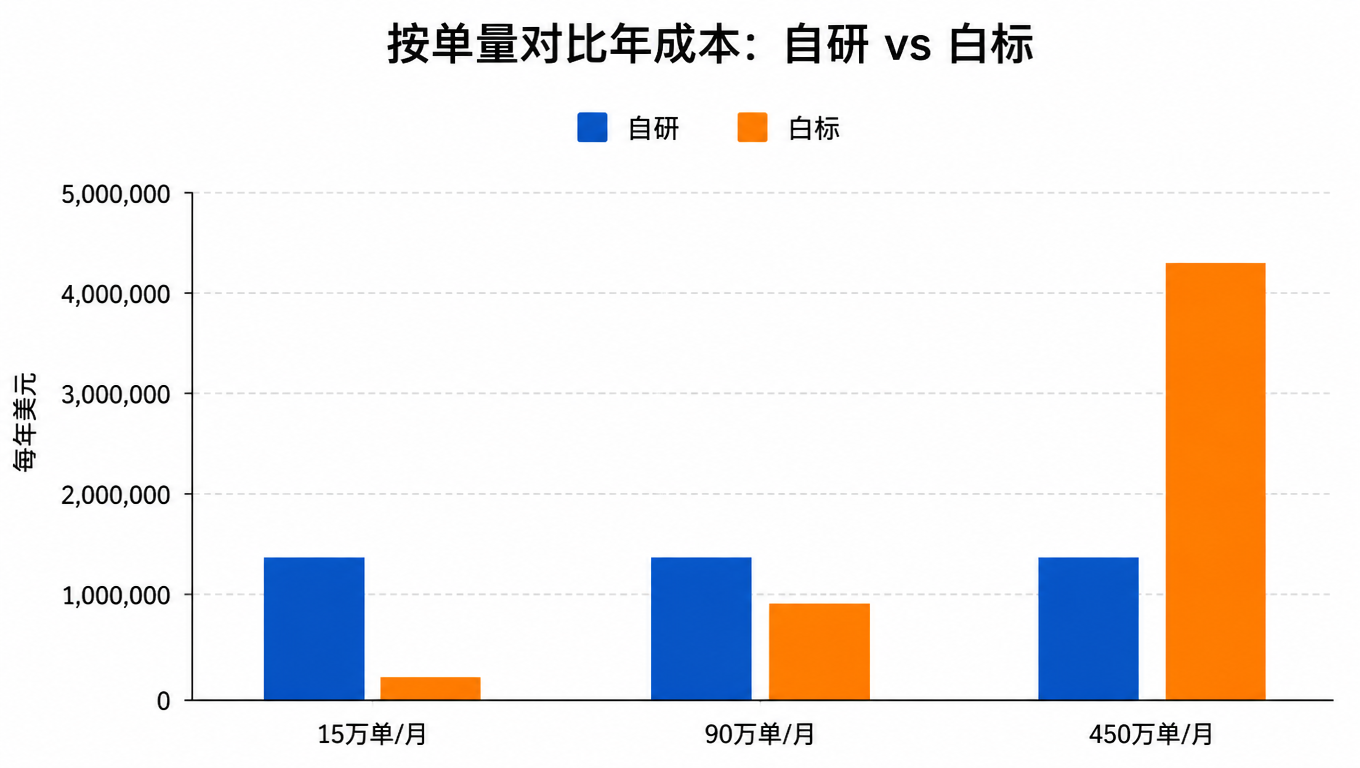
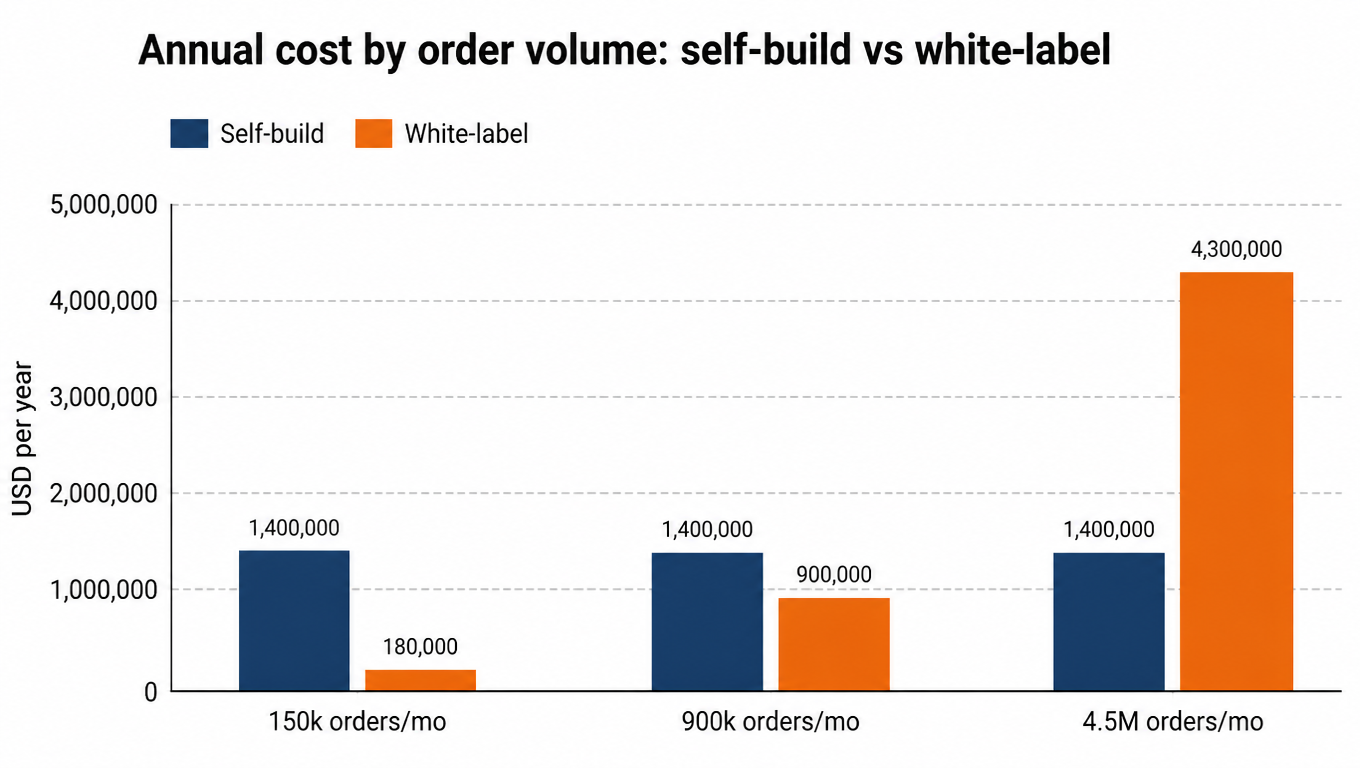
自建唯一真正占优的是规模上的边际成本。团队成本是平的:无论你每月发 15 万单还是 450 万单,大约都是每年 140 万美元。按每月 450 万单算,摊到每单约 0.03 美元。只有货量高到足以摊薄这支固定团队时,自建才开始产生规模经济,而这正是白标对比暴露出来的交叉点。The one thing self-build has going for it is marginal cost at scale. The team cost is flat: roughly $1.4 million a year whether you ship 150,000 orders a month or 4.5 million. At 4.5 million orders a month, that works out to about $0.03 per order. The build path only starts generating economies of scale once volume is high enough to amortize the fixed team, which is exactly the crossover the white-label comparison exposes.

四、采购这条路:白标定价与权衡4. The Buy Path: White-Label Pricing and Trade-offs

白标定价是订阅加按单费用[^2]。一个典型结构是每月 3000 美元平台费加每单 0.08 美元,上线以周计而不是以月计。按每月 15 万单算,第一年约 18 万美元;每月 90 万单约 90 万美元;每月 450 万单约 430 万美元。White-label pricing is a subscription plus a per-order fee.[^2] A representative structure is a $3,000 per month platform fee plus $0.08 per order, with setup in weeks, not months. Year one at 150,000 orders per month lands around $180,000; at 900,000 orders per month around $900,000; at 4.5 million orders per month around $4.3 million.

你买到的是自建路径要花好几年才能攒齐的一切:现成的承运商网络、认证过的面单格式、合规维护、品牌跟踪与通知,以及一套已经能跑的多客户架构。上线通常只需两到六周的品牌化部署,而不是 12 到 24 个月的工程。What you get for that is everything the build path spends years assembling: an existing carrier network, certified label formats, compliance upkeep, branded tracking and notifications, and a multi-client architecture that already works. Launch is typically two to six weeks for a branded rollout instead of 12 to 24 months of engineering.

权衡是真实存在的。定制有上限:你在供应商的产品和路线图范围内工作,客户最刁钻的需求可能永远无法实现。数据归属和可迁移性要靠合同约定,不能想当然。你还背着依赖风险:供应商涨价、改路线图优先级或宕机,你的品牌都要承受后果。这些都可管理,但前提是签约前就谈清楚。The trade-offs are real. Customization has a ceiling: you work within the vendor's product and roadmap, so your most exotic client asks may stay unfulfilled. Data ownership and portability need to be contractual, not assumed. And you carry dependency risk: if the vendor raises prices, changes roadmap priorities, or has an outage, your brand absorbs the impact. These are manageable, but only if you negotiate them up front.

五、自建 vs 采购的决策框架5. A Decision Framework for Choosing Build vs. Buy

做选择前先按五个维度给自己打分:每日订单量、真正能投入的工程人力、上市时间窗口、你的差异化在多大程度上依赖定制功能,以及你对固定成本或变动成本的预算容忍度。Score your situation on five dimensions before choosing: daily order volume, engineering headcount you can actually commit, time-to-market window, how much of your differentiation depends on custom features, and budget tolerance for either fixed or variable cost.

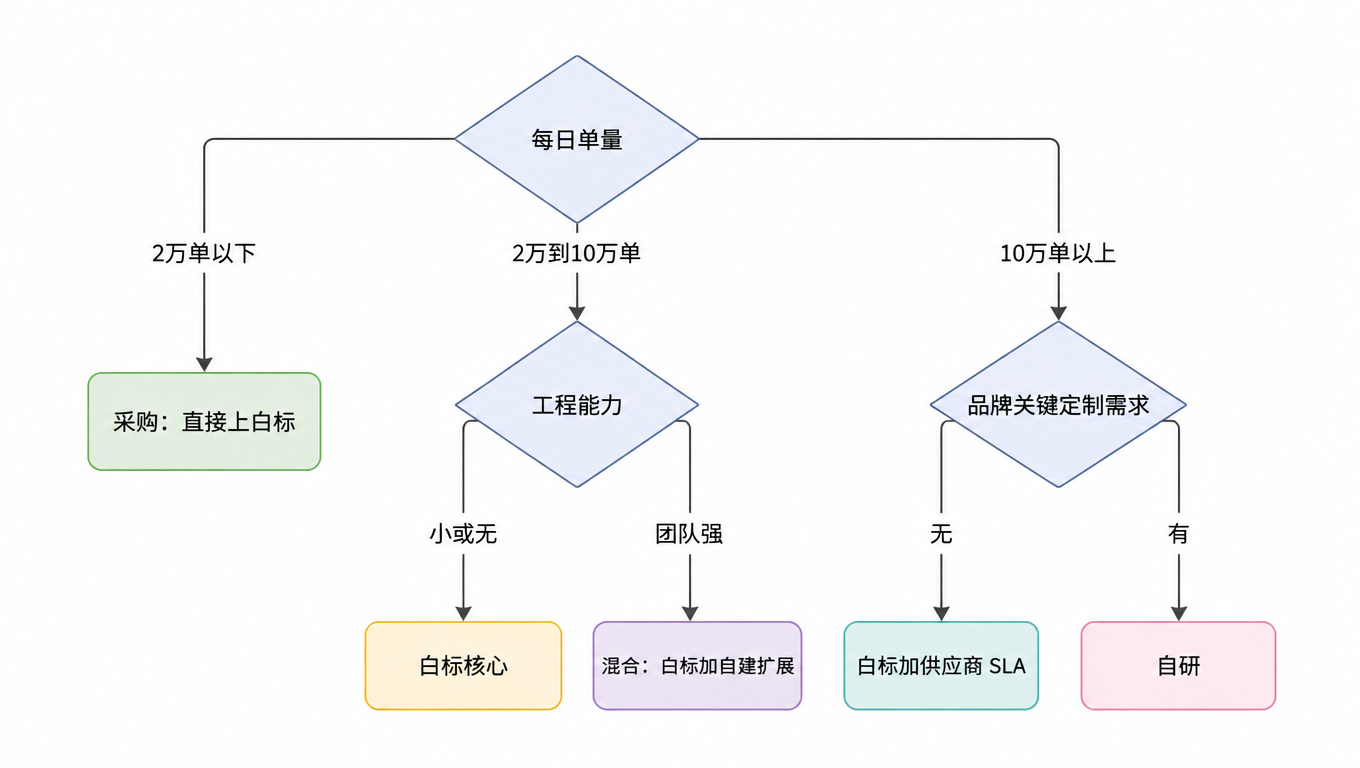
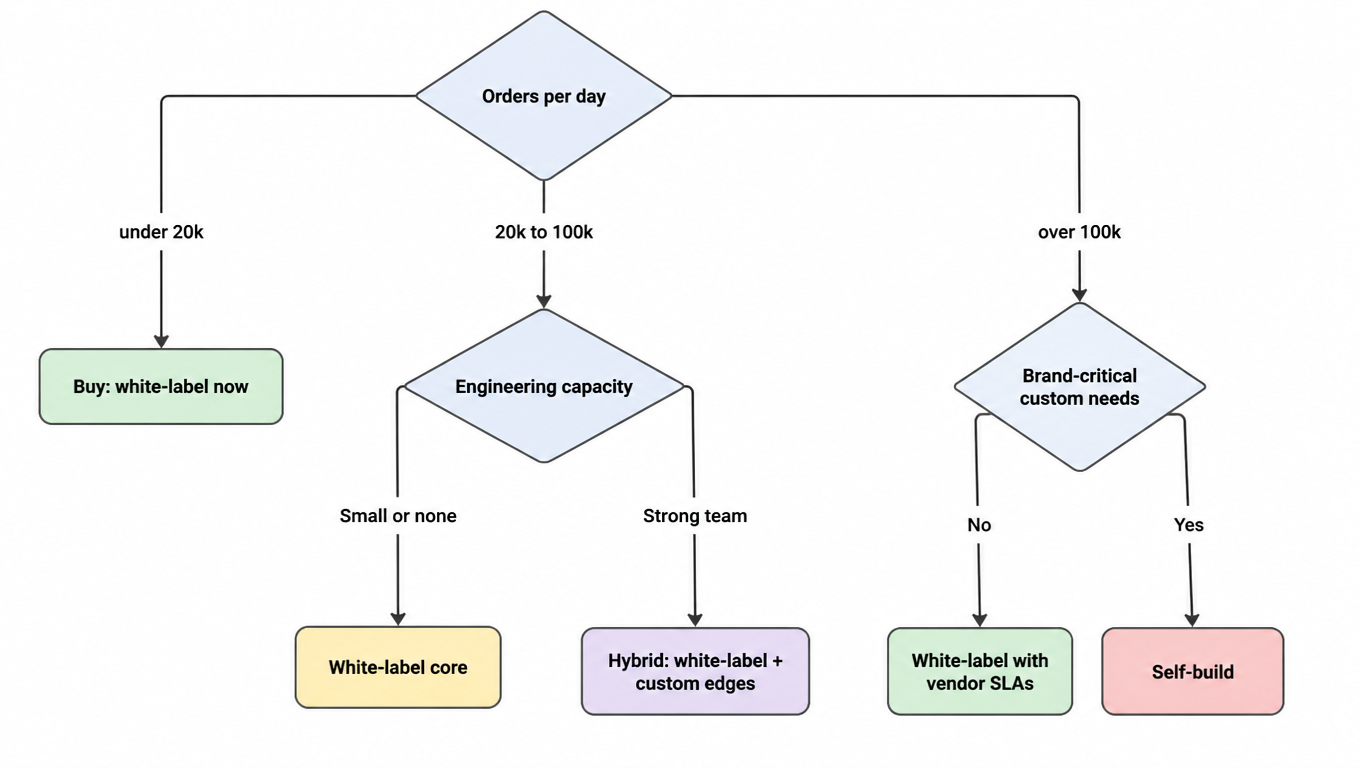
分层指引很简单。中小型 3PL(每日几万单以内)默认走白标:把固定的工程风险换成变动费用,几周内产品上线。拥有常驻工程团队、又有品牌关键定制需求的大型平台,应该认真评估自建。中间地带,也就是有真工程团队但没有强烈需要拥有整条栈的,通常用混合方案赢:白标核心加自建扩展。The tiered guidance is simple. Small and mid-size 3PLs (up to tens of thousands of orders per day) should default to white-label: it converts fixed engineering risk into a variable fee and gets the product live in weeks. Large platforms with a standing engineering team and brand-critical custom needs should evaluate self-build seriously. The middle tier, meaning a real engineering team but no burning need to own the whole stack, usually wins with a hybrid: a white-label core with custom edges built on top.

交叉点数学把分层变具体。自建是每年 140 万美元的固定成本;白标随货量线性增长。The crossover math makes the tiers concrete. The build path is a fixed $1.4 million per year; the buy path scales linearly with volume.

柱状图:按单量对比年成本,自建恒定 140 万美元,白标从 18 万、90 万到 430 万美元Bar chart: annual cost by order volume, self-build flat at $1.4M, white-label from $180K to $900K to $4.3M
自建固定、白标线性:交叉点在每日 3 万到 15 万单的区间Self-build is fixed, white-label is linear: the crossover sits in the 30k to 150k orders/day band

只有当货量高到足以摊薄团队时自建才更便宜,交叉点通常落在每日 3 万到 15 万单的区间,取决于你的按单费用和实际团队规模。低于这个区间白标在成本上胜出;高于它自建在毛利上胜出。下面的决策树用同样的逻辑一步步走。Self-build is cheaper only once volume is high enough to amortize the team, and the crossover typically sits in the 30,000 to 150,000 orders per day band, depending on your per-order fee and your actual team size. Below that band, white-label wins on cost; above it, build wins on margin. The decision tree below applies the same logic step by step.

决策树:每日单量 2 万以下直接采购白标;2 万到 10 万看工程能力选白标核心或混合;10 万以上看品牌定制需求选自研或白标加 SLADecision tree: under 20k orders per day buy white-label; 20k to 100k depends on engineering capacity; over 100k depends on brand-critical custom needs
按每日单量分档,再按工程能力与定制需求细分Tier by daily volume, then split by engineering capacity and custom needs

六、风险清单:没人告诉你的那些6. Risk Register: What Nobody Tells You

自建的风险集中在维护和人。承运商 API 变更是安静的杀手:每家承运商按自己的节奏发版本,而你永远拥有每一个集成。合规会悄悄漂移,面单规则、费率表和法规都在变。关键人风险是真实的,因为一个两年的项目把知识集中在少数几个工程师身上。时间超支是常态,多数系统晚到 1.5 到 2 倍。Self-build risks cluster around maintenance and people. Carrier API changes are the quiet killer: each carrier version-ships on its own schedule, and you own every integration forever. Compliance drifts quietly as label rules, rate tables, and regulations change. Key-person risk is real, because a two-year build concentrates knowledge in a few engineers. And timeline overruns are the norm, with most systems arriving 1.5 to 2x late.

白标的风险是合同和依赖形态的。供应商锁定:你的品牌和商家工作流围绕一个你无法控制的平台生长。SLA 依赖:供应商宕机就是你的品牌宕机,而且你自己能修的范围很有限。定制限制:最佳客户最想要的功能可能永远在产品之外。续约涨价还会悄悄吃掉你的毛利。White-label risks are contract and dependency shaped. Vendor lock-in: your brand and your merchants' workflows grow around a platform you do not control. SLA dependency: an outage at the vendor is an outage at your brand, and you have limited ability to fix it yourself. Customization limits: your best client's must-have feature may be permanently outside the product. And pricing changes at renewal can quietly move your margin.

每一类风险都有缓解办法。自建:承运商集成交给外部专家、写能对 API 漂移告警的集成测试、文档写全、分阶段建设让核心先上线。白标:合同里写明数据导出和迁移支持、要求公开的带赔付 SLA、保持集成层薄以便换供应商、给续约涨价设上限。这些都不会消除风险,只是把风险从意外变成你管理的一个条目。Every risk class has a mitigation. For self-build: contract carrier integrations with external expertise, write integration tests that alert on API drift, document everything, and phase the build so a core slice ships early. For white-label: negotiate data export and migration support in the contract, demand a published SLA with credits, keep an integration layer thin so you can swap vendors, and cap renewal price increases. None of these remove the risk; they convert it from a surprise into a line item you manage.

七、怎么降低决策风险7. How to De-risk the Decision

风险最低的路径是递进的,不是二选一的。先上白标验证需求,学商家真正要什么,几周内让品牌跟踪上线。等货量跨过固定成本压过按单费用的区间、又有能持续维护的工程团队时,再重新评估自建。许多 3PL 会长期跑白标、永远不跨那条线,这也是完全合理的结果。The lowest-risk path is sequential, not binary. Start with white-label to validate demand, learn what merchants actually ask for, and get branded tracking live in weeks. Reassess self-build once volume crosses the band where fixed cost beats per-order fees, and once you have the engineering team to sustain it. Many 3PLs run white-label for years and never cross that line, which is a perfectly good outcome.

无论选哪条路,在需要之前就把退出通道谈好。把数据导出、商家迁移支持和源码级文档写进合同。保持集成层薄,让承运商、供应商甚至平台都能被替换。目标是让这个决策始终是你能做的决定,每年都能重新评估,而不是一次性的永久绑定。Whatever you choose, negotiate the exit before you need it. Get data export, merchant migration support, and source-level documentation written into the contract. Keep your integration layer thin so carriers, vendors, and even platforms remain swappable. The goal is that the decision stays yours, re-evaluable every year, instead of becoming permanent.

行动清单:Action checklist:

  • 估算你的每日订单量和未来 12 个月增速Estimate your daily order volume and its 12-month growth rate
  • 数真正能投入的工程人力,而不是纸面上的编制Count real engineering capacity, not headcount on paper
  • 按你的货量给白标报价:平台费加按单费Price white-label at your volume: platform fee plus per-order fee
  • 给自建算账:团队、12 到 24 个月、再加 15% 到 25% 维护Cost the build path: team, 12 to 24 months, plus 15 to 25 percent maintenance
  • 把两条路套进上面的决策树Map both to the decision tree above
  • 签约前谈好数据导出、SLA 和涨价上限条款Negotiate data export, SLA, and price-cap clauses before signing
  • 按新货量每年重新评估一次Re-evaluate annually at your new volume

对大多数 3PL 和履约平台,结论是先采购、只在规模上自建。白标让你几周内带着一个带品牌、接通承运商的产品上市,并把风险最大的工程活变成变动费用。自建只对一小撮高货量、高度差异化的平台才是正确的选择。跑一遍数字,跑一遍框架,答案通常会自己冒出来。The verdict for most 3PLs and fulfillment platforms is buy first, build only at scale. White-label gets you to market in weeks with a branded, carrier-connected product, and it converts the riskiest engineering work into a variable fee. Self-build remains the right call for a narrow set of high-volume, highly differentiated platforms. Run the numbers, run the framework, and the right answer tends to announce itself.

常见问题FAQ

白标物流技术是完整的物流软件栈(多客户架构、下单 API、面单与承运商集成、品牌跟踪页、主动通知、计费分账),重新打包、以 3PL 自己的品牌对外销售。3PL 把它当作自己的产品来运营和定价,对商家呈现为自己的能力,底层供应商全程不可见。White-label shipping technology is the full shipping software stack (multi-client architecture, order intake API, labels and carrier integrations, branded tracking pages, proactive notifications, and billing) rebranded and resold under the 3PL's own name. The 3PL operates it as its product, sets its own pricing, and presents it to merchants as its own capability, with the underlying vendor staying invisible.
自建是固定成本(约每年 140 万美元),白标随货量线性增长。交叉点通常在每日 3 万到 15 万单的区间,取决于你的按单费用和实际团队规模。低于这个区间白标在成本上胜出,高于它自建在毛利上胜出。Self-build is a fixed cost (roughly $1.4 million per year) while white-label scales linearly with volume. The crossover typically sits in the 30,000 to 150,000 orders per day band, depending on your per-order fee and your actual team size. Below that band white-label wins on cost; above it, build wins on margin.
三类风险:供应商锁定(你的品牌和商家工作流围绕一个你无法控制的平台生长)、SLA 依赖(供应商宕机就是你的品牌宕机)、定制限制(客户最想要的功能可能永远不在产品里)。缓解方式:合同里写明数据导出与迁移支持、要求带赔付的公开 SLA、保持集成层薄、给续约涨价设上限。Three classes: vendor lock-in (your brand and merchants' workflows grow around a platform you do not control), SLA dependency (a vendor outage is your brand's outage), and customization limits (a client's must-have feature may stay out of product). Mitigations: contract data export and migration support, demand a published SLA with credits, keep the integration layer thin, and cap renewal price increases.
先上白标:几周内把品牌跟踪和发货能力上线,验证需求,同时摸清商家真正要什么。等货量跨过固定成本压过按单费用的区间、又有能持续维护的工程团队时,再重新评估自建。多数 3PL 会长期跑白标,这也是完全合理的结果。Start with white-label: get branded tracking and shipping live in weeks, validate demand, and learn what merchants actually ask for. Reassess self-build once volume crosses the band where fixed cost beats per-order fees and you have the engineering team to sustain it. Many 3PLs run white-label for years and never cross that line, which is a perfectly good outcome.

想评估一套支持白标的发货平台?Ready to evaluate a white-label-capable shipping platform?

EasyShippingX 把 3PL 多租户当成设计目标:按客户映射费率、客户品牌面单与跟踪、按客户计费,支持白标品牌化部署。先拿真实货量跑一遍数字,再决定自建还是采购。EasyShippingX treats 3PL multi-tenancy as a design goal: per-client rate mapping, client-branded labels and tracking, per-client billing, and white-label branded rollout. Run the numbers at your real volume, then decide build or buy.

Get Rate Comparison
Get Rate Comparison