3PL 指南3PL Guide

3PL 的 Shipping API:自建还是采购Shipping API for 3PLs: Build vs Buy

每家 3PL 都会在同一个路口停下。你替客户发货,需要十几个承运商的面单、运价和跟踪,会议室里迟早有人问:自己的 Shipping API 集成,是自建还是采购?这个答案会影响你未来几年的预算、招人和上线节奏。这篇文章把两条路摊开讲清楚:各自真实的成本、能拿到的控制权、要花的时间、风险藏在哪里,以及"集成"这个词背后藏着的技术工作量。最后给你一个三道题的决策框架,五分钟就能对着自己的运营打一遍分。Every 3PL hits the same fork in the road. You ship for clients, you need labels, rates, and tracking for a dozen carriers, and someone in the room eventually asks: should we build our own shipping API integration, or buy one? The answer shapes your budget, your hiring, and your launch timeline for years. This article lays out both paths honestly: what they really cost, how much control each gives you, how long each takes, where the risks live, and the technical work hiding behind the word "integration." It closes with a three-question framework you can run against your own operation in about five minutes.

A warehouse operations manager in a bright modern 3PL facility reviews carrier shipping options shown as charts on a large wall dashboard while labeled parcels move along a conveyor behind them
自建还是采购,先算清三笔账:成本、控制权、时间Build or buy: the answer starts with three numbers, not a gut feeling

一、老板先看:30 秒结论1. The 30-Second Answer for Busy Owners

没有放之四海而皆准的答案,但有一个清晰的默认项:大多数 3PL 应该买,少数应该建。决定权落在三个变量上,这篇文章本质上就是把这三个变量从不同角度各看一遍。There is no universal answer, but there is a clear default: most 3PLs should buy, and a minority should build. The decision turns on three variables, and the whole article is just those three variables examined from different angles.

第一个变量是你实际跟几家承运商合作、跟哪些。只用 UPS、FedEx、USPS 发地面包裹的 3PL,和还要走十几个区域及尾程网络的 3PL,面对的是完全不同的两个问题。第二个变量是你有没有一支能长期拥有集成工作的开发团队,是几年不是几个月,因为自建集成要求的就是这个。第三个变量是比起典型的仓库,你的工作流有多独特:你的面单版式、规则和客户集成,是否符合现成产品默认的样子。The first variable is how many carriers you actually ship with, and which ones. A 3PL shipping parcel ground through UPS, FedEx, and USPS has a very different problem from one that also routes through a dozen regional and last-mile networks. The second is whether you have an in-house development team that can own integration work for years, not months, because that is what a self-built integration demands. The third is how unique your workflows are compared to a typical warehouse: whether your label layouts, rules, and client integrations match what a ready-made product assumes.

如果你只跟少数几家标准承运商合作、工作流相当常规、又没有专职工程团队,采购几乎总是更便宜也更安全的选择。如果你发货量巨大、运营确实与众不同、或者已经有集成工程师,自建就值得认真考虑。文末的决策框架可以让你五分钟打出自己的分数,而不是靠直觉拍板。If you ship with a handful of standard carriers, run fairly typical workflows, and do not have a dedicated engineering team, buying is almost always the cheaper and safer choice. If you ship huge volume, run genuinely unusual operations, or already employ integration engineers, building deserves a serious look. The decision framework at the end of this article lets you score yourself in five minutes instead of trusting a gut feeling.
二、成本:买与建各花多少钱2. Cost: What Buying Really Costs vs What Building Really Costs

采购 Shipping API 的定价很直接。主流模式是按面单收费,视量级通常每单 0.05 到 0.15 美元,有时再加一笔月费。换来的是一堆由供应商维护的承运商连接、谈判运价直通、面单生成、跟踪、地址校验和合规文档。你自己这边的接入工作真实存在但有边界:几周的集成投入,而不是一个季度的工程时间。Buying a shipping API is priced simply. The dominant model is a per-label fee, typically $0.05 to $0.15 per label depending on volume, sometimes with a monthly subscription on top. For that you get connections to dozens of carriers maintained by the provider, negotiated-rate passthrough, label generation, tracking, address validation, and compliance documentation. The setup work on your side is real but bounded: a few weeks of integration effort, not a quarter of engineering time.

自建是完全不同的算术。一条承运商集成大约要一个高级工程师 3 到 6 个月,含人力成本大约 5 万到 10 万美元。五条承运商就是 25 万到 50 万美元,而且还没发出一张面单;这还不算每条承运商在放行生产权限前要求的认证工作。然后维护开始了:承运商更新 API 版本、弃用端点、改字段,全部由你兜底,通常每年还要再投入 1.5 万到 3 万美元的工程时间。Building is a different arithmetic. A single carrier integration is roughly three to six months of a senior engineer's time, which lands at about $50,000 to $100,000 in loaded cost. Five carriers means $250,000 to $500,000 before you have shipped a single label, and that is before the certification work each carrier requires before granting production access. Then the maintenance begins: carriers update API versions, deprecate endpoints, and change fields, and you own all of it, typically another $15,000 to $30,000 per year in ongoing engineering time.

两条路都有隐藏成本。买的一侧,按单费用随你的量级增长,还要暴露在供应商调价的风险里。建的一侧,隐藏成本在运营端:贴错的面单、漏掉的跟踪事件,以及向客户解释这两件事所花掉的客服工时。这些在立项会上很容易被忽略,在真实世界里却非常贵。Both paths have hidden costs. On the buy side, the per-label fee grows with your volume, and you are exposed to the provider's pricing changes. On the build side, the hidden costs are operational: a mislabeled parcel, a missed tracking event, and the customer-service hours spent explaining both. These are easy to ignore in a planning meeting and expensive in the real world.

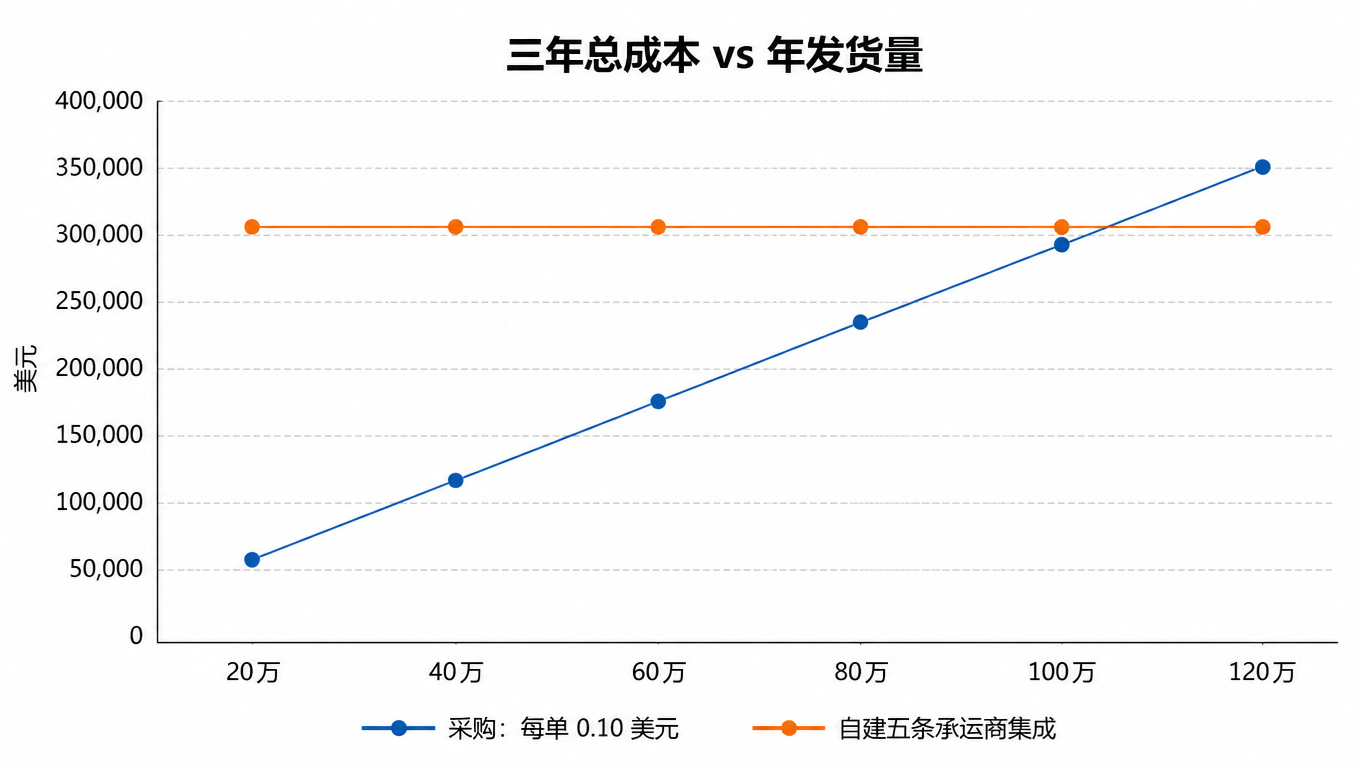
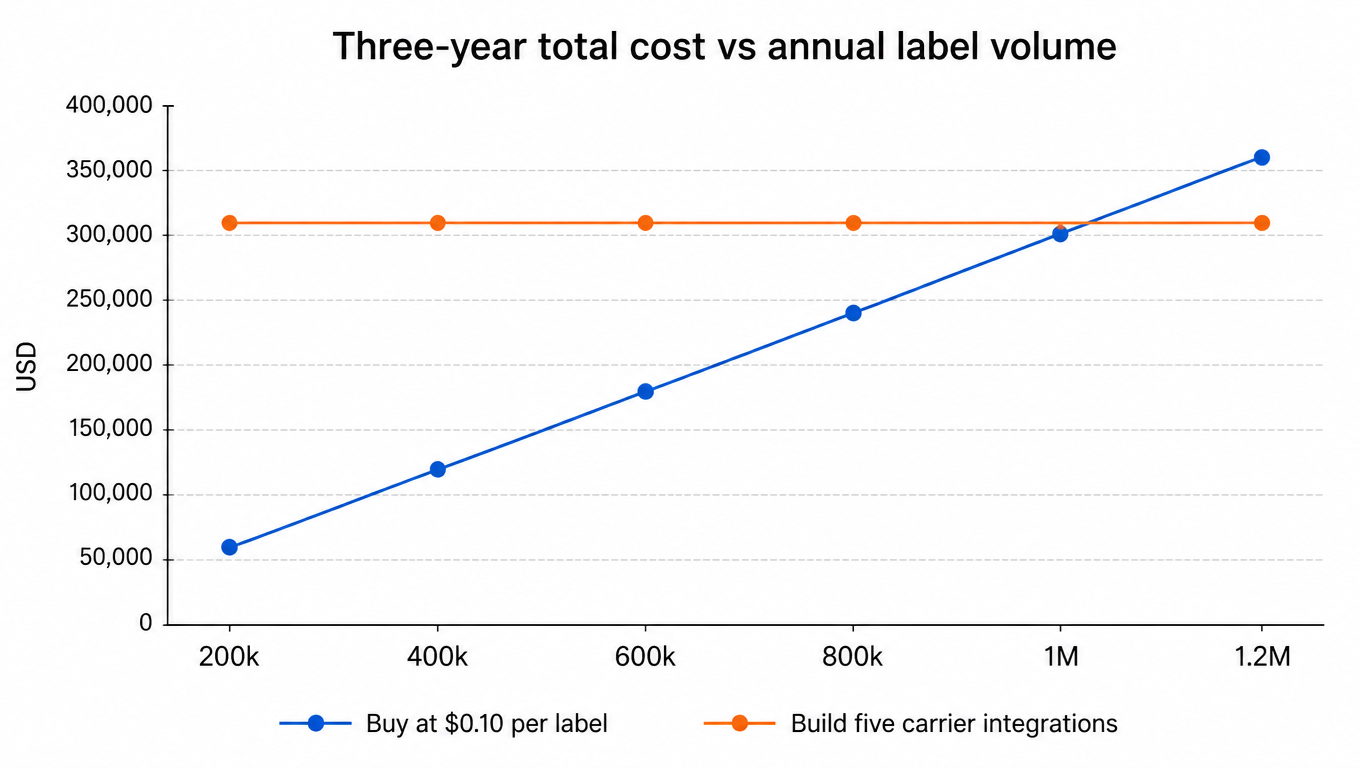
盈亏平衡点值得算出一个数字。三年算下来,自建五条集成加维护大约是 31 万美元。采购按每单 0.10 美元,三年就是每单 0.30 美元,盈亏平衡大概落在每年 100 万单。一家年发 40 万单的 3PL,三年采购侧大约付 12 万美元,自建则要大约 31 万美元。规模就是全部游戏。The crossover is worth putting a number on. Over three years, building five integrations plus maintenance comes to roughly $310,000. Buying at $0.10 per label over the same three years is $0.30 per label, so the breakeven sits around one million labels per year. A 3PL shipping 400,000 labels a year pays about $120,000 over three years on the buy side, against roughly $310,000 to build. Scale is the whole game.

三年总成本 vs 年发货量折线图:按单 0.10 美元的采购成本随量增长,自建五条集成加维护约 31 万美元持平,盈亏平衡点在每年约 100 万单Line chart of three-year total cost vs annual label volume: buy at $0.10 per label grows with volume, build five carrier integrations plus maintenance is flat at about $310K, breakeven around one million labels per year
年发量不到约 100 万单,采购在成本上稳赢Below roughly one million labels a year, buying wins on cost

三、能力与自由度:你能真正控制什么3. Capability and Control: What You Can Actually Change

采购 Shipping API,意味着活在供应商的功能边界里。支持哪些承运商、支持哪些面单格式、支持哪些工作流步骤,都是供应商决定建什么就是什么,你的功能请求会进入他们的公开路线图,跟所有人一起排队。对大多数 3PL 来说这没问题,因为供应商的默认设置正好匹配市场上 90% 的情况。Buying a shipping API means living inside the provider's feature boundaries. The supported carriers, the supported label formats, and the supported workflow steps are whatever the provider decided to build, and your feature requests go onto their public roadmap where you wait like everyone else. For most 3PLs that is fine, because the provider's defaults match the market's 90 percent case.

自建意味着集成活在你自己的系统里。发货调用跑在你自己的 WMS 界面里,面单版式就是客户要求的版式,你的定制规则、暂存逻辑、特殊包装步骤、按客户路由,全都成立,因为是你自己写的。控制权是真实的,而且会复利:每多一个工作流怪癖,就多一个拥有代码的理由。Building means the integration lives inside your own systems. Shipping calls run inside your own WMS screens, label layouts are whatever your clients require, and your bespoke rules, hold-for-pickup logic, special packaging steps, and customer-specific routing all work because you wrote them. Control is real, and it compounds: every workflow quirk is an argument for owning the code.

反转在于,独特性是一把双刃剑。你的运营越独特,你越是在为可能永远用不上的灵活性付钱,因为现成产品照样按它的完整表面积向你收费。诚实的问题不是"我们能定制吗",而是"我们是不是那 10% 工作流没有任何供应商覆盖的仓库?"如果答案是否,你就是在用自建的价格,买采购级别的需求。The twist is that uniqueness cuts both ways. The more unique your operation, the more you are paying for flexibility you may never use, because a ready-made product still charges you for its full surface area. The honest question is not "can we customize?" but "are we the 10 percent of warehouses whose workflows no provider covers?" If the answer is no, you are paying build prices for buy-level needs.

四、时间与风险:上线速度与出错代价4. Time and Risk: Speed to Launch vs Cost of Getting It Wrong

时间是最直观拉开两条路差距的维度。采购从签合同到打出第一张面单只要几周,定价可预期,可以直接写进预算。自建要几个月,而且时间表是开放的,因为承运商认证和 API 的怪癖不会跟着你的项目计划走。Time is the dimension where the two paths diverge most visibly. Buying gets you from contract to first label in weeks, with predictable pricing you can put in a budget. Building takes months, and the timeline is open-ended because carrier certifications and API quirks do not follow your project plan.

风险清单也完全不同。采购一侧的风险是:供应商涨价、改条款、甚至关停,以及只有等客户投诉你才发现运价不准。自建一侧,风险全部由你一个人扛:面单出错把包裹发到错误的地方、跟踪断档破坏客户体验、周五下午四点承运商 API 变更把你的集成打挂。自建时你就是最后一道防线,而且没有供应商支持热线可以打。The risk inventories look different. On the buy side, the risks are the provider raising prices, changing terms, or shutting down, plus rate inaccuracies that you catch only when a client complains. On the build side, the risks are yours alone: label errors that ship boxes to the wrong place, tracking gaps that break the client experience, and carrier API changes that break your integration at 4 p.m. on a Friday. When you build, you are the last line of defense, and there is no vendor support line to call.

自建确实有真实的上行空间。量级大了之后没有按单费用跟着你涨,没有供应商锁定,而且你建的集成是一项资产,甚至可能变成你卖给其他仓库的产品。对少数 3PL 来说,这个上行空间就是全部意义。对大多数来说,这是为一个并不存在的未来下注,赌注还很贵。Building does carry a real upside. At high volume there is no per-label fee to grow with you, there is no provider lock-in, and the integration you built is an asset that could even become a product you sell to other warehouses. For a minority of 3PLs that upside is the whole point. For most, it is an expensive bet on a future they do not have.

五、技术视角:一条承运商集成的真实工作量5. Technical View: What One Carrier Integration Actually Involves

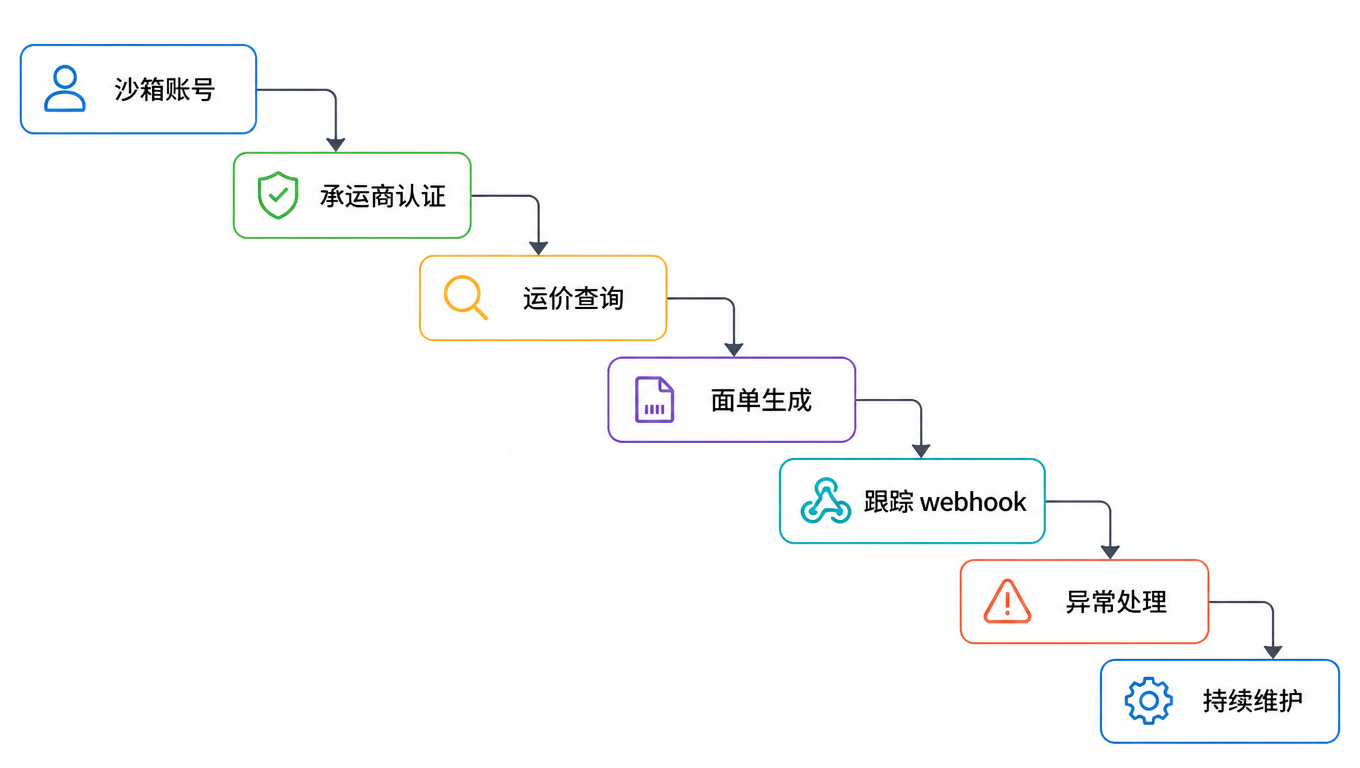
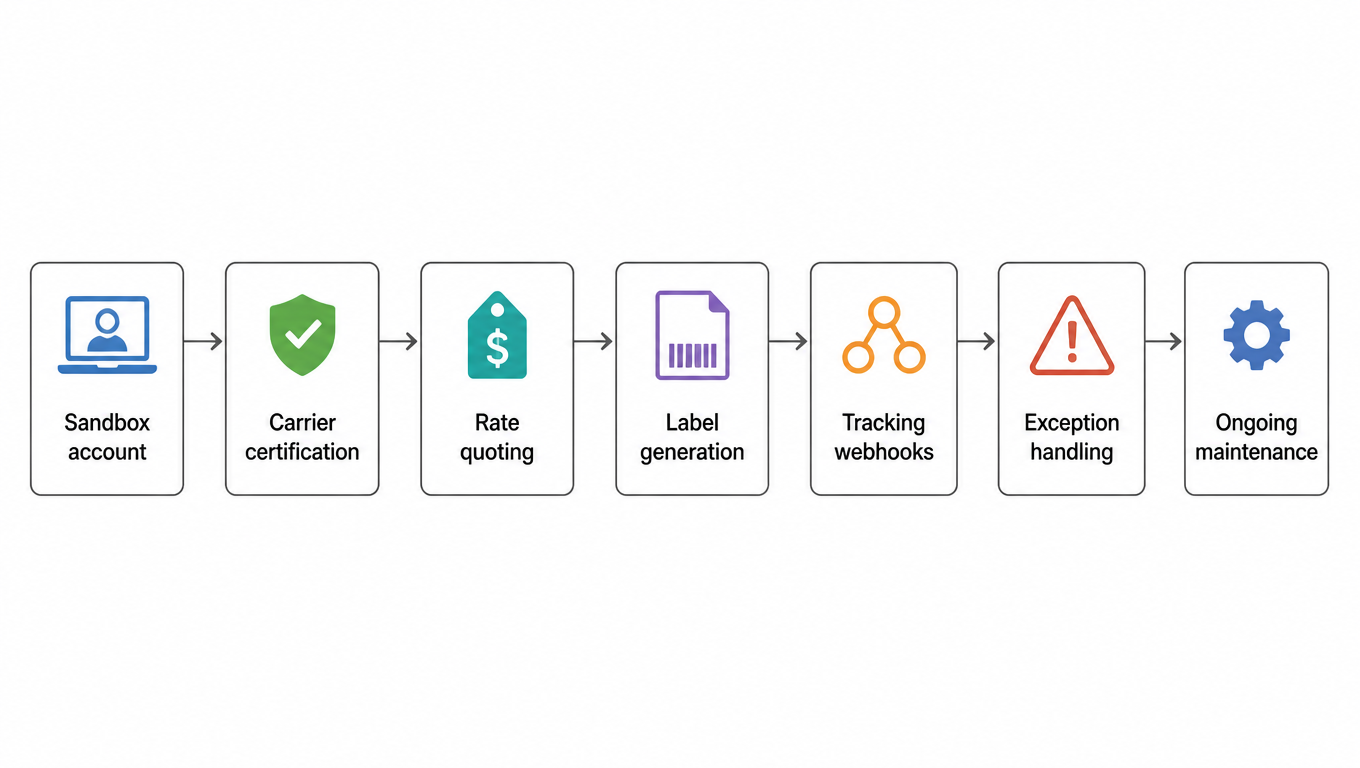
"集成"这个词底下是一个完整的项目,值得把步骤说具体。每条承运商你都需要一个沙箱账号,然后是认证,通过后承运商才放行生产权限,然后是核心工作:运价查询、面单生成、跟踪 webhook、以及快乐路径失败时的异常处理。上面还要叠一层地址校验和标准化,因为糟糕的地址在包裹动起来之前很久就会制造面单错误和生气的客户。Underneath the word "integration" sits a full project, and it is worth being concrete about the steps. For each carrier you need a sandbox account, then certification before the carrier grants production access, then the core work: rate quoting, label generation, tracking webhooks, and exception handling for the cases where the happy path fails. On top of that sits address validation and normalization, because bad addresses produce label errors and angry clients long before any parcel moves.

最让经营者意外的是维护的跑步机。承运商不会冻结自己的 API;他们会发布版本更新、弃用端点、改变字段含义,有时通知很仓促,有时悄无声息。你接的每一条承运商都是一个永远属于你的移动靶,这就是为什么上面的人力测算里有一项持续成本,而不是一次性开销。The part that surprises most owners is the maintenance treadmill. Carriers do not freeze their APIs; they release version updates, deprecate endpoints, and change field meanings, sometimes with little notice and sometimes silently. Each carrier you integrate is a moving target that you own permanently, which is why the staffing math above includes an ongoing line item rather than a one-time cost.

一个合理的规划估算长这样:每条承运商集成,一个高级工程师,3 到 6 个月。五条承运商意味着第一年要有一个专职集成工程师,之后还有常驻维护承诺。工作长这样:A fair planning estimate looks like this: one senior engineer, three to six months, per carrier integration. Five carriers means a dedicated integration engineer for the first year, then a standing maintenance commitment after that. Here is the shape of that work:

承运商集成流程图:沙箱账号、承运商认证、运价查询、面单生成、跟踪 webhook、异常处理、持续维护Flow diagram of one carrier integration: sandbox account, carrier certification, rate quoting, label generation, tracking webhooks, exception handling, ongoing maintenance
每条承运商都是一条完整管道,外加永久的维护义务Each carrier is a full pipeline, plus a permanent maintenance obligation

六、技术视角:评估现成 Shipping API 的检查清单6. Technical View: Checklist for Evaluating a Ready-Made Shipping API

先从承运商覆盖和运价开始。供应商是否连上了你实际发货的每一条承运商,包括区域和尾程网络?是否直通你自己谈的运价,而不是悄悄用它自己的?下一个测试是运价准确性:报出的价应该就是账单上的价,有出入要能解释,而不是玄学。Start with carrier coverage and rates. Does the provider connect to every carrier you actually ship with, including regional and last-mile networks, and does it pass through your own negotiated rates rather than silently using its own? Rate accuracy is the next test: the quoted rate should be the billed rate, and discrepancies should be explainable rather than mysterious.

然后是面单和打印。确认供应商能生成你的打印机和客户需要的面单格式,包括热敏格式,且国内和国际面单都覆盖。签约前用你自己的真实硬件测一遍,因为一张扫不出来的面单就是一张让你亏钱的面单。Then labels and printing. Confirm the provider generates the label formats your printers and clients need, including thermal formats, and that both domestic and international labels are covered. Test with your actual hardware before you commit, because a label that does not scan is a label that costs you money.

然后是运营层:SLA、可用性历史和支持质量,这些在你发货高峰时段最重要,而不是演示的时候。仔细看定价模式,按单还是订阅,量级阶梯从哪里开始,因为每月 1 万单看起来很便宜的计划,到了 50 万单可能完全不是。Then the operational layer: SLA, uptime history, and support quality, which matter most at your peak shipping hours, not during the demo. Check the pricing model carefully, per-label versus subscription, and where the volume tiers kick in, because the plan that looks cheap at 10,000 labels a month may not be at 500,000.

最后是法务关心的部分:数据驻留和合规,比如 PCI、GDPR 或 CCPA,再加上与你自家 WMS 的集成深度,以及客户强加的 EDI 要求。一个一周就能接入你技术栈的供应商,比一个仪表盘更好看的供应商值钱得多。Finally, the parts your lawyer cares about: data residency and compliance such as PCI and GDPR or CCPA, plus integration depth with your own WMS and any EDI requirements your clients impose. A provider that integrates with your stack in a week is worth more than one with a prettier dashboard.

七、决策框架:三个问题7. Decision Framework: Three Questions

问题一:你实际跟几家承运商合作、跟哪些?如果不到五家、都是标准包裹网络,买是显而易见的答案。如果超过十家还包含区域承运商,按单的经济账和集成负担都会开始向自建倾斜。Question one: how many carriers do you actually ship with, and which ones? If it is fewer than five and they are the standard parcel networks, buying is the obvious answer. If it is ten-plus including regionals, the per-label economics and the integration burden both start shifting toward build.

问题二:你能长期养得起集成工作吗?如果诚实的答案是"我们只有一个工程师,还要顺便管 Wi-Fi",那就买,因为一个你维护不起的自建系统,是你花钱造出来的负债。一支三年后仍然存在的专职集成团队,才会彻底改变这笔账。Question two: can you staff integration work for the long term? If the honest answer is "we have one engineer who also keeps the Wi-Fi running," buy, because a build you cannot maintain is a liability you paid to create. A dedicated integration team that will still exist in three years changes the math entirely.

问题三:你的工作流有多独特?如果你发标准地面包裹、用标准面单,供应商完全覆盖你。如果你的运营跑在没有任何供应商支持的定制规则上,你一边付按单费一边跟边界搏斗,这是两个世界最差的组合。Question three: how unique is your workflow? If you ship standard parcel ground with standard labels, a provider covers you completely. If your operation runs on custom rules no provider supports, you are paying a per-label fee and fighting boundaries at the same time, which is the worst of both worlds.

把三个答案放在一起,出现三种画像。买家:年发量不到约 100 万单、工作流标准、没有专职开发团队,买完走人。混合者:买 Shipping API 拿承运商连接,但自己建中间层和 WMS 集成,真正的价值其实大部分住在这里。建造者:量级大、工作流确实独特、有一支会长期拥有代码的团队,对这些人来说自建是战略决策,而不是省钱决策。Put the three answers together and three profiles emerge. The buyer: under roughly one million labels a year, standard workflows, no dedicated dev team, buy and move on. The hybrid: buy the shipping API for the carrier connections, but build the middleware and the WMS integration yourself, which is where most of the real value actually lives. The builder: high volume, genuinely unique workflows, and a team that will own the code for years, for whom building is a strategic decision rather than a cost-saving one.

八、结论8. Conclusion

大多数 3PL 应该买,少数应该建,而聪明的那批会先算出一个数字。算出你的单均成本,数一数你的承运商,诚实地问自己三年后你的团队还在不在维护这条集成。最便宜的决定,是基于你自己运营真实数据做出的决定。Most 3PLs should buy, some should build, and the smart ones start with a number. Compute your per-label cost, count your carriers, and be honest about whether your team will still be maintaining this integration in three years. The cheapest decision is the one made from real data about your own operation.

可执行的下一步很简单:在跟任何供应商谈之前,拿自己的数字过一遍那三个问题。写下你的年发货量、承运商清单和工程团队规模。答案会自己浮出来,而且经得起销售电话的考验。The actionable next step is simple: before you talk to any vendor, run the three questions against your own numbers. Write down your annual label volume, your carrier list, and the size of your engineering team. The answer will be obvious from the answers, and it will survive contact with a sales call.

常见问题FAQ

一条承运商集成的现实含人力成本是 5 万到 10 万美元(一个高级工程师 3 到 6 个月),还没算每条承运商放行生产权限前的认证工作。之后还有持续维护:承运商每次更新 API 版本、弃用端点、改字段,都要你兜底,通常每年每条再花 1.5 万到 3 万美元。五条承运商就是 25 万到 50 万美元的前期投入,外加常驻维护承诺。A realistic loaded cost for one carrier integration is $50,000 to $100,000 (three to six months of a senior engineer), before the certification work each carrier requires for production access. On top of that comes ongoing maintenance: every carrier API version update, endpoint deprecation, or field change is yours to absorb, typically $15,000 to $30,000 per carrier per year. Five carriers means $250,000 to $500,000 upfront plus a standing maintenance commitment.
按每单 0.10 美元算,三年下来采购成本约合每单 0.30 美元;对比自建加维护五条集成约 31 万美元,盈亏平衡点大约在每年 100 万单。一家年发 40 万单的 3PL,三年采购侧大约付 12 万美元,自建则要大约 31 万美元。低于约 100 万单,采购在成本上稳赢;超过这个量,按单费才开始贵过自建的维护成本。At $0.10 per label, buying comes to about $0.30 per label over three years. Against roughly $310,000 to build and maintain five integrations, the breakeven sits around one million labels per year. A 3PL shipping 400,000 labels a year pays about $120,000 over three years on the buy side, versus roughly $310,000 to build. Below about one million labels a year, buying wins on cost; above it, the per-label fee starts to cost more than self-maintained engineering.
能。好的供应商会通过你自己的凭证直通你自己谈的运价,定价优势和承运商关系都不变。3PL 仍然选择提供哪些承运商、仍然定自己的运价、仍然拥有客户关系。采购换来的是不用自己维护几十条承运商连接,放弃的是定制自由度,不是运价控制权。Yes. A good provider routes through your own credentials and passes through your negotiated rates, so your pricing edge and carrier relationships stay intact. The 3PL still chooses which carriers to offer, still sets its own rates, and still owns the client relationship. What buying trades away is customization freedom, not rate control.

不想让自建成为默认答案?Ready to skip the build?

EasyShippingX 让你一次接入、多承运商开跑:自有账号运价直通,FedEx、UPS、USPS 与区域承运商随时可用,从签约到第一张面单只要几周,而不是几个季度。EasyShippingX connects your stack once and lets you ship with multiple carriers right away: your own-account rates pass through, FedEx, UPS, USPS, and regional carriers are ready to go, and you go from contract to first label in weeks instead of quarters.

Get Rate Comparison
Get Rate Comparison