电商物流指南Ecommerce Shipping Guide

为什么 Shipping API 报价和承运商最终扣费对不上Why Your Shipping API Rate Quote Doesn't Match the Final Carrier Charge

你的费率 API 返回 9.40 美元。你买下面单,包裹发出,四周后承运商账单、平台账单或月末结算里,同一票件变成了 13.72 美元。同一订单、同一面单、同一运单号,两个不同的数字。如果你是 3PL 或高量级履约团队,这不是偶发的意外,而是每天都要处理的核销问题,同时落在运营、财务和工程三张桌子上;量一大,这就是真金白银,不是四舍五入的误差。这篇文章讲清楚差异从哪几层产生,给你一套五价格状态框架让每个金额各归其位,最后是一套五步排查决策框架和一份用结算成本评估承运商的评分卡。写给电商运营、3PL 账单与财务、仓储与物流经理,以及维护 WMS、ERP 或 SaaS 集成的开发者。Your rate API returns $9.40. You purchase the label, the parcel ships, and four weeks later the carrier invoice, the platform billing report, or your month-end settlement shows $13.72 for the same shipment. Same order, same label, same tracking number, two different numbers. If you operate a 3PL or a high-volume fulfillment business, this is not an occasional surprise. It is a daily reconciliation problem that lands on the desks of operations, finance, and engineering at the same time, and at volume it is real money, not a rounding artifact. This article explains where the gap comes from, gives you the Five Price States Framework so every amount has a job, and ends with a five-step decision framework for investigating a mismatch and a settled-cost scorecard for choosing carriers. Written for ecommerce operations, 3PL billing and finance, fulfillment and logistics managers, and the developers who own the WMS, ERP, or SaaS integration.

编辑插画:仓库主管坐在办公桌前,左手拿一张承运商账单,右手拿一张面单,屏幕上是费率 API 的报价页面,白底黑线加橙色点缀,不对称构图,手绘笔触
报价不是最终价,它只是五个价格状态里的第一个The quote is not the final price. It is only the first of five price states

问题:同一票件,两个数字The problem: two numbers for the same shipment

你的费率 API 返回 9.40 美元。你买下面单,包裹发出,四周后承运商账单、平台账单或月末结算里,同一票件变成了 13.72 美元。同一订单、同一面单、同一运单号,两个不同的数字。[^5] 如果你是 3PL 或高量级履约团队,这不是偶发的意外,而是每天都要处理的核销问题,同时落在运营、财务和工程三张桌子上;量一大,这就是真金白银,不是四舍五入的误差。[^6]Your rate API returns $9.40. You purchase the label, the parcel ships, and four weeks later the carrier invoice, the platform billing report, or your month-end settlement shows $13.72 for the same shipment. Same order, same label, same tracking number, two different numbers.[^5] If you operate a 3PL or a high-volume fulfillment business, this is not an occasional surprise. It is a daily reconciliation problem that lands on the desks of operations, finance, and engineering at the same time, and at volume it is real money, not a rounding artifact.[^6]

3PL 的场景把每一美元都放大了。客户已经按最初的报价付了钱,承运商事后又追加了一笔调整。现在你手里有一票件:报价是一个数,账单是另一个数,客户按第一个数付的款。总得有人决定这笔差额是自己承担还是向客户补收,而这个决定需要证据,不能靠猜。The 3PL case amplifies every dollar. Your client has already paid on the initial quote. The carrier then adds an adjustment after the fact. Now you hold a shipment that was quoted at one amount, billed at another, and your client was charged on the first one. Someone has to decide whether the difference is absorbed or billed back, and that decision needs evidence, not guesses.

与此同时,运营、财务和工程各自保存了一份「运费成本」。运营看到的是购买面单时的价格,财务看到的是承运商账单上的明细行,工程看到的是 API 响应里持久化的那个数。三个数字对不上,就没有人能可靠地回答承运商管理里最重要的问题:这个包裹段,到底哪个承运商更便宜?只建立在报价上的比价,会悄悄奖励那些报价好看、最终扣费糟糕的承运商。Meanwhile operations, finance, and engineering each keep their own version of the "shipping cost." Ops sees the label price at purchase time. Finance sees the carrier invoice line item. Engineering sees whatever the API response persisted. Because the three numbers disagree, nobody can reliably answer the most important question in carrier management: which carrier is actually cheaper for this parcel segment? Rate comparison built on quotes alone silently rewards carriers whose quotes look good and whose final charges are bad.
为什么「报价等于最终价」是错误的思维模型Why "quote equals final price" is the wrong mental model

传统理解把费率报价当成最终价格。你请求一个费率,API 返回一个数字,你把这个数字当作这票件的成本。它感觉很对,因为数字很精确,而它错也错在这里:精确不等于准确。The traditional understanding treats a rate quote as the final price. You request a rate, the API returns a number, and you treat that number as the cost of the shipment. It feels correct because the number is precise, and it is wrong for the same reason: precision is not accuracy.

一票发货交易不是只有一个价格。它要经过好几个价格状态,每个状态各有用途:下单前展示给客户的结账预估、针对你的发货数据返回的 API 报价、购买面单时实际扣的金额、承运商称重、量尺、核验后确认的费用[^4],以及最后加上调整、作废和退款之后的净额。这些金额本来就该不一样,它们之间的差值不是噪声,而是信息。A shipping transaction does not have one price. It passes through several price states, and each state serves a different purpose. There is the checkout estimate shown to the customer before the order, the API quote returned against your shipment data, the charge captured when the label is purchased, the cost the carrier assesses after weighing, measuring, and validating the package[^4], and finally the net charge after adjustments, voids, and refunds are applied. These amounts legitimately differ, and the gaps between them are information, not noise.

如果系统只保存一个 shipping_cost 字段,每来一个新数字就覆盖一次,你就把这部分信息抹掉了。报价是基于当下输入做出的预测,最终扣费是基于承运商实际观察到的结果做出的结算。只存一个数字,对结账够用,但解释不了之后发生的变化。正确的修法不是让数字强行一致,而是把每个数字都留下来。If your system stores a single shipping_cost field and overwrites it with each new number, you erase that information. The quote was a prediction based on the inputs at that moment. The final charge is a settlement based on what the carrier actually observed. Storing one number is fine for checkout, but it cannot explain the changes that happen after it. The fix is not to make the numbers match. It is to keep all of them.

五价格状态框架The Five Price States Framework

为了让这些差异可以被讨论,我们引入五价格状态框架。每个状态回答两个问题:这个数字是干什么用的?它还会变吗?To make these differences discussable, we use a Five Price States Framework. Each state answers two questions: what is this number for, and can it still change?

价格状态Price state 作用What it is for 是否可能变化Can it change
预估Estimated结账展示与初步预算Checkout display and preliminary budgetingYes
报价Quoted基于当下输入返回的承运商费率Carrier rate returned for the inputs at that momentYes
购买Purchased创建面单时实际扣取的金额Charge captured when the label is createdYes
核定Assessed承运商称重、量尺、核验后确认的费用Cost confirmed after the carrier weighs, measures, and validates the shipmentYes
结算Settled加上调整、作废与退款后的净额Net charge after adjustments, voids, and refunds最终核算基准Final baseline

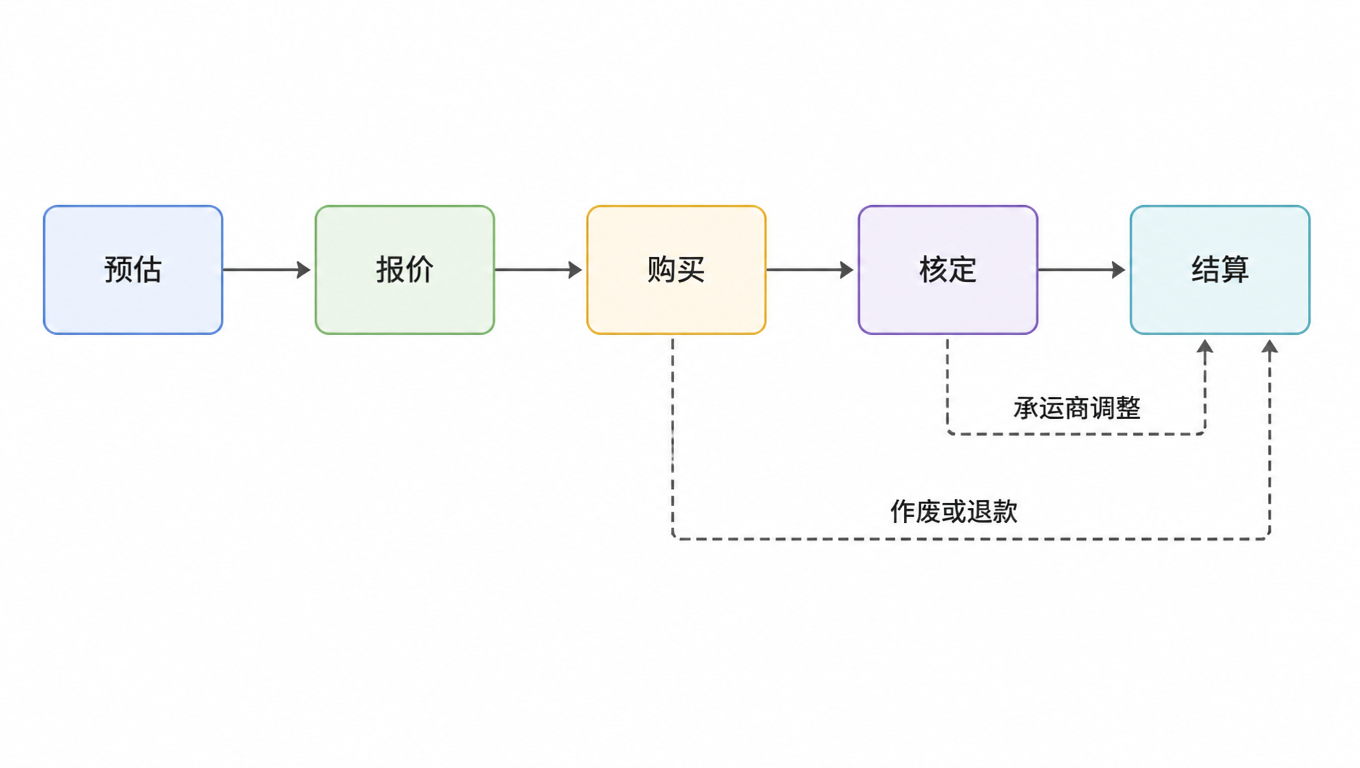
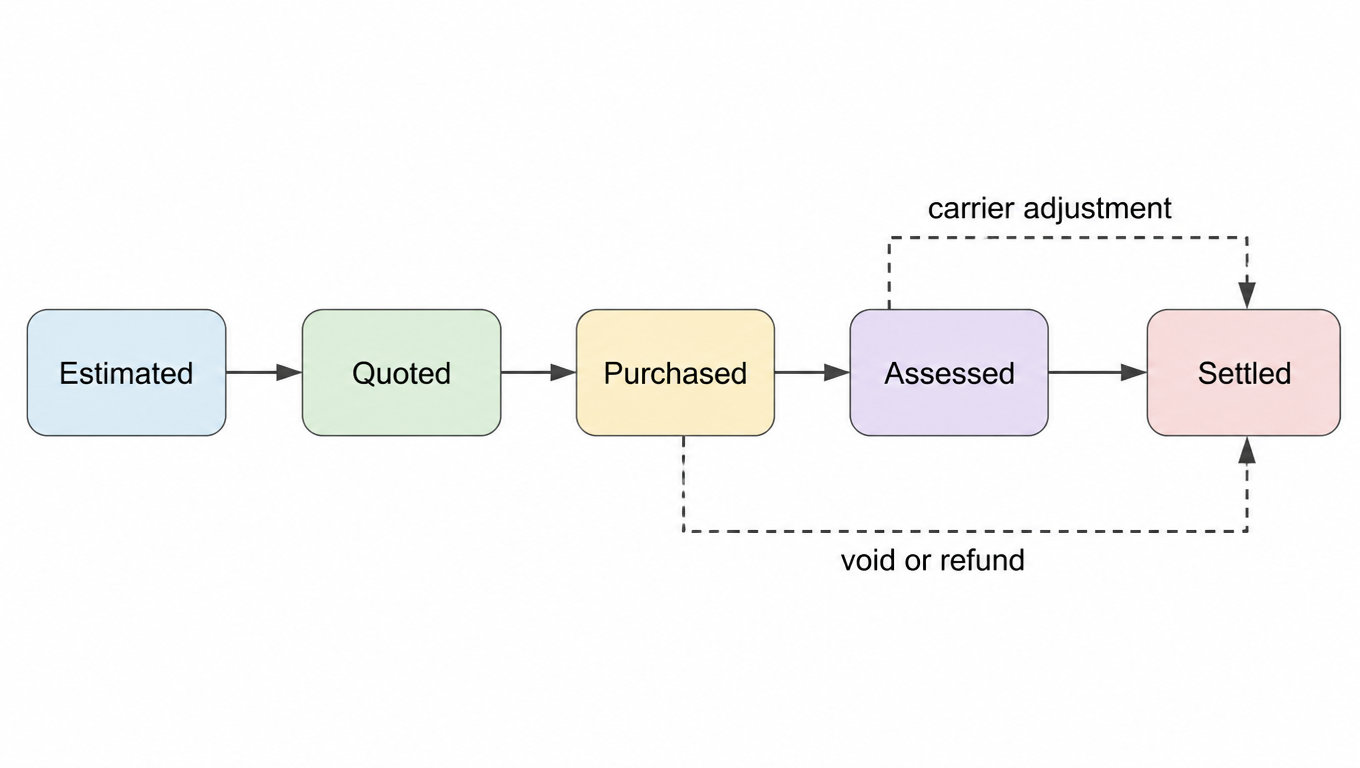
流转方向是从左到右,在票件结算之前,每个状态都还可能变化:The flow moves left to right, and each state can still change until the shipment settles:

流程图:预估 → 报价 → 购买 → 核定 → 结算,核定经承运商调整到达结算,购买经作废或退款到达结算Flowchart: Estimated, Quoted, Purchased, Assessed, Settled, with carrier adjustment from Assessed and void or refund from Purchased leading to Settled
结算之前,每个状态都还可能变化Every state can still change until the shipment settles

结算价才是对账、承运商评分卡和客户账单真正用的那个数,之前的每个状态都只是它的预测。Settled is the number that matters for accounting, carrier scorecards, and client billing. Every earlier state is a forecast of it.

框架只有有人负责才成立。运营负责输入准确:结账和仓库录入的重量、尺寸、地址,是后面每个状态赖以建立的原材料。工程负责持久化:每个状态都要带上自己的时间戳和关联 ID(报价 ID、面单 ID、运单号、扣费 ID)保存下来,这样后续出现的差异才能一路追回到它出现的那个状态。财务负责结算成本和客户账单政策:决定客户按什么收费、调整什么时候转嫁、最终数字怎么核销的规则。The framework only works if someone owns it. Operations owns input accuracy: the weight, dimensions, and address entered at checkout and at the warehouse are the raw material every later state is built from. Engineering owns persistence: every state must be saved with its own timestamp and the IDs that link it (quote ID, label ID, tracking number, charge ID), so a later difference can be traced back to the state where it appeared. Finance owns the settled cost and the customer billing policy: the rules that decide what a client is charged, when an adjustment is passed through, and how the final number is reconciled.

让报价偏离扣费的变量The variables that make a quote diverge from a charge

大多数差异都不是玄学。要么是报价生成那一刻和承运商实测那一刻之间,输入发生了变化;要么是输入从一开始就是错的。排查不一致时,按这个顺序检查这些变量。Most divergences are not mysteries. They are caused by inputs that change between the moment the quote was generated and the moment the carrier measured the shipment, or by inputs that were wrong from the start. When you investigate a mismatch, check these variables in this order.

位置与服务:起止 ZIP、所选承运商和服务,以及报价用的服务和购买面单时是否一致。重量:你提交的申报重量,对比承运商在入网或分拣时扫描到的重量。尺寸与 DIM:录入的长宽高、适用的 DIM 除数,以及由两者算出的计费重量。[^1] 包装类型:纸箱、快递袋还是圆筒,既影响体积重也影响费率表。分类:住宅还是商业派送,以及是否适用 DAS、EDAS 或偏远地区等配送区域附加费。[^3] 地址:报价之后地址有没有被修正,一旦修正,通常在费率变化之外还会多一笔地址修正费。[^2] 附加服务:报价之后才挂到面单上的签名、保险等。结构:多包裹订单,报价时合并计算,承运商却逐件核定。生命周期:面单作废、退款和补打,每一件都可能产生独立的扣费行,或者没有冲销掉原始扣费。时点:报价时间戳和它对应的费率版本,因为承运商会在版本更新之间调整服务和燃油系数。最后是账单上的承运商调整原因代码,那是承运商自己对差异的解释。Location and service: origin and destination ZIP, the carrier and service selected, and whether the quote used the same service the label was purchased on. Weight: the declared weight you submitted versus the weight the carrier scanned at induction or sortation. Dimensions and DIM: the length, width, and height captured, the DIM divisor applied, and the billable weight derived from both.[^1] Packaging type: a box, poly bag, or tube changes both dimensional weight and the rates table. Classification: residential versus commercial delivery, and whether delivery area surcharges apply, such as DAS, EDAS, or remote-area fees.[^3] Address: whether the address was corrected after the quote, which usually triggers an address correction fee on top of any rate change.[^2] Add-ons: signature, insurance, and other services attached to the label after quoting. Structure: multi-package shipments, where each package is assessed separately while the quote aggregates them. Lifecycle: label voids, refunds, and reprints, each of which can create a separate charge line or fail to credit the original one. Timing: the quote timestamp and the rate version it came from, because carriers reprice services and fuel factors between releases. Finally, the carrier adjustment reason code on the invoice, which is the carrier's own explanation for the difference.

实际的修法分两层。第一,在源头把变量录对,因为任何对账框架都修不了一个输错的重量。第二,把每个价格状态都挂到同一组标识符上(订单 ID、发货 ID、面单 ID、运单号、扣费 ID),这样数字一变,你能证明它属于哪一票件。The practical fix has two layers. First, capture the variables correctly at the source, because no reconciliation framework can repair a weight that was typed wrong. Second, link every price state to the same set of identifiers (order ID, shipment ID, label ID, tracking number, charge ID), so that when a number changes you can prove which shipment it belongs to.

排查差异的决策框架A decision framework for investigating a mismatch

报价和扣费对不上时,按顺序走五步。每一步都在你花时间申诉或核销之前,先缩小排查范围。When a quote and a charge disagree, follow five steps in order. Each step narrows the search space before you spend time disputing or reconciling.

第 1 步:确认你在比较同一笔交易Step 1: Confirm you are comparing the same transaction

承运商和服务一致、重量尺寸和 ZIP 一致、包裹数量一致、附加费假设一致。相当一部分「不一致」其实是在比较两个不同的东西:5 区的报价对 8 区的扣费,或者单包裹的报价对多包裹的账单。Same carrier and service, same weight, dimensions, and ZIP, same package count, same surcharge assumptions. A surprising share of "mismatches" are simply two different things being compared: a zone 5 quote against a zone 8 charge, or a single-package quote against a multi-package invoice.

第 2 步:定位差异出现在哪个阶段Step 2: Locate where the difference appeared

金额是在报价和购买面单之间变的,还是在购买和承运商核定之间变的?核定之后有没有冒出新的调整?作废或退款有没有冲销掉原始扣费?有没有重复的面单或重复的扣费行?答案会指向责任人:你的费率逻辑、仓库的数据录入,还是承运商的账单系统。Did the amount change between quote and label purchase? Between purchase and carrier assessment? Did a new adjustment appear after assessment? Did a void or refund fail to credit the original charge? Is there a duplicate label or a duplicate charge line? The answer points to the responsible party: your rate logic, the warehouse capture, or the carrier's billing.

第 3 步:按原因分类Step 3: Classify the cause

把原因归入标准分类:输入不一致、重量或 DIM 调整、地址或 ZIP 分类、服务或包装不匹配、附加费、作废退款处理、承运商或平台账单错误。分类决定修法。Classify the cause into one of the standard buckets: input mismatch, weight or DIM adjustment, address or ZIP classification, service or packaging mismatch, surcharge, duplicate or void or refund handling, or a carrier or platform billing error. The bucket determines the fix.

第 4 步:决定处理方式Step 4: Decide the handling

调整合理且在你自己设定的容差内,就接受它。输入错了,就修仓库的数据录入。核定本身错了,就向承运商申诉。差异是系统性的,就更新客户账单政策。同一段路一直产生糟糕的最终成本,就调整路由规则。如果某个承运商在某个包裹段上持续超出容差,就换掉这个段的承运商。Accept the adjustment if it is legitimate and within the tolerance you set. Fix the warehouse data capture if the input was wrong. Dispute with the carrier if the assessment itself is wrong. Update the client billing policy if the mismatch is systematic. Adjust the routing rule if the same segment keeps producing bad final costs. And if a carrier keeps landing outside tolerance on a parcel segment, switch carriers for that segment.

第 5 步:用结算成本评估承运商Step 5: Evaluate the carrier on settled cost

这是下一节的主题。整套排查存在的意义,就是喂给这个数字。This is the subject of the next section. The whole investigation exists to feed that number.

用结算成本评估承运商,而不是报价Evaluating carriers on settled cost, not quoted rate

只建立在报价上的承运商评分卡会误导你,因为报价不含后来才到的调整。每条线路、每个包裹段至少保留五个指标:平均报价成本、平均购买成本、调整率(购买之后金额发生变化的票件占比)、平均结算成本,以及成功妥投成本(已妥投包裹的结算成本除以实际妥投件数)。A carrier scorecard built on quoted rates alone will mislead you, because quotes do not include the adjustments that arrive later. Keep at least these five metrics per lane and parcel class: average quoted cost, average purchased cost, adjustment rate (the share of shipments that changed after purchase), average settled cost, and cost per successful delivery, which divides the settled cost of delivered parcels by the count of parcels that actually delivered.

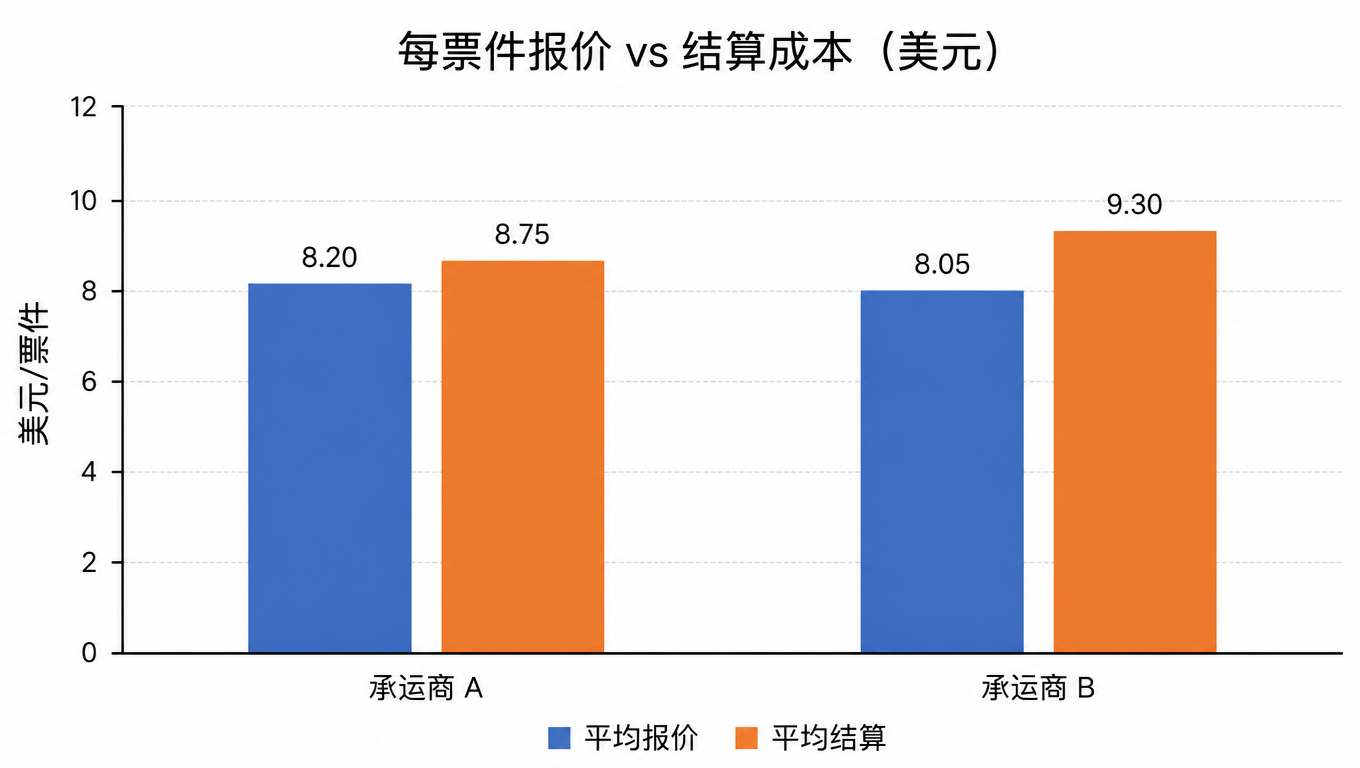
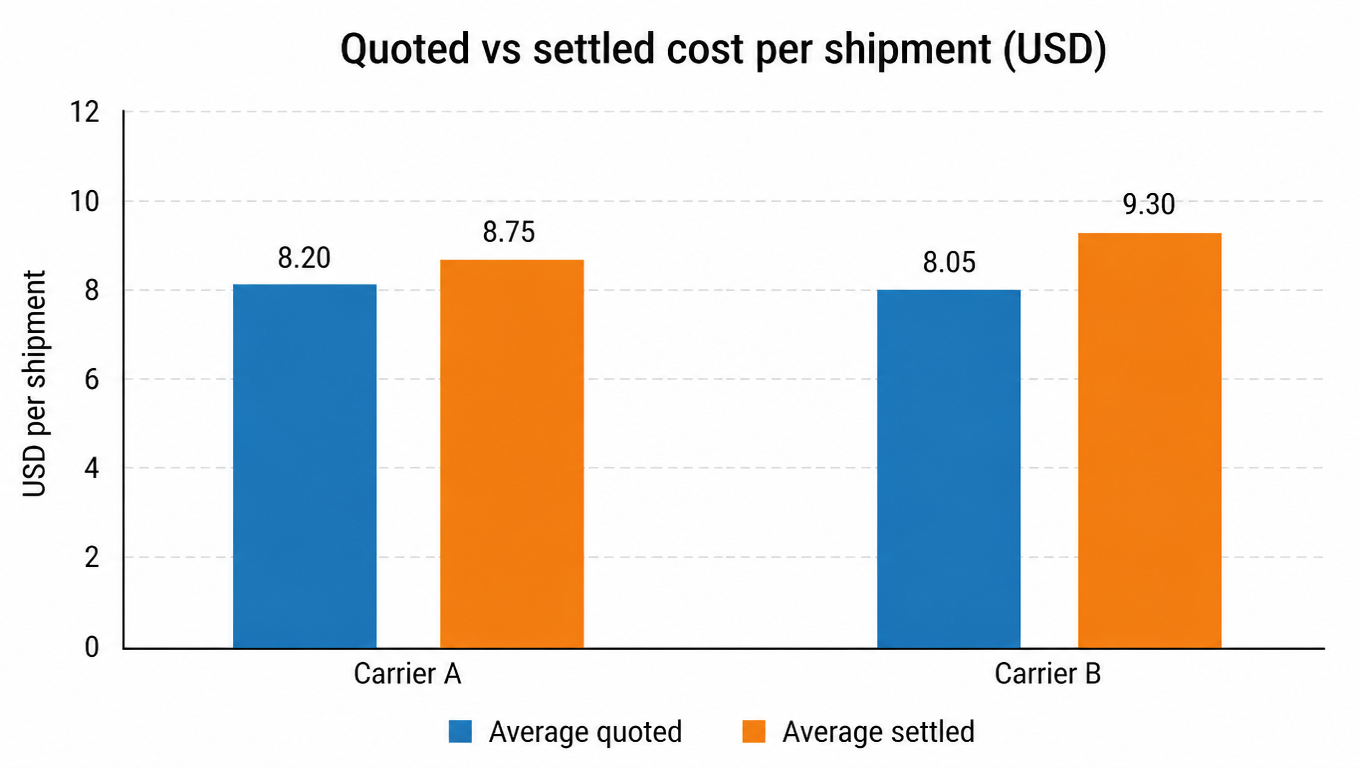
用同一线路、同一包裹段的 500 票件做个算例。承运商 A 平均报价 8.20 美元,结算 8.75 美元,调整率 8%。承运商 B 平均报价 8.05 美元,在报价页面上看起来更便宜,结算 9.30 美元,调整率 21%。只看报价,承运商 B 便宜 15 美分;看结算成本,承运商 A 便宜 55 美分。Here is a worked example from the same lane and parcel class across 500 shipments. Carrier A quoted an average of $8.20 and settled at $8.75, with an 8 percent adjustment rate. Carrier B quoted an average of $8.05, looked cheaper at the quote screen, and settled at $9.30, with a 21 percent adjustment rate. On quoted cost alone, Carrier B wins by 15 cents. On settled cost, Carrier A wins by 55 cents.

柱状图:承运商 A 平均报价 8.20 美元、平均结算 8.75 美元,承运商 B 平均报价 8.05 美元、平均结算 9.30 美元Bar chart: Carrier A average quoted 8.20 USD and settled 8.75 USD, Carrier B average quoted 8.05 USD and settled 9.30 USD
报价上更便宜的承运商,结算成本可能更贵The carrier that looks cheaper on quotes can be more expensive on settled cost

我们不会给你一个放之四海而皆准的容差阈值,因为这样的阈值不存在。合适的容差取决于你的包裹段、线路、包装纪律,以及你承担得起多少核销工作量。用你自己的数据建:取三到六个月的已结算票件,按线路和包裹段分组,看报价与结算成本之差的分布。既能抓住真实的承运商错误、又不会让团队被噪声淹没的那个阈值,就是适合你这个分布的值,通常在观察到的差额的第 90 或第 95 百分位附近。把这个数写进路由规则和承运商评分卡,「哪个承运商更便宜」从此就能用证据回答。We are not going to give you a universal tolerance threshold, because one does not exist. The right tolerance depends on your parcel classes, your lanes, your packaging discipline, and how much reconciliation effort you can afford. Build your own from your own data: take three to six months of settled shipments, group them by lane and parcel class, and look at the distribution of differences between quoted and settled cost. The threshold that catches genuine carrier errors without flooding your team with noise is the one that fits your distribution, typically somewhere around the 90th or 95th percentile of your observed deltas. That is the number to encode in your routing rules and your carrier scorecard, and it is the number that makes "which carrier is cheaper" answerable with evidence.

常见问题FAQ

因为一票发货交易要经过好几个价格状态,每个状态基于的信息不同。报价是基于当下输入做出的预测,最终扣费是基于承运商实际称重、量尺、核验的结果,再加上调整、作废和退款之后的结算。两者之间的差值,是「什么变了」的信息,不是该被藏起来的错误。Because a shipping transaction passes through several price states, and each one is based on different information. The quote is a prediction built from the inputs at that moment; the final charge is a settlement built from what the carrier actually weighed, measured, and validated, plus adjustments, voids, and refunds. Gaps between them are information about what changed, not errors to be hidden.
结算成本:加上调整、作废和退款之后的净额。之前的每个状态(预估、报价、购买、核定)都只是它的预测。对账、承运商评分卡和客户账单,都用结算成本。The settled cost: the net charge after adjustments, voids, and refunds are applied. Every earlier state (estimated, quoted, purchased, assessed) is a forecast of it. Use settled cost for accounting, carrier scorecards, and client billing.
这是账单政策问题,而且需要证据。先让这笔差异走一遍五步框架:确认是同一笔交易、定位差异出现在哪个状态、把原因归类。然后按你的政策决定:容差内的合理调整自己吸收,系统性的承运商调整向客户转嫁,错的就申诉。政策应该在争议到来之前就写好,而不是之后。That is a billing-policy decision, and it needs evidence. Run the mismatch through the five-step framework first: confirm it is the same transaction, locate which state the difference appeared in, and classify the cause. Then decide per your policy: absorb legitimate adjustments within tolerance, pass through systematic carrier adjustments, and dispute what is wrong. The policy should be written down before the dispute arrives, not after.
没有放之四海而皆准的数字。取三到六个月的已结算票件,按线路和包裹段分组,看报价到结算的差额分布,把阈值设在观察到的差额的第 90 或第 95 百分位附近,然后写进路由规则和评分卡。There is no universal number. Take three to six months of settled shipments, group by lane and parcel class, and look at the distribution of quoted-to-settled differences. Set the threshold around the 90th or 95th percentile of your observed deltas, then encode it in your routing rules and scorecard.
不能只看报价页面。每条线路、每个包裹段至少跟踪五个数字:平均报价、平均购买、调整率、平均结算、成功妥投成本。本指南的算例里,承运商 B 在报价上便宜 15 美分,结算成本却贵 55 美分。建立在结算成本上的评分卡,才能用证据回答这个问题。Not from the quote screen. Track at least five numbers per lane and parcel class: average quoted, average purchased, adjustment rate, average settled, and cost per successful delivery. In the worked example in this guide, Carrier B looked 15 cents cheaper on quotes but was 55 cents more expensive on settled cost. Scorecards built on settled cost answer the question with evidence.

想让报价和最终扣费对得上?Want quotes and final charges to line up?

EasyShippingX 工作在承运商执行层(费率、面单、追踪)。多承运商实时费率、购买面单前的地址校验,以及带完整标识符的每个价格状态记录,让你有证据去核销、去申诉,并按结算成本而不是报价页面的承诺来评估承运商。五价格状态框架和结算成本评分卡,正是把「哪个承运商更便宜」变成有据可答的问题所需的基础设施。EasyShippingX operates in the carrier execution layer (rates, labels, tracking). Multi-carrier live rates, address validation before you buy the label, and a full record of every price state with its identifiers give you the evidence to reconcile, dispute, and score carriers on settled cost, not on what the quote screen promised. The Five Price States Framework and a settled-cost scorecard are exactly the infrastructure that turns "which carrier is cheaper" into a question you can answer with evidence.

Get Rate Comparison
Get Rate Comparison