电商物流指南Ecommerce Shipping Guide

7 个信号表明你的物流软件已跟不上业务:如何在不打断履约的前提下完成迁移7 Signs You've Outgrown Your Shipping Software, and How to Migrate Without Disrupting Fulfillment

你的物流软件仍然能打印面单,但这不等于它还适合你的业务。陷阱在于「还能用」听起来像留下来的理由,而真正的成本一直在后台悄悄累积:操作时间、培训周期、承运商错误、峰值积压。Your shipping software can still print a label. That is not the same as it still fitting your business. The trap is that "it still works" feels like a reason to stay, while the real costs keep compounding invisibly in the background: operator time, training cycles, carrier mistakes, peak backlogs.

Al 的故事说明了一切。Al 经营一家 DTC 店铺,日均约 300 单,大促时冲到 800 单。他的打单工具一次都没有打错过面单,但他的运营卡住了:团队为每一单手动选择承运商,因为谈好的折扣价和时效等级躺在 Excel 里,不在软件里;新员工要先跟岗两周才能独立发货;订单量翻倍,人均产出却原地不动。打印按钮没有问题,有问题的是运营本身:人工选择承运商、培训时长、吞吐量。Al's story makes the point. Al runs a DTC shop doing around 300 orders a day, spiking to 800 during sales. His shipping tool printed labels without a single failure. Yet his operation was stuck. His team manually picked a carrier for every order because negotiated rates and service tiers lived in a spreadsheet, not in the software. New hires needed two weeks of shadowing before they could ship unsupervised. Throughput per person flatlined while order volume doubled. The label button worked. The operation didn't. The problem was never the printing. It was manual carrier decisions, training time, and throughput.

「还能用」是一种感觉,「还适合」是一个测量结果。在评估任何供应商之前,你需要一张运营指标仪表盘,因为迁移的决定应该由数字触发,而不是由某个忙碌周一的软件体验触发。这张仪表盘有八行:每人每小时发货量是先行指标,同时对应信号 1;接下来的六个指标对应信号 2 到 7;第八项,API 与 Portal 兜底可用性,根本不是预警信号,而是你迁移目标系统的验收标准。"Still works" is a feeling. "Still fits" is a measurement. Before you evaluate a single vendor, you need a dashboard of operational metrics, because the decision to migrate should be triggered by numbers, not by how the software feels on a busy Monday. That dashboard has eight rows. Orders shipped per labor hour is the leading indicator, and it doubles as Signal 1. The next six metrics map to Signals 2 through 7. The eighth, API and portal fallback availability, is not a warning sign at all. It is the acceptance criterion for whatever you migrate to.

编辑风照片:黄金时刻的小型电商履约间,一名操作员在热敏面单打印机旁打包,工作台上堆着纸箱,忙碌但从容
打印面单 ≠ 软件还适合你的业务Printing a label is not the same as still fitting your business

信号 1:每人每小时发货量触顶Signal 1: Orders Shipped per Labor Hour Has Flatlined

每人每小时发货量是最真实的履约健康指标[^1]:当天出门的订单总数,除以全部履约工时,包括打包、贴单、异常处理和重打。如果订单翻倍,工时也跟着翻倍,你没有规模化,你只是用加人换回了原来的比例。Orders shipped per labor hour is the truest measure of fulfillment health[^1]: total orders out the door divided by total fulfillment labor hours, including packing, labeling, exceptions, and reprints. If orders double and your labor hours double with it, you have not scaled. You hired your way back to the same ratio.

信号藏在伪装成忙碌的低效里。复制粘贴地址。在浏览器标签页里查承运商。因为没人相信上一个报价,再核一遍费率。每周像钟表一样准时报到的加班。这些看起来都不像失败,它们看起来像工作,但这是本应由软件吸收的工作。The tell is disguised busyness. Copy-pasting addresses. Looking up a carrier in a browser tab. Rechecking a rate because nobody trusts the last quote. Overtime that shows up every week like clockwork. None of this looks like failure; it looks like work. But it is work the software should have absorbed.

先诊断,再怪旺季。节假日前后的下滑只是波动;业务增长的同时连续三个季度持平或下降,那是结构性天花板:软件限制了一个操作员能发多少货,加多少人都不改变这个比例。Diagnose before you blame the season. A dip around a holiday is a blip. Flat or declining for three consecutive quarters while volume grows is a structural ceiling: the software is capping how much one operator can ship, and no amount of headcount changes the ratio.
信号 2:每 1,000 单的人工决策次数持续上升Signal 2: Manual Decisions per 1,000 Orders Keeps Climbing

数一数一个典型订单上的人工操作点:每一个需要人替软件做决定的地方。选承运商。选时效等级。修正一个坏地址。处理异常。套用一条系统表达不了的规则。Count the operator touches on a typical order: every point where a human has to decide something the software didn't. Choose the carrier. Choose the service tier. Fix a bad address. Handle an exception. Apply a rule the system can't express.

好系统把决策变成规则,差系统把规则变成人的判断。当软件无法编码你的业务逻辑,键盘前的人就成了路由引擎,而人的路由引擎每次给出的答案都略有不同。这种不一致,正是错误和客诉的来源。Good systems turn decisions into rules. Bad systems turn rules into human judgment. When the software can't encode your logic, the person at the keyboard becomes the routing engine, and a human routing engine gives a slightly different answer every time. That inconsistency is where errors and customer complaints come from.

Al 最大的错误来源就是人工选择承运商。因为费率和时效映射在软件之外,每一单都要重新决策,由当天打包的那个人、在当时的时效压力下决定。软件没有错,它只是没有在决策。Al's single largest error source was manual carrier selection. Because his rates and service mapping lived outside the software, the decision was made fresh on every order, by whoever was packing that day, under whatever time pressure existed. The software wasn't wrong. It simply wasn't deciding.

追踪每 1,000 单的人工决策次数。如果它在业务增长的同时逐季上升,说明你的业务复杂化的速度,超过了系统学会编码它的速度。Track touches per 1,000 orders. If that number rises quarter over quarter while volume grows, your business got more complex faster than your system learned to encode it.

信号 3:面单重打与错误率突破基线Signal 3: Label Reprints and Error Rate Break the Baseline

每一次重打都是一串成本:面单本身、退款或补发、客服时间,对平台卖家来说,还有惩罚延迟与错误发货的平台指标[^3]。Every reprint is a chain of costs: the label itself, the refund or reship, the customer service time, and for marketplace sellers, the platform metrics that punish late and incorrect shipments[^3].

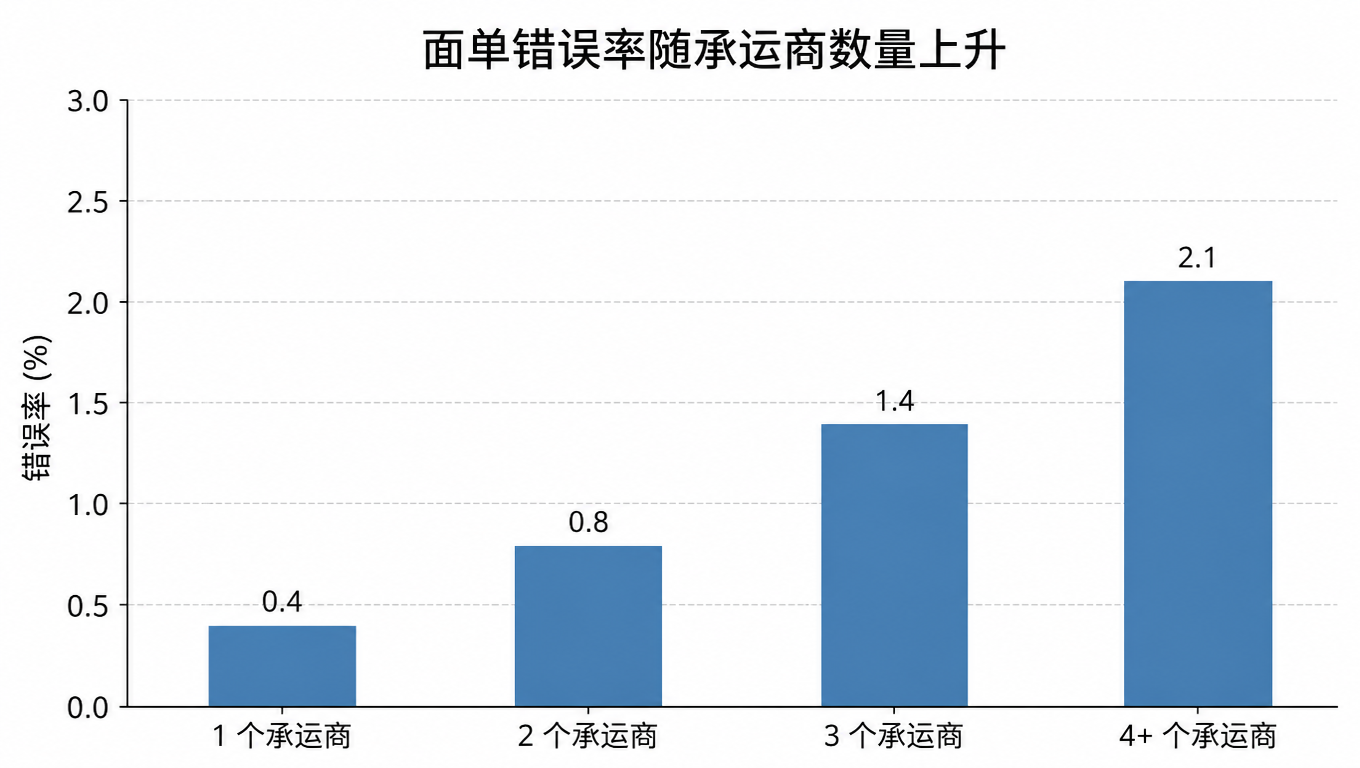
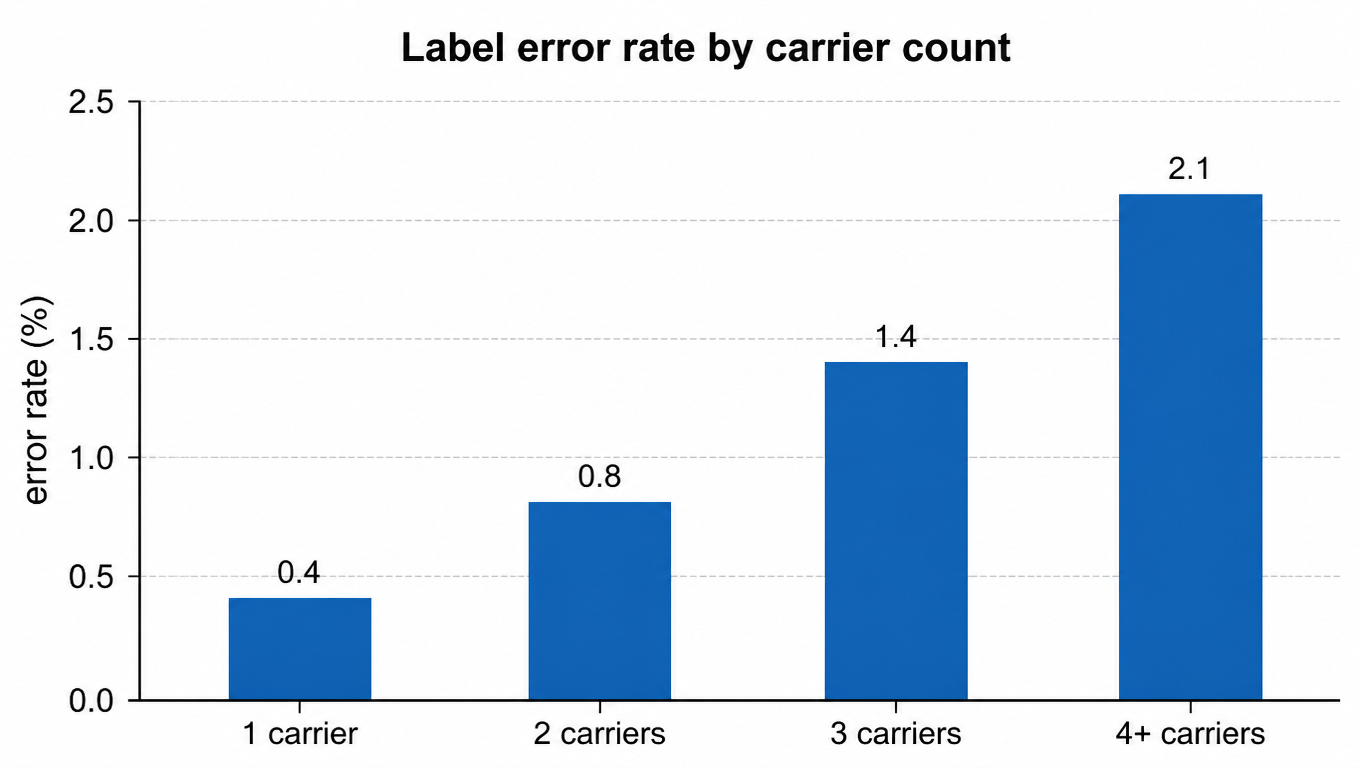
健康店铺的错误率低于 1%[^2]。规则变多后的走势是可以预测的:单一承运商、单一费率档,约 0.4%;加第二个承运商和分层时效,爬到约 0.8%;三个承运商约 1.4%;超过四个、再叠上谈好的折扣价,可能突破 2%。A healthy shop runs under 1 percent[^2]. The pattern as rules multiply is predictable. A single carrier and one rate tier sits around 0.4 percent. Add a second carrier with tiered services and it creeps toward 0.8. At three carriers it's about 1.4. Past four, with negotiated rates layered on top, it can pass 2 percent.

柱状图:面单错误率随承运商数量上升,1 个承运商 0.4%、2 个 0.8%、3 个 1.4%、4 个以上 2.1%Bar chart: label error rate by carrier count, 1 carrier 0.4%, 2 carriers 0.8%, 3 carriers 1.4%, 4+ carriers 2.1%
面单错误率随承运商数量上升Label error rate by carrier count

错误率是复杂度的滞后信号。当多承运商、多时效、折扣价逻辑超出软件能表达的范围,规则就搬进了人的脑袋,而压力之下的人会犯错。重打率上升不是人的问题,是穿着人的外衣的系统问题。The error rate is a lagging signal of complexity. When multi-carrier, multi-tier, negotiated-rate logic outgrows what the software can express, the rules move into people's heads, and people under pressure make mistakes. Rising reprints aren't a people problem. They're a system problem wearing a people costume.

信号 4:新员工培训要数周而不是数天Signal 4: New-Hire Training Takes Weeks, Not Days

培训时长是系统复杂度的直接函数。如果新员工需要两周才能独立发货,说明知识不在软件里,而在老员工脑子里。Training time is a direct function of system complexity. If a new hire needs two weeks before shipping unsupervised, the knowledge isn't in the software; it lives in the heads of your tenured staff.

最明确的信号是部落知识。培训就是跟 Maria 学一周,大多数问题的标准答案是「问 Maria」。当学习运营的唯一方式是向人吸收,你的运营就是软件未文档化的界面。The unmistakable tell is tribal knowledge. Training consists of shadowing Maria for a week. The documented answer to most questions is "ask Maria." When the only way to learn the operation is to absorb it from a person, the operation is your software's undocumented UI.

好系统按小时培训,不是按周。规则在软件里,新员工第一天就能安全地打出一张真面单,因为系统在强制执行逻辑。培训从背流程变成处理异常。如果每次招人上手时间都更长,那就是指标在说话。A good system trains in hours, not weeks. The rules live in the software, so a new hire ships a real label on day one, safely, because the system enforces the logic. Training becomes exception handling instead of process memorization. If onboarding gets longer every time you hire, that is the metric talking.

信号 5:接入新承运商要以周计Signal 5: Carrier Onboarding Lead Time Runs Weeks

每接入一个承运商都有成本:API 密钥、费率配置、时效映射、测试、教团队用新界面。如果这一圈要三周,你绝不会为了试一个报价去走一遍。Every carrier you add costs you in lead time: API keys, rate setup, service mapping, testing, training your team on a new interface. If that loop takes three weeks, you will not run it just to test a quote.

这是沉默的税。被锁定在一两个承运商里,你就失去了议价筹码,因为每一次费率谈判都建立在「否则我们换一家」的潜在威胁上。而当你实际上换不了,这个威胁就是空的。你的软件正在向你未来的每一场谈判征税。That is the silent tax. Locked into one or two carriers, you lose negotiating leverage, because every rate conversation happens under the implicit threat of "or we switch." Without the ability to actually switch, that threat is empty. Your software is taxing every negotiation you will ever have.

现代系统按天接入承运商,因为集成是标准化的,费率配置是配置项,不是项目。你的议价能力来自「说走就能走」。如果加一个承运商像签一份承诺书,你的软件已经把你锁死了。A modern system onboards carriers in days, because integrations are standardized and rate setup is config, not a project. Your negotiating power comes from being able to move. If adding a carrier feels like a commitment, your software has you locked in.

信号 6:峰值队列恢复时间越来越长Signal 6: Peak Queue Recovery Time Keeps Growing

峰值不是以「忙」的形式失败,而是以队列恢复时间的形式失败:从促销结束到积压清完的小时数。Peaks don't fail as "busy." They fail in queue recovery time: the hours from the end of the sale until the backlog is clear.

健康的运营在几小时内清完峰值,比如全员到岗、四小时。被压垮的运营要几天。队列排不动,是因为吞吐被人工步骤卡住:每一单都需要同样的人工决策,积压自我复利。与此同时 SLA 违约在堆积、平台发货时效指标在咬人、退款在往外走。A healthy operation clears a peak in hours. Four hours, say, with everyone at their stations. An overtaxed one takes days. The queue doesn't drain because throughput is capped by manual steps; every order needs the same human decisions, and the backlog compounds on itself. Meanwhile the SLA misses pile up, platform late-shipment metrics bite, and refunds go out.

每次峰值后都测量它。如果加了人,恢复时间反而变长,瓶颈是软件的人工操作负荷,不是人头。你正在用人的方式解决一个本应用规则解决的问题。Measure it after every peak. If recovery time grows even as you add labor, the constraint is the software's operator-touch load, not your headcount. You are solving a throughput problem with people when you should be solving it with rules.

信号 7:对账要几天而不是几分钟Signal 7: Reconciliation Takes Days, Not Minutes

承运商的账单来了,和你预期要付的对不上。某处多了一笔附加费、重新计算了体积重、重新划分了分区[^4]。你几周后才发现,因为拿账单对订单是一件没人喜欢的手工仪式。The carrier invoice arrives and doesn't match what you expected to pay. Somewhere, a surcharge was applied, a dimensional weight recalculated, a zone reclassified[^4]. You find out weeks later, because checking the invoice against the orders is a manual ritual nobody enjoys.

你无法优化一个你看不见的数字。如果每单运费在对账之前都是谜,那你的费率谈判、定价、产品毛利,就全是叠在一起的猜测。You cannot optimize a number you don't see. If per-order shipping cost is a mystery until reconciliation, then your rate negotiations, your pricing, and your product margins are all guesses stacked on top of each other.

好系统在面单打印的那一刻实时显示每单运费,账单无需表格就能对上。当成本真相要几天而不是几秒才能看到,你就是在延迟中经营业务。A good system shows per-order shipping cost in real time, at the moment the label prints, and the invoice reconciles against it without a spreadsheet. When cost truth is days away instead of seconds, you are running your business on a delay.

迁移手册:不打断履约的 5 步The Migration Playbook: 5 Steps That Don't Disrupt Fulfillment

迁移失败,是因为被当成一次大爆炸式切换:周五扳开关,周一祈祷。管用的手册把迁移当作一次部署:分阶段、有测试、可回滚。前后输出一致,否则不继续。Migrations fail when they are treated as a big-bang swap: flip the switch on Friday, pray on Monday. The playbook that works treats migration like a deployment. Staged. Tested. Reversible. Same output before and after, or you don't proceed.

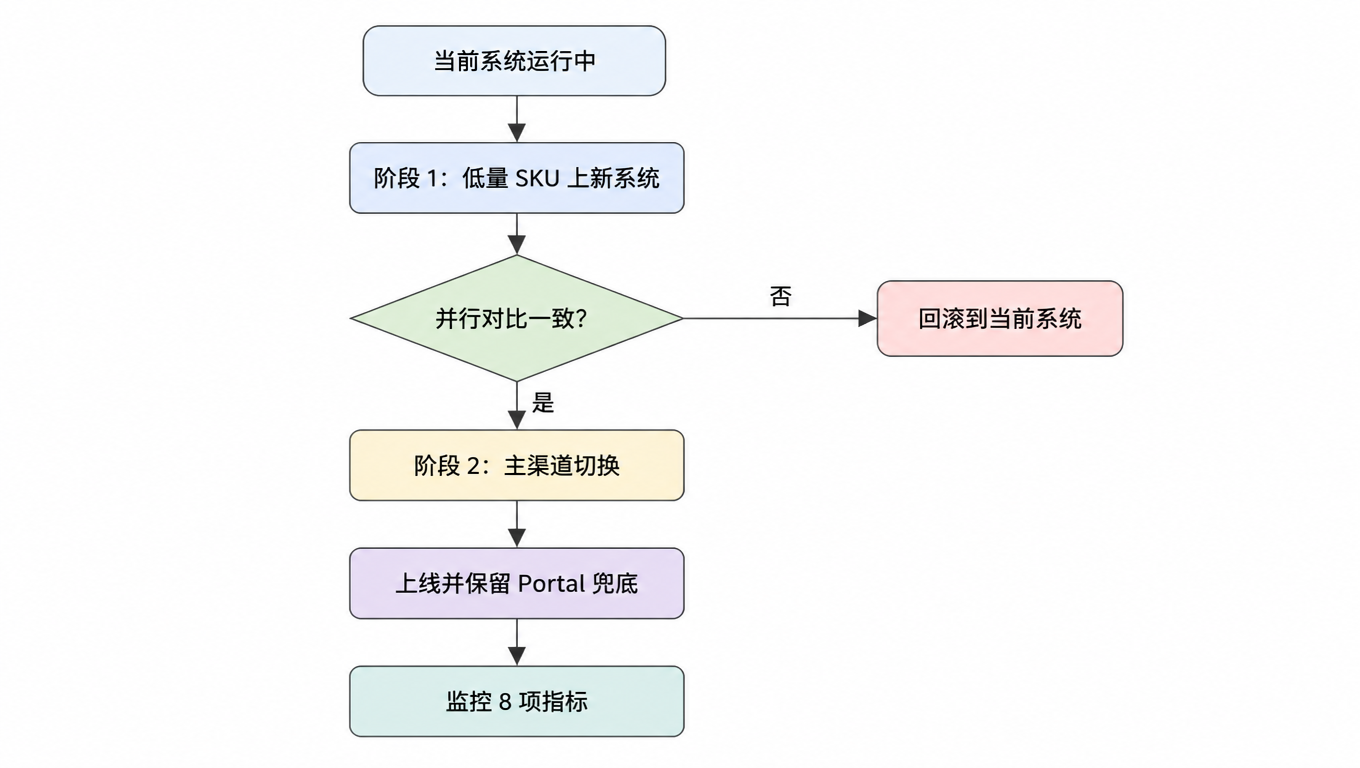
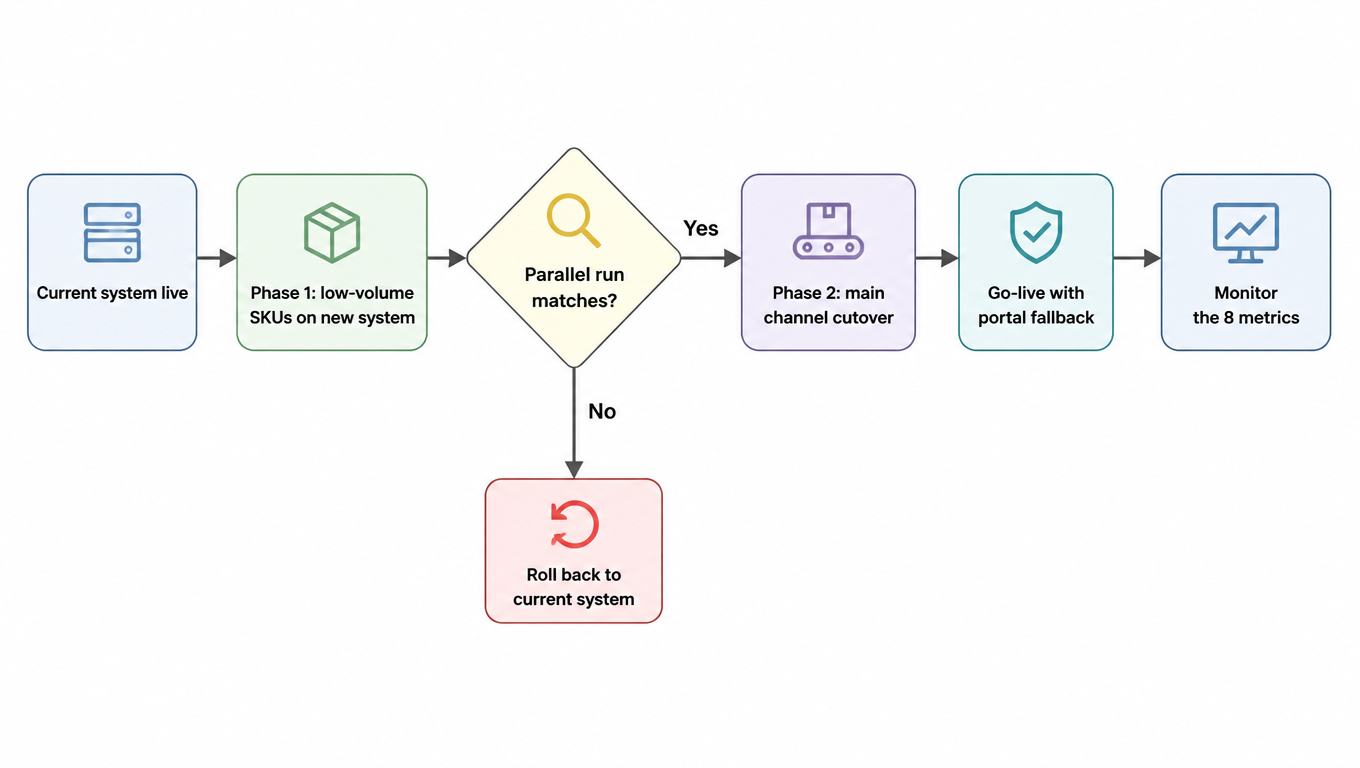
第一步是分阶段迁移:先把低量 SKU 或非核心渠道放到新系统,而不是你的旗舰产品线。第二步是并行运行:同一批订单在两个系统里各打一遍,对比面单、费率、地址和追踪号。在新系统的输出与旧系统逐单一致之前,任何订单都不从新系统发出。Step one is phased migration. Put the low-volume SKUs or a non-core channel on the new system first, not your flagship line. Step two is a parallel run: ship the same batch of orders through both systems and compare labels, rates, addresses, and tracking numbers. Nothing ships from the new system until its output matches the old one, order for order.

流程图:当前系统运行中、阶段 1 低量 SKU 上新系统、并行对比决策、回滚或主渠道切换、上线并保留 Portal 兜底、监控 8 项指标Flowchart: current system live, phase 1 low-volume SKUs on the new system, parallel run decision, rollback or main-channel cutover, go-live with portal fallback, monitor the 8 metrics
分阶段迁移,并行验证,必要时回滚Migrate in phases, validate in parallel, roll back if needed

第三步是代表性包裹测试:建一个覆盖你实际发出的每个承运商、重量段、目的地分区和时效等级的测试集,再加上边缘情况:超尺寸箱、货运、PO Box、AK、HI、PR。如果新系统复现不了你的真实组合,它就没准备好,演示再漂亮也没用。Step three is the representative package test. Build a test set that covers every carrier, weight band, destination zone, and service tier you actually ship, plus the weird cases: oversized boxes, freight, PO boxes, AK, HI, PR. If the new system can't reproduce your real mix, it isn't ready, no matter how nice the demo was.

第四步是回滚计划,在正式上线之前写好,而不是之后[^5]。提前定义触发条件:错误率超过阈值、队列恢复超过设定小时数、对账缺口无法闭合。定义数据同步路径,让你能回到旧系统而不丢订单历史。没有回滚计划的迁移是赌博,不是计划。Step four is the rollback plan, written before go-live, not after[^5]. Define the triggers in advance: error rate above a threshold, queue recovery over a set number of hours, a reconciliation gap that won't close. Define the data sync path so you can return to the old system without losing order history. A migration without a rollback plan is a bet, not a plan.

第五步是 Portal 兜底:API 挂掉时,操作员还能不能从网页端发货?把它写成合同验收标准,而不是一个愿望。仪表盘第八行:如果新供应商不能回答「能」,迁移就不交给它。Step five is portal fallback. When the API is down, can your operators still ship from a web portal? Make it a contractual acceptance criterion, not a hope. The eighth dashboard row: if the new vendor can't answer yes, they don't get the migration.

触发仪表盘:把指标变成迁移决策The Trigger Dashboard: Turning Metrics into a Migration Decision

整篇文章浓缩成一页。八项指标,每一项都有黄线和红线。黄灯意味着开始规划:建候选清单、跑并行测试、估算迁移成本。红灯意味着按计划迁移,因为维持现状的成本已经超过切换。Here is the whole article on one page. Eight metrics, each with a yellow line and a red line. Yellow means start planning: build a shortlist, run a parallel test, price the migration. Red means migrate on a schedule, because the status quo is costing more than the switch.

指标Metric黄灯:开始规划Yellow: start planning红灯:必须迁移Red: must migrate
每人每小时发货量Orders shipped per labor hour连续 2 个季度持平Flat for 2 quarters连续 3 个季度下降Down 3 consecutive quarters
每 1,000 单人工决策次数Manual decisions per 1,000 orders逐季上升Rising quarter over quarter每 10 单就有 1 次人工决策Manual decision on 1 in 10 orders
面单重打 / 错误率Label reprint / error rate1% 到 2%1% to 2%超过 2%Above 2%
新员工培训时长New-hire training time3 到 5 天3 to 5 days超过一周More than a week
承运商接入周期Carrier onboarding lead time1 到 2 周1 to 2 weeks超过 3 周More than 3 weeks
峰值队列恢复时间Peak queue recovery time8 到 24 小时8 to 24 hours超过 48 小时More than 48 hours
对账延迟Reconciliation delay1 到 3 天1 to 3 days超过一周More than a week
API / Portal 兜底API / portal fallback存在但未测试Exists but untested完全没有Missing entirely

这些阈值不是教条,你的数字会不同。重点是在迁移争论开始之前就把它们定下来,让决策由仪表盘做出,而不是由某个经历了最糟周一的人做出。None of these thresholds are gospel; your numbers will differ. The point is to pick them now, before the migration debate starts, so the decision is made by the dashboard and not by whoever had the worst Monday.

Al 不需要一台更好的打印机。他需要把决策从团队的脑子里搬进系统:用路由规则代替人工选承运商,用标准流程代替跟岗学习,用每单成本真相代替月度对账惊吓。迁移不是换软件,是把运营指标从人的手里搬进系统。当指标说走,打印按钮从来都不是问题。Al didn't need a better printer. He needed the decisions out of his team's heads and into the system: routing rules instead of carrier pickers, standard flows instead of shadowing, per-order cost truth instead of monthly reconciliation surprises. Migration isn't switching software. It's moving operational metrics from human hands into the system. When the metrics say go, the label button was never the question.

常见问题FAQ

不看它能不能打印面单,看运营指标:每人每小时发货量是否触顶、每 1,000 单的人工决策次数是否上升、面单错误率是否超过 1% 基线、新员工培训是否要数周、接入新承运商是否要数周、峰值后清完积压要几小时还是几天、对账要几分钟还是几天。给每项指标配上黄灯和红灯阈值,让仪表盘做决定,而不是让某个糟糕的周一做决定。Don't look at whether it can print a label. Look at operational metrics: has orders shipped per labor hour flatlined, are manual decisions per 1,000 orders rising, is the label error rate above the 1 percent baseline, does new-hire training take weeks, does carrier onboarding take weeks, does peak recovery take hours or days, does reconciliation take minutes or days? Put yellow and red thresholds on each metric, and let the dashboard decide, not whoever had the worst Monday.
不是。表格里的数字是起点,不是教条,你的业务会不同。关键是在迁移争论开始之前就把阈值定下来,让决策由数字做出,而不是由情绪做出。阈值定好后,黄灯意味着开始规划(建候选清单、跑并行测试、估算迁移成本),红灯意味着按计划迁移,因为维持现状的成本已经超过切换。No. The numbers in the table are a starting point, not gospel; your business will differ. The point is to set them now, before the migration debate starts, so the decision is made by numbers rather than emotion. Once set, yellow means start planning (build a shortlist, run a parallel test, price the migration), and red means migrate on a schedule, because the status quo is costing more than the switch.
强烈建议。并行运行是成本最低的验证方式:同一批订单在两个系统里各打一遍,逐单对比面单、费率、地址和追踪号。在新系统的输出与旧系统完全一致之前,不让任何订单从新系统发出。它把「上线即赌」变成「验证后切换」,也是回滚计划的基础。Strongly recommended. A parallel run is the cheapest validation: ship the same batch of orders through both systems and compare labels, rates, addresses, and tracking numbers order by order. Nothing ships from the new system until its output matches the old one. It turns "go live and pray" into "switch after verification," and it grounds your rollback plan.
回滚触发条件应该在正式上线前写死,而不是事后拍脑袋:错误率超过阈值、峰值队列恢复超过设定小时数、对账缺口无法闭合。同时定义数据同步路径,让你回到旧系统时不丢订单历史。没有回滚计划的迁移是赌博,不是计划。Write the rollback triggers before go-live, not after: error rate above a threshold, queue recovery over a set number of hours, a reconciliation gap that won't close. Also define the data sync path so you can return to the old system without losing order history. A migration without a rollback plan is a bet, not a plan.
只要按手册走就不会:分阶段迁移先上低量 SKU 和非核心渠道,代表性包裹测试覆盖你真实的承运商、重量段、目的地组合,Portal 兜底保证 API 故障时还能发货。整个迁移的设计原则是前后输出一致:面单、费率、地址、追踪号逐单相同。买家看到的应该和之前完全一样,甚至更好。Not if you follow the playbook: phased migration starts with low-volume SKUs and non-core channels, the representative package test covers your real carrier, weight-band, and destination mix, and portal fallback keeps you shipping even when the API is down. The design principle is identical output before and after: same labels, rates, addresses, and tracking numbers, order for order. Buyers should see exactly what they saw before, or better.

想让履约建立在可测量的运营指标上,而不是「还能打单」上?Want fulfillment grounded in measurable operational metrics, not in "it can still print a label"?

EasyShippingX 在承运商执行层(费率、面单、追踪)工作。多承运商实时费率、可编码的路由规则、打印面单那一刻的实时每单成本与可追溯账单,把人工决策搬回系统里,让七个信号全部转绿。迁移到 EasyShippingX 时,分阶段并行、代表性包裹测试和回滚支持都按手册来,不打断你的履约。EasyShippingX operates in the carrier execution layer (rates, labels, tracking). Multi-carrier live rates, routing rules you can encode instead of decisions your team has to make, real-time per-order cost at the moment the label prints, and traceable billing move the manual touches back into the system, so all seven signals turn green. When you migrate to EasyShippingX, phased parallel run, representative package testing, and rollback support follow the playbook, without disrupting your fulfillment.

Get Rate Comparison
Get Rate Comparison