承运商策略Carrier Strategy

区域快递到底什么时候真的省钱?When Does a Regional Carrier Actually Save Money?

每个卖家和 3PL 经营者应该都听过这套话术:把包裹切给区域快递,立刻省 15% 到 25%。销售材料上的费率卡,价格低到让你的 UPS 账单像打错了字。听起来像白捡的钱,很多人签约时都在期待成本一夜下降。Every seller and 3PL operator has heard the pitch by now: switch your parcels to a regional carrier and save 15% to 25% overnight. The sales deck shows a rate card with prices that make your UPS invoice look like a typo. It sounds like free money, and many operators sign up expecting an instant cost cut.

现实要复杂得多。区域快递只有在你的发货画像和它的网络对得上时才省钱:目的地落在它的覆盖区内、包裹重量落在它的甜点区、货量超过它的最低门槛,而且把每一项附加费算完之后的总成本,仍然低于你今天付的钱。条件不满足时,同一家区域快递可能悄悄比你原本想逃离的全国承运商更贵。The reality is more conditional. A regional carrier saves money only when your shipment profile lines up with its network: your destinations inside its coverage area, your package weights in its sweet spot, your volume above its minimum, and your total cost, after every surcharge, still below what you pay today. When those conditions are not met, the same carrier can quietly cost you more than the national alternative you were trying to escape.

这篇文章给你四样东西:一个把决策收敛到四个变量和一个数字的盈亏平衡模型、一套一个下午就能跑完的五步判断框架、一组按分区并排对比的费率数据告诉你节省到底在哪里,以及一份先测试再承诺的落地手册,卖家与 3PL 仓库分开讲。This article gives you four things: a break-even model that reduces the decision to four variables and one number, a five-check decision framework you can run in an afternoon, side-by-side rate comparisons showing where the savings actually live, and a test-before-you-commit playbook, with separate scenarios for e-commerce sellers and for 3PLs and fulfillment warehouses.

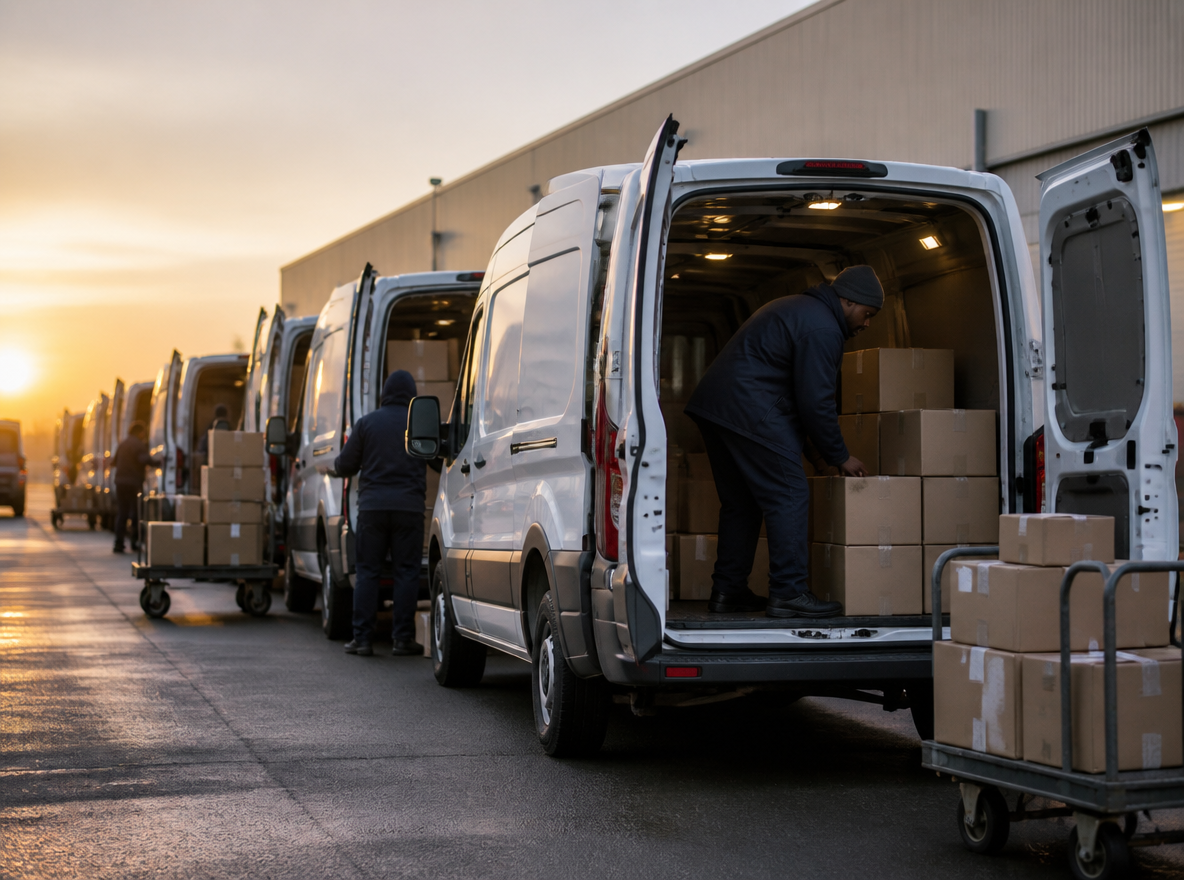
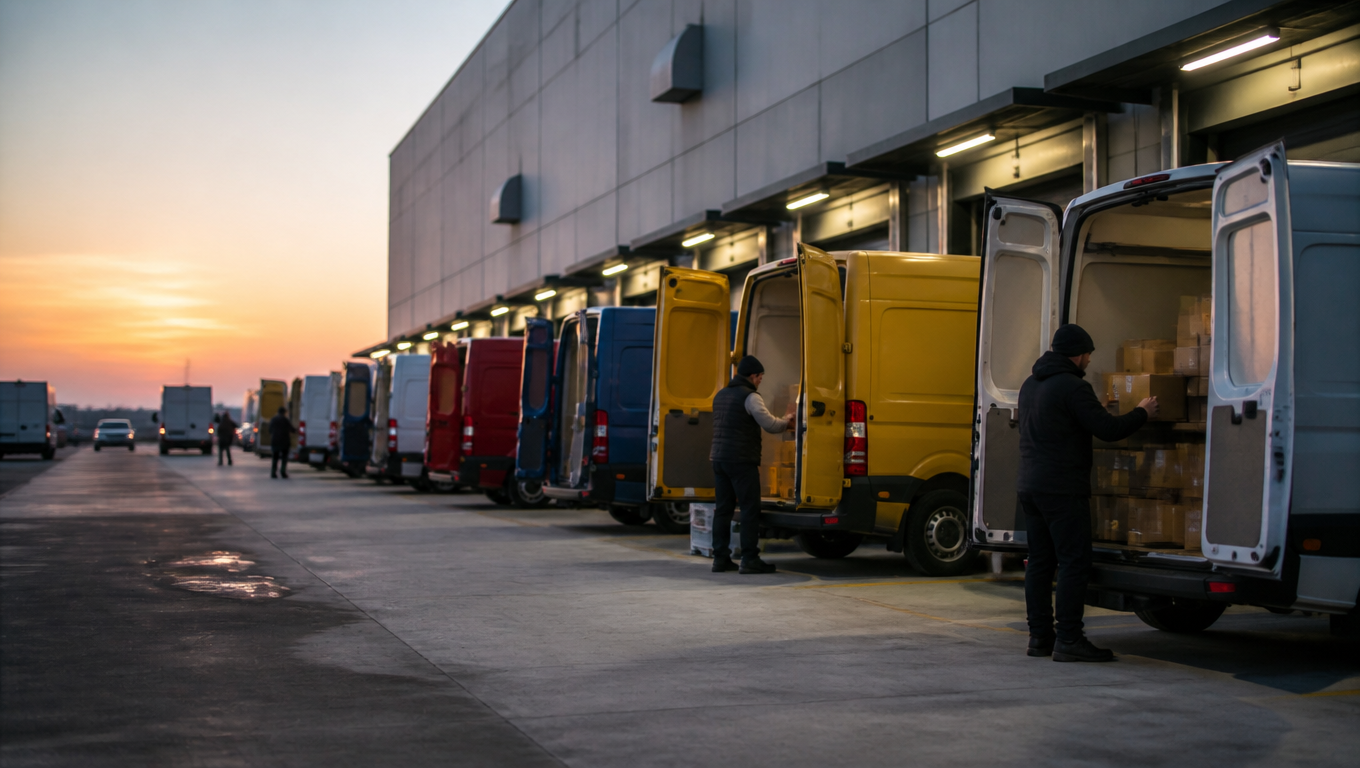
黎明时分,区域快递的派送货车在郊区仓库外排队,司机往车尾装载包裹
区域快递的省钱逻辑建立在覆盖区内的停靠密度上,覆盖区之外全是转卖A regional carrier's savings logic is stop density inside its coverage area; everything outside it is resale

区域快递到底是什么What a Regional Carrier Actually Is

区域快递是只覆盖特定地理区域的派送网络,而不是全国网络。西海岸有 OnTrac 和 SpeedX,东海岸有 GLS(前身是 LaserShip)和 Better Trucks,南方和德州有 LSO。每一家都运营一套为少数几个州、而不是五十个州设计的密集本地枢纽和线路网络。A regional carrier is a delivery network that covers a specific geographic area rather than the whole country. The West Coast has OnTrac and SpeedX. The East Coast has GLS, formerly LaserShip, and Better Trucks. The South and Texas have LSO. Each one operates a dense, localized network of hubs and routes built for a handful of states, not fifty.

与全国承运商的区别是策略的区别,不只是规模。UPS 和 FedEx 运营横跨全美的大型轴辐式系统,包裹先经过中央分拣设施,再分散到本地线路。这种覆盖面要花钱,而且每一档分区费率里都带着这笔钱。区域快递跳过了大部分干线运输:卡车跑短途、每条线路停靠很多户、设施和人工成本更低。这种密度就是它价格优势的全部来源。The difference from a national carrier is a difference of strategy, not just scale. UPS and FedEx run giant hub-and-spoke systems that span the continent, moving packages through central sortation facilities before fanning them out to local routes. That reach costs money, and the cost shows up in every zone-based rate. A regional carrier skips most of the long-haul leg. Its trucks run short distances, stop at many houses per route, and feed on lower facility and labor overhead. That density is the entire source of its price advantage.

实际的结论是:区域快递不是全国网络的替代品,而是多承运商策略里的一块拼图。落在它覆盖区内的包裹享受便宜、密集的区域式处理;覆盖区外的包裹被转交给合作伙伴,通常是 USPS 或全国承运商,转交价格会吃掉折扣。搞懂这个分流,哪些货留在网内、哪些漏出去,才是整件事的关键。The practical consequence: a regional carrier is not a replacement for a national network. It is a piece of a multi-carrier strategy. Packages that land inside its coverage area get the cheap, dense, regional treatment. Packages outside its area get handed off to a partner, often USPS or a national carrier, at rates that erase the discount. Understanding that split, which shipments stay in-network and which leak out, is the whole game.

核心规则:省不省钱是分区和货量的游戏The Core Rule: Savings Are a Zone and Volume Game

你能拿到的节省不是一个固定百分比,而是三个因素的乘积:区域匹配度、重量结构和货量。区域匹配度是你的货量里有多少落在承运商覆盖区内;重量结构是你的平均包裹有多重;货量是你有没有超过承运商的最低门槛。三者相乘才是真实数字,任何一个接近零,整个乘积就塌了。The savings you can capture is not a flat percentage. It is the product of three factors: zone fit, weight profile, and volume. Zone fit means how much of your volume lands inside the carrier's coverage area. Weight profile means how heavy your average parcel is. Volume means whether you clear the carrier's minimums. Multiply the three together and you get the real number. If any one of them is near zero, the whole product collapses.

区域匹配度最重要。包裹派送的经济性建立在停靠密度上:一个司机一个班次能在同一片街区放下多少件。区域快递在自家地盘内密度极高,单点停靠成本确实更低;出了地盘它毫无密度,只能向别人买运力,而你要为这笔转卖买单,还要加上它自己的利润。Zone fit matters most. Parcel delivery economics are built on stop density: how many packages a driver can drop in a single neighborhood in a single shift. A regional carrier inside its home territory has exceptional density, so its cost per stop is genuinely lower. Outside that territory it has no density at all, so it must buy capacity from someone else. You pay for that resale, plus the carrier's margin on top.

重量是第二个杠杆。区域快递在 1 到 5 磅的轻小件上优势最大,这个区间单点停靠的经济性主导成本。包裹变重之后,燃油和处理费随重量上涨,全国承运商的规模优势开始发力,区域快递在基础费率上的折扣一路缩水到趋近于零。一摞 25 磅的箱子,切换理由远比一摞 2 磅的 T 恤弱得多。Weight is the second lever. Regional carriers win biggest on light parcels in the 1 to 5 lb range, where per-stop economics dominate the cost. As packages get heavier, fuel and handling charges grow with the weight, the national carriers' scale advantages kick in, and the regional discount on the base rate shrinks toward nothing. A book of 25 lb boxes is a much weaker case for switching than a book of 2 lb shirts.

货量是守门员。大多数区域快递在周货量低于最低门槛(通常几百件起步)时根本不给你看费率卡,门槛以下你只能按牌价或单件最低价付钱。同时 80/20 法则站在你这边:通常 20% 的 SKU 贡献 80% 的货量。把这密集的 20% 喂给区域快递、长尾留给全国承运商,你就能用一小部分复杂度换来大部分节省。Volume is the gatekeeper. Most regional carriers will not even open a rate card below a minimum weekly volume, often in the low hundreds of parcels, and below that threshold you pay list price or per-piece minimums. Meanwhile, the 80/20 rule works in your favor: typically 20% of your SKUs generate 80% of your volume. Feed that dense 20% to the regional carrier and leave the long tail with your national provider, and you capture most of the savings with a fraction of the complexity.

最经典的翻车模式是区域泄漏。卖家因为 60% 的货量在网内而签约,然后发现另外 40% 被悄悄转给全国承运商,按全价再加价计费。混合下来可能比只用一家全国承运商还贵。签合同前必须搞清楚覆盖区外的包裹会发生什么、按什么价计费。The classic failure mode is zone leakage. A seller signs up because 60% of volume is in-network, then discovers the other 40% is silently handed off to a national carrier at full rates plus a markup. The blended result can be more expensive than staying with one national carrier. Never sign a contract without knowing exactly what happens to out-of-zone parcels, and at what price.

盈亏平衡模型:四个变量,一个数字The Break-Even Model: Four Variables, One Number

在跟任何销售谈之前,先把真正决定问题的模型搭起来:切换每周到底给你的利润表加多少钱?答案收敛到四个变量,而且它们和前面的故事一一对应。Before you talk to a sales rep, build the model that actually decides the question: what does switching add to your bottom line each week? The answer reduces to four variables, and they map exactly onto the story so far.

覆盖率(c)。Coverage rate (c).留在承运商网络内的包裹占比。这是乘数。如果 60% 的货量在网内,宣传的折扣只作用于这 60% 的包裹,另外 40% 按转卖的全国价漏出去。The share of your parcels that stay inside the carrier's network. This is the multiplier. If 60% of your volume is in-network, the headline discount applies to 60% of your parcels; the other 40% leak out at resold national rates.

最低货量(V)。Minimum volume (V).你能长期维持的周货量,包括淡季低谷。这是守门员。低于承运商门槛,你只能按牌价或单件最低价付钱,其他三个数字再好,模型也塌。The weekly volume you can sustain, including your seasonal trough. This is the gatekeeper. Below the carrier's minimum you pay list price or per-piece minimums, and the model collapses no matter what the other three numbers say.

异常率差(Δe)。Exception rate gap (Δe).区域快递的异常率和你现在这家承运商的差值。每一次异常都是真金白银:重打面单、重发、客服工单,还常常搭上丢单的利润。把重发、客服和流失算进去,失败派送单件成本通常在 15 到 40 美元。The difference between the regional carrier's exception rate and your current carrier's. Every exception costs real money: a replacement label, a reshipment, a support ticket, and often the margin on a lost order. Failed deliveries typically run $15 to $40 per order once reship, support, and churn are counted.

成本差(Δ)。Cost difference (Δ).每件全口径节省,基础费率加每一项附加费,和你当前的落地成本比。牌价不是数字,扛过整张费率卡之后剩下的才是。The all-in per-parcel saving, base rate plus every surcharge, compared with your current landed cost. Sticker rates are not the number; the number is what survives the full rate card.

把它们放进一条算术式:Put them together and the arithmetic is one line:

周净节省 = V × c × Δ − V × Δe × C_e − FNet weekly savings = V × c × Δ − V × Δe × C_e − F

其中 C_e 是单次异常成本,F 是切换的固定成本(系统接入、合同启动、多运营一家承运商)。中间那一项是异常税:悄悄吃掉折扣的隐性成本。盈亏平衡条件就是净节省大于零,倒过来就是货量门槛:V > F / (c × Δ − Δe × C_e)。where C_e is the cost of a single exception and F is the fixed cost of the switch (integration, contract setup, running a second vendor). The middle term is the exception tax: the hidden cost that quietly eats the discount. The break-even condition is simply net savings greater than zero, which inverts to a volume bar: V > F / (c × Δ − Δe × C_e).

算例。Worked example.一个卖家每周发 1,000 件,网内覆盖率 80%,单件全口径节省 1.80 美元,异常率差 1.5%,单次异常成本 25 美元,每周固定切换成本 400 美元:毛节省 1,000 × 0.80 × 1.80 = 1,440 美元;异常税 1,000 × 0.015 × 25 = 375 美元;净结果每周 1,440 − 375 − 400 = 665 美元,约合每月 2,900 美元。A seller ships 1,000 parcels a week with 80% in-network coverage, an all-in saving of $1.80 per parcel, an exception-rate gap of 1.5%, $25 per exception, and $400 a week in fixed switching cost: gross saving 1,000 × 0.80 × $1.80 = $1,440; exception tax 1,000 × 0.015 × $25 = $375; net result $1,440 − $375 − $400 = $665 a week, roughly $2,900 a month.

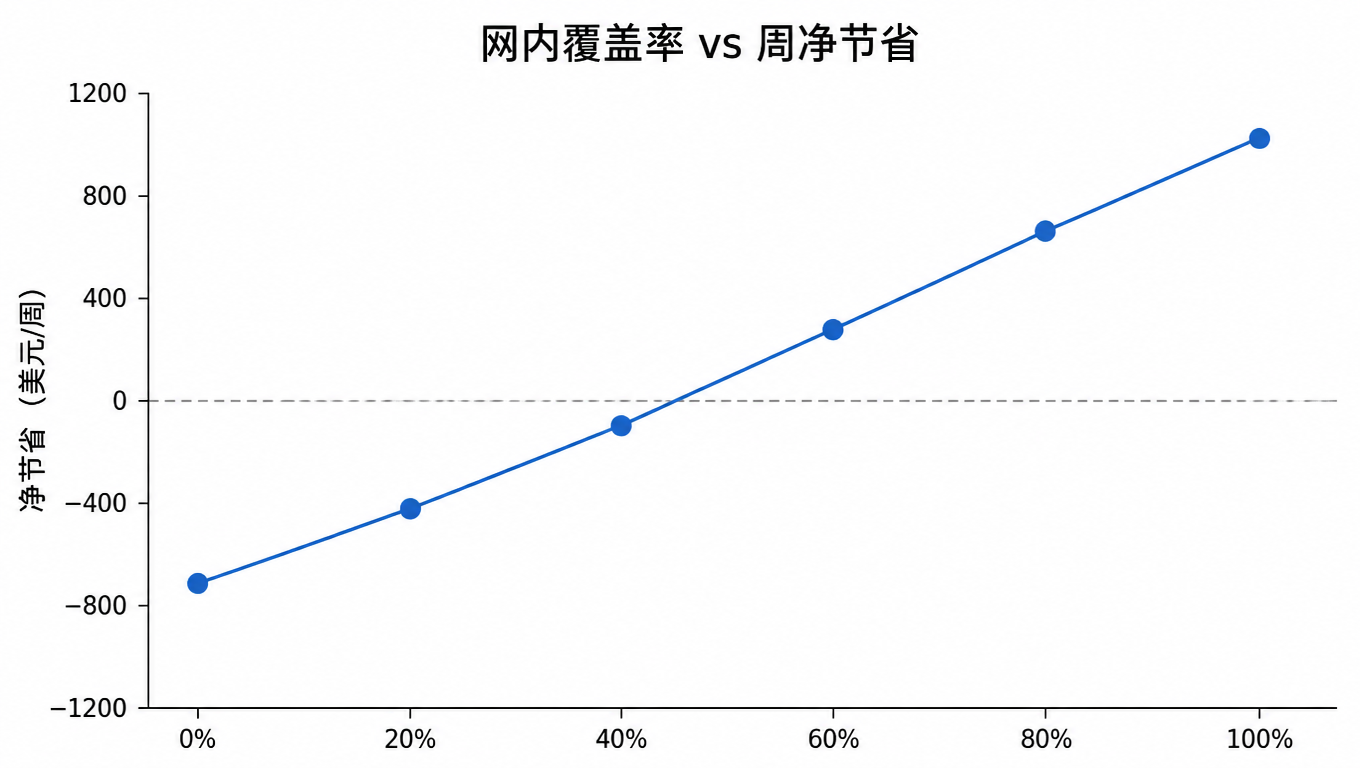
现在拧一拧覆盖率这个数字,因为它最容易变动。同样画像下 50% 覆盖率每周净省 125 美元;40% 时转负,每周亏 55 美元。这个画像的盈亏平衡覆盖率是 43%,毛节省刚好覆盖异常税加固定成本。低于这条线,区域快递不是在帮你省钱,而是在让你亏钱。Now wiggle the coverage number, because it moves the most. At 50% coverage the same profile nets $125 a week; at 40% it turns negative at $55 a week lost. The break-even coverage for this profile is 43%, the point where gross savings exactly cover the exception tax plus fixed cost. Below that line, the regional carrier is not saving you money, it is costing you.

折线图:网内覆盖率从 0% 到 100% 对应的每周净节省,40% 覆盖率处转负,43% 为盈亏平衡点,80% 处每周净省 665 美元Line chart of net weekly savings vs in-network coverage from 0% to 100%, turning negative at 40%, break-even at 43%, and $665 per week at 80% coverage
净节省随覆盖率变化,43% 以下转负Net savings vs coverage: below 43% the deal loses money

下面的五项检查就是这套模型的实操版:检查 1 量覆盖率,检查 3 执行货量门槛,检查 5 算出真实成本差,异常率差则在试点里实测,在同一批线路上和你的全国承运商并排追踪异常。The five checks below are the practical version of this model. Check 1 measures the coverage rate, Check 3 enforces the volume gate, Check 5 computes the true cost difference, and the exception-rate gap is measured in the pilot, where you track exceptions side by side with your national carrier on the same lanes.

决策框架:切换前的 5 项检查The Decision Framework: 5 Checks Before You Switch

在跟任何销售谈之前,先拿自己的数据跑这五项检查。每一项都有一个大致的通过线。这是一条漏斗:第一项不过,后面都不用看。Before you talk to a single sales rep, run these five checks against your own data. Each one has a rough pass bar. This is a funnel: fail the first check and the rest do not matter.

检查 1:区域匹配度。Check 1: Zone fit.导出 90 天的发货记录,把目的地邮编和承运商公布的覆盖图对照。通过线:至少 80% 的包裹落在网络内。低于这条线,泄漏的账基本算不平。Export 90 days of shipments and map destination ZIPs against the carrier's published coverage map. The pass bar: at least 80% of your parcels land inside the network. Below that, the leakage math rarely works.

检查 2:重量结构。Check 2: Weight profile.算出将交给区域快递的包裹的平均重量和中位重量。通过线:大部分货量落在 1 到 5 磅区间。如果大多数超过 10 磅,优势收窄得很快。Compute the average and median weight of the parcels that would go to the regional carrier. The pass bar: the bulk of your volume sits in the 1 to 5 lb range. If most of it is over 10 lb, the advantage narrows fast.

检查 3:货量。Check 3: Volume.你能不能全年扛住承运商的最低周货量,包括淡季的低谷,而不只是旺季?通过线:能,而且轻松有余量,足以应对承运商想要更多货的胃口。Can you sustain the carrier's minimum weekly volume through the whole year, including your seasonal trough, not just your peak? The pass bar: yes, comfortably, with room for the carrier to want more.

检查 4:服务要求。Check 4: Service requirements.把时效承诺、周末派送、货到付款、签收选项、申报价值上限和理赔处理,逐项和你客户真正需要的对比。通过线:区域快递能满足对你买家重要的每一项服务承诺,因为一项更便宜但违背服务承诺的费率,换来的是流失客户。Compare transit time promises, weekend delivery, COD, signature options, declared value limits, and claims handling against what your customers actually need. The pass bar: the regional carrier can meet every service promise that matters to your buyers, because a cheaper rate that breaks a service promise costs you customers.

检查 5:总成本。Check 5: Total cost.基础费率只是诱饵。要求看完整费率卡:燃油附加费、住宅派送附加费、区外费用、超尺寸和体积重计价、地址更正、退货处理。逐行重建你平均包裹的成本,再和你当前的落地成本对比。The base rate is a teaser. Ask for the full rate card: fuel surcharge, residential surcharge, out-of-zone fees, oversized and dim-weight pricing, address correction, returns handling. Rebuild your average parcel's cost line by line and compare against your current landed cost.

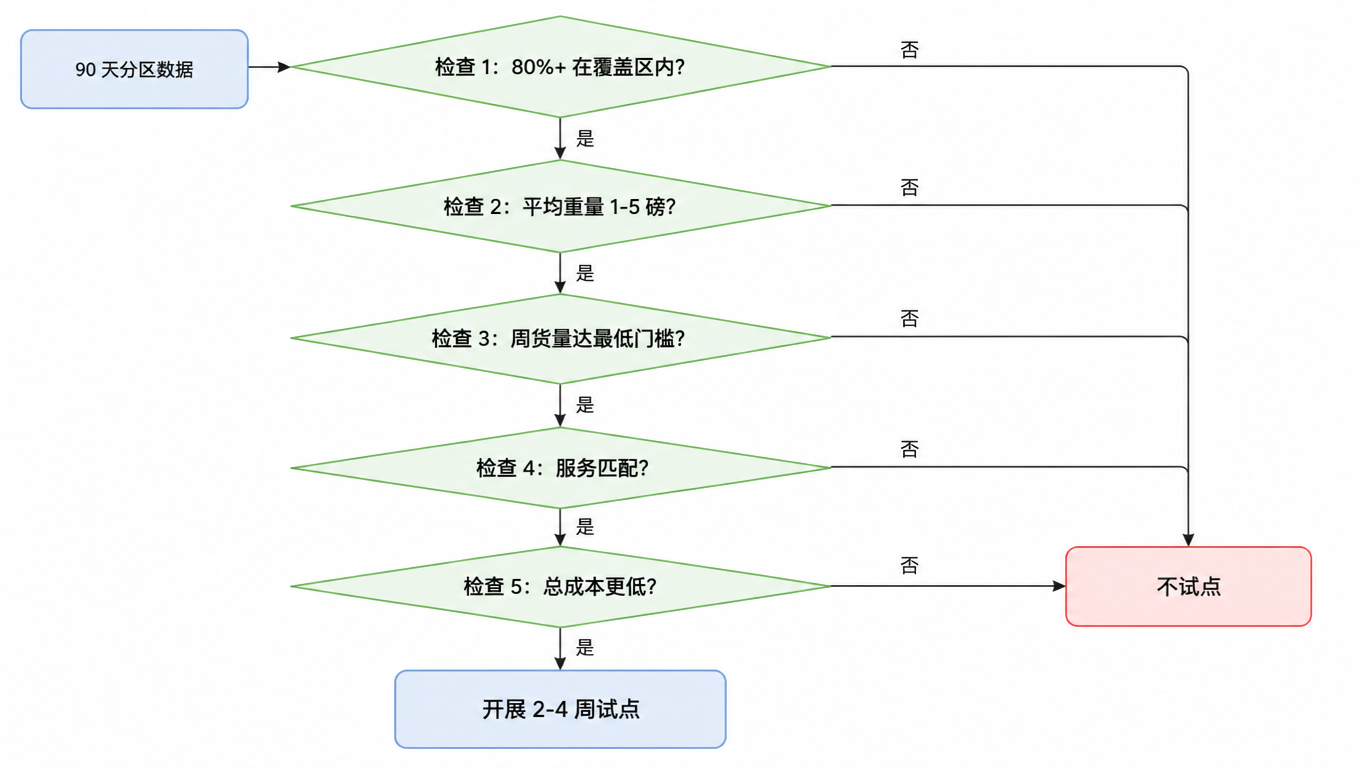
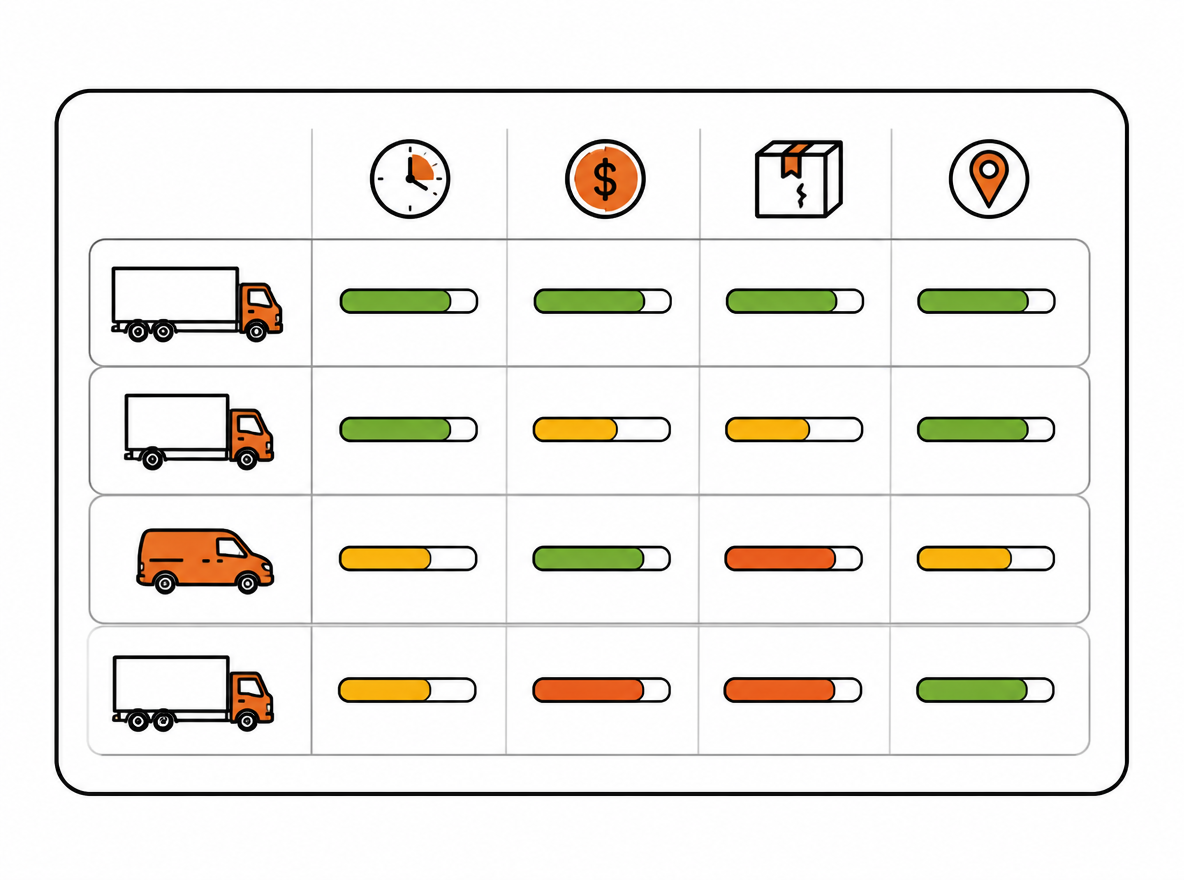
五步检查决策流程图:90 天分区数据、80% 覆盖、平均重量 1-5 磅、周货量达标、服务匹配、总成本更低,全部通过才进入 2-4 周试点,任何一步不通过则不试点Five-check decision flow: 90-day zone data, 80% in-network, 1-5 lb average weight, weekly volume minimum, service match, lower total cost, all leading to a 2-4 week pilot or no pilot
五步漏斗:任何一项不过都不进试点The five-check funnel: any failed check means no pilot

没有哪项检查是孤立的过或不过。货量偏薄有时能用更高的承诺买下来,重量结构不理想也能被出色的区域匹配度抵消。但有两项检查本身几乎就是一票否决:区域匹配度差,因为节省根本不会出现;服务有缺口,因为省下来的钱都花在流失的客户上了。No single check is pass or fail in a vacuum. A thin volume number can sometimes be bought down with a higher commitment, and a weak weight profile can be offset by an exceptional zone fit. But two checks are close to disqualifying on their own: a poor zone fit, because the savings never materialize, and a service gap, because the savings get spent on lost customers.

数据:费率卡并排对比The Numbers: Rate Cards Side by Side

下面的表格是基于公开费率卡和典型区域快递折扣构建的示意对比,不是报价。你谈到的价格会不同,但数字的形状就是重点。表格对比一家区域快递和一家全国地面服务,1 磅和 5 磅包裹,覆盖分区 2 到 8。The tables below are illustrative comparisons built from published rate cards and typical regional-carrier discounts, not quotes. Your negotiated pricing will differ, but the shape of the numbers is the point. They compare a regional carrier against a national ground service for a 1 lb parcel and a 5 lb parcel across zones 2 to 8.

1 磅包裹(每件)1 lb parcel, per piece

分区Zone全国地面National ground区域快递Regional节省Savings
2$5.20$3.9025%
3$5.50$4.2024%
4$6.00$4.7022%
5$6.70$5.5018%
6$7.50$6.6012%
7$8.40$8.005%
8$9.30$9.102%

5 磅包裹(每件)5 lb parcel, per piece

分区Zone全国地面National ground区域快递Regional节省Savings
2$8.10$6.6019%
3$8.60$7.1017%
4$9.40$7.9016%
5$10.50$9.1013%
6$11.80$10.709%
7$13.20$12.902%
8$14.60$14.401%
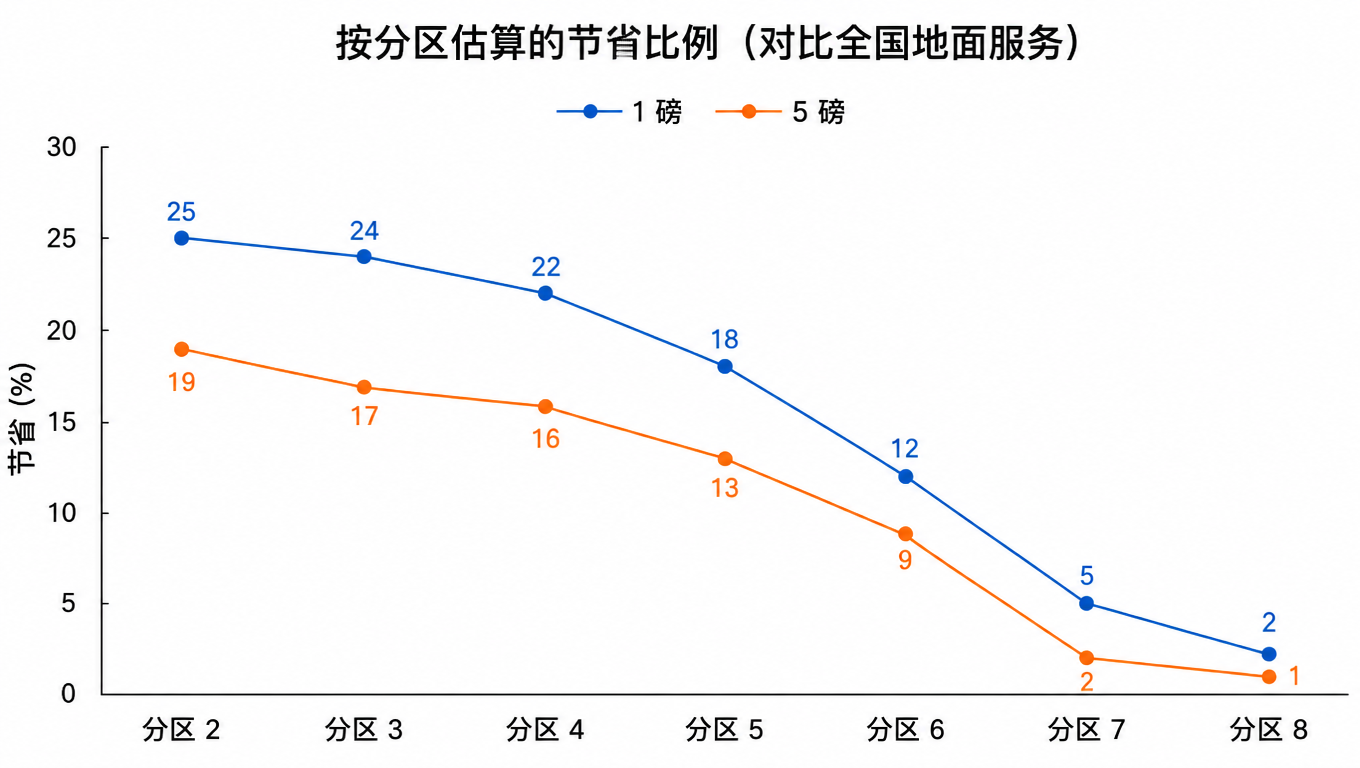
按分区估算节省比例的折线图:1 磅和 5 磅包裹,节省从分区 2 的 25% 和 19% 一路降到分区 8 的 2% 和 1%Line chart of estimated savings by zone: 1 lb and 5 lb parcels, from 25% and 19% at zone 2 down to 2% and 1% at zone 8
节省在近距离分区最大,随距离和重量缩水Savings peak in close zones and shrink with distance and weight

表格要这样读:节省在近距离分区最大,随着距离拉长稳步缩水。到分区 7 和 8,区域优势只是一个舍入误差,因为网外包裹实际上是被当作全国运力转卖的。而且在每个分区,5 磅包裹都比 1 磅包裹省得明显更少,因为按重量计的收费稀释了密度优势。真正的钱在甜点区:分区 2 到 5、重量 1 到 5 磅。这个窗口之外都是噪音。Read the tables like this. Savings are biggest in the close zones and shrink steadily as distance grows. At zone 7 and 8, the regional advantage is a rounding error, because out-of-network parcels are effectively being resold as national capacity. And at every zone, the 5 lb parcel saves noticeably less than the 1 lb parcel, because weight-based charges dilute the density advantage. The sweet spot, zone 2 to 5 at 1 to 5 lb, is where the real money lives. Everything outside that window is noise.

什么时候真的省钱:卖家与 3PL 场景When It Saves Money: Seller and 3PL Scenarios

三种画像能拿到全部收益,而且每家省钱的原因略有不同。Three profiles get the full benefit, and each one saves for a slightly different reason.

场景 A:城区 DTC 卖家。Scenario A: the urban DTC seller.一个洛杉矶服装品牌主要发往加州、亚利桑那和内华达。这正是 OnTrac 和 SpeedX 的地盘。85% 的货量落在网内,平均包裹 1.5 磅,周货量轻松过线。这个卖家有很大可能为大部分包裹省下 15% 到 25%,把全国承运商降级为备用。要盯住的是纪律:发往中西部的 15% 仍然会有区域泄漏,所以合同里必须有明确的区外价格。A Los Angeles apparel brand ships mostly to California, Arizona, and Nevada. That is OnTrac and SpeedX country. 85% of volume lands in-network, average parcel is 1.5 lb, and weekly volume clears the minimum without breaking a sweat. This seller can plausibly take 15% to 25% off the majority of their parcels and shift the national carrier to backup duty. The watch-out is discipline: zone leakage still happens for the 15% that goes to the Midwest, so the contract needs a clear out-of-zone price.

场景 B:区域集中的 3PL。Scenario B: the regionally concentrated 3PL.达拉斯的履约仓库服务德州和俄克拉荷马的客户,每天几百件包裹,分布在邻近三个州。这是 LSO 的地盘。这家 3PL 拿到双倍的密度收益:自己的业务在网内,客户的下单买家也集中在同一区域。节省直接流进仓库的利润,或者变成它的报价优势。要盯住的是客户结构:一个买家分布全国的大型电商客户,可能悄悄把区域匹配度拖到通过线以下。A fulfillment warehouse in Dallas serves Texas and Oklahoma customers, with a few hundred parcels a day across three nearby states. LSO territory. The 3PL gets the density benefit twice: its own book of business is in-network, and its clients' customers cluster in the same region. The savings flow straight into the warehouse's margin or into its pricing pitch. The watch-out is client mix: one national e-commerce client whose buyers live everywhere can quietly drag the zone fit below the pass bar.

场景 C:大件轻抛货卖家。Scenario C: the large, light, dim-weight seller.发大件、蓬松、轻质商品的卖家,比如家具配件、灯具或超大包装,通常按体积重计价,这类货每磅的经济性不那么重要、停靠密度更重要。为住宅派送而生的区域快递可以给这类包裹开出更有竞争力的价格,它们在体积重货物上的节省往往超过轻小件卖家。要盯住的是费率卡上的超尺寸和体积重附加费一行,必须明确谈出来,而不是在第一张账单上发现。Sellers shipping big, bulky, lightweight items, think furniture accessories, lamps, or oversized packaging, are often priced on dimensional weight, where per-pound economics matter less and stop density matters more. Regional carriers built for residential delivery can price these parcels more aggressively, and their savings on dim-weight freight often exceed what a light-parcel seller captures. The watch-out is the oversized and dim-weight surcharge line on the rate card, which must be negotiated explicitly, not discovered on the first invoice.

什么时候不省钱:隐性成本与陷阱When It Doesn't: Hidden Costs and Traps

同一家区域快递,为上面的画像省钱,也会悄悄为另一些画像亏钱。陷阱都是可预测的。The same carrier that saves money for the profiles above quietly loses it for others. The traps are predictable.

陷阱 1:区域泄漏。Trap 1: Zone leakage.网外包裹被转交给合作伙伴,按全国全价再加价计费。如果你的目的地分布很广,泄漏可以吃掉全部折扣。这是区域快递合作让人失望的头号原因,而且它通常藏在合同的小字里,而不是销售话术里。Out-of-network parcels get handed off to a partner at full national rates plus a markup. If your destination spread is wide, leakage can consume the entire discount. This is the number one reason regional deals disappoint, and it is usually buried in the contract's small print rather than in the pitch.

陷阱 2:货量门槛。Trap 2: Volume minimums.周货量低于承诺值,你就要面对单件最低收费,或者失去谈好的费率档。危险在于季节性:11 月达标的卖家 2 月可能不达标,全年账单可能比旺季省下的还多。Fall below the promised weekly volume and you face per-piece minimum charges or lose your negotiated tier. The danger is seasonality: a seller who qualifies in November may not in February, and the annual bill can be higher than the peak-month savings.

陷阱 3:服务缺口。Trap 3: Service gaps.区域快递在货到付款、周末派送、申报价值上限和理赔体验上历来偏弱。如果你的业务承诺周六派送或发高价值商品,缺口会直接变成你的损失。一个看起来便宜 15% 的费率,如果让你丢掉 2% 的客户留存优势,就不算便宜。Regional carriers historically lag on COD, weekend delivery, declared value limits, and claims experience. If your business promises Saturday delivery or ships high-value items, the gap costs you directly. A rate that looks 15% cheaper but loses a 2% customer-retention edge is not cheaper.

陷阱 4:隐藏费用。Trap 4: Hidden fees.燃油附加费、住宅派送附加费、地址更正、退货处理。有些区域快递把住宅派送算进基础价,有些把它当附加项收。读完整费率卡、重建你的落地成本、把每一行都放进对比。只看基础费率对比,就是卖家说服自己签下坏合同的方式。Fuel surcharges, residential surcharges, address corrections, returns processing. Some regional rate cards price residential delivery as the baseline, others charge it as an add-on. Read the full card, rebuild your landed cost, and put every line in the comparison. The base-rate comparison alone is how sellers talk themselves into bad deals.

陷阱 5:客户分散的 3PL。Trap 5: The scattered 3PL book.客户分布在十个州的 3PL,永远只有一小部分货量能落在网内。它要管理两家承运商、两套面单、两套理赔流程,大部分包裹还是付全国价。复杂度是真实的,净节省往往是负的。对这种画像,区域快递是干扰,不是机会。A 3PL whose customers live across ten states will only ever get a fraction of volume in-network. It manages two vendors, two sets of labels, two claims processes, and still pays national rates on most parcels. The complexity is real and the net savings are often negative. For this profile, the regional carrier is a distraction, not an opportunity.

还有一个微妙之处:全国承运商很清楚区域快递在特定线路上能给什么,它们会用留存定价守这些线路。切换之前,先找现在的承运商要一份逐分区的费率复核。有时候你追的那个 15% 已经躺在那里,而且没有转交环节。One more subtlety: national carriers know exactly what a regional carrier can offer in a given lane, and they defend those lanes with retention pricing. Before you switch, ask your current carrier for a zone-by-zone rate review. Sometimes the 15% you were chasing is already available, without the handoffs.

签约前如何测试How to Test Before You Commit

握个手、拿张费率卡就切换,是后悔的经典开头。做一次正规测试吧。Switching on a handshake and a rate card is how regret happens. Run a proper test instead.

第一步:90 天分区分析。Step 1: 90-day zone analysis.从承运商账单或平台报表里拉 90 天发货记录,ShipStation、Shopify、你的 WMS,哪个可信用哪个。按分区和州建目的地分布,再叠上候选承运商的覆盖图。这一张电子表格就能回答检查 1,并告诉你这场对话还值不值得谈。Pull 90 days of shipments from your carrier invoices or platform reports, ShipStation, Shopify, your WMS, whichever you trust. Build a destination distribution by zone and state, then overlay the candidate carrier's coverage map. This single spreadsheet answers Check 1 and tells you whether the conversation is even worth having.

第二步:2 到 4 周试点。Step 2: 2 to 4 week pilot.挑一两个密集分区,把一小部分货量,10% 到 20%,切到区域快递上。在同一批线路上,把准时率、异常率和理赔和你的全国承运商并排对比。不要宣布全面切换,你在收集数据,不是在作承诺。Pick one or two dense zones and move a small slice of volume, 10% to 20%, onto the regional carrier. Track on-time delivery, exception rate, and claims side by side with your national carrier on the same lanes. Do not announce a full switch; you are gathering data, not making a commitment.

第三步:衡量落地成本,不是牌价。Step 3: Measure landed cost, not sticker price.对比每件的真实成本:基础费率加燃油、附加费、地址更正、退货处理,还有第二家承运商带来的管理时间。忽略退货和异常的节省数字是虚构的。落地成本是唯一应该驱动决策的数字。Compare the real cost per parcel: base rate plus fuel, surcharges, address corrections, returns handling, and the admin time of a second vendor. A savings figure that ignores returns and exceptions is fiction. Landed cost is the only number that should drive the decision.

第四步:谈判合同。Step 4: Negotiate the contract.争取费率锁定、附加费豁免或封顶、带补救条款的时效和理赔 KPI,以及干净的退出条款。区域快递渴望货量,愿意谈判;不肯谈的那几家,本身就在告诉你一些事。Get rate locks, surcharge waivers or caps, on-time and claims KPIs with remedies, and a clean exit clause. Regional carriers are hungry for volume and will negotiate; the ones who will not are telling you something.

而且要把全国承运商留在组合里。对大多数运营者来说,赢家配置是并行多承运商策略:密集分区走区域快递,其余走全国承运商,每季度复盘。一次性硬切换是下注,并行运行是对冲。And keep the national carrier in the mix. The winning setup for most operators is a parallel multi-carrier strategy, dense zones on the regional, the rest on national, reviewed quarterly. Cold-turkey switching is a bet; parallel running is a hedge.

结论The Bottom Line

一句话规则:当你的包裹落在它的网络内、重量合适、货量达标、总成本更低时,区域快递才真的省钱。改变其中任何一项,节省就会缩水或消失。Here is the one-line rule: a regional carrier saves you money when your parcels land inside its network, at the right weight, at the right volume, at the right total cost. Change any one of those and the savings shrink or disappear.

在给任何销售打电话之前,先把盈亏平衡模型跑一遍,你会知道那条精确的分界线:低于你的盈亏平衡覆盖率,这笔交易无论话术多好都是亏钱。Run the break-even model before you call a single sales rep and you will know the exact line: below your break-even coverage, the deal loses money regardless of the pitch.

有了数据,决策很快。五项检查全过,就跑试点、量落地成本;任何一项不过,别急,先修画像或者按兵不动。承运商不会跑,那个 15% 也不会,等你的数据真正撑得起它的那一天,它还在桌上。The decision is quick to make once you have the data. All five checks pass, run a pilot and measure landed cost. Any check fails, do not rush, fix the profile first or stay put. The carriers are not going anywhere, and neither is the 15%, it will still be on the table the day your data actually supports it.

你的行动清单:本周导出分区数据、跑完五项检查;下个月,如果检查通过,跑试点;之后每季度复盘落地成本对比。这就是全部打法,它让 15% 的故事待在它该待的地方:电子表格里,而不是销售话术里。Your action list: this week, export your zone data and run the five checks. Next month, if the checks pass, run the pilot. Then review the landed-cost comparison quarterly. That is the whole playbook, and it keeps the 15% story where it belongs: in the spreadsheet, not in the sales pitch.

常见问题FAQ

只在特定条件下成立:至少 80% 的货量落在覆盖区内、包裹重量主要在 1 到 5 磅、货量过门槛、附加费算完之后的总成本仍然更低。条件不满足时,区域泄漏和附加费会让混合成本高于全国承运商。文章里的五步检查框架就是用来验证这四条前提的。Only under specific conditions: at least 80% of volume inside the coverage area, parcel weights mostly in the 1 to 5 lb range, volume above the minimum, and total cost still lower after every surcharge. When those conditions are not met, zone leakage and surcharges can make the blended cost higher than a national carrier. The five-check framework in this article verifies exactly those preconditions.
不能。区域快递只覆盖特定地理区域,覆盖区外的包裹会被转交给合作伙伴(通常是 USPS 或全国承运商),转交价格会吃掉折扣。正确的做法是并行多承运商策略:密集分区给区域快递,其余给全国承运商。No. A regional carrier covers only a specific geographic area, and parcels outside it are handed off to a partner, often USPS or a national carrier, at prices that erase the discount. The right setup is a parallel multi-carrier strategy: dense zones to the regional, the rest to a national carrier.
可能不值得。客户分布越广,落在网内的货量比例越低,区域泄漏越多。做一次 90 天分区分析,如果覆盖区内货量低于 80%,区域快递通常是干扰而不是机会,先修客户结构或按兵不动。Probably not worth it. The wider your destination spread, the lower the share of volume in-network and the more zone leakage you pay for. Run a 90-day zone analysis; if less than 80% of parcels land inside coverage, the regional carrier is usually a distraction, so fix the profile or stay put.
现实的时间线是三到六周:第一周导出 90 天分区数据、跑完五步检查;两周做合同谈判和系统接入;然后跑 2 到 4 周试点,用落地成本验证,再决定是否全面切换。把试点当成验证,而不是承诺。Three to six weeks in a realistic timeline: week one, export 90 days of zone data and run the five checks; two weeks for contract negotiation and integration; then a 2 to 4 week pilot measuring landed cost before any full switch. Treat the pilot as validation, not as a commitment.
在覆盖区内通常不差,甚至更快,因为卡车跑短途、密度高。真正的短板在服务项目:货到付款、周末派送、申报价值上限和理赔体验历来偏弱。如果你承诺周六派送或发高价值商品,先用检查 5 逐项对比,再决定。Inside their coverage area, usually not, often faster, because trucks run short routes at high density. The real gaps are service features: COD, weekend delivery, declared value limits, and claims experience have historically lagged. If you promise Saturday delivery or ship high-value items, compare every line in Check 5 before deciding.
周净节省 = V × c × Δ − V × Δe × C_e − F。V 是周货量,c 是网内覆盖率,Δ 是全口径单件成本差,Δe 是异常率差,C_e 是单次异常成本,F 是每周固定切换成本。净节省大于零才值得换;把公式倒过来就能算出你的盈亏平衡覆盖率,低于它,折扣再漂亮也是亏钱。Net weekly savings = V × c × Δ − V × Δe × C_e − F, where V is weekly volume, c is in-network coverage, Δ is the all-in per-parcel cost difference, Δe is the exception-rate gap, C_e is the cost of one exception, and F is weekly fixed switching cost. Switch only when net savings is positive; invert the formula to find your break-even coverage, below which the deal loses money no matter the discount.
Get Rate Comparison
Get Rate Comparison