
Logistics Guide

How to Differentiate Your Fulfillment Business

Walk into any three fulfillment centers and you will hear the same pitch: warehousing, pick and pack, shipping, returns, all at competitive rates. The menu is identical because the operations are identical. This article is about escaping that trap, not with a longer service menu but with sharper positioning: pick a niche, build a moat with data and your tech stack, keep customers with value-add services, and become the first choice for a few instead of the fallback for everyone.

Pickers and parcel conveyors in a modern fulfillment center lit by skylights.
Differentiation is not doing more; it is being the best for a few

Why Fulfillment Has Become a Red Ocean: The Price-War Trap

Walk into any three fulfillment centers and you will hear the same pitch: warehousing, pick and pack, shipping, returns, all at competitive rates. The menu is identical because the operations are identical. A mid-size 3PL that competes on price is offering the exact same commodity as the warehouse down the street, only cheaper.

Price competition creates a trap that is hard to escape. Margins compress, so you cannot invest in the tools that would make you different. Customers churn the moment a cheaper quote lands in their inbox. Growth comes from outbidding the next warehouse, and every win makes your margins a little thinner. Meanwhile the biggest players keep adding scale, and their cost advantage only widens.

The way out is not a longer service menu. It is a sharper definition of who you serve and what problem you solve for them. Differentiation in fulfillment is rarely about doing more things. It is about being the obvious choice for one type of customer, and quietly wrong for everyone else.
Step 1: Pick a Niche, Don't Be a Generalist 3PL

The generalist positioning is a silent killer. "We can do everything" sounds like a strength and behaves like a weakness: prospects hear "we are not the best at anything," and they are right. When every option looks the same, buyers decide on price, and price is the one game you cannot win sustainably.

A niche narrows the field to where you can actually win. Three dimensions are worth considering. Category specialization: large and bulky goods, beauty, supplements, apparel, each with its own packaging, compliance, and carrier quirks. Customer type: DTC brands, marketplace sellers, or cross-border sellers, each with different order profiles and service expectations. Geography: a regional network that delivers faster into your own backyard than national carriers can, which turns proximity into a measurable advantage.

The test for any niche is the same three questions. Is the pain acute enough that buyers are actively looking for a specialist? Is the market big enough to support your growth for years, not months? Are customers in it willing to pay a premium for expertise, or will they still shop on price? If all three answers are yes, you have found a segment worth owning. If any answer is no, keep looking.

Step 2: Turn Operational Data Into a Selling Point

Nobody ever chose a 3PL because the warehouse was 200,000 square feet. Customers choose on outcomes: on-time delivery, low damage, accurate inventory, fast response when something goes wrong. Square footage is an input. On-time rate is an output, and outputs are what your customers' customers feel.

Lead with data in three concrete ways. Publish SLA commitments in your quote packet, not buried in the contract. Give every client a real-time dashboard where they can see inventory, open orders, and shipments without emailing you. Ship a structured monthly report that turns raw numbers into the story of their business: what shipped, what arrived on time, what broke, what you fixed.

Then convert the number into a value story. "98.7% on-time rate" is a statistic. "Nine out of ten orders arrive when your customer expects them, and we flag the other one before it becomes a complaint" is a reason to stay. The same metric, told as the customer's outcome, is what turns a commodity bid into a premium relationship.

Step 3: Build a Moat With Your Tech Stack

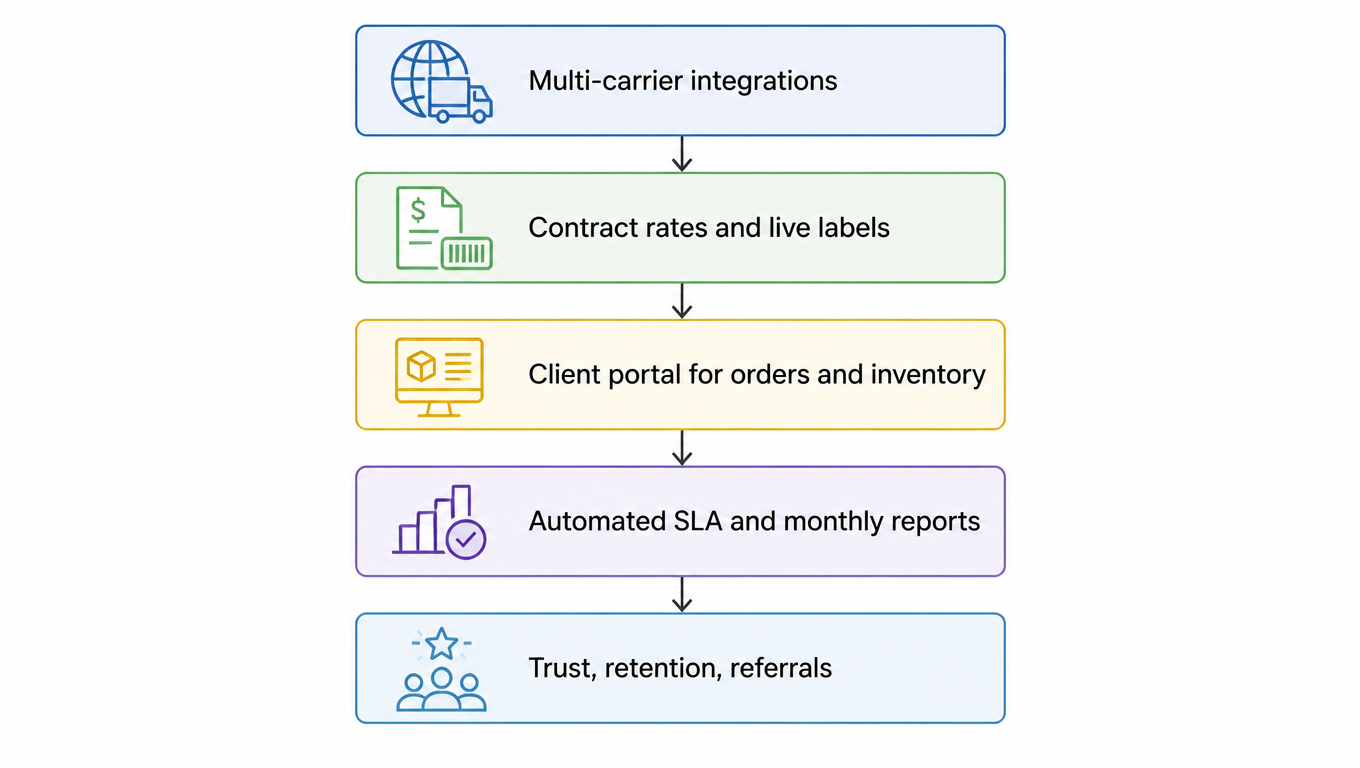
The deepest moat a mid-size 3PL can dig is breadth of integration. Every carrier you can talk to from one system, every region you can reach at negotiated contract rates, every last-mile network you can switch to when one carrier disappoints. The customer does not buy "we use software." They buy the outcome: cheaper shipping, more delivery options, fewer service failures, and no lock-in to a single carrier's whims.

The second layer is the client portal. Real-time visibility is an experience difference as much as an operational one. A portal where clients check inventory, approve orders, and pull reports themselves removes the most common friction in a fulfillment relationship: waiting for answers. Control plus transparency is what makes a client feel partnered instead of served.

Flowchart: multi-carrier integrations lead to contract rates and live labels, to a client portal for orders and inventory, to automated SLAs and monthly reports, and finally to trust, retention, and referrals
How the tech stack builds toward trust and retention

The buy-versus-build question resolves itself for most mid-size operators. Building an integration layer in-house takes a team of engineers, years of maintenance, and constant catch-up as carriers change their APIs. Buying proven, integrated technology and plugging it into your operations gets you to the moat faster and keeps you focused on the one thing customers actually pay for: service. Build only what your niche genuinely cannot buy.

Step 4: Value-Add Services and "Stickiness by Design"

The most profitable services are the ones your competitors never quoted. Custom packaging for subscription boxes, gift messaging and inserts, kitting for seasonal launches, multi-channel inventory sync so a brand can sell on its site, Amazon, and TikTok from one pool of stock. Each one solves a real problem for a specific niche, and each one carries better margins than a pick and pack.

Design these services with one goal in mind: raise the customer's switching cost. When a brand's packaging, subscriptions, kitting flows, and inventory sync are all wired into your systems, moving to a cheaper warehouse means rebuilding all of it. That is not a lock-in you have to enforce. It is simply the arithmetic of convenience, and it is the difference between a vendor that gets replaced every quarter and a partner that gets renewed every year.

The relationship shift follows the service shift. A generalist sells a transaction: we store, we ship, here is the invoice. A specialist sells an operating partnership: we run the part of your supply chain that touches your customers, and we are measured on how well it performs. Once you are accountable for outcomes instead of activities, price stops being the conversation.

Action Plan: A Three-Step Playbook

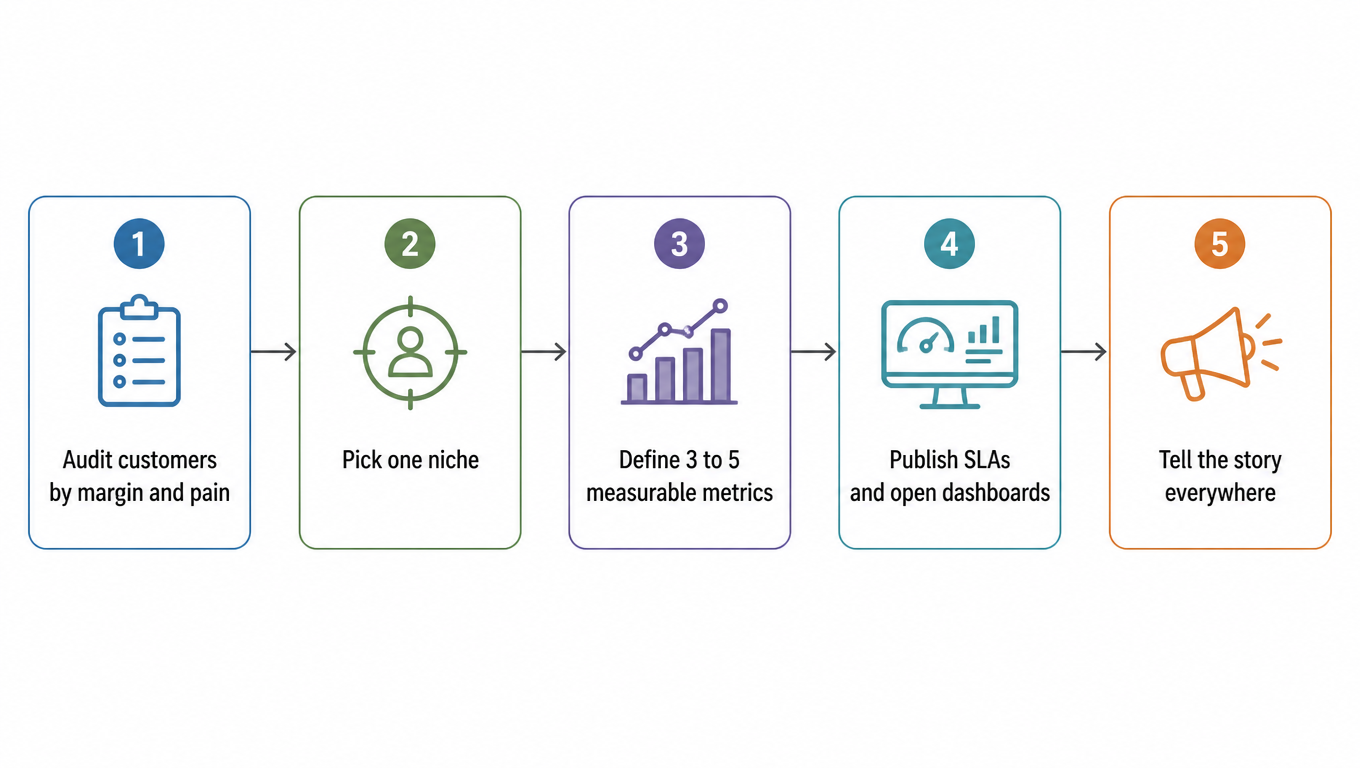
Start with an audit, not a rebrand. List your current customers and segment them by margin, churn risk, and how painful their fulfillment problems are. You will usually find a cluster that is already disproportionately profitable or loyal. That cluster is your niche, hiding in plain sight, and picking it is mostly a decision, not a discovery.

Flowchart: audit customers by margin and pain, pick one niche, define 3 to 5 measurable metrics, publish SLAs and open dashboards, then tell the story everywhere
Three steps: audit, quantify, tell the story

Second, define three to five metrics that prove your differentiation, and start publishing them. On-time rate, inventory accuracy, damage rate, response time, net retention. Public SLA commitments force you to improve and give salespeople something concrete to defend. Third, tell the story everywhere a prospect meets you: blog posts that show your niche expertise, case study pages that quantify client outcomes, and a quote packet that leads with your metrics instead of your rates.

Conclusion: Differentiation Is a Habit, Not a One-Time Positioning

Markets copy fast. The packaging you invented this quarter will be table stakes next year, and the niche you own today will attract three imitators before the season ends. Treat differentiation as a habit: re-audit your niche, refresh your metrics, and add the next service your best customers ask for before they ask twice. Standing still in a red ocean is how you sink.

Choose to be the first choice for a few, not the fallback for everyone. That sentence is the whole strategy. A specialist serves a narrow slice of the market so well that the price conversation disappears, and that is a position no amount of rate cutting can touch.

FAQ

Three test questions: is the pain acute enough, is the market big enough, and will customers pay a premium for expertise? Pick a dimension from category (bulky goods, beauty, supplements), customer type (DTC brands, marketplace sellers, cross-border sellers), or geography (a regional network). Audit your existing customers first: the cluster that is already disproportionately profitable or loyal is your niche.
No. For most mid-size operators, building an integration layer in-house means a team of engineers, years of maintenance, and constant catch-up as carriers change their APIs. Buying proven, integrated technology gets you to the moat faster and keeps you focused on the service customers actually pay for. Build only what your niche genuinely cannot buy.
Publishing commitments forces you to improve and gives salespeople something concrete to defend. The key is picking the right metrics (on-time rate, inventory accuracy, damage rate, response time), backing them with real data, and having a remediation process ready when an SLA is missed.
Don't fight on price. Big players win price wars through scale. Move the battle to ground they cannot easily cover: category expertise, transparent data, and value-add services that raise switching costs. Be the first choice for a few, not the fallback for everyone.