Logistics Guide

The Complete Walmart Marketplace Shipping Guide

Walmart Marketplace is one of the largest e-commerce platforms in the United States, and for many sellers the most important growth channel outside Amazon. But its shipping rules are not Amazon's: the performance metrics are measured differently, the trade-off logic between WFS (Walmart Fulfillment Services) and seller fulfilled is different, and return windows, tracking requirements, and peak-season fees each have their own quirks. This guide walks the full chain in order: rules, model selection, execution, fees, performance, returns, and optimization. It suits sellers preparing to join as well as those already operating who want a systematic refresher.

Ecommerce warehouse with neatly stacked boxes, a scanner and workers packing orders.
A solid shipping chain is what makes Walmart sales stable

Performance Thresholds: Know the Rules Before You Ship

Walmart reviews the performance of all Marketplace orders on a regular schedule, rather than waiting for a problem to find you. The core metrics include cancellation rate, on-time delivery rate, valid tracking rate (VTR), seller response rate, return rate, item not received rate, and negative feedback rate. The three directly tied to shipping are the first three.

The three hard red lines: keep cancellation rate under 2%; hold on-time delivery above 95%, meaning orders arrive on or before the promised estimated delivery date (EDD); and keep VTR at 99% or higher, meaning nearly every shipped order carries a tracking number that the carrier's system recognizes. Sitting on the line consistently does not close the store immediately, but it starts with warnings, traffic suppression, and delisting, and only worsens into account suspension.

The core mechanism for shipping speed is fulfillment lag time, the number of days between receiving an order and handing the package to a carrier. The default requirement is to ship within 2 business days of the order (unless you have an approved exemption), and that date is your ship by date, also called the expected ship date. The EDD your shipping template promises is derived from that lag time plus the carrier's transit time. Tracking numbers must be uploaded before the ship by date, and the package must keep producing scan events after handoff until it shows delivered.
Choosing a Fulfillment Model: WFS, Seller Fulfilled, or 3PL

Walmart's official fulfillment service is WFS (Walmart Fulfillment Services), which works like Amazon FBA: you send inventory into Walmart fulfillment centers, Walmart packs, ships, and handles returns, and buyers see a TwoDay or faster delivery badge plus free shipping benefits, which usually means better visibility and conversion. The cost is that you pay fulfillment and storage fees, and your inventory capital sits in US warehouses in advance.

The results are backed by real cases: Italian coffee brand Lavazza grew sales nearly 200% within 18 months of switching from seller fulfilled to WFS. Data presented at Walmart's 2025 Let's Grow! seller summit also showed that items carrying the Walmart Fulfilled and 2-Day Shipping badges delivered about 50% more GMV on average in non-peak periods, and Walmart reported that WFS orders generate nearly 15% more GMV on average than seller-fulfilled ones. These numbers say it plainly: the fulfillment fees, storage fees, and upfront inventory capital of WFS buy real visibility and conversion.

Seller fulfilled means you (or your team) do the packing and handoff. Its advantage is flexibility: you can negotiate rates, control packaging and brand experience, and run lean inventory or even buy per order. The cost is that you carry every performance metric yourself, and a failure in tracking, speed, or delivery directly hurts account health. Third-party logistics (3PL) and overseas warehouses sit in between: warehousing, picking, packing, and last mile are handled by the service provider, but order integration and performance responsibility still count against the seller. The upside is one warehouse serving many platforms, with the same inventory feeding Walmart, Amazon, your own store, and more.

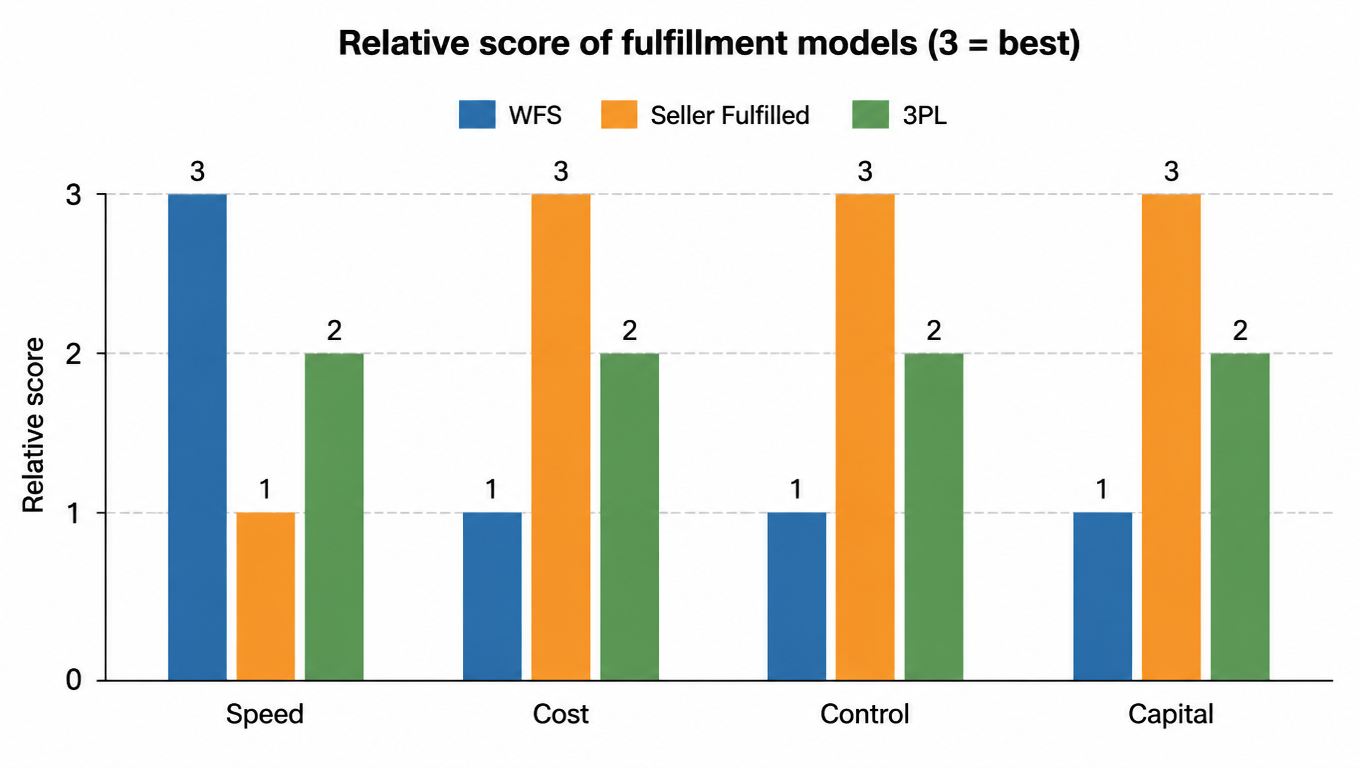
The selection boils down to four dimensions: speed, cost, control, and capital tied up. The chart below is this guide's relative assessment for a typical small or mid-size seller, where a higher score is better (3 = best). Your actual trade-offs depend on your category, order volume, and cash position.

Bar chart of the relative scores of three fulfillment models across speed, cost, control, and capital tied up: WFS, seller fulfilled, and 3PL, with 3 as the best score
Relative scores of the three fulfillment models (3 = best)

In short: if you chase sales and conversion and can absorb upfront inventory, choose WFS; if volume is low and you want margin and control over the process, choose seller fulfilled; if you already need multi-channel inventory and want scalable operations, choose a 3PL. One more thing to remember: Walmart gives traffic preference to free shipping and the TwoDay badge. If a seller-fulfilled listing charges buyers for shipping, it loses visibility in search results and the buy box, and that hidden cost belongs in the comparison too.

The Seller Fulfilled Workflow: From Order to Handoff

The first step in seller fulfilled is setting up your shipping template. The template decides three things: delivery speed (Standard, TwoDay, OneDay, Value), shipping cost (what you charge the buyer, or free), and handling speed (fulfillment lag time). To earn the TwoDay badge, set lag time to 0 days, meaning you process and hand off the same day; Standard defaults to 2 days. Note that Walmart does not let you slow your promise down to build in buffer; the EDD you commit to must be genuinely achievable, or your on-time delivery rate collapses.

For carriers, the mainstream choices are UPS, FedEx, USPS, and regional carriers. USPS suits light small parcels under 1 lb, with low rates and convenient pickup. UPS and FedEx Ground handle mid-size and large parcels, but they bill on dimensional weight, so a bigger box costs more. Regional carriers (for example, West Coast or East Coast local networks) offer a clear price advantage in specific ZIP coverage areas, but coverage is limited, so verify before you commit that they reach your main buyer regions. Whichever you pick, the tracking number must be recognized by the carrier's system and generate scans; plain mail with no scan history does not work on Walmart.

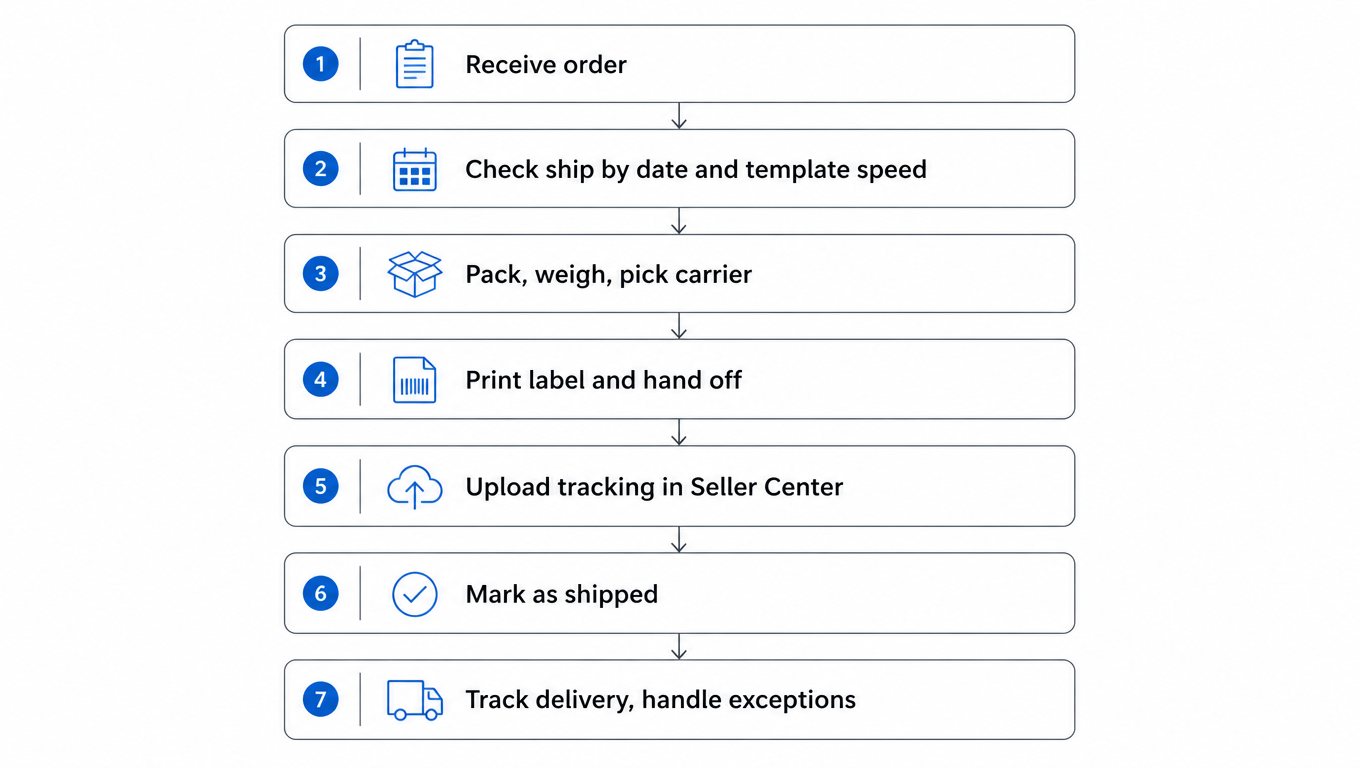
A complete seller-fulfilled order flows like this:

Flowchart of the seller-fulfilled process: receive order, check ship by date and template speed, pack and weigh and pick carrier, print label and hand off, upload tracking in Seller Center, mark as shipped, track delivery and handle exceptions
The complete seller-fulfilled order flow

The three most common violations in daily operations all involve tracking numbers: first, a malformed number or one the carrier's system cannot recognize, which counts as an invalid tracking event; second, entering a carrier that does not match the order (a UPS label with a FedEx number); third, uploading the tracking number after the ship by date, which the system records as a late shipment even if the package actually went out. Every one of these hits VTR and on-time delivery at the same time, so upload on the day of handoff, ideally at the moment you print the label.

WFS Inbound and Replenishment: From Inbound Order to Inventory Performance

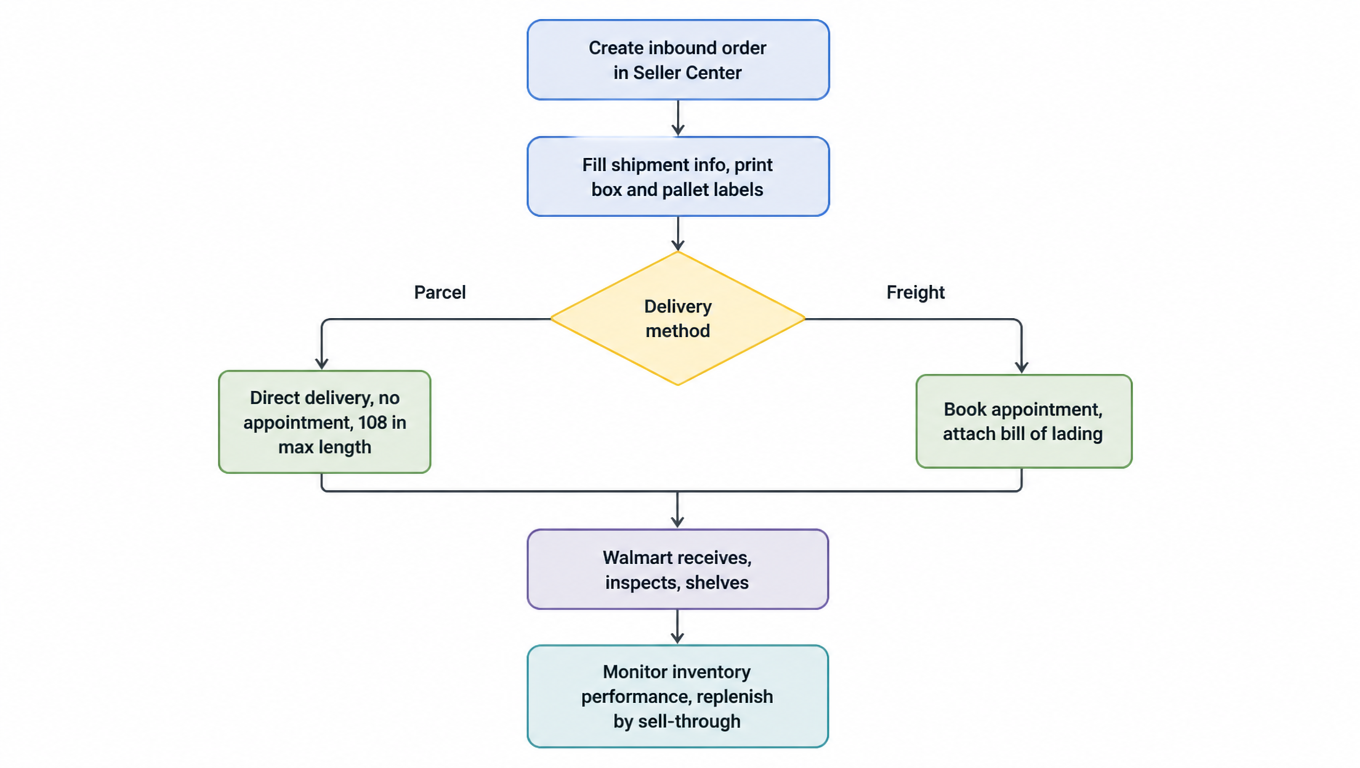
WFS has no subscription fee and no minimum or maximum inventory requirement. You enable it by applying in Seller Center, and once approved you can create inbound orders. The first step is creating an inbound order in Seller Center, filling in shipment details, and printing the box labels and pallet labels the system generates onto the matching units. A packing slip is optional, but truckload freight must include a bill of lading.

The delivery method determines the appointment rules. Small parcels go by courier with no appointment needed, but a single box may not exceed 108 inches in length, length plus girth must stay under 165 inches, and there is a cap on parcels per delivery. Truckload freight must reserve a delivery appointment in advance and include a bill of lading. If you ship directly from China, Walmart's Cross Border Imports service can move goods from Asia straight to US fulfillment centers; otherwise you route through a forwarder. The full inbound decision flow looks like this:

Flowchart of WFS inbound: create inbound order in Seller Center, fill shipment info and print box and pallet labels, choose parcel direct delivery or freight appointment, Walmart receives and inspects and shelves, monitor inventory performance and replenish by sell-through
The WFS inbound decision flow

After inbound, what really moves your profit is inventory performance. Walmart scores you on how fast your stock turns; slow movers push storage fees up, and inventory older than 12 months triggers long-term storage fees. For replenishment cadence, reserve the full cycle time from order to shelf (production, ocean or air freight, inbound, putaway) based on historical sell-through, keep 4 to 8 weeks of safety stock, add extra before peak season, and avoid the two extremes: stockouts that cost sales and ranking, and overstock that eats margin.

Fees Explained: WFS Fulfillment and Storage Fees

WFS costs come in two parts: the fulfillment fee and the storage fee, with no onboarding fee and no monthly fee. Walmart's official line is that WFS rates average about 15% below competitors'. The fulfillment fee is charged per item and set by weight and dimension tiers, with dimensions measured on the packed box, so tighter packaging means a lower fee for the same product. Using an example from the official pricing page, a small item about 1 x 1 x 2 inches weighing 0.13 lb carries a fulfillment fee of about USD 3.45. Always confirm against the official pricing page and fee calculator, because tiers and prices change.

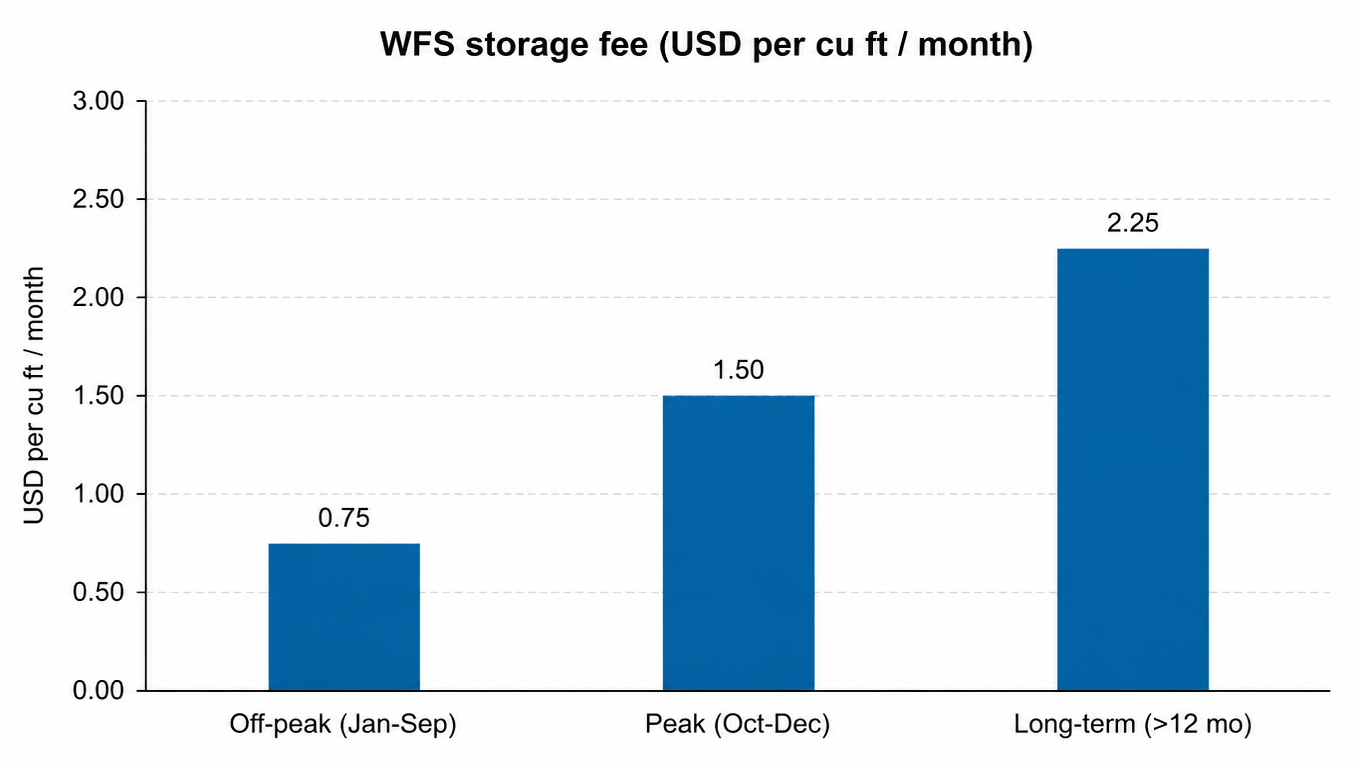
Storage fees are charged per cubic foot per month and vary by season:

Bar chart of WFS storage fees in USD per cubic foot per month: off-peak 0.75, peak 1.50, long-term storage 2.25
WFS storage fees (USD per cubic foot per month)

Off-peak (January to September) runs about USD 0.75 per cubic foot per month, peak season (October to December) steps up to about USD 1.50, and inventory stored longer than 12 months adds a long-term storage fee of about USD 2.25 per cubic foot per month. Walmart has also run peak-season waivers: in 2025 it waived storage fees for the entire October to December peak, saving about USD 1.50 per cubic foot per month across three months, so always check the current season's official rate table before stocking up for Q4.

Seller-fulfilled costs are structured completely differently: mostly freight (USPS First Class by weight for light small items; UPS or FedEx Ground billing on actual vs dimensional weight, whichever is greater, for mid-size and large items), label and tag consumables, packing materials, and possibly pickup surcharges. For the same product, per-order cost is usually lower with seller fulfilled, but if your conversion drops from missing the TwoDay badge and free shipping benefits, the freight you save may not make up the traffic loss. That is why the model decision is a total-cost comparison, not a freight-rate comparison.

Delivery Speed and Performance Red Lines: VTR, Late Shipments, and Appeals

Valid tracking rate (VTR) is the share of shipped orders carrying a valid tracking number, with a 99% red line. Valid does not just mean a number exists; the carrier's system must recognize it and scan pickup and delivery events. Unscanned mail, wrong numbers, and locker-style services without tracking all drag VTR down. Falling below the line triggers warnings and restrictions, and persistent non-compliance can delist items or suspend the account.

On-time delivery (OTD) watches delivery, not dispatch: orders must arrive on or before the promised EDD. That is a higher bar than shipping on time, because carrier transit delays after handoff still count against you. Late shipment is judged against the ship by date: if you have not handed off the package and uploaded a tracking number by then, it is late. The cancellation red line is under 2%, and note that seller-initiated cancellations and buyer cancellations after ordering are treated differently; the former counts directly against you. Seller response rate (replying to buyer messages on time) is also a performance item, just less tied to the shipping chain.

A breach of the cancellation threshold is not a paper risk. In seller communities there are real cases of accounts suspended after ERP-to-marketplace inventory sync errors caused oversells and forced cancellations, with appeals repeatedly rejected because the seller could not produce system inventory records. These problems are prevented beforehand: sync scripts need failure alerts, orders beyond available stock should be blocked automatically, and it is better to under-sell than to over-promise.

When performance goes wrong, the sequence is: confirm the violation and calculation window on the Seller Performance page first, then gather evidence and appeal. Useful evidence includes carrier website scan screenshots, documentation of weather or carrier-announced delays, and screenshots of system failures. File the appeal within the required window, be specific, and make sure the evidence matches the order numbers in question. If a carrier really dragged you down (for example, a blizzard causing mass delays), appeals succeed fairly often, but only if your own handoff and upload actions were compliant.

Returns and Refunds: Policy, Process, and Seller Protection

Walmart's returns policy puts the buyer experience first. First-party items get a standard window of 90 days in most categories, while Marketplace seller items have a minimum standard: at least a 30-day return window (the exact window depends on your category and settings, and some categories are longer). Returns use prepaid labels generated by the platform; buyers can mail the item back or return it in store, and returned parcels are routed to Walmart's marketplace returns center, so sellers never have to chase buyers for the package themselves.

The biggest difference between WFS and seller fulfilled in returns is where the item goes and who handles it. WFS returns go straight back to a Walmart fulfillment center, where the platform runs inspection and refunds, and the seller mostly follows return reasons and inventory status in reports. Seller-fulfilled returns also use the platform-generated prepaid label and returns center, but refund handling and disposition of returned stock fall on the seller. Some categories allow a restocking fee; whether you can charge one and how much depends on category policy, and getting it wrong can be judged a violation of buyer experience standards.

Return rate is itself a performance metric, and return reasons feed back into product quality assessment. For seller protection: when a buyer claims the item was not received (INR), an appeal with a valid delivery scan almost always holds up, and negative feedback or low scores caused by logistics delays can be removed on carrier records too. The daily habits that matter: keep tracking records complete, process refunds promptly (delays directly trigger negative reviews and complaints), and review the returns report regularly to find what high-return SKUs have in common, cutting returns at the source in packaging, description, and size charts.

Cost Optimization and Common Pitfalls: Peak Season and the New Seller Checklist

Freight is the biggest cost for seller-fulfilled merchants, and optimization runs in three directions. First, negotiate on volume: once order volume is stable, talk discounts with UPS, FedEx, or regional carriers, or use a shipping aggregation platform for tiered rates. Second, cut weight and size: when mid-size and large parcels bill on dimensional weight, a smaller box and less filler often save several dollars immediately. Third, regional carriers: if your buyers cluster in specific areas, regional networks have a clear price edge, but verify coverage and delivery performance first.

Peak season (Q4) stacks profit and risk together. WFS sellers should ship stock in 2 to 3 months early, so the storage-fee peak and stockouts do not hit at once. Seller-fulfilled sellers should confirm carrier cutoff times, peak surcharges, and holiday delivery deadlines in advance, and dial down the delivery promise in the shipping template when needed; better to take fewer orders than to promise what you cannot deliver. Every seller should build performance buffer before Q4, because reviews are just as strict in peak season and appeals queue longer when something goes wrong.

Finally, a pre-launch checklist:

  • Does the shipping template's speed and shipping cost match your promise?
  • Does lag time match your actual packing capacity?
  • Do all carriers provide valid tracking and delivery scans?
  • Is a ship by date reminder wired in (email, ERP, or third-party tool)?
  • Has WFS inventory accounted for the inbound lead time?
  • Is the returns policy set with a legitimate restocking fee?
  • Has peak-season stock been ordered?
  • Is the performance dashboard being watched weekly?

Walk through these eight items and your Walmart shipping chain is basically solid.

FAQ

Look at three factors: order volume (WFS suits sellers with steady volume who can stock ahead), conversion dependence (will conversion drop without the TwoDay and free-shipping badges), and cash (can you afford inventory sitting in US warehouses). If volume is low, you value margin, and you want control, start seller fulfilled.
VTR must stay at 99% or above; the number must be a valid tracking number the carrier's system recognizes, with scan events from handoff to delivery; and it must be uploaded before the ship by date. Unscanned mail does not work on Walmart.
The standard picture is about USD 0.75 per cubic foot per month off-peak, about USD 1.50 in peak (October to December), plus about USD 2.25 for stock over 12 months. Walmart also runs peak waivers; in 2025 it waived fees for the whole October to December peak, so check the season's rate table before stocking up.
The red line is under 2%. Persistent breaches start with warnings and traffic suppression, then escalate to delisting and account suspension; seller-initiated cancellations count directly against you. Prevent it with inventory sync alerts and oversell blocking, and appeal with system inventory records if it happens.