The Cost Ledger: What a Delay Actually Costs You
When a shipment stalls, you have three broad options: refund, reship, or wait. Each carries a different price tag, and most sellers choose by gut feel rather than arithmetic. The trap is that the cheapest-looking option, waiting, is often the most expensive in expected terms, because it converts a shipping problem into a trust problem.
Start with a concrete order to make the math real. Say a customer paid $40 for a product that costs you $12 to buy and $8 to ship, leaving roughly $20 of gross margin. Now the parcel stops scanning. What does each action actually cost?
Refunding means giving back the $40 plus writing off the $8 shipping you already paid, about $48 out of pocket, and you also forfeit the $20 margin you had banked. Reshipping means paying a second $8 shipment and a second $12 unit, about $20, and it only makes sense if the first unit is genuinely lost; if both eventually arrive, you have over-delivered by a whole extra order. Waiting costs nothing today, but it carries the expected cost of a chargeback: if 25% of customers in this situation dispute the charge, the expected cost is roughly 25% of $55, about $14, before you count the goodwill damage that never shows up in the ledger.
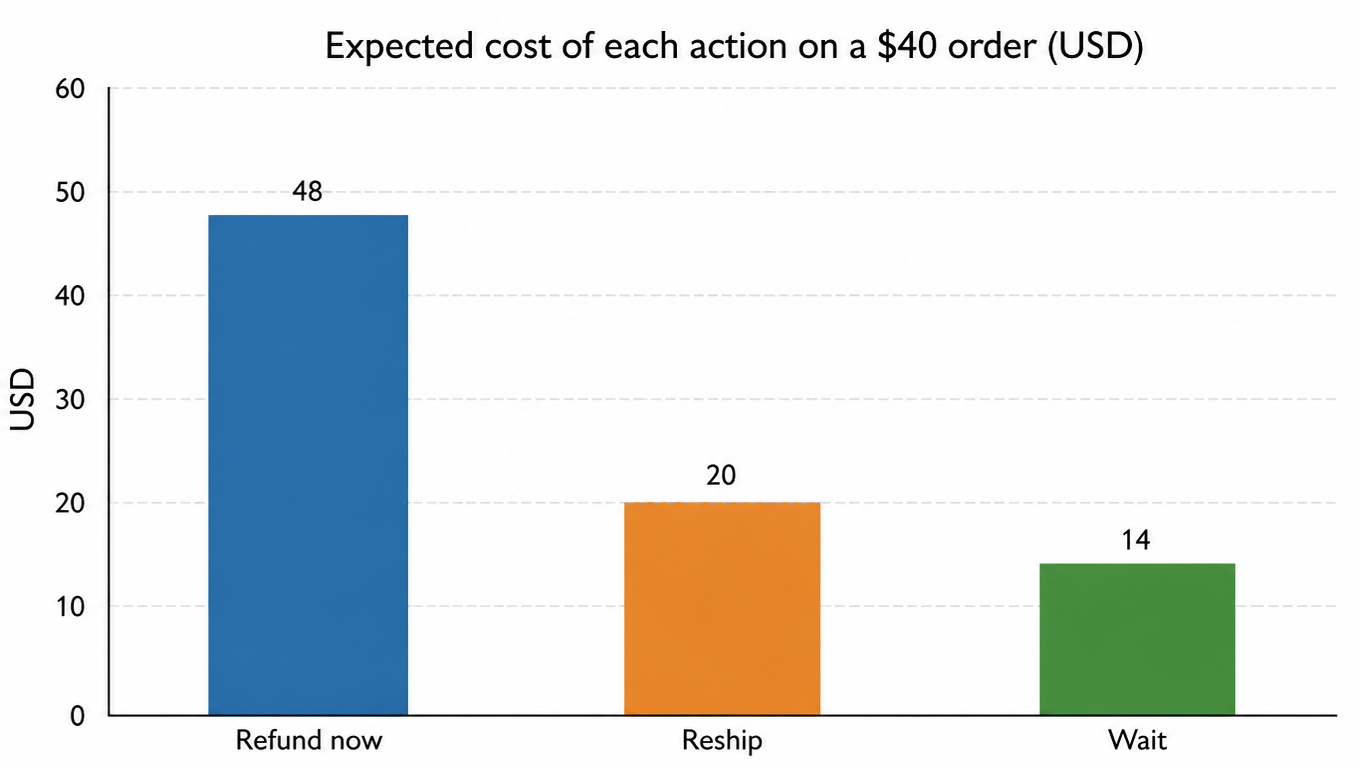
The ledger view changes the question. A $14 expected cost for waiting looks cheap until you remember that a chargeback is not the only way to lose a customer. Buyers who quietly never come back cost you the full lifetime value, not the order value. If a returning customer is worth $120 over three years, then spending $20 to reship a $40 order is not a loss; it is the cheapest acquisition you will run all week. The rule of thumb that falls out of this: compare remedy cost against order value for one-off buyers, but against lifetime value for anyone with purchase history.