The short answer is yes, but only with controls. The useful answer is a framework for deciding which shipping actions an AI agent may take unattended, which ones require a human, and how to enforce both in code. This article lays out that framework for ecommerce operations teams, SaaS and ERP/WMS product teams, 3PL technology managers, and the operations and compliance leaders who answer for the money.
We start by sorting every shipping action into a five-tier risk ladder, then stack eight controls on top: budget caps, carrier and service allowlists, approval thresholds, idempotency, dry run, audit log, and exception escalation. Each one maps onto primitives that standard shipping APIs already ship, and the whole thing lands in a staged rollout from read-only to thresholded autonomy. None of this requires a dedicated agent product.We then work through the harder case: an approval that covers a batch of labels rather than a single one.
The agent can buy labels, but every money move runs through policy
Why This Question Is Suddenly Practical
AI agents are moving out of the chat window and into the shipping workflow. A year ago an "AI assistant for shipping" answered tracking questions and suggested carriers. Today the same agent, wired through an MCP server or a similar tool layer, can call shipping APIs directly: create shipments, purchase labels, request voids, even re-route parcels in bulk.
That shift changes the question. The interesting question is no longer whether an agent can buy a label, because any agent with API credentials can. The interesting question is authorization: whose money the agent spends, whose carrier accounts it touches, and what happens when it spends that money wrong. Buying a shipping label is usually the first high-stakes action a team automates, because it is cheap enough to automate early and expensive enough to hurt when it goes wrong.
Most of the existing writing on AI in logistics covers freight booking, customs clearance, or compliance, and coverage of shipping API readiness exists too. What is missing is a control framework applied to the specific, mundane, high-stakes act of buying, voiding, and recreating labels. That is the gap this article fills.
The Shipping Action Risk Ladder
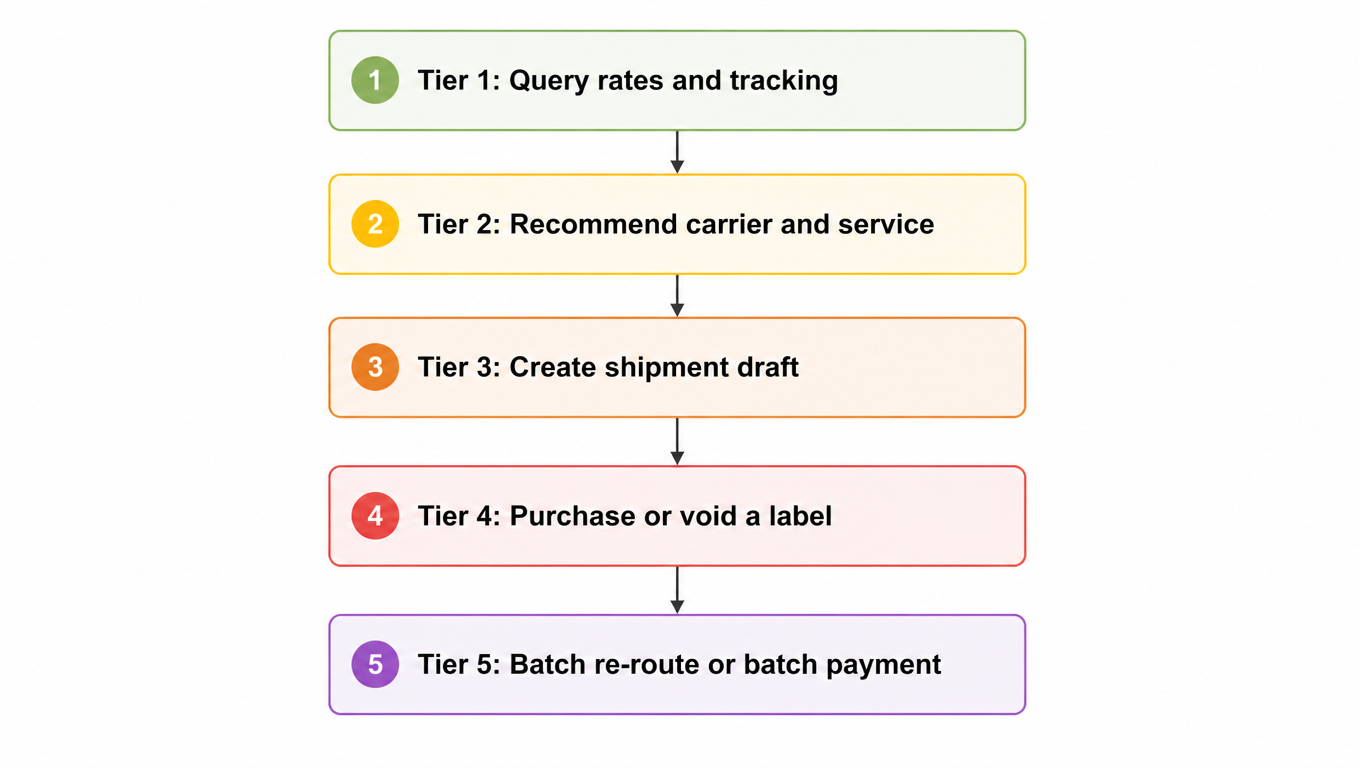
Before designing controls, rank the actions. The Shipping Action Risk Ladder sorts every operation an agent might perform into five tiers, from read-only to system-wide.
Tier 1, query rates and tracking: read-only, lowest risk. Wrong answers cost nothing but a little time.
Tier 2, recommend a carrier and service: medium-low risk. A bad recommendation is recoverable because a human sees it before anything is booked.
Tier 3, create a shipment draft: medium risk. Money does not move, but drafts consume downstream attention, and a flood of drafts can bury an ops queue.
Tier 4, purchase or void a label: high risk. Real money leaves the account, and a void may be time-limited or impossible after pickup.
Tier 5, batch re-route or batch payment: extreme risk. One decision multiplied across hundreds of parcels, with a systemic blast radius.
Five tiers, from read-only to system-wide
Every policy in this article maps back to this ladder. A control that cannot be stated as a rule about tiers is probably not precise enough to enforce.
Eight Controls That Make Automation Safe
Eight controls cover the practical surface of safe automation. Most teams need all of them; none of them is optional decoration.
Budget caps. A hard ceiling on what an agent may spend per run, per day, and per month, enforced before the purchase call is allowed. When the cap hits, purchasing stops until a human raises the limit.
Carrier allowlist. The agent may only touch carriers pre-approved by the team. Adding a carrier is a human decision, so an attractive offer from an unfamiliar carrier can never override policy.
Service allowlist. Within an allowed carrier, restrict which service levels are usable. Ground and standard are in; express and freight stay out until reviewed.
Approval thresholds. A dollar amount or action tier above which a human must approve. This is the boundary between unattended and supervised operation.
Idempotency. Every mutating call carries an idempotency key, so a network timeout and retry cannot produce two labels or two charges for one shipment.
Dry run. A simulate mode that runs the full decision logic and reports what would have happened, spending nothing and reserving nothing.
Audit log. Every automated action records what was ordered, which agent run ordered it, which policy allowed it, and the reasoning, so any incident can be replayed.
Exception escalation. Failures reach the right human with the right context instead of being silently retried until the damage is done.
The controls work as a stack, not a menu. Budget caps and allowlists decide what the agent may do at all; thresholds decide what it may do alone; idempotency and dry run protect the mechanics; the audit log and escalation decide what happens when something still goes wrong.
Setting Approval Thresholds: What Stays Human
The default rule is simple: read-only actions and drafts run unattended; anything that spends money or is hard to reverse gets a threshold.
A threshold combines two things: dollar amount and reversibility. A cheap label is still not freely voidable, so reversibility can matter more than price. For a typical ecommerce team the practical split looks like this. Tiers 1 through 3 run unattended, with a cap on drafts per run so the ops queue is not flooded. Tier 4 purchases under a per-label threshold, for example $50, run unattended. Voids require approval once a label has been used, because a void at that point means a process error, not a typo. Tier 5 batch actions are always human-approved, one authorization per batch.
Human approval should be a designed queue, not an ad hoc pager. The reviewer needs the order summary, the customer context, the budget remaining, and a one-tap approve or reject. If approval requires digging through three systems, reviewers will rubber-stamp, and the threshold becomes theater.
One authorization per batch sounds clean until the batch has two hundred lines in it. The next four sections turn that sentence into a process a person can actually review.
The Batch Handoff: What an Operator Is Actually Approving
The scenario that makes this concrete takes about ten seconds. An operator asks an agent to prepare today's rush orders for shipping. The agent comes back with a batch: forty lines, each one an order, a carrier, a service, and a fee, all ready to buy. Before anyone clicks, the operator has to answer four questions the batch itself does not answer. Are these the right orders? Do the chosen services meet what the customers were promised? Are these fees reasonable? And has any of this already been bought?
A confirmation button answers none of them. It proves that a person clicked, which is a fact about the person and not about the batch. It says nothing about which order set was approved, which service each line uses, what fee band was accepted, how long the approval stays valid, or what happened after execution. Those are exactly the questions that arrive later, from a finance review, a customer complaint, or a carrier invoice someone is disputing three weeks from now.
A per-label threshold does not survive contact with a batch either. A hypothetical batch of two hundred lines at twelve dollars each never trips a fifty dollar per-label rule, and still moves two thousand four hundred dollars of spend. The control that governs a batch is not the per-line threshold, then. It is the approved scope of the batch: which lines, which services, which fee band, valid until when.
Four Questions Every Batch Approval Has to Answer
A batch approval is only as good as the record it leaves behind. Four questions define that record, and all four have to be answerable later from stored data rather than from someone's memory.
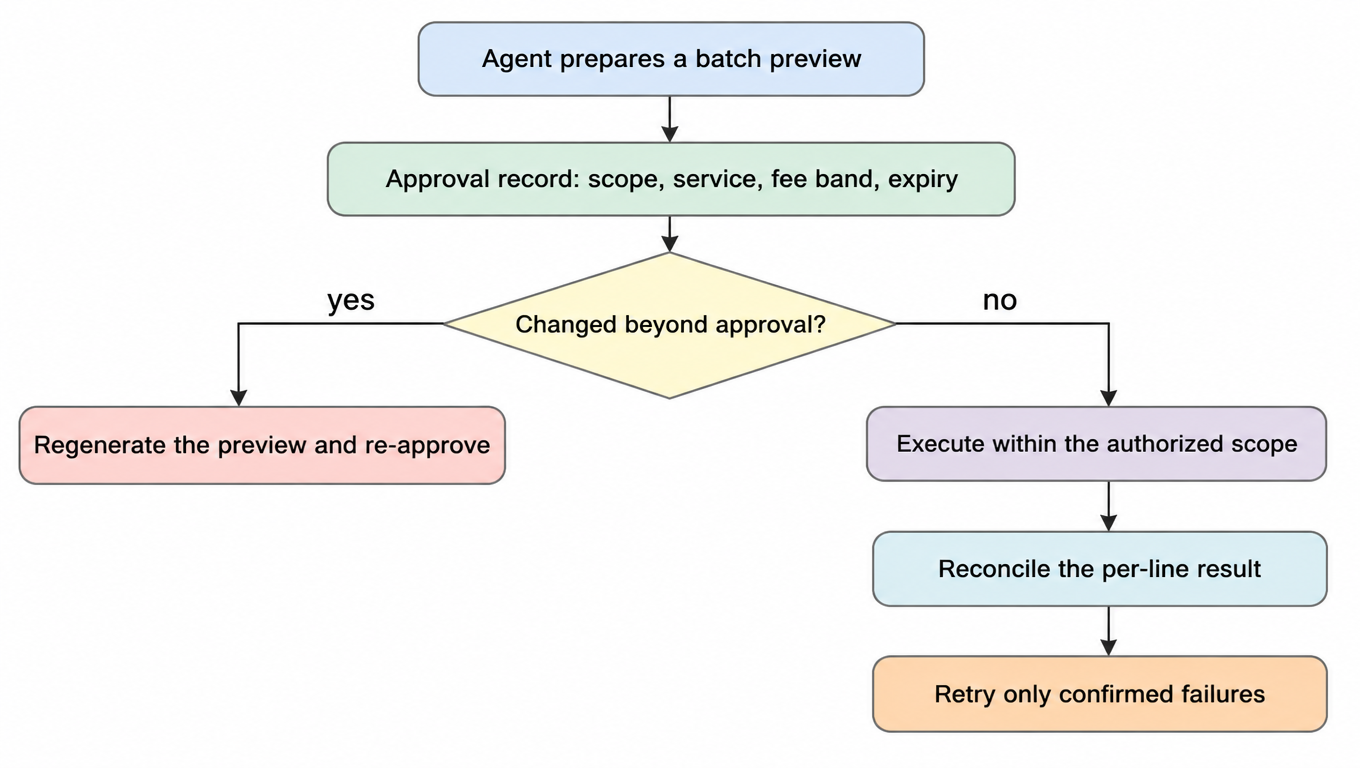
What was approved. The exact order and package set, the carrier and service on each line, and the fee band that was accepted. This has to be structured data, order identifiers plus service codes plus amounts, because a note saying the agent's plan looked fine cannot be re-checked.
On what basis. The evidence the decision rested on, each item timestamped: the destination and package eligibility check, the quote that produced the fees, whether a label already exists for that order, and the ship deadline the batch is racing. A basis without timestamps cannot be reviewed, only believed.
When it stops being valid. Approvals decay. Name the invalidators explicitly: lines added or removed, a carrier or service substitution, a fee moving outside the accepted band, and the clock itself. Quotes and eligibility checks age, so the approval carries an expiry, and the ship deadline is the natural outer bound.
What the execution result was. Per line: purchased, failed, skipped, or unknown. Keeping unknown separate from failed matters more than it sounds, because retrying an unknown is how one order ends up with two labels.
Change the scope, regenerate the preview, re-approve
Those four questions also define what the review screen has to show. If the reviewer cannot see the order set, the service, the fee band, and the expiry in one view, batch review collapses into the rubber-stamp the previous section warned about. That is what one authorization per batch has to mean in practice.
The Fields a Batch Has to Pin Before It Runs
Before a batch runs, eight fields have to be pinned. Each one closes a specific failure that has a habit of showing up later.
What has to be pinned
How it is recorded
Which failure it closes
Order and package scope
The order identifiers and package count in the preview
A batch that quietly grew or lost lines
Carrier and service
Carrier plus service code, per line
A service level that does not match what the customer was promised
Destination and package eligibility
The serviceability result, with the time it was checked
A destination that was shippable at quote time and is not at label time
Quote time and fee band
The quote timestamp plus the band accepted
Spend drift between preview and purchase
Ship deadline
The per-line cut-off time
An approval that waits longer than the shipment can
Existing labels
Whether a label already exists for the order: bought, voided, or used
Duplicate purchases
Execution result
Purchased, failed, skipped, or unknown, per line
A partial success read as a whole failure
Retry state
Attempt count and idempotency key, per line
A retry that produces a second label
The fee in a preview is an estimate built from the rate and the data available at that moment, not a settlement. The invoice can differ after billing adjustments: weight and dimension corrections, address corrections, and surcharges that only apply once the parcel is measured or scanned. A quote and a final charge are two different objects, so keep them apart in the workflow. The accepted band controls the batch's spend. The invoice is reconciled separately, against its own evidence and on its own cadence. Treating a quote as a settlement turns a control problem into a billing surprise.
With scope, basis, expiry, and result pinned, the decisions reduce to five cases.
Batch situation
Recommended action
Scope clear, data complete, inside the approved rules
Execute within the authorized scope
Orders, packages, service, or price change beyond the approved scope
Regenerate the preview and review it again
Missing serviceability, quote, or handoff evidence
Pause the affected lines and fill the gap first
Request timed out, purchase status unknown
Establish the transaction result before deciding whether to retry
Partly succeeded, partly failed
Keep the successful results and handle only the confirmed failures
This list is a set of acceptance requirements, not a description of any specific API. Which of the five you can enforce in code depends on what the connected API actually exposes: whether it returns a batch identifier and a per-line status, whether it accepts an idempotency key, whether a quote carries an identifier and an expiry, and whether an ambiguous result can be resolved by a lookup instead of a retry. Verify that contract before promising the control. Where the API cannot express a check, the check stays manual, and the operator's checklist has to carry it.
Standard Shipping APIs Already Support This
None of this requires a dedicated agent product. Standard shipping APIs already ship with the primitives the eight controls map onto.
Control
Standard API primitive
Budget caps
Account-level spending limits and billing webhooks
Carrier allowlist
Carrier scoping on API credentials
Service allowlist
Service enumeration on the rates endpoint
Approval thresholds
Quote-only request followed by a confirmed purchase
Idempotency
Idempotency key on every purchase and void call
Dry run
Rate-only endpoints with no side effects
Audit log
Webhook event logs and stored request records
Exception escalation
Error webhooks routed to a review queue
The design principle is that purchasing is two steps: ask for the price, then confirm the purchase. Agents should use the quote step for everything they are not explicitly authorized to buy, and the confirm step only inside policy. A quote is a promise to pay nothing; a confirm is the money move. Keeping them separate is what makes thresholds enforceable in the API rather than in a hope.
Failure Handling and Exception Escalation
Automation fails in predictable ways, and each failure mode needs a defined response. Rate limits mean slow down and retry. Address errors mean the payload is bad, retrying will not fix it, and the shipment should be parked for a human. Payment failures mean the funding source is the problem, not the request. Carrier outages mean the chosen carrier is unavailable and the policy, not the agent, decides what happens next.
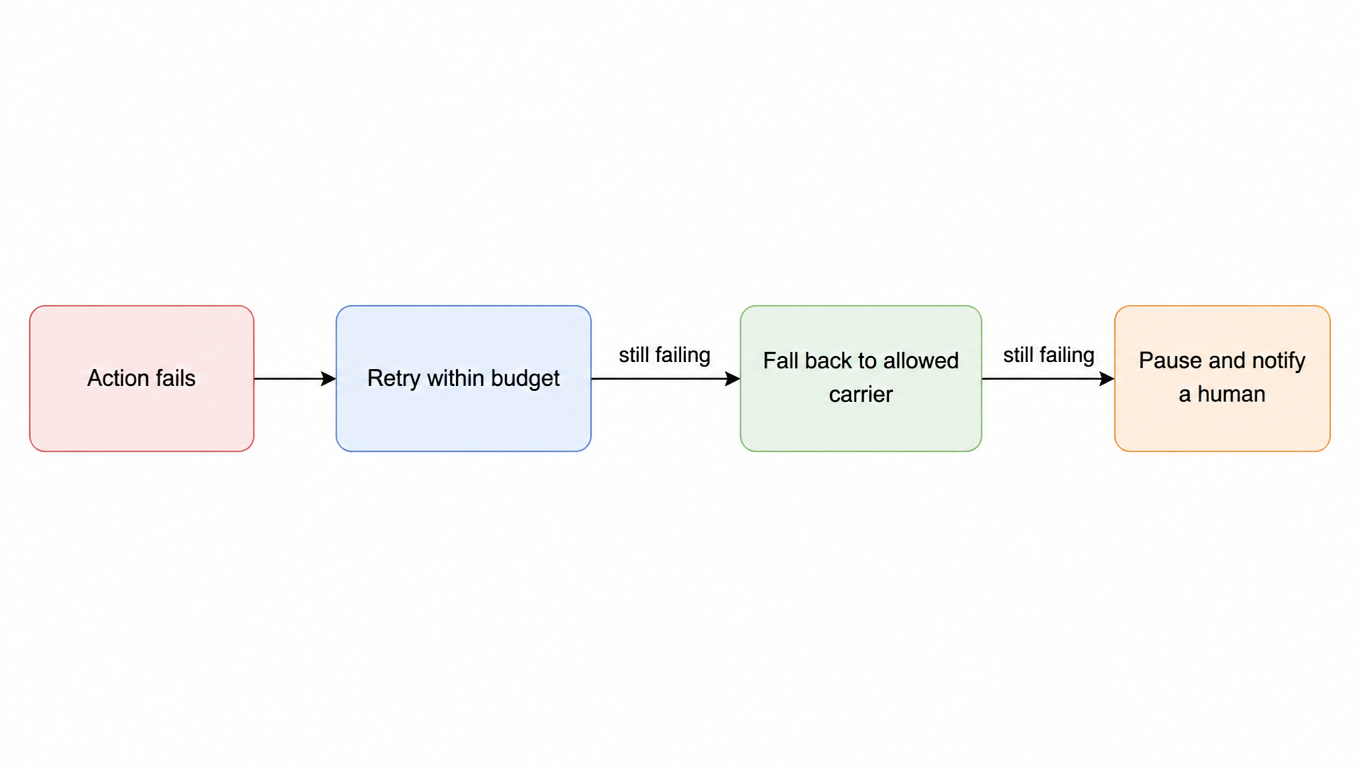
The escalation ladder has three rungs.
Three rungs: retry, fall back, pause and notify
First, retry within budget: the same action, the same idempotency key, up to a small number of attempts and within the spend cap. Second, fall back to an allowed alternative carrier or service from the allowlists, never an unapproved one. Third, pause and notify a human with the full context: what failed, how many attempts, which fallbacks were considered, and what budget remains.
One rule ties it together: a failed automated action must never silently become a human action outside the policy. If the agent cannot complete a purchase, the outcome is either a recorded fallback or a paused escalation, not a manual order placed by a panicked operator who was not told the agent was in play.
Rollout: From Read-Only to Full Automation
The safest path is staged. Phase one, observe: the agent runs read-only queries and logs what it would have done, changing nothing. Phase two, draft with human execution: the agent creates drafts and recommendations, and a human clicks buy. Phase three, low-tier autonomy: tiers 1 through 3 run unattended. Phase four, high-tier autonomy: tiers 4 and 5 run within thresholds, reviewed monthly.
The monthly review matters as much as the rollout. Limits drift, service levels change, and a threshold that was sensible in March is an invitation in August. Review spending against budget caps, review which approvals actually escalated, and review the exceptions the ladder caught. The checklist for evaluating any agent or MCP integration, whether you build it or buy it:
Can the action be reversed, and does the reviewer know how hard it is to reverse?
Does every mutating call carry an idempotency key?
Does every action have a dry run?
What happens on the third failure: retry, fallback, or human?
Who gets paged, and with what context?
Can the audit log answer "why did this order happen" for last month's incidents?
When was the last time the thresholds were reviewed?
An agent that buys labels is just code with a credit card. Wrapped in a risk ladder, capped, logged, and escalated, it is a member of the operations team that never sleeps, never argues, and always tells you what it did. That is a trade worth making, on your terms.
Yes, but only under controls: a risk ladder, budget caps, carrier and service allowlists, approval thresholds, idempotency keys, dry runs, an audit log, and exception escalation. Tiers 1 through 3 (query, recommend, draft) can run unattended; anything that spends money or is hard to reverse gets a threshold; batch actions are always human-approved. The real question was never "can it", it is "under what rules".
Three typical cases: Tier 4 purchases above a per-label threshold (for example $50), voids after a label has been used (at that point a void means a process error, not a typo), and all Tier 5 batch re-routes or batch payments. Approval should be a designed queue where the reviewer sees the order summary, customer context, and remaining budget.
No. All eight controls map onto primitives standard shipping APIs already ship: account-level spending limits, carrier scoping on credentials, quote-only endpoints, idempotency keys, webhook event logs, and error webhooks. The design principle is two-step purchasing: ask for the price, then confirm, keeping "a promise to pay nothing" separate from the actual money move.
The escalation ladder has three rungs: retry within budget (same action, same idempotency key, a small number of attempts), fall back to an allowed alternative carrier or service, then pause and notify a human with the failure reason, attempt count, fallbacks considered, and remaining budget. The rule that ties it together: a failed automated action must never silently become a human action outside the policy.
Four things at minimum: the exact order and package set, the carrier and service on each line, the fee band that was accepted, and the expiry. After execution it also carries a per-line result of purchased, failed, skipped, or unknown. All of it has to be structured data rather than a sentence, because those fields are exactly what a later review asks for, and removing any one of them turns the approval into a click that proves nothing.
Establish the transaction result first, then decide. A timeout is an unverified state, not a failure: the purchase may have completed. Retrying with the same idempotency key is safe where the API supports it. Without a verified transaction result and without idempotency protection, a retry is how duplicate labels and duplicate charges happen. Look up the batch and each line first, then retry only the lines confirmed as not purchased.
No. A preview fee is a quote built from the rate and the data available at that moment. The final invoice can differ after billing adjustments: weight and dimension corrections, address corrections, and surcharges that only apply once the parcel is measured or scanned. Treat the accepted fee band as a spend control on the batch rather than a settlement promise, and reconcile the invoice separately, against its own evidence and its own cadence.
Ready to put these controls into your shipping workflow?
EasyShippingX bakes real-time multi-carrier comparison, intelligent routing, and freight verification into your shipping flow, so every label is priced by the rules and quoting power becomes your product.