Shipping hazardous materials in the United States is one of the few logistics problems where a single mistake can ground a shipment, void a carrier contract, or trigger a federal penalty. This guide walks DTC brands, Amazon sellers, 3PLs, and overseas warehouses through the complete journey: spotting a product that may be hazardous, classifying it under federal law, storing and packing it correctly, choosing a carrier, and documenting the shipment for both domestic and international transport.
This guide does not answer "which carrier takes hazmat". It answers the question behind it: once a product that may be hazardous arrives in your hands, how do you identify, classify, store, pack, mark, document, and tender it in compliance, for both domestic and international transport? Every chapter ends with a two-role summary: what the seller should do versus what the warehouse should do.
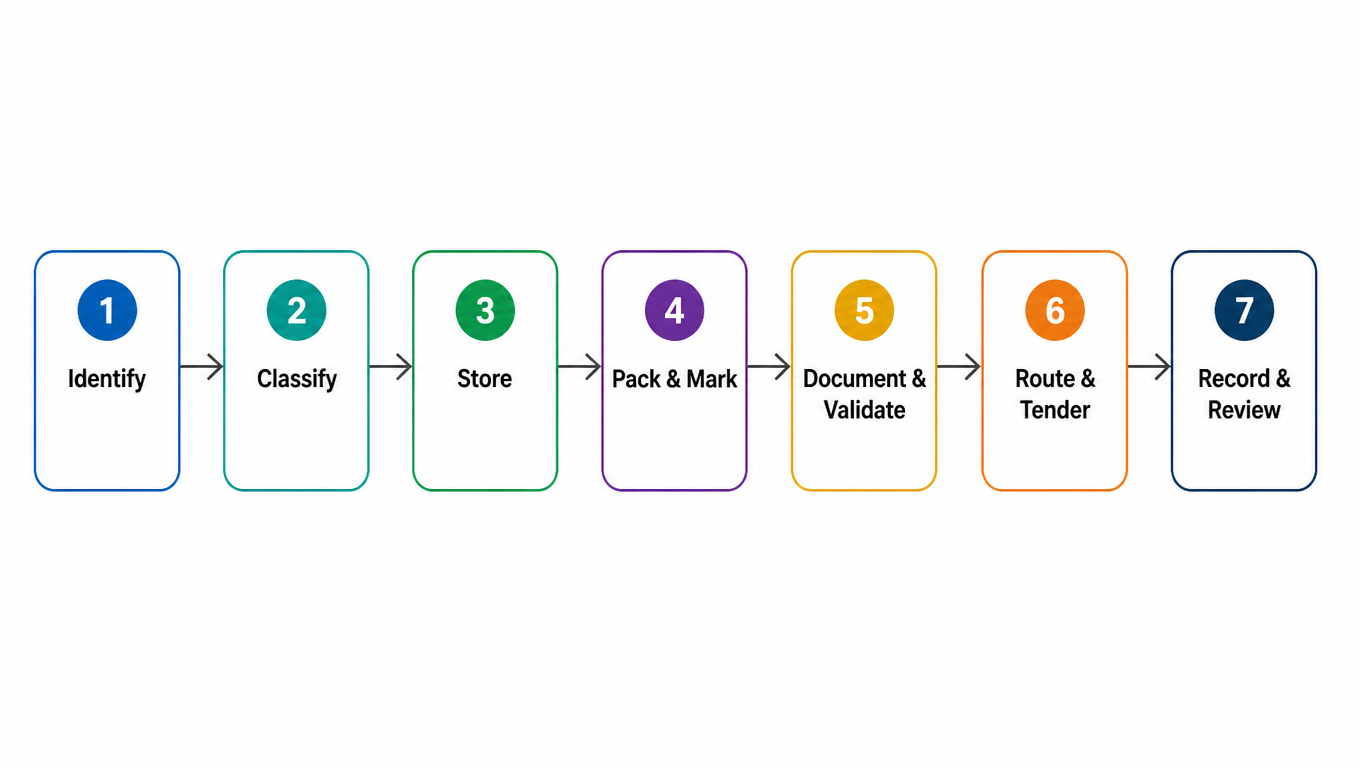
Hazmat compliance is a chain from identification to handover, not a patch on one step
How to Use This Guide
Carrier policy is not federal law. U.S. hazardous materials law lives in 49 CFR Parts 171 through 180, the Hazardous Materials Regulations (HMR) administered by the Pipeline and Hazardous Materials Safety Administration (PHMSA) under the Department of Transportation.[^1] Carriers are allowed to be stricter than the HMR, never more lenient, so you cannot reverse-engineer legality from "will UPS take it". A package can be perfectly legal to ship and still be refused by every carrier you try. The correct order is always: classification, compliance, eligibility, carrier, cost.
The full workflow this guide follows is an eleven-step loop, and every chapter maps to one part of it: Identify → Classify → Store → Pack & Mark → Document & Validate → Route & Tender → Record & Review.
Finish the compliance chain before you start optimizing rates
The guide is written for four audiences: DTC brands and marketplace sellers who need to know what their products actually are; 3PLs and overseas warehouses that receive, store, and ship these products on behalf of clients; and shipping software teams that build the tools the other three rely on. Quick-reference tables are decision aids, not legal advice; both the regulations and carrier policies change, so verify current terms before you ship.
Seller takeaway: Read the classification chapter and the carrier chapter before you list a product, not after the first rejection.
Warehouse takeaway: Treat every inbound SKU as potentially regulated until the onboarding data says otherwise.
Hazmat 101: What Counts as Hazardous & Who Regulates It
The terminology depends on where the shipment is going. Domestically, the U.S. Department of Transportation uses "hazardous materials" or "hazmat" as the statutory term. Internationally, and especially for air transport, the same goods are called "dangerous goods" (DG). Carriers add two more buckets of their own: "restricted articles", which are accepted only under specific conditions, and "prohibited articles", which are never accepted regardless of what the law allows.
The HMR divides hazardous materials into nine hazard classes. The class, not the product name, drives everything downstream: packaging, marks, labels, documents, and which carriers and services may touch the package.
Class
Name
Common ecommerce examples
1
Explosives
Fireworks, flares, ammunition
2
Gases
Aerosols (hairspray, deodorant, spray paint), lighters, camping gas
3
Flammable liquids
Perfume, nail polish and remover, paints, thinners, alcohol-based products
4
Flammable solids
Matches, some metal powders
5
Oxidizers and organic peroxides
Pool chlorine, hydrogen peroxide, bleach powder
6
Toxic and infectious substances
Pesticides, some cleaning chemicals, medical waste
7
Radioactive material
Medical isotopes, some testing equipment
8
Corrosives
Drain cleaner, battery acid, strong acids and alkalis
The uncomfortable truth for ecommerce is that "everyday consumer product" does not equal "ordinary cargo". The items that trip sellers up most often are: lithium batteries and power banks; phones, laptops, and other devices containing batteries; perfume and fragrance; aerosols; nail polish; paint; adhesives; cleaning chemicals; some cosmetics; alcohol-based sanitizers; automotive products such as coolant and brake fluid; and dry ice used to keep food cold. Each one falls into a class, and each one carries its own packaging and documentation obligations.
Four regulators matter. DOT/PHMSA writes and enforces the HMR itself, covering classification, packaging, hazard communication, training, shipping papers, and incident reporting. The FAA adds requirements whenever hazmat moves by air. The FMCSA governs the highway transport of hazmat, relevant to warehouses that arrange truckload or LTL moves. USPS runs its own mailability rules, Publication 52, on top of the HMR for anything moving through the mail.[^2] State and local fire codes, plus OSHA workplace rules, layer on top again for anyone storing hazmat. The right first question is never "which carrier accepts this", it is "what is this material, and which modes of transport allow it at all".
Seller takeaway: Learn to spot hazmat before the carrier does. If a product has a battery, a flammable solvent, or a warning label, it is probably regulated.
Warehouse takeaway: Flag suspicious SKUs at onboarding and route them to classification review. Never let a picker decide by looking at the box.
Classification: The Make-or-Break First Step
Classification is the step where almost every hazmat problem is created or avoided. The starting point is the Safety Data Sheet (SDS), specifically Section 14, Transport Information, which normally lists the UN number, proper shipping name, hazard class, and packing group assigned by the manufacturer. But the SDS is a starting point, not a verdict: the shipper legally owns the classification decision, and SDS data is sometimes wrong, generic, or written for a different mode. A warehouse or marketplace that relies on a product name in a listing instead of the SDS is guessing, and guessing is how misdeclarations happen.
A complete classification answers seven questions: the UN or NA identification number; the proper shipping name (PSN); the hazard class and division; the packing group (I for the highest danger, II, or III); the quantity; the package type; and the mode of transport. Change any one of those and the compliance answer can change. For example, a 50 mL bottle of perfume and a 5 liter can of solvent may share a class, but their packaging, marks, and carrier eligibility will look completely different.
The HMR then places the material into one of three regulatory tiers. A fully regulated hazardous material requires complete compliance: UN specification packaging where mandated, hazard labels, marks, shipping papers, emergency response information, and trained personnel. A limited quantity (LQ) shipment qualifies for reduced packaging and generally does not need the hazard class label, but still requires the limited quantity mark and trained staff. Ground LQ shipments are excepted from the shipping paper requirement unless the material is a hazardous substance, hazardous waste, or marine pollutant; LQ packages moving by air or vessel still need the shipping paper entry.[^15] An excepted quantity shipment is the lightest tier: small volumes, minimal packaging, and a small "E" mark. One legacy concept to unlearn: the old ORM-D (Other Regulated Material) category and the "consumer commodity" description no longer exist in the HMR.[^3] If an old procedure or checklist still references ORM-D, it is obsolete.
Mode changes the answer before carrier policy does. The same product that moves legally by ground can be prohibited on passenger aircraft or restricted to cargo-only flights. This is why "ground is fine" can never be stretched into "air is fine": the federal air rules are stricter, and carrier air services inherit that strictness. Domestic air, international air, and ocean each add another layer, which is covered later in this guide.
The practical consequence is that "can I ship perfume?" has no single answer. The honest answer depends on the flash point, the container volume, the packaging, the mode, and the carrier's own policy. Any tool or checklist that returns a blanket yes or no for a product category is doing classification wrong.
Seller takeaway: Obtain the SDS before you list the product, and check Section 14 before you launch. If the manufacturer cannot produce an SDS, treat the product as hazardous until proven otherwise.
Warehouse takeaway: Verify classification against the SDS at onboarding. Do not trust the product name, the client's description, or what the last warehouse did.
Packaging, Marking, Labeling & Documentation
When fully regulated, the package must meet the standard the HMR sets, which is more than "use a sturdy box". For many materials that means UN specification packaging, identifiable by the UN mark printed on the box (for example "4G" for a fiberboard box, followed by the packing group, year, and other codes). The complete packaging picture includes the inner packaging (the bottle, can, or pouch), the outer packaging, cushioning that keeps inner packagings from moving, leak prevention for liquids, closure method, orientation, material compatibility (acids do not go in containers that react), and per-package quantity limits. Each class has its own packaging instructions, so the packaging decision is always downstream of the classification decision.
Lithium batteries deserve their own paragraph because they are the most common hazmat in ecommerce. The rules split into three configurations: battery alone (UN 3480 for lithium ion, UN 3090 for lithium metal), packed with equipment (UN 3481 / UN 3091), and contained in equipment. The obligations depend on battery type, on watt-hour rating for lithium ion or lithium content for lithium metal, and on condition. Damaged, defective, or recalled batteries are a separate, stricter process entirely: they generally cannot move through standard shipping channels, and may require PHMSA approval or a special permit.[^4] A swollen or damaged battery must never be packed and shipped like a new one.
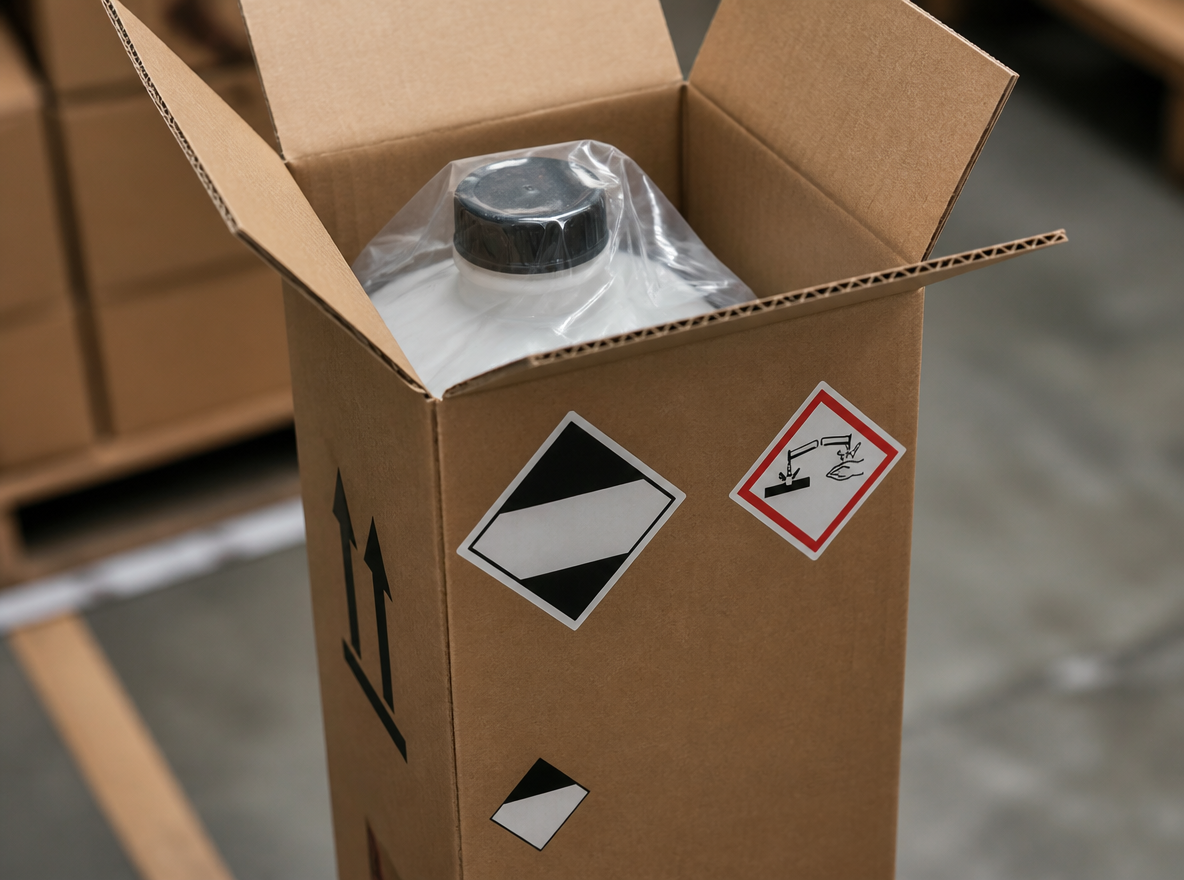
Marking and labeling are two different jobs that people routinely merge. Package marking is the printed information on the outside: the UN number, the proper shipping name, the limited quantity mark, the lithium battery mark, and orientation arrows for liquids. Hazard labels are the diamond-shaped class labels (for example the Class 9 label for lithium batteries) applied when the material is fully regulated. Air adds the "cargo aircraft only" handling label when the shipment is restricted to freighters. The single most important distinction in this chapter: the shipping label is not a hazmat label. A carrier barcode proves the carrier scanned a parcel; it proves nothing about whether that parcel was compliant when it left your dock.
Documentation completes the picture. Ground shipments of fully regulated materials need shipping papers with the hazardous materials description (proper shipping name, hazard class, UN number, packing group, and quantity) plus emergency response information and, for many shipments, a 24-hour emergency contact number. Air shipments additionally require the shipper's declaration for dangerous goods. Carriers add their own layer: UPS and FedEx require hazmat data to be transmitted electronically through approved systems, and DHL requires its own DG paperwork.[^6][^7][^8] There is no single form that covers all hazmat; the documents are driven by the same classification and mode that drove everything else.
Packaging follows classification, not "which box is cheapest"
Seller takeaway: Packaging, marks, and documents are per classification, not one-size-fits-all. Buy packaging to the UN specification your material needs, not to the cheapest box on the shelf.
Warehouse takeaway: Stock the approved packaging and keep reference materials (packaging instructions, label samples, a copy of the SDS) at every packing station, not in an office somewhere.
Carrier by Carrier: UPS, FedEx, DHL, USPS & Regional Carriers
"UPS supports hazmat" is a sentence with no usable meaning, because the answer always decomposes into carrier plus service plus hazmat type. The comparison that matters looks like this: does this carrier accept this material, on this service, with this approval and documentation in place? The matrix below summarizes the shape of each program; the paragraphs after it add the details that change most often.
Carrier
Ground hazmat
Air / Express hazmat
Approval / contract
Documentation
Key restrictions
Best fit
UPS
Yes, most classes
Restricted, class-dependent
UPS hazmat agreement required
Electronic declaration via approved system
Air services limited; lithium surcharges; per-package hazmat fee
Mid to large volume sellers with approved account
FedEx Ground
Yes, selected classes
Not applicable
FedEx Ground hazmat approval
Ground hazmat paperwork
Separate program from Express, do not mix rules
Ground shipments of approved classes
FedEx Express
Not applicable
Yes, IATA-based
Express DG approval required
Shipper's declaration for dangerous goods
Passenger vs cargo aircraft rules
Time-critical DG by air
DHL Express
Not applicable
Yes, IATA-based
DG account approval + DG agreement
Shipper's declaration, DG paperwork
Only approved stations handle DG
International DG, especially to Asia and Europe
USPS
Very limited
Very limited
Publication 52 mailability
HAZMAT STC/ESC codes in the barcode
Most hazmat prohibited; lithium rules tight
Small, mailable consumer items only
Regional carriers
Generally no
Generally no
Check with carrier
Usually none offered
Hazmat rarely accepted; confirm in writing
Non-hazmat last-mile parcels
UPS accepts hazardous materials only on an account with an approved hazmat agreement, and every hazmat package must be tendered through an approved electronic shipping system with the hazmat data transmitted up front.[^6] UPS Ground is the workhorse for most regulated classes; the air services are more restrictive, with some classes limited or prohibited on passenger aircraft. Expect a per-package hazmat surcharge and, for lithium, a separate battery surcharge; the exact amounts change regularly and depend on service, class, and negotiated contract terms.
FedEx runs two separate programs, and treating them as one is a classic error.[^7] FedEx Ground hazardous materials is a ground program with its own approval process, paperwork, and selected classes. FedEx Express dangerous goods is an air program that follows IATA rules, requires its own approval, and needs a shipper's declaration for dangerous goods on air shipments. An approval for one does not cover the other, and the rule sets do not merge.
DHL Express handles international dangerous goods under IATA rules, but only with a DG-approved account and, typically, a signed Dangerous Goods Agreement.[^8] Not every DHL Express station accepts DG, so approved shippers still need to confirm station capability. For many small and mid-size sellers, the practical route to international DG is a freight forwarder or a 3PL that already holds the approvals, rather than building DG capability in-house.
USPS is a special case and is covered in depth in its own guide, USPS requirements for shipping hazardous materials: a complete mailing workflow. The short version: Publication 52 governs mailability, most hazardous materials are prohibited in the mail, and lithium battery rules tightened significantly: only batteries properly installed in the equipment they operate may be mailed internationally today, and standalone batteries are out.[^5] Because USPS rules are dense and change often, this guide only summarizes them and defers to the deep dive.
Regional carriers such as OnTrac, UniUni, GOFO, SpeedX, Veho, Better Trucks, and SwiftX operate primarily as non-hazmat last-mile delivery networks, and their public hazmat acceptance policies are thin or absent.[^9] Never assume acceptance from a rate sheet. If a package is regulated, confirm in writing with the carrier before tendering, and if they cannot confirm, route it through a carrier with a documented hazmat program.
Seller takeaway: Match product plus service plus carrier, not just "carrier X takes hazmat". Document which class each carrier approved you for.
Warehouse takeaway: Keep carrier eligibility rules in the WMS, keyed to each SKU's class, so the system can block a non-compliant service before a label is printed.
Warehouse & 3PL Hazmat Operations
This chapter is where a carrier guide becomes an operations guide, because most hazmat compliance failures happen before the carrier sees the package. A warehouse that stores, picks, packs, and tenders hazmat is acting as the offeror, and offerors carry legal responsibility regardless of who owns the inventory.[^16] The eight steps below form the operating system.
1. SKU onboarding. Collect the data before the first pallet arrives: product name, SDS, battery information if any, chemical composition where relevant, UN or classification data if the client has it, package quantities, and regulatory notes. If the client cannot supply an SDS, the SKU is flagged, not guessed.
2. WMS hazmat flag. Maintain a hazmat flag per SKU with the hazard class, UN number, allowed shipping modes, carrier restrictions, and packaging rules attached to the product record. The WMS, not the warehouse floor, is the source of truth; employees should never have to decide from memory or instinct.
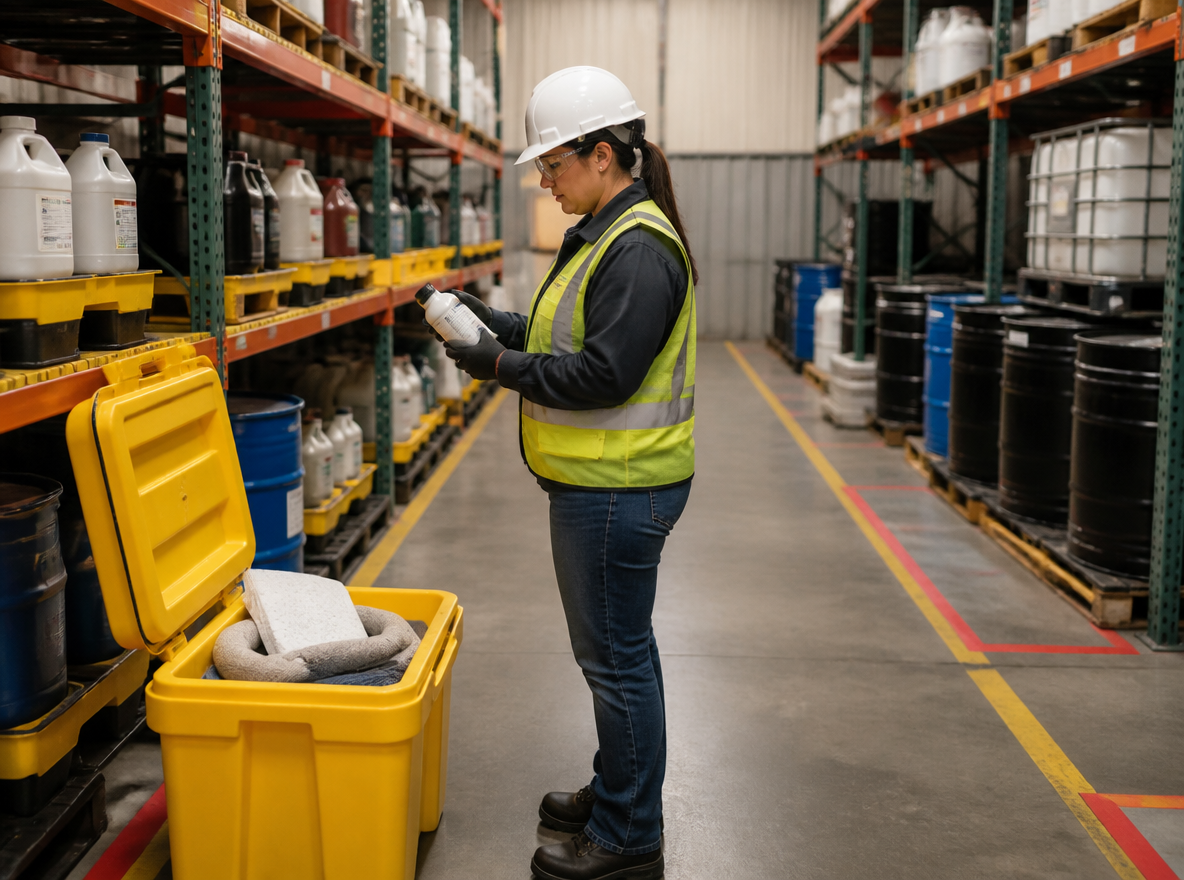
3. Storage. Storage design follows the material's properties: segregation of incompatible classes (oxidizers away from flammables), temperature requirements, fire protection, spill containment, quantity limits, and local fire and building codes. Not all hazmat belongs in a dedicated "hazmat warehouse"; a shelf of aerosol cans needs different controls than a drum of solvent. The facility's fire code and insurance policy are the binding documents here.
4. Picking. The system should prevent incompatible SKUs from being co-packed and prevent regulated items from being picked into orders they were not approved for. Pickers see the hazmat flag as an instruction, not a curiosity.
5. Packing station. Each station needs the approved packaging, the correct marks and labels, the SOP, reference materials, and trained personnel. If the station cannot assemble a compliant package, the order stops rather than shipping wrong.
6. Carrier routing. The decision logic is fixed: is this hazmat? Which modes are legally eligible? Does a carrier with an approved service accept this material? Then, and only then, compare cost and performance. Compliance must come before rate shopping.
7. Handover. Prevent the three classic failures: a hazmat package slipping into a non-hazmat pickup stream, a wrong service selection (air when only ground is allowed), and missing documents or a misdeclared description.
8. Recordkeeping. Keep what the regulations and company policy require: training records, shipping documents, and incident reports. When a regulator or a carrier asks, records are the only defense that matters.
Hazmat employees need training under 49 CFR Part 172 Subpart H. The program covers general awareness or familiarization, function-specific training for the jobs each person actually performs, safety training, and security awareness; in-depth security training applies where the facility's security plan requires it. Initial training must be completed within 90 days of employment or a job-function change, and recurrent training is required at least every three years, with training records retained as the regulation specifies.[^10][^11] Facilities that ship DG by air add IATA or ICAO training for the staff involved. The exact cycles are worth re-verifying periodically, since PHMSA updates the HMR regularly.
The 15-step SOP below is a framework any 3PL can adapt: (1) product onboarding, (2) SDS collection, (3) classification verification, (4) WMS hazmat tagging, (5) storage rules, (6) pick restrictions, (7) packaging instructions, (8) marking and labeling, (9) carrier eligibility, (10) shipping documentation, (11) manifest and handover, (12) recordkeeping, (13) incident response, (14) employee training, and (15) periodic compliance review. If a step is skipped, the chain is broken, and the failure usually surfaces at the worst possible moment.
Incident and exception management is a process, not a repair job. The situations to plan for: leakage, damaged or swollen batteries, broken packages, misdeclared hazmat, carrier rejection, fire or thermal events, spills, and returned packages. The principles are consistent. Stop normal processing immediately. Follow the trained facility procedure for the situation. Escalate to qualified hazmat or safety personnel. Follow the SDS and emergency procedures. Meet applicable reporting requirements. Never simply repackage the item and resend it, because the item's condition may have changed its classification.
Different operators have different responsibilities. A DTC brand owns product classification, SDS collection, 3PL capability checks, carrier eligibility, and hazmat returns handling. An Amazon or marketplace seller adds marketplace fulfillment requirements, FBA hazmat restrictions for fulfillment-by-Amazon,[^12] and return policies that keep damaged batteries out of the standard return stream. A 3PL or overseas warehouse owns client onboarding, SKU data quality, training, WMS rules, storage, multi-client separation, carrier routing, and the audit trail. Shipping software teams own the hazmat data fields, service eligibility rules, validation logic, API mapping, and the ability to block a non-compliant service selection before a label is created.
Storage follows the material: segregation, temperature, fire protection, and spill containment
Seller takeaway: Ask every 3PL what they can store and ship, in writing, before you send them a hazmat SKU. A 3PL that "probably" handles hazmat is not a compliant 3PL.
Warehouse takeaway: Run the 15-step SOP as a checklist, not a philosophy. The step that gets skipped is the step that gets audited.
International & Air: IATA, IMDG & Export Basics
Regulatory weight escalates with every mode change: ground, then domestic air, then international air, then ocean. Ground may permit what air prohibits; international air adds documentation and approval layers on top of domestic air; ocean follows yet another rulebook. Classification and packaging that passed on a ground move cannot be assumed to pass on any faster move.
For air, the operative rules are the IATA Dangerous Goods Regulations (DGR), built on the ICAO Technical Instructions, and airlines and their agents enforce them strictly.[^13] For ocean, the IMDG Code applies.[^14] Air shipments of fully regulated dangerous goods require a shipper's declaration for dangerous goods, and the SDS travels with the shipment for reference. A large share of dangerous goods is either prohibited on passenger aircraft or restricted to cargo-only flights, which is why "cargo aircraft only" handling exists. Lithium batteries face the strictest air regime: watt-hour and lithium-content limits, state-of-charge caps on some shipments, and approval requirements that change frequently. These rules are verified against current official sources at publish time, and any seller shipping lithium by air should treat the current IATA DGR, not this guide, as the operating document.
Destination rules differ from U.S. rules. Some countries prohibit materials that are legal domestically, restrict aerosols or alcohol-based products, or impose their own labeling and documentation. Separate from hazmat law, U.S. export controls (EAR and ITAR) apply to certain chemicals and devices regardless of their hazmat classification, and customs requires an accurate commercial invoice, which for DG should match the shipper's declaration. The practical question for most sellers is not "how do I learn all of this", it is "who is already approved to do it". A freight forwarder or customs broker with dangerous goods capability, or a 3PL with an international DG operation, holds the approvals and does the training; the seller's job is to hand over accurate classification data and an honest SDS.
Seller takeaway: For international DG, use an approved forwarder or a 3PL with DG capability, and give them the SDS and classification before you book. Do not book air freight on a "should be fine" basis.
Warehouse takeaway: Keep an international hazmat workflow separate from the domestic one, with its own documentation, training, and carrier list. A package that clears your domestic rules can still fail at the border.
The Final Framework: Decision Tree, Common Mistakes & Compliance Checklist
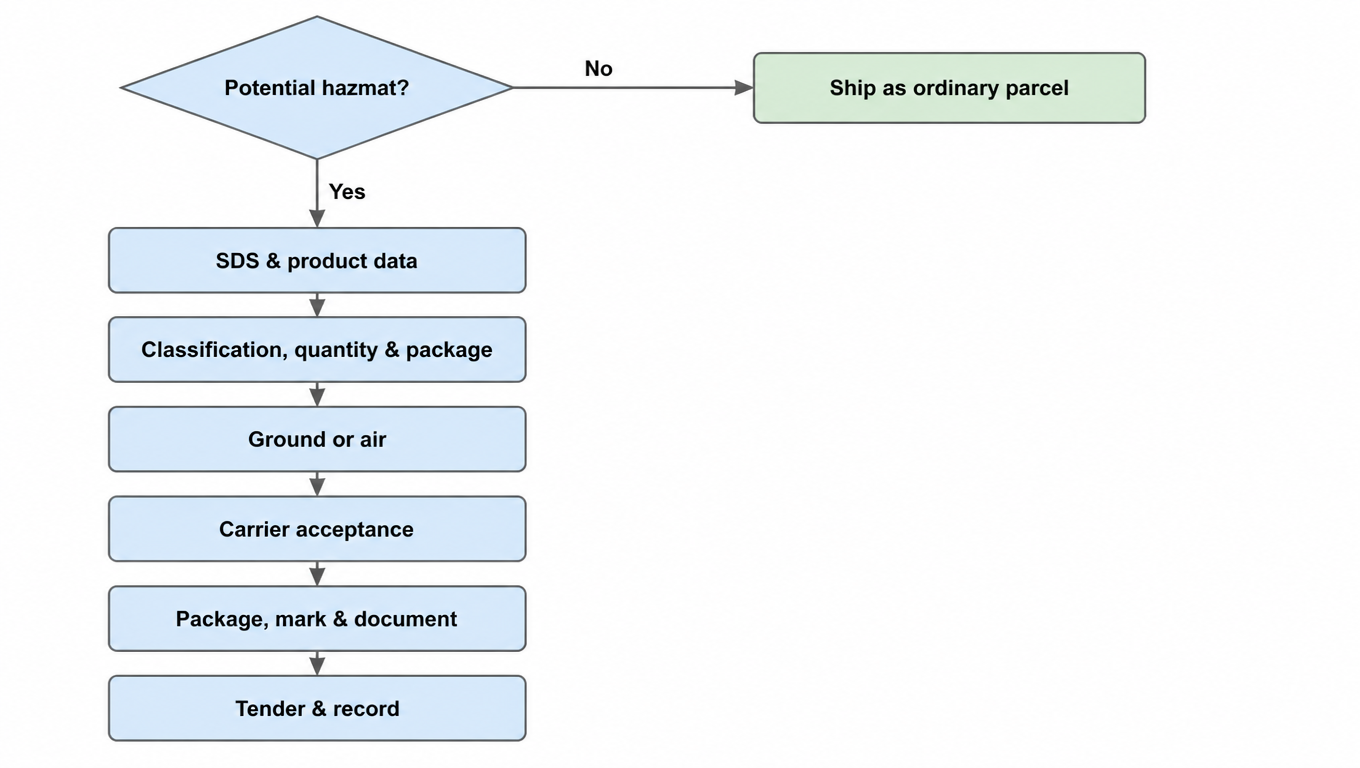
The entire guide compresses into one decision tree, and the tree should be followed in order. Never start with "which carrier is cheapest", because cost optimization is the last question, not the first.
Classification, compliance, eligibility, carrier, cost: the order cannot be reversed
The ten most common mistakes, in rough order of frequency: assuming everyday consumer goods are not hazmat; judging by product name instead of verifying classification; shipping by air on the strength of a ground approval; confusing the shipping label with the hazmat label; treating limited quantity as "unregulated"; having no hazmat flag in the WMS; applying one rule to all carriers; letting untrained staff handle hazmat; handling damaged or recalled batteries like new ones; and, after a carrier rejection, quietly switching carriers instead of investigating the cause. Every one of these is a process failure, and every one is preventable with the checklist below.
The compliance checklist: an SDS is on file for every regulated SKU; the classification is documented (UN number, proper shipping name, class, packing group); packaging meets the requirement, including UN specification packaging where mandated; marks and labels are applied correctly; shipping papers and emergency response information are complete; the carrier and service are approved for this class; trained staff are on duty; the WMS flag is set; records are being kept; and the incident response plan is current. Run this list before launch, and again whenever a carrier or regulator changes a rule.
Hazmat shipping in the U.S. is, first and foremost, a classification and compliance problem, and only secondarily a carrier selection problem. The mature system does not answer "which carrier takes this"; it runs Identify, Classify, Store, Pack, Mark, Document, Validate, Route, Tender, Record, Review, and only then does it start optimizing rates. Build that chain once, and hazmat becomes a manageable, auditable part of your operation instead of the shipment that comes back to haunt you.
Seller takeaway: Keep the decision tree in front of your team. If a product is flagged as potential hazmat, the answer to "can we ship it" always starts with the SDS, never with the rate table.
Warehouse takeaway: Make the checklist the gate for new SKUs and for carrier changes. Compliance is not a department, it is the order of operations.
Sources
The [^N] markers in the text map to the sources below. Regulations and carrier policies change, so verify against the current official texts before you ship.
[^1] eCFR: 49 CFR Part 171, General Information, Regulations, and Definitionsecfr.gov
[^2] USPS Publication 52, Hazardous, Restricted, and Perishable Mailpe.usps.com
[^3] Federal Register: Hazardous Materials Harmonization With the UN Recommendations (HM-215K, ORM-D removal)federalregister.gov
[^4] eCFR: 49 CFR 173.185, Lithium cells and batteriesecfr.gov
[^5] USPS International Shipping Restrictionsusps.com
Very limited. Publication 52 governs mailability, most hazardous materials are prohibited in the mail, and lithium battery rules are especially tight: only batteries properly installed in the equipment they operate may be mailed internationally, standalone batteries are out. Only a few small consumer items are mailable, and they must be declared with HAZMAT STC/ESC codes in the barcode. See the dedicated USPS hazmat guide for the full workflow.
A fully regulated hazardous material requires complete compliance: UN specification packaging, hazard class labels, marks, shipping papers, emergency response information, and trained personnel. A limited quantity (LQ) shipment qualifies for reduced packaging because of its small volume and generally does not need the hazard class label, but it still needs the limited quantity mark and trained staff. Ground LQ shipments are generally excepted from the shipping paper requirement unless the material is a hazardous substance, hazardous waste, or marine pollutant; LQ by air or vessel still needs the shipping paper entry. The key insight: LQ is not "unregulated", it is a lighter tier with strict substance and quantity limits.
Yes, but under strict conditions, and it is one of the most regulated areas in air transport. The rules depend on battery type, watt-hour rating for lithium ion or lithium content for lithium metal, the three configurations (alone, packed with equipment, contained in equipment), and battery condition. Some shipments carry state-of-charge caps and many are restricted to cargo-only flights. Damaged, defective, or recalled batteries almost never move through standard air channels. Treat the current IATA DGR as the operating document and check it line by line before you ship.
Yes. UPS requires an approved hazmat agreement on your account and electronic transmission of hazmat data through an approved system. FedEx runs two separate programs, FedEx Ground hazardous materials and FedEx Express dangerous goods, each with its own approval that does not cover the other. DHL Express requires a DG-approved account and typically a signed Dangerous Goods Agreement, and only approved stations handle DG. Tender without approval and the package will be refused, and your account may be suspended.
The layers stack. Carrier level: refusal, violation fees, account suspension, or a voided contract. Federal level: PHMSA can issue civil penalties for HMR violations, with fines reaching tens of thousands of dollars per violation, and knowing violations can escalate to criminal penalties, with additional exposure for unmet incident-reporting obligations. For a warehouse or 3PL acting as offeror, liability applies regardless of who owns the inventory. Beyond the fines, one misdeclared shipment can lock you out of every carrier lane and put you on the audit list permanently.