USPS HAZMAT Guide

USPS requirements for shipping hazardous materials: a complete mailing workflow

Perfume, aerosols, nail polish, lithium-battery devices, dry ice, and some cleaning products may all be hazardous materials. The answer is rarely just “mailable” or “prohibited”: proper shipping name, hazard class, quantity, packaging, destination, and air eligibility also matter. This guide uses USPS Publication 52 and the HAZMAT Search Tool to explain the domestic workflow from identification through tender.

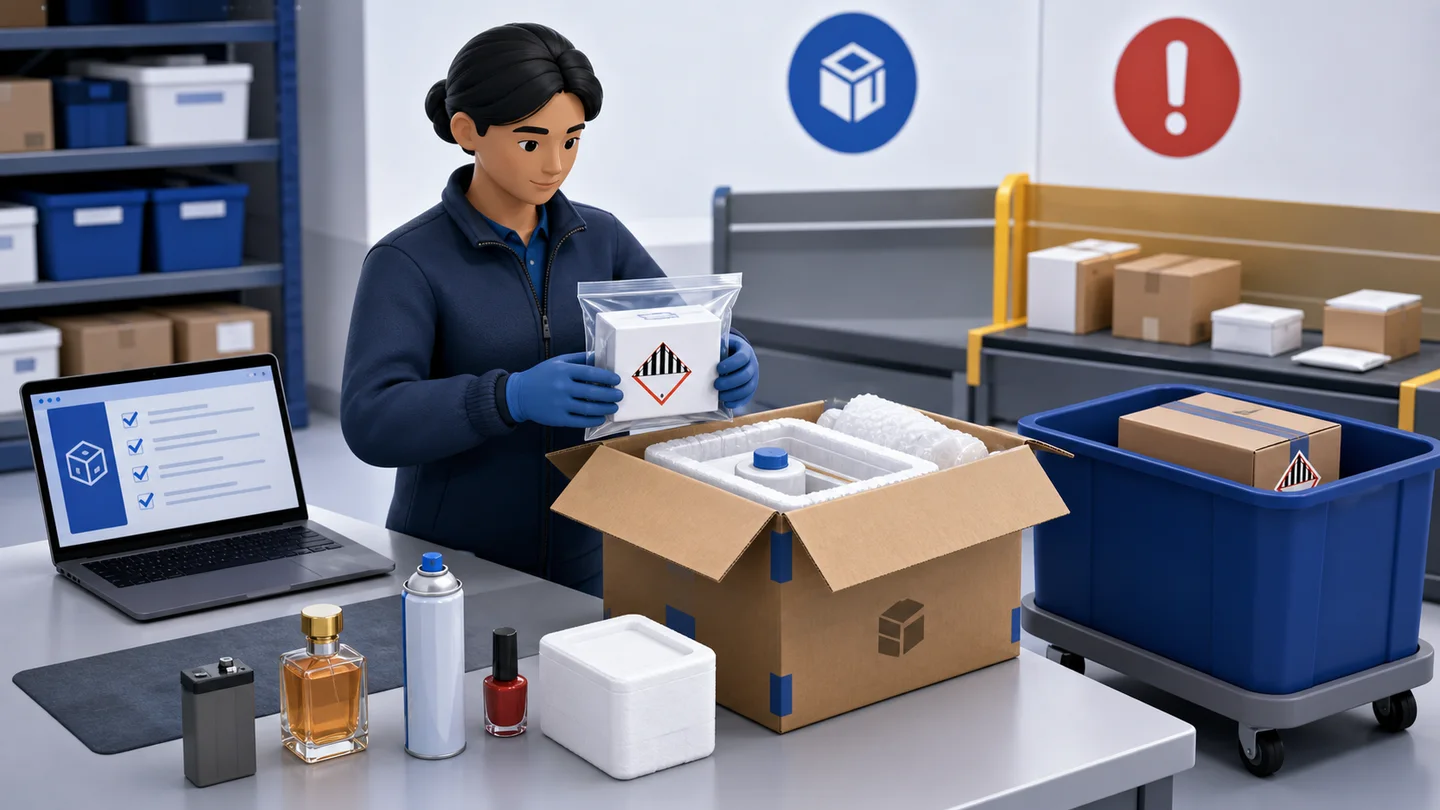
A warehouse specialist inspecting protected hazardous-material packaging and separating the parcel from ordinary shipments
HAZMAT compliance is a chain of decisions from product identification through separate tender—not a single sticker.

The first rule: the mailer owns the HAZMAT determination

USPS places responsibility on the mailer to know the contents and accurately identify flash point, toxicity, corrosivity, battery characteristics, and other hazards. A Post Office employee, label platform, or warehouse operator may help with execution, but does not replace the mailer’s classification duty. If the properties are unknown, obtain the current Safety Data Sheet (SDS) and transportation data from the manufacturer instead of guessing from a product name or smell.

Important: This is an operational guide, not a mailability ruling for a specific product. USPS rules, fees, and platform fields can change. Recheck Publication 52, the applicable Packaging Instruction, destination restrictions, and current label-platform requirements before mailing. Last reviewed: August 22, 2026.

Step 1: decide whether the item is prohibited, restricted, or mailable HAZMAT

“Hazardous,” “restricted,” and “prohibited” are not synonyms. Some hazardous materials are forbidden in all domestic USPS mail. Some items become mailable only after quantity, packaging, service, and destination conditions are met. Other products look ordinary but are regulated because they contain a flammable liquid, compressed gas, or lithium battery.

ResultMeaningTypical examples
Domestically prohibitedCannot be sent through USPS; stop label creationAmmunition, explosives, gasoline, metallic liquid mercury, air bags, and marijuana (not an exhaustive list)
Restricted or mailable HAZMATMailable only when every applicable condition is metCertain aerosols, perfumes, nail polish, paints, adhesives, dry ice, lithium-battery devices, safety matches, corrosives, and toxic substances
Not regulated as HAZMATStill subject to ordinary mail and other restricted-matter rulesFor example, some nonflammable, noncorrosive, nontoxic water-based products; actual composition and data control

The best starting point is the USPS HAZMAT Search Tool. Search by proper shipping name, UN/NA identification number, or a precise description; review air, surface, and international status; then open the linked Packaging Instruction. No search result does not mean “safe to mail”—it means you need better SDS/manufacturer data or a USPS mailability determination.

Product data to collect before mailing

A warehouse should not rely on shorthand such as “perfume” or “battery.” Each hazardous SKU needs a traceable compliance record shared by purchasing, support, label systems, and packing stations.

  • Manufacturer, complete product name, composition, and current SDS revision.
  • Proper shipping name, UN/NA ID, hazard class or division, and packing group when applicable.
  • For liquids: flash point, concentration, quantity per inner receptacle, and total package quantity.
  • For lithium batteries: chemistry, Wh rating or lithium content, count, installed/packed-with/spare status, and whether the device is new, used, damaged, defective, or recalled.
  • Origin, destination, Alaska/Hawaii/territory/APO/FPO/DPO involvement, and the intended USPS service.

Step 2: determine the transportation mode before choosing a USPS service

USPS HAZMAT rules depend on air versus surface transportation. Hazardous material sent by Priority Mail Express or Priority Mail must qualify for air transportation even if a particular parcel might physically move by ground. “It probably will not fly” is not a compliance basis. Surface-only items generally need an eligible USPS Ground Advantage or other authorized surface product.

Common scenarioTypical transport restrictionStill verify
Alcohol-based perfume, hand sanitizer, and many flammable liquidsOften domestic surface transportation onlyFlash point, concentration, quantity limits, and Packaging Instruction 3A/3D
Used, damaged, or defective electronics with lithium batteriesProhibited in air transportation; exceptions are narrowDevice condition, markings, destination, and Packaging Instruction 9D
UN3090/UN3480 standalone or spare lithium batteriesProhibited in domestic USPS air transportationChemistry, Wh/lithium content, terminal protection, count, and markings
Dry ice used as a refrigerantMay be mailable, but packaging must vent carbon dioxideNet weight, transport mode, contents, and Packaging Instruction 9A

International dangerous-goods permissions are much narrower than domestic mail and are also controlled by destination-country rules. Never carry a “domestic surface mailable” decision into international, APO/FPO/DPO, or territory mail without a separate review of Publication 52 Chapter 6, the International Mail Manual, and destination restrictions.

Step 3: package exactly to the applicable Packaging Instruction

There is no universal hazardous-material package. The HAZMAT Search Tool or Publication 52 Appendix A points a specific material to an Appendix C Packaging Instruction. That instruction controls inner receptacles, per-receptacle and per-package quantities, closures, absorbent/cushioning material, pressure tests, outer packaging, and markings. Extra tape cannot cure a failure to meet a required element.

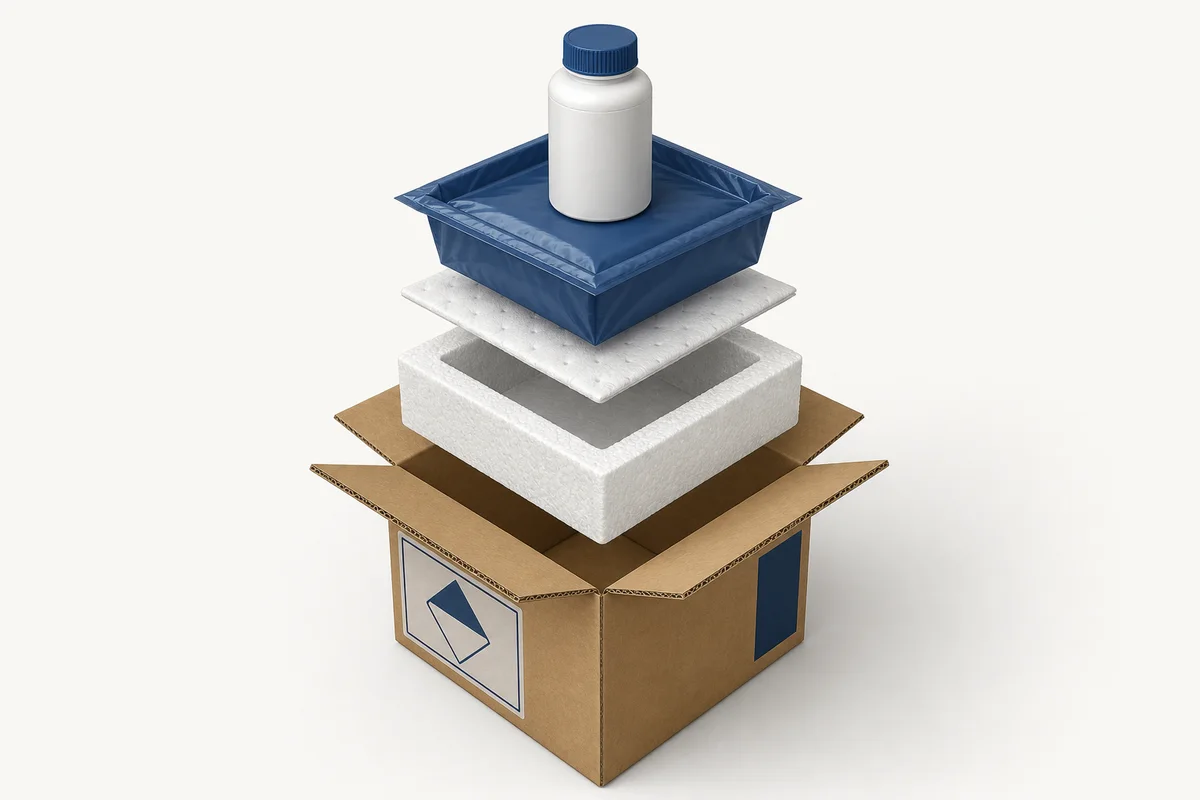
Exploded view of a protected inner receptacle, secondary containment, cushioning, and rigid corrugated outer carton
The illustration shows layered protection only. Receptacle material, absorbency, quantity limits, and specific markings must come from the applicable Packaging Instruction.

General USPS outer-packaging baselines

  • Unless a specific rule permits otherwise, use rigid outer packaging.
  • HAZMAT mailpieces at 20 lb or less generally require at least 200 lb burst strength or 32 ECT equivalent; over 20 lb generally requires at least 275 lb burst strength or 44 ECT equivalent.
  • Do not use USPS-produced Priority Mail or Priority Mail Express packaging for mailable hazardous materials.
  • Do not combine different hazard classes in one mailpiece unless Postal Service standards expressly allow it.
  • Liquids commonly require secure closures, sufficient absorbent/cushioning material, and orientation markings; follow the item-specific rule rather than this summary.

Step 4: mark the package and declare HAZMAT during label creation

Required markings belong on the address side (with limited adjacent-side allowance for certain DOT markings when space is insufficient), never on the bottom. They must be clear, durable, and resistant to rubbing or smearing. Except for specified exceptions, HAZMAT packages need a domestic return address plus all item-specific content, DOT hazard, orientation, or “Surface Transportation Only” markings required by the governing instruction.

Electronic declaration is not optional

When creating a USPS label, identify that the package contains hazardous material. Publication 52 section 323 requires the applicable three-digit HAZMAT Service Type Code (STC) in the Intelligent Mail package barcode (IMpb) or Intelligent Mail matrix barcode (IMmb) for domestic outbound and return packages, together with the required HAZMAT Extra Service Code (ESC) data. The mailer must verify that the platform-generated product, STC, ESC, barcode banner, and actual contents agree.

Separate STC from ESC: the STC identifies the USPS product/service and designates the package as HAZMAT; it is driven mainly by outbound versus return, mail product, weight tier, and purchased extra service. The ESC identifies the hazardous-material category. A lithium-battery ESC cannot replace the STC, and hazard class alone does not select the STC. Codes 810–832 are current USPS content-specific ESCs, not obsolete STCs.

How to select the correct HAZMAT STC

The safest method is not to guess from a code list. Answer six questions in order, and do not continue label creation until the preceding decision is resolved.

1Is the item mailable?Confirm material, quantity, Packaging Instruction, and destination
2Does the destination use a domestic STC?Handle APO/FPO/DPO, certain territories, and FAS exceptions separately
3Outbound or return?Enter the matching Publication 199 STC table
4Which USPS product is eligible?Establish air or surface eligibility first
5Which Ground Advantage weight tier?Up to 15.999 oz, or one pound and above
6Is a listed extra service purchased?Use the baseline STC, or the dedicated STC for the listed extra-service option
  1. First confirm that the destination uses a domestic STC. Domestic outbound and return packages generally require a HAZMAT STC. Section 323.2 excepts packages destined for APO/FPO/DPO locations, U.S. possessions, territories, and Freely Associated States, excluding Puerto Rico. Do not mechanically apply the domestic tables to those destinations; Puerto Rico is not part of that exception.
  2. Separate outbound from returns. Use the Domestic Outbound list for ordinary shipments and the Domestic Returns list for prepaid return labels. The codes are not interchangeable.
  3. Select the USPS product already approved by the mailability review. Priority Mail Express or Priority Mail may be used only when the HAZMAT qualifies for air transportation. Surface-only matter needs an authorized surface product. An STC cannot make an ineligible transportation mode compliant.
  4. For USPS Ground Advantage, apply the weight tier. Packages up to 15.999 ounces use different STCs from packages one pound or more. Do not select the tier from an incorrect rounding or display value.
  5. Check whether an eligible extra service was purchased. With no extra service, use the required baseline STC. For an eligible option such as Insurance, Signature Confirmation, or Adult Signature, use the dedicated STC listed for that product and option in Publication 199. Section 323.2 prohibits combining multiple extra services on HAZMAT mail. “Insurance Restricted Delivery” and “Adult Signature Over 21 Restricted Delivery” in the table are USPS-named options with dedicated STCs, not permission to assemble unrelated services.
  6. Perform a final check against the latest Publication 199. Publication 52 Appendix G says the STC list may change and directs mailers to Publication 199. The codes below were checked against Publication 199 Version 35 dated July 2, 2026, which contains some codes not yet displayed on the current Appendix G pages. A production system should not rely on a cached Appendix G list alone.

Domestic outbound: baseline STCs without an extra service

USPS productConditionSTC
Priority Mail ExpressSignature waived; HAZMAT must be air-eligible760
Priority MailUSPS Tracking; HAZMAT must be air-eligible116
USPS Ground AdvantageUp to 15.999 oz, USPS Tracking184
USPS Ground AdvantageOne pound or more, USPS Tracking362
Parcel SelectUSPS Tracking395

Stop label creation when the platform lacks the applicable STC: do not substitute an ordinary non-HAZMAT STC or remove the HAZMAT declaration to obtain a label. Confirm that the platform uses the current Publication 199, request an updated code mapping, or use a USPS labeling channel that supports the required product and service option.

Domestic outbound: dedicated STCs for eligible extra-service options

USPS productExtra service → STC
Priority Mail ExpressSignature requested → 761
Insurance → 762
Insurance Restricted Delivery → 763
Adult Signature Over 21 → 764
Adult Signature Over 21 Restricted Delivery → 665
Priority MailInsurance ≤ $500 → 120
Insurance > $500 → 323
Adult Signature Over 21 → 075
Signature Confirmation → 063
Adult Signature Over 21 Restricted Delivery → 121
USPS Ground Advantage, up to 15.999 ozInsurance ≤ $500 → 185
Insurance > $500 → 186
Signature Confirmation → 166
Adult Signature Over 21 → 220
USPS Ground Advantage, one pound or moreInsurance ≤ $500 → 363
Insurance > $500 → 365
Signature Confirmation → 383
Adult Signature Over 21 → 223
Parcel SelectInsurance ≤ $500 → 483
Insurance > $500 → 628
Signature Confirmation → 646

How common products relate to ESCs: follow the applicable provision, not the product name alone

The examples below explain code logic; they are not mailability rulings for a specific SKU. The same product may fall under a different provision because of formulation, concentration, quantity, packaging method, device condition, or transportation mode.

Example scenarioContent ESC when applicableWhat still determines the STC
Ethanol fragrance or hand sanitizer specifically authorized as air-eligible810Priority Mail Express or Priority Mail product and extra service
Perfume, nail polish, hand sanitizer, aerosol, or paint moving under a ground Limited Quantity provision831Ground Advantage weight tier, Parcel Select, and extra service
A package declared under the Class 3 flammable-liquid category rather than the ground Limited Quantity provision812Eligible USPS product, weight, and extra service
New standalone or spare lithium batteries marked UN3480/UN3090 and restricted to surface transportation816Ground Advantage weight tier or Parcel Select and extra service
Return of a used electronic device with lithium batteries when a lithium-battery marking is required817Return product, weight tier, and insurance extra service
New equipment packed with lithium batteries and requiring a UN3481/UN3091 marking818Outbound or return, product, weight, and extra service
Eligible new equipment containing or packed with lithium batteries when no lithium-battery marking is required820Transportation mode, USPS product, weight, and extra service
Dry ice used as refrigerant for eligible contents819Air or surface eligibility, USPS product, and extra service
A sealed lead-acid battery meeting the nonspillable wet-battery provision815Eligible product, weight, and extra service

The same ESC can accompany different STCs: for example, a new spare-lithium-battery package using ESC 816 has baseline STC 184 when sent outbound by Ground Advantage at 12 ounces, baseline STC 362 at 2 pounds, or STC 383 at 2 pounds with Signature Confirmation. The HAZMAT category did not change; the USPS product/service combination did.

Domestic return STCs

Return product or conditionBaseline STCInsurance STC
USPS Ground Advantage Returns, up to 15.999 oz187≤ $500: 190
> $500: 191
USPS Ground Advantage Returns, one pound or more385≤ $500: 388
> $500: 399
Priority Mail Return Service037≤ $500: 515
> $500: 517
Division 6.2 HAZMAT: Ground Advantage Returns, up to 15.999 oz217—
Division 6.2 HAZMAT: Ground Advantage Returns, one pound or more218—
Division 6.2 HAZMAT: Priority Mail Return Service219—
Division 6.2 HAZMAT: Priority Mail Express Return, signature waived667—
Division 6.2 HAZMAT: Priority Mail Express Return668—

Four examples that test the selection logic

ScenarioCorrect STCWhy
Domestic outbound, Ground Advantage, 12 oz, no extra service184Outbound + up to 15.999 oz + baseline Tracking code
Domestic outbound, Ground Advantage, 2 lb, Signature Confirmation purchased383Use the dedicated one-pound-or-more Signature Confirmation STC, not baseline 362
Domestic outbound, Priority Mail, $300 insurance, contents air-eligible120Priority Mail + insurance at or below $500
Domestic return, Ground Advantage Returns, 2 lb, no insurance extra service385It is a return rather than outbound and falls in the one-pound-or-more tier

After the STC, select the ESC

All shipments containing HAZMAT or dangerous goods must provide generic ESC 857. Domestic outbound and return mailers may also use the content-specific ESC that matches the actual material, a practice USPS currently recommends. Section 323.3 permits omission of 857 only when a content-specific ESC is used and the package record does not have enough ESC fields. In a normal implementation, send 857 and the matching content-specific ESC rather than treating them as freely interchangeable.

ESCHAZMAT categoryESCHAZMAT category
810Air-eligible ethanol package822Division 4.1 flammable solids or safety matches
811Class 1 toy propellant or safety fuse823Division 5.1 oxidizers
812Class 3 flammable liquid824Division 5.2 organic peroxides
813Class 7 radioactive materials825Division 6.1 toxic materials
814Class 8 corrosive materials826Division 6.2 infectious substances
815Class 8 nonspillable wet battery827Excepted Quantity Provision
816Class 9 lithium battery, marked, ground only828Ground-only HAZMAT not otherwise listed
817Class 9 lithium-battery return829ID8000 consumer commodity
818Class 9 lithium batteries, marked830Authorized lighters
819Class 9 dry ice831Limited Quantity, ground
820Class 9 lithium batteries, unmarked832Small Quantity Provision
821Class 9 magnetized materials——

International and APO/FPO/DPO dangerous-goods eligibility is very limited. For an item that is actually permitted, Appendix G also requires the applicable content code in the Shipping Service File: 813 for Class 7 radioactive material, 820 for an unmarked lithium-battery package with the batteries installed in the equipment, or 826 for Division 6.2 infectious substances; generic ESC 857 still applies. Finding an ESC does not establish international mailability or destination acceptance.

For domestic HAZMAT shipped through PC Postage or USPS Ship, commercial label systems must transmit the applicable STC/ESC in a Shipping Services File Version 1.7 or higher, or Shipping Partner Event File Version 5.0 or higher, before or concurrent with tender. When legacy postage meters or hard-copy postage statements are used, present the HAZMAT shipment directly at a USPS retail or business mail entry unit.

Shipping documentation is separate from the mailing label

Most air HAZMAT and certain surface HAZMAT require shipping documentation. Domestic surface shipments generally use a shipping paper that meets Publication 52 section 326, while air shipments generally use a Shipper’s Declaration for Dangerous Goods. Except for sharps waste and regulated medical waste, which follow specialized rules, the documents are generally completed and signed in triplicate by the mailer, enclosed in an envelope or similar carrier that can be easily opened and resealed, and securely affixed to the package exterior for inspection access. The exact requirement, contents, and attachment method still come from 49 CFR, section 326, and the applicable Packaging Instruction. Creating a USPS label does not by itself remove the shipping-document requirement.
Step 5: tender separately and retain compliance records

For mailable HAZMAT that requires a label or marking, do not mix the completed pieces into an ordinary parcel cart or sack. Except for specified destination-entry situations, containers, pallets, or other mail transport equipment holding those pieces must be separate from non-HAZMAT mail and clearly marked “HAZMAT” on an exterior side. Tender at an eligible Post Office or use a supported Click-N-Ship and pickup workflow.

Ten checks before sealing and tender

  • Actual product, formulation, and device condition match the approved SKU record.
  • SDS, UN/NA ID, hazard class, and applicable Packaging Instruction are current.
  • Inner-receptacle quantity, per-container capacity, total package quantity, and packing group limits are met.
  • Closures, absorbency, cushioning, terminal protection, venting, or pressure-test requirements are complete.
  • Outer-carton strength, dimensions, and removal of obsolete markings are compliant.
  • Return address, orientation arrows, LTD QTY, lithium-battery, and other required markings are correct on the address side.
  • The selected USPS product agrees with air or surface eligibility.
  • The STC exactly matches outbound/return, product, weight tier, and extra service.
  • ESC 857, content-specific ESC, electronic file, and required shipping documentation are complete.
  • When a HAZMAT label or marking is required, the pieces are separated from ordinary mail and the exterior tender receptacle is clearly marked “HAZMAT.”

Recommended audit records

  • SDS, manufacturer transportation guidance, HAZMAT Search Tool result, and the applicable Packaging Instruction revision.
  • SKU classification decision, approved USPS service, package specification, quantity limits, and label-field mapping.
  • Finished-package photos, label/marking photos, weight record, tender manifest, and operator training record.

With an approved SKU-level template, the warehouse can verify that product revision, quantity, packaging, and destination remain unchanged. Reclassify whenever formulation, battery, supplier, package specification, or transport lane changes—do not inherit an old decision.

The USPS HAZMAT mailing workflow at a glance

#ActionPass condition
1Identify the productSDS, UN/NA ID, hazard class, quantity, and critical properties are known
2Check mailabilityItem is not prohibited and the current Packaging Instruction is identified
3Select mode and serviceAir eligibility, surface restrictions, and destination all match
4Package and markInner packaging, quantity, cushioning/absorbency, outer box, and markings pass
5Declare and labelHAZMAT declaration, STC/ESC, barcode, service, and documents are correct
6Tender separately and archiveHAZMAT receptacle is marked and records are traceable

Five worked mailing cases: from product review to STC, ESC, and tender

These cases demonstrate the operating path; they are not mailability rulings for a real SKU. The code selection can match only when the SDS, actual quantity, device condition, destination, and applicable Packaging Instruction match the assumptions. Recheck whenever a condition changes.

Case 1

12 oz ground Limited Quantity fragrance, no extra service

Assumptions: The SDS confirms a Class 3 flammable liquid that qualifies for a domestic surface Limited Quantity provision; total billable package weight is 12 oz; no signature or insurance service is purchased.

  1. Select USPS Ground Advantage; do not switch to an air product merely because Priority Mail is faster.
  2. Follow the applicable Packaging Instruction for inner receptacles, secure closures, absorbency/cushioning, rigid outer packaging, orientation marks, and the ground Limited Quantity mark.
  3. Declare HAZMAT during label creation, use baseline STC 184, and transmit generic ESC 857 plus content ESC 831.

Fee result: The HAZMAT Handling Fee applies beginning July 12, 2026; current Notice 123 lists $0.00 for Ground Advantage.

Case 2

2 lb new spare-lithium-battery package with Signature Confirmation

Assumptions: The batteries are new standalone or spare batteries whose ratings and count meet the domestic surface Packaging Instruction; a UN3480 or UN3090 lithium-battery mark is required; the package weighs 2 lb and Signature Confirmation is purchased.

  1. Use an authorized surface product and complete terminal insulation, short-circuit protection, movement prevention, and rigid outer packaging.
  2. Apply the applicable lithium-battery mark and surface-only wording on the address side; do not use Priority Mail.
  3. For Ground Advantage at one pound or more with Signature Confirmation, use dedicated STC 383 and transmit ESCs 857 and 816.

Key point: Do not retain baseline STC 362; Signature Confirmation changes the USPS product/service combination.

Case 3

Consumer return of a used phone with an intact battery

Assumptions: The phone is used, its installed lithium battery is not swollen, damaged, overheated, or recalled, the applicable rule requires a lithium-battery mark, the return weighs 2 lb, and no additional insurance is purchased.

  1. Use USPS Ground Advantage Returns; a used lithium-powered device must not be treated as an ordinary air return.
  2. Power the device off, prevent accidental activation, immobilize it in rigid outer packaging, and apply “Restricted Electronic Device” and “Surface Transportation Only” when required.
  3. The baseline STC for Ground Advantage Returns at one pound or more is 385; transmit ESC 857 and lithium-battery-return ESC 817.

Key point: Outbound code 362 cannot replace the return code, and device condition must be confirmed before creating the return label.

Case 4

Food refrigerated with dry ice and verified as Priority Mail air-eligible

Assumptions: The food contents and net dry-ice quantity meet domestic air limits and the applicable Packaging Instruction, the package permits carbon-dioxide gas release, and no extra service is purchased.

  1. Complete leak prevention, cushioning, venting, net dry-ice quantity and other applicable markings, and attach air HAZMAT shipping documentation when required.
  2. Select Priority Mail, use baseline HAZMAT STC 116, and transmit ESC 857 plus dry-ice ESC 819.
  3. Tender the HAZMAT package separately from ordinary mail and retain weight, packaging, and shipping-document records.

Fee result: Beginning July 12, 2026, the Priority Mail HAZMAT Handling Fee is $7.50 per piece and is nonrefundable after network entry.

Case 5: Stop

The phone battery is swollen or manufacturer-recalled

Decision: This is not an ordinary used-phone surface return. Swelling may indicate a damaged or defective battery. Damaged, defective, or recalled lithium batteries are generally prohibited unless specifically approved by the USPS director of Product Classification.

  1. Do not create an STC and do not use ESC 817 to present it as an ordinary used-device return.
  2. Isolate the item, escalate it to compliance or safety personnel, and contact the manufacturer or an authorized hazardous-waste/dangerous-goods channel.
  3. Do not bypass the restriction by clearing the HAZMAT selection, using an ordinary label, or removing markings.

Key point: Sometimes the correct outcome is not a code—it is stopping the item from entering the USPS mailstream.

Handling fees, noncompliance fees, and legal penalties beginning July 12, 2026

Distinguish three different costs: the HAZMAT Handling Fee and $50 noncompliance fee are USPS product and compliance charges; the current statutory range of $393 to $156,422 applies to serious HAZMAT mailing violations and is not an ordinary postage add-on. The handling fee applies to compliant pieces using the relevant product, while the noncompliance fee addresses data, barcode, or marking failures on applicable commercial pieces.

ItemScopeCurrent amountWhen it applies
HAZMAT Handling FeeDomestic retail and commercial HAZMAT pieces using Priority Mail Express, Priority Mail, USPS Ground Advantage, Parcel Select, and USPS ReturnsPriority Mail Express: $7.50
Priority Mail: $7.50
Ground Advantage: $0.00
Parcel Select: $0.00
Assessed at mailing and nonrefundable after network entry. Amounts are those currently listed in Notice 123 effective July 12, 2026; for returns, verify the current price listing for the actual return product used.
HAZMAT Noncompliance FeeApplicable domestic commercial-priced HAZMAT packages50 USD per pieceAssessed through Census and Automated Package Verification when the HAZMAT STC, service icon, barcode banner text, or DOT markings are incorrect, missing, or mismatched.
Statutory civil penaltyKnowingly mailing nonmailable HAZMAT or failing to follow postal laws governing HAZMAT393–156,422 USD per violationCurrent amounts are stated in the USPS regulation at 39 CFR § 233.12; cleanup costs, damages, and criminal exposure may also apply. Penalty amounts may be adjusted again.

What the $50 fee validations examine

USPS sets a 100-percent quality threshold for the “Hazmat Quality” compliance category. Its eight validations cover conflicts between HAZMAT symbols or indicators and non-HAZMAT STCs, improper HAZMAT STCs or service icons for Military/PTFAS destinations, the HAZMAT STC, service icon, barcode banner text, and DOT markings. Failure of any validation can cause the applicable commercial piece to incur the HAZMAT Noncompliance Fee.

Some charges can stack: if a commercial HAZMAT package is noncompliant and also lacks the applicable HAZMAT Handling Fee, the USPS industry notice states that both the handling and $50 noncompliance fees may be assessed. Between the HAZMAT Noncompliance Fee and the ordinary Package Quality Noncompliance Fee, USPS applies the higher fee rather than both.

Seven frequent failure points

  1. Using a marketing name instead of the proper shipping name, or mailing without an SDS.
  2. Stopping at “mailable” without determining air versus surface eligibility.
  3. Treating used, damaged, and new-in-original-packaging lithium devices as the same scenario.
  4. Packaging correctly but failing to select HAZMAT during label creation, producing the wrong barcode or service type.
  5. Using free USPS Priority Mail packaging for HAZMAT.
  6. Reusing a carton with obsolete HAZMAT, alcohol, or battery markings that were not completely removed.
  7. Mixing HAZMAT packages into the ordinary-mail receptacle at tender.

Frequently asked questions

Is a USPS HAZMAT STC selected by hazard class?

No. The STC is driven mainly by domestic outbound versus return, USPS product, Ground Advantage weight tier, and the purchased extra service. Hazard category is represented by ESC 857 and, for domestic mail, content-specific ESCs 810–832. Establish mailability and mode first, then select the STC from the current Publication 199.

Can I keep the baseline HAZMAT STC after buying insurance or signature service?

No. When an eligible extra service is purchased, use the dedicated STC that identifies the USPS product, that service option, and HAZMAT. For example, a Ground Advantage HAZMAT package at one pound or more with Signature Confirmation uses 383, not baseline 362. Do not combine multiple extra services on HAZMAT mail; a USPS-named option such as Insurance Restricted Delivery must use the single dedicated STC listed in Publication 199.

Why can the same hazardous material use different STCs?

Because the STC identifies the USPS product/service combination, not just the hazard category. The same lithium-battery package may move from 184 to 362 because of weight, or to 383 because Signature Confirmation was purchased, while its content ESC remains unchanged.

What if my label platform does not offer the applicable HAZMAT STC?

Stop label creation. Do not substitute an ordinary STC or remove the HAZMAT declaration. Confirm the platform’s Publication 199 version and mappings, request an update, or use a USPS label channel that supports the required product, extra service, and HAZMAT combination.

Will every HAZMAT package be charged $50 beginning July 12, 2026?

No. A compliant HAZMAT package is subject to the product's HAZMAT Handling Fee, currently $7.50 for Priority Mail Express and Priority Mail and $0.00 for Ground Advantage and Parcel Select. The $50 HAZMAT Noncompliance Fee applies per applicable domestic commercial piece when the STC, service icon, barcode banner text, or DOT markings are incorrect, missing, or mismatched.

Can USPS Ground Advantage ship every hazardous material?

No. Ground Advantage is a surface product; it does not make prohibited matter mailable. The material, quantity, packaging, markings, destination, and applicable Packaging Instruction must all permit the shipment.

Can perfume or hand sanitizer go by Priority Mail?

Alcohol-based perfume and most hand sanitizer are flammable and are generally limited to domestic surface transportation. Priority Mail cannot be selected merely because it is faster. Actual flash point, concentration, quantity, and the Packaging Instruction control.

Are lithium batteries in phones and laptops always HAZMAT?

Lithium batteries are regulated, but packaging, marking, and transport mode depend on chemistry, Wh/lithium content, count, installed status, and whether the device is new, used, damaged, or defective. “Installed in equipment” alone does not establish air eligibility.

Can a handwritten marking fix a label created without HAZMAT selected?

Generally no. HAZMAT requires the correct electronic declaration, STC/ESC, barcode, service type, and package markings. Void the incorrect label and recreate it for the actual contents instead of relying on handwritten text.

Can USPS pick up a HAZMAT package?

The USPS HAZMAT Search Tool says a pickup may be scheduled through a supported Click-N-Ship workflow after all Packaging Instructions are met. HAZMAT must still be separated from ordinary packages and the tender receptacle marked “HAZMAT” as required.

Where can I get a final decision for a specific product?

Start with the SDS, manufacturer transportation data, and HAZMAT Search Tool. If ambiguity remains, seek a USPS mailability ruling or a dangerous-goods specialist familiar with 49 CFR and Publication 52. Do not test-mail an item with incomplete data.

Turn HAZMAT rules into a controlled workflow, not tribal knowledge

Create an approved service, packaging, marking, and label template for each hazardous SKU, then train operators to execute the current revision. When rules change, update the template and retrain to reduce wrong-service selection, undeclared HAZMAT, and tender errors.