Influencer Gifting Fulfillment

Influencer Gifting Fulfillment: When to Pack PR Kits and What Each Delivery Costs

“Can we get 200 boxes out today?” On Friday, December 4, a fictional clothing brand brings its US creator gifting list to its 3PL. Of 200 invitees, 140 claimed a crewneck. Eight still need to confirm a size, and 60 have yet to claim. At most 132 original kits can be released today. Fewer will ship if the warehouse misses the carrier cutoff.

It is possible to stage blank boxes, common cards and inserts for up to 200 kits. For today’s run, bring the common materials for the 132 ready orders to the bench and pack each one with its confirmed SKU. Keep the eight incomplete claims on hold. At 5 p.m. Pacific on Tuesday, December 8, use the actual handoff and delivery records for the campaign cost review.

Compare assembly labor · Calculate cost per delivery · Open the release sheet

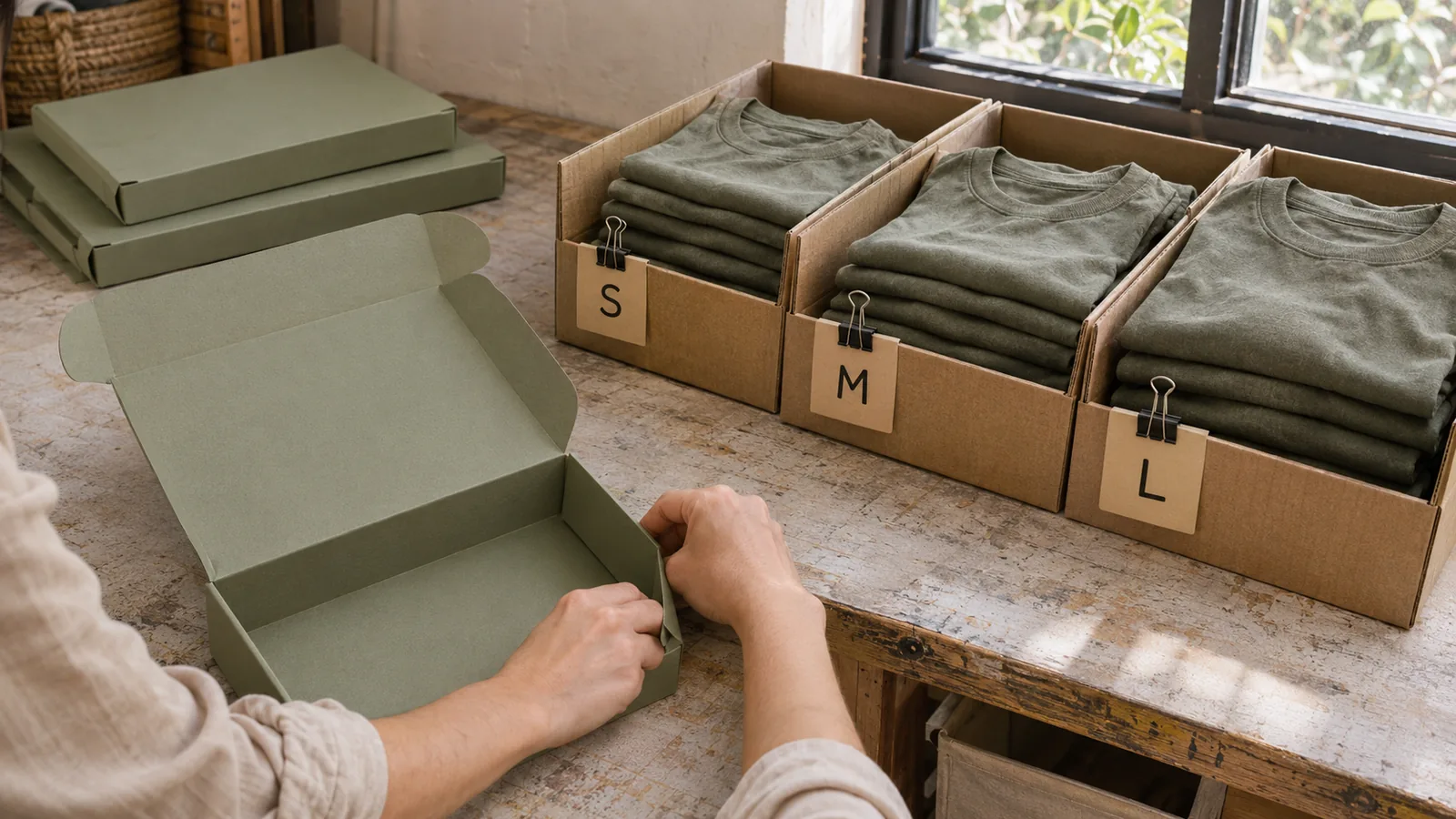
A packer folds an empty gift box beside three separate bins of folded shirts marked S, M and L.
Fold empty gift boxes ahead of time. The shirt goes into the box once the recipient’s size is confirmed.

Which of the 200 invitations can become warehouse orders?

Open the KIT-26 claim list and filter for an accepted gift, a confirmed size and address, and stock at the shipping warehouse. The resulting 132 rows are the starting pick list. Give the campaign contact a second view with the eight claims that need a size. Leave the 60 unclaimed invitations in the outreach list, where a reminder cannot accidentally generate a label.
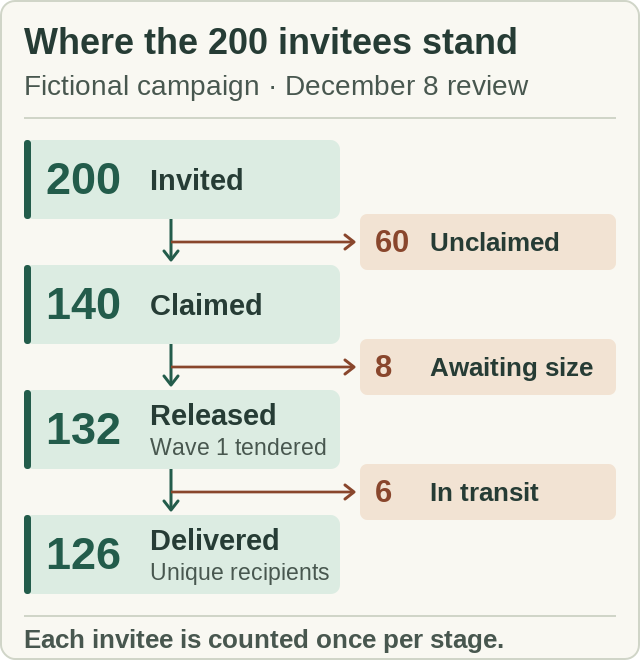
Fictional December 8 review. Of 200 invitees, 140 claimed, leaving 60 unclaimed. Of the claimants, 132 were released and tendered in the first wave and 8 await size confirmation. Of the 132 tendered, tracking shows delivery for 126 distinct recipients, and the other 6 shipments are still in transit.
At the December 8 review, 60 invitees had yet to claim, eight claimants still needed to confirm a size, and six first-wave parcels were in transit. Delivery was confirmed for 126 distinct recipients.

A claim is the creator saying yes. A warehouse order is the brand telling a particular location which physical item it may send, to whom, and under what conditions. Keep a campaign record even for a claim that can't go to the warehouse yet. When C041 replies with a size, someone should be able to find the original request, check stock in that size and release it once. Otherwise a second request can reach the bench while the first one is still waiting for an answer.

How would the same gift reach a 3PL from Collabs or a spreadsheet?

Take C017, who has confirmed a navy crewneck in size M and a residential address. Use the route the brand has agreed with the warehouse to authorize this one gift.

How one C017 claim becomes one original shipment
StepShopify Collabs product giftBrand-authorized list
Offer and claimThe brand offers one physical crewneck to a creator connection. C017 claims the gift and chooses navy M from the permitted variants.The brand records C017’s acceptance, chosen size and color, and the address confirmed for this campaign.
Authorize fulfillmentThe claim creates an order in Shopify admin. The brand checks the variant, address, assigned location and fulfillment status, then uses its configured route to the 3PL.A named brand approver releases one row for KIT-26 / C017 with SKU CREW-NV-M, quantity one, the confirmed address and the delivery requirement.
Confirm one warehouse orderThe warehouse locates the imported order, returns its reference WH-017 and matches its one pick line to C017.The warehouse acknowledges the approved row and returns WH-017. Resubmitting the same claim should resolve to that existing original.
Ship the physical giftCheck CREW-NV-M, seal and weigh parcel P-017, and link its actual carrier handoff to WH-017 and the original KIT-26 claim.

Shopify identifies a free product, a percentage discount code and a fixed-amount discount code as separate gift options. For a product, the merchant can limit the variant choices or let the creator choose. Shopify says that a claimed gift produces an order in the merchant’s admin and that shipping is free to the creator. The brand still needs a way to pay for postage and a working connection from that order to the correct warehouse. Check the Shopify order before asking the creator to claim again. Shopify Help Center on offering and sending creator gifts.

On a manual list, put the approver and release time beside the order instructions. Keep address details where only the people preparing and shipping the gift need them. The campaign team can work with C017, the garment and the delivery requirement. The packer needs the final deliverable address, including an apartment or box number where applicable. A previous campaign's shipping file can help someone find a record. The address that governs this shipment is the one the recipient confirmed for KIT-26. For collecting and checking many individual destinations, see the multiple-address gift shipping guide.

Can one free gift get through once, even when it appears on two lists?

Run two small tests before releasing the batch. First, send an authorized zero-dollar test order through the intended route to a test queue or agreed warehouse hold. Find the reference on both sides. Ask the warehouse to read back the location, SKU, quantity and recipient reference, then verify that it can return the shipping status to the campaign owner. A connector that imports paid storefront sales may filter out a free order. If the test is missing, check the routing and filters with the person who manages that feed before sending a second instruction.

Next, present the same test claim through the shop route and the manual list. Agree that KIT-26 plus the original claim reference identifies this gift across both sources. The expected result is one authorized pick and one warehouse reference. If two picks appear, pause both, agree which record will fulfill, and mark the other as a duplicate linked to it before a label is issued. If a second creator lives at the same address, their own approved claim can still be valid. An address match alone cannot tell a duplicate from two intended gifts.

Release both test reservations after the checks. Exclude test orders from handoff and campaign totals. For the real wave, subtotal each variant against available stock at the assigned location. Units reserved for paying orders or awaiting inspection cannot cover a missing size. Send the approved 132 to the warehouse and the eight incomplete claims to the campaign contact for follow-up.
How many PR kits should the crew prepare before all the sizes are in?

Stage blank materials for all 200 invitations. For today’s 132 verified orders, fold 132 generic boxes and lay out the common inserts. Add each garment, personal card and final label after the approved pick line is visible and the correct variant is reserved. Up to 132 originals can leave this wave if the warehouse meets its packing and carrier cutoffs.

At what claim count does the lower assembly rate actually win?

Ask for two assembly-only prices covering comparable work. In this teaching example the warehouse quotes $2.10 each to assemble all 200 in advance, or $3.00 per kit assembled against a claim. The advance job costs $420 as soon as the crew completes it. On the second quote, the bill depends on the final number actually assembled. For this comparison, let n be the number of claims that ultimately become kits. A missing size keeps a claim out of today's work even if it will count in the final campaign total.

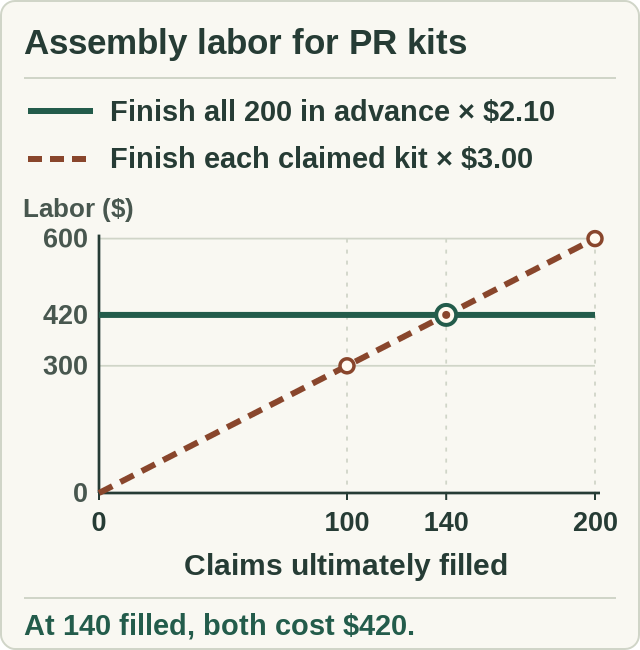
Assembly labor only. Finishing all 200 kits in advance at $2.10 each costs $420. Finishing kits for claims at $3 each costs $3 times the number of claims ultimately filled. At 100 claims that is $300, at 140 claims both options cost $420, and at 200 claims the per-claim option costs $600. Illustrative costs in dollars.
The lines show assembly labor only. At $3 per claim, 100 finished kits cost $300 and 200 cost $600. Finishing all 200 in advance costs $420. The lines meet when 140 claims ultimately become finished kits.
Illustrative assembly labor in US dollars at three final volumes
Final kits assembled against claimsBuild all 200 up frontBuild to claimsAssembly labor difference
100200 × $2.10 = $420100 × $3 = $300Building to claims costs $120 less.
140$420140 × $3 = $420The two labor bills are equal.
200$420200 × $3 = $600The advance run costs $180 less if all 200 kits are needed and correctly assembled.

The break-even point is $420 divided by $3, or 140 completed kits. Above 140, advance assembly costs less on labor alone. At 140, no labor savings pay for storing the 60 extra finished boxes. The 100-kit case tests a different campaign’s lower response. KIT-26 already has 140 acceptances, but eight more sizes and their stock must be confirmed before the warehouse can complete all 140.

Leave product value, box and insert materials, storage, postage, rework and replacement shipments outside this comparison. If the advance quote includes a generic insert but the claim-based quote includes printing and matching a personal note, ask the warehouse to price the same set of actions. Splitting generic preparation from final assembly is a third option. It needs its own price, including a second handling step where applicable. The two quoted unit rates don't tell you what the warehouse would charge for that split.

What can come back into stock if a creator changes size?

Look at one finished kit before approving the advance run. An unmarked empty shipper and a common insert can go to the next person. A pristine crewneck in its original sleeve may be available for another order once inventory control releases it. A printed C017 note has one intended reader. Tissue sealed with a campaign sticker can tear when someone opens the box to check the size. Put these parts on separate lines in the pack instruction so a later shift can see which work it can reuse and which work it must redo.

If a creator switches from M to L after packing, have the warehouse check the L stock before releasing the M reservation. Return the M to available stock if its condition permits, record any spoiled card or carton at materials cost, and log the extra handling. Record how many units were held away from regular orders and for how long if popular sizes ran short. An unworn, undamaged garment returned to stock has not cost the brand its full retail price in write-offs. A size change after carrier handoff may instead require an authorized second shipment.

For KIT-26, keep the 68 unused sets of blank materials flat after the first 132 boxes are prepared. Keep the eight missing-size claims in the follow-up queue and the 60 unclaimed gifts on the invitation list. Guessing the eight sizes would create apparent demand for particular variants. If there is only one navy M on the shelf, a guess could use the unit reserved for C017. When a size arrives, recheck that variant at the shipping location, add that creator to the next approved wave, and then print the personal insert.

Give the packer an example they can inspect without breaking a finished kit. Show where the crewneck's size label should face, which side of the card should be visible when the box opens, and when the recipient code is checked. For an individually named card, compare it with the pick line while the box is open. If the names or codes differ, hold the affected box where it can be corrected. Everyone else’s kit can continue. For a longer production run, the kitting and fulfillment guide covers how to organize that repeatable assembly work.

Which creator actually needs a faster delivery service?

Start the service comparison with two identically packed navy M crewnecks. Each sealed parcel measures 12 × 9 × 3 inches and weighs 20 ounces, including the garment, gift box, card, tissue and shipping carton. Both leave from ZIP 90021. The first planned carrier handoff is Friday, December 4, 2026, before the participating location's cutoff for the selected service. These are fictional planning inputs. Take them to the accounts and services available at the actual warehouse to obtain eligible options, current prices and delivery dates.

Creator and destinationWhen is the garment needed?Service decision
C017 · residential · 10001In hand by Wednesday, December 9, for preparation on December 10 and a shoot on December 11.Hypothetical estimates with December 4 tender: standard December 9–11, faster December 8–9. Choose the faster option if the warehouse validates the route, deadline and approval.
C064 · ordinary USPS PO Box · 10002Flexible arrival agreed by Tuesday, December 15. No posting or shoot commitment. Allow the day after receipt for a try-on before any separately arranged activity.Start with an eligible tracked service that accepts the PO Box. Check likely pickup timing before spending money to upgrade.

Will the garment be in C017’s hands in time to prepare?

“Shoot on the 11th” leaves out a day. C017 needs the navy M on December 9 to steam it, check fit and coordinate the look on December 10. In the hypothetical comparison above, the standard window extends to the shoot date itself. The faster window ends on the 9th. Choose that option if the current route check supports it and the lead approves the price. An estimate at the edge of the window leaves little time to fix a wrong item or a building-access problem.

Use the actual ship date, origin, destination, packed dimensions and weight in each comparison. Record the service name, estimated arrival day or stated commitment, account price, and latest local acceptance time. Note any conditions relevant to that address. If the standard option supports the agreed margin, authorize it. If only the faster eligible option does, put its price difference and the last handoff time in front of the person who can approve the upgrade. When neither option works, call the campaign lead while there is time to arrange another plan with the creator.

A 3PL can print a label on Friday and still miss the last collection. Get the warehouse's own packing deadline as well as the carrier's acceptance cutoff. If the carton will miss one of them, change the tender date in the service comparison and obtain a fresh estimate. Do that before telling C017 to expect the garment on Wednesday. In the shipping record, retain the actual carrier handoff evidence and the next tracking check. For a shoot with a firm preparation day, ask the campaign contact to confirm that the garment reached the person who needs it.

What changes when C064 gives an ordinary PO Box?

The two destination ZIPs look close together on the quote screen. Their address types still change the usable services. For C064, specify the ordinary USPS PO Box when looking up options. As of November 25, 2026, USPS describes Priority Mail Express as available to most US addresses and PO Boxes, with conditions, and lists USPS Ground Advantage as a tracked standard service with expected delivery times. Compare a standard PO Box-eligible option for the specific route before requesting a premium service. The national delivery ranges alone cannot establish an arrival date for KIT-26. USPS domestic mail and shipping service comparison.

If the parcel exceeds the space in a PO Box, USPS describes collection from a parcel locker or at the counter during business hours. A counter notice on the agreed arrival day can still leave C064 without the garment that evening. Find out when the creator can collect it. Some postal facilities offer Street Addressing for deliveries from other carriers, subject to availability and restrictions. Use that arrangement only if the creator confirms it and provides the applicable address. Simply replacing “PO Box” with the street address of the post office gives the warehouse no evidence that the service will work. USPS on larger parcels, pickup and Street Addressing.

C064 agreed to receive the gift by December 15. If they collect it that day, keep the 16th for a try-on before any separately arranged activity. No shoot or post is due. Choose the eligible standard service when the estimate and pickup window fit. If a missed handoff puts the date at risk, revisit the options with C064 and the campaign lead.

What did each shipped kit and each delivered gift cost?

Freeze the shipment list and the expense list at the same time. Use Tuesday, December 8, 2026, at 5:00 p.m. Pacific time for the KIT-26 example. By then the warehouse has tendered 132 original parcels. Tracking shows delivery for 126 distinct creator gifts and six originals still in transit. The eight incomplete claims and 60 unclaimed offers have no original parcel. Four kits needed corrections before tender. The warehouse has recorded the extra work, and no second parcel has gone out by this cutoff. All amounts below are fictional US dollars.

What was the direct fulfillment cost per original shipment?

Cost recorded through the cutoffBasisCampaign amount
Gift product132 crewnecks × $12 at product cost$1,584
Packaging132 kits × $2 for the gift box, card and outer packaging actually used$264
Original assembly labor132 kits × $3 actual labor per kit in this example$396
Outbound postageActual postage on the 132 originals, including selective service upgrades$924
Additional pre-tender workFour corrections × $6 accrued, no extra postage$24
Two costs at the same cutoff, December 8, 2026, at 5 p.m. Pacific
MeasureWarehouse cost per parcel shippedCampaign cost per creator with delivery recorded
Numerator$1,608 for packaging, labor, postage and rework$3,192 including garment cost
Denominator132 original parcels handed to the carrier126 distinct creators with a recorded delivery
Result$1,608 ÷ 132 = $12.18$3,192 ÷ 126 = $25.33
UseCompare the cost of packing and shipping the waveTrack campaign spending against creators reached to date

The direct fulfillment bill for the originals is $264 + $396 + $924 + $24 = $1,608. Divide by 132 original parcels tendered to get $12.18 per shipped kit, rounded to cents. That figure answers a warehouse question about materials, labor, postage and corrections. It excludes the crewneck itself. Even a zero-dollar gift uses materials, labor and postage. Charge extra correction work only where it occurred. The unused flat materials remain in stock. The $396 covers routine folding and filling for all 132 kits in this example. The $420 advance-run quote belonged to a planning comparison and adds no expense to this ledger.

Use the warehouse's handoff log for the 132. Printed labels sitting at the bench, voided labels and an accidental second export can all inflate a label count. For postage, use the amount associated with the parcels actually tendered, then reconcile later credits or adjustments to the same campaign. The $924 already includes the upgrades that the lead authorized. Adding an “expedite” allowance on top would count part of that spend twice. Likewise, the four corrected kits still traveled in the original 132 parcels. They contribute $24 of extra work and zero additional parcel count.

How much has the brand spent for each creator reached by the cutoff?

Add the product cost to get $1,608 + $1,584 = $3,192 for the five cost lines in this example. Use a different denominator for the delivery question. There are 126 unique gifts with a recorded delivery, so the result is $3,192 ÷ 126 = $25.33 per delivered gift. It measures the cost incurred so far against delivery evidence available so far. It includes the costs already incurred on the six gifts still traveling. Paid creator work, campaign management and other expenses beyond the five lines would need separate amounts if your budget includes them.

Counting all 140 people who claimed would give the brand credit for eight gifts it has yet to ship. Counting all 200 invitees would include 60 people who haven't accepted. Dividing the same $3,192 by 132 gives $24.18. That will be the cost per delivered gift if all six in transit deliver and no further cost is incurred. At 5:00 p.m. on December 8, $24.18 is a projection. A report sent that evening should show $25.33 with the 126 delivered and six still traveling beside it.

For the KIT-26 example, record delivery evidence against each original claim. Store the carrier tracking event and its date, and record a pickup or recipient confirmation separately when the activity depends on having the garment in hand. Keep a later report of damage or nonreceipt on the same gift record. A carrier delivery event can answer the accounting question defined here while the campaign manager still has a problem to solve. A photo, a fitting and a published post are different outcomes altogether. None enters the 126 simply because a creator accepted the invitation.

Consider what happens on December 9, after the report closes. C093 reports damage to the original parcel, which tracking already showed delivered by the December 8 cutoff. The brand reconfirms the navy L and delivery address, authorizes a replacement and gives the warehouse a separate reference, WH-R093, linked to the original claim. At authorization the warehouse has permission for a future reship. Record its additional garment, materials, labor and postage as incurred in the next reporting period. Keep the December 8 snapshot intact. When the replacement eventually arrives, the brand has served the same creator. It can report two physical shipments once both have been tendered, but only one unique gift recipient.

What should the campaign lead hand the warehouse before it closes the boxes?

Send an approved list naming the campaign, shipping warehouse, release version, cutoff and contact for exceptions. Retain each original claim reference through changes of size or address. Link it to the warehouse order, current parcel and any separately authorized replacement so the next shift can reconstruct what happened.

Fictional campaign KIT-26. At 5 p.m. Pacific on Dec 8, 132 original shipments comprised 126 delivered and 6 in transit. Eight other claimed kits, including C041, remained on hold. C093’s original parcel is included in the 126. These three sample rows were updated Dec 9. The authorized replacement has not shipped. Blank IDs have not been assigned.

Download the PR kit release sheet for Excel (.tsv)

C017 · Original order released
Campaign ID
KIT-26
Recipient alias
C017
Claim state
Claim accepted
Confirmed style, color, size and SKU
Crewneck / navy / M / CREW-NV-M
Address confirmation
Residential address confirmed
Latest needed arrival
2026-12-09
Warehouse order
WH-017
Parcel ID
P-017
Release decision
Original order released and tendered with the first wave. No new pick.
Exception owner
Brand operations if the recipient requests a change.
Linked original / reason
C041 · Size pending
Campaign ID
KIT-26
Recipient alias
C041
Claim state
Claim accepted. Size pending.
Confirmed style, color, size and SKU
Navy crewneck selected. Size and SKU pending.
Address confirmation
Address confirmed.
Latest needed arrival
Pending agreement
Warehouse order
Parcel ID
Release decision
Hold for size. Confirm the chosen size and match it to the warehouse SKU before release.
Exception owner
Brand operations follows up on size by the next release cutoff.
Linked original / reason
C093 · Damage replacement authorized
Campaign ID
KIT-26
Recipient alias
C093
Claim state
Original claim retained. Replacement authorized on Dec 9.
Confirmed style, color, size and SKU
Crewneck / navy / L / CREW-NV-L
Address confirmation
Recipient reconfirmed the original address and size on Dec 9.
Latest needed arrival
2026-12-15
Warehouse order
WH-R093
Parcel ID
Release decision
Replacement order authorized. Record its parcel ID once created. It has not shipped.
Exception owner
Brand operations owns the damage case. The warehouse records the new parcel when created.
Linked original / reason
Original WH-093 / P-093 was delivered by Dec 8. Recipient documented damage on Dec 9. Replacement stays on the original claim.
Copy the release sheet into Excel

Select the text below and paste it into cell A1. The download has the same eleven columns and three example records.

Campaign ID	Recipient alias	Claim state	Confirmed style, color, size and SKU	Address confirmation	Latest needed arrival	Warehouse order	Parcel ID	Release decision	Exception owner	Linked original / reason
KIT-26	C017	Claim accepted	Crewneck / navy / M / CREW-NV-M	Residential address confirmed	2026-12-09	WH-017	P-017	Original order released and tendered with the first wave. No new pick.	Brand operations if the recipient requests a change.	
KIT-26	C041	Claim accepted. Size pending.	Navy crewneck selected. Size and SKU pending.	Address confirmed.	Pending agreement			Hold for size. Confirm the chosen size and match it to the warehouse SKU before release.	Brand operations follows up on size by the next release cutoff.	
KIT-26	C093	Original claim retained. Replacement authorized on Dec 9.	Crewneck / navy / L / CREW-NV-L	Recipient reconfirmed the original address and size on Dec 9.	2026-12-15	WH-R093		Replacement order authorized. Record its parcel ID once created. It has not shipped.	Brand operations owns the damage case. The warehouse records the new parcel when created.	Original WH-093 / P-093 was delivered by Dec 8. Recipient documented damage on Dec 9. Replacement stays on the original claim.

At the December 4 handoff, schedule the next review for Monday, December 7, at 10 a.m. Pacific. The brand brings any size replies. The supervisor checks the actual variant stock and pickup cutoff for each cleared row. Keep unanswered claims on hold. Move an invitee onto this list only when a new claim arrives.

Which rows can the pack lead release, hold or reopen?

At original packout, match C017’s navy M and personal card to the order, then check the parcel against the selected service and label. If an apartment detail changes before handoff, have the warehouse acknowledge the revised address under the same order. The December 9 sheet retains WH-017 and P-017 as shipping history.

Keep C041 on hold while the campaign contact asks for the missing size. Leave the warehouse and parcel numbers blank. When the answer arrives, check stock and timing before adding C041 to a dated release.

Keep C093’s original tracking and damage report. Link the replacement approval, reconfirmed address and size to WH-R093. When the replacement leaves, enter the new parcel, postage and handoff time there. The creator gets a shipping update and the original claim stays traceable.

Ask the warehouse to return the accepted references and any holds before the next wave. Compare the names behind the total. A missing C017 and a duplicate for someone else could still add up to 132. Record who owns each unresolved row and when they will check again.

For the December 4 handoff, the campaign lead could write, “Please pick one approved SKU per released KIT-26 row. I’ll follow up on the eight missing sizes. Tell me how many can make this collection and return the parcel references after actual handoff. If a row looks duplicated, send me both references before picking another garment.”

Frequently asked questions

Stage the blank materials for 200. In KIT-26, prepare common parts for the 132 verified, stocked orders and add garments and personalized cards against those orders. Retain the other materials for later claims. At the example labor rates, a full advance run and 140 claim-based builds both cost $420.

Claiming a product gift creates an order in Shopify admin. The route to a specific warehouse depends on your configuration. Run a zero-dollar test through that route, match the variant and quantity at the warehouse, and verify the same claim on a manual list cannot generate a second pick.

Compare eligible services from the actual origin for the packed parcel and planned handoff. For C017, protect December 9 for receipt and December 10 for preparation before the shoot. For C064, choose a PO Box-eligible standard service if the estimate and pickup window support the agreed December 15 arrival.

Use distinct original gift claims with delivery evidence by the report cutoff. KIT-26 has $3,192 in product and fulfillment expense and 126 delivered gifts, or $25.33 each. Direct fulfillment alone is $1,608 across 132 tendered originals, or $12.18 per shipped kit.

Link the separately authorized reship to the original claim. Track its own expense, parcel and tracking events, and count the creator once. C093’s December 9 replacement authorization leaves the December 8 shipment count and cost snapshot intact.

If your brand or 3PL regularly ships samples to US creators, compare product seeding shipping costs using a recent set of anonymized origin and destination ZIPs, packed outside dimensions and weights, and required arrival dates. Ask EasyShippingX to quote parcel services for those shipments.