Fulfillment Operations Guide

What Is Kitting Fulfillment? Process, Costs, and Shipping for Ecommerce

Editorial illustration of a small brand owner at a long packing table, setting a finished printed gift box into a plain shipper, with three unbranded skincare bottles, a stack of flat boxes, a small scale, and a roll of tape on the table.
Illustration of a hypothetical case, not a customer example and not any real brand's packaging spec.

Lark & Loam is a hypothetical skincare brand facing a decision it makes every October. It takes three products off the shelf, a hydrating serum, a moisturizer, and a travel-size cleanser, sets them in a printed gift box, and sells the set all through December. The set is the brand's best seller in the fourth quarter, and it raises four questions that have nothing to do with skincare: how many sets to build before the orders arrive, which SKU holds the inventory count, what the assembly costs all in, and what happens to the shipping rate once the set sits in a bigger box.

Kitting fulfillment is the work of answering those four questions in the right order. Get the order wrong and you either pay for assembly twice or lose sales you had the stock to fill.

This guide follows that one gift set through five decisions: what kitting is, pre-kit or build to order, how the warehouse has to be set up, what one set costs, and how the finished parcel ships.

For corporate projects sending different gifts and personal cards to hundreds of recipients, use the corporate gift shipping guide to connect roster approval, individual matching, batch release, and project reconciliation.

What kitting is, and what it is not

A kit is two or more sellable components assembled into one unit that has its own SKU, its own bill of materials, and its own place in inventory. The key word is assembled. A kit is a small manufacturing step that happens inside a warehouse, and that is where both its value and most of its cost come from.

It is easy to confuse with two neighbors.

A promotional bundle is a pricing decision, not a physical one. The customer sees three products and a discount at checkout, and the warehouse picks three separate SKUs. No kit SKU exists, no bill of materials exists, and the components are always counted correctly because nothing was ever combined. When the offer ends, nothing is stranded.

Pick-and-pack is the last step for both. For a kit, though, the pick is trivial (one line, one unit) and the real labor has moved upstream to an assembly bench. That shift is the point: you trade a per-order pick for a per-kit build, and you decide when the build happens. The pick-side mechanics are covered in pick and pack fulfillment.

DimensionPromotional bundlePre-built kitKit built to order
Line items at checkoutThree items and a discountOne kit SKUOne kit SKU
Inventory recordComponents onlyKit count, components deducted at buildComponents only
Picking per orderThree linesOne lineThree lines
Assembly laborNonePaid in advance, in batchesPaid per order
Changing one componentChange the offerRebuild or write offChange the bill of materials

Three forms are worth knowing:

  • Assembly to stock. Kits are built in a batch, counted, and put away as a kit SKU. Orders later pick one unit. Labor is concentrated, pick time drops, and you carry the assembled kits as inventory.
  • Assemble to order. Components stay separate. When the order drops, the warehouse picks components and builds the kit for that order. No assembled stock and no overbuild, but the assembly labor lands on the order and sits inside your fulfillment time.
  • Hybrid. The common base is pre-built, with the variable part added at pick time. For a skincare set with a scent choice, that means building the base box and dropping in the chosen mini or scent card when the order arrives.

Pre-kit or kit-on-demand: the inventory risk problem

The choice is rarely about labor cost. It is about what you are willing to have left over.

Pre-kitting converts components into a product that fits one offer. Once the serum is sealed inside a holiday gift box it cannot be sold as a serum, at least not without unbuilding it. That is a real constraint, and it is usually underweighted because the labor saved is visible and the stranded inventory is not.

Run the downside explicitly. The brand plans 400 kits on a $21.00 per hour loaded labor rate, which works out to $0.35 per minute.

ScenarioKits builtKits soldWhat it costs
Demand 340 (downside)40034060 kits to unbuild: 2.1 min each, about $44 in labor, plus about $85 of printed packaging that cannot be reused. Roughly $130 in total.
Demand 400 (plan)400400No rework, no stockout.
Demand 460 (upside)40046060 orders built to order at 3.5 min each, about $74 in labor, assuming the components are still in stock and the bench has capacity.

The asymmetry is the useful part. Overbuilding 60 kits costs roughly $130 once the printed packaging counts as unusable. If the boxes can be held for next season, the same overbuild costs about $45 of unbuild labor plus a little storage. Underbuilding costs about $74 in extra assembly plus whatever margin you lose on orders you cannot assemble in time.

The rule you can actually apply: pre-kit up to the volume you would be willing to unbuild, hold the rest as components, and set the pivot date by measuring how many kits your bench can assemble per day rather than by hope.

400 kits at 3.5 minutes each is about 23 labor hours, close to three shifts for one person. That work belongs in the second week of November, not the week before the cutoff. If assembly is still running while orders are already queuing, kit-on-demand has quietly become your process whether you planned it or not.

Fixed kits and configurable kits carry different risk. A fixed kit has one bill of materials and one sellable form, so the table above describes it exactly: every kit you build is either sold or unbuilt. A configurable kit (choose one of three scents, choose a card, choose a mini) changes the shape of the bet. Pre-building the shared base is the safe part, because most of the assembled value works no matter which option the buyer picks. The risk sits in the options, and the option stock you hold has to cover the spread across options, not total demand.

Worked through the case: suppose the set comes with a scent choice among three minis. At 400 kits split evenly, each option absorbs about 133 units. Buy 160 of each and you cover normal fluctuation, with roughly 80 units left over that only recover their value if the mini also sells on its own. Buy 130 of each and you break sets the first time one option runs hot: a kit with no matching mini is an order you cannot ship, even though the components for 390 of the 400 orders were sitting in stock.

One rule on top: count options at the option level, not the kit level, and pre-build only as far as the smallest option's stock allows. That number, not total demand, is your real pre-kit ceiling.

Component sharing. If the serum inside the gift set is also sold on its own, every kit you pre-build removes a serum from loose-sale availability. If the serum is a low-stock hero product, pre-building is a bet on the gift set winning those units.

How fast the offer changes. A kit that changes every season should be built late and small. A kit whose contents are stable across seasons can be built in large batches with little risk, because unsold units carry into the next selling window instead of being written off.

How kitting enters the warehouse process

A kit is only cheap when it is set up properly in the warehouse management system. Four things have to exist before the first kit is built, and all four belong to the wider work of 3PL shipping operations.

A bill of materials. The component list, with quantities and units of measure, tied to the kit SKU. For the skincare set that is one serum, one moisturizer, one travel cleanser, one printed box, one insert card, tissue paper, and a seal. Consumables belong on the list too, otherwise their cost never reaches the kit.

A kit SKU with a defined inventory model. There are two common ways to record it, and they behave very differently:

  • Assembled kit with a build transaction. Building consumes components and creates kit units. The kit has a real on-hand count you can cycle count, and unbuilding reverses the transaction. This is the honest model when kits physically exist on a shelf.
  • Virtual kit deducted at shipment. The kit SKU never carries stock, and components are deducted when the order ships. The ledger stays clean and nothing needs unbuilding, but nothing reserves the components either. If a loose order takes the last serum, two kit orders can both look fillable.

Whichever you use, write it down. Most reconciliation arguments start because one side assumed assembled stock and the other assumed component stock.

Receiving and quantity reconciliation. Count kits and components, then check the math in both directions. If a vendor ships pre-assembled kits, the receiving count should match the kit SKU. If the warehouse builds them, the component count should drop in exactly the ratio of the bill of materials. A kit count that drifts by a few units per cycle is usually a substitution, or a broken unit that was never recorded as scrap.

A written packaging spec. Not a verbal instruction. Box SKU and dimensions, which panel is the top, where the insert card sits, how the tissue folds, which seal is used, whether the printed box ships as the outer carton or needs a plain overbox, and where the label goes on a box whose lid is meant to be handed to someone as a gift. Photograph the finished kit from two angles and attach the photos. Without this, every new picker builds a slightly different product, and returns arrive describing a set you did not intend to sell.

Editorial illustration of a kitting bench from a low angle: three unbranded skincare bottles on the left, a stack of flat printed gift boxes in the centre, a half-folded box with tissue, an insert card propped against a bottle, and a small scale at the right edge.
Every motion at the bench is worth writing down, because the next person doing it will not be there to hear the explanation.

Two operational details that get missed:

Shelf life and lot codes. A kit's expiry is the earliest expiry among its components. For cosmetics this matters: a travel cleanser with eight months left in a gift set that looks like a fresh holiday release is a complaint waiting to happen. Put a minimum remaining shelf life in the kitting instruction, and record lot codes on the build.

Cycle counting a kit. Count kits as units, then open a small sample every month and verify the contents. Counting the box tells you it exists. Opening it tells you it is a kit.

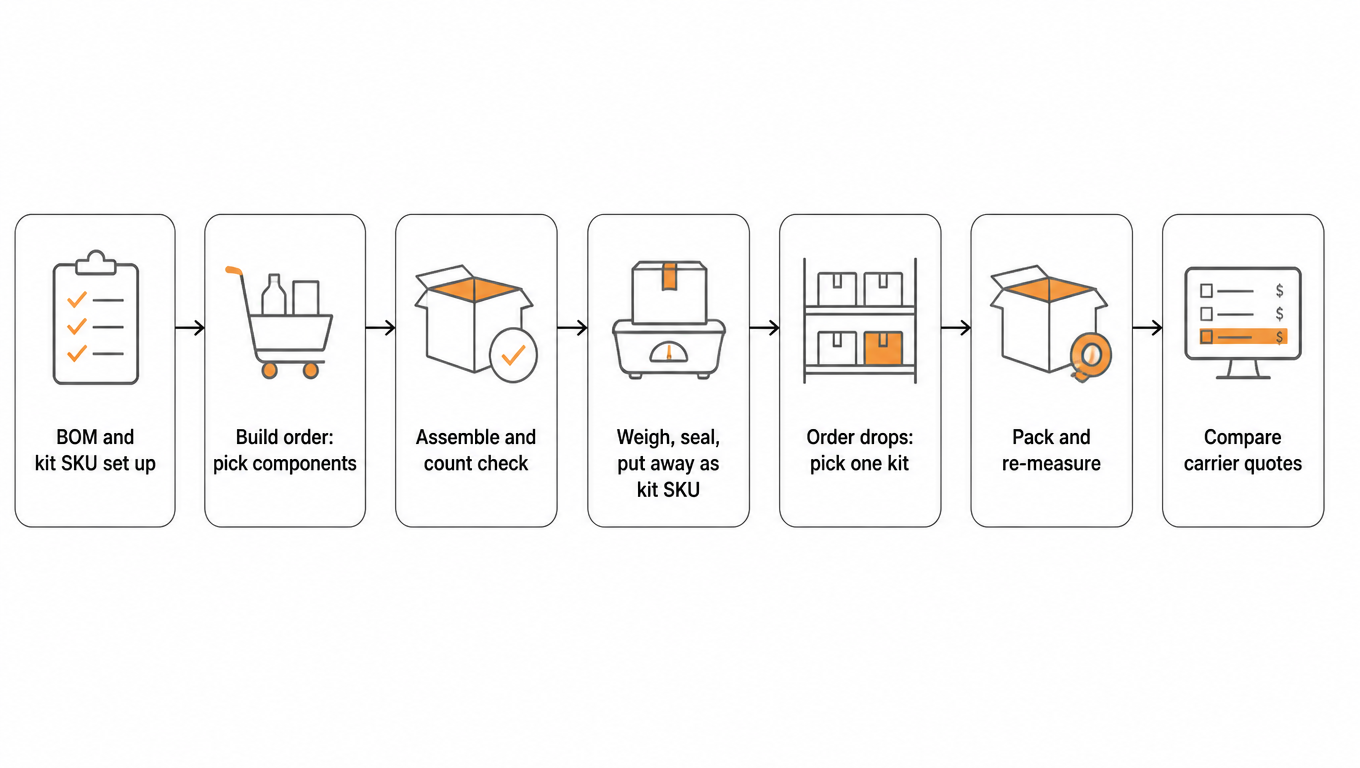
Flow chart: set up the bill of materials and kit SKU, pick components on a build order, assemble and count check, weigh, seal and put away as a kit SKU, then pick one kit per order, pack and re-measure, and compare carrier quotes
Kitting moves labor upstream and measurement downstream. Neither end can be skipped.

The failure modes are predictable once you know where to look. Component substitution happens when a component is short and someone grabs the nearest size. Variant mix-ups happen when two kits share a box design and differ only by a card. Missing inserts happen when the card is stored away from the bench. Count mismatches happen when the bill of materials changes and the old instruction stays pinned to the wall. None of these are exotic, and all of them are cheaper to prevent with a spec sheet than to fix with a reship.

What one kit actually costs

Most brands count two things: the box and the assembly minutes. The full number has five lines, and the two that get dropped are usually storage and rework.

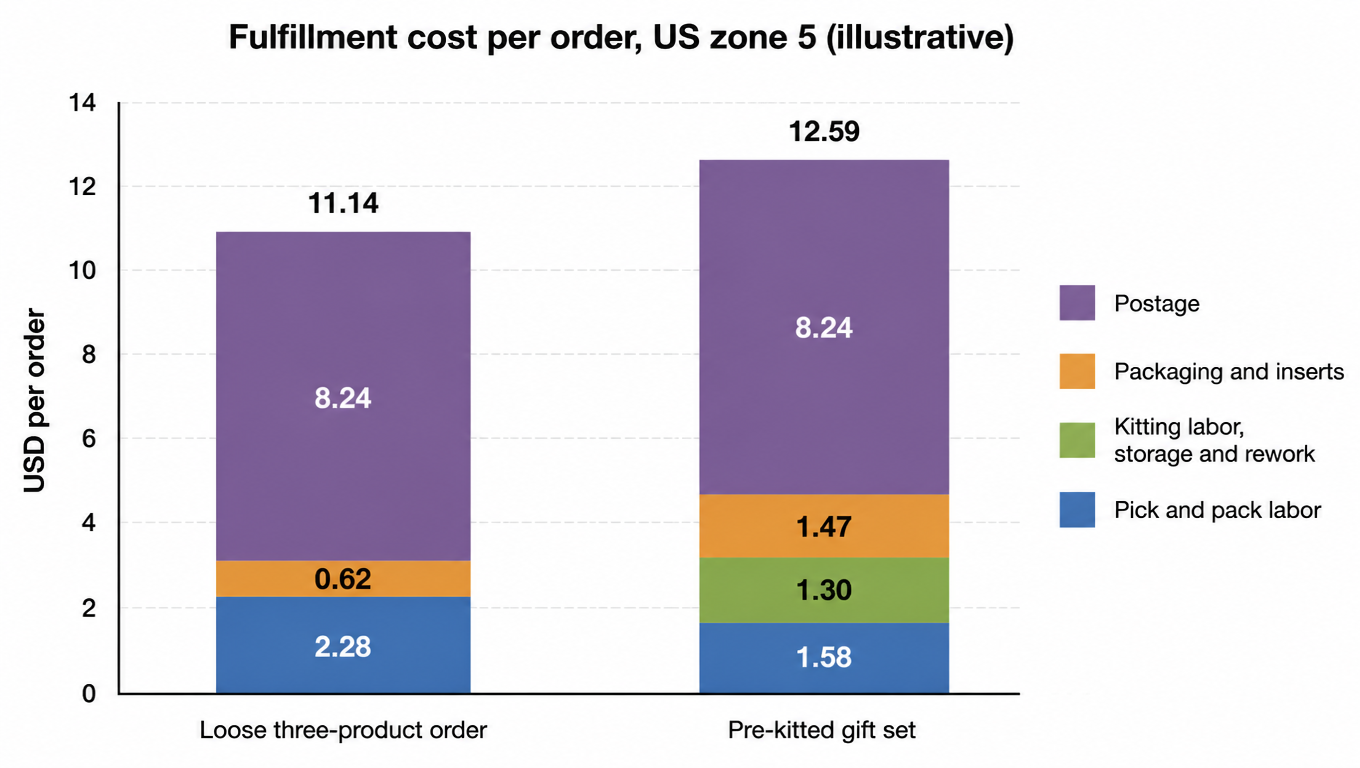
Here is the illustrative case. Every number below is a stated assumption, not a benchmark. Substitute your own labor rate, box cost, and postage before using any of it. Packed weight works out as follows: the three products total 7.0 oz, the printed mailer box adds 5.1 oz, the insert card 0.4 oz, tissue and seal 0.5 oz, and the finished kit weighs 13.0 oz.

Cost linePre-kitted gift setLoose three-product order
Pick and pack labor4.5 min at $0.35/min = $1.586.5 min at $0.35/min = $2.28
Kitting labor3.5 min at $0.35/min = $1.23$0.00
Packaging and inserts$1.47$0.62
Kit storage and rework$0.07$0.00
Postage, zone 5$8.24$8.24
Total per order$12.59$11.14

The detail behind the smaller lines:

  • Packaging, kitted. Printed mailer box $0.95, insert card $0.22, tissue and seal $0.25, label and tape $0.05. Total $1.47. The printed box doubles as the shipper, which is why there is no separate mailer.
  • Packaging, loose. Poly mailer $0.38, tissue $0.18, label $0.06. Total $0.62.
  • Storage. An assembled kit occupies about 0.06 cubic feet and sits for roughly six weeks. Cubic-foot billing at US 3PLs commonly lands between about $0.35 and $0.85 per cubic foot per month, with an average near $0.46, so the $0.65 used here is a mid-range assumption: about $0.05 per kit.
  • Assembly minutes. 3.5 minutes per kit is a lean figure. Published kitting cost models work from an assembly cycle of roughly four to six minutes per kit, and complexity rather than product count drives the spread. Time your own bench for twenty kits before adopting any number, including this one.
  • Rework. Three percent of kits need rebuilding at 2.1 minutes each, about $0.02 per kit.
Stacked bar chart of fulfillment cost per order at US zone 5, showing a loose three-product order at 11.14 dollars and a pre-kitted gift set at 12.59 dollars, split into pick and pack labor, kitting labor with storage and rework, packaging and inserts, and postage
Almost the whole gap is warehouse labor and packaging. Postage does not move at all.

The result is a $1.45 gap per order, and almost all of it is warehouse labor and packaging rather than postage. That is the number the gift set has to earn back, either through a price premium above the loose products or through conversion, returns, and repeat purchases that a gift set produces and a three-product cart does not. Whether the packaging itself pays for that is the subject of a parcel-first packaging cost audit.

Three cautions on using this number:

It is incremental cash cost, not order profitability. The $1.45 does not include product cost, marketplace fees, payment processing, or the marketing that got the order. Do not compare a kitted order's fulfillment delta against the full margin on a normal order.

The labor rate is the swing factor. At a $15 per hour rate the assembly line drops to $0.88 and the gap narrows. At an overtime rate during peak it widens. Build the model at both.

It assumes the kit is assembled in a slow week. If assembly happens to order in December, the same minutes cost more and the order also waits.

Negotiating kitting fees with a 3PL

A kitting quote is rarely one number, and the number at the top of the page is rarely the one you pay. The work is mostly translation: turn every line into a per-kit cost at your real component count, your real volume, and your worst month.

What you are actually buying. Six lines show up on kitting invoices, and they bill on different units:

LineBilled perWhat it covers
Kit assemblykitbench labor, placing components, a basic count check
Component handlingcomponent piece, or carton or pallet receivedreceiving, put-away, replenishment to the bench
Materialskit, at cost or cost plus a markupbox, card, tissue, seal, labels
Storagecubic foot, pallet, or bin per monthcomponents and finished kits, often at different rates
Setup and engineeringone timebill of materials in the system, slotting, written spec, photos
Rework and teardownkitunbuild, re-sort, scrap logging

Two clauses are not lines at all but change the total: a monthly minimum spend, and a peak-season rate. Reported monthly minimums at fulfillment providers average around $752, with a spread from about $150 to over $1,500 (Prepvia on contracting a 3PL for seasonal volume). A minimum is a floor and not a cap, and it does not care that you sell gift sets in one quarter.

Published ranges for the assembly line alone are wide. One 2026 pricing guide puts a standard three to five component kit with branded packaging at $2.00 to $4.50 per kit (Kitting & Assembly Pricing Guide); a provider comparison quotes $0.75 to $3.00 for simple bundles rising to $5 to $15 for complex multi-component builds (3PL Hub: kitting services); a per-touch model is often described around $0.38 per item or a loaded hourly rate near $39 (EasyPost on 3PL costs and fees). Those numbers are not in conflict. They describe different bundles of work, which is why a quote comparison has to start from your bill of materials rather than a per-kit headline.

Normalize every quote to a per-kit number. Two quotes for the seasonal build look like a rout until you read the inclusions:

Quote AQuote B
Kit assembly$2.10 per kit, materials included$0.45 base plus $0.07 per component placed: seven placements, $0.94
MaterialsIncludedBrand supplies, $1.42 per kit
Component receiving$0.09 per piece, three pieces, $0.27Included
Component storage$0.75 per cubic foot per month, about $0.06 per kit for the seasonIncluded
SetupNone$350 one time
All in at 400 kits$2.43 per kit$3.24 per kit
All in at 1,000 kits$2.43 per kit$2.71 per kit
All in at 5,000 kits$2.43 per kit$2.43 per kit

The flat quote wins at every volume this brand will actually reach, and not because its assembly rate is better. It is the $350 setup that never amortizes on one seasonal build: the per-touch quote only draws level at around 5,000 kits. The useful question is therefore not which rate is lower, but what the all-in number is at your volume, and what it is in your slow month.

That second half matters. If either contract carries a $750 monthly minimum and January's billable work is $210, the invoice is $750 either way, and the gift set has to earn back a cost that lands in a month where almost nothing ships.

Ten levers, roughly in order of how much they move the number:

  1. Buy the printed box yourself if materials are billed at cost plus a markup. Weigh that markup against your own carrying cost for a pallet of gift boxes. The trade is real: you take on the minimum order quantity and the twelve months of storage you were paying someone else to hold.
  2. Quote the build as a batch. Ask for one fixed price to deliver 400 kits by a date instead of a per-kit rate. You will usually pay slightly more per unit and stop paying for the provider's labor variance.
  3. Price the pick at one line. A kit order is a single pick line. If you are charged a full multi-line pick-and-pack fee on top of assembly, ask why, and ask what the single-line rate is.
  4. Get the teardown rate in writing before December. The number that decides how many kits to pre-build is the cost of unbuilding one, and you want it in the contract rather than in a phone call in January.
  5. Cap component handling to your bill of materials. Your kit has three components and four consumables. Per-piece receiving priced for a forty-component kit should not apply to yours.
  6. Treat setup as one-time and negotiable. Offer a volume commitment in exchange for waiving it, or amortize it across the first 500 kits. Whatever you agree, require the written spec and the finished-kit photos in a file you own, so leaving later does not cost you the process as well.
  7. Commit to a ramp, not an annual number. A monthly minimum sized to your November is a January liability. Ask for a quarterly true-up or a seasonal adjustment clause.
  8. Ask how peak pricing applies to kitting. Most brands ask about peak pick-and-pack rates and forget the bench. Get the start date, the uplift, and whether it applies per kit or per labor hour.
  9. Ask for kit-level reporting. Kits built, kits shipped, components consumed, kits unbuilt, scrap by reason. That report is how you catch a bill of materials that no longer matches the instruction pinned to the wall.
  10. Settle exit terms. Who owns leftover components and unsold kitted stock, and at what price can you retrieve them? A pallet of custom-printed gift boxes in someone else's rack is leverage against you at renewal.

What to send with the request. A quote built on a two-line email is a guess. Send the bill of materials with component counts and units of measure, the packed dimensions of the finished kit, the box spec, monthly volume for each month of the season, the date the first build must be complete, and whether the finished kit ships in its own box. The numbers that come back will be comparable, and the shipping question gets answered in the same document instead of a month later.

Then ask one last question that belongs to the next section: who re-weighs the finished kit? If the provider measures the assembled parcel at the bench, your first label is correct. If it carries the component weight forward, you will meet the difference as a postage adjustment.

How kitted parcels ship

The shipping question is not whether the box got bigger. It is which price band the packed parcel landed in. Three measurements decide it.

Weigh and measure the finished parcel. Never add the component weights and call that the shipping weight. The three products weigh 7.0 oz; the assembled kit weighs 13.0 oz. The packaging added 6.0 oz and almost none of it was visible in the product data.

Check the weight band before you assume a cost increase. On the current USPS Notice 123 price list, Ground Advantage commercial pricing for parcels from 4 oz to 15.999 oz is a single band, so an 8 oz parcel and a 13 oz parcel pay the same rate in the same zone: $8.24 for zone 5. In this case the kit added six ounces of packaging and no postage. The same table puts a 1 lb zone 5 parcel at $9.29, so the band boundary is worth finding before you redesign a box.

That boundary produces a specific trap. Suppose the 3PL decides the printed gift box needs protection and adds a plain overbox at 4.0 oz plus 0.5 oz of void fill. The parcel goes to 17.5 oz, lands at 1 lb 2 oz, and costs $9.29 instead of $8.24. Add the overbox cost of $0.85 and the brand pays about $1.90 per order for packaging it did not ask for and, in this case, did not need. The printed box either ships as the outer carton or it does not; decide which, and write it in the spec.

Check dimensional weight, but check it properly. Under the USPS Ground Advantage rules, dimensional weight applies only to parcels larger than one cubic foot, 1,728 cubic inches, dividing length by width by height by 139. The skincare kit at 7 by 5 by 3 inches is 105 cubic inches, so dimensional weight is irrelevant to it. It becomes very relevant three products later: a six-piece set in a 16 by 12 by 10 inch carton is 1,920 cubic inches, which bills at 13.8 lb even if the parcel weighs 6 lb. Kitting changes the box, and a bigger box can quietly change the billable weight by more than the postage line suggests. To estimate it first, use the dimensional weight calculator.

Size thresholds run alongside weight. Per the USPS parcel size and fee standards, a length fee applies from 22 inches up to 30 inches, a higher fee above 30 inches, and the maximum combined length and girth is 130 inches. A long gift box for a rolled item or a candle trio hits those limits before it hits a weight limit, and the surcharge applies on top of the base rate.

Flat-rate fit. If you are considering a flat-rate option, measure the internal dimensions of the carrier box against the outside of your gift box, not against the products. The gift box either fits or it does not, and close costs a full rate.

Complete quote comparability. A full price is base postage plus residential surcharge plus fuel where applicable plus any per-kit handling fee the 3PL charges. A quote that leaves out a $0.50 per-kit handling fee is not a comparison, it is a fragment. The same applies to a packaging upcharge for the printed box.

Finally, decide deliberately between one kitted parcel and a split. A kit containing an aerosol, a fragrance with alcohol, or a flammable nail product may not be shippable as one parcel at all, and a heavy kit is sometimes cheaper split into two lighter parcels. Both are covered in split shipments: the true cost framework, and the measurement step above tells you which side you are on.

At the execution layer the requirement is narrow: quote the packed parcel against the carrier options actually eligible for that destination, then buy the label. EasyShippingX is a channel-neutral shipping layer that compares carrier options inside the US and executes through the Portal, Excel, or the API.

A five-question checklist before you kit anything

  1. Does the kit have to exist physically before the order arrives? If not, keep the components separate.
  2. Which SKU holds the count, the kit or the components, and does the system reserve components for a kit order?
  3. What is an unsold kit worth to unbuild, and is the packaging reusable next season?
  4. What does the finished parcel weigh and measure, and which price band does it land in?
  5. Does the kit earn back its fulfillment delta in price, conversion, or returns?

If the answer to the last question is unclear, the honest move is to run the gift set as a promotional bundle for one season, measure what it does to average order value, and kit it the following year with real numbers. That costs nothing and settles the argument.

FAQ

Not quite. A subscription box is a kit whose contents change on a schedule, so bill of materials versioning matters more than the box design. The assembly logic is the same, but the reconciliation burden is higher because every cycle is a new kit. Scheduling and carrier choice for that model are covered in subscription box shipping.
Yes, and both are normal, because they cover different work: assembly at the bench and picking and packing at the station. Ask for the two rates separately so you can see which one drives the cost, and ask which of them carries the peak-season uplift.
Only if the marketplace supports a distinct SKU with its own dimensions and weight. A kit listed with the component's weight will produce wrong labels and postage adjustments on every order.
A fixed kit, usually. Its risk can be priced with the three-scenario table above, while a configurable kit moves the risk onto an option spread you have no history for. Once you know each option's take rate, move to a shared base box and add the option at pick time.
Yes. The packed weight and dimensions should be attached to the kit SKU rather than re-derived by a packer each time. Weigh it once, store it on the item record, and stop relying on a feel for the box.

Measure the parcel, then compare the full quote

Most of the kitting cost sits in the warehouse, and most of the shipping cost sits in the packed weight and dimensions. Weigh and measure the finished kit once, store it on the kit SKU, then compare that parcel against the carrier options actually eligible for the destination.

EasyShippingX compares carrier options inside the US in one place as a channel-neutral shipping layer and executes them through the Portal, Excel, or the API.