Subscription Fulfillment

Subscription Box Shipping: Costs, Schedules, and Carrier Selection

A subscription box has a clock the customer cannot see. They pay on the same day every month and expect the box to arrive on roughly the same day every month, and those two events are produced by two different systems that never talk to each other directly. The charge comes from your subscription platform. The delivery comes from a warehouse queue and a carrier network. Between the two sit an order record, a pick wave, a cutoff time, and a weekend. This guide answers six questions: whether to ship in fixed batches or on rolling cycles, which owner holds each of the three dates, what one cycle actually costs, when a pause or skip or address change can still reach this month's box, how to pick carriers for orders that repeat forever and rarely change shape, and how to keep the whole thing in one table you can fill in.

Editorial illustration of a fulfillment room on a release day, with two workers filling identical kraft boxes at a packing bench, a wall calendar with circled dates, and a label printer.
One batch, one promise, one cutoff

1. Why a Billing Cycle Is Not a Delivery Cycle

The renewal charge is the start of a process, not the start of a shipment. Between the moment a card is charged and the moment a box is scanned at the door, four handoffs happen, and each one can absorb time without anyone noticing.

Order generation is the first. The renewal fires, the platform writes an order, and the order has to reach the warehouse system with the right address, the right box contents, and the right service level. This is usually minutes, but it is minutes that only start when the platform decides to run the job. The warehouse queue is the second and the largest. Orders land in a queue behind whatever else is in the building, and the box is picked, packed, weighed, and labeled according to when the queue reaches it, not when the customer paid. Carrier cutoff is the third. A labeled box still needs to be tendered before the carrier's cutoff, and a box that misses it waits for the next business day. This is the handoff that turns a busy afternoon into a missed cycle. Weekends and line haul are the fourth. Transit time is measured in business days for most ground services, so a Friday tender and a Monday tender can arrive on the same day, and a Saturday release can cost two days before anything moves at all.
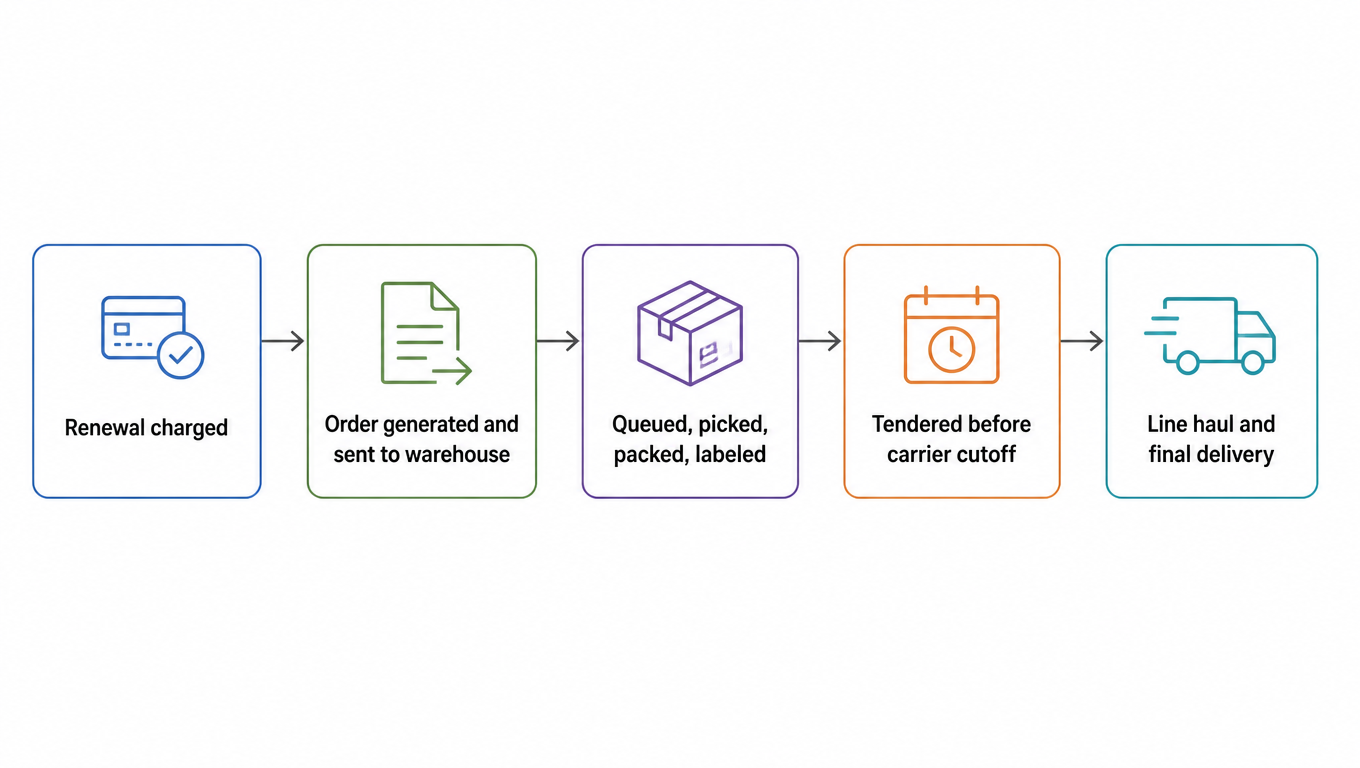
Flowchart: renewal charged, order generated and sent to the warehouse, queued and picked and packed and labeled, tendered before carrier cutoff, line haul and final delivery
Four handoffs between the charge and the delivery

Subscription customers also change things. Pausing, skipping a cycle, changing an address, changing the renewal date, and swapping a tier are normal self-service actions in a subscription portal[1], and each one rewrites what this cycle is supposed to ship. A delivery plan that assumes a fixed roster of identical orders will be wrong every month by a few percent, and those few percent are exactly the orders that generate support tickets.

Two boundaries before we start. This article is about arranging the shipment once a renewal has been charged, so it does not repeat how to measure the relationship between shipping and repeat purchase (that measurement framework is here), nor when to send retention messages around delivery events (that timing model is here), nor how the fulfillment chain behaves when volume doubles (that stress test is here). The question here is narrower and monthly: what gets released, when, and on which carrier.

The running example is a subscription brand shipping about 10,000 boxes a month, boxes between 2 and 5 lb, most volume on the East and West coasts, a small share on an expedited tier. The base tier promises an arrival window, the expedited tier promises a hard date. Every number below is a worked example of the method, not a benchmark to copy.
2. Fixed-Date Batches or Rolling Cycles: Choosing the Shipping Model

There are only two ways to schedule subscription shipping, and most brands end up using both. A fixed-date batch charges everyone on the same day, releases the whole cohort at once, and ships inside a short window. A rolling cycle charges each subscriber on their own anniversary, which spreads releases across every business day of the month.

The choice is not about preference, it is about what the box contains. A monthly gift box with the same contents for everyone is a batch by nature: the inventory arrives together, the packaging is identical, and the picking work is one repetitive wave. A replenishment product that people consume at different rates is a rolling cycle by nature: there is no shared content, and the only reason to hold a box is that the customer has not run out yet.

DimensionFixed-date batchRolling cycle
InventoryOne arrival, one countSKUs held for every renewal date
Warehouse workloadConcentrated in a short windowSpread across the month
Tender and carrier leverageOne large daily tender, easier to negotiate and easier to hand over as a single dropSmall daily tenders, less leverage
Per-box costLower, because picking is repetitive and packaging is standardizedHigher, because every pick is a small batch
Customer flexibilityChanges have to hit a single cutoffChanges can land any day
FitsContent-led boxes, seasonal items, limited-run productsConsumables, replenishment, personalized builds

The batch model earns its keep in three places. Inventory lands once and is counted once. The warehouse can be staffed against a known curve instead of a guess. And the daily tender is large enough to negotiate on and to hand over as a single drop, which is where a subscription brand gets its best rates. Its cost is a narrow window. Ten thousand boxes is not a number you can spread evenly if the promise is an arrival window that starts nine days after the renewal. Rolling cycles trade the opposite way: work is smooth and changes are easy, but SKUs sit on the shelf for the whole month, picks are fragmented, and the average box costs more to produce.

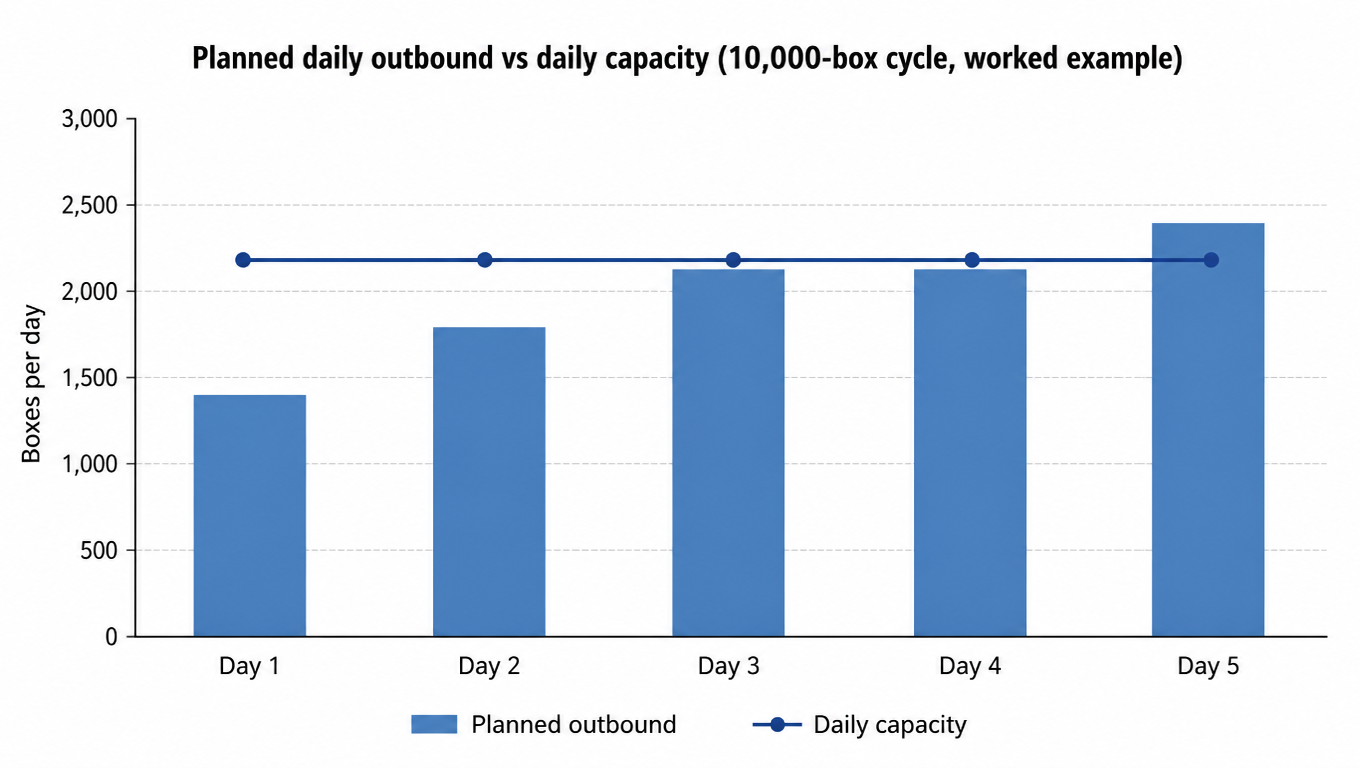
The realistic answer is a hybrid. The subscription box ships in a monthly batch, and add-on consumables or one-time purchases ship as they are ordered, on the same carrier tier table and a different schedule. Two timetables, one set of carrier rules. The principle that settles the argument is this: the length of the outbound window decides the model, not the other way around. Work out how many boxes the warehouse can genuinely clear per day against its cutoff, then see whether the promise leaves room for that many days. A cycle of 10,000 boxes with a five-day window needs 2,000 boxes a day on average, and the average is not the number that matters.

Bar chart with a capacity line: planned daily outbound of 1400, 1800, 2200, 2200 and 2400 boxes against a daily ceiling of 2200
The plan breaks its own limit before anything goes wrong

Read that plan the way a warehouse supervisor would. Days one and two are light, because the pick waves are still being built and the tote supply has not caught up. Day three and day four sit exactly at the ceiling, which means no equipment failure, no staffing gap, and no rework is affordable on either day. Day five is 200 boxes over the ceiling, so the plan already breaks its own limit before anything goes wrong. The overdue cluster that shows up in customer complaints at the end of the window is drawn on this chart weeks earlier.

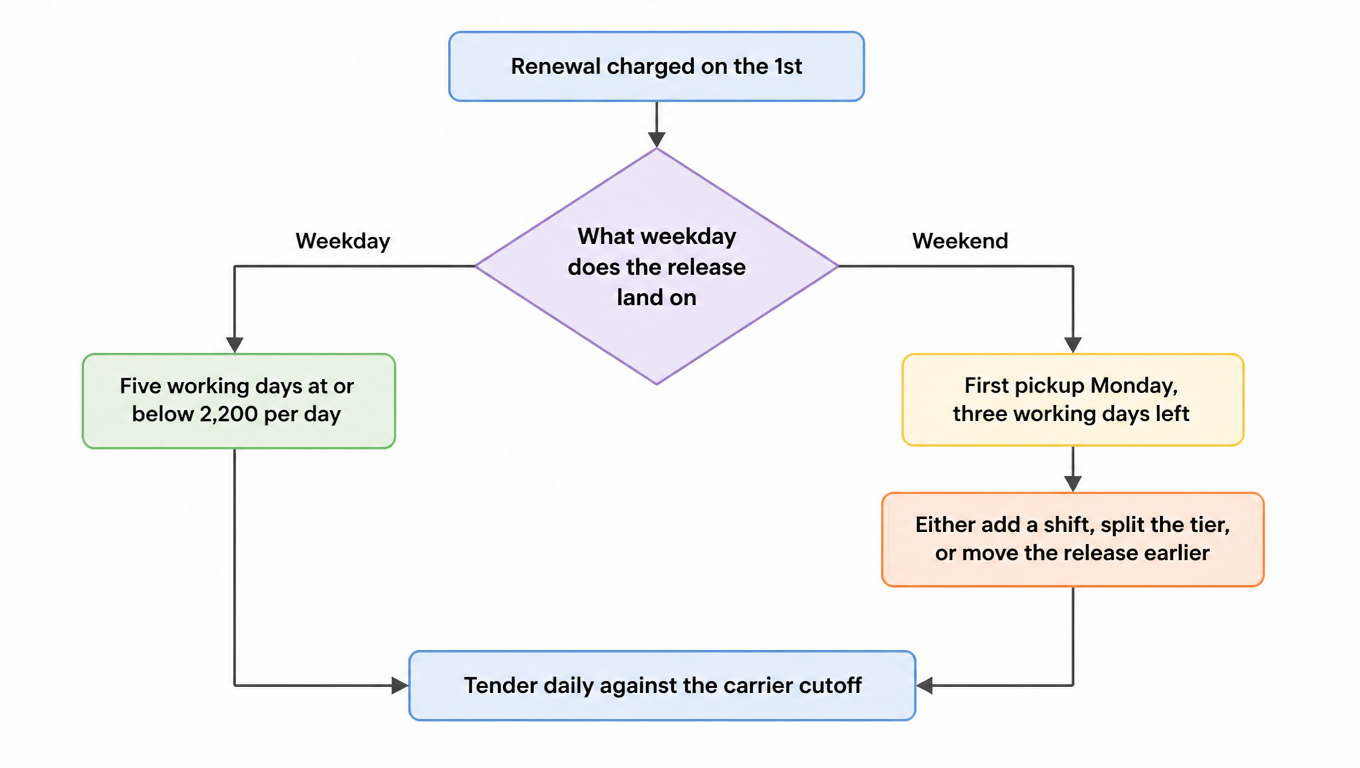
Now put the calendar next to it. In October 2026 the first of the month is a Thursday, so a release on the 3rd lands on a Saturday and the five-day window contains two days with no pickup. The same 10,000 boxes then have to clear in three working days, which is 3,333 boxes a day against a 2,200 ceiling. Nothing about the volume changed. Only the weekday of the release did.

Decision flowchart: renewal charged on the 1st, a weekday release gives five working days at or below 2200 a day, a weekend release leaves only three working days and requires an extra shift, a split tier, or an earlier release
The weekday of the release decides how many days the cycle has left

The lever that fixes most of this is the release date, not the carrier. Charging on the 1st and releasing on the 3rd is a choice. Charging on the 1st and releasing on the 28th of the previous month is also a choice, and it converts a weekend problem into extra buffer that costs nothing but a week of working capital.

3. Billing Date, Ship Date, Estimated Delivery: Three Dates, Three Owners

Most scheduling arguments inside a subscription company are really ownership arguments wearing a date. Three dates matter, and each one belongs to a different system with a different ability to make promises.

The billing date belongs to the payment and subscription platform. It is exact, it is contractual, and it is not a delivery signal.

The ship date belongs to the warehouse. It is the one date you control completely, which is why it is the only date you should ever promise in a service-level sense. Ships by the 7th is a commitment your operation can keep or miss.

The estimated delivery date belongs to the carrier network. It is a projection built from service level, origin, destination, and the day of tender. It can be forecast and it can be measured, but it cannot be guaranteed by you, which is exactly why the promise you publish to customers should be built on the ship date plus a delivery window rather than on a single arrival day.

Here is the cycle laid out with its owners, using the worked example.

StepDate in the exampleOwnerWhat can still change
Renewal charged1stSubscription platformNothing downstream has happened yet
Change cutoff2nd, 17:00YouAny edit that should reach this cycle
Release to warehouse3rdYou and the warehouseOrders can still be pulled back before the wave starts
Outbound window3rd to 7thWarehousePicks, cartons, and labels, at warehouse cost
Daily carrier cutoffEach day, fixed timeCarrierA missed cutoff pushes a box to the next business day
Base arrival window12th to 18thCarrier networkMeasured, not promised
Expedited hard date10thCarrier network and youThe tier that carries real exposure

Two mechanics on that table cause more missed promises than any other pair. The first is that cutoff is a scan time, not a label time. A label created at 16:50 for a 17:00 cutoff is not tendered at 16:50, and if the boxes leave the bench in a tote that reaches the dock at 17:10, the whole day's tenders shift by one business day. The second is that weekends are not neutral. A Saturday release, a Friday tender, and a Sunday cutoff all distort the arithmetic in ways that a five-day plan quietly ignores.

The practical discipline is to write hard nodes on the calendar rather than soft intentions. Release by 3rd, tender by 14:00 daily, expedited lane labeled by 12:00 can be audited. Ship as early as possible cannot, and it is the phrase that produces the end-of-window pile-up described above.

The two tiers need two timetables that share a release date and nothing else. The base tier picks a service level whose real transit distribution fits a window. The expedited tier picks a time-definite service with a fixed cutoff, and it goes out on its own lane so that a batch backlog never delays the orders with a hard date attached.

The classic error is a marketing page that promises a hard date while the terms describe a window. Whichever document the customer read first becomes the standard your support team is held to, and a hard date printed on a landing page becomes a refund policy in practice.

Hand-drawn editorial illustration of a fulfillment dock in the late afternoon, with a cart of identical kraft boxes beside a roll-up door, a wall clock ten minutes to the hour, and a worker checking the cart against a list.
Cutoff is a scan time, not a label time

4. What One Cycle Actually Costs: From Box to Delivered

A per-box postage rate is not the cost of a subscription box. It is one line on a list that has at least six, and the lines that get left out are the ones that decide whether the tier is profitable.

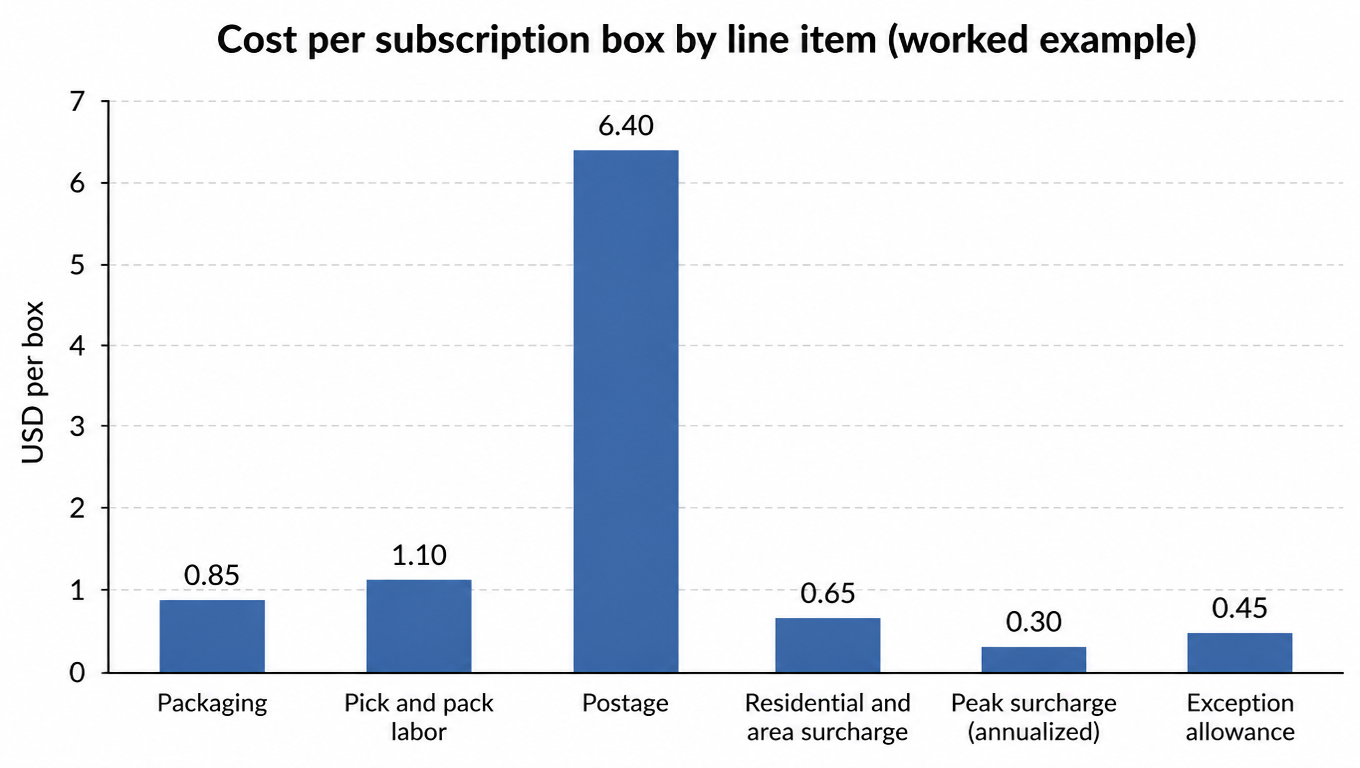
Packaging: the carton, the filler, the insert card, the tape. Pick and pack labor: the minutes per box multiplied by the loaded hourly rate, and this number is stable enough to measure once and track. Base postage: the rate for the billable weight and zone that the box actually produces. Residential and area surcharges: the fees attached to delivering to a home address or to a less accessible destination[5]. Seasonal surcharges: a peak surcharge annualized across twelve cycles, because January's margin has to absorb December's fee[3]. Exception handling: reships, refunds, replacement boxes, and the support minutes that come with them, amortized across every box in the cycle whether or not it went wrong.

That last line is the one subscription brands leave off, and it is not a rounding error. Reships and refunds are the direct cost of a schedule that ran late, so they belong in the per-box cost of the cycle that produced them, not in a customer service budget.

Bar chart of cost per subscription box by line item: packaging 0.85, pick and pack labor 1.10, postage 6.40, residential and area surcharge 0.65, peak surcharge 0.30, exception allowance 0.45 US dollars
The minimum six lines of a per-box cost

Add those lines and the worked example lands at 9.75 USD per box, which is 97,500 USD for a 10,000-box cycle. The postage line is the largest single item, which is why the reflex is to attack it, but the smaller lines are where the money is lost by accident.

The most expensive accident in subscription packaging is a carton change. Suppose a cycle adds a light but bulky item, a folded insert, a filler layer, or a gift that stands two inches tall. The material cost of that addition might be twelve cents. But if the carton height grows from 5 inches to 7 inches, the cubic size goes from 400 to 560 cubic inches, and a dimensional weight divisor of 139[2] turns that into 3 lb of dimensional weight and then 5 lb once the box is filled, so the box moves from a 4 lb billable tier to a 5 lb billable tier. That is roughly 55 cents of postage plus 14 cents of taller carton, about 69 cents per box, which is 6,900 USD across the cycle spent on a change that cost 1,200 USD in materials. The measurement to run before any content change is three steps: weigh the box, cube the box, and re-tier the box. The dimensional weight guide covers the divisor and the rounding rules, and the packaging comparison in box, poly mailer, or padded mailer helps decide whether the same contents can travel in a cheaper shape.

Standardizing the box usually beats renegotiating the rate. A brand that ships three carton sizes instead of seven gets better carton pricing, faster packing, fewer dimensional surprises, and a cleaner rate card to negotiate from. Standardization is also measurable within one cycle, while a carrier negotiation takes a quarter.

The expedited tier has to be costed on its own line. In the worked example, the expedited service runs about 14.20 USD of postage against 6.40 USD for the base service, with a small handling surcharge for the separate lane, which puts the expedited box near 17.80 USD against 9.75 USD for the base box. If 4 percent of a 10,000-box cycle takes the expedited tier, that is 400 boxes at an extra 8.05 USD each, or 3,220 USD per cycle. Average that into the base tier and you can no longer see which tier is paying for itself and which one is quietly subsidized by the subscription price.

Then close the cycle with a margin check: cost per box multiplied by boxes in the cycle, set against subscription revenue for the same cycle, with the expedited tier shown separately. If you track variance instead of averages, the cost variance analysis method shows where the drift sits between the quoted rate and the final invoice.

5. Pause, Skip, Change Address: When a Change Can Still Reach This Cycle

Customers treat their subscription settings as a live control panel, and in a sense they are. The part they cannot see is that only some of those changes can still affect the box that is already committed to this cycle, and the boundary is a single point in time.

Everything after the release date is a warehouse question, not a settings question. Changing a future cycle is a data update. Changing a box that has already been released is a physical intervention with labor attached, and it follows the order edit and rework path rather than the subscription settings screen.

ChangeWhere it is handledLatest point it can affect this cycle
Pause subscriptionSubscription systemAny time before release, otherwise this cycle still ships
Skip one cycleSubscription systemAny time before release
Change renewal dateSubscription systemTakes effect from the next cycle
Change addressSubscription system, then warehouse if releasedBefore the label exists; after that it is a relabel or a rework
Change contents or tierSubscription system, then warehouse if releasedBefore the pick wave starts, after that it costs rework

Pause and skip are not the same action, and conflating them creates billing disputes. A pause stops future renewals while keeping the subscription alive. A skip removes one cycle. If the release has already happened, neither one stops this month's box, and the customer service answer (you will still receive this month) has to be written before the first time it is asked.

Address changes have three states, and only the first two can land inside this cycle. If no label exists, the change is a data update. If a label exists but the box has not been tendered, the change is a void and a relabel, which is a real but routine cost, and the voided label process matters because an old label left on the carton can be scanned by mistake. If the box is already with the carrier, the only remaining options are interception, rerouting, or letting it arrive and correcting the outcome afterward. Promising a customer that a normal address change will work at that stage is the most expensive sentence in subscription support.

The change cutoff belongs in two places the customer already looks at: the subscription portal, next to the button they are about to press, and the renewal reminder email, with the date spelled out rather than described. A cutoff that exists only in an operations document is a cutoff you will explain a hundred times.

Then measure it. Log every change request by type and by whether it arrived before or after the release, and the pattern will tell you whether your release date is set correctly. A cutoff that is too early rejects changes the warehouse could easily have absorbed and irritates customers for no reason. A cutoff that is too late leaves the picks and labels in a permanent rework loop, which shows up as a slow trickle of repacked boxes rather than one visible failure.

6. Choosing Carriers for Subscription Orders

Subscription shipping has an unusual property: the same order profile repeats every month for the same customer, which means the carrier decision is made once and then lives for a long time on both sides. That is a reason for more rigor, not less.

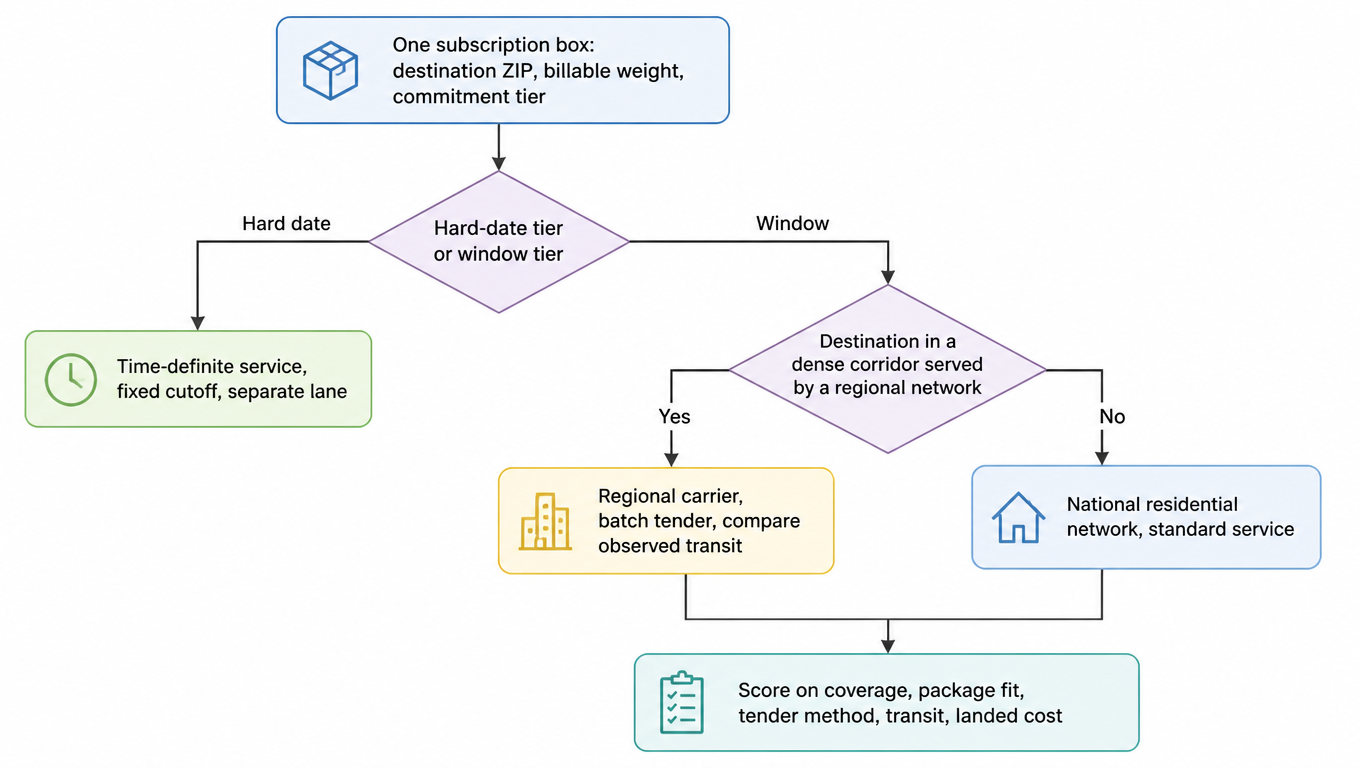
Five dimensions decide it. Coverage: whether the service actually reaches the destination ZIP, including residential and rural addresses. Package fit: the weight band, carton dimensions, and whether the service accepts the shape you are shipping. Tender method: pickup at your dock, a scheduled drop, or a batch handoff at a depot, and how that lines up with the daily cutoff. Actual transit: the observed distribution for that lane and service, not the advertised number of days. Landed cost per box: the delivered cost including surcharges and adjustments, which is the only number that can be compared across carriers honestly.

USPS is usually right for the orders where reach matters more than density. A standard-weight box going to a residential address that sits outside the dense metro corridors is a poor fit for a regional carrier's network and a natural fit for the national residential network, and the delivered cost is competitive because the network already goes there every day. Ground service pricing and its weight tiers are worth understanding before comparing[4], as the Ground Advantage pricing breakdown shows.

A regional carrier is worth evaluating for the orders where volume is concentrated. If a large share of a cycle goes to one or two metro regions and those boxes can be tendered as a batch, a regional network can be cheaper and faster on those lanes, and it can be tested lane by lane rather than as an all-or-nothing switch. The condition is that the tender actually works: a batch drop needs a schedule the warehouse can hold every cycle, and a service that requires a new process for 400 boxes is a service that will be quietly forgotten in month three.

The decision is per order, not per brand. In a single cycle of 10,000 boxes, the dense metro destinations and the rural destinations may reasonably ride different carriers, and the tier also matters: an expedited box belongs on a time-definite service with a published cutoff, regardless of what the base tier is doing.

Decision flowchart: one subscription box split by destination ZIP, billable weight and commitment tier, with a time-definite service for the hard-date tier and a regional or national network choice for the window tier
Tier first, then corridor, then price

Score candidates on a grid rather than a single ranking. The cell is a box profile crossed with a destination band and a service tier, and each cell carries one primary carrier and one backup. A single overall rate card hides the fact that the middle weight band on the far zone is where the money leaves, and a grid makes that visible in one screen. Comparing carriers on delivered cost rather than headline rate is the discipline that makes the grid trustworthy, and the USPS versus regional carrier comparison walks through where each one tends to win.

Two operational trade-offs come with running more than one carrier. Discount tiers reward concentration, so splitting volume can cost rate on both sides. Tracking, exceptions, and label handling have to come together in one place, otherwise the warehouse is learning three portals and the support team is checking three tracking pages. Both are manageable with software and both are real costs of complexity, which is why the answer is usually two or three carriers chosen deliberately, not five added opportunistically.

Backup capacity is part of the design, not an emergency measure. A peak surcharge, a service change, or a cut-off shift announced mid-cycle should find a prepared second option rather than a scramble, and the practical way to keep one ready is to run a small share of real volume through it every month, because a carrier that has never seen a parcel from your dock is not a backup. The evaluation criteria for standing up a secondary carrier are covered in regional carrier savings and carrier serviceability validation.

One note on tooling, because it changes what is feasible for a small team. A channel-neutral shipping layer lets you compare US carrier options for the same box and destination, then execute the chosen option through a portal, a spreadsheet, or an API without rebuilding the schedule around a single carrier's workflow. That is what makes a per-order carrier decision practical at the volume where subscription brands actually operate, and it is the reason the grid above is worth maintaining even for a two-carrier mix.

7. The Cycle Shipping Table You Can Fill In

One table, one row per release batch, updated weekly, is enough to run this. It is not a dashboard, and it is deliberately less ambitious than one.

FieldSourceFilled in when
Renewal cycleSubscription platformAt charge time
Release dateYou, against the warehouse calendarPlanned, before the cycle
Change cutoffYou, published to customersPlanned, before the cycle
Billable weight and cartonWarehouse, after weighingAt pack time
Destination ZIP or region bandOrder recordAt release
Carrier and serviceCarrier grid cellAt label time
Promised windowYour published promiseAt label time
Actual delivery and exceptionsCarrier tracking eventsAfter delivery

A filled row from the worked example looks like this.

Renewal cycleRelease dateChange cutoffBillable weight and cartonDestination bandCarrier and servicePromised windowActual result
October 2026Oct 3Oct 2, 17:004 lb, 10 by 8 by 5 inZone 4, dense corridorRegional groundOct 12 to Oct 18Delivered Oct 14
October 2026Oct 3Oct 2, 17:005 lb, 10 by 8 by 7 inZone 7, ruralNational groundOct 12 to Oct 18Delivered Oct 17
October 2026Oct 3Oct 2, 17:004 lb, 10 by 8 by 5 inZone 8, metroNational expeditedOct 10Delivered Oct 10

The value is in the last column. Filling the table turns the promise into a measured number and turns the monthly argument about the service being slow into a comparison of the promised window against what actually arrived, for a specific lane, service, and box profile.

Keep three calibration signals next to it. Calendar node attainment: the share of cycles where release and tender happened on the planned days, which is a warehouse and planning metric, not a carrier metric. Cost per box including the exception allowance, which is where a packaging change or a surcharge shows up before it reaches the P&L. And change exception volume by type, which tells you whether the cutoff is set at the right point.

The review cadence is weekly for the deviation column, monthly for cost, and quarterly for the grid itself. The table expires, and it is worth knowing what invalidates it: a carton or weight change, a shift in the destination mix, a change in the commitment structure, a cutoff shift, and a new peak season schedule. Any one of those means the last month's grid is describing a business that no longer exists.

8. The Takeaway

Delivery quality for a subscription brand is the granularity of the promise multiplied by the execution rate of the calendar. A window that the operation can actually hit beats a hard date that it cannot, and a measured actual column beats both.

The order of operations matters more than the individual pieces. Separate the three dates and their owners first. Build the calendar from the release date backward, checking weekdays and cutoffs. Choose carriers last, against the box profiles and destination bands that the calendar produced. Reversing that order is how brands end up using a carrier contract to compensate for a schedule that was never feasible, and that is a permanent tax on every cycle.

Three things worth doing before the next renewal run. Write this cycle's nodes as dated entries on a calendar, including the daily tender cutoff, and check which weekday the release actually lands on. Add the exception allowance to the per-box cost so the number on the finance slide matches the number on the invoices. And start the cycle table with this month's batch, even with half the columns empty, because the deviation column is the only place a promise becomes a fact.

It also helps to place this in the wider shipping chain. Subscription fulfillment is one stage of the run from checkout to delivery, and the framework for the whole of it is ecommerce shipping solutions.

Build the tier table for your next cycle

EasyShippingX is a channel-neutral shipping layer: one consistent way to compare US domestic carrier options and execute through a portal, a spreadsheet, or an API. Bring this cycle's box profiles, destination bands, and commitment tiers, and you can compare the available services and quotes for those exact parcels, then validate on a small slice in the next cycle. See pricing or book a multi-carrier workflow demo.

FAQ

It depends on what the box contains. A gift box with identical contents suits a batch: one inventory arrival, repetitive picking, and one large daily tender that is easier to negotiate on. Replenishment products that people consume at their own pace suit rolling cycles, because there is no shared content and the picks can happen any day. Most brands run a hybrid: the box ships monthly in a batch, and add-ons and one-time orders ship as they are ordered, on the same carrier tier table.
The billing date belongs to the subscription platform: exact, contractual, and not a delivery signal. The ship date belongs to the warehouse and is the one date you control completely, which makes it the only date worth promising in a service-level sense. The estimated delivery date belongs to the carrier network. It can be forecast and measured but not guaranteed by you, which is why the promise you publish should be the ship date plus a window, not a single arrival day.
Because postage is one line on a list of at least six: packaging, pick and pack labor, base postage, residential and area surcharges, annualized peak surcharge, and exception handling. That last line is the one most often left off, and reships plus refunds are the direct cost of a schedule that ran late, so they belong to the cycle that produced them.
It depends on the label state. With no label, the change is a data update. With a label but no tender, it is a void and a relabel, which is a real but routine cost, and the old label must not stay on the carton where it can be scanned by mistake. Once the box is with the carrier, the options are interception, rerouting, or correcting it after delivery. Promising that an address change will work at that stage is the most expensive sentence in subscription support.
Decide per order, not per brand. For residential addresses outside dense metro corridors, the national residential network is usually the better fit, because it already goes there every day. When a large share of volume concentrates in one or two metro regions and those boxes can be tendered as a batch, a regional network can be cheaper and faster on those lanes, provided the warehouse can hold that tender schedule every cycle.
Weekly for the deviation column, monthly for cost, and quarterly for the carrier grid. A carton or weight change, a shift in destination mix, a change in the commitment structure, a carrier cutoff change, or a new surcharge schedule all invalidate the last grid, and it has to be rebuilt.