Ecommerce Shipping Guide

How Shipping Events Should Trigger, or Suppress, Ecommerce Retention Campaigns

Every ecommerce marketer builds the same post-purchase sequence: order confirmation, shipping notification, delivery confirmation, then a review ask and a cross-sell. The mistake is building it as one linear flow and firing it at everyone identically. The tracking status of the order should decide which of those messages may even exist. A customer whose order was delivered an hour ago and a customer whose order is three days late are in completely different emotional states, and no single campaign should ever reach both.

This article makes one thing precise: turning shipping events into triggers and suppression signals for retention marketing, the decision matrix that connects tracking data to marketing automation. It starts with the framework (permission layer, event state, message), then gives a trigger/suppress rules table you can copy directly, with the recommended channel (email and SMS) and audience tier (first order, repeat, VIP) for every event, and ends with guardrails, wiring, and metrics.

Courier hands a parcel to a customer whose phone shows a delivery notification.
The moment of delivery is the retention touchpoint marketing wastes most often

Why Shipping Events Are Retention Moments

Post-purchase is the highest-intent stretch of the entire customer journey. 91% of consumers actively track their packages, and 19% of Americans check tracking multiple times a day[^1]. Buyers check tracking more than they check any other page on your site, and every status change is a moment where the brand is top of mind. It is the rare window where the customer is actively waiting to hear from you.

Shipping events are also the only brand touchpoints that arrive exactly on time and are impossible to ignore. A newsletter gets skimmed, an ad gets scrolled past, but a tracking notification lands in the middle of the actual experience, answering the question the customer is asking right now: where is my package? That attention is precious, and it is wasted on generic copy.

Retention campaigns fail when they talk at customers instead of responding to their current state. A 15% off code reads completely differently to someone who just received a perfect delivery and to someone who just watched a delivery exception appear for the third day in a row. Same message, same offer, same timing, wildly different outcomes.

Shipping status is, in effect, a trust signal. On-time delivery builds confidence in the next purchase; delays and exceptions erode it. That makes the logistics event the raw material for retention: it tells you precisely what the customer is feeling right now, if you let it.

One scope note before we go deeper. This article covers only one layer of the post-purchase stack: how shipping events become campaign triggers and suppression signals, the decision matrix that connects tracking data to marketing automation. Tracking UI design, support closed loops, and exception root-cause diagnosis each have their own guides (multi-carrier order tracking, USPS tracking unavailable, shipping problem diagnostics), and we link to those rather than repeat them.
The Permission Layer: Event, State, and Message

Here is the core proposition of this article: a customer whose order was delivered and a customer whose order is three days late must never sit in the same campaign. Shipping status is the permission layer of retention marketing. Before any creative, offer, or channel decision matters, the logistics event decides whether you are allowed to speak to this customer at all.

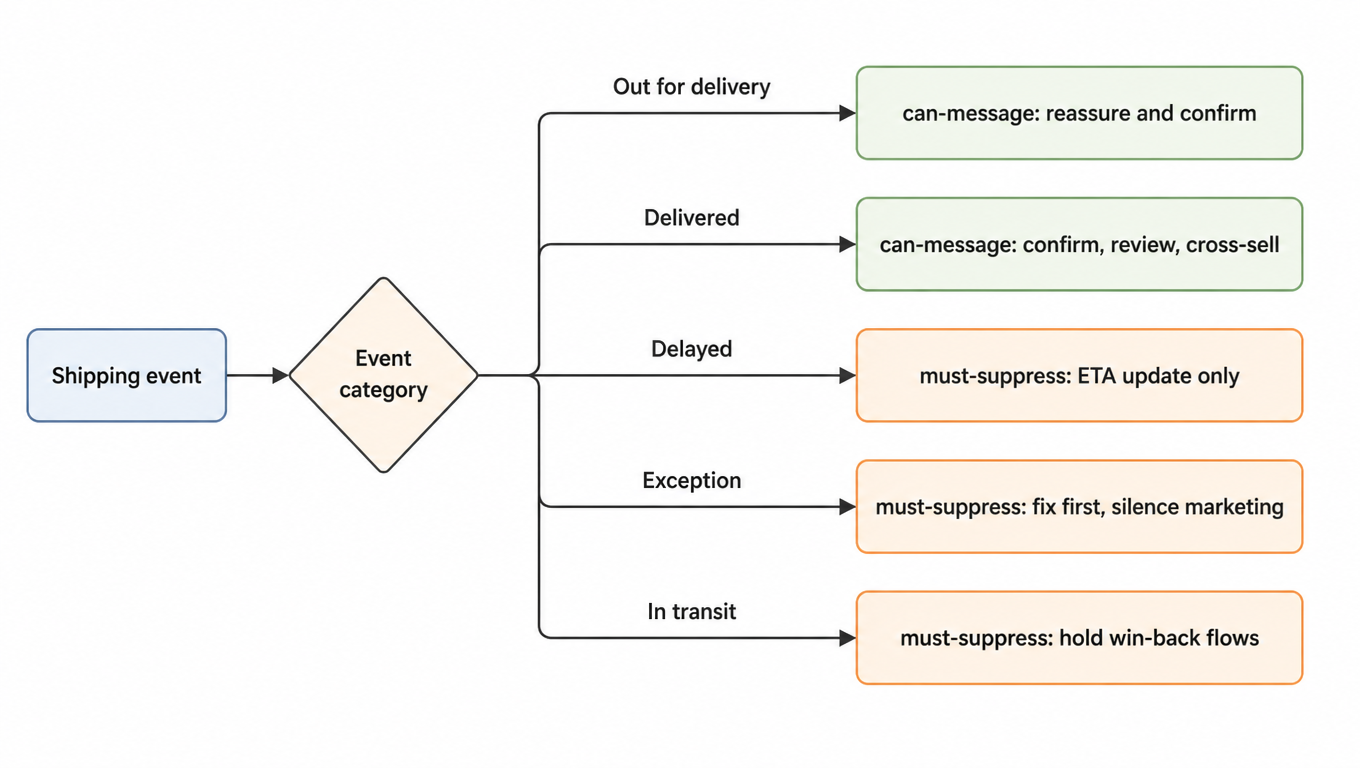
Think of two permission states. Can-message: the order is out for delivery or delivered, and the customer is in a receptive state, waiting for confirmation. Must-suppress: the order is delayed or in an exception state, and every marketing message will read as tone-deaf. There is a subtle third case: a package sitting in transit for a week looks like a perfect win-back target by recency rules, but messaging a customer "we miss you" while their order is still moving toward them is exactly the wrong note.

The gate works in two steps. The event first decides whether you may send anything at all, and only then does the second step decide which message fits. Three inputs go into that second decision: the shipping event itself, the customer's journey stage (first order, repeat, VIP), and the message's purpose (reassure, cross-sell, recover). Match the message type to the emotional state each event creates: reassurance for anxiety, confirmation for excitement, recovery for frustration.

Flowchart: shipping event goes to event category; out for delivery maps to can-message (reassure and confirm), delivered maps to can-message (confirm, review, cross-sell), delayed maps to must-suppress (ETA update only), exception maps to must-suppress (fix first, silence marketing), in transit maps to must-suppress (hold win-back flows)
The event decides whether you may send; the message type matches the emotion

Trigger when the event opens a genuine conversation: out for delivery is an invitation to say "it's almost there." Suppress when the message would feel tone-deaf: no promotion, no review ask, no cross-sell while a package is late. This ordering, event first, message second, is the discipline that keeps shipping flows from becoming spam.

Normalize the Event Stream

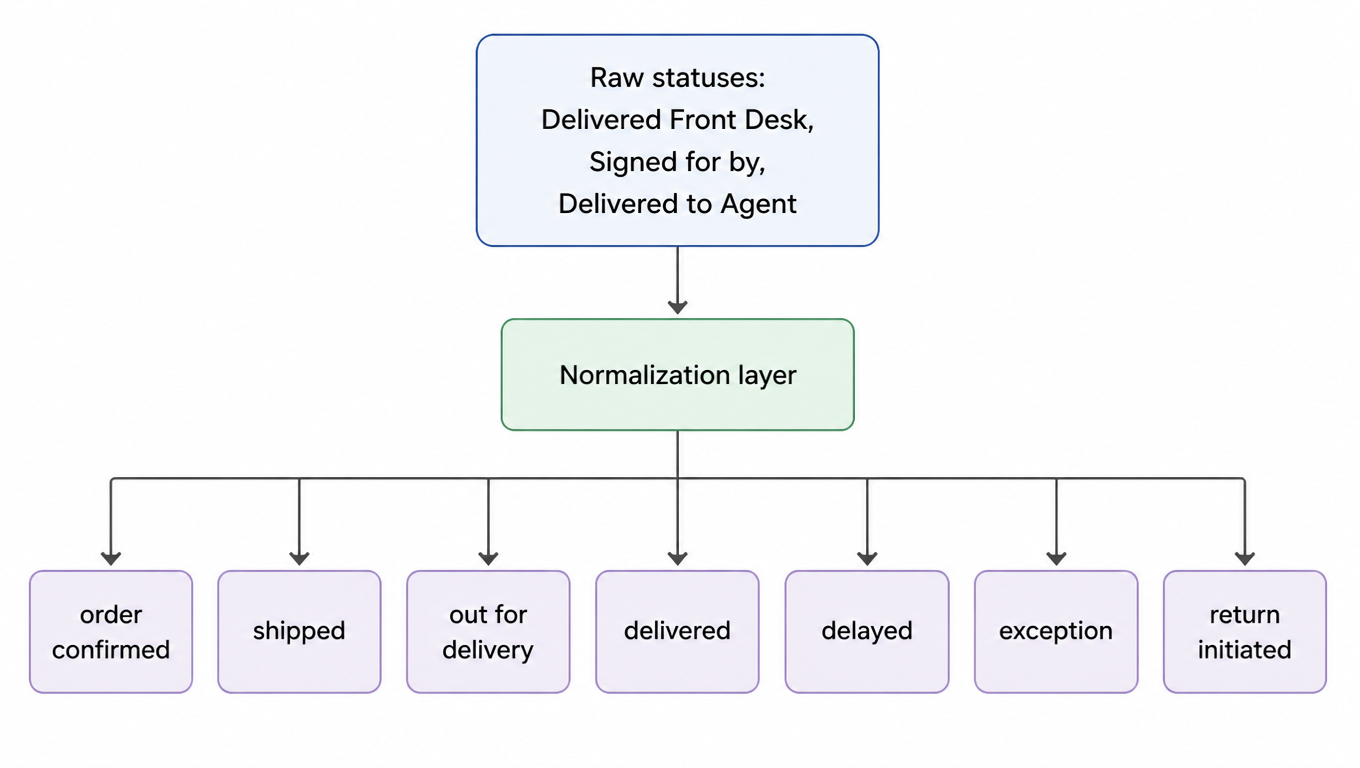
Raw carrier statuses are dozens of strings, and they are wildly inconsistent. USPS reports "Delivered, Front Desk/Reception,"[^3] FedEx reports "Delivered, Signed for by..." with a person's name attached,[^4] and UPS reports "Delivered to Agent for Final Delivery."[^5] The same physical outcome, delivered, arrives as three different strings, and that is just one carrier pair for one event.

Before any marketing system can judge a status, those strings must be normalized into a small, consistent vocabulary. Seven event categories cover nearly every case: order confirmed, shipped, out for delivery, delivered, delayed, exception, and return initiated. Raw strings break rule matching and cause misfires, because a rule that says "on delivered, send review request" only works if every delivered-shaped string actually maps to delivered.

Flowchart: raw statuses (Delivered Front Desk, Signed for by, Delivered to Agent) go through a normalization layer and map to seven categories: order confirmed, shipped, out for delivery, delivered, delayed, exception, return initiated
Dozens of raw strings normalize into seven event categories so marketing rules can match

Here is the real-world failure mode. "Delivered to Agent for Final Delivery" means the package was handed to an agent or a front desk on the recipient's behalf, not put into the customer's hands[^5]. A marketing system that treats it as a signed delivery fires the review request immediately, and the customer gets asked to rate a product they have not touched yet. The fix is normalization that understands what the status means, not what it literally says, and a delivered event that is only emitted when the package is truly in the customer's hands.

The Rules Table: What to Trigger, What to Suppress

With the event stream normalized, the decision matrix becomes simple to read. Each event gets a recommended channel, the audience tiers it should reach, the purpose of the message, and the condition that must hold before it fires.

EventChannelAudienceMessage purposeSuppression condition
Order confirmedEmailAll tiersSet expectations, share tracking portalNone
ShippedEmail (+ SMS for high value)All tiersTracking link, delivery windowNone
Out for deliverySMS (email fallback)All tiers, emphasize first orderLive tracking link, "arriving today"None
DeliveredEmailAll tiersConfirm delivery, care tips, day 3 review askOnly after confirmed delivered
DelayedEmailAll tiersApologize, new ETA, next stepNever attach marketing
ExceptionSMS + EmailAll tiersImmediate fix outreachSuppress everything until resolved
Return initiatedEmailRepeat + VIPReturn flow, recovery offerSuppress promos during open return

Audience tier changes the intensity, not the permission. First-order customers get a heavier reassurance and education cadence: they do not know your delivery process, your carrier, or your typical transit time, and every message that reduces uncertainty pays off in their next purchase. Repeat customers need a lighter touch: they know the mechanics, so status messages can be shorter and the mix shifts toward review requests and cross-sells. VIP customers should skip the routine noise entirely: status updates do not build loyalty for someone who orders every month, but being protected during an exception does. Save their messages for things that matter.

Hard Suppression Rules: When Silence Is the Right Message

The rules table says what to send. Suppression rules say when silence is the correct campaign, and they protect everything else from looking careless.

Never send promotional content during a delay or exception. Never send a review request before delivery is confirmed. These are the two most common retention sins, and both come from firing on a calendar instead of firing on events.

Never stack messages. One campaign per event per day, and dedupe across channels: a customer who got the out-for-delivery SMS should not also get the out-for-delivery email. Stacking is how a "helpful" flow becomes an unsubscribed customer.

Suppress win-back and lapsed-customer flows while a package is in transit. The recency model sees an active customer and wants to re-engage them; the shipping event says they are already engaged, with a package moving toward them, so the flow must wait. And exclude any customer with an open support ticket about shipping: if support is already talking to them, marketing must stay completely quiet until the ticket closes.

Trigger Examples Done Right

The out-for-delivery SMS with a live tracking link is the highest-open message in ecommerce[^2], because it answers the one question every buyer asks: when will it arrive? Short, concrete, one link, no branding essay attached.

The delivered confirmation does two jobs: it closes the loop ("it's here") and it seeds the next step. Send it with product care tips or usage ideas, and hold the review request until day 3, timed so the customer has actually opened the box. Asking too early measurably lowers the likelihood that customers post a review[^6].

Customer unboxes a product at a kitchen table beside instructions and a delivery notification.
The review ask should anchor to unboxing, not to shipping

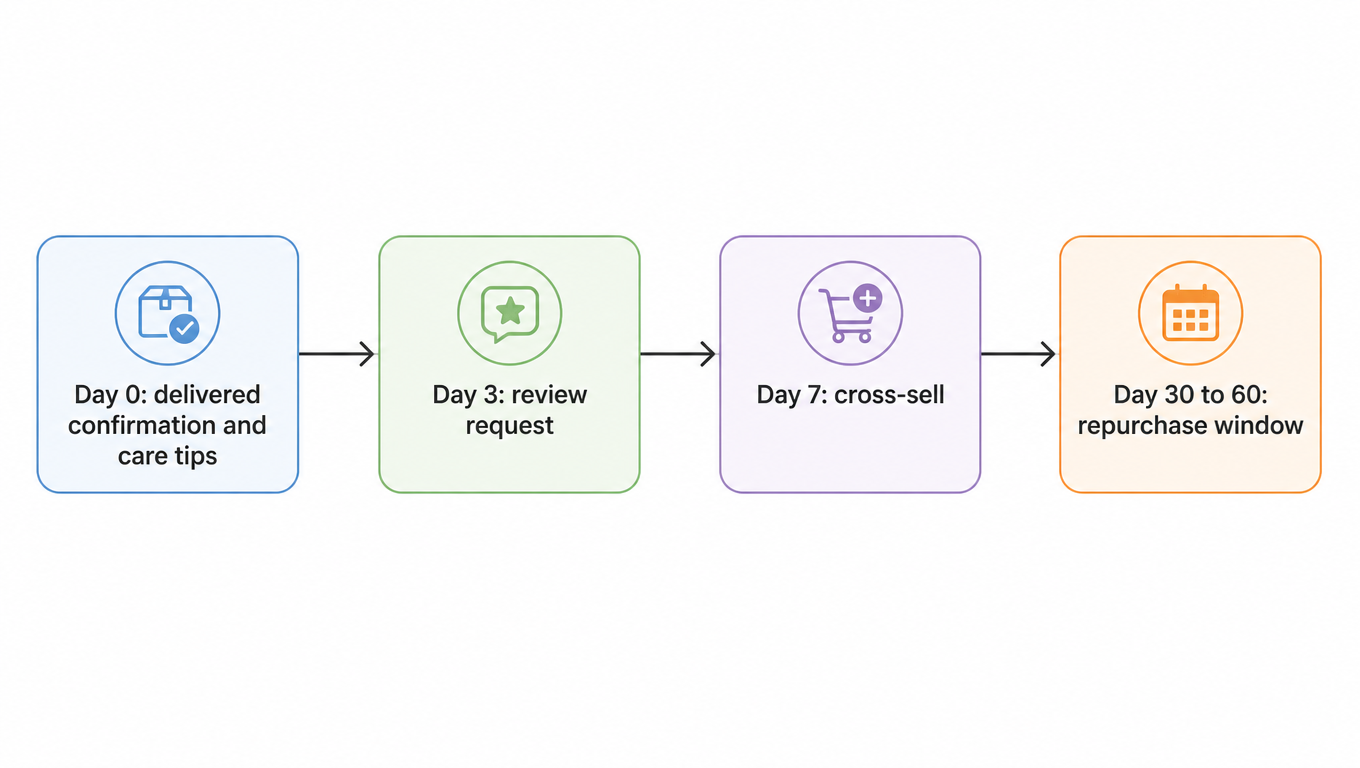
The delivered timeline turns one delivery into a sequence of conversations, every step gated on confirmed delivery:

Timeline: day 0 delivered confirmation and care tips, day 3 review request, day 7 cross-sell, day 30 to 60 repurchase window
Day 0 confirms, day 3 asks, day 7 cross-sells, day 30 to 60 opens the repurchase conversation

Day 0 confirms and reassures, day 3 asks for the review while the experience is fresh, day 7 cross-sells a compatible product to repeat and VIP tiers, and the day 30 to 60 window opens the repurchase conversation. If the order is not confirmed delivered, none of these fire, and the sequence simply waits.

Delay and exception messages are the opposite job. A delay notification should apologize, give the new ETA, and offer one concrete next step, with zero marketing attached. An exception, like an address issue or a carrier return, needs immediate outreach to fix the problem before the package is lost, and the message is all problem-solving, no persuasion. Cross-sells exist only after confirmed delivery, only for repeat and VIP tiers, and only when the delivered experience justifies them.

Guardrails and Deliverability

Carrier-wide outages and weather events are the great equalizer: every package is late, and the entire customer base is in the must-suppress state at once. Suppress or throttle sends when carrier systems show widespread disruption. Sending the normal cadence into that moment is how a brand earns a wave of complaints in a single day.

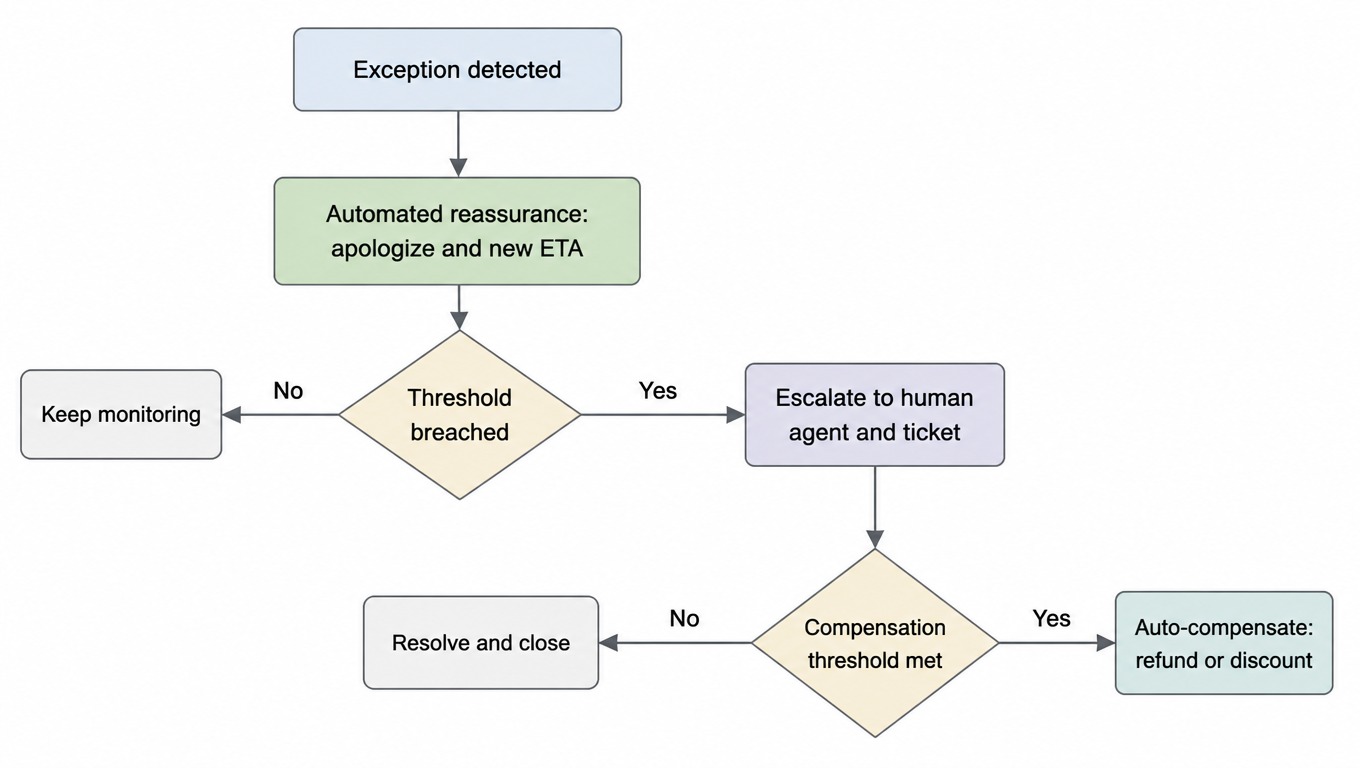
Exceptions need an escalation ladder, not a single alert. Start with automated reassurance: apologize, give the current status, set the next checkpoint. If the exception breaches a defined threshold, escalate to a human agent or a support ticket. If it breaches the compensation threshold, trigger the compensation decision automatically: a shipping refund at one level, a discount at the next, full resolution at the worst.

Flowchart: exception detected goes to automated reassurance (apologize and new ETA); threshold breached? no keeps monitoring, yes escalates to human agent and ticket; compensation threshold met? yes auto-compensates (refund or discount), no resolves and closes
Exceptions climb a ladder: automated reassurance, human escalation, auto-compensation

Respect time zones and quiet hours. SMS is intrusive and should never fire at night; email is less so but still respects local morning. Keep unsubscribe friction low: every message carries an easy opt-out, because a shipping flow that traps the customer is how opt-outs become complaints.

Compliance is not optional: TCPA consent for SMS, CAN-SPAM for email, and GDPR and CCPA rules for EU and California customers. And coordinate with support, so marketing never emails a customer whose ticket is already open, which is the same suppression rule from the support side.

Wiring It Up: Tracking API, Order Data, and the CRM

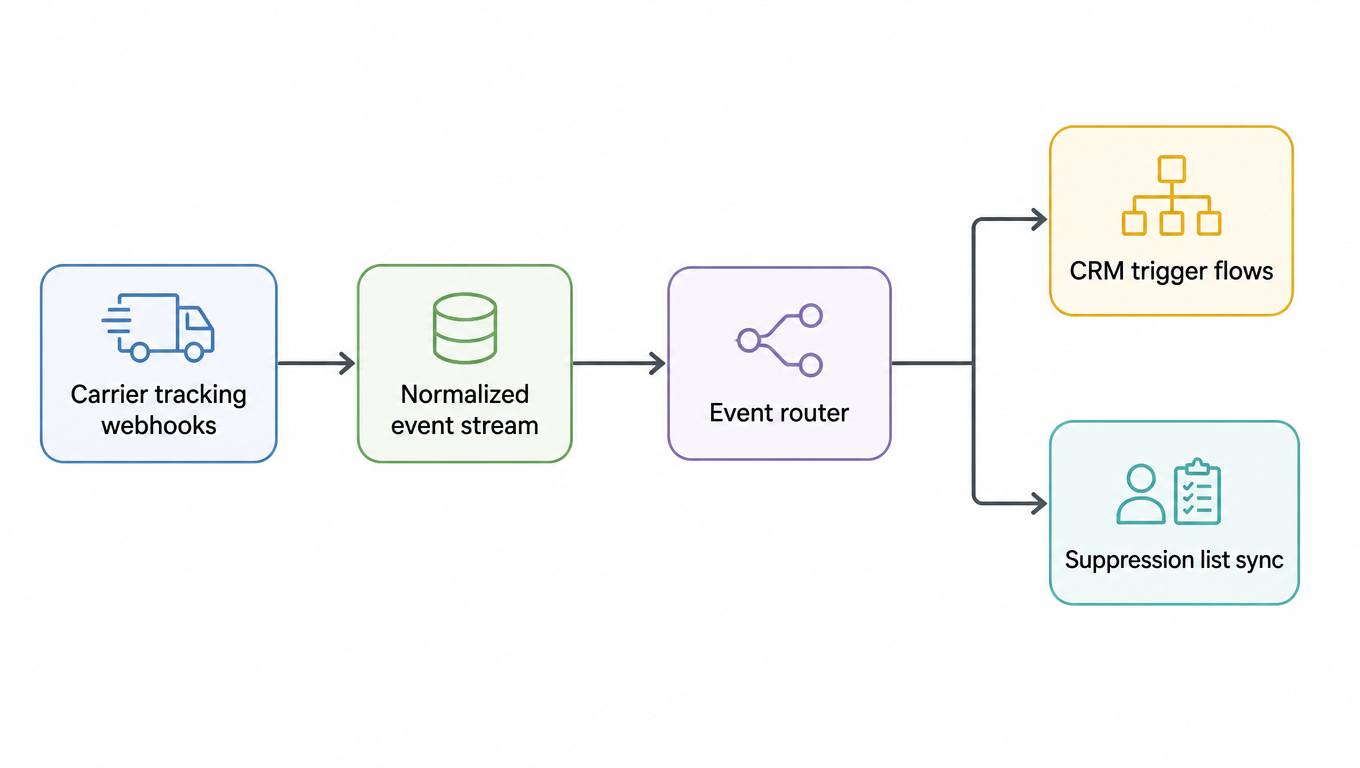
None of this works if the marketing platform never learns about the events. The pipeline is: carrier tracking API webhooks feed a normalized event stream, an event router decides which flows care, and the CRM or loyalty platform runs the trigger flows and syncs the suppression list.

Flowchart: carrier tracking webhooks feed a normalized event stream; an event router splits to CRM trigger flows and suppression list sync
The event says what happened; the order profile says who you are talking to

Order data joins the event stream at the router: customer tier (first order, repeat, VIP), product category, and order value decide which message variant fires for which audience. The event says what happened; the order profile says who you are talking to.

Suppression list updates must be near real time, not nightly. A delayed order needs to suppress the win-back flow within minutes, not tomorrow morning. Latency matters most for out-for-delivery and exception events; the event-to-trigger gap should be minutes, not hours.

The typical stack is an ESP or SMS platform like Klaviyo, Attentive, or Postscript consuming normalized events from a tracking aggregator or a custom integration. The architecture matters less than the discipline: every flow reads the permission state before it sends, and every event updates that state before anything else happens.

Metrics: Measuring Retention Lift from Shipping Flows

Measure the funnel first: delivery rate, click-through on each event message, and repeat purchase within 30 and 60 days. These show whether the flows perform, but they do not show whether the flows cause the repeat purchase.

For that, measure the counterfactual: compare cohorts that received shipping flows against cohorts that did not. The suppression rules make this easier, because a properly suppressed group is a natural control group.

Watch the suppress-side metrics too: complaint rate, unsubscribe rate, and SMS opt-out rate. If the suppression rules are working, these stay flat while engagement rises. Rising opt-outs are usually the first sign that a flow is firing on events it should not.

Finally, run health checks: message fatigue, time-to-first-reply on exception alerts, and CSAT after delay handling. Use the delivery performance data to tune which events carry which messages, and treat the whole thing as a loop, not a launch.

FAQ

First normalize raw carrier statuses into seven event categories (order confirmed, shipped, out for delivery, delivered, delayed, exception, return initiated), then let an event router distribute normalized events to the CRM or loyalty platform's trigger flows while syncing the suppression list. The rules table gives the recommended channel and audience per event: out for delivery goes by SMS (highest open rate), delivered by email (confirmation plus day 3 review ask), delayed sends only an apology with a new ETA, and exceptions get immediate fix outreach.
Four hard rules: never send promotions during a delay or exception; never send a review request before delivery is confirmed; suppress win-back and lapsed-customer flows while a package is in transit; and stay completely quiet on any customer with an open shipping ticket until it closes. Also never stack messages: one campaign per event per day, deduped across channels, and suppress or throttle everything during carrier-wide outages.
Day 0 sends the delivered confirmation with care tips, day 3 asks for the review while the experience is fresh (asking too early lowers review rates), day 7 cross-sells to repeat and VIP tiers, and the day 30 to 60 window opens the repurchase conversation. The whole sequence is gated on confirmed delivery: without it, nothing fires. VIP customers skip routine status noise and keep only messages that truly matter, like exception protection.
The same physical outcome arrives as different strings per carrier: USPS reports "Delivered, Front Desk/Reception," FedEx reports "Delivered, Signed for by...", and UPS reports "Delivered to Agent for Final Delivery." Without normalization, rule matching misfires. Real failure: treating "Delivered to Agent for Final Delivery" (handed to an agent or front desk) as a signed delivery fires the review request immediately, asking the customer to rate a product they have not touched. The normalization layer must understand meaning, and only emit a delivered event when the package is truly in the customer's hands.
The pipeline: carrier tracking API webhooks feed a normalized event stream, an event router decides which flows care, and an ESP or SMS platform like Klaviyo, Attentive, or Postscript consumes the events and runs the trigger flows. Order data joins at the router (tier, category, and order value pick the message variant). Suppression list sync must be near real time, so a delayed order suppresses the win-back flow within minutes. Discipline matters more than architecture: every flow reads the permission state before it sends.

Want your marketing flows grounded in trustworthy shipping events?

EasyShippingX operates in the carrier execution layer (rates, labels, tracking). Your CRM decides how the out-for-delivery SMS, the delivered confirmation, and the suppression list fire; EasyShippingX makes sure tracking events flow back normalized and near real time, so "delivered," "delayed," and "exception" are always the real basis of your marketing decisions, never a guess at a status string.