A ZIP code that exists is not a ZIP code your carrier can deliver to. Carrier serviceability validation checks address, ZIP, service, parcel profile, and fallback carrier before a label is created, so undeliverable shipments become early intercepts instead of returns. This guide walks the six-step pre-label pipeline, the real data sources behind USPS/FedEx/UPS serviceability, non-continental destination classification (Alaska, Hawaii, Puerto Rico, APO/FPO/DPO), a destination-by-address-type routing matrix, rule precedence before rate shopping, delivery-promise and holiday-calendar validation, business-address receiving-hours validation, a fallback-versus-manual-review decision tree, WMS/OMS/API implementation fields, an 18-scenario pilot test scorecard, and the build vs buy decision for ecommerce teams.
Every ecommerce order is a promise that a package will reach a specific door. When that promise fails because the carrier you auto-selected cannot physically deliver to that address, you do not just eat the shipping cost once. You pay for the outbound label, the return leg, the repick and repack, the refund or replacement, and the customer who never orders again. Most of these failures are preventable, because they are decided in the seconds before a label is created, when your system assigns a carrier and a service to a ZIP code. Which raises the question this guide exists to answer: if the address validates and the API returns a rate, why do packages still get rejected, re-rated, delayed, or returned?
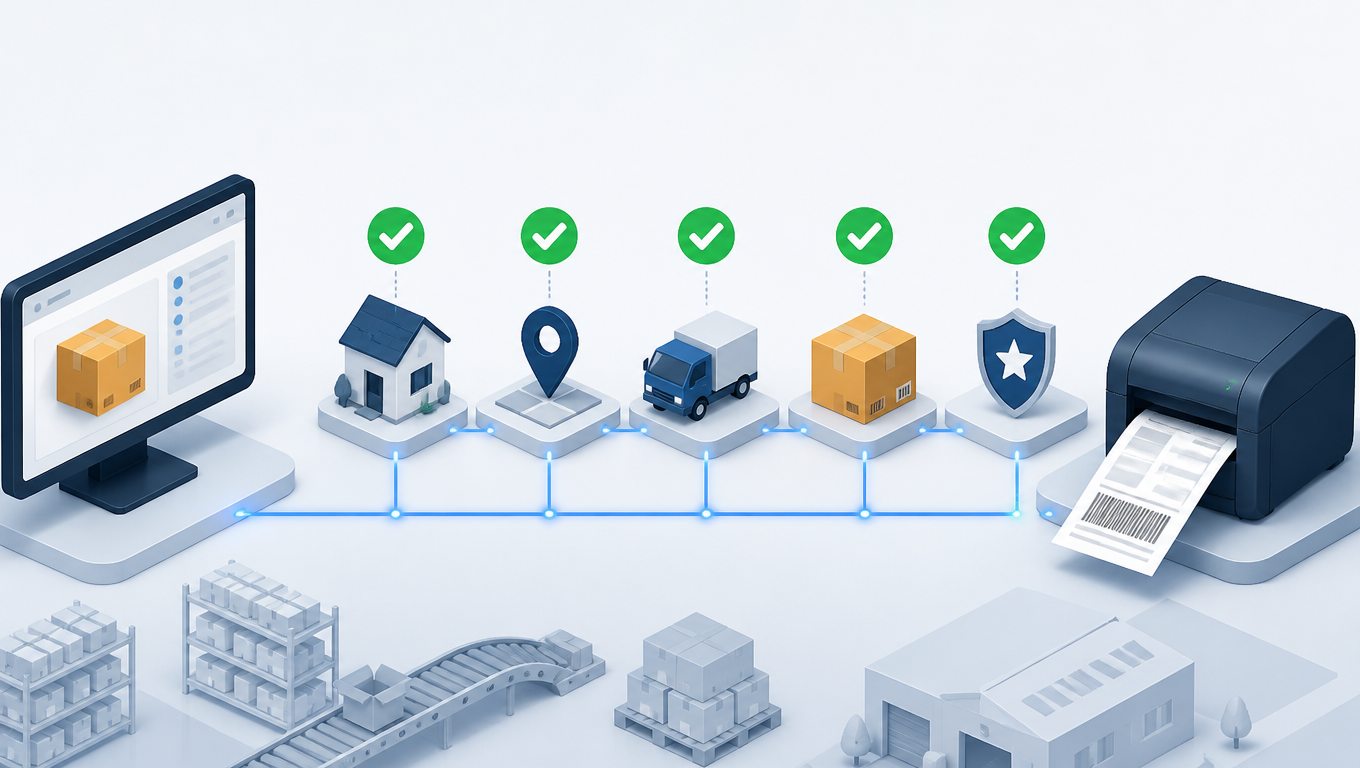
Only a full pass prints a label; any failure intercepts
Second-carrier evaluation: stage 2
You are at stage 2 of a second-carrier evaluation. Validate coverage eligibility for the client, facility, service, and parcel segment before confirming the physical handoff. Mark missing evidence as pending and assign an owner to collect it.
Keep the ZIP and parcel checks within the operating scope defined in multi-carrier strategy overview. Once a service is eligible, use the carrier handoff checklist to verify how the warehouse will actually tender the parcel.
1. What Is Carrier Serviceability, and Why It Matters
Serviceability answers one question: can this carrier physically get this package to this address with the service we are about to buy? A ZIP code being real does not answer it. A carrier's network has edges: rural routes served only by a particular carrier, regions where ground service is not offered, addresses that only accept mail through a PO Box, military destinations handled by a separate mail system. Serviceability is a property of the pair (carrier, address), not of the address alone.
Checking it before label creation matters because a label is a contract. The moment you purchase a label, you owe the carrier the rate, the carrier owes you a delivery attempt, and neither party has any obligation to refund you just because the destination turned out to be outside the service area. If your system routes an order to FedEx Ground for a remote Alaskan village that FedEx serves only through a slower service, the package does not quietly adapt. It gets held, returned, or re-rated after the fact.
The cost chain of a single undeliverable assignment compounds quickly. Start with the label itself, which you paid for and cannot reuse. Add the return shipping when the carrier sends the package back, the labor to process the return and refund, the repick and repack for the replacement order, the second label with a correctly routed carrier, and the customer support time explaining the delay. Then add the quiet cost: a customer whose order arrives a week late or not at all rarely complains loudly, they just never buy again. For a brand shipping thousands of orders a month, even a one percent misrouting rate is a monthly leak that a handful of validation rules can shut.
2. Why a Valid ZIP Is Not a Deliverable ZIP
The USPS ZIP database covers every five-digit ZIP in the country, which makes it a tempting shortcut: look up the ZIP, and if it exists, ship. The problem is that you are not shipping with the USPS ZIP database, you are shipping with a specific carrier, and carriers do not all cover the same geography.
Rural and remote areas are the classic gap. A five-digit ZIP can be valid while ground service from a given carrier simply does not reach it, or reaches it only on a limited schedule. Alaska, Hawaii, and Puerto Rico add another layer: some carriers serve them only through specific services or through ground relay arrangements that add transit time. PO Boxes are deliverable only by the USPS (and by carriers that hand off to USPS), so a FedEx or UPS label pointed at a PO Box will fail.[^2] Military addresses with APO, FPO, or DPO ZIPs run through the military postal system, again a USPS-only path.[^3]
Beyond geography, the address type matters. Residential and commercial addresses can have different rate structures and different service eligibility. Some services require a physical signature or impose weekend-delivery restrictions. A ZIP can be perfectly served by a carrier while a specific service on that carrier, say a cheaper ground option, is not eligible for that address. And carriers apply extended-area surcharges to ZIPs outside their standard delivery zone,[^4] which is a serviceability signal of its own: the service exists, but at a cost your routing logic should have known about before checkout quoted a price.
The practical conclusion is that deliverability must be evaluated per carrier and per address, never against a single ZIP list. The five-digit ZIP is the coarsest useful signal, ZIP+4 is finer, and the carrier's own service data is the only authoritative source.
3. Where Serviceability Data Actually Comes From
Each carrier publishes serviceability data, and the formats are not interchangeable. The USPS offers address validation through CASS-certified tools and the Delivery Point Validation (DPV) check,[^1] which confirms that a specific address exists at the delivery-point level rather than just at the ZIP level. ZIP code lookup and NCOA (change of address) services fill in the rest:[^5] the USPS knows not only where addresses are, but where mail should be forwarded.
FedEx and UPS take a different shape. They publish service area files that describe which ZIPs and ZIP+4 ranges each service covers,[^6] and their rating APIs return serviceability errors when you request a rate for a destination outside a service's area. These errors are your ground truth: if the Rate & Service API refuses the pair, no amount of address formatting will make the shipment eligible.
Third-party address validation services (Smarty, Lob, and similar) wrap USPS data into a simple API[^7] and are excellent at the address-normalization problem. What they do not do is tell you whether FedEx Ground serves ZIP 99685. That answer has to come from carrier data or from a multi-carrier shipping platform that maintains the carrier integrations for you. The operating principle is simple: validate against the carrier you will actually ship with, not against the USPS ZIP database as a stand-in.
Build an auditable coverage record for the second carrier
When a 3PL adds a second carrier, record validation by client, origin facility, carrier service, and parcel segment. A national coverage map alone is insufficient. Each record should identify the effective source file or service check, the reviewer, and the trigger for revalidation. These are recommended working fields, not promises about any carrier’s capabilities.
Validation object
Evidence to retain
When evidence is missing
Client and origin facility
Actual origin address, account/service eligibility, and the tender method available at that facility.
Do not copy a conclusion from another facility belonging to the same client.
Destination and address type
Destination ZIP, complete address type, current service-check result, and effective date.
Keep the existing path or send for manual review; a valid ZIP alone does not authorize release.
Service and parcel
Service identifier, measured weight/dimensions, contents eligibility, and client promise.
Revalidate after changes to size, contents, or promise instead of reusing an old result.
Version and ownership
Source, effective date, validation timestamp, reviewer, and unresolved items.
Mark as pending verification and assign an owner to collect the evidence.
Separate passed, failed, and pending verification
A segment confirmed ineligible should not enter candidate rate comparison. Missing documentation or an ambiguous provider result remains pending verification; absence of an error is not proof of eligibility. If the original service remains available, validate it against the original promise. If it also fails, assign the issue to operations rather than silently downgrading the client promise.
Coverage approval still leaves a practical question: how will this facility tender the parcels? Continue with the carrier handoff checklist to verify pickup/drop-off, cutoff, counts, and first-scan ownership. Proceed to the final-cost comparison only after both checks are supported.
4. The Pre-Label Validation Pipeline
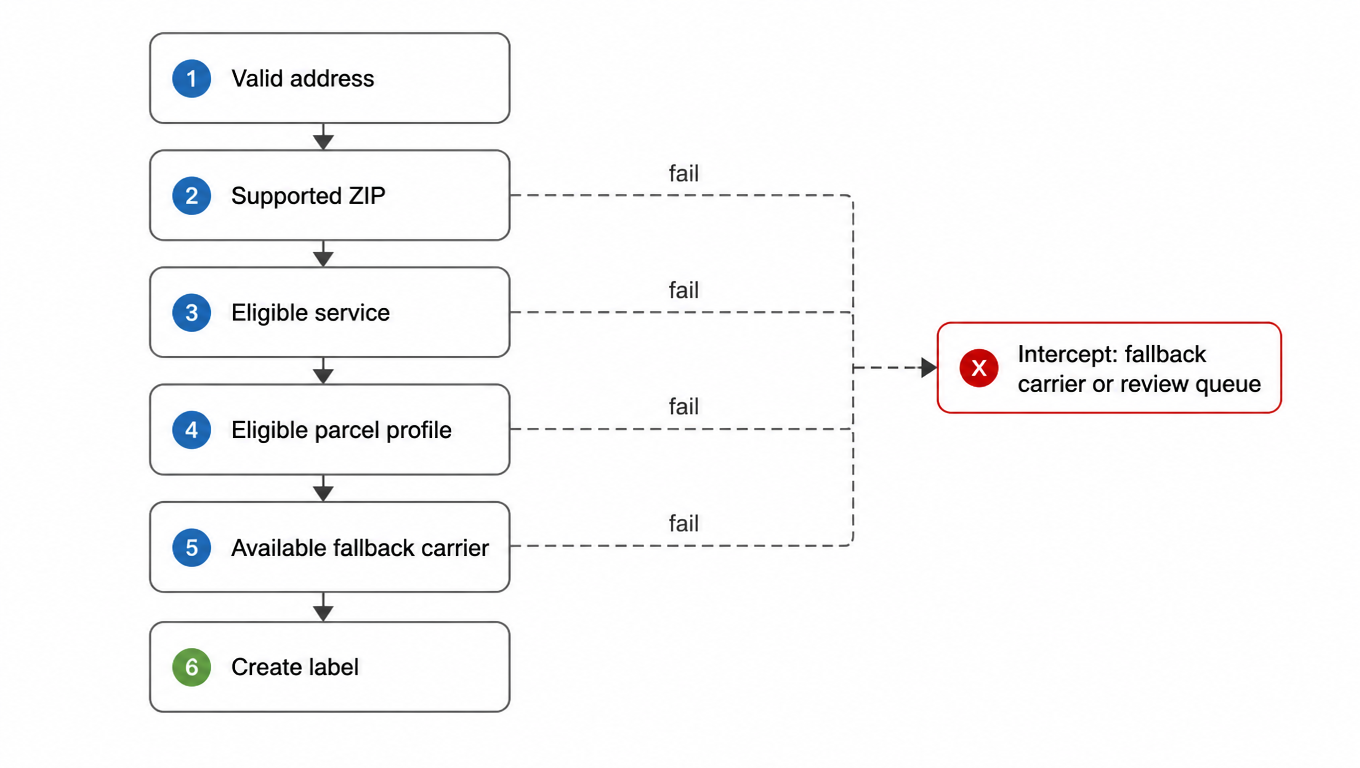
The reliable way to prevent undeliverable assignments is to run every order through a fixed sequence of checks before a label is created. Each step has a clear pass condition, a data source, and a failure action. Think of it as a funnel: an order only reaches the label printer if it clears every stage, and any failure routes the order to a fallback carrier or to a human review queue instead of to a doomed shipment.
Six-step pipeline: only a full pass prints a label, any failure intercepts
Step 1, Valid address. Run the address through CASS-style normalization and DPV. Fix the street name, the direction, the unit number, the city-state-ZIP match. If the address fails validation, it is not a routing problem yet, it is a data problem: intercept it and ask the customer or your warehouse team to correct it before anything else happens.
Step 2, Supported ZIP. Take the validated address and check the ZIP (ideally ZIP+4) against each candidate carrier's service area. The primary carrier may not cover the ZIP at all; that is a normal outcome, and it is exactly what the fallback logic in Step 5 is for. What you must never do is skip this step because the ZIP "exists".
Step 3, Eligible service. The ZIP is supported, now confirm that the specific service you intend to buy is eligible for this address type. PO Boxes and APO/FPO ZIPs lock the service to USPS-only. Some destinations require a signature service, some do not accept weekend delivery, some ground options exclude extended areas. This is where address type (residential vs commercial) enters the check.
Step 4, Eligible parcel profile. The address and service are fine, but the parcel itself must fit the service's rules: weight, dimensions, oversize thresholds, lithium battery restrictions, hazmat flags. A service that accepts the destination but not a 70-pound box is not a service you can use. Profile checks are cheap to run and embarrassingly easy to forget.
Step 5, Available fallback carrier. If the primary carrier fails any earlier step, walk the fallback chain and rerun Steps 2 through 4 against the next candidate. The fallback must be validated, not assumed: just because carrier A cannot serve a ZIP does not mean carrier B can. Only when a candidate clears every check does it become the chosen route.
Step 6, Create label. Every check has passed, so the label is created with confidence. If no candidate survives the pipeline, the order goes to a review queue where a human can look at the address, call the customer, or arrange an exception. The cost of one manual review is trivial next to the cost of one undeliverable shipment.
5. Non-Continental Destination Classification
Before you ask which carrier serves a ZIP, classify the destination. US geography is not one continuous service area, and the most reliable routing pattern is to decide the destination class once, at order intake, and let that class drive the rest of the branch.
Five classes cover almost every US ecommerce destination: contiguous US (CONUS), non-continental states (Alaska and Hawaii), US territories (Puerto Rico, Guam, US Virgin Islands, American Samoa, Northern Mariana Islands), military and diplomatic addresses (APO, FPO, DPO), and PO Boxes. The USPS Domestic Mail Manual treats territories and possessions, and the military and diplomatic mail system, as rules separate from domestic street delivery,[^11] which is a reminder that each class has its own operating rules and no single ZIP list covers them all.
Why classify instead of maintaining ZIP lists? Because each class behaves differently on four axes: which carriers can serve it at all, which services within those carriers are eligible, how transit time behaves, and which surcharges apply.
CONUS: every major carrier and most regional carriers compete, and the standard serviceability checks apply.
Alaska and Hawaii: regional carriers (OnTrac, GLS, Better Trucks and peers) do not serve them; USPS serves them directly, while FedEx and UPS reach them only through specific services or ground relay arrangements that add transit time.
Puerto Rico and the other territories: mostly served by USPS, plus express-type services from FedEx and UPS with extended-area surcharges; cheap ground options are often not eligible.
APO, FPO, and DPO: USPS-only, because the military postal system is the only delivery path and commercial carriers do not serve these ZIPs.[^3]
PO Boxes: USPS-only as well.[^2]
Store the result as a single destination_class field on the order. The class rarely changes, so compute it once at intake and let the routing matrix in section 6 consume it, instead of rediscovering Alaska inside each carrier's ZIP lookup.
6. Destination × Address Type × Carrier Service Routing Matrix
The routing matrix is the table that maps destination class and address type to the carriers and services that are actually allowed. It is the policy artifact your team maintains, and the pipeline in section 4 is the engine that executes it. The matrix makes the rules visible, reviewable, and testable instead of scattering them across routing code.
Read it by picking the row for the destination class, then reading across the carriers. A cell names the eligible services and any conditions: relay, handoff, surcharge, longer transit. An empty cell means not eligible, and no amount of address formatting changes that.
Address type adds a second dimension inside each class. Residential and commercial addresses can differ in rate structure (residential surcharge), in signature requirements, and in weekend delivery. The matrix should state these, because a service can be eligible for one address type and not the other.
Destination class
USPS
UPS
FedEx
Regional (OnTrac / GLS / Better Trucks)
CONUS residential
All parcel services
Ground, 2nd Day, Next Day (residential surcharge)
Ground, 2nd Day, Express (residential surcharge)
Eligible inside coverage area
CONUS commercial
All parcel services
Ground, 2nd Day, Next Day
Ground, 2nd Day, Express
Eligible inside coverage area
PO Box
Only carrier (Priority Mail, Ground Advantage, etc.)
Not eligible directly
Not eligible directly
Not eligible
APO / FPO / DPO
Only carrier (military mail)
Not eligible
Not eligible
Not eligible
Alaska / Hawaii
Ground Advantage, Priority, Express
Specific services or relay, longer transit
Specific services or relay, longer transit
Not eligible
PR / US territories
Ground Advantage, Priority, Express
Express-type services, extended-area surcharge
Express-type services, extended-area surcharge
Not eligible
A matrix like this is a starting policy, not a substitute for live validation. Carrier service areas change, so the matrix sets the allowed set and the pipeline still confirms each candidate against current carrier data before a label is created.
7. Rule Precedence Before Rate Shopping
Back to the question this guide keeps asking: the address validates, the rating API returns a price, and the package still gets rejected, re-rated, delayed, or returned. Why? Because a rate quote is not an eligibility decision. Rating APIs return a number for almost any carrier-service-destination pair unless the pair hard-errors, and a number in the response does not mean the service can complete the delivery, meet the promise you showed at checkout, or survive contact with surcharges. ZIP validation only confirms that an address exists; it cannot substitute for carrier, service, parcel, and promise eligibility.
The fix is a fixed order of operations, executed before rate shopping. Each earlier stage is cheaper to evaluate and eliminates more candidates, so the engine sorts hard constraints first and compares price last:
Destination class lock. PO Box and APO/FPO/DPO go USPS-only; non-continental destinations take the non-continental branch. This is a lookup, not a debate.
Address normalization and DPV. Fix what can be fixed, intercept what cannot.
Carrier serviceability. Does the carrier serve the ZIP+4 at all?
Service eligibility by address type. Residential or commercial, signature required, weekend delivery available.
Parcel profile. Weight, dimensions, oversize thresholds, lithium batteries, hazmat flags against the service's limits.
Promise eligibility. Can the service deliver within the customer promise, given cutoff, holiday calendar, and transit days?
All-in cost. Base rate plus residential, extended-area, fuel, and dimensional surcharges. Sort survivors by true cost.
Fallback. If no eligible carrier remains, manual review. Never auto-ship a failing order.
The principle: rate shopping is the last step, not the first. You compare prices only among carriers and services that have already passed every eligibility check. A cheap rate for an ineligible route is not a discount, it is the most expensive outcome in this guide, a sale converted into a return. The rating API's number is an input to step 7, not a green light.
8. Delivery-Promise and Holiday-Calendar Validation
A rate is not a promise. The promise is the service's transit commitment adjusted by three things your routing logic must model: the cutoff at the origin warehouse (when the label is created relative to carrier pickup), the carrier's holiday calendar (non-operating days do not count as transit days), and weekend delivery availability for that service.
Here is an example with the math: a Ground service promises three business days. The customer orders Thursday at 4:30 PM, the warehouse cutoff is 5 PM, so the package ships Friday; Saturday is not a transit day for Ground; Monday is a carrier holiday. The delivery date lands on Wednesday, but checkout promised Tuesday. The address was valid, the rate was valid, and the promise was broken anyway.
The holiday calendar is carrier-specific and must not be shared across carriers. The USPS observes eleven federal holidays and publishes its holiday service schedule,[^10] while UPS and FedEx publish their own schedules that differ in which days are full closures and which have modified service.[^8][^9] A Thursday order in a holiday week lands on different days depending on which carrier you route it to, which is a promise-relevant decision your router should make with the calendar in hand, not discover after the fact.
Validate the promise at routing time, before the label is created: apply the cutoff, drop non-operating days, apply weekend rules, and compare the computed delivery date with what the customer was told at checkout. If the fastest eligible service cannot meet the promise, upgrade to a faster service within the cost cap or route to review, but never let the ETA silently drift past the promise. The API fields you need are transit days, commit date, cutoff time, pickup schedule, and the holiday set, and they should be stored with the order for auditability.
9. Shipping to Business Addresses: How to Check Receiving Hours Before Choosing a Carrier
A validated address is not a staffed receiving dock
An order to a business address can clear every check in the pipeline above and still fail at the door. The address validates, the carrier serves the ZIP, the service is eligible, the parcel profile fits, the rating API returns a rate, and the computed delivery date beats the promise. Then the driver reaches the dock at 4:40 PM on a Friday and finds it locked, because receiving closed at 3. Nothing in the pipeline was wrong. The fact that would have prevented the failure, whether anyone is at the destination to take the package, was never in the pipeline.
That is the gap this section closes. ZIP coverage, service availability, an estimated delivery date, and the recipient's ability to receive on that date are four different layers of information, and only the first three are things a carrier API answers.
A commercial flag on an address does not help here. It is a billing attribute: it decides the rate structure and some delivery rules, and it says nothing about whether the site is open. A business can be flagged commercial and still close on weekends, take a two-week inventory shutdown, receive only between 8 AM and noon, or funnel every delivery through one dock with one person and a clipboard. None of that is visible in the address record, and none of it appears in a rate quote.
The same category error shows up in how delivery timing is read. A transit computation gives you a date, not an hour. Carriers deliver across a wide route window: FedEx publishes typical delivery hours of 8 AM to 8 PM,[^12] and UPS commits commercial deliveries by end of day rather than to a clock time.[^14] Clock commitments do exist, but they belong to time-definite express services, and even then the promise attaches to the service rather than to the destination: USPS ties a guaranteed delivery date and time only to Priority Mail Express.[^13] For ordinary ground and commercial deliveries a specific arrival window is generally a paid arrangement instead of a default, which is exactly how FedEx packages it for recipients.[^15] If your system has no time-window service and no reliable receiving-hours data, the honest output is a date, not an hour, and the routing decision should be made on that basis.
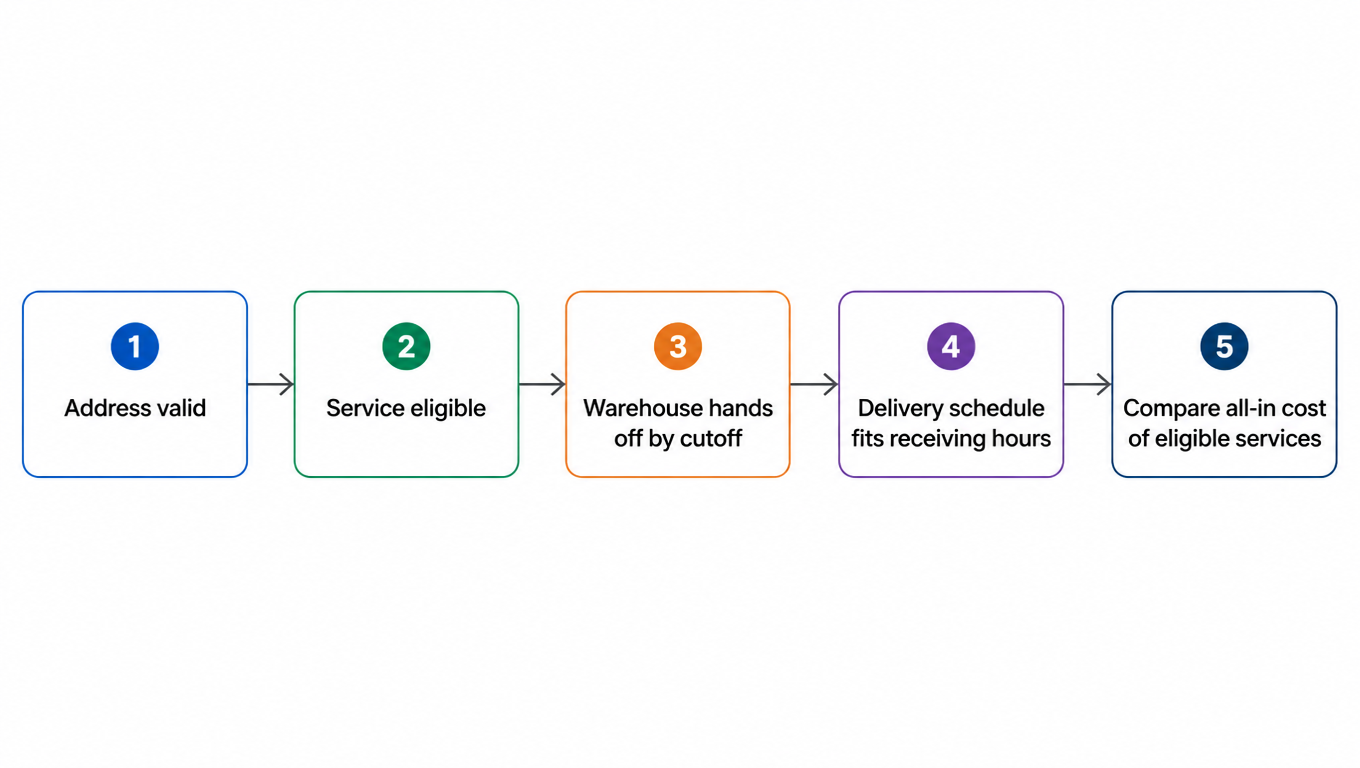
Treat the whole thing as a five-link chain, evaluated in order, with cost comparison last:
Receiving-hours compatibility comes before cost comparison
Address valid: the pipeline above already establishes this. It is still worth saying that a business address can validate at the delivery-point level while belonging to a company that moved out last month, which is why receiving information needs its own source and its own date.
Service eligible: carrier, service, and parcel profile all pass for this destination.
Warehouse hands off by cutoff: the date you compute has to start from the day the parcel actually leaves, which is not always the day the label is created. Orders created after cutoff, or on a day the carrier does not pick up, start their transit clock later.
Delivery schedule fits receiving hours: the carrier's service calendar and route pattern have to overlap with the days and hours when someone can receive.
Compare all-in cost: only after the four links above is price a meaningful comparison. A cheaper service that arrives outside receiving hours is not cheaper.
The information that fourth link depends on breaks into four groups:
Recipient side: receiving days and hours, temporary closures (holidays, inventory counts, vacation), a receiving contact and any standing instructions, and the source and last-updated date for each of those facts.
Your side: the warehouse cutoff, the actual handoff day, and what the destination can physically accept (dock or no dock, liftgate, weight and pallet limits).
Carrier side: the service calendar (which days count as transit days), the delivery commitment (end of day versus a clock time), and whether an appointment or delivery window is obtainable for that service at all.
Decision side: which alternate services stay eligible, and the all-in cost cap above which paying more stops making sense.
Two rules keep this honest. First, store receiving hours with a source and a timestamp, the way any structured schedule should be stored, because a receiving window recorded last year is a guess now. Structured formats exist for exactly this reason, and the OpenStreetMap opening_hours specification is a useful reference for how much detail a schedule actually needs.[^16]
Second, when the information is missing, do not fill the gap with an assumption and do not promise the customer an hour you cannot control. Record the assumption you did use, so that a later failure is traceable to it.
The decision framework below turns the check into an action. It is deliberately blunt about two things: missing information is a work item, not a permission slip to ship, and once a parcel is in the carrier's hands, service selection stops being a lever.
Validation result
Recommended action
Information complete, delivery schedule compatible
Compare the all-in cost of the qualified services and choose the cheapest
Recipient time information missing
Obtain it or review manually; record the assumption used and the date it was recorded
Delivery schedule clearly conflicts
Check other qualified services, or a different shipping arrangement that fits the receiving window
No option meets the commitment
Escalate to manual handling and customer communication; do not default to the cheapest option
Parcel already handed to the carrier
Move to the exception workflow; you cannot re-select a service as if the parcel had not shipped
The last row is the one teams learn the hard way. Re-routing is a pre-label decision. After handoff, the available moves change from choosing a service to managing an exception: intercept, redirect, reattempt, or hold for pickup, each with its own cost and its own success rate. That is why the receiving-hours check belongs where the pipeline already runs, before the label, next to the promise validation, since both answer the same question: can this service deliver on the date we told the customer, to a place that can actually take it?
10. Fallback Carrier vs Manual Review: Decision Tree
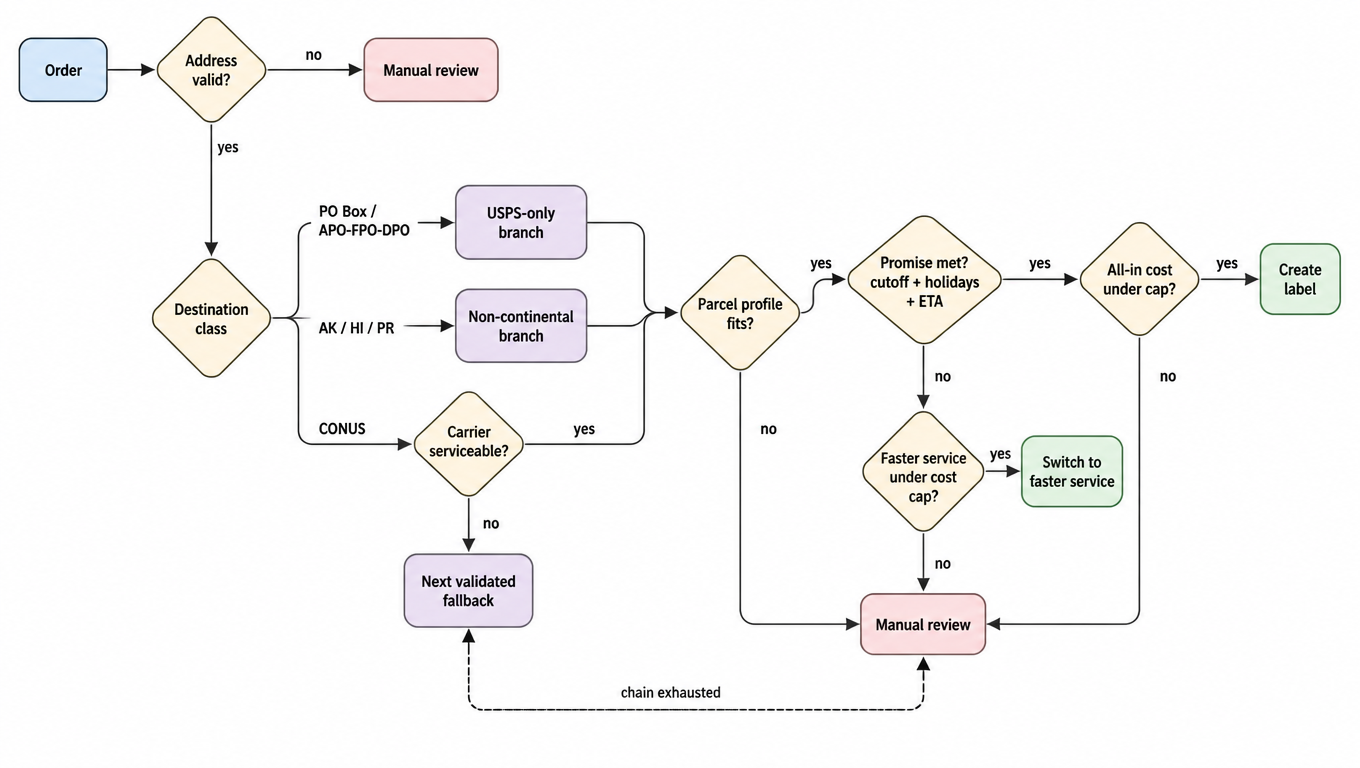
When a candidate fails, the next step is not automatically "try another carrier." It depends on the kind of failure, because the right response differs.
Data failure: the address does not validate, or the parcel data is wrong (impossible weight, missing dimensions). No carrier change fixes a data problem; fix the data or send to manual review.
Eligibility failure: the carrier does not serve the ZIP or the address type. This is the only case where walking the fallback chain is right, and every fallback candidate must be re-validated, never assumed.
Parcel failure: the service does not accept the weight, size, battery, or hazmat profile. Another carrier might, so the parcel check is part of fallback validation; but if no carrier accepts the parcel, it is manual review.
Promise failure: the service cannot deliver within the promised date given cutoff, holidays, and transit. The first response is a faster service on the same carrier or a different carrier, if it fits the cost cap.
Cost failure: the only eligible options exceed your all-in cost cap. This needs human judgment: the route is valid but uneconomic, so it goes to review rather than being silently shipped at a loss.
Fallback only for eligibility failures; everything else goes to manual review
A few rules keep the tree honest: fallback candidates must pass the full eligibility re-run, there must be a cost cap so a "fallback" never becomes an absurdly expensive label, and manual review is a first-class outcome, not a bug. A review queue with a human looking at five orders a day is cheaper than five undeliverable shipments.
11. Routing Rules That Respect Serviceability
Serviceability should be a hard constraint in your routing logic, applied before cost comparison. An undeliverable "cheap" route is not cheap, it is the most expensive option you have, because it converts a sale into a return. The pipeline above gives you a boolean per candidate: eligible or not. Feed that boolean into the router first, then compare rates only among eligible carriers.
Fallback chains need the same discipline as the primary route. If you route A to B to C when A fails, each step of that chain must be checked against the address and the parcel, not assumed. A common pattern is a carrier-agnostic eligibility check followed by a cost sort among the survivors, which keeps both correctness and price pressure.
Some rules are simpler than a full pipeline. PO Boxes, APO, FPO, and DPO ZIPs can be locked to USPS-only at the routing layer with a lookup table, because no other carrier can complete those deliveries anyway. Extended-area surcharges should be pulled into the cost calculation at routing time, not discovered when the carrier bill arrives, so that the rate you quoted at checkout survives contact with reality.
Finally, record the outcome. Store the chosen carrier, the service, and the validation results with each order. When a package does come back or a carrier bill shows an unexpected surcharge, you can trace exactly which check should have caught it, and you can measure whether your failure rate is actually improving.
12. Common Pitfalls and Edge Cases
Five-digit ZIPs hide more than they reveal. Two addresses in the same ZIP can have different serviceability at the ZIP+4 level, because carrier service areas are defined finer than five digits. Validate at the finest granularity your data source supports, and treat a five-digit pass as a preliminary signal, not a conclusion.
Carrier service data changes. Service areas are adjusted, extended areas shrink and grow, new services launch. A serviceability table you cached last year is a liability, so refresh carrier data on a schedule and re-run the pipeline whenever a rate or service definition changes.
New addresses and aliases slip through validation. A subdivision that just opened, a street renamed a decade ago, a customer typing the old house number: DPV catches many of these but not all, which is why the review queue exists. Never let an unvalidated address auto-route just because it "looks" fine.
Alaska, Hawaii, and Puerto Rico are special cases even when the ZIP is valid. Some carriers serve them only through specific services or ground relay arrangements, and the relay changes the transit time and sometimes the eligibility. Confirm the exact service, not just the ZIP.
And the cheapest mistake of all: validating the ZIP but not the street number. A ZIP can be fully served while the specific address inside it does not exist, and the package still comes back. Address validation and serviceability validation are two different checks, and both belong in the pipeline.
13. Build vs Buy: Options for Ecommerce Teams
A DIY integration means connecting to each carrier's rating API, parsing their serviceability errors, maintaining their service area files, and re-implementing all of it when any carrier changes their format. For a team shipping a few hundred orders a month, that maintenance burden usually outweighs the integration cost, and the failure mode is silent: your cached data goes stale and orders start misrouting without a crash to alert you.
Address validation SaaS (Smarty, Lob, and peers) solves the first step of the pipeline cleanly. It normalizes and validates addresses against USPS data, and some also expose carrier-level metadata. But it stops at validation: it does not route, it does not manage fallback chains, and it does not create labels, so you still build the pipeline around it.
Multi-carrier shipping platforms are the middle path. They maintain the carrier integrations, refresh the serviceability data, run the address and eligibility checks, and execute the fallback routing as one built-in flow, which is exactly the pipeline described here. The tradeoff is less control over the details in exchange for not owning the maintenance.
As a rough guide: if you already operate a label-creation integration and have engineering time to spare, DIY is viable. If you want validation without building carrier integrations from scratch, a platform that ships with the pipeline built in is the faster route to the same outcome, and it is the route we built at EasyShippingX.
14. WMS/OMS/API Implementation Fields
For the pipeline to be auditable and the rules maintainable, every check's inputs and outputs must be persisted with the order. If you cannot reconstruct, months later, why a package was routed to a given carrier, you cannot improve the rules.
The field list below is the audit trail. The OMS owns order and address data, the WMS owns parcel master data, and the shipping API layer executes the pipeline and returns the decision with reason codes. Persist all of them.
Field
Layer
Purpose
Normalized street, unit, city, state, ZIP+4, DPV status
OMS
Address validation result
destination_class
OMS
Destination class from section 5
address_type
OMS
Residential or commercial
Candidate carrier, service
API layer
What was evaluated
serviceability_status
API layer
Eligible, not eligible, extended-area
Parcel weight, L/W/H, dim weight, oversize flag, battery flag, hazmat flag
WMS
Parcel profile
Cutoff time, pickup schedule, holiday calendar reference
API layer
Promise inputs
Transit days, commit date, promised delivery date
API layer
Promise result
Base rate, surcharge breakdown, all-in cost, cost cap
API layer
Economics
Routing decision (carrier + service), reason code, fallback chain used
API layer
The decision and why
review_status
OMS
Auto-routed or reviewed by a human
Reason codes matter most. Every failure should map to exactly one check from the precedence order in section 7, so the scorecard in section 14 can tell you which rule is doing the work and which one is leaking.
API field checklist: when you evaluate a shipping API, ask whether serviceability errors are surfaced distinctly from rating errors, whether the response includes a commit date and cutoff rather than just transit days, whether surcharges come itemized, and whether every decision returns a reason code. A platform that returns only a price is returning step 7 with none of the steps before it. For testing details see the WMS shipping API integration testing guide, and for the broader build vs buy decision see shipping API for 3PLs: build vs buy.
15. Pilot Test and Exception-Monitoring Scorecard
Before you go live, run a pilot. Replay several months of real historical orders through the pipeline and confirm two things: orders that shipped fine still pass, and orders that failed are intercepted. Then run a targeted set of edge-case tests. Each scenario below has an expected behavior and a pass criterion, and your pipeline should produce exactly the expected outcome.
#
Scenario
Expected behavior
Pass criterion
1
PO Box + FedEx Ground
Intercept, route USPS-only
FedEx label never created
2
APO AE + UPS Ground
Intercept, route USPS-only
USPS label created
3
Rural Alaska ZIP + regional carrier
Not eligible, fallback
Next validated carrier chosen
4
Hawaii ZIP + FedEx Ground
Re-route to relay-capable service
Transit-adjusted service chosen
5
Puerto Rico + UPS Ground
Extended-area surcharge applied before quote
All-in cost includes surcharge
6
Residential address + commercial-only service
Intercept
Service swapped or review
7
Address fails DPV
Manual review
Order in review queue
8
ZIP valid, ZIP+4 outside carrier area
Fallback carrier
Next candidate re-validated
9
70 lb parcel + 50 lb service limit
Intercept
Parcel check fails cleanly
10
Oversize (length + girth over limit) + ground service
Intercept or parcel re-measure
No label created
11
Lithium battery flag + non-eligible service
Intercept
Battery-eligible service chosen
12
Order after cutoff + standard promise
Promise date shifts
Checkout promise recalculated
13
Holiday week + promise date on holiday
Delivery date shifts past holiday
New date communicated
14
Saturday promise + no weekend delivery
Intercept or date shift
No broken promise
15
Fallback chain exhausted
Manual review
Order never auto-ships
16
New subdivision address (not in DPV yet)
Manual review
No auto-route
17
Tracking / POD required + service lacks POD
Intercept
POD-capable service chosen
18
Fallback cost above cap
Manual review
Order flagged, not shipped
After the pilot, watch the numbers that matter month over month (targets below are illustrative, set your own): validation failure rate at intake, intercept rate, fallback usage, manual review rate, promise miss rate, return rate from undeliverable shipments, and surcharge dispute rate. Every exception maps to a reason code, which maps to the check that should have caught it. If promise misses stay high, the holiday calendar is wrong or the cutoff is optimistic; if the review queue is full of parcel failures, the parcel master data is dirty. The scorecard turns exceptions into a list of fixes, which is the whole point of building the pipeline. You can verify rate comparison and all-in cost with the rate comparison tool.
16. Implementation Checklist
Roll this out in the same order as the pipeline, and verify each layer before adding the next.
Address normalization and DPV on every order at intake. Fix what can be fixed automatically, intercept what cannot.
Carrier serviceability checks against each candidate carrier, at ZIP+4 granularity where available, refreshed on a schedule.
Service eligibility rules by address type: PO Box and APO/FPO to USPS-only, signature and weekend restrictions honored.
Parcel profile checks: weight, dimensions, battery and hazmat flags matched to service limits before routing.
Fallback chains that re-run the full eligibility check per candidate, with extended-area surcharges folded into cost comparison.
A review queue for orders that clear no route, staffed and monitored rather than auto-approved.
Logging of every routing decision with its validation results, so failures are traceable to the check that should have caught them.
Before you go live, replay a few months of real historical orders through the pipeline and confirm that the orders you know shipped fine still pass and the ones that failed are intercepted. After go-live, watch the numbers that matter: validation failure rate, return rate, reshipment rate, and carrier surcharge disputes, month over month. Each of those metrics has a check in this list that moves it, and each check is cheaper than the shipment it prevents.
Carrier serviceability validation is the set of checks that confirms, before a label is created, whether the carrier you selected can actually deliver to the destination. It is not the same as checking that a ZIP code exists: a ZIP can be real while a given carrier's ground service does not cover it. A full pipeline checks valid address, supported ZIP, eligible service, eligible parcel profile, and available fallback carrier in sequence, printing a label only on a full pass and intercepting, rerouting, or flagging for review on any failure.
Because a ZIP being real only means it exists in the USPS ZIP database, not that your chosen carrier covers it. Rural and remote areas, Alaska/Hawaii/Puerto Rico, PO Boxes, and APO/FPO/DPO military addresses can all break delivery for a given carrier. Address type (residential vs commercial), specific service eligibility (signature, weekend delivery), and extended-area surcharges are part of serviceability too. Evaluate per carrier and per address, never against a single ZIP list.
Not directly. PO Boxes are deliverable only by the USPS (and by carriers that hand off to USPS), so a FedEx or UPS label pointed at a PO Box will fail. APO, FPO, and DPO military addresses likewise run through the USPS-only military postal system. Routing rules should lock these ZIPs to USPS-only with a lookup table.
A six-step pipeline: (1) valid address via CASS normalization and DPV, (2) supported ZIP checked against each candidate carrier's service area, ideally at ZIP+4, (3) eligible service for the address type, (4) eligible parcel profile for weight, dimensions, battery, and hazmat rules, (5) available fallback carrier that re-runs steps 2 through 4, and (6) create label. Any failure intercepts: fallback carrier or human review.
It depends on whether you have engineering time. DIY means integrating each carrier's rating API, parsing serviceability errors, and maintaining service area files, with silent failure when cached data goes stale. Address validation SaaS only solves the normalization step. Multi-carrier shipping platforms package address validation, serviceability refresh, eligibility checks, and fallback routing into one built-in flow, which is the faster route to the same outcome.
Because a rate quote is not an eligibility decision. Rating APIs return a price for almost any carrier-service-destination pair unless the pair hard-errors; a number only means the pair can be priced, not that the service can complete the delivery, meet the checkout promise, or survive surcharges. Eligibility checks must run in a fixed order first (destination class, address, serviceability, service eligibility, parcel profile, delivery promise), and only then is all-in cost compared among eligible candidates.
Because the delivery promise equals the service's transit time minus non-operating days and weekend rules, on top of the warehouse cutoff. The USPS observes eleven federal holidays, while UPS and FedEx run their own schedules, so a Thursday order in a holiday week lands on different days depending on the carrier. Validating the promise with the holiday calendar and cutoff at routing time is how the date you showed at checkout stays intact.
Treat receiving hours as a separate validation layer from address validation. Confirm the address is valid and the service is eligible, confirm the warehouse can hand off before cutoff, then compare the carrier's delivery window against the recipient's receiving days, receiving hours, and any temporary closures. Store that information with its source and last-updated date. When it is missing, do not fill the gap with an assumption: route to manual review and record the assumption used. Compare all-in cost only among services whose delivery schedule is confirmed compatible. A parcel already handed to the carrier cannot be re-selected for a different service, only handled as an exception.
Can I pilot the cheaper second carrier before its coverage evidence is complete?
A low quote is not eligibility evidence. Record pending items and owners, validate the client, facility, service, destination, and parcel conditions, then confirm handoff before cost comparison.
Continue after this stage
Continue after reviewing this stage’s evidence and open items. If the conclusion is unresolved, retain the original path or assign manual verification.