Ecommerce Shipping Guide

Shipping Zones vs. Carrier Coverage vs. Delivery Area Surcharges: Why One ZIP Code Produces Three Different Answers

Take a hypothetical package: same package, same recipient address. You enter the ZIP and three carrier rate APIs return three very different numbers, and sometimes one of them simply says the address is out of service range. Most sellers' first reaction is "the system is buggy" or "this carrier is gouging me".

Neither is true. The three answers come from three different mechanisms working at the same time: the distance between the ZIP and the origin decides the zone [^2], the carrier's network decides whether it can deliver at all, and the density of the destination area decides whether a surcharge applies. This guide breaks all three layers apart, then gives you a self-check checklist and a decision framework for choosing a carrier. When you finish, you will know exactly where to look the next time three quotes disagree.

Three couriers holding a ruler, map and pricing sheet consider the same delivery address.
One address, three carriers, three answers

Three concepts, three different questions

Put the three concepts side by side first. They answer three completely different questions.

Shipping Zone: how far? A zone is the distance-based pricing scale. It answers "how far is the destination from the origin, and which band of the rate table does that distance fall into?".

Carrier Coverage: can it deliver? Coverage is the physical boundary of the carrier's network. It answers "is this ZIP inside my delivery network?". Outside the network there is no quote, not an expensive quote.

Delivery Area Surcharge (DAS): how expensive is the last mile? A DAS is a surcharge on remote, low-density delivery areas. It answers "how much does the last mile into this ZIP cost?".

The final quote is the superposition of all three: the zone sets the base rate, coverage decides whether a quote exists at all, and the DAS adds on top of the base rate. Change any one variable and the final number changes. Let's take them apart one by one.
Shipping Zones: a distance scale, not a ZIP property

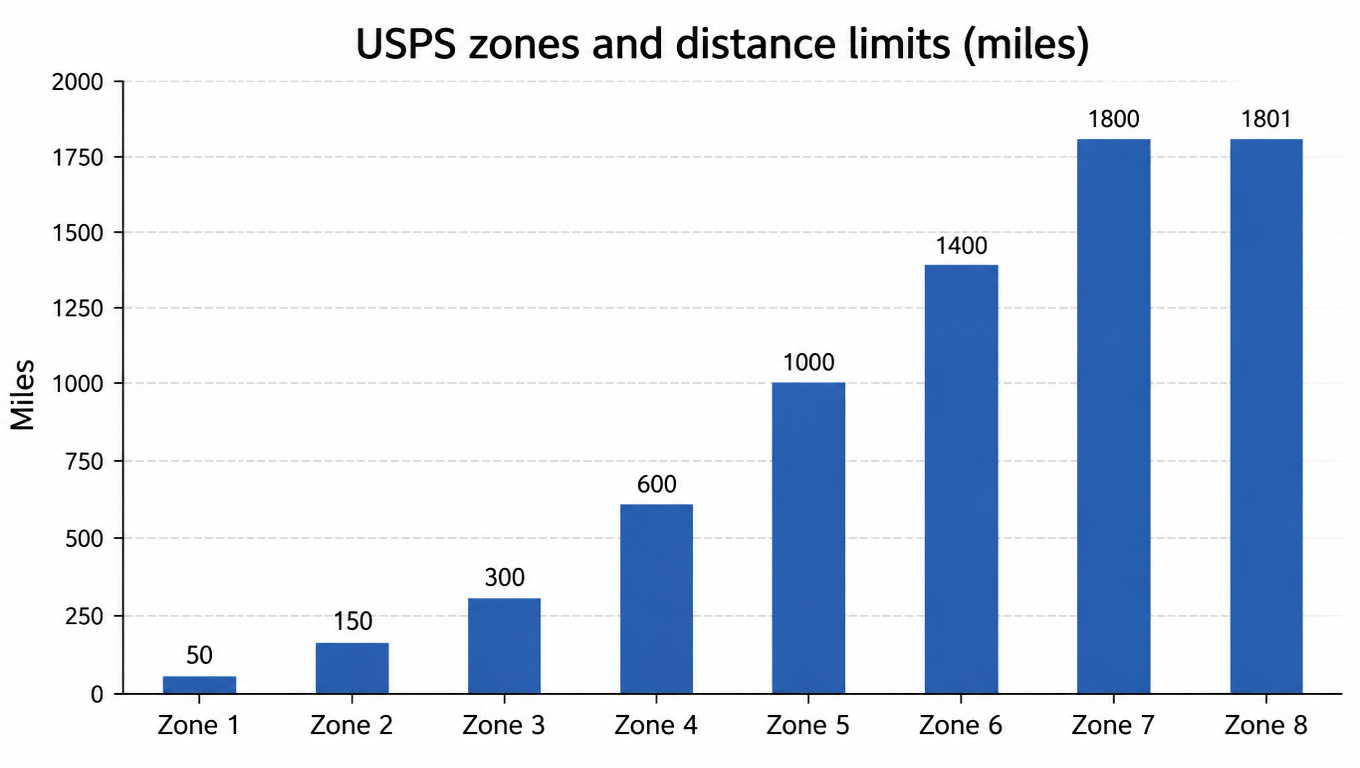
A zone is the scale the postal and parcel industry uses to band distance. The USPS divides the contiguous United States into 8 zones: Zone 1 covers up to 50 miles, Zone 2 is 51 to 150 miles, Zone 3 is 151 to 300, Zone 4 is 301 to 600, Zone 5 is 601 to 1000, Zone 6 is 1001 to 1400, Zone 7 is 1401 to 1800, and Zone 8 is anything over 1800 miles.[^1]

Bar chart: USPS Zone 1 to Zone 8 with their distance limits in miles
Zones are a distance scale: eight bands all the way past 1,800 miles

The key point: a zone is never an intrinsic property of a ZIP. The same destination ZIP sits in a completely different zone when shipped from New York versus from Los Angeles. Looking up a zone always requires both the origin and destination ZIPs.[^2] UPS and FedEx keep their own zone tables, which do not match USPS exactly, and each carrier applies its own base rates to its own zones. That is why "the same ZIP gets cheaper when I change the origin": what changed is the zone, not the ZIP. For the full USPS zone-based rate structure, see our USPS Ground Advantage pricing guide.

Carrier Coverage: the physical boundary of delivery

GOFO, SwiftX, UniUni, and SpeedX services offered through EasyShippingX: Delivery to APO/FPO/DPO military or diplomatic addresses and PO Box addresses is not supported, even when the destination ZIP is within the coverage area.

Coverage answers the most basic question: does this carrier's delivery network actually reach this ZIP? National networks (USPS, UPS, FedEx) cover nearly the entire continental US, but regional carriers do not. Regional networks like OnTrac and GOFO started on the West Coast and have been expanding aggressively in recent years (OnTrac now covers 30+ states[^9] and GOFO requires product-specific ZIP validation[^10]), but coverage still is not 100%: ZIPs outside the network simply get no quote.

No quote and an expensive quote are two different things. An expensive quote means the network reaches the ZIP, just at a higher base rate or surcharge. No quote means the ZIP is outside the service area, so you are not even in the running to compare. In ecommerce, "address not in service range" usually comes from regional carriers, and sellers often misread it as "too expensive" when the carrier never participated in pricing at all. Before you compare rates, confirm serviceability first, with our carrier serviceability validation guide.

Coverage also changes over time. Carriers adjust their networks every year and regional carriers keep expanding, so a ZIP that was undeliverable last year may be deliverable this year. Coverage is a dynamic boundary that needs periodic re-checks, not a fact you verify once and forget. For current coverage and expansion across the US regional networks, see our US last-mile delivery carriers analysis.

Delivery Area Surcharges: the hidden cost of the last mile

A DAS is a surcharge on remote, low-density delivery areas, keyed to the destination ZIP rather than the distance. A ZIP can sit in Zone 2, close to the origin, and still carry a heavy DAS because it lies in mountains or a sparsely populated region where last-mile delivery is expensive. Two ZIPs in the same zone can therefore end up with very different final prices.

Charge categories are not interchangeable. Check current carrier ZIP lists for UPS Delivery Area and Extended Area Surcharges[^6] and FedEx DAS[^4]. USPS Priority Mail states that it has no fuel, residential, rural, or Saturday delivery surcharge; dimensional weight, nonstandard size, and extra-service fees can still apply. Do not describe it as using a rural-ZIP surcharge list to achieve the same mechanism. Verify current product-specific rules and charges.

USPS Priority Mail fee guidance

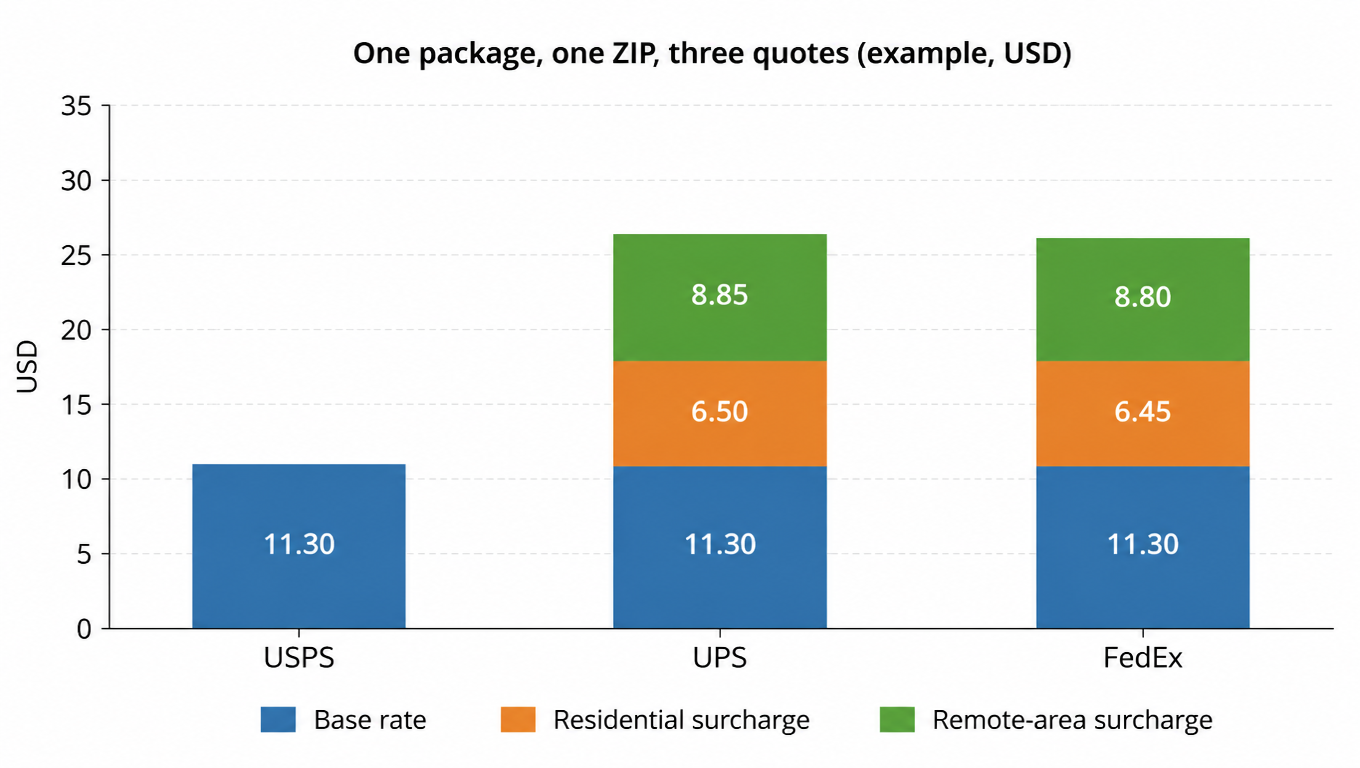
A worked example makes the structure visible. Take a 2 lb package from Phoenix (85001) to a remote ZIP in Montana. The base rates in this example exist only to show the structure; the surcharges follow the public 2026 rate cards, and actual prices vary by contract and by date.[^11] USPS Priority Mail has a base rate of about $11.30 with no separate rural delivery surcharge. UPS Ground has a base rate of about $16.20, plus a $6.50 residential surcharge and an $8.85 remote-area surcharge, about $31.55 total. FedEx Ground has a base rate of about $16.40, plus a $6.45 residential surcharge and an $8.80 remote-area surcharge, about $31.65 total.

Stacked bar chart: one package, one ZIP, three quotes broken down. USPS has no surcharge; UPS and FedEx each add residential and remote-area surcharges (example, USD)
The gap is not in the base rate, it is in the last mile

That is where the gap comes from: the three base rates are close, but UPS and FedEx each add a substantial last-mile fee [^11], ending up noticeably more expensive than USPS. If you only look at the final number, UPS looks like the expensive one; once you break it apart, you see the last mile is expensive, not the base rate.

Why one ZIP produces three answers

Now the three mechanisms snap together. The zone answers "from where to where, and how far", coverage answers "does the network reach", and DAS answers "how expensive is the last mile". They vary independently, and when any one of them changes, the quote changes:

  • Change the origin, the zone changes and so does the base rate;
  • Change the carrier, both the coverage and the DAS determination may change, and a regional carrier may return no quote at all;
  • With the same carrier and the same origin, a DAS list update changes the quote for the same ZIP.

A rate API returns a single aggregated total and never tells you which layers make it up. Breaking the total back into zone, coverage, and DAS is the only way to see where a difference comes from and where to optimize. Two mistakes are common: treating the zone as a fixed property of the ZIP, then being confused when the origin changes; and treating DAS as bad luck, as if you occasionally stepped on it. In reality DAS is structural. Remote ZIPs are simply more expensive, and that is predictable and auditable.

A self-check checklist for your quotes

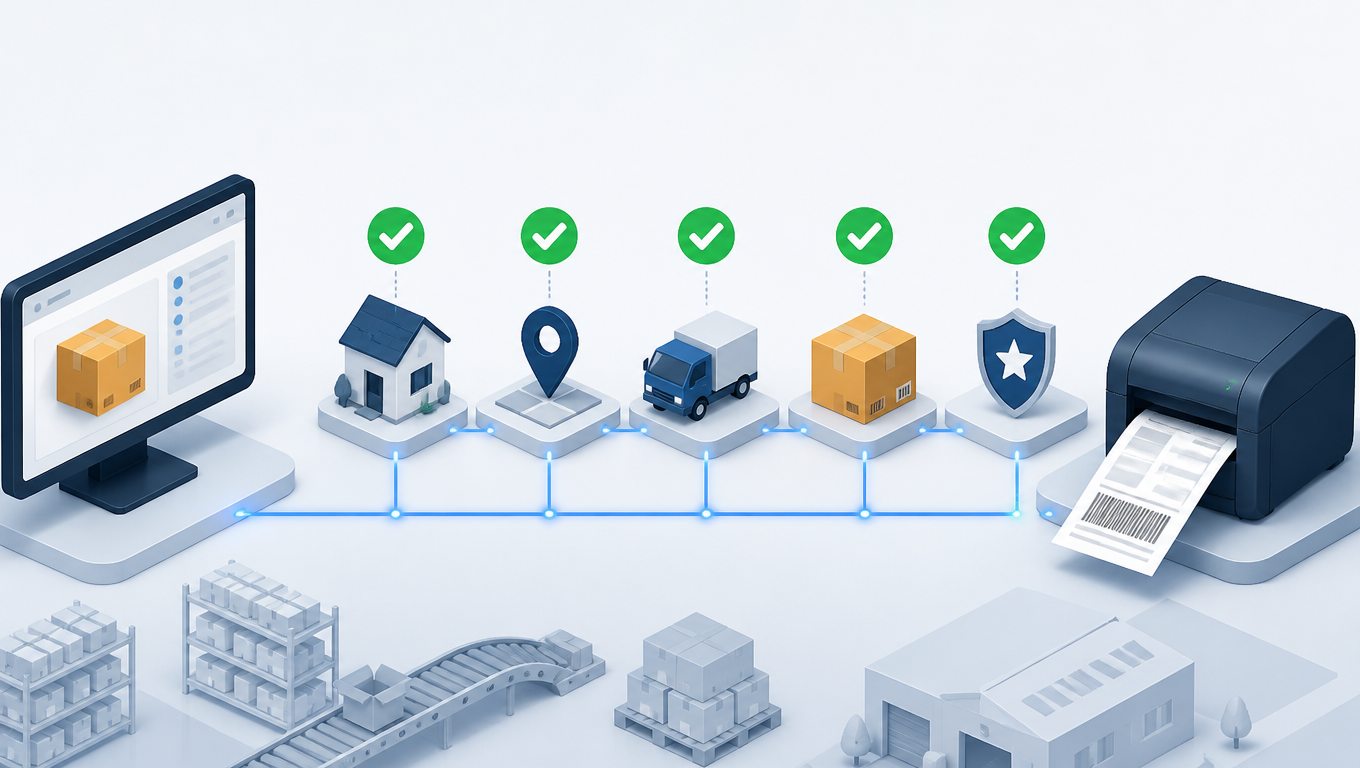
Next time a quote lands in front of you, do not compare totals first. Break it down in this order:

  1. Look up the zone. Use the USPS zone chart or PostCalc[^2] with both the origin and destination ZIPs and confirm which zone the package falls into. Re-check when the origin changes, because the zone moves with it. You can also run the lookup directly in our ZIP-to-ZIP USPS zone calculator.
  2. Check coverage. First confirm the carrier's network serves this ZIP. This step is mandatory for regional carriers: a missing quote means "cannot deliver", not "expensive".
  3. Check the DAS. Compare against the newest DAS ZIP list on the carrier's site, refreshed annually with in-year additions.[^7][^8] Old lists lie.
  4. Break down the quotes. Get at least three quotes for the same package and split each total into base rate, residential surcharge, and remote-area surcharge to find which layer each carrier is expensive on. Our shipping cost calculator is built for exactly this line-by-line comparison.
  5. For 3PL operations: filter cost by DAS instead of looking at average rates. A 3PL's average cost per parcel can look healthy simply because remote parcels are averaged away; separate accounting by DAS ZIP is the only way to see the real cost structure.

A decision framework: choosing carriers and optimizing

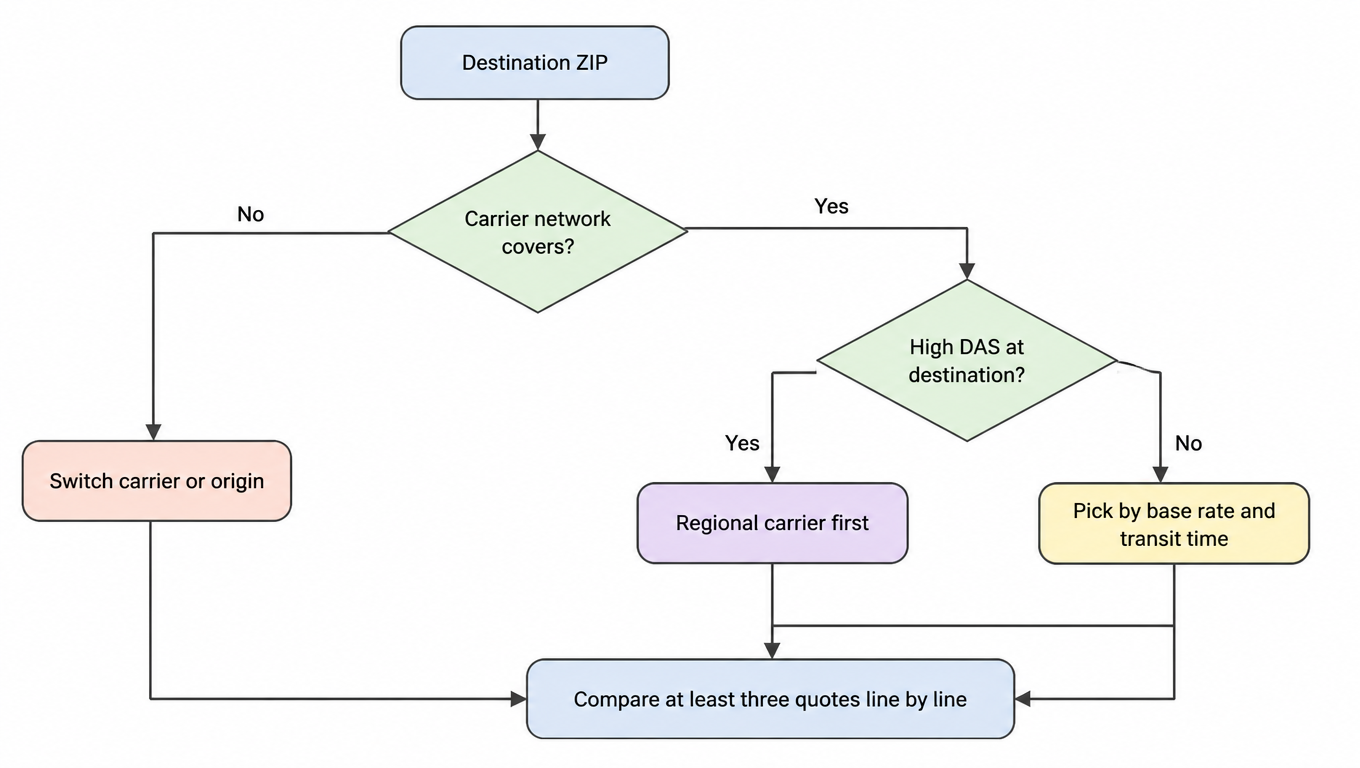
Feed the checklist results into a simple decision flow: coverage first, then DAS, then base rate.

Flowchart: identify the destination ZIP, ask whether the carrier network covers it, if not switch carrier or origin, if yes check whether the DAS is high, if high prefer a regional carrier, if low pick by base rate and transit time, then compare at least three quotes line by line
Coverage first, last-mile cost second, base rate last

When should you use a regional carrier? When the destination ZIP is inside the regional network and the last-mile cost is low: in that scenario, regional carriers are often cheaper than national networks because their delivery network sits closer to the ground. When should you change the origin? For high-zone long-haul parcels, shipping from an origin closer to the customer, through split warehousing or a fulfillment center, drops the zone directly and cuts the base rate immediately. We have a dedicated guide on exactly when a regional carrier actually saves you money.

Treat one-off parcels and volume differently. For one-off parcels, for example, run the flow above and pick the best single shipment. For volume going through a 3PL, use the DAS ZIP share as the basis for carrier selection and pricing negotiations instead of the blended average rate.

One final principle: pick carriers with data, not with feel. The same ZIP will produce different answers at different times and across different carriers, because that is how the industry is structured, not because of magic. Run the checklist above once a quarter and your cost structure will be clearer than most of your peers'. To place this layer inside a complete strategy, see our multi-carrier shipping strategy guide.

Summary

Three sentences to wrap up: the zone decides how expensive the base rate is, coverage decides whether anyone delivers at all, and DAS decides how expensive the last mile is. One ZIP produces three answers because three mechanisms vary independently, not because the system is broken.

The action item is simple: next time you check a quote, break it apart first. Split the total into zone, coverage, and DAS, and every comparison and every carrier negotiation you run from then on will be clearer than before.

FAQ

Because the final quote is the superposition of three independent mechanisms: the zone sets the base rate (how far), coverage decides whether a quote exists at all (does the network reach), and DAS decides how much the last mile adds (how dense the destination is). Change any layer and the number changes, which is why the same ZIP can produce different answers across origins, carriers, and dates.
A zone is a distance scale determined by the distance between origin and destination. A DAS is a surcharge on remote, low-density delivery areas, keyed to the destination ZIP. A ZIP can be close to the origin (Zone 2) and still carry a hefty DAS because it sits in mountains or a sparsely populated area.
Query serviceability using the product, origin warehouse, and destination ZIP. GOFO Parcel and other products use different footprints. If no rate is returned, inspect eligibility, parcel details, or an API error before choosing an alternative.
Lists update at the start of each year with quarterly additions through the year, and roughly 200 DAS ZIPs were added in 2026 alone. An old copy of the list can be outdated, so check the carrier's latest official list before you compare quotes.
Break it down in order: look up the zone with both origin and destination ZIPs using a zone chart or a ZIP-to-ZIP calculator; then confirm the carrier's network serves the ZIP (mandatory for regional carriers); finally compare against the carrier's latest official DAS ZIP list. Once the three steps are done, the source of any quote difference is clear.

Want to see shipping costs the way rates are actually built?

The EasyShippingX multi-carrier quoting API returns a total while keeping the layers visible: serviceability checks first, regional network coverage decided per ZIP, and DAS lists kept in sync with carrier updates. Every comparison, reconciliation, and carrier negotiation can start from the layer that actually drives the number.