
Carrier Mix Guide

When to move from a single carrier to a multi-carrier shipping strategy

A single-carrier workflow is often the simplest way to start, but it becomes restrictive as volume grows, destinations diversify, and peak periods add pressure. A multi-carrier shipping strategy is not just about adding more carriers. It is about designing a more resilient shipping operation around shipment profile, team structure, and rollout pace.

Editorial illustration of a warehouse operator at a packing bench holding a parcel in one hand and a shipping label in the other, four simple line icons around the figure standing for a delivery van, a sorting bin, a map pin, and a checklist, black ink with a few orange accents on a white background.
One warehouse, several paths, and the segment defined before the assignment

Move from portfolio planning to a second-carrier evaluation

This guide covers carrier roles, routing, and review across the portfolio. Move into a second-carrier evaluation when you can name a warehouse, client, and parcel segment that may need a complementary path alongside USPS. That keeps a portfolio decision from turning into a wholesale replacement.

Evidence to prepare
Record the origin and handoff conditions, destination ZIPs and address types, weights and dimensions, delivery promises, current costs, and exceptions. Keep the comparison within the same shipment segment and identify the record period and unsettled charges.
If evidence is incomplete
Build the baseline when the current path or comparable records are unstable. Verify eligibility and handoff when coverage or collection conditions are unclear. Keep using the primary path without expanding automated diversion.
Next decision
Use the five-stage evaluation to continue, supplement locally, or pause for that segment. Name an owner and preserve the existing route before piloting. Use both cost and service outcomes to support expansion.
Why single-carrier models often break down as operations scale

Use the U.S. last-mile market analysis to understand the network changes behind the decision, then the carrier-mix role guide to decide what each additional provider is meant to do.

Single-carrier operations are simple to train, easy to manage, and straightforward to integrate. Their weakness is that every order, region, and peak fluctuation must fit one service model. As soon as one dimension no longer fits, the team absorbs the mismatch through manual work. The real value of a carrier mix is not having more options for the sake of it. It is about routing different order types through better-fit workflows so cost and exception risk improve at the portfolio level.

ScenarioSingle carrier outcomeCarrier mix value
Nationwide lightweight parcelsOften acceptableChoose a baseline for the main segment, then validate regional backup
Regionally concentrated demandMay miss a better-fit laneUse current ZIP serviceability and pilot results to screen regional networks
Peak season volatilityCapacity and exception risk concentrate fasterPreserve routing flexibility and backup lanes

When teams should not rush into a carrier mix

When the requirement concerns route execution or driver dispatch, use the delivery-management and shipping-software comparison to define the software boundary before adding parcel carriers.

A carrier mix is not always better simply because it starts earlier. If the team has not stabilized the primary workflow, if order fields are still inconsistent, or if portal, Excel, and API workflows do not even share the same input definitions, adding a second path only increases complexity. Mature carrier strategies usually begin after the team understands its baseline process and can clearly identify which order segments deserve a separate routing rule.

Current stateBetter next move
Primary carrier workflow is still unstableStabilize the primary lane before expanding
Field definitions are still changingStandardize field definitions across portal, Excel, and API first
Billing and exception review is still weakImprove tracking and reconciliation before adding routes

Define the shipment segment before comparing carriers

The fulfillment-center carrier planning guide helps turn the warehouse order mix into an operating plan. Use the carrier selection requirements to write the brief that each candidate must satisfy.

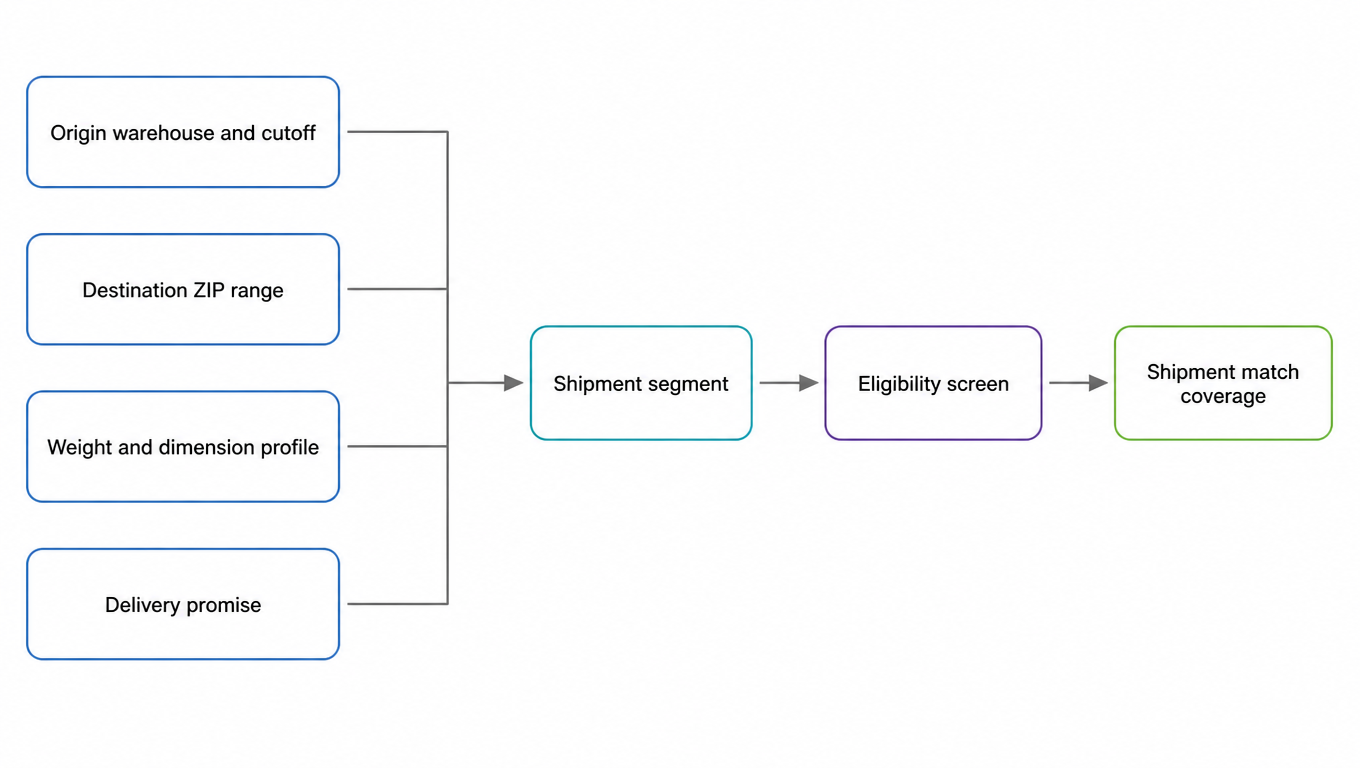
A carrier only means something against a shipment group you can name. A segment is a repeatable set of shipments that share an origin, a destination range, a package profile, and a delivery promise. Two orders that look identical on the packing bench can belong to different segments once ZIP mix, dimensional profile, or promised transit changes.

Defining the segment first also avoids the most common mistake in carrier expansion: choosing a provider and then hunting for shipments that fit it. Reversed, the question becomes whether every eligibility condition in this shipment group can be met by a service the account already has.

DimensionWhat to write downWhy it changes the fit
Origin and handoffWhich warehouse, which dock, what cutoff, who collectsReaching the destination is not the same as collecting at your dock
Destination rangeStates, ZIP prefixes, PO boxes, multi-unit or rural addressesTheir coverage footprint is not your order coverage
Package profileWeight, dimensions, packaging, value, batteries or liquidsEligibility is not decided by weight alone
Delivery promiseCheckout expectation, client tier, signature and tracking needsA lower price cannot override a promise already made

The number worth computing is shipment match coverage: of the shipments you intend to route to the new service, how many meet every eligibility condition rather than only the weight limit. A service that covers part of a segment is a partial improvement, not a replacement, and the rest still needs a documented path. For the verification method, see carrier serviceability validation.

Flowchart: origin warehouse and cutoff, destination ZIP range, weight and dimension profile, and delivery promise together define a shipment segment, which passes an eligibility screen to produce shipment match coverage
Four dimensions define the segment, and coverage only comes after the eligibility screen

Pass readiness gates before assigning carrier roles

Apply the same gates to origin-specific planning, as in the Texas warehouse carrier-planning example. For marketplace orders, review the Seller Fulfilled Prime readiness checks or the TikTok Shop fulfillment comparison before committing the workflow.

A second carrier creates value only when it solves a measured problem. If the team cannot answer which shipments move, why they move, who owns the rule, where failures fall back, and how outcomes will be proven, fix the baseline before adding accounts.

Readiness gatePassNot ready
Can the problem be isolated by segment?Create candidate segmentImprove data and baseline reporting
Are current cost and service outcomes reviewable?Define comparison metricsFix reconciliation and event normalization
Can warehouse and systems execute a second path?Design route and overrideExercise label, sort, handoff, and exception flow
Has fallback been validated?Run a narrow pilotDo not automate routing
Multi-carrier readiness: isolate problem → compare baseline → support execution → validate fallback
RoleWhat it carriesWhat it should not carry
PrimaryLargest stable segment with mature executionIneligible or promise-breaking shipments
ComplementSpecific ZIP, weight, parcel, or service needUnvalidated areas or vaguely “cheaper” shipments
OverflowPre-approved capacity or peak diversionFirst-time, untested emergency volume
FallbackShipments that still meet the minimum promise when preferred path failsBypassing contents, address, or parcel eligibility

Four steps to build a carrier mix strategy

1. Establish a primary carrier baseline

Start by identifying a primary carrier baseline. USPS is often that baseline for standardized lightweight parcel workflows.

2. Add complement carriers by shipment profile

Secondary carriers should be introduced by parcel weight, destination concentration, delivery priority, and exception profile.

3. Keep the execution workflow consistent

A good carrier strategy should still operate through one portal, one API model, or at least one Excel upload structure so the team experiences multiple carriers through a consistent workflow.

4. Validate the result through tracking and reconciliation

The real test is whether tracking exceptions, billing exports, reversals, and shipment fields become easier to review and manage.

Once the problem is isolated to comparable shipments, use the second-carrier need assessment to record why you continue, supplement, or pause. Keep candidate services out of the pilot until coverage and handoff are validated.

Move from a carrier list to a routing policy

Translate the approved policy into SKU-level shipping rules. Keep address restrictions explicit with the PO Box address-type checks, so a low quote cannot bypass an eligibility rule.

The core output of a multi-carrier strategy is not a carrier list but an explainable selection order. For every shipment, first remove paths that fail address, contents, dimensional, weight, or service-promise requirements, then compare projected total cost. If the preferred service is unavailable, fall back through a pre-approved order and record why the final option was selected.

Routing layerPrimary checkTypical guardrail
ServiceabilityPostal code, address type, contents, dimensions, and weightIneligible services never enter price comparison
Order promiseCheckout expectation and client tierA lower price cannot override the promised service
Projected total costPostage, dimensional impact, extra services, and exception costRetain quote version and selection reason
Capacity and fallbackCutoff, pickup, system status, and warehouse readinessPilot fallback paths before peak volume arrives

Define manual-override boundaries before automating selection

Automation should return the carrier, service, and a readable reason. A manual override should require a reason while retaining the original recommendation. This lets the team separate rule defects, data problems, and genuine exceptions. Continue with the automated carrier selection guide for rule inputs, precedence, and fallback design.

Evaluate the mix by outcomes rather than quotes

Compare on-time delivery, delayed first scans, exception rate, cost per successful delivery, override rate, and quote-to-invoice variance by carrier and shipment segment. Expand routing only after outcomes remain stable across multiple review cycles; if a lane wins only in the quote table, keep the pilot narrow.

What a second carrier really costs

A carrier mix is often argued from the difference between two label quotes, but the quote is one line of the incremental cost. The decision needs the change in total cost for the same set of shipments across both networks, not the gap between two headline prices.

Cost itemWhat it includesWhat teams miss
Label and surchargesPricing, dimensional weight, residential and remote add-ons, fuelComputing from a quote instead of a mature invoice
Access and handoffAn extra stop, self-drop-off, dock and loading timeLabor and vehicle time at a second collection point
Added operating workSorting the split, label checks, bench instructions, trainingRework during the ramp-up of a new flow
Net exception costClaims, reships, support contact, returns handlingCounting only the shipments that arrived
Incumbent termsDiscount tiers, collection frequency, or minimum volume after divertingRecomputing the volume that stays behind

A second name on the label is not always a second network. Several services hand off to the same final-delivery provider, so two accounts can fail on the same day in the same ZIP. Before counting a path as redundancy, confirm who performs the last mile, where the handoff happens, and what would change that arrangement.

That is why the unit of comparison is a plan rather than a provider: the combined cost of the new path plus the volume that stays behind, the added operating work, and the net exception cost, all measured against the current baseline. For the full cost structure, continue with the real cost of adding one more carrier.

Pilot the lane before you scale it

If delayed imports create a sudden release of local orders, use the delayed-import parcel capacity plan to set the dispatch scope and capacity checks before increasing the pilot volume.

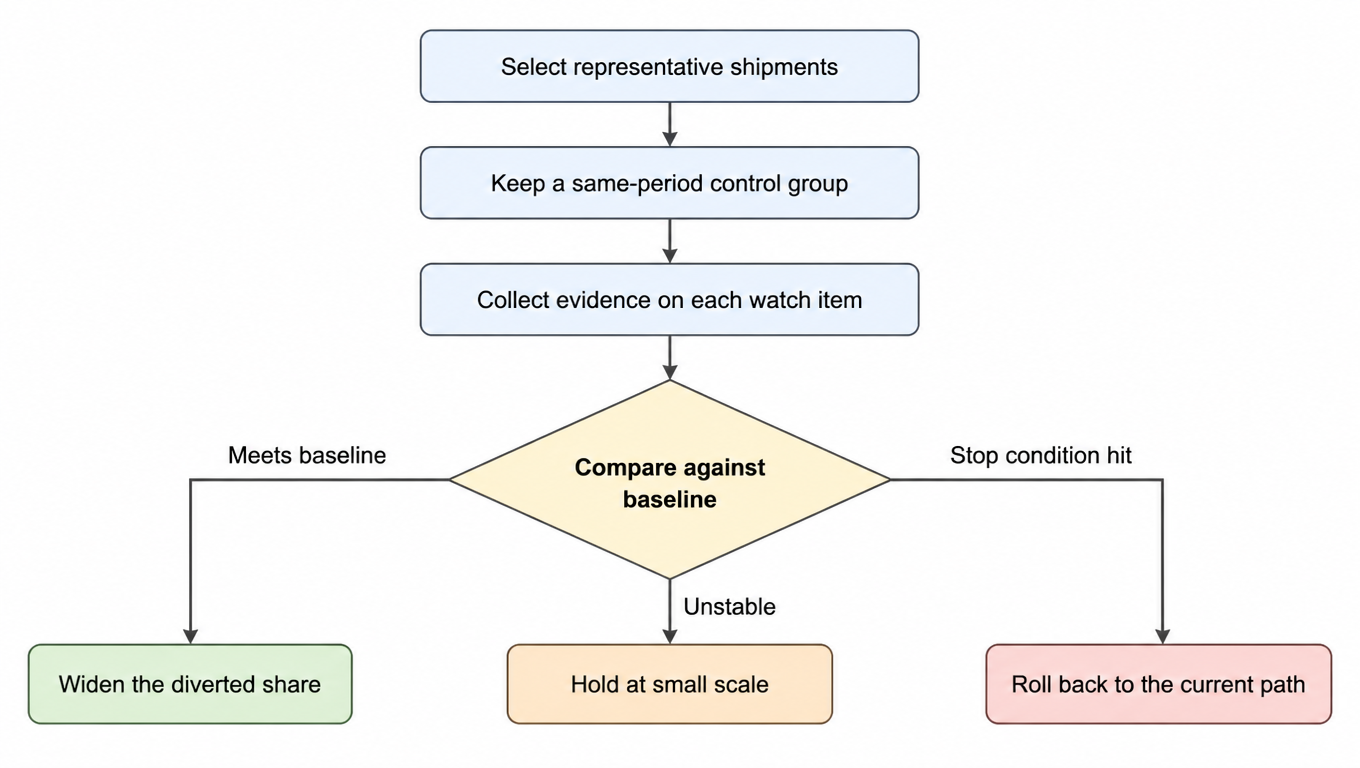
A pilot only has to answer one question: does this service hold up on this segment under normal conditions? That requires a comparable set of shipments, a same-period control, and a definition of failure written down before the first label.

Pilot elementWhat to write down
SelectionDrawn from the target segment across main destinations and weight tiers, not skewed by a promotion or one large client
Control groupSimilar shipments kept on the current path in the same period, so the difference can be attributed to the service
WindowA full invoicing cycle rather than a single shipping week
Watch itemsFirst acceptance scan, promise-date attainment, damage and loss, support contact, proof-of-delivery completeness, and the gap between quote and mature invoice
Stop conditionWritten in advance: what triggers an immediate pause and rollback

Failure has to be defined before the first label prints. A service that hits the promise date but produces a billing dispute every other shipment is not passing; one that misses an occasional scan yet still delivers on time is not automatically failing. Both thresholds should come from your own baseline, meaning how the same segment performs today, rather than from a borrowed industry figure.

Flowchart: select representative shipments and keep a same-period control group, collect evidence on each watch item, compare against the baseline, then widen the diverted share if it meets the baseline, hold at small scale if results are unstable, or roll back to the current path if a stop condition is hit
A pilot has three exits: widen, hold small, or roll back

Review cadence: expand, restrict, or roll back

A carrier mix is a standing decision rather than a one-time project. Surcharges, service names, coverage, and handoff arrangements change on the provider's schedule, not yours, so an assignment that was correct at launch can drift without anyone making a mistake.

TriggerQuestion to reopenDecision output
Standing reviewOn-time rate, exception rate, cost per successful delivery, and override share per pathMaintain, widen, or reduce
Provider announcementChanges to service names, coverage, billing structure, or the final-mile handoffRe-verify eligibility and total cost
Billing varianceWhich segment keeps showing a gap between quote and mature invoiceFix the rule or move the path
Before peakWhether the fallback still has capacity, cutoff, and handoff capabilityWhether it can genuinely absorb volume
Client or channel changeA new destination mix, SLA, or package profileRedefine the shipment segment

Rollback should be rehearsed as carefully as the rollout. When a path degrades, the team needs a pre-approved order to fall back to, a way to reverse the routing rule, and a named owner for the decision. Without those, one bad week turns into an improvised scramble at the packing bench.

Every assignment decision should leave a reason behind: why this shipment took this path, who changed the rule, and which version of the rule applied. For the review structure, continue with the carrier performance scorecard and testing a backup carrier before peak season.

Frequently asked questions

Is it always better to add multiple carriers early?

No. A carrier mix creates real value only after the primary workflow is stable and shipment segments are clear enough to route intentionally.

How should teams choose the second carrier?

It should be chosen by weight profile, regional concentration, delivery expectations, and exception handling pressure rather than preference alone.

Does a carrier mix always make operations more complex?

It can, if execution paths stay fragmented. The practical goal is to keep portal, API, or Excel workflows as consistent as possible across carriers.

How should teams validate whether a carrier mix is working?

Teams should review tracking exceptions, billing exports, reversals, and shipment-level auditability instead of only comparing headline label prices.

How many carriers does a mix need?

There is no fixed number. It depends on how many definable segments you run and how much redundancy each one needs. What matters more than the count is whether every segment has a validated primary path and a documented fallback.

Does a second path always slow the warehouse down?

Not necessarily, but it will if the split is not designed. Keep one execution entry point and one set of field definitions so the packing bench follows instructions instead of memorizing provider-specific rules.

What should a fallback path prove before it matters?

At a minimum: that it can collect from your warehouse on schedule, that its cutoff matches your outbound rhythm, that its coverage actually matches your order mix, and that handoff exceptions have an owner and evidence.

What if the new path only looks cheaper on the quote?

Keep the pilot narrow and wait for mature invoices before comparing. If the advantage only exists in the quote table, do not widen the diverted share.

Need a more specific carrier mix recommendation?

Share your shipment profile and we can review carrier fit, routing logic, and onboarding path together.

Turn the review into operational preparation

For procurement teams in Canada, Europe, or elsewhere, separate company location from the actual U.S. shipping workflow: picking and packing U.S. inventory, or tendering parcels after import release. Customers or partners own the upstream stages in both workflows; carrier selection still depends on product eligibility, tender location, full charges, and pilots. A 4PL should record the executing warehouse owner, client ownership, and escalation path in each routing rule.

Use order samples to request a rate review and system requirements for the API product and onboarding evaluation. A strategy scorecard is not a live quote, service promise, or activation list.

Before peak, verify capacity, cutoffs, and fallback paths with the peak-season carrier plan. During a disruption or service reduction, use the carrier disruption decision guide to distinguish holding, rerouting, and switching, with eligibility checks and an approval record.