Ecommerce Shipping Guide

How to Test a Backup Carrier Before Peak Season: A Failover Readiness Framework

"We have a backup carrier under contract" sounds like insurance, but a signed contract does not mean the carrier can hold your volume. In the last few seasons, USPS rate increases [^1] and peak surcharges [^2] turned carrier risk from an IT incident into a business decision. When the primary carrier fails, whether through an API outage or a surcharge that destroys your margin, the backup carrier stops being a line item in a contract and becomes the company running your delivery promise. The question is whether it can.

Most backup carriers are onboarded once and then ignored: the rate table on file drifts from the rate card in the contract, a label format that validated in March stops validating in October, and zone data, tracking feeds, and exception codes each decay on their own schedule. Failures appear in three layers: rates (what you pay), labels (how you ship), and tracking (what your customer sees), and none of them announce themselves. This guide gives you a four-dimension test framework: suggested timing per dimension, a static readiness scorecard, and one live failover drill under real volume.

Dispatch desk with parcels and two delivery routes on a map, highlighting the backup route in orange.
A backup carrier is not a line item. It is a route that has to actually work.

Why a Contracted Backup Carrier Isn't Automatically Ready

Peak season planning usually ends with the sentence "we have a backup carrier under contract," and that sentence feels like insurance. But in the last few seasons, USPS rate increases [^1] and peak surcharges [^2] have turned carrier risk into a business decision, not an IT incident. When the primary carrier fails, whether through an API outage or a surcharge that destroys your margin, the backup carrier stops being a line item on a contract and becomes the company running your delivery promise. The question is whether it can.

Most backup carriers are onboarded once and then ignored. The rate table on file drifts from the rate card in the contract. The label format that validated in March stops validating in October. Zone data, tracking feeds, and exception codes each decay on their own schedule. Failures appear in three layers: rates (what you pay), labels (how you ship), and tracking (what your customer sees). None of them announce themselves.

The two audiences this framework is written for feel these failures differently. A self-fulfilling seller hits checkout-rate surprises and a single label that will not generate while a rush order is on the clock. A 3PL or fulfillment center hits batch manifests, file-format incompatibility, and integration failures across hundreds of parcels at once. The framework below works for both: four test dimensions, each with a suggested time to run before peak, a static readiness scorecard, and one live failover drill under real volume.
Step 0: Define Your Failover Scope and Triggers

Before testing anything, write down what actually triggers a switch. Common triggers: a sustained peak surcharge above a defined threshold, a primary-carrier API outage past a time limit, or an on-time performance rate that drops below your floor. A trigger without a number is a debate waiting to happen in the middle of November. Put the number in the runbook.

Then decide scope. Which lanes, zones, weight tiers, and product lines must the backup carrier cover? A backup that handles your 2 lb domestic ground parcel may be useless for your 40 lb regional overnight lane. Set target SLAs for the backup: cost per package, transit time, scan coverage, and exception rate, each measured the same way you measure the primary.

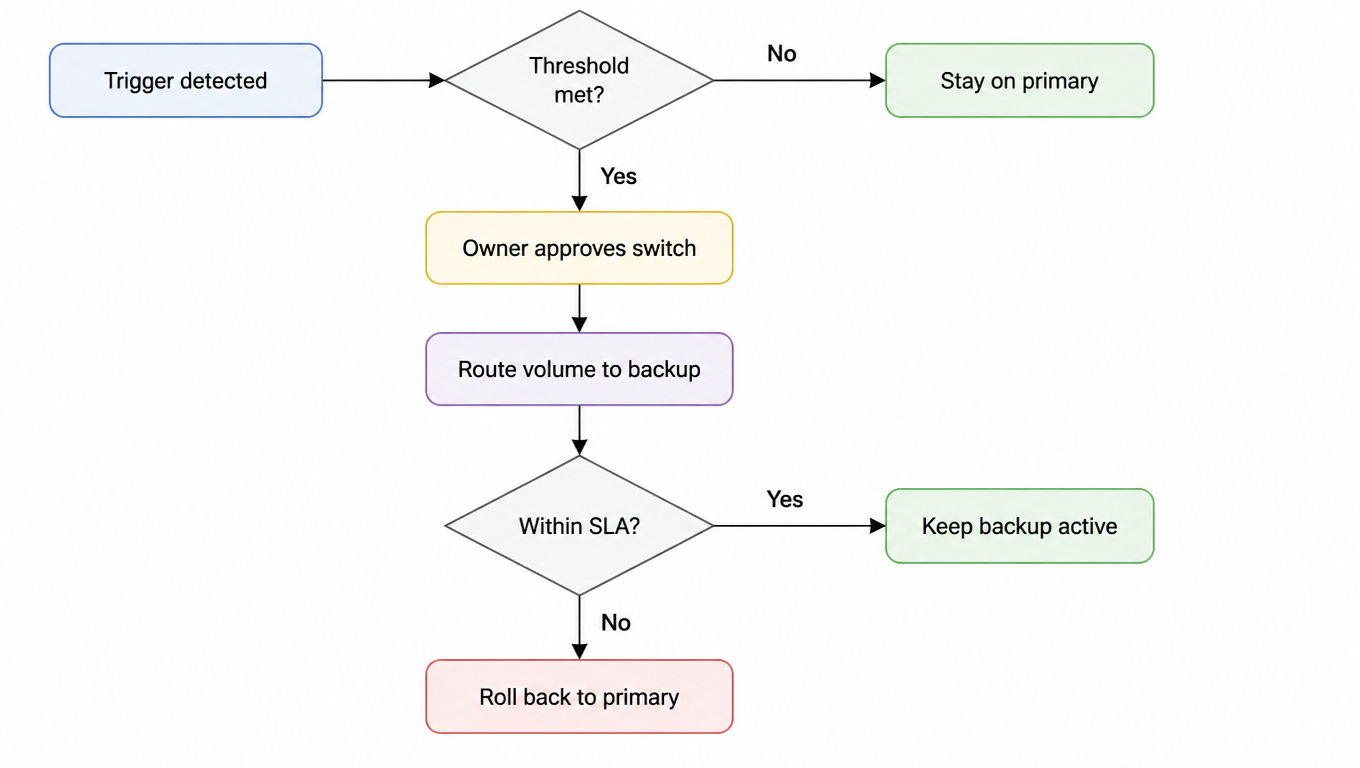
Name the decision owner and the rollback rule before any test label is generated. The rollback rule is the part teams forget: under what conditions do you switch back, and how fast can you do it? The deliverable is a one-page failover runbook built around the flow below, plus owner names and dates.

Flowchart: Trigger detected → Threshold met? No → stay on primary; Yes → owner approves switch → route volume to backup → Within SLA? Yes → keep backup active; No → roll back to primary
A trigger without a number is a debate waiting to happen

Test 1: Rate and Contract Accuracy (90 Days Out)

Start ninety days out with the dimension that quietly bleeds margin: rates. Quote identical shipment specs on the primary and the backup carrier, then compare those quotes against three things: the contract rate card, a real invoice, and the rate your shipping tool displays. Discrepancies live in the seams between these three.

Check that dimensional weight, residential surcharges, fuel adjustments, and peak add-ons are computed identically on both carriers. A backup that quotes clean base rates but layers on a residential or peak surcharge your contract did not price for is a cost trap, not a backup. For sellers, test the full path: the checkout-quoted rate, the label rate, and the final invoice. For 3PLs, run batch quotes and confirm negotiated volume pricing applies at the counts you actually ship, not the counts you promised in the sales call.

Pass criteria: across the first 20 test labels, every quote matches its invoice within a stated tolerance (for example, plus or minus 2 percent), with no surprise surcharges. If the backup's quotes are consistently off, that is a contract problem, not a rounding issue, and it needs a conversation with the carrier now, not in October. This is also a good moment to make ZIP-based carrier serviceability and rate comparison a routine, pulling the real rates for the same destination ZIPs onto one table, the way our guide on when regional carriers save money does.

Test 2: Label Generation and Integration Reliability (60 Days Out)

Sixty days out, prove the label path end to end. Generate real labels through the backup carrier: PDF and ZPL formats, a barcode that scans at the counter, manifest submission, and a pickup request. A label that looks right on screen but fails validation at the carrier's system is the most common quiet failure in this dimension.

Push edge cases through the same workflow: PO boxes, military addresses, AK and HI, invalid ZIPs, and refused addresses. Each one should produce a defined outcome, either a valid label or a clear error message, never a hang. Then verify the failover path in your shipping tool: can you switch the carrier without re-entering order data? Whether you execute through a portal, a spreadsheet, or an API, the switch should take minutes, and the same workflow should carry the order data over.

Sellers should time single-label generation and check error handling; 3PLs should stress batch manifest throughput and file-format compatibility. Pass criteria: a label generates in seconds, the first scan registers with the carrier, and a full manifest clears with zero manual fixes.

Test 3: Tracking and Delivery Performance (60-30 Days Out)

Between sixty and thirty days out, ship live test parcels through the backup during shoulder season, when your normal volume is low enough that mistakes are cheap. Measure transit time against the estimate, and scan coverage: the share of parcels with scans at pickup, hub, and delivery milestones. This is the dimension where the backup's real network shows up, independent of what the contract says.

Watch exceptions closely: delays, undeliverables, returns to sender, and how the carrier notifies you when something goes wrong. For sellers, compare actual delivery against the transit promise shown at checkout; a mismatch there is a customer-service problem in waiting. For 3PLs, measure batch-level on-time and exception rates, because one bad ZIP cluster will show up in the aggregate.

Pass criteria: on-time rate within a few points of the primary carrier, scan coverage above a threshold you set (many teams use 95 percent) [^3], and exception handling documented end to end. If shoulder-season performance is already weak, peak volume will make it worse, and the fix is either a different backup or a different expectation set for customers.

Test 4: Claims, Exceptions, and Customer Communication (30 Days Out)

Thirty days out, file a real test claim. Not a pretend one: a genuine claim on a genuinely damaged or lost test parcel, through the backup carrier's real process. Document what it takes: the paperwork required, the response time, and how fast reimbursement lands. The claims process is part of the product, and it is only testable by using it.

Check that the backup carrier's liability matches the promise you make to customers. If you promise free replacement on delivery issues, the carrier's liability cap needs to cover that promise. Then update customer-facing delivery estimates so the checkout promise matches backup-carrier reality, not primary-carrier optimism. Decide what you will ship with the backup, what you will not, and what the customer is told either way.

Prepare internal comms so customer service knows what to say if transit slips during a failover. Pass criteria: claim turnaround within the number of days your contract promises, and no surprise exclusions when you actually read the claims section under stress.

The Readiness Scorecard: A Static Go/No-Go Check

With all four tests run, score each dimension from 0 to 5 against its pass criteria, weight each dimension by your package mix, and total out of 100. The scorecard is a static health check: it tells you where the gaps are, but it does not prove the backup works under volume. That is what the drill is for.

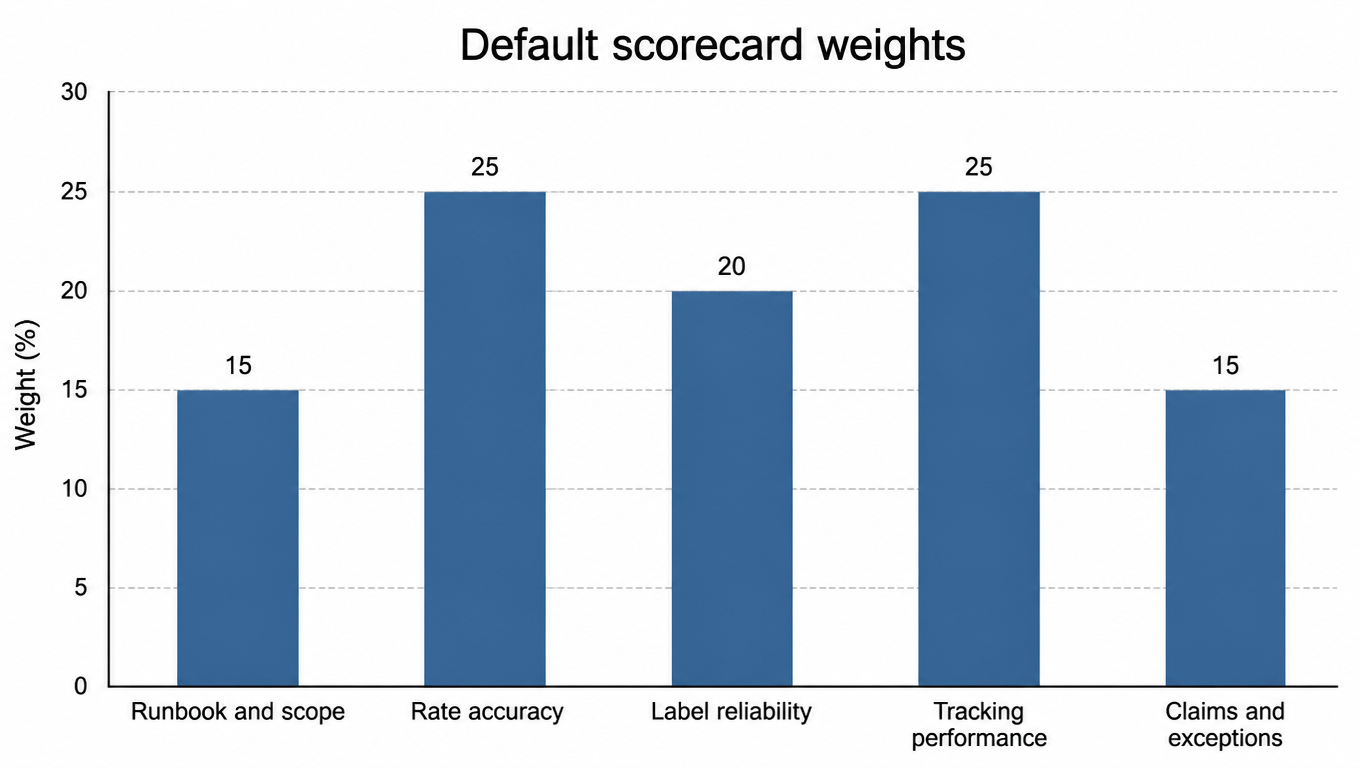
A sensible default split for a parcel-heavy mix weights rate accuracy and tracking performance highest, with the template below. Adjust the weights for your own mix; the point is to decide the weights before scoring, not after.

DimensionSuggested weightScore (0-5)Weighted contribution
Runbook and scope (Step 0)15%
Rate accuracy (Test 1)25%
Label reliability (Test 2)20%
Tracking performance (Test 3)25%
Claims and exceptions (Test 4)15%
Total100%/ 100
Bar chart: default scorecard weights, runbook and scope 15%, rate accuracy 25%, label reliability 20%, tracking performance 25%, claims and exceptions 15%
Decide the weights before scoring, not after

Define go, fix-and-retest, and no-go bands before you score. As a starting point: 80 and above is commit-ready, 60 to 79 is fix-and-retest with owners and dates assigned to every gap, and below 60 is no-go. No-go means staying on the primary carrier and re-testing later; it is not a failure of the framework, it is the framework working. Document owners and dates for every gap regardless of band.

The Live Failover Drill: Proof Under Real Volume

Two to four weeks before peak, run the drill: route 5 to 10 percent of real volume through the backup carrier, through the same workflow a real switch would use, the tool, not a manual workaround. The scorecard proves the pieces work; the drill proves they work together under real volume, real addresses, and real customer expectations.

Watch the same four dimensions during the drill: label errors, customer-service contacts, tracking gaps, and the cost delta against the primary. A small routed share keeps the blast radius small while making the failures visible. If the drill surfaces issues, you still have weeks to fix them, which is the entire point of doing it before peak.

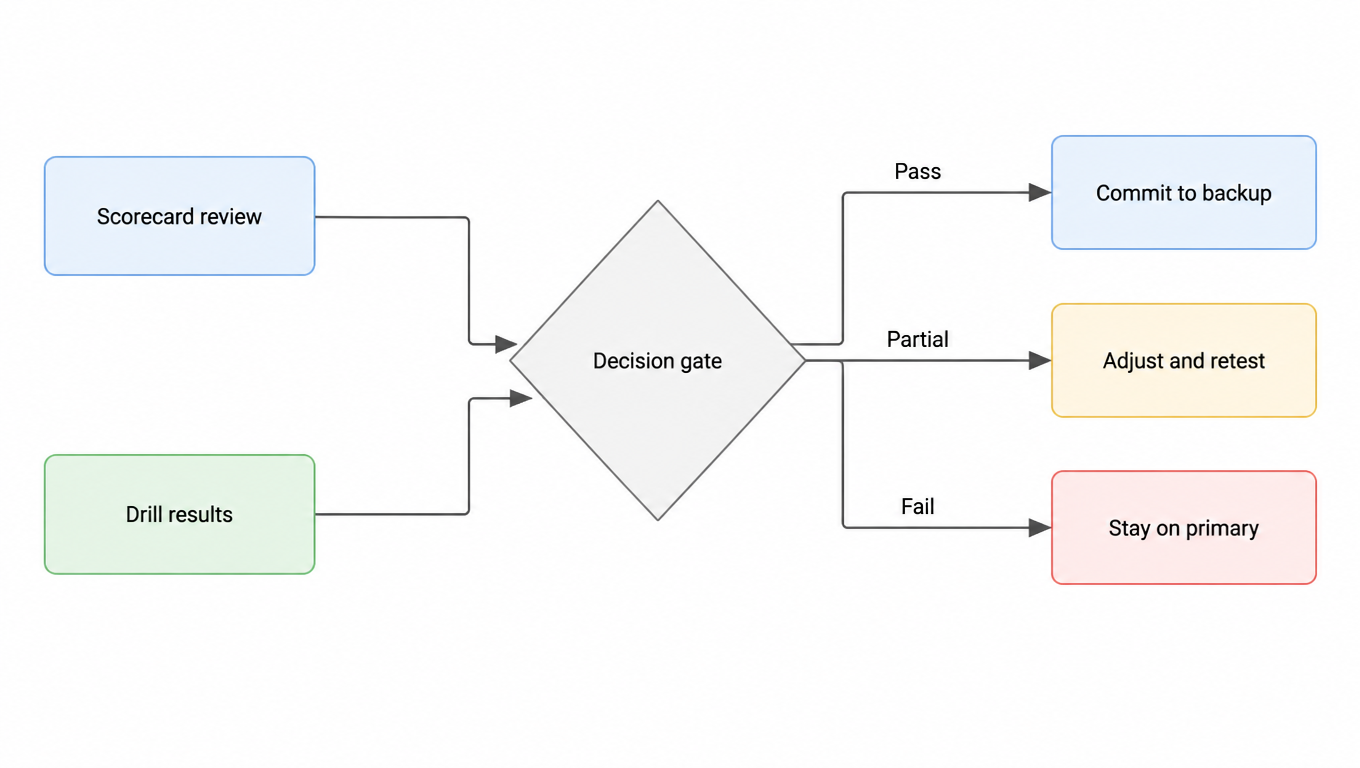
The decision gate combines both inputs: scorecard and drill results together decide commit, adjust, or abort. After the drill, keep the machinery alive: re-run rate tests monthly, re-drill quarterly, and keep the runbook current as contracts, zones, and surcharges change. A backup carrier that was ready last November is not automatically ready this one.

Flowchart: scorecard review and drill results feed the decision gate; pass → commit to backup; partial → adjust and retest; fail → stay on primary
Scorecard plus drill results, through one decision gate

When you run these tests, manage the backup carrier as a real carrier: put both options on one table with ZIP-based coverage and rate comparison, so the switch decision runs on data. A channel-neutral shipping layer like EasyShippingX compares US domestic carrier options uniformly and executes through a portal, Excel, or API, which is exactly the tooling this drill needs. It fits inside a broader multi-carrier shipping strategy rather than replacing one; for 3PLs deciding when to actually drop a carrier, see our guide on when a 3PL should fire a carrier, and our USPS API outage playbook covers the day-of actions when the primary goes down.

When you are ready to compare rates, our shipping rate calculator and shipping cost optimization advisor will do the arithmetic for you, and our pricing page shows how a channel-neutral shipping layer fits in. Sellers wiring this into Amazon self-fulfillment should see our multi-carrier strategy for Amazon FBM, and when negotiating carrier redundancy with a 3PL, our carrier redundancy checklist for 3PLs works as a negotiation baseline.

FAQ

In stages. Test rate and contract accuracy 90 days out, label generation and integration reliability 60 days out, tracking and delivery performance 60 to 30 days out (during shoulder season when mistakes are cheap), and claims and customer communication 30 days out. Run the live failover drill two to four weeks before peak with 5 to 10 percent of real volume. Starting 90 days out leaves time to fix every gap you find.
Score the four test dimensions plus Step 0's runbook and scope on a 0 to 5 scale against their pass criteria, weight each by your package mix, and total out of 100. The default split is runbook 15%, rates 25%, labels 20%, tracking 25%, claims 15%; adjust for your own mix, but decide the weights before scoring. 80 and above is commit-ready, 60 to 79 is fix-and-retest, below 60 is no-go. The scorecard is a static check; the live drill is what proves the backup works under real volume.
Aim for 5 to 10 percent of real volume, through the same tooling and workflow a real switch would use, not a manual workaround. That share is enough to expose label, tracking, cost, and support problems while keeping the blast radius small. Watch four dimensions during the drill: label errors, support contacts, tracking gaps, and the cost delta. Issues you surface still leave you weeks to fix them, which is the point.
That is a contract problem, not a rounding issue. If the first 20 test labels show a consistent gap, go to the carrier with the contract rate card, the quotes, and real invoices, now, 90 days out, while you still have leverage and margin. Check dimensional weight, residential surcharges, fuel adjustments, and peak add-ons first, they are the most common silent markup points.
It means peak volume will make it worse. A few points of on-time gap is acceptable, but scan coverage below your threshold (many teams use 95 percent), murky exception handling, and slow claims are hard failures. There are only two fixes: get a backup that can actually perform, or lower the delivery promise you show customers and update checkout accordingly. Do not enter peak with a backup that cannot even run in shoulder season.