承运商管理Carrier Management

3PL 需要多少承运商冗余才够?How Much Carrier Redundancy Is Enough for a 3PL?

每个 3PL 老板都听过「不要把货量都押在一家承运商上」这句忠告。但能给出下一个问题答案的人不多:那到底配几家才够?两家、四家、还是七家?诚实的答案是:承运商冗余不是一个人头指标,而是一个组合决策,要逐线路来做,在三件事之间找平衡:议价杠杆、服务可靠性、运营可管理性。这篇指南给你一套五步框架,帮你找到适合自己业务的数字,附本季度就能套用的基准值。Every 3PL owner has heard the advice "don't put all your volume on one carrier." Fewer have a defensible answer to the follow-up: then how many carriers is enough? Two, four, seven? The honest answer is that carrier redundancy is not a headcount target. It is a portfolio decision, made lane by lane, that balances three things: cost leverage, service reliability, and operational manageability. This guide gives you a five-step framework for finding the right number for your business, with benchmarks you can apply this quarter.

正确答案在中间:承运商多到任何一次单一故障都放不倒一条线路,少到每家都还值得为你服务、你也还保有议价权。本文带你把五步框架完整走一遍,给出按货量分层的基准表、保住杠杆的 70/20/10 分配规则,以及让每条线路三到六个承运商变得可负担的运营层。读完这篇文章,你再也不用靠猜来回答「配几个承运商」。The answer sits in the middle: enough carriers that no single failure takes down a lane, few enough that each carrier still earns your volume and your leverage. This guide walks the full five-step framework, gives you the volume-tier benchmarks, the 70/20/10 allocation rules that keep your leverage, and the operations layer that makes running three to six carriers per lane affordable. By the end, you will never answer "how many carriers" with a guess again.

黄昏时分的 3PL 调度室:墙上的屏幕显示着货运跟踪地图,调度员正在各自的工位上协调派送卡车与多家承运商
冗余是逐线路的保险组合决策,不是人头指标Redundancy is a lane-by-lane portfolio decision, not a headcount target

为什么单一承运商依赖是你承担不起的风险Why Single-Carrier Dependency Is a Risk You Can't Afford

只由一家承运商服务的线路,就是一条存在单点故障的线路。当这家承运商在旺季遭遇运力挤兑、重组网络或出现服务故障时,这条线路上 100% 的货量会同时受影响。你没有备用选项,你只有一通电话和一份排队名单。A lane served by one carrier is a lane with a single point of failure. When that carrier hits a capacity crunch in peak season, re-routes its network, or suffers a service breakdown, 100% of your volume on that lane is affected at once. You do not have a backup option; you have a phone call and a waitlist.

集中度会放大风险。当一家承运商扛着一条线路的大部分货量时,它的麻烦就是你的麻烦,它的涨价就是你利润的流失。这些故障模式一点都不罕见:区域性天气事件、枢纽停运、司机短缺、每年一次的旺季挤压,受伤最重的都是货量高度集中的线路。Concentration amplifies this. When one carrier carries the majority of a lane's volume, its problems become your problems, and its rate increases become your margin erosion. The failure modes are not exotic: regional weather events, hub closures, driver shortages, and the annual peak-season squeeze all hit concentrated lanes hardest.

第一条经验法则:任何单一承运商在一条线路上的货量占比,不要超过约 60%-70%。超过这个份额,从风险角度看你就等于单一承运商,无论发票上写着几家。The first rule of thumb: cap any single carrier at no more than roughly 60-70% of a lane's volume. Beyond that share, you are effectively single-carrier in risk terms, whatever your invoice count says.

一个具体例子说明这个上限为什么重要。假设一条线路本周发 100 票。只有一家承运商时,一次故障让 100 票全部暴露。把同一条线路按 70/20/10 拆分(主、备、溢出)后,同样的故障只暴露 70 票,另外 30 票在你调拨运力时继续流动。A concrete example shows why the cap matters. Say a lane moves 100 shipments this week. With one carrier, a failure exposes all 100. Split the same lane 70/20/10 (primary, backup, overflow) and the same failure exposes 70; the other 30 keeps moving while you shift volume.
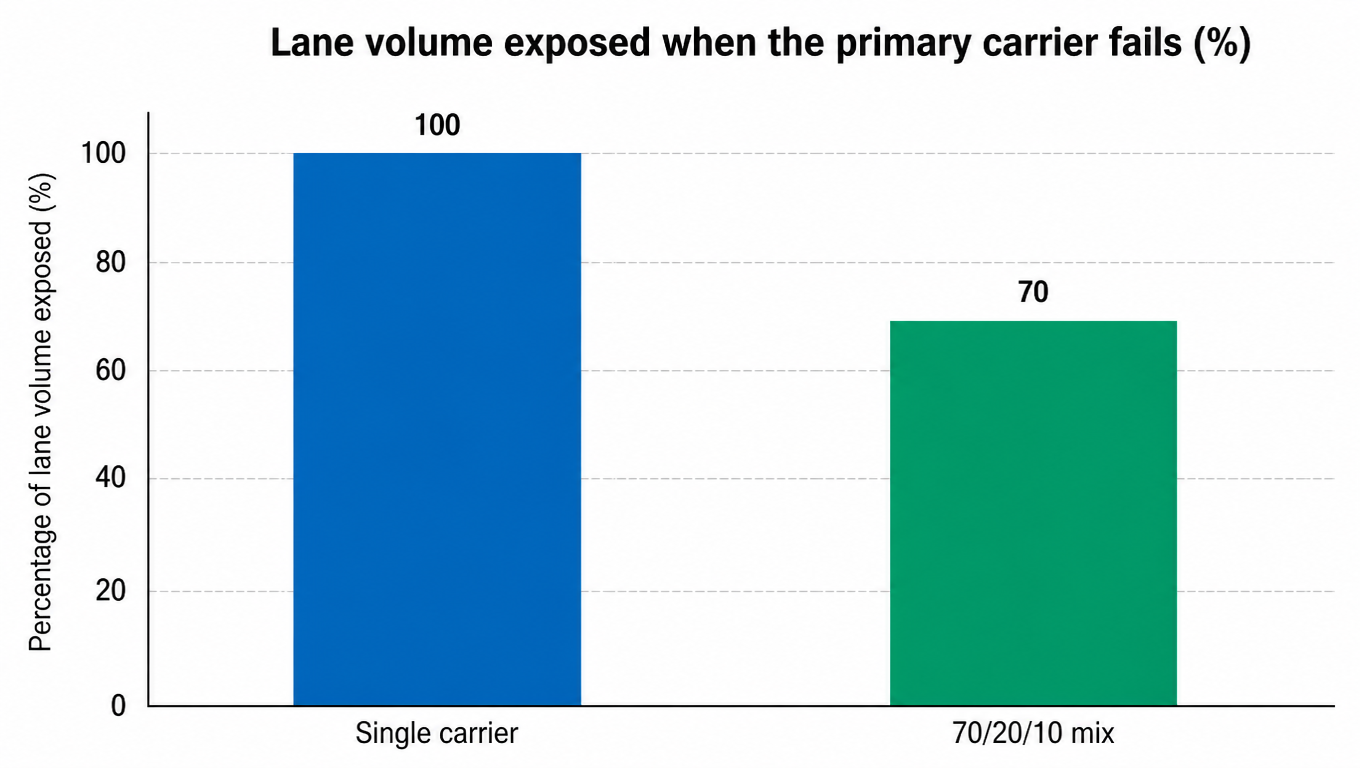
柱状图:主承运商故障时暴露的线路货量,单一承运商 100%,70/20/10 组合 70%Bar chart of lane volume exposed when the primary carrier fails: 100% with a single carrier, 70% with a 70/20/10 mix
同样的故障:单一承运商暴露 100% 货量,70/20/10 组合只暴露 70%The same failure exposes 100% of lane volume with one carrier, 70% with a 70/20/10 mix

承运商过多的隐性成本The Hidden Cost of Too Many Carriers

冗余有天花板,天花板就是经济账。把货量摊到太多承运商头上,稀释会悄悄毁掉你的议价权:没有一家承运商看得到足够多的货量,也就没有理由重视你。承运商把稀缺运力优先分配给最大的货主,所以那个把货量摊在六家承运商手里的发货人,正是旺季被晾在一边的那一个。Redundancy has a ceiling, and the ceiling is economics. Split your volume across too many carriers and the dilution quietly destroys your leverage: none of them sees enough of your business to care about you. Carriers allocate scarce capacity to their biggest shippers first, so the shipper whose volume is spread across six vendors is the one left waiting in peak season.

每加一家承运商,就多一笔真实的、持续发生的管理成本:对接与合同、合规与文档、费率表、账单对账、纠纷处理。每一家都是一段需要有人盯着的合作关系。Every added carrier also adds real, recurring management cost: onboarding and contracts, compliance and documentation, rate tables, invoice reconciliation, and dispute resolution. Each one is a relationship that needs a person watching it.

配多了的信号是:你的管理成本增速,超过了换回来的冗余收益。每多加一家承运商,新增那家的边际收益都在缩水,而成本一路爬升。冗余保护你免于故障,但只有真正承运你货量的承运商才给你杠杆。被摊薄的承运商既不是保险,也不是伙伴。The signal that you have overshot: your management overhead is growing faster than the redundancy benefit you are getting back. The benefit of an extra carrier shrinks with every carrier you add, while the cost keeps climbing. Redundancy protects you against failure, but only the carriers that actually carry your volume earn you leverage. Carriers you spread thin are neither insurance nor partners.

五步决策框架The 5-Step Decision Framework

别猜了,跑流程。下面这套框架带你从「我们该配几家承运商?」走到「这是每条线路的分配方案」。Stop guessing and run a process. The framework below takes you from "how many carriers should we have?" to "here is the allocation for every lane we ship."

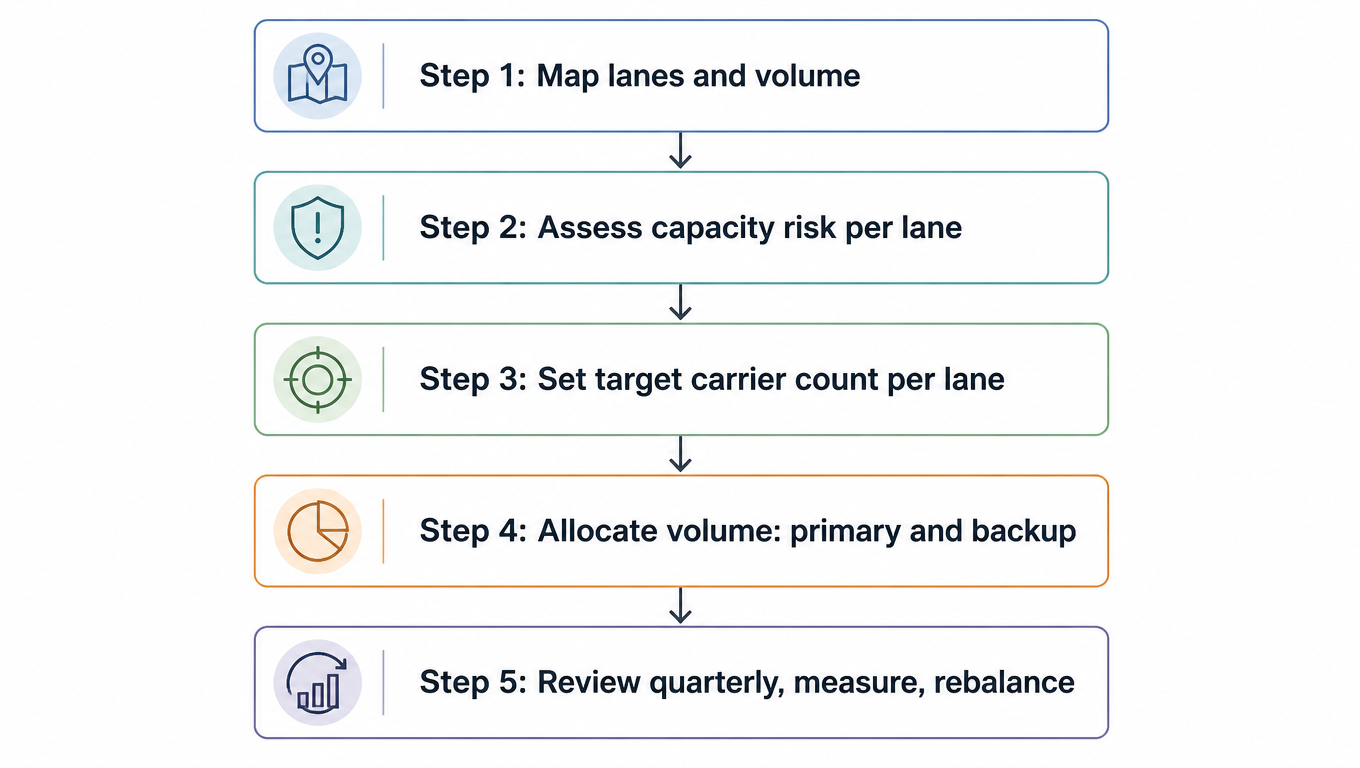
五步决策框架流程图:盘点线路与货量、逐线路评估运力风险、定目标承运商数、主备结构分配货量、季度复盘再平衡Flow diagram of the five-step framework: map lanes and volume, assess capacity risk per lane, set target carrier count per lane, allocate volume primary and backup, review quarterly and rebalance
五步框架:从盘点线路走到季度再平衡The five-step framework: from mapping lanes to quarterly rebalancing

第一步到第二步:盘点线路,再评估风险。列出你发的每一条线路:每月多少票、季节性如何。分析单位是线路,不是整个网络:一条高货量的东海岸线路和一条低货量的区域线路,不需要同一个答案。然后给每条线路的运力风险评估打分:当前承运商集中度、区域特定风险(天气、拥堵、单一枢纽依赖)、服务类型复杂度、历史故障率。故障代价高或发生概率高的线路,需要更多冗余。Steps 1-2: Map the lanes, then score the risk. List every lane you ship, how many shipments it moves per month, and its seasonality. The lane is the unit of analysis, not your whole network: a high-volume East Coast lane and a low-volume regional lane do not need the same answer. Then score each lane's capacity risk: current carrier concentration, region-specific exposure (weather, congestion, single-hub dependence), service type complexity, and historical failure rate. Lanes where a failure is expensive or likely need more redundancy.

第三步到第四步:定目标数量,再用主备结构分配。套用下一节的货量分层基准,再按风险上调:关键线路即使货量小,也要两家或更多承运商。份额要刻意分配,不能看哪家承运商先回电话就多给谁。下一节的分配规则给你具体模式。Steps 3-4: Set the target count, then allocate with a primary/backup structure. Apply the volume-tier benchmarks in the next section, then adjust up for risk: a critical lane gets two or more carriers even if its volume is small. Assign shares deliberately, not by accident of which carrier called back first. The allocation rules in the following section give you the pattern.

第五步:季度复盘、衡量、再平衡。冗余是一份活配置。每个季度重跑一遍计分卡,确认每家承运商配得上它的份额,然后主动地加人或减人,而不是被动应对。Step 5: Review quarterly, measure, rebalance. Redundancy is a living configuration. Every quarter, re-run the scorecard, confirm each carrier earned its share, and add or drop carriers deliberately rather than reactively.

基准:按货量分层该配几个承运商Benchmarks: How Many Carriers by Volume Tier

货量是预测一条线路能支撑几家承运商的最佳单一指标。小线路配两家就够;巨型线路可以养一个组合。以下是可用的目标值:Volume is the best single predictor of how many carriers a lane can support. Small lanes need two carriers; giant lanes can carry a portfolio. Here are working targets:

3PL 规模(票/月)3PL size (shipments/month)每条线路目标承运商数Target carriers per lane说明Notes
小(<5,000)Small (<5,000)每条线路 2 家2 per lane主承运商 + 1 家备用,保持简单primary + 1 backup; keep it simple
中(5,000-50,000)Mid-size (5,000-50,000)每条线路 3-4 家3-4 per lane关键线路至少 2 家at least 2 on critical lanes
大(50,000+)Large (50,000+)每条线路 4-6 家4-6 per lane全国 + 区域搭配national + regional mix

这些数字底下还有两条规则。第一,线路底线:每条线路必须有一家主承运商和至少一家备用,没有例外。即使低货量线路也需要一个验证过的第二选项,因为你从不使用的备用承运商,正是你终于需要它时掉链子的那个。第二,组合结构:用全国性承运商保覆盖,在区域承运商赢的线路上用它们拼成本和时效。六个同一家承运商的复制品不是冗余,那是六种获得同一种故障的方式。Two rules sit underneath these numbers. First, the lane floor: every lane gets a primary and at least one backup, with no exceptions. Even a low-volume lane needs a tested second option, because the backup you never use is the one that fails when you finally need it. Second, the mix: blend national carriers for coverage and regional specialists for cost and service on the lanes where they win. A portfolio of six clones of the same carrier is not redundancy; it is six ways to have the same failure.

保住杠杆的分配规则Allocation Rules That Keep Your Leverage

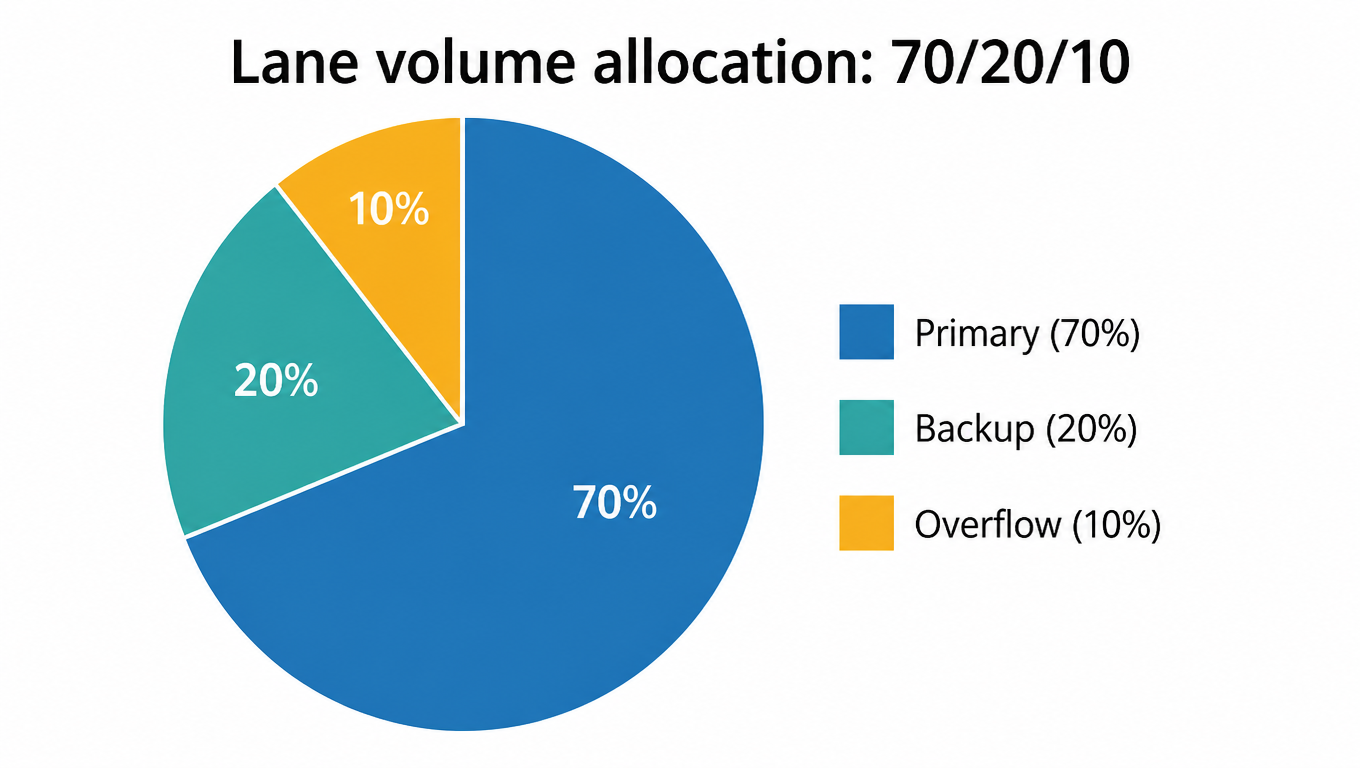
只有分配有结构,冗余才真正保护你。70/20/10 法则是一个扎实的起点:主承运商拿线路约 70% 的货量,备用承运商拿约 20%,最后的 10% 留给溢出/弹性仓位。Redundancy only protects you if the allocation is structured. The 70/20/10 rule is a solid starting point: the primary carrier gets roughly 70% of the lane, the backup gets about 20%, and the overflow/flex slot gets the last 10%.

饼图:线路货量 70/20/10 分配,主承运商 70%、备用 20%、溢出 10%Pie chart of lane volume allocation: primary 70%, backup 20%, overflow 10%
70/20/10 分配:主 70%、备 20%、溢出 10%The 70/20/10 allocation: primary 70%, backup 20%, overflow 10%

备用承运商只有在拿到真实货量时才起作用。把备用份额保持在线路的 15% 以上,因为几乎看不到你业务的承运商没有理由在你身上投入,你也没有数据知道它实际表现如何。5% 的备用只是合同上的一个名字,不是备用。A backup only works if it gets real volume. Keep the backup at 15% or more of the lane, because a carrier that sees almost none of your business has no reason to invest in you, and you have no data on how it actually performs. A backup at 5% is a name on a contract, not a backup.

什么时候加承运商:线路货量跨过所在档位、线路运力风险上升、或备用承运商无法在 SLA 内吸收溢出。什么时候砍承运商:持续不达标、费率悄悄高过市场、或份额稀释到对双方都不再有意义。Add a carrier when: lane volume grows past its tier, capacity risk on the lane rises, or the backup cannot absorb overflow within its SLA. Drop a carrier when: it persistently misses its SLA, its rates creep above the market, or its share has diluted so far that it no longer matters to either of you.

再平衡期间守住底线:任何线路的承运商数都不要跌破两家,哪怕只是暂时。把一家新承运商带起来需要整整一个季度,而你拆空的线路,正是下一次中断会砸中的地方。During rebalancing, respect the floor: never let a lane drop below two carriers, even temporarily. It takes a quarter to bring a new carrier up to speed, and the lane you stripped down is the one a disruption will hit.

管理组合:KPI 与季度复盘Managing the Mix: KPIs and the Quarterly Review

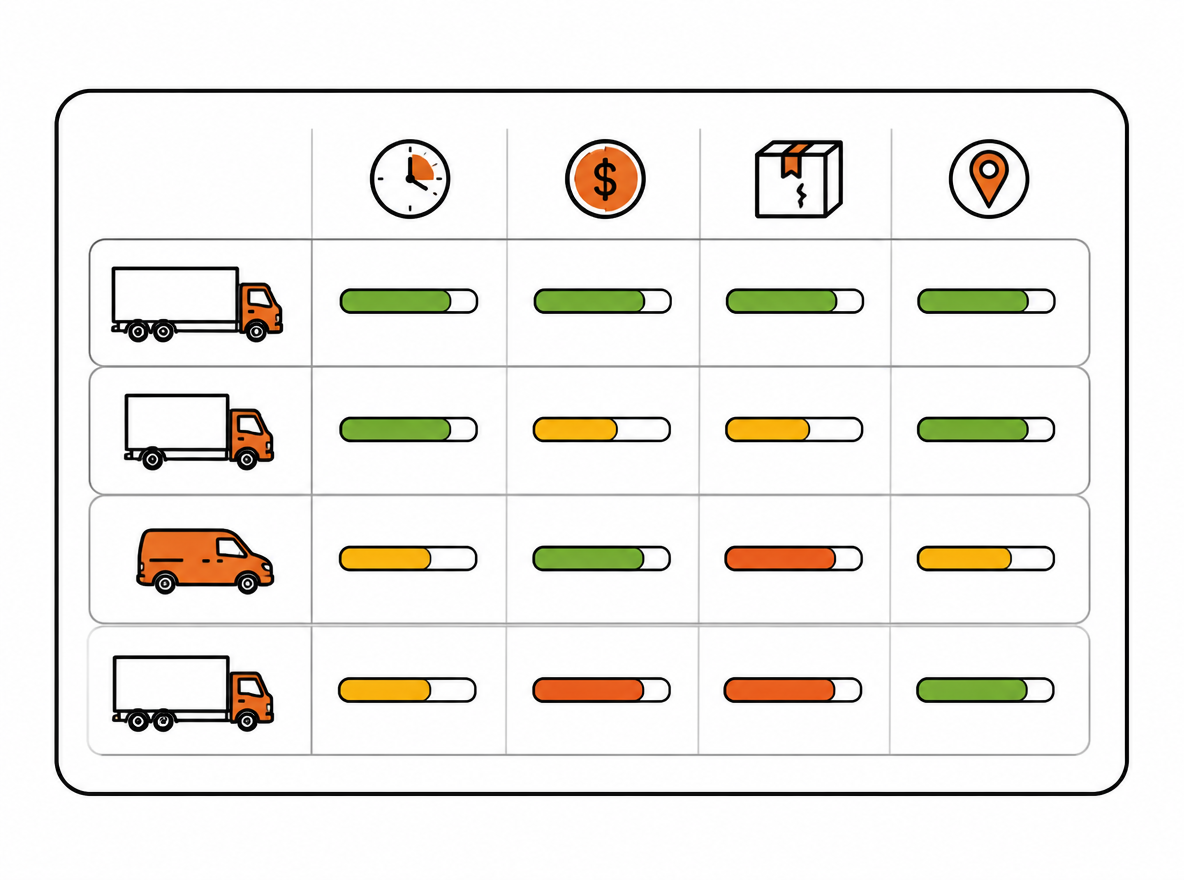
没有衡量的冗余只是花钱。每条线路、每家承运商盯五个核心 KPI:准时派送率、破损率、费率稳定性、运力承诺兑现率(承运商有没有真的运走它承诺的货量)、SLA 响应时间。Redundancy without measurement is just spending. Track five core KPIs per lane and per carrier: on-time delivery rate, damage rate, rate stability, capacity commitment fulfillment (did the carrier actually move what it committed to move), and SLA response time.

每个季度跑一次承运商计分卡:按这些 KPI 给承运商排名,复盘分配,再做再平衡。复盘要回答每家承运商一个问题:这家这个季度配得上它的份额吗?如果一家承运商在关键指标上持续低于线路平均线,它的份额就是可谈的,这正是计分卡存在的意义。Every quarter, run a carrier scorecard: rank carriers against these KPIs, review the allocation, and rebalance. The review should answer one question per carrier: did this carrier earn its share this quarter? If a carrier is consistently below the lane average on the metrics that matter, its share is negotiable, and that is the point of having the scorecard.

把淘汰写下来。砍掉一家承运商时,记下原因:SLA 不达标、费率侵蚀、破坏信任的事件。机构记忆是防止你两年后因为「他家销售人不错」又签回同一家问题承运商的东西。Document exits. When a carrier is dropped, write down why: the SLA misses, the rate creep, the incident that broke trust. Institutional memory is what stops you from re-signing the same problem carrier two years later because "their rep was nice."

让 N 个承运商可运营Making N Carriers Operable

大多数 3PL 的冗余死在这里:运营层。手工在每条线路的四到六家承运商之间切换费率表、账单和追踪,本身就是一份全职工作;调度员一旦淹没在标签页和电子表格里,备用承运商就不再被使用,而恰恰是那一刻,你花真金白银买来的保护消失了。Here is where redundancy dies in most 3PLs: the operations layer. Juggling rate tables, invoices, and tracking across four to six carriers per lane by hand is a full-time job, and the moment a dispatcher is drowning in tabs and spreadsheets, the backup carrier stops being used, which is exactly when you lose the protection you paid for.

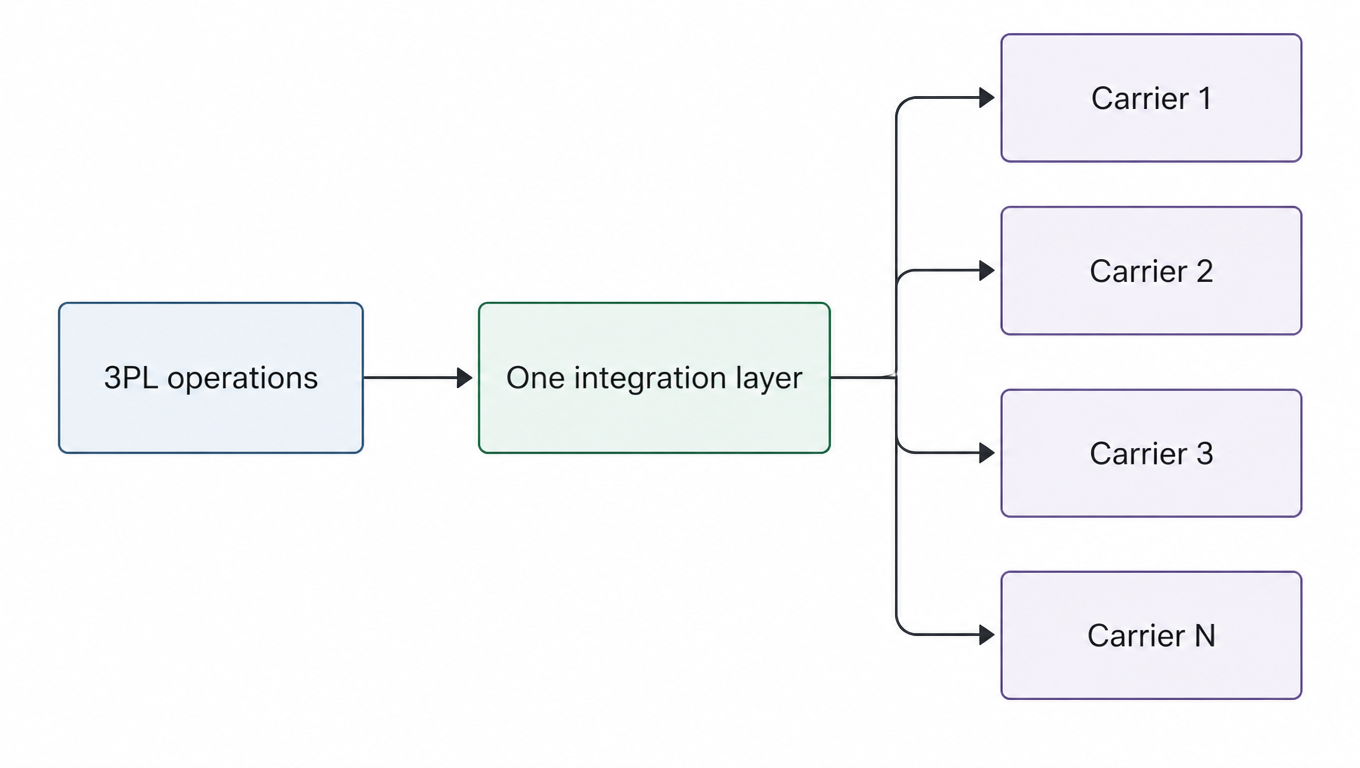
手动多承运商运营,就是冗余「纸面上成立、实操中失败」的原因。解法不是减少承运商,而是一个让 N 家承运商变得可负担的运营层:一个集成代替六个、一次性拿到所有承运商的实时报价、自动路由为每票选最优方案、承运商违约时自动故障转移切换货量。Manual multi-carrier operations is why redundancy works on paper and fails in practice. The fix is not fewer carriers; it is an ops layer that makes N carriers affordable: one integration instead of six, real-time quotes across all carriers at once, automated routing that picks the best option per shipment, and automated failover that shifts volume when a carrier misses a commitment.

流程图:3PL 运营通过单一集成层连接承运商 1、承运商 2、承运商 3 直到承运商 NFlow diagram: 3PL operations connect through one integration layer to Carrier 1, Carrier 2, Carrier 3, up to Carrier N
一个集成层连接 N 家承运商,让冗余真正可运营One integration layer across N carriers makes redundancy operable

当平台接管了复杂度,每条线路跑三到六家承运商就不再是壮举,而是日常。冗余不再是你组织架构图上的负担,而回归它的本意:一份同时保住你议价权的保险单。When the platform handles the complexity, running three to six carriers per lane stops being heroic and becomes routine. Redundancy stops being a liability on the org chart and becomes what it was always meant to be: an insurance policy that also keeps your leverage.

要点清单Key Takeaways

  • 冗余是逐线路的组合决策,不是人头指标:配几家由货量、线路风险与议价权共同决定。Redundancy is a lane-by-lane portfolio decision, not a headcount target: the number follows from volume, lane risk, and leverage.
  • 给单一承运商设上限:一条线路上任何承运商不要超过约 60-70%,否则从风险角度看仍是单一承运商。Cap any single carrier at roughly 60-70% of a lane's volume, or you are effectively single-carrier in risk terms.
  • 跑五步框架:盘点线路、评估风险、定数量、主备分配、季度再平衡。Run the five-step framework: map lanes, score risk, set target counts, allocate primary/backup, rebalance quarterly.
  • 按货量分层:小线路 2 家、中型 3-4 家、大型 4-6 家,且每条线路都有「主 + 备」的底线。Use volume tiers: 2 carriers on small lanes, 3-4 mid-size, 4-6 large, with a primary-plus-backup floor on every lane.
  • 用 70/20/10 分配并让备用保持 15% 以上:没有货量的备用只是合同上的一个名字。Allocate 70/20/10 and keep the backup above 15%: a backup with no volume is a name on a contract.
  • 加承运商要有触发条件,砍承运商要记录原因;用 KPI 与季度计分卡管理整个组合。Add carriers on triggers, drop them with documentation, and manage the mix with KPIs and a quarterly scorecard.

常见问题FAQ

因为正确的数量随线路变化。一条月发 1,000 票、只有一家强势承运商的低风险线路,两家就够;一条月发 100,000 票、跨多个区域、故障代价极高的线路,需要四到六家加刻意分配。先按货量分层定基准,再按线路风险上调,固定数字只在巧合时正确。Because the right number varies by lane. A low-risk lane moving 1,000 parcels a month with one strong carrier needs two. A critical 100,000-parcel lane across multiple regions with expensive failures needs four to six with deliberate allocation. Volume tiers set the baseline, lane risk adjusts it up, and a fixed number is only right by coincidence.
至少线路的 15%。低于这条线,承运商没有动力为你投入,你也没有数据判断它的实际表现。5% 的备用只是合同上的名字;真出故障时,它既没有理由把你往前排,也没有动力帮你。At least 15% of the lane. Below that, the carrier has no incentive to invest in you and you have no data on its real performance. A backup at 5% is a name on a contract; when a failure hits, it has no reason to move you up the queue.
要提前一个季度加,而不是旺季前几周。新承运商需要时间完成对接、测试和磨合,临时加的承运商在旺季只会增加管理负担,而它自己的运力也在被挤兑。提前一个季度锁定并分配真实货量,让它在旺季前成为一条验证过的第二路径。Add a quarter ahead, not weeks before. Onboarding, testing, and ramp-up take time, and a carrier added at the last minute adds management load exactly when everyone's capacity is squeezed. Lock in real volume a quarter early so it is a tested second path before peak hits.
每条线路、每家承运商五个核心指标:准时派送率、破损率、费率稳定性、运力承诺兑现率、SLA 响应时间。季度复盘时按这些指标排名,回答一个关键问题:这家承运商这个季度配得上它的份额吗?Five core KPIs per lane per carrier: on-time delivery rate, damage rate, rate stability, capacity commitment fulfillment, and SLA response time. Rank carriers against them every quarter and answer one question per carrier: did it earn its share this quarter?
这正是冗余在实操中失败的主因,解法不是砍承运商,而是上运营层:一个集成代替多个、实时比价、自动路由、自动故障转移。当平台接管了复杂度,每条线路三到六家承运商就不再是负担,而是日常。That is exactly why redundancy fails in practice, and the fix is not fewer carriers but an ops layer: one integration instead of many, real-time rates, automated routing, and automated failover. When the platform handles the complexity, three to six carriers per lane becomes routine instead of heroic.
Get Rate Comparison
Get Rate Comparison