Carrier Decisions

What Is the Real Cost of Adding One More Carrier?

A regional carrier's sales rep quotes you 12% below your incumbent. The math takes three seconds: cheaper labels, lower cost per order, done. Sign the paper.

Not so fast. The urge to diversify is industry-wide: more than 90% of supply chain leaders reported plans to expand their carrier networks within the year [1], and national carriers raised general rates 5.9% in 2025 [2]. But onboarding a carrier is not a rate card swap. It is a full operations project with its own build hours, training ramp, billing cycles, exception handling and contract traps. The 12% discount is the sticker price. What you actually pay is the total cost of ownership (TCO): the discount, minus everything it costs to integrate, run, reconcile and manage that carrier over its whole lifecycle.

This guide gives you a two-step decision framework. Step 1 is a red-flag veto list that catches disqualifying carriers in minutes. Step 2 is a weighted six-dimension TCO scorecard that turns \"is this carrier cheap?\" into \"is this carrier cheap to run?\". You will also find two worked examples, one for a DTC e-commerce brand and one for a 3PL, because the same carrier can be a clear yes for one business and a clear no for the other.

Logistics manager compares two carrier rate cards beside parcels and a laptop cost sheet.
The 12% discount is the sticker price; TCO is what you actually pay

The Framework in Two Steps: Veto First, Then Score

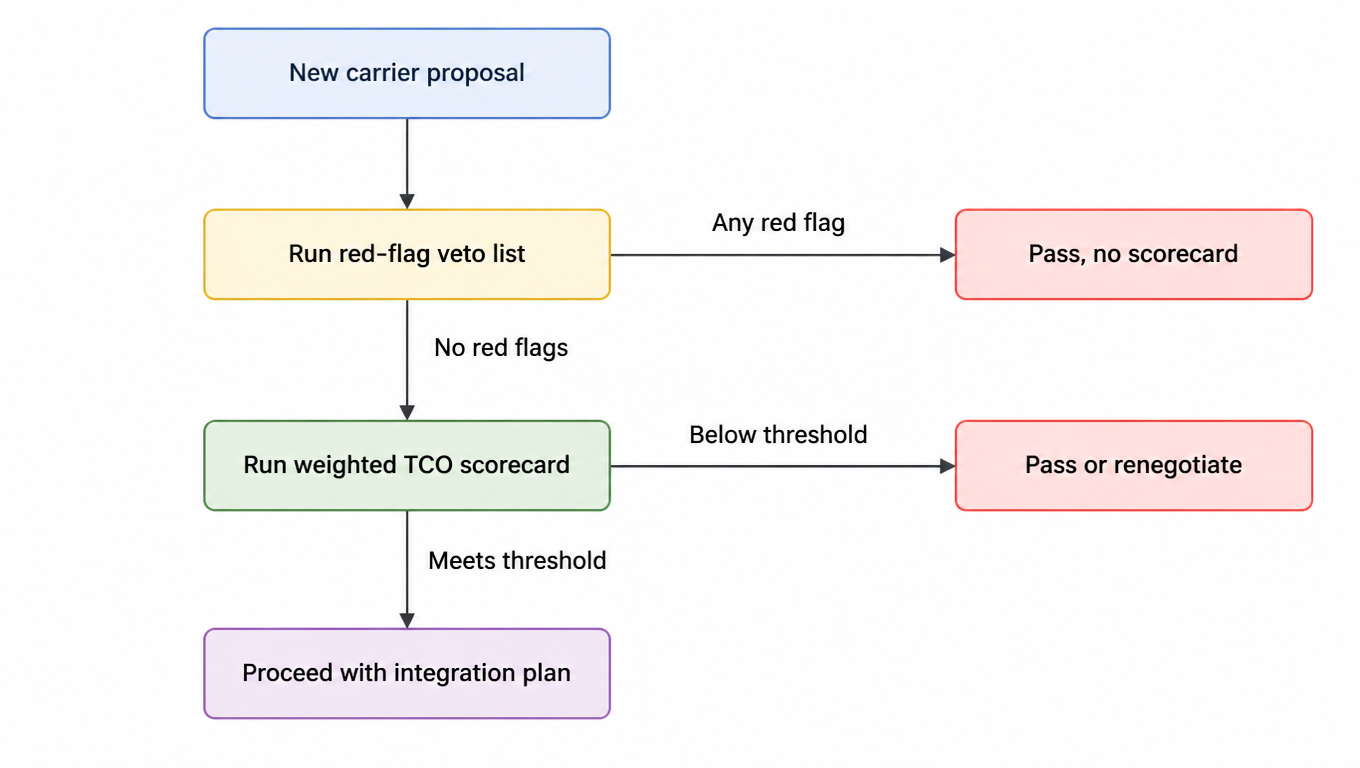
Step 1 is the red-flag veto list. One red flag means pass, no scorecard run. The reasoning is simple: no discount can fix a carrier that cannot integrate with your systems, cannot be billed accurately, or cannot be trusted with your customers' parcels. The veto list is cheap, an afternoon's work; the scorecard is expensive to run properly, so it should only ever touch carriers that already cleared the bar.

Evaluate the new network as one part of the multi-carrier strategy overview. Use the cost-per-successful-delivery method to compare its added operating work with the final delivered outcome.

Step 2 runs the weighted six-dimension scorecard. Each dimension scores from 1 to 5, multiplies by a weight, and sums to a weighted total out of 5. Weights are yours to set: a 3PL that lives on billing automation weights settlement differently than a brand that lives on customer experience.

Two-step decision flow: a new carrier proposal runs the red-flag veto list; any red flag means pass, no scorecard; with no red flags run the weighted TCO scorecard; meeting the threshold proceeds to integration, below it you pass or renegotiate
A red flag vetoes; the scorecard decides priority

Step 1: The Red-Flag Veto List

Before you run any math, run the veto list. One red flag means automatic pass, no scorecard. Financial red flags: hidden surcharge clauses buried in the tariff, no rate-protection period, auto-renewal traps that lock you in after year one. Technical red flags: no API, or an API with documentation so thin your developers will reverse-engineer it, no sandbox or test environment, no tracking event feed. Operational red flags: no WMS or OMS integration path, manual label entry only, no batch label support. Service red flags: no phone or chat support, no service-level agreement, a claims process that requires a fax. Compliance red flags: no certificate of insurance, no bonding, or a gray-market postal origin that puts your packages into the lowest tier of international handling.

The rule is absolute: one red flag, automatic pass, no scorecard run. The veto list is cheap and takes an afternoon. The scorecard is expensive to run properly, so it should only ever touch carriers that already cleared the bar.

Step 2: The Six-Dimension TCO Scorecard (Weighted, 1-5)

The scorecard scores each dimension from 1 to 5, multiplies by a weight, and sums to a weighted total out of 5. The six dimensions below are what you measure.

API & integration cost

Score 1 if your team must hand-build a fragile integration against thin docs; score 5 if the carrier ships a maintained SDK and a real sandbox. Measure build hours for development, testing and go-live, and decide whether you use an internal team or a paid integrator. Add ongoing maintenance: carriers change API versions, and every quarter someone must re-test. Add failure cost: failed label requests, stuck orders and retry handling all consume support time. Finally, check whether your shipping platform or middleware already supports this carrier, because that turns a multi-week project into a config change [6].

Training cost

Every new carrier adds a learning curve for operations, customer service and warehouse teams. Score 1 if training is informal and knowledge lives in one person's head; score 5 if the carrier provides training materials and your SOPs update cleanly. Include new-hire ramp: every future hire must now learn N+1 carriers. And count the mistakes made during the learning period: mis-labels, wrong service selection, re-ships and the goodwill costs that come with them.

Billing & settlement cost

This is the quiet killer: industry analyses estimate that 15 to 20 percent of parcel invoices contain billing errors or recoverable service failures [3]. Score 1 if invoices must be checked label by label by hand; score 5 if settlement is automated or your platform reconciles on your behalf. Measure invoice reconciliation hours and the billing error rate: overcharges, wrong surcharges and the dispute cycles that follow. Add the complexity of reconciling one more carrier across your whole book of business, and check settlement terms, because a longer invoice cycle can tie up cash flow for months.

Customer service cost

When a parcel goes missing, your team calls the carrier and your customers call you. Score 1 if the carrier has no direct support channel; score 5 if issues are answered in minutes and resolved in hours. Measure the support channel cost, staffing and the average response and resolution time on carrier issues. Remember the hidden part: your customer service team now holds the rules of N+1 carriers in their heads, and that mental load shows up as slower answers and more escalations.

Exception handling cost

Exceptions are where cheap carriers stop being cheap: denial rates for standard parcel claims run 30 to 45 percent [4]. Score 1 if loss and damage rates run high and claims are routinely denied; score 5 if claims are paid fast and without a fight. Measure the loss and damage rate, the claims success rate and the hours spent per claim. Count the full cost per exception: research, escalation, re-ship, refunds and goodwill. Then add the CX impact, because every exception is a repeat-purchase risk.

Contract management cost

The contract is a cost center few people open. Score 1 if the agreement is a one-way door with no escape; score 5 if terms are clean and auditable. Count negotiation hours and the annual audit: every carrier needs a rate review each year, and that workload grows with each carrier you add. Watch the contract term, the minimum volume commitment (MVC) and the exit penalties. The worst case is an MVC written against forecasted volume that dips: you pay shortfall penalties on shipments you never made. Carriers typically set that threshold at or near your total annual parcel spend, so a volume dip shrinks your discounts or reverts you to published rates [5].

The Scorecard Template (Copy-and-Use Table)

Copy the table below, set your weights, score every dimension 1 to 5, and multiply to get the weighted score. The example weights assume a typical brand: integration and exceptions matter most, so they carry the highest weight.

Dimension Weight Score (1-5) Weighted score
API & integration cost20%
Training cost15%
Billing & settlement cost15%
Customer service cost10%
Exception handling cost20%
Contract management cost20%
Total100%/ 5.00

Two rules of thumb. First, only proceed when the weighted total is 3.5 or higher. Second, flag any single dimension scored 2 or below: a carrier that scores 2 on exceptions will cost you more than its discount, no matter how the other five dimensions average out. Score as a team: finance, operations and customer service each score independently, then average the results. Re-run the scorecard annually and any time your volume changes materially, because a carrier that wins at 3,000 orders a month can lose at 30,000.

Worked Example A: DTC E-Commerce Brand

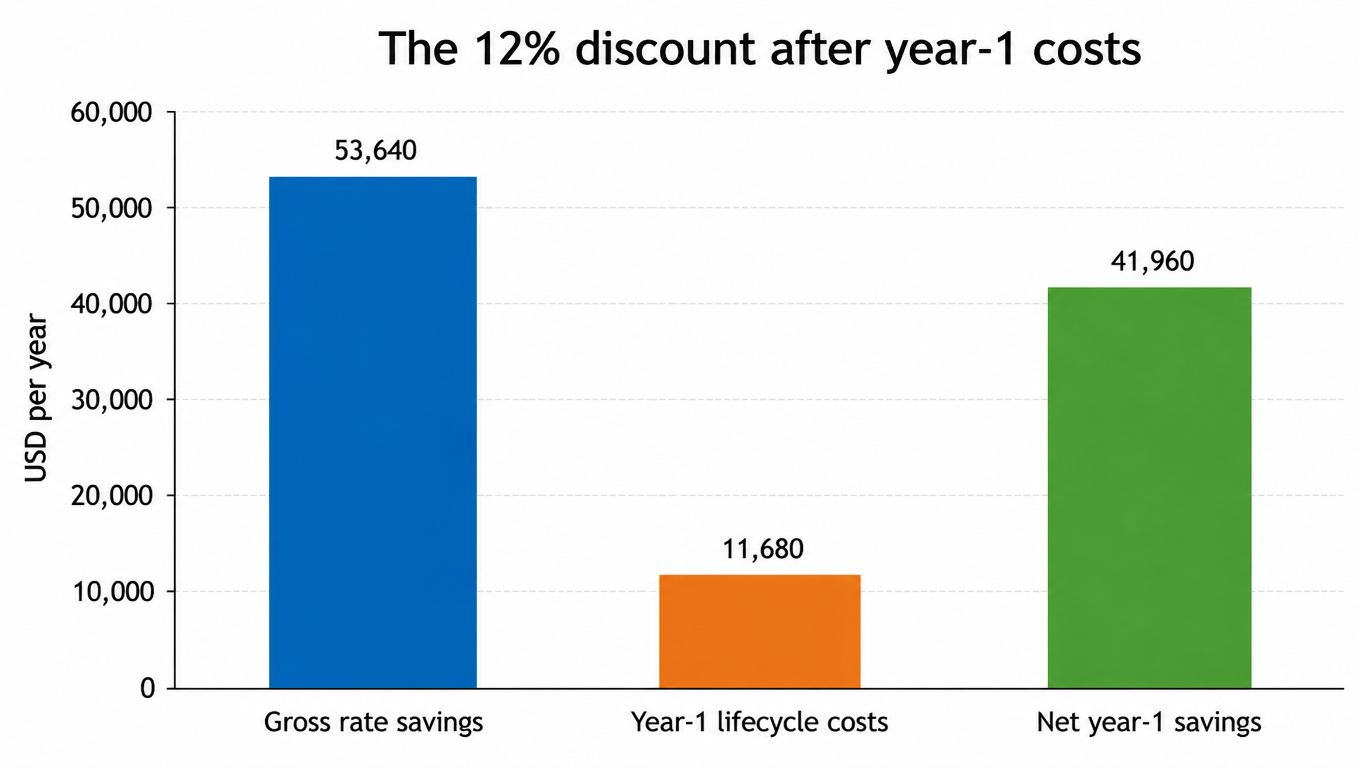
Meet a Shopify seller doing about 3,000 orders a month. Their incumbent carrier averages $12.40 per label. A regional carrier quotes 12% below, $10.91 per label, a saving of $1.49 per order and roughly $53,640 a year in gross savings. Regional carriers often beat national networks on first-attempt delivery in their home territory, by 5 to 8 percentage points [7].

The veto list passes: the carrier has a real API with a sandbox, insurance and an SLA. So the team runs the scorecard. The costs arrive fast. Integration runs about 40 developer hours, roughly $6,400 fully loaded. Training materials and staff time land around $1,500. Ongoing operations add about 9 hours a month of reconciliation and exception work, about $3,780 a year. Year-one lifecycle costs total roughly $11,680, which eats about a fifth of the gross saving.

Bar chart: the 12% discount after year-1 costs. Gross rate savings 53,640 USD, year-1 lifecycle costs 11,680 USD, net year-1 savings 41,960 USD
Year-one fixed costs eat about a fifth of the gross saving

So the verdict logic: at 3,000 orders a month the discount is real but the fixed costs take a visible bite, and the decision turns on what comes next. If this brand projects volume growth past 5,000 orders a month, or the regional carrier also improves delivery times for their best customers, the answer is yes, the per-label saving compounds. If volume stays flat and the incumbent's service is fine, the answer is no: they would be paying thousands of dollars to run a second carrier for a $1.49-per-order saving.

Worked Example B: 3PL

Now the same carrier, a different buyer. A 3PL managing about 40 client accounts adds the regional carrier because one large client, about 12,000 parcels a month, asked for it. That client alone generates roughly $193,000 a year in gross savings, and the 3PL runs the same scorecard from a very different vantage point.

Integration and training costs are the same one-time expenses, but they amortize across the client book, not a single brand. The 3PL can offer the newly integrated carrier to other clients next quarter at near-zero marginal cost. Billing is the decisive dimension: a 3PL that reconciles per label will drown in a fourth carrier's invoices, while a 3PL whose platform automates settlement absorbs the new carrier almost for free. That difference can swing the weighted total by a full point.

The contract is where the 3PL must be ruthless. The MVC should be shared across the client book, never tied to one client's volume, because client churn is the 3PL's normal operating rhythm and a shortfall penalty on a departed client is pure loss. Negotiate settlement automation and an API SLA with uptime credits as contract terms, not favors, and put a quarterly rate review in writing.

The verdict logic differs from example A: the marginal cost of the third or fourth carrier is small when integration is amortized and billing is automated, so the bar to add one is lower. But the MVC structure and the exit terms decide everything. A clean shared-MVC contract with automated billing makes this carrier an easy yes; a per-client MVC makes it a trap.

Decision Cheat Sheet and Conclusion

Eight steps before you sign any carrier agreement.

  1. Verify the quote against all surcharges, not the base rate.
  2. Run the red-flag veto list and let one red flag end the conversation.
  3. Score all six dimensions as a team: finance, operations and customer service.
  4. Require a weighted total of 3.5 or higher and no single dimension at 2 or below.
  5. Read the contract terms: MVC, term, exit penalties and rate protection.
  6. Budget integration and training before you sign, not after.
  7. Build reconciliation and exception workflows before go-live.
  8. Set a 12-month review date and re-run the scorecard.

The formula that matters: cheap rate times full lifecycle cost equals the real number. The cheapest carrier is never the one with the lowest quote. It is the one that clears the veto list, wins the scorecard and stays profitable to run after year one. Run the framework on your next carrier proposal, and keep the scorecard for rate negotiation, multi-carrier strategy and the annual review, because every carrier you manage makes the next decision harder, and a documented framework is the only thing that keeps it rational.

FAQ

There is no fixed percentage. A discount is only worth it for what survives after the fixed costs are spread out: integration hours, training, monthly reconciliation, exception handling and contract management. In worked example A, the 12% discount lost a fifth of itself to year-one costs. Use the scorecard and lifecycle costs in reverse: divide the net saving by annual volume to see the real per-order gain, then decide.
Weights come from your business model, not the carrier. A brand that lives on customer experience weights service and exceptions higher; a 3PL that lives on billing automation weights settlement higher. The example weights in the template (integration and exceptions at 20% each) assume a typical brand. Adjust them after the first carrier based on where you actually feel the pain.
At least annually, and immediately after any material volume change. A carrier that wins at 3,000 orders a month can lose at 30,000: volume scales the discount, but it also scales exceptions, reconciliation and support costs. Put the annual review in the contract so re-running is an obligation, not an impulse.
The denominator of fixed costs differs. A brand amortizes integration and training across its own volume; a 3PL spreads them across the whole client book and can sell the newly integrated carrier to other clients next quarter at near-zero marginal cost. The 3PL's decisive battlefield is the contract: the MVC must be shared across the client book, never tied to one client's volume, because churn is a 3PL's normal operating rhythm.
No. The veto list filters unfixable dealbreakers: no integration path, un-auditable billing, no SLA, questionable compliance. These are not negotiable, they are costs that bleed every month. No discount can save them. The scorecard exists to compare which of the carriers that cleared the bar is actually worth running.