3PL Guide

Multi-Carrier Shipping for 3PLs: When One Carrier Is No Longer Enough

Relying on a single carrier is the most comfortable setup in 3PL. One integration, one invoice, one claims process, one support line. The team knows one portal cold, and volume discounts deepen every quarter. It feels like a well-oiled machine. It is actually a single bet with your entire network riding on it.

For a 3PL, carrier dependence is a risk-management problem before it is a cost problem. The discounts are real and measurable; the risks are deferred and compound. This article walks through the three ways single-carrier dependence breaks a 3PL: rate hikes and surcharge creep, peak-season paralysis, and policy or labor shocks. It then shows how those risks multiply through to your customers, gives you a framework for diagnosing your own dependence, and sketches the multi-carrier operating model that fixes it.

A busy 3PL distribution hub at dusk with parcel vans from several different carriers lined up at the loading docks, warm warehouse lights glowing
Parcel vans from several carriers at a 3PL hub at dusk: multi-carrier is the norm, not the exception

1. Why One Carrier Feels So Comfortable

The comfort is not imaginary. Consolidating volume with one carrier buys the deepest rate tier, a single weekly invoice, and one relationship to manage. Your staff master one portal, one exception process, one pickup cadence. Exceptions are rarer because the operation is tuned to a single set of rules. For a small 3PL, that simplicity is worth real money.

Use the multi-carrier strategy overview to keep the operating model consistent across clients. The second-carrier evaluation path turns the need for another carrier into a sequence of coverage, cost, and pilot decisions.

The problem is that every one of those benefits is a form of foreclosed optionality. The deeper the discount, the more volume is concentrated. The smoother the operation, the less experience your team has with any other carrier's rules, labels, and claim processes. The comfort compounds quietly, and each quarter makes the exit more expensive. You are not optimizing operations; you are building a dependence and calling it efficiency.
2. Risk 1: Rate Hikes and Surcharge Creep

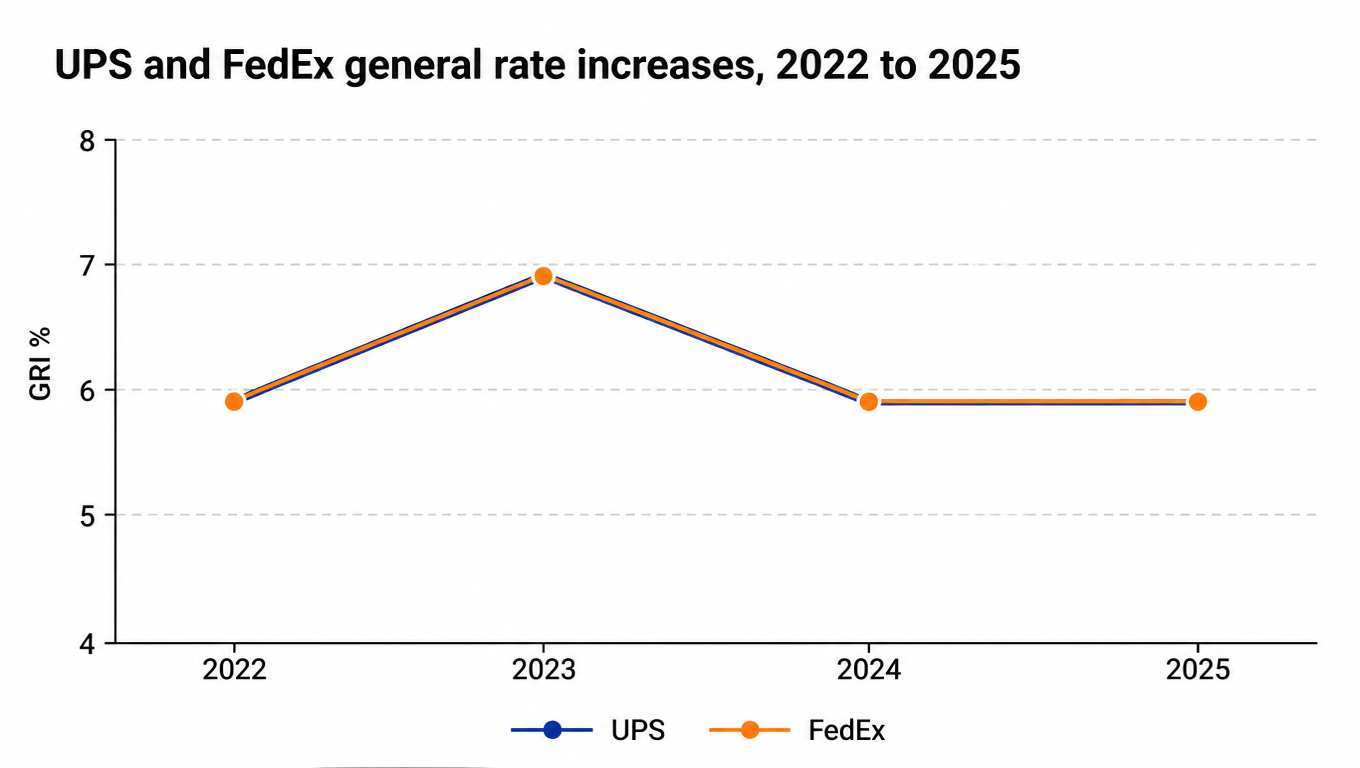
The first risk is the most predictable, and the most corrosive. Every January, the national carriers raise base rates. UPS and FedEx both raised general rate increases of 5.9% for 2022, 6.9% for 2023, then 5.9% again for 2024 and 2025. Note what is missing from that sentence: any meaningful difference between the two. The duopoly reprices in lockstep, so holding two national carriers does not diversify this risk at all.

Line chart: UPS and FedEx general rate increases 2022 to 2025 (percent)
UPS and FedEx GRI moved in lockstep from 2022 to 2025; the duopoly does not diversify rate risk

On top of the annual increase come peak surcharges: per-package fees applied only during defined peak windows, ranging from fractions of a dollar to several dollars per package depending on volume tier. Then come the accessorials: dimensional weight repricing, address correction, residential delivery, fuel. Each is small; together they compound faster than your client contracts reprice.

That is the squeeze: your carrier cost moves up on January 1, your client pricing moves when contracts expire, and margin is whatever is left in between. A 3PL running on a single carrier cannot push back on any of it, because there is no credible alternative to threaten. The carrier knows it, and the pricing reflects it.

3. Risk 2: Peak-Season Paralysis

Peak season is when single-carrier dependence stops being a pricing problem and becomes an operational one. The 2020 peak is the canonical case. USPS suspended its delivery service guarantees in April 2020, and by December UPS was capping volume and temporarily pausing pickups from major retailers like Nike, Gap, and Macy's to protect its network. Shippers who had no second path simply could not move their volume.

When the network throttles, the 3PL absorbs the failure. Packages sit at the dock, dispatch windows slip, SLA breaches pile up, and the client's angry phone call lands on your operations manager, not on the carrier. The carrier's service guarantee was already suspended, so there is no credit to claim. The cost of the failure is 100% yours.

Peak is the moment your business is actually tested, and it is the moment single-carrier 3PLs fail the test. Meanwhile the surcharges from Risk 1 are stacking on top of the operational pain. You are paying a premium for the privilege of being throttled.

4. Risk 3: Policy and Labor Shocks

The third risk is the one nobody can schedule around. In 2023, the UPS-Teamsters negotiations covered 340,000 workers with a strike deadline of August 1; a tentative deal was reached only days earlier, on July 25, narrowly averting what would have been the largest single-employer strike in US history. For the weeks before that, every shipper with UPS volume was building contingency plans, and carriers competing for overflow raised rates into the panic.

USPS is its own source of policy risk. The Delivering for America plan has driven repeated rate increases and network rationalization, shifting package volume between classes and closing processing facilities. And at the border, tariff changes and de minimis threshold shifts can reprice an entire lane overnight, with no alternate routing when you are wired to one carrier.

These events share one property: they are unpredictable by nature, which is precisely why they cannot be managed inside a single-carrier contract. You cannot negotiate your way out of a strike you did not see coming. The only hedge is a portfolio, a second carrier that is already integrated, tested, and funded with volume before the shock arrives.

5. The Customer Multiplier: When Your Risk Becomes Their Risk

Sellers ride on your carrier choices. When your one carrier stumbles, your outage becomes their outage, and theirs becomes their customers'. A delayed delivery cascades fast: refund requests, chargebacks, negative reviews, marketplace performance penalties, and for sellers shipping into retail, OTIF fines from retailers that enforce delivery windows to the day.

Single-carrier dependence is invisible to the seller until it is their problem. They cannot see your concentration, your peak surcharges, or your renewal leverage. They only see the tracking number that stops moving in December, or the contract repriced mid-season. That is when the account is at risk, and it is the account you least want to lose in the quarter you can least afford it.

This is why diversification at the 3PL level is de-risking at the seller level. Every carrier you add to your network is a failure mode you can route around before your client ever hears about it. Your optionality is their service level.

6. A Framework for Diagnosing Carrier Dependency

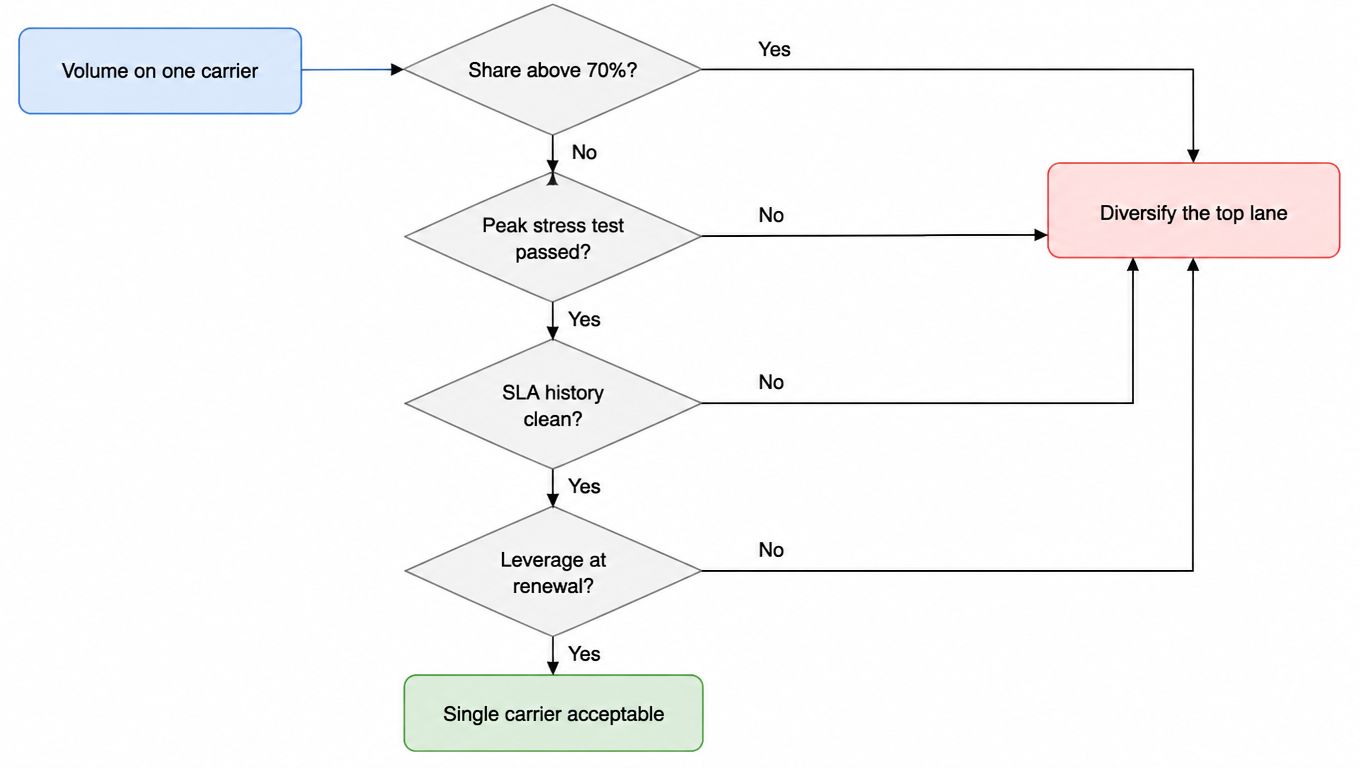
Diagnose your dependence with four dimensions before you build anything. First, volume concentration: what share of your total volume sits on one carrier, and on the top lane specifically. Second, peak elasticity: can your network absorb a 2x peak day without service degradation, or is capacity capped exactly when you need it? Third, SLA history: how many times in the last 12 months did the carrier miss its own published service standard on your lanes. Fourth, negotiation leverage: what happens at renewal if you walk away, and does the carrier know it.

The thresholds are practical, not theoretical. If one carrier carries more than 70% of your volume, you are concentrated. If your peak stress test fails, you are fragile regardless of your concentration ratio. If your SLA history is clean, your concentration is a discount; if it is not, your concentration is a liability with a discount attached.

Carrier dependency diagnosis flowchart: volume share, peak stress test, SLA history, renewal leverage
Dependency diagnosis: concentration above 70%, peak stress test, SLA history, and renewal leverage, checked in sequence

The framework ends with a deliberate answer: some lanes genuinely do not need a second carrier. A low-volume, low-variance lane on a carrier with a clean SLA record is fine single-carrier. The goal is not diversification for its own sake. It is finding the lanes where dependence is dangerous, and fixing those first.

7. Building the Multi-Carrier Operating Model

A multi-carrier operation is not a free-for-all. It is a tiered structure: a primary carrier as the default on each lane, a tested secondary for rate and capacity competition, and a backup that you exercise regularly enough that it is never untested. The backup that only exists on paper is not a backup; it is a document.

Routing rules need to be executable, not aspirational. Cost-first rules send each package to the cheapest carrier that meets the service requirement. Speed-first rules protect the premium lanes where late delivery costs more than fast shipping. Recovery-first rules kick in automatically when a carrier's network degrades, diverting volume before SLAs breach. The rules have to be in the system, not in someone's head, because they only matter at the moment when the person who knows them is on the other end of a dock full of packages.

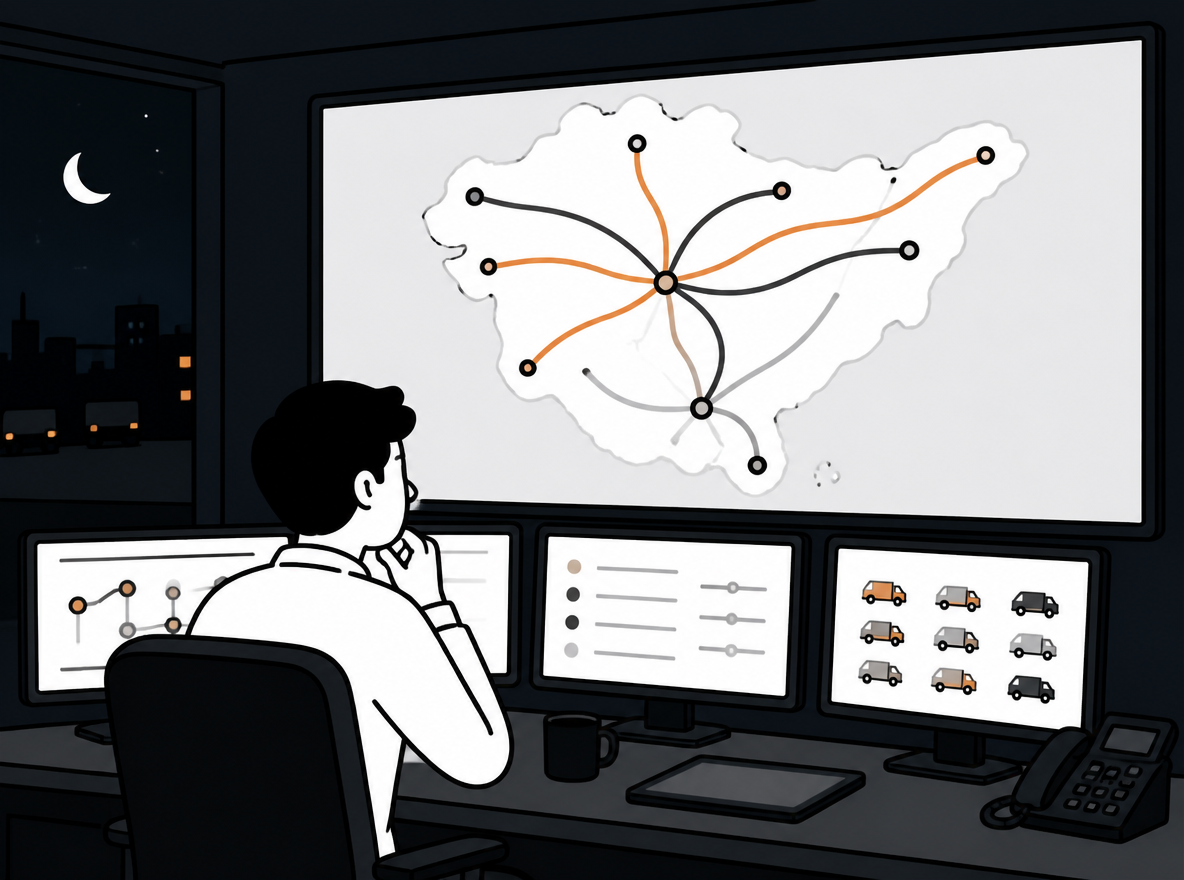
A logistics control room at night, an operator studying a large wall screen showing colored route lines converging on a map of the country
Multi-carrier operations need a console that shows every lane in real time

The real cost of this model is integration complexity: labels, rates, tracking, and claims across multiple carriers, each with different formats and failure modes. That complexity is what most 3PLs are actually choosing against when they stay single-carrier. The pragmatic answer is to start small: diversify the top volume lane first, add a tested carrier for peak-season overflow second, and let the integration prove itself before it touches every lane. Optionality is built lane by lane, not all at once.

8. Conclusion: From One Carrier to a Carrier Portfolio

The reframe that matters is the goal. Multi-carrier shipping is not about churning carriers every quarter to shave a few cents. It is about holding a portfolio: a stable primary that earns your volume through performance, a secondary that keeps the primary honest, and a backup that is ready the day something breaks. The point is optionality, and optionality is priced in the moments it is exercised, which are rare and expensive.

Diversification is not free. It costs integration effort, split volume, and the end of the deepest discount. But single-carrier risk is not priced at all until it materializes, and when it does, it bills at peak rates: lost accounts, breach penalties, and a season you cannot ship. Every 3PL should ask itself one question each January, before the GRI lands and the peak window opens: if my one carrier stops moving my packages tomorrow, what happens to my network?

A 3PL that cannot ship when its one carrier stumbles is not really a 3PL. It is a reseller of one carrier's capacity, with all the risk of the carrier and none of the leverage.

FAQ

When one carrier carries more than 70% of your volume, when your peak stress test fails, when the carrier's SLA history on your lanes is not clean, or when you have no leverage at renewal. The cheapest time to add a second carrier is before you need it: integrate, test, and fund it with volume while your primary is still performing.
Both carriers raised general rates 5.9% for 2022, 6.9% for 2023, and 5.9% for 2024 and 2025, in lockstep. On top of that come peak surcharges of fractions of a dollar to several dollars per package, plus accessorials like dimensional weight repricing, address correction, residential delivery, and fuel. Because the duopoly reprices together, holding both national carriers does not diversify the risk; only a mix that includes alternatives with independent pricing does.
Run four checks: volume concentration (is one carrier above 70% of volume, especially on the top lane?), peak elasticity (can you absorb a 2x peak day?), SLA history (how often did the carrier miss its own standard in the last 12 months?), and renewal leverage (what happens if you walk away?). Fail any of the first three and you are dependent.
The UPS-Teamsters negotiations covered 340,000 workers with a strike deadline of August 1, 2023. A tentative deal was reached on July 25, days before the deadline, narrowly averting what would have been the largest single-employer strike in US history. In the weeks before, shippers with UPS volume built contingency plans and competing carriers raised rates on the overflow. It is the textbook case of a labor shock no single-carrier contract can manage.

Ready to diversify without the integration project?

EasyShippingX provides Portal, Excel import, and API workflows for USPS and regional carriers, with services and rates governed by the enabled account list. Validate coverage and total charges by origin hub, destination, and parcel profile, then pilot tracking, billing, and a fallback path. Automatic routing or fallback requires separate configuration and validation.

When orders mix marketplace fulfillment and your own warehouse, confirm who ships before evaluating carriers. The TikTok Shop comparison of Amazon MCF and 3PL fulfillment helps establish ownership of handoff, tracking updates, and exceptions.