Carrier Guide

What are the best USPS alternatives, and when should teams evaluate them?

USPS remains an important baseline for many eCommerce teams, but that does not mean every shipment should stay on one path forever. The value of alternatives usually comes from complementing USPS for selected shipment segments rather than replacing it entirely.

Editorial illustration of a shipping coordinator at a packing bench holding a parcel, surrounded by outline icons of a mailbox, several alternative route arrows reaching toward destination dots, a checklist, a label, and a scale, one route accented in orange, black linework on white with generous empty space.

A second-carrier evaluation path for 3PLs

For a 3PL serving several brands, a second carrier should solve an explainable problem. Follow this path to identify the evidence you need, then use the full carrier comparison, cost example, and pilot guidance below.

  1. Decide whether a second carrier is needed

    Define the problem for one client, facility, and parcel segment.

  2. Validate coverage and handoff

    Confirm eligibility, then verify how the facility will tender parcels.

    Then check the warehouse handoff checklist
  3. Compare the final cost

    Connect quotes to invoices, exceptions, and added operating cost.

  4. Run a controlled pilot

    Keep the existing path and exercise success, failure, and recovery.

  5. Review continuing performance

    Use consistent definitions to maintain, adjust, expand, or stop.

Decide whether you need a replacement or a complementary carrier

In practice, USPS more often remains the broad-coverage baseline while regional last-mile networks or mail consolidators receive only shipment segments that pass serviceability checks. The useful question is not “who replaces USPS?” but “which shipments have a specific, measurable problem that another network can solve?”

For example, USPS currently says Ground Advantage can reach all 50 states, military bases, territories, and other listed destinations, includes tracking, and has an expected 2–5-day range with stated exceptions. That broad reach and single final-mile chain help explain why USPS is often a baseline, but “serviceable” does not mean best for every parcel, promise, or cost target. Source: USPS Ground Advantage for Business.

Evaluation angleUSPSAlternative direction
National baselineOften strongOften complementary rather than full replacement
Regional optimizationGood baselineRegional last-mile options are worth testing
Peak flexibilityVaries by workflowUseful as a backup path

Choose whether to continue, supplement, or pause for one segment

The following is an EasyShippingX evaluation method, not a carrier policy. Name the client, origin facility, destination ZIPs, parcel profile, and delivery promise being evaluated. A carrier that helps Client A may not help Client B. Use settled charges, handoff and first-scan records, delivery exceptions, and manual-work records to identify the segment that needs improvement.

DecisionEvidence to look forNext action
Continue with USPSThe current path meets this segment’s promise and the candidate has no verified cost or service advantage.Keep the baseline and address packaging, data, or handoff issues before reassessing.
Add a carrier for a defined segmentA facility, client, or destination segment has a recurring problem and the candidate offers a verifiable way to address it.Validate coverage and handoff, compare complete cost, then pilot if the conditions are met.
Pause the evaluationCoverage data is outdated, quote conditions are incomplete, the client promise is unclear, or actual cost cannot be reconstructed.Assign an owner to each missing item; unknown does not count as passed.

Put the problem and the executable scope in the same evaluation record

For example, a 3PL could evaluate Client A’s common lightweight parcels from Facility B to a verified ZIP group. This is an illustrative scope, not a customer case. Record the current service and client promise, the outcome to improve, the outcomes that must not deteriorate, and the candidate carrier and service. Do not pool different clients, promises, and weight bands into one average savings claim.

If the evidence justifies an evaluation, start with the coverage validation guide, then use the warehouse handoff checklist to check the operational conditions. A cheaper quote is not yet an executable shipping path without coverage and handoff evidence.

Common USPS alternative paths to review

Use the USPS service overview to define the postal baseline, then the multi-carrier strategy overview to decide which role an alternative would fill before comparing its rates.

GOFO, SwiftX, UniUni, and SpeedX services offered through EasyShippingX: Delivery to APO/FPO/DPO military or diplomatic addresses and PO Box addresses is not supported, even when the destination ZIP is within the coverage area.

GOFO

GOFO describes its U.S. service as an ecommerce last-mile network operated through its own and partner delivery resources, with a ZIP footprint that continues to change. Do not accept “nationwide” as sufficient evidence: validate origin facility, destination ZIP, parcel attributes, pickup method, and fallback. GOFO's pickup page also ties automatic pickup to shipment volume, so confirm handoff conditions for every facility. Sources: GOFO U.S. and GOFO pickup instructions.

UniUni

UniUni publishes U.S. primary and secondary hubs and describes an expanding North American ecommerce last-mile network. Its platform documentation covers label purchase, batches, tracking, and webhooks, but “has an API” does not prove that your facility and customer ZIPs are serviceable. Validate coverage, delivery service, pickup or drop-off, batching, and exception-status mapping separately. Sources: UniUni North American coverage and UniUni API documentation.

SpeedX

Screen SpeedX’s permanent Oversize Surcharge alongside coverage: 24–35.4 in longest side carries $15 per package; 120–150 cm L+W+H carries $20. Over 35.4 in longest side, 150 cm L+W+H, or 30 lb weight also involves partner shipping rates; the weight surcharge is $200 per package. Use the higher surcharge when two types apply; payment does not replace required written approval.

SpeedX oversize charges and acceptance conditions

SpeedX presents itself as a technology-enabled last-mile network focused on dense U.S. ecommerce markets and describes pickup or drop-off, online tracking, and proof-of-delivery photos. Public footprint counts change as the network expands, so route from a current ZIP file or serviceability response rather than a website total. Source: SpeedX. This revision makes no capability claim for SwiftX: we did not find current official U.S. service material strong enough for a like-for-like comparison. Request its coverage, service, and integration files before evaluation.

UPS MI

UPS Mail Innovations is not a last-mile network independent of USPS. UPS says it performs pickup, processing, and interim transportation before postal networks such as USPS complete final delivery, and business shippers contact UPS to establish an account. Evaluate it as a mail or lightweight-parcel consolidation model, with special attention to handoff visibility, final-delivery responsibility, insurance, address changes, and billing. Source: UPS Mail Innovations.

Which shipment segment each path suits first

PathNetwork roleSegment to pilot firstMust confirm before go-live
GOFOEcommerce last-mile network using owned and partner delivery resourcesDense-region orders where both the origin facility and destination ZIP sit inside current coveragePickup terms and minimums per facility, destination-ZIP serviceability, exception and return paths
UniUniEcommerce last-mile network supported by U.S. primary and secondary hubsDestination ZIPs inside hub reach where batching and event callbacks are neededCoverage and delivery service, pickup or drop-off, batching rules, exception-status mapping
SpeedXLast-mile network focused on dense ecommerce regionsUrban dense-area orders where proof of delivery mattersCurrent ZIP coverage, tender, tracking/photo proof, permanent oversize charges, partner shipping rates, and acceptance
UPS Mail InnovationsMail and lightweight-parcel consolidation with postal final mileLightweight, pre-sortable, time-tolerant mail-type volumeAccount and preparation requirements, the boundary between interim transport and postal final mile, handoff visibility and claims ownership

This table only narrows the shortlist; it is not a service commitment. Every row still has to be validated against your own facility, destination ZIPs, parcel attributes, and tender arrangement, and coverage lists keep changing as networks expand.

Compare different networks through the same gates

USPS, regional last-mile networks, and mail consolidators are not the same product. Apply elimination gates before price: a path that cannot serve the destination ZIP, accept your facility handoff, or meet parcel and promise requirements should never enter the rate comparison.

Evaluation gateUSPSRegional last mileConsolidator / postal final mile
ServiceabilityValidate USPS service, destination, and parcel rulesValidate ZIP, facility, dimensions, weight, and contentsValidate account, preparation, and postal eligibility
Facility handoffPickup, drop-off, or bulk entryConfirm pickup, drop-off, minimums, and cutoff per facilityConfirm pickup, preparation, postal induction, and manifest
Customer promiseManage to service standard and exceptionsValidate through a pilot in target ZIPsMeasure interim transport and postal final mile together
Tracking and exceptionsMap USPS to internal statusesCheck first scan, proof, failure reasons, and support pathDefine support and claims ownership before and after handoff
Cost and billingCompare purchase and final chargeInclude pickup, injection, exception, and fallback costInclude preparation, induction, surcharge, and insurance differences
Decision order: serviceability → facility handoff → customer promise → tracking/exceptions → final billing

What a complete cost comparison includes, and why a quote is not yet an invoice

Whether an alternative path pays off is rarely decided by the base freight line alone. Everything below belongs in the full cost: when a quote leaves an item out, record the actual amount during the pilot rather than treating the gap as zero.

Cost itemWhat it coversWhy it can flip the conclusion
Base transportationThe main charge computed from weight, dimensions, and zoneIt is the easiest number to compare and usually the widest gap, but it is only the starting line
Tender and handoffPickup charges, drop-off handoff, postal preparation, and manifest workRegional networks often price pickup around per-facility minimums, so a low-volume facility carries a higher cost per parcel
Accessorials and adjustmentsDimensional weight, oversize handling, address corrections, re-delivery, fuel or peak surchargesRate sheets usually exclude them; they surface at invoice time and can consume the entire base-freight gap
Returns and re-deliveryReturn to sender, second delivery attempt, abandoned-parcel handlingWhen first-attempt delivery rates differ, return cost gets spread across every parcel, not just the few that fail
Support and manual overridesException follow-up, manual re-routing, and customer-service laborWhen status conventions differ, this cost quietly shifts onto your operations team
Quote-to-invoice varianceAdjustments between the purchased label amount and the final settlementIt decides whether you can budget from quotes at all, or must budget from invoices instead

Worked example: cost per successful delivery on one shipment segment

Assume one explainable segment: a single facility, 500 parcels a month, 1 to 2 pounds each, destination ZIPs concentrated in one metro area. Every figure below is a hypothetical example rather than a carrier quote; replace it with your own invoice data. Unit: USD per parcel.

ItemPath A: USPS baselinePath B: regional alternative
Base transportation7.605.90
Tender and handoff0.350.55
Accessorials and adjustments0.400.60
Returns and re-delivery (spread over the example return rate)0.300.75
Support and manual overrides0.150.30
Quote-to-invoice variance0.100.25
Net cost per parcel (total)8.908.35
First-attempt delivery rate (example)97%94%
Cost per successful delivery9.188.88

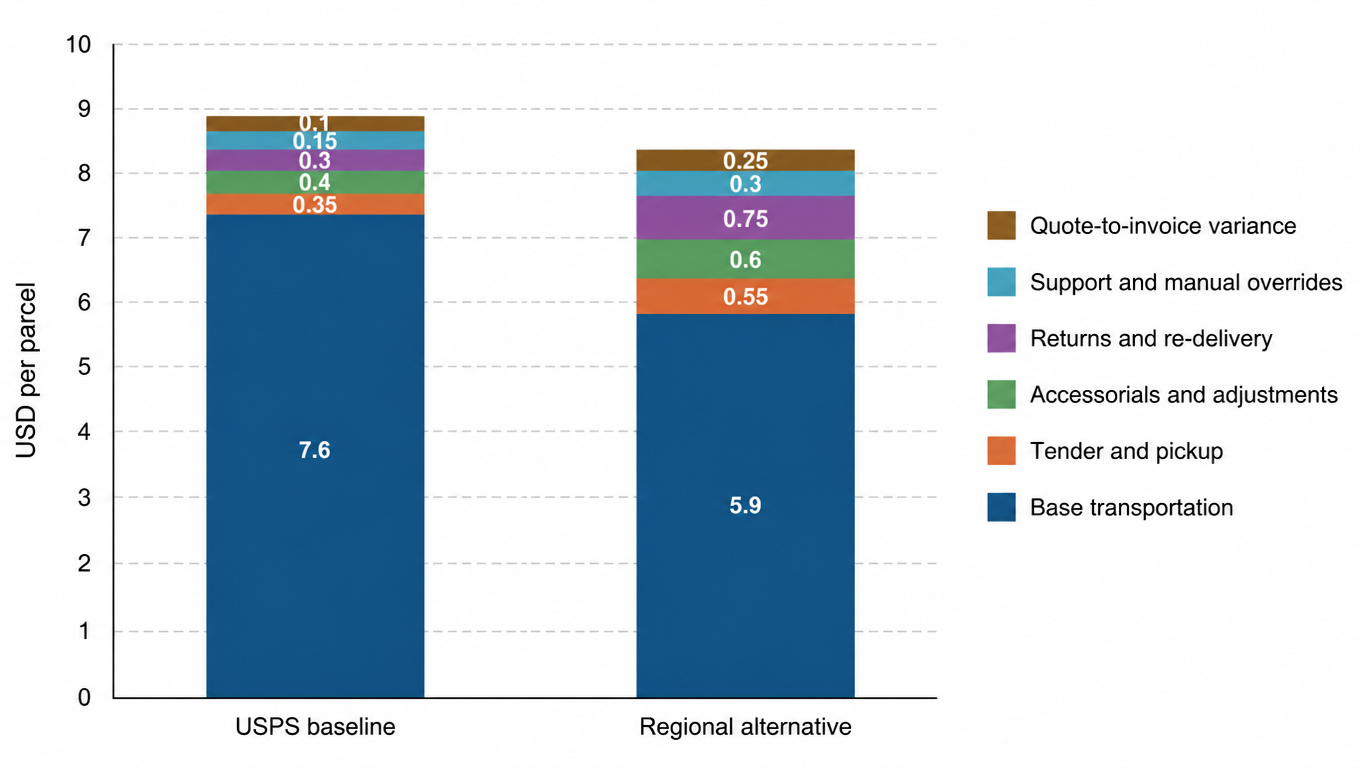
The definition is a single formula: cost per successful delivery = net cost per parcel ÷ first-attempt delivery rate. In this example the base freight gap is 1.70 dollars a parcel, but once tender, accessorials, returns, labor, and billing variance are included, net cost differs by only 0.55 dollars. Converted through the delivery rate, the cost per successful delivery differs by about 0.30 dollars, roughly 148 dollars a month at 500 parcels. The real question is not which quote is lower, but whether 148 dollars is worth carrying a second chain, a second exception process, and the upkeep of another account and integration.

The conclusion is sensitive to first-attempt delivery: if the alternative path delivers one point lower, cost per successful delivery rises to about 8.98 dollars and the advantage shrinks to roughly 0.20 dollars; around 91 percent the two paths break even. Fix the denominator before comparing: parcels sent, not parcels that eventually arrived.

Stacked bar chart of the hypothetical net cost per parcel for a USPS baseline at about 8.90 dollars and a regional alternative at about 8.35 dollars, split into base transportation, tender and handoff, accessorials and adjustments, returns and re-delivery, support and manual overrides, and quote-to-invoice variance
Example: net cost per parcel build-up for two paths on the same segment (hypothetical values, not a carrier quote)

When it is time to review alternatives more formally

A formal alternative-carrier review should not begin only because another network appears attractive on paper. More practical signals include repeated friction in selected regions, too much dependence on a single path during peak periods, materially different service expectations for part of the order mix, or recurring billing disputes that show up in month-end review. Once those signals appear, a carrier-mix review becomes much more actionable.

Business signalBetter response
Repeated friction in selected regionsReview a region-oriented complementary carrier
Peak periods rely on one pathAdd a backup carrier path
Shipment profile is clearly segmentedUse carrier mix by weight band or destination

Pilot a shipment segment instead of moving all volume

  1. Build the USPS baseline: record final cost, first scan, delivery, exceptions, support, and returns by facility, destination ZIP, dimensions/weight, and promise.
  2. Select one explainable segment: for example, a verified group of ZIPs from one facility rather than every region and parcel type.
  3. Exercise failure paths: test no-service, label failure, missed scan, failed delivery, return, and integration outage with a pre-approved USPS or other fallback.
  4. Compare final outcomes: use cost per successful delivery, promise attainment, exception aging, manual overrides, and quote-to-invoice variance rather than one rate sheet.
  5. Expand, revise, or withdraw: increase ZIPs or volume only after service and financial outcomes remain stable across multiple review cycles.

Coverage changes quickly. Even when a carrier publishes a map or total, routing should use a versioned, effective-dated ZIP file or live serviceability response and review it regularly. See the carrier serviceability validation guide for the full validation method.

Pilot pass criteria: what to record and what counts as passing

RecordPass condition
Quote traceabilityEvery quote maps to a weight, dimensions, destination ZIP, service, and effective date
Label and tenderEvery parcel in the batch appears at the first scan node, with no missed scans or missing data
Delivery and exceptionsProof of delivery, failure reasons, and return or re-delivery states map to internal statuses that support can answer from
Billing varianceThe gap between purchased label amount and settlement is explainable and traceable to a specific cost item
Fallback pathNo-service, label failure, or an integration outage can fall back to a pre-approved path within the same batch
OwnershipService, billing, and exceptions each have a named owner and a fixed review cadence

Common mistakes

  • Treating a website claim of nationwide coverage as proof of serviceability
  • Comparing only base transportation instead of full cost and first-attempt delivery
  • Moving all volume at once and stretching pilot risk across a whole month of shipping
  • Running without a fallback, so an outage or label failure has nowhere to go
  • Evaluating a consolidation service such as UPS Mail Innovations as if it were an independent last-mile network
  • Declaring a price winner for a fixed weight band

Printable second-carrier evaluation checklist

Use this working checklist across operations, finance, engineering, and support. Print and complete it on paper; this page does not provide online entry or saving. It is recommended evaluation guidance, not carrier certification or a service commitment.

Client / facility
Candidate carrier / service
Evaluation date

Use verified / failed / pending / not applicable; explain any not-applicable item. Record the source name, version or date, and record location in the evidence column. Missing evidence remains pending and must not be treated as approval.

Five-stage evaluation record with fifteen core checks
CheckEvidence recordOwnerStatusConclusion / next action
1. Decide whether a second carrier is needed
1.1 Identify the client, origin facility, and parcel segment.
1.2 Record the current service, client promise, and problem to improve.
1.3 Choose continue, supplement, or pause and record why.
2. Validate coverage and handoff
2.1 Validate ZIP/address type, parcel and service eligibility; record the source’s effective date.
2.2 Confirm facility tender method, cutoff, manifest, and count evidence.
2.3 Assign handling and owners for no-service, missing-scan, and handoff exceptions.
3. Compare the final cost
3.1 Match client, facility, ZIP, parcel profile, and promise for comparison.
3.2 Include surcharges, handoff, exceptions, returns, and added operating cost.
3.3 Join quotes to final invoices; state denominators, open items, and client billing.
4. Run a controlled pilot
4.1 Define pilot scope, participating shifts, and an available original path.
4.2 Cover success, failure, and recovery; use one actual shipping path per real order.
4.3 Confirm pass, pause, rollback, and expansion criteria and approving owners.
5. Review continuing performance
5.1 Review cost and client promises by client, facility, and parcel segment.
5.2 Record evidence and owners for maintain, adjust, expand, or stop decisions.
5.3 Set the next review date and revalidation triggers for scope changes.
Overall decision and next action:Approving owner / next review date:

Source:https://www.easyshippingx.com/en/shipping-guides/best-usps-alternatives/#carrier-evaluation-checklist

FAQ

Usually not. A more common approach is to keep USPS as a baseline and add a second path for selected shipment segments.
No. Fit depends on weight, destination mix, fulfillment model, and billing discipline.
No. It can also reduce dependence on one path and create more resilience during operational change.
When specific regions, peak periods, or billing patterns repeatedly show friction, a formal review becomes much more valuable.
Not necessarily. The gap depends on destination density, weight band, tender arrangement, and how disciplined your billing review is. In the example above, base transportation differed by 1.70 dollars a parcel while cost per successful delivery differed by about 0.30 dollars, and a different sample can reverse it.
No. A parcel has one final-mile chain. A multi-path setup happens at the routing layer, where different parcels or segments take different paths, not where one parcel takes two.
Postal-only addresses such as PO boxes, and some remote destinations, usually still need the postal network for final delivery. Validate serviceability by address type and destination ZIP separately, and define the fallback for rejections.
At least several review cycles, including one promotion or peak period, so service results and settlement invoices can be compared with the baseline on the same footing. The first week of rates and first scans is not enough sample.
Can I fill in the second-carrier evaluation checklist online?

No. It is a static checklist for your team to print and record evidence, owners, status, and conclusions. There is no online entry or saving.

Product and evidence checks

Compare products rather than inferring coverage, postal handoff, or price from a brand name. USPS Ground Advantage, UniUni core services, and the SpeedX service agreement impose different eligibility and operating constraints. Validate full charges and tender arrangements for your account.

Compare eligible share, tender-to-first-scan time, final invoices, and exception handling on the same sample. Use the Carrier Fit Advisor to shortlist, then validate with the rate calculator or an account rate assessment. A fixed weight band does not establish a price winner.