Rollout Guide

How to roll out a new shipping workflow with lower operational risk

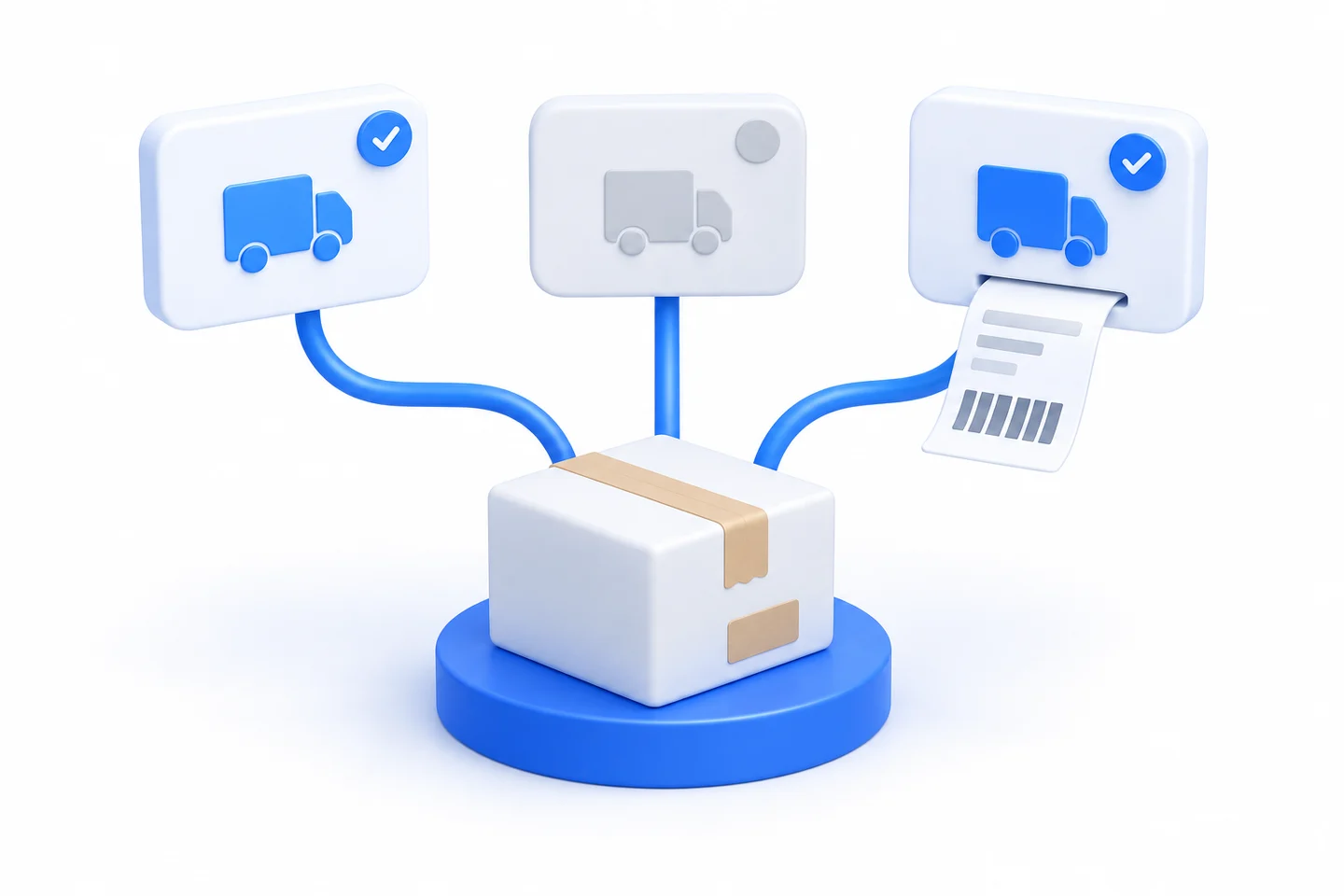
Illustration of service selection and label workflow
Workflow illustration, not a customer case or an actual quote.

When teams evaluate a new shipping workflow, the main fear is often not pricing but the risk of disruption. That is why low-risk rollout should be treated as an operating method, not as a fallback plan after implementation starts.

This page breaks the method into four things a team can copy: define the baseline, write entry criteria and exit evidence for each stage, work through a hypothetical pilot example to fix the judgement rules, and set an expansion order.

Second-carrier evaluation: stage 4

You are at stage 4 of a second-carrier evaluation. Pilot within a validated scope, keep an available original path, and define pause, rollback, and expansion criteria. Mark missing evidence as pending and assign an owner to collect it.

Define the baseline first, or stability cannot be proven

The step teams skip most often is the baseline. Without pre-change data from the same order segment, any improvement can only be described from memory and any regression has nothing to compare against. The baseline does not need to be elaborate, but it needs six numbers taken from your own invoice and tracking records rather than a provider's pricing page.

Baseline metricHow to measure itDenominatorWhy it decides the verdict
Settled cost per parcelAggregate shipment-level invoice detail, not the quote sheetParcels shippedA quoted difference only exists once it settles
Time to first scanGap between the handoff time and the first scanParcels handed offIt decides whether the promised window still holds
Exceptions and re-sendsCount per 100 parcels by reason codeParcels shippedExceptions are where hidden cost lives
Customer cases and ticketsTickets per 100 parcels, grouped by causeParcels shippedThe customer side has to be measured alongside cost
Label voids and refundsWhether unused labels are voided inside the window and refundedLabels createdUnvoided labels quietly cancel out a discount
Shipment-level data completenessCheck a small sample field by fieldParcels sampledWithout shipment-level data none of the rows above can be repeated

Take the baseline from the most recent full billing cycle and use the same segment definition as the pilot (facility, weight and size band, destination range, service). When even one full cycle is missing, run both paths in parallel for a cycle instead of inferring the result from a quote. For the handoff side, record the baseline items item by item in the carrier handoff checklist.

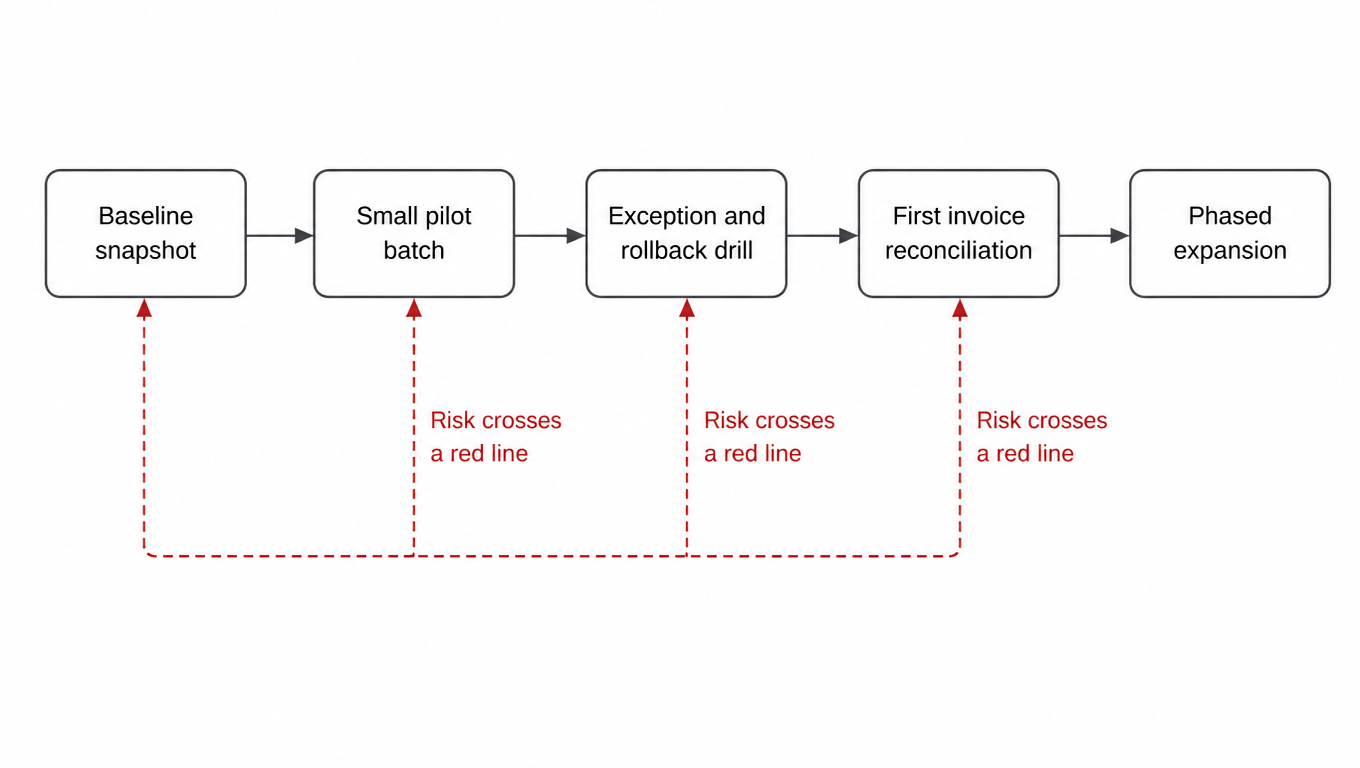
Five stages of a low-risk rollout

Every stage needs entry criteria, test scope, owners, pass evidence, and rollback action. The number of stages is not the point; the point is whether evidence from one stage supports the next expansion.

Flow chart of the rollout gates: baseline snapshot, small pilot batch, exception and rollback drill, first invoice reconciliation, then phased expansion, with each stage returning to the baseline snapshot when risk crosses a red line
Low-risk rollout gates: baseline → live cohort → exception drill → financial close → expansion, with any stage returning to the baseline when risk crosses a red line
StageGoalExpected output
Baseline and scopeDefine current state, target segment, roles, and fallbackComparable baseline and approved plan
Pilot batchValidate real shipment fitInitial carrier-fit evidence
Exception and fallback drillValidate rejection, timeout, duplicate, missing scan, and human takeoverExecutable failure handling and rollback evidence
Reconciliation reviewConfirm billing fields and exportsTraceable net-cost view
Phased expansionExpand to more lanes or APIMore controlled scale-up

The rollout charter: entry criteria, exit evidence, owners, and rollback triggers

The five stages only constrain anything once each one states what qualifies it to start and what proves it may continue. The table below can be filled into the rollout document row by row, and every row should name a specific role and a date.

StageEntry criteriaExit evidenceOwnerRollback trigger
Baseline and scopeThe current state is measurable and one full billing cycle existsBaseline snapshot, approved scope list, written rollback pathOperationsThe requested scope contains non-reversible orders (high value, restricted, or date-promised)
Pilot batchThe baseline is confirmed and written into the charterPilot evidence pack: quote, label, first scan, delivery result, settled chargeOperations and financeAny threshold metric crosses the charter limit
Exception and fallback drillThe normal path is stable across consecutive batches in the same scopeDrill records: rejection, timeout, duplicate request, missing scan, human takeoverEngineering and supportData integrity or a duplicate charge cannot be explained
First reconciliationThe pilot invoice has been issuedEvery charge is explainable and unmatched items have an owner and a due dateFinanceUnmatched charges cannot be traced back to a shipment
Phased expansionThe first four gates have all passedA review record after one full billing cycle at the new scopeOperations and financeThe new scope repeats a failure already seen in the pilot

The charter does not need to be long, but the owner column cannot name a team. When it does, the rollback usually has nobody to run it at the moment it is needed.

Why a day-one full migration concentrates risk

A full migration may look faster on paper, but it stacks carrier fit, training, exception handling, billing verification, and technical integration risk into the same moment. A better approach treats rollout as a validation chain: first basic workflow, then live shipment behavior, then billing clarity, then broader expansion.

If the current state isLower-risk move
The team has not validated the basic operating flowComplete end-to-end validation in the minimum viable mode
Carrier fit is still unclearRun a pilot batch before scaling volume
Billing and shipment fields are still misalignedFinish reconciliation review before broad migration

The pilot must cover both success and failure paths

Test familyValidate at minimumEvidence
Eligibility and label purchaseServiceable, unserviceable, boundary weight/dimensions, restricted content, and bad addressReturned service, rejection reason, label, and charge inputs
Duplicate and voidRepeat click/request, timeout retry, reprint, and voidNo duplicate charge and original/new records remain linked
Warehouse handoffPrint, scan, sort, manifest, carrier acceptance, and missing first scanParcel/label match and provable handoff ownership
Tracking and customerNormal delivery, stall, failed attempt, return, and notificationEvent mapping, case, authorized action, and customer record
Financial closePurchase, adjustment, refund, return, and final invoiceEvery charge is explainable and unmatched items have owners

Pilot size follows risk coverage, not a fixed shipment count

The cohort should cover major facilities, parcel segments, destination regions, services, shifts, and exception types, while keeping high-value, restricted, or non-reversible orders outside the approved scope. If a low-frequency failure path has not occurred, drill it deliberately rather than merely adding more normal shipments.

How to choose the pilot scope

Coverage dimensionWhy it must be coveredMinimum coverage
Facilities and shiftsHandoff timing drives when the first scan appearsAt least one early and one late shift per participating facility
Parcel segmentWeight and size bands decide the pricing rules and the handoff methodCover your two largest volume bands
Destination rangeZones and regional assignment affect tracking and transitCover one nearest and one farthest region
ServiceService selection changes both price and promiseOnly test services you intend to keep
Exception typeLow-frequency failures do not show up on their ownDrill rejection, timeout, duplicate, missing scan, and bad address once each
Explicit exclusionsNon-reversible orders should not carry the experimentKeep high-value, restricted, and date-promised parcels out of scope

The scope table separates "no problem found" from "not tested". When a dimension is missing, write the conclusion as unverified rather than passed.

Worked example (assumed values): four numbers one pilot has to record

Every number below is an assumed input used to show the judgement method. None of it is a customer's data and none of it is a quoted price. Assume a 3PL runs 200 parcels in parallel on one facility and one segment (1 to 2 lb, residential, same service), shipping on both paths and recording the same four metrics on each side.

Metric (assumed)Baseline pathPilot pathCharter limit (example)Verdict
Settled cost per parcel7.587.22Not above baselinePass
Time to first scan (hours)6.49.2No more than 1.25 times baselineFail
Exceptions and re-sends per 100 parcels1.61.4Not above baselinePass
Customer tickets per 100 parcels2.12.3Not above baselineFail

Two of the four metrics cross the limit, so the conclusion is not "it is cheaper, scale it up" but "fix the handoff first". A slower first scan usually comes from the drop time, the handoff location, or the manifest process rather than from the network itself. Fix it, re-test only those two metrics on a fresh batch, then decide about expansion.

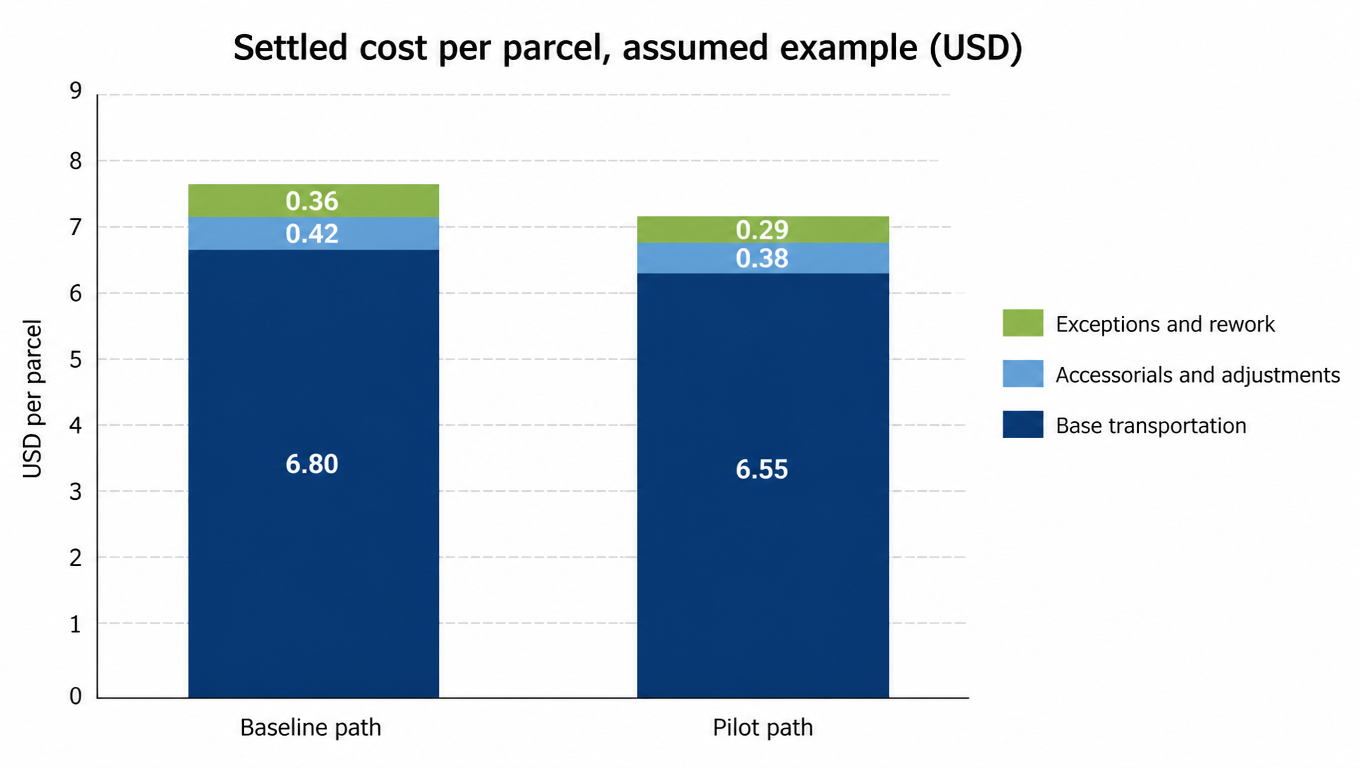
Splitting the cost makes the gap easier to read. Base transportation explains part of the difference, while accessorials and adjustments, plus exceptions and rework, make up the rest. That is why comparing base transportation alone overstates the gain.

Stacked bar chart splitting settled cost per parcel into base transportation, accessorials and adjustments, and exceptions and rework for the baseline and pilot paths, an assumed example of 7.58 against 7.22 dollars
Assumed example: how settled cost per parcel is composed (assumed values, not a quote and not a savings promise)

All four metrics use parcels shipped as the denominator and take cost from shipment-level detail. Switch to delivered parcels as the denominator and the parcels that failed or came back drop out of the average, making the pilot look better than it was. If all four pass, move on in the order below.

Set separate criteria for pass, pause, rollback, and expansion

  • Pass: In-scope success and failure paths complete with evidence, ownership, and customer/finance writeback.
  • Pause: The issue is containable but unexplained; freeze new assignments and monitor in-flight shipments.
  • Rollback: Customer promise, charge, compliance, or data integrity crosses an approved boundary; return to baseline.
  • Expand: Results are stable across batches, unmatched charges and exception aging are controlled, and the next scope has owners.

Operations owns scope and handoff, engineering owns data and failure recovery, support owns the customer promise, and finance closes final charges and refunds. Use the exception-management workflow to design drills and shipping reconciliation for the financial gate.

Make the second-carrier pilot a traceable operating decision

Before the pilot, include the quote-to-final-invoice comparison method in the charter and identify pending cost items and approved boundaries.

Apply the low-risk framework to a second carrier using a pilot record that preserves how the decision was made. The scenario below is recommended practice, not a customer case or universal pass standard. Operations, finance, engineering, and support should agree on scope and boundaries before shipping rather than changing the definitions after seeing the results.

Scenario: one client, one origin facility, one verified segment

Choose a segment that has passed coverage and handoff checks. Record the client promise, original and candidate services, participating shifts, and exception contacts. Keep the original path available, but each real order must use only one actual shipping path. Parallel comparison uses comparable distinct orders rather than buying or shipping the same order twice. Identify test parcels separately from real client orders. Size the pilot by risk and scenario coverage, not a universal parcel count.

ScenarioEvidence to retainConfirmation owner
Normal shipment and handoffService selection, label, manifest, handoff confirmation, first scan, and promise outcome.Operations
Ineligible service, label failure, or request retryHold/recovery record and evidence of any duplicate charge or label.Engineering and operations
Missing scan, failed delivery, or returnEscalation ownership, notification, recovery action, and final parcel outcome.Operations and support
Invoice and refundQuote-to-settled-charge join, adjustments/reversals, and client billing review.Finance

Review the evidence before expanding the scope

Alongside the existing pass, pause, rollback, and expansion criteria, record the evidence, approving owner, and scope version behind each decision. Pause expansion if eligibility is unclear or invoices remain open. Parcels already tendered continue through exception handling; a system rollback does not recall every parcel. If a client promise fails or charges exceed the approved boundary, stop new assignments under the charter and restore the original path where rollback remains possible.

At pilot close, carry the segmented scope, exceptions, settled costs, and unresolved items into the carrier performance scorecard. Review the first full billing cycle, then revalidate after changes to client, facility, service, or order mix. A single pilot result is not permanent eligibility.
Record the system pilot’s scope and recovery ownership separately

This guide applies both to carrier pilots and system onboarding. For onboarding, separately define the client, facility, mode, and service; identify actions retained by the existing workflow and who resolves unknown outcomes. An API connection does not prove that Portal can take over. Validate the fallback’s permissions, services, fields, and recovery for unfinished orders.

Pilot controlEvidence to retainDecision condition
Entry conditionsRequirements, mode, mapping, and applicable failure scenarios have conclusions; open items have owners.Complete essential evidence before using the pilot to validate operations.
Single execution and fallbackHow orders are assigned between modes, outcomes are queried, and duplicate purchase is prevented.One mode executes a given real shipping action.
Pause and rollbackHandling of duplicate charges, broken identities, promise failure, or unrecoverable exceptions.Stop new assignments first; continue handling purchased/tendered records.
Expansion and reviewWorkstation timing, charge closure, exceptions, and client outcomes in a complete window.Change one scope dimension at a time with evidence-based approval.

Parallel comparison uses comparable distinct real orders, not duplicate shipments through multiple entry points. Software rollback cannot recall tendered parcels; void/refund eligibility depends on actual state. Engineering and operations confirm recovery together rather than declaring a full migration based on volume alone.

After a stable pilot, use scan-to-paper monitoring for workstation performance and reconciliation for late charges and credits. Carrier and system pilots can share evidence while retaining distinct scopes and conclusions.

Expansion order: change one thing at a time

Most expansion failures are not provider problems, they are too many changes at once. Split expansion into four dimensions and validate each on its own so a problem can be located. Change facility, service, and automation level in the same step and nothing is attributable.

Expansion dimensionSignal that it is nextDo not change at the same time
A new order segment at the same facility and serviceThe four metrics hold steady across two consecutive batchesDo not widen the destination range in the same step
A new service on an existing segmentThe price and promise for that service were verified on their ownDo not change packaging or billable weight inputs at the same time
An additional facilityHandoff and first scan have run once at the new facility on their ownDo not change shift patterns at the same time
Automation level: portal, spreadsheet, APIThe manual flow is stable and field and status mappings are confirmedDo not change an order source or platform in the same step

Before moving to the API, finish validating fields, statuses, and failure recovery. That order matches integration testing for WMS and shipping APIs: idempotency, duplicate requests, timeout retries, and status writeback all need answers before expansion.

Continue after this stage

Continue after reviewing this stage’s evidence and open items. If the conclusion is unresolved, retain the original path or assign manual verification.

Method and definitions

  • Denominator: cost, exception, and ticket metrics all use parcels shipped, never delivered parcels, so failed parcels do not disappear from the statistics.
  • Cost basis: settled invoice charges, including accessorials, billing adjustments, and return re-sends, never the quoted amount.
  • Time basis: time to first scan runs from the handoff time to the first scan, with the handoff time taken from the warehouse scan or the manifest.
  • Example status: every cost and metric figure on this page is an assumed example used to explain the judgement method. None is a quoted price and none is a savings promise.
  • Review cadence: once after the first full billing cycle, then again whenever scope, service, or volume mix changes.

Frequently asked questions

Does a low-risk rollout always mean a slower launch?

Not necessarily. The point is to validate risk in stages rather than expose every issue on the same day.

Should teams migrate everything first and optimize later?

Usually no. A safer path is to validate carrier fit, workflow, and billing fields in a smaller scope first.

In what order should portal, Excel, and API be adopted?

Most teams stabilize portal first, use Excel for batch efficiency next, and only then move into API once the workflow is clear.

When should teams scale up volume?

It is safer to scale once pilot results, tracking behavior, and billing review are all stable.

How many parcels should the pilot include?

Coverage decides it, not a fixed count. Start with early and late shifts at every participating facility, your two largest parcel segments, the nearest and farthest regions, the services you intend to keep, and one drill for each of the five exception types. The parcel count is the result of coverage, not the starting point.

What if there is no historical baseline?

Run both paths in parallel for one full billing cycle and use those two data sets from the same segment as the baseline. The cost of parallel running is usually smaller than the cost of deciding on a wrong baseline.

Should the old flow be paused during the pilot?

No. The point of the pilot is the comparison: both paths shipping in the same period is what makes cost, time to first scan, and exceptions comparable. Pausing the old flow removes the comparison.

When is rollback mandatory?

A broken customer promise, a charge outside the approved boundary, a compliance or data-integrity problem with no explanation, or a non-reversible order pulled into the test scope. None of the four needs another debate about continuing.

When can the team move from the portal to the API?

Once the manual flow is stable, field and status mappings are confirmed, and duplicate requests and timeout retries have answers. That order matches integration testing, so do not use the API go-live to validate the workflow at the same time.

Who signs off on expansion?

Operations confirms scope and handoff, finance confirms charges and refunds, and engineering and support confirm failure recovery and the customer promise. Expand when all three can point to the previous stage's exit evidence.

How often should the rollout be reviewed after go-live?

Once after the first full billing cycle, then again whenever scope, service, or volume mix changes. Each of those changes invalidates the earlier conclusion.

Does a parallel pilot mean shipping the same real order twice?

No. Each real order uses one actual shipping path. Compare the paths using comparable distinct orders and identify test parcels separately from client orders.

Can Portal always take over an API failure?

Do not assume it. Validate permissions, services, fields, and unfinished-order recovery, then assign one mode to new execution. Continue handling already purchased/tendered records.

Need a more controlled rollout path?

Share your shipment profile, team workflow, and rollout goal, and we can help define the right starting point.