
Operations Guide

Shipment exception management: detection, triage, remedy, evidence, and billing writeback

Editorial illustration of an operations desk reviewing a stalled parcel, with a tracking timeline, a phone, and a carton in view
Workflow illustration, not a customer case or an actual quote.

A shipment exception is not the same thing as a tracking status. It is a case: the network has stopped matching the plan, the customer promise is at risk or already missed, and someone has to decide the next move. Teams that run exceptions as a support inbox pay for it in three places at once: premature reships and refunds, duplicate customer replies, and charges that never get reversed because nobody wrote the outcome back to the billing record. This guide lays out the operating system behind the work: how to detect exceptions without drowning in alerts, the order to triage them in, who owns each family, what evidence to keep, and how to close the loop in billing and root-cause review. It is written for ecommerce operations, 3PLs, and warehouse teams running multi-carrier shipping.

Separate carrier events, risk signals, and actionable exceptions

A carrier event is a raw fact: label created, facility arrival, delivery attempt failed. A risk signal is an internal interpretation built from the promise and elapsed time. An actionable exception has crossed an approved trigger and therefore needs an owner and a next action. Blending the three reliably produces two mistakes: treating every quiet period as a loss, which triggers reships too early, and forwarding raw status only, which buries the cases that actually need intervention.

Exception familyValidate firstLikely owner
Pre-induction / delayed first scanPrinted, staged, handed off, or simply missed a scan; whether the promise is already at riskWarehouse operations
Address / serviceabilityAddress source, customer confirmation, service coverage, and whether it can still be correctedSupport + operations
Transit delay / missortLast physical scan, network path, promise, and any known service eventCarrier support + customer support
Failed delivery / returnFailure reason, retry path, inventory position, and customer reachabilitySupport + returns operations
Delivery dispute / damageProof of delivery, photos, address, packaging, and the customer statementSupport + claims / finance

Carrier statuses, claim eligibility, and waiting periods are not universal. Normalize internal categories, but verify any decision about loss, refund eligibility, or required evidence against the current official rules of the carrier involved instead of carrying over the previous carrier's assumptions.

Four layers of exception management

The four layers look obvious. What separates teams is whether each layer's output actually exists. If standardized tags live only in one person's habits, the next layer has nothing dependable to build on.

LayerGoalOutputFailure signal
Event detectionDetect stalled tracking, address problems, and failed deliveryStandardized exception tagsDifferent people describe the same case with different words
Escalation routingRoute issues to the right operations, support, technical, or finance ownerClear ownershipEvery case waits for someone else to move first
RemediationExecute reshipment, refund, reversal, or customer updatesResolution logThe same shipment gets reshipped twice
Reconciliation writebackMap the outcome to billing and finance fieldsAuditable cost explanationMonth-end shows the charge but nobody can name the case behind it
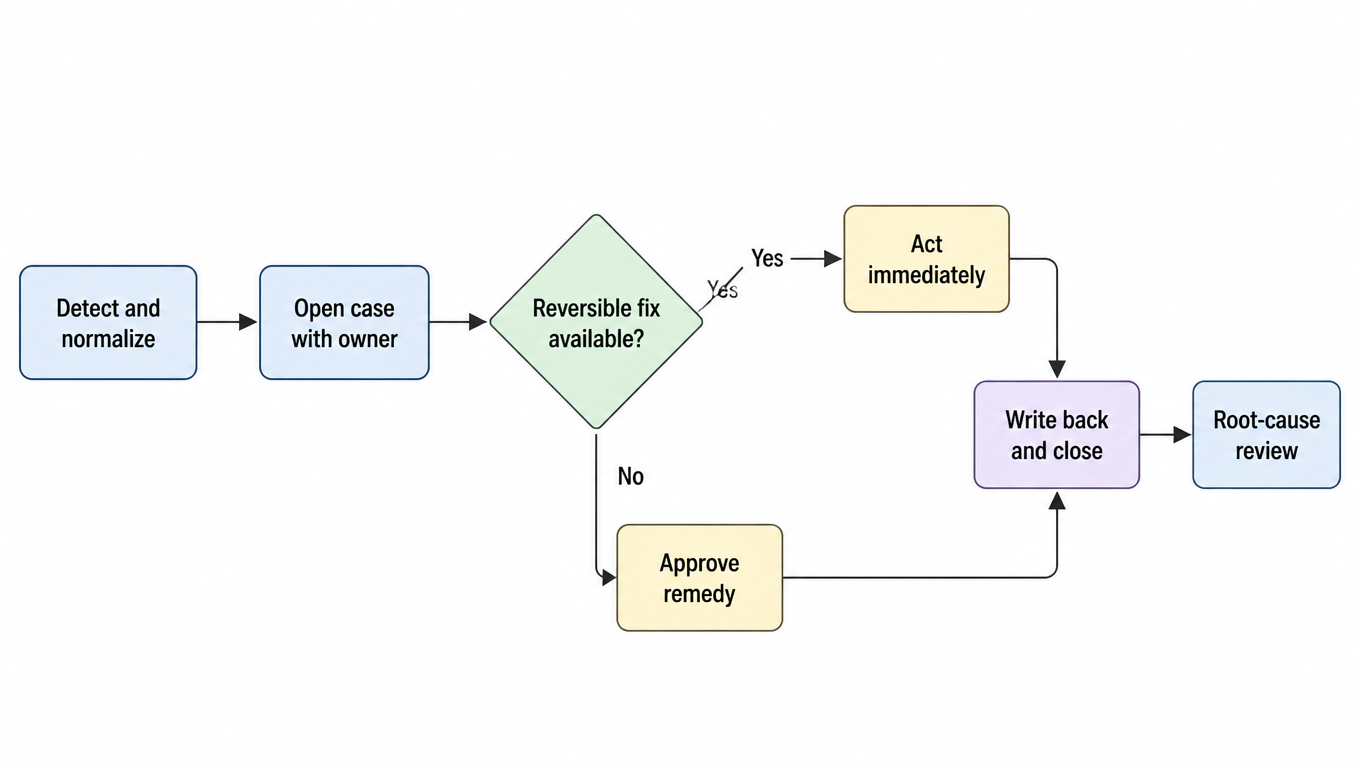
Exception lifecycle diagram: detect and normalize, open a case with an owner, decide whether a reversible fix exists, act or approve a remedy, write back and close, then review root cause
The loop has six stages: give the case an owner first, decide the action second, and never skip the writeback and review at the end.

Detection: turn triggers into rules someone else can re-check

A trigger that depends on one person's instincts cannot be handed over or reviewed. A re-checkable trigger names four things: the object being watched, the calculation, the exclusions, and the deduplication window. The thresholds themselves can start as informed guesses, but a colleague must be able to recompute the same number the same way. For first-scan monitoring in practice, see the carrier handoff checklist.

Trigger typeWhat to watchCommon false positiveCorrect handling
Scan-based: missing first scanShipments on the manifest that still show no network scan at allThe driver collected the batch without per-piece scans; the parcels are already movingCheck the handoff record first, then decide whether to reprint
Time-based: quiet periodTime since the last event compared with the normal rhythm of that service on your laneLong line haul produces no scans by itselfConfirm the leg and any known service event before touching the order
Promise-based: window missedThe promised date has passed without deliveryThe promise date was computed wrong or holidays were ignoredRaise priority and give the customer a verifiable next step
Reverse scans and failed attemptsReturn-to-sender, refusal, address not found, or repeated delivery attemptsReading a normal retry as a returnPrefer reversible actions while the parcel is still in the network
Eligibility: address and serviceAddress deliverability, service coverage for that area, and parcel limitsShipping to a corrected address while keeping the old address's promiseUpdate address, promise, and customer notice together

False positives are asymmetric in cost. A premature reship burns goods and freight with almost no recovery; a late investigation costs a few minutes of labor. Start triggers loose, calibrate them against a small hand-checked sample, and tighten from there. To judge what "normal rhythm" looks like on a lane, use tracking status interpretation and the shipping problem diagnostic framework instead of impressions.

Deduplication matters just as much. One shipment should hold one open case per exception family per window; later events update that case instead of opening a new one, or a reship and a refund can each fire from two parallel tickets.

Triage: reversible actions before irreversible promises

Triage is not about reaching a conclusion fast. It is about moving the case into the right next state. The five gates run in a fixed order: collect missing data first, avoid spending money or goods while the promise is still intact, exhaust recovery paths before replacements, require an authorized approval for irreversible action, and finish both the customer and the billing writeback last.

Triage gatePassFail
1. Is the record complete?Validate physical stateCollect order, shipment, last event, and promise
2. Is the customer promise at risk?Raise priority and prepare communicationMonitor; do not refund or reship early
3. Is there a recoverable path?Correct, retry, intercept, or escalate to the carrierEvaluate reship, refund, or return handling
4. Is the irreversible action approved?Execute and notify the customerRoute to an authorized owner
5. Are both writebacks complete?Close and enter root-cause reviewComplete the customer or finance and inventory record
Triage order: validate, assess promise impact, recover, approve the remedy, then write back both sides.

The remedy ladder: start with the cheapest reversible move

Order remedies by unrecoverable cost, not by how responsible they look. While a parcel is still in the network, an address correction or an intercept is usually far cheaper than a replacement; replacement and refund belong to the stage where the goods are genuinely unrecoverable. Writing the preconditions of each action into the workflow is what lets frontline staff take the right first step without asking permission.

ActionPurposeReversibilityPrecondition
Delivery instruction / address correctionGet the parcel to the right personReversible if requested before deliveryCustomer-confirmed new address, deliverability checked
Intercept / rerouteChange the destination before deliveryReversible, but the window is narrow and the carrier must accept itCarrier eligibility met and the per-piece fee understood
Hold for pickupPark the parcel at a controlled locationReversibleThe customer can attend and show identification
ReshipProtect the customer experienceIrreversibleInventory available, approval given, original shipment confirmed unrecoverable
Refund / reversalClose the money disputeIrreversibleFinance authority, liability decision, and complete billing fields
Claim filingRecover part of the lossOutcome uncertainInside the carrier window with complete evidence

Carriers do not price or restrict the same action the same way. With USPS, for example, a successful Package Intercept is charged at 19.45 dollars per piece plus applicable postage, and that fee is not refundable (USPS Package Intercept). Before an intercept becomes a standard step, confirm it pays off on your parcel profile and decide who is allowed to request it.

One action gets overlooked: doing nothing on purpose while recording "hold until X is observed". That is a legitimate choice while the promise is still intact, provided the case keeps an owner and a review time instead of quietly disappearing.

Ownership: exactly one first owner per exception family

Cases usually stall not because nobody cares but because everyone assumes someone else is on it. Naming one first owner per family, with an escalation target and a trigger for escalating, does more than another dashboard. For the longer version of these boundaries, see the delivery promise RACI.

Exception familyFirst ownerEscalationEscalate when (example)
Missing first scanWarehouse operationsLogistics manager / 3PL contactNo scan after the handoff record is reconciled
Transit silence or missortCustomer support (first reply)Carrier support / logistics managerNo verifiable answer can be given inside the promised window
Failed attempt / returnCustomer supportReturns operations / financeA decision is needed between retry, restock, or refund
Delivery dispute / damageCustomer supportClaims / financeEvidence is complete and it moves to claim or payout review
Billing variance (surcharges, corrections)FinanceLogistics managerThe same charge type appears two months running

The triggers above are example wording; calibrate real thresholds against your own promise windows and carrier response times. The point is not the number but that each family has exactly one person currently working it.

Customer communication during an exception: promise only what you can prove

Customers do not distinguish between the carrier, the warehouse, and the software. They hold you to the promise they saw at checkout. The goal of exception communication is therefore not to allocate blame but to give a next step: what happened, what you are doing about it, what the customer will hear next, and when.

  • State only what is already provable, such as "an investigation has been opened with the carrier", not "it will definitely arrive tomorrow".
  • Keep irreversible decisions such as refunds and replacements behind verification, so communication and commitment stay separate.
  • Every update carries the tracking number, the last event, the next step, and a time, which removes most of the reason to ask again.
  • During bulk delays use one shared template and spend human time on the cases that need individual judgement.
  • Do not push blame onto the carrier and do not repeat claims you cannot verify yourself.

The volume of "where is my order" contacts tracks the certainty of your updates more than the length of your promise. For status wording, see the order shipment tracking status guide; if automated agents are already deciding on refunds or reships, use the refund and reship decision boundary.

Evidence and claims: record the window per carrier

Claims most often fail not because the carrier refuses to pay but because the evidence was lost at packing time. Label photos, seal images, weight records, customer statements, and the last scan timestamp should be produced inside the outbound workflow, not reconstructed after a dispute appears. By then, the single most important item is usually already missing.

EvidenceCreated whenOwner
Label and carton photosPack stationWarehouse
Weight and dimension recordOutbound weighingWarehouse
Event history and last scan timeContinuously retained, exported on disputeSystems / operations
Delivery attempt recordWhen the failure event arrivesSupport
Customer statement and photosAt first customer contactSupport

Windows have to be recorded per carrier. USPS accepts a Missing Mail search request starting 7 days from the mailing date (USPS Missing Mail). UPS asks that loss or damage claims be started within 60 days of the scheduled delivery date (UPS File a Claim). FedEx requires damaged or missing contents claims for U.S. packages to be filed no later than 60 calendar days from the shipment date (FedEx claims). These are summaries of public terms, the terms change, and the carrier's current page decides.

Define closure for each family as "evidence complete and filed or still inside the window" rather than "processed according to the steps". That prevents a common loss pattern: the workflow closes on time while the claim period quietly expires. For cases that reverse direction, compare against the return-to-sender guide.

Billing writeback: map the outcome back to real fields

Resolving a case is not the end of the work. Reships, refunds, reversals, and claims all change the cost picture: one complaint produces two freight charges, an address correction leaves a surcharge line behind, and a claim sits as pending before it becomes recovered. Without writeback, none of that can be explained at month end.

OutcomeFields to write backReconciliation impact
ReshipNew shipment id, reason code, cost ownerTwo freight charges trace back to one case
RefundRefund id, original shipment id, liability decisionAffects margin and net shipping cost
Reversal / adjustmentAdjustment line id, carrier invoice numberExplains next month's variance
ClaimClaim id, status, recovered amountPending and recovered stay separate
Correction / intercept feeSurcharge type, timestamp, requesterExplains why surcharges rose

For field conventions, see the shipping reconciliation guide and reconciliation best practices; when surcharge disputes cluster around weight and dimensions, use weight adjustment disputes. The billing reconciliation checklist turns these fields into a weekly routine instead of a month-end search.

Metrics: volume, aging, and closure cost by exception family

A single "total exceptions" number cannot drive a decision, because it blends false positives, real failures, and cases that healed themselves. Splitting metrics by family is what tells you whether to tighten a trigger, fix a process, or change routing.

MetricDefinitionAnswersCommon distortion
New casesCases opened, split by familyIs the problem growing or shrinkingThe total hides differences between families
Aging distributionOpen cases bucketed by ageWhere the workflow is jammedAverages flatten the long tail
Promise impact rateShare of exceptions that actually touched the customerWhether triggers are too sensitiveCounting every exception as a customer issue
Reship and refund ratesBy family, with cases entering handling as the denominatorWhether irreversible actions fire too earlyUsing completed cases as the denominator hides failures and self-healed cases
Duplicate action rateShare of shipments receiving the same remedy twiceWhether dedupe and idempotency holdCounting only first actions
Cost per successful closureLabor, fees, and unrecoverable goods divided by cases closedWhether the workflow pays for itselfCounting carrier fees while ignoring labor and goods

Write the cost per successful closure as a visible formula rather than a black-box number: labor minutes times the loaded labor rate, plus unrecoverable goods, extra freight, and carrier fees, divided by cases closed. That is example wording; fill in your own inputs.

One case through all five gates (worked example)

The scenario below is a hypothetical example used to show why sequence matters. It is not a customer case. Suppose that on a given morning a parcel shows a failed delivery attempt because the address could not be served, and the customer asks for a refund at the same moment.

  • Gate 1, complete the record: reconcile the order, the shipment, the last event time, and the promised date, and confirm the customer is asking about this shipment and not another open order.
  • Gate 2, promise impact: the promised date has passed, so priority goes up, but no refund is executed at this point.
  • Gate 3, recovery path: the parcel is still at the local delivery unit, so confirm a deliverable address or a pickup point with the customer and file a delivery instruction with the carrier. This step is reversible.
  • Gate 4, irreversible action: only if the instruction fails and the parcel enters the return flow do you approve a reship or refund, through someone with authority, with inventory and liability recorded.
  • Gate 5, both writebacks: the customer gets an update carrying the tracking number, last event, next step, and time, while billing receives the surcharge type, requester, and reason code so the charge is explainable at month end.

If the workflow jumps from gate 2 straight to a refund, the team pays twice on a parcel that was still recoverable: once for a refund that cannot be undone and once for a replacement that was avoidable. That is what the order buys you.

Automation boundaries and the root-cause loop

Automate fact collection, status normalization, deduplication, internal triggers, case creation, and reminders. High-value reships, irreversible refunds, customer-liability calls, and carrier claim statements belong with a person who can see inventory, order value, customer history, and evidence on one screen. Automation should shorten the decision path, not hide accountability.

StepRecommendation
Event collection and normalizationAutomate, and always retain the raw event with its timestamp
Trigger evaluation and case creationAutomate, with auditable rules, a rollback path, and a dedupe window
Customer noticesSend from templates; humans maintain the wording
Reship and refundTiered human approval by value and customer tier, never fully automatic
Claim statements and liabilityHuman decision; automation only assembles the evidence pack

The root-cause loop exists to make the next quarter's cases fewer. Reviewing by family finds patterns that case-by-case review misses.

Review dimensionQuestion to answerPossible change
Packaging and addressDoes the issue cluster by package, SKU, or address source?Packaging baseline, address validation, or intercept rules
Warehouse handoffDo missing first scans cluster by shift, dock, or handoff batch?Scan confirmation, manifest, and day-close control
Routing and carrierDoes the issue cluster by ZIP, service, or order segment?Serviceability checks, fallback routing, or a pilot scope
Policy and authorityWhich cases repeatedly wait for approval or receive duplicate remedies?Authority matrix, templates, and idempotency controls

A thirty-day rollout and execution checklist

There is no need to onboard every family at once. Pick one or two families that are easy to observe and verify, prove the loop end to end, then expand. For early collaboration rhythm across teams, see the first 90 days communication SLA.

  • Week 1: agree on family names and owners, and write the escalation trigger and closure condition for each.
  • Week 2: open cases only for missing first scan and delivery disputes, hand-check the false positive rate, and calibrate the triggers.
  • Week 3: connect the evidence template and the billing fields, and require an outcome code before a case can close.
  • Week 4: review aging and closure cost per family, then decide which family joins next.

Execution checklist:

  • Define one status code, trigger, and owner for each exception type.
  • Require order id, shipment id, last tracking event, and promise date in every ticket.
  • Gate irreversible actions behind value and customer tier approvals.
  • Write back billing, reversal, and inventory fields after resolution and update export flags.
  • Put carrier claim windows into the closure condition and add an early reminder.

FAQ

Because exceptions change refunds, reversals, and net cost. Without writeback, month end shows a charge with no case behind it.
No. You also need triggers, escalation paths, resolution logs, and billing linkage to close the loop.
Start loose and tighten later. A premature reship costs goods and freight that cannot be recovered, while one late investigation costs minutes of labor, so the costs are not symmetric.
Yes, and it is the better route. Validate templates and triggers on one or two families at small volume, then scale to full order flow.
No. USPS accepts a Missing Mail search starting 7 days from mailing, UPS frames loss or damage claims at 60 days from scheduled delivery, and FedEx asks U.S. packages to be filed within 60 calendar days of the shipment date. Terms change, so the carrier's current page decides.
Collection, normalization, case creation, and reminders suit automation. Reships, refunds, liability calls, and claim statements need an authorized person, with automation limited to preparing evidence and context.

Sources and how these figures were checked

The carrier rules and charges on this page come from public references: USPS Missing Mail and lost packages, the USPS Package Intercept service page, UPS claim filing support, FedEx claims support, and FedEx rate and surcharge changes, reviewed on October 4, 2026. Triggers, escalation times, and the worked example in this guide are illustrative, not quotes and not customer data. Your own invoices, the carriers' current terms, and your internal approval rules decide.

Unify exception handling with tracking and reconciliation

Use EasyShippingX to connect tracking events, exception cases, refunds and reversals, and billing exports in one workflow.