Returns Operations · Exception Handling

Return to Sender in Ecommerce: Why Packages Reverse and What Operations Teams Should Do

Every operations team knows the scene: a parcel leaves the warehouse in perfect condition, and three weeks later it comes back with a carrier label where the customer's signature should be. Return to sender (RTS) is one of the quietest leaks in ecommerce operations. It is not a customer-initiated return, not an exchange, and not a lost package. It is a delivery failure that reverses the shipment through the network, and every mile of that reverse journey costs money. This guide walks through why packages reverse, what each stage of the return looks like, and what DTC operations, support, 3PL, and fulfillment teams should do about it.

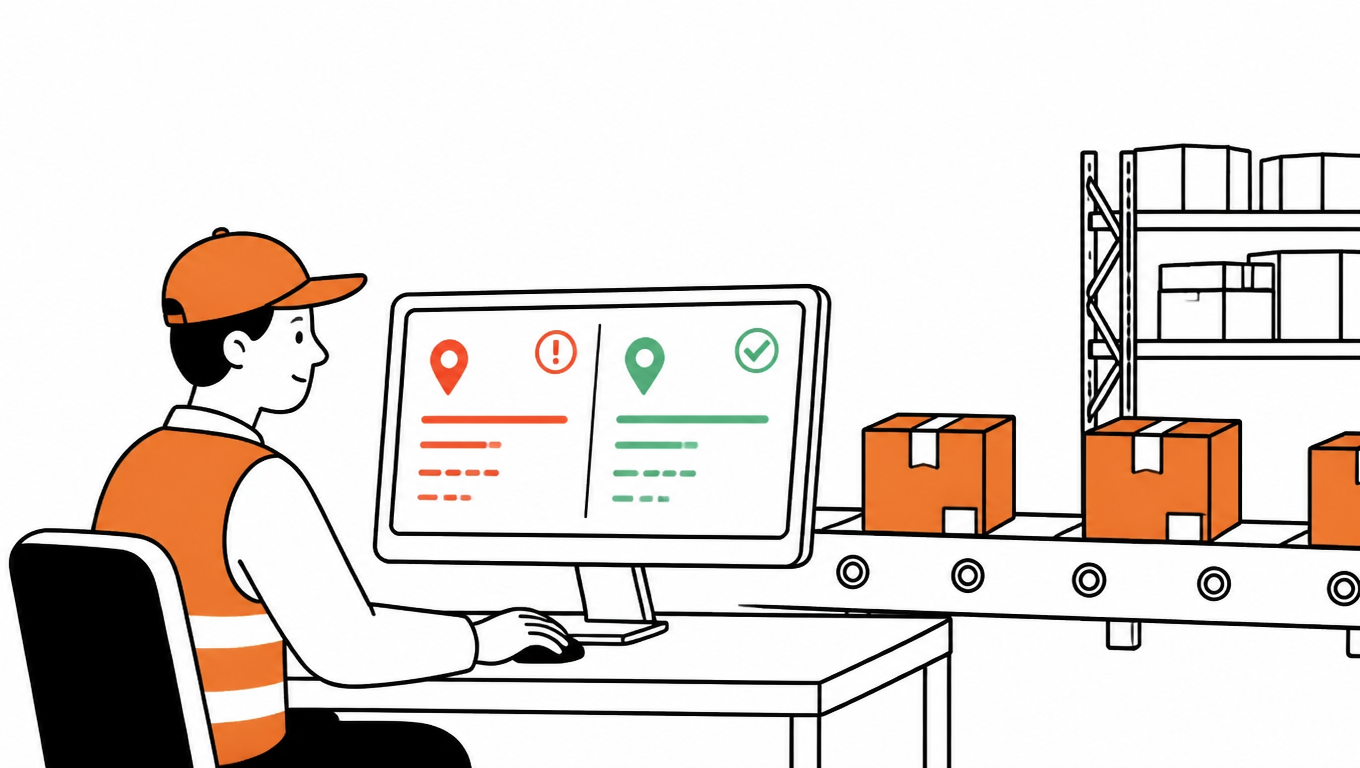
Returns worker scans a parcel beside a screen showing logistics exceptions.
Every mile of the reverse journey costs money

1. What Return to Sender Really Costs

Return to sender is distinct from the returns your team already manages. A customer-initiated return starts with a customer decision: the item was wrong, unwanted, or broken, and the customer ships it back through a label you provided. Return to sender starts with a delivery failure: the carrier could not complete the delivery, marked the parcel undeliverable, and sent it back through the network to the origin. The customer may not even know the package exists. That distinction matters because the two problems have different causes, different costs, and different fixes.

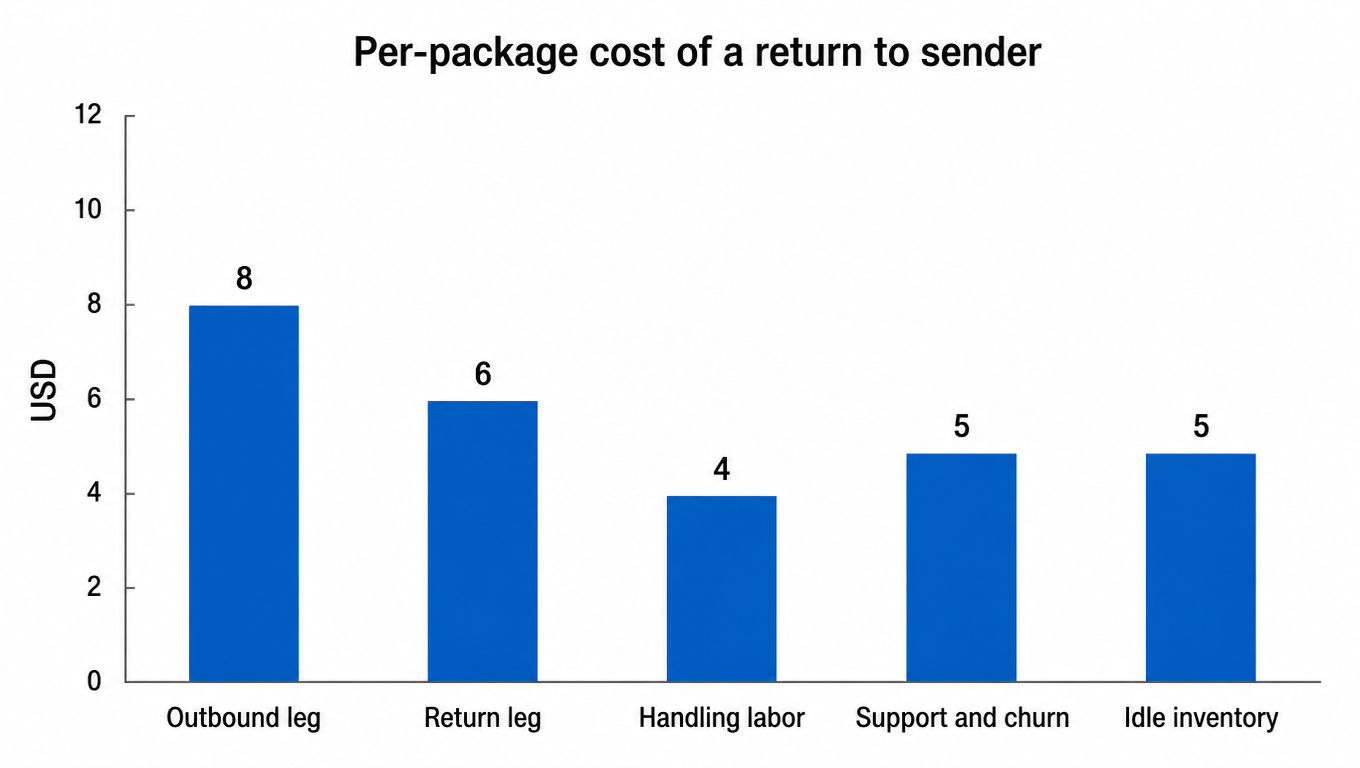
Break down a typical mid-value domestic shipment that comes back. The outbound leg cost $8. The return leg costs another $6, often at a different rate class. Receiving, inspecting, and restocking the parcel takes about fifteen minutes of labor, call it $4. The support ticket, the refund or credit discussion, and the elevated churn risk add about $5. And the item sits in limbo, occupying shelf space and depreciating while the team decides what to do with it, roughly $5. That is $28 per incident, before you count the second shipping label if the customer still wants the item.

Bar chart: per-package cost of a return to sender, outbound leg $8, return leg $6, handling labor $4, support and churn $5, idle inventory $5
The fully loaded cost of one return is $28, before the second label

Industry estimates commonly put RTS at 1-3% of outbound volume for most ecommerce shippers, and the percentage climbs for marketplaces with many small sellers, subscription boxes, and anyone shipping to addresses that change often. Most teams never see the number, because the cost hides inside carrier invoices, labor hours, and refund lines. That is exactly why it leaks: what is not measured cannot be managed.

2. The Six Phases of a Return

Every return passes through six phases. Knowing which phase a parcel is in determines what you can still do about it. The phases are: pre-induction (the label exists but the parcel has not entered the carrier network), in-network but not yet out for delivery (the carrier has the parcel and it is still moving toward the destination), delivery exception (the carrier tried and failed, or flagged the parcel as undeliverable), return initiated (the carrier has formally started the return), return already moving (the parcel is traveling back), and returned to warehouse (it is back on your dock).

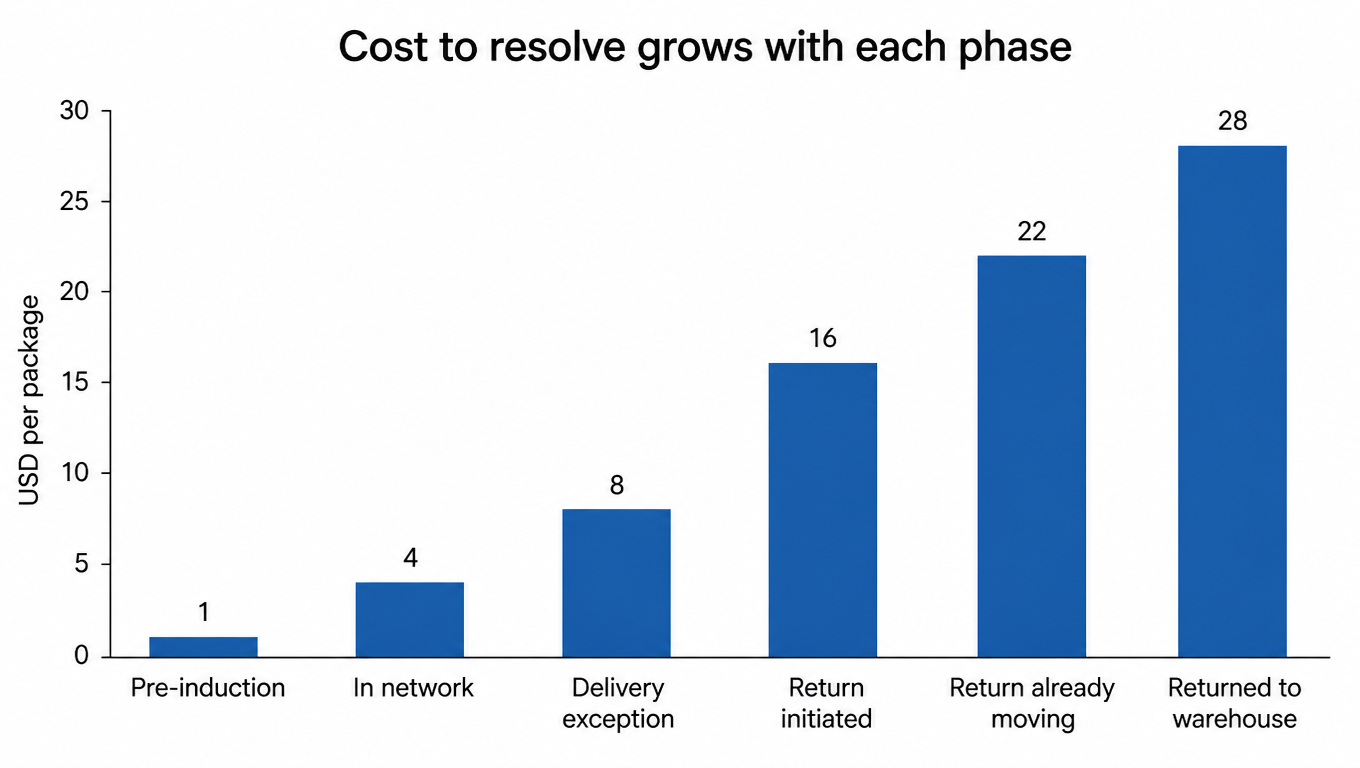
The cost of resolving a return climbs with each phase. Catch the problem before induction and fixing the address costs about $1 in tooling and a minute of work. Intervene while the parcel is still in the network and the cost is about $4: an intercept request and a quick customer message. By the delivery-exception stage you are paying $8: the intercept fee plus the labor of a real exception workflow. Once the return is initiated you are committed to the return leg, $16. Once it is moving back, $22. Once it lands at the warehouse, the full $28 per-package cost from the previous section.

Bar chart: cost to resolve grows with each phase, pre-induction $1, in network $4, delivery exception $8, return initiated $16, return already moving $22, returned to warehouse $28
The same parcel costs $1 to fix at phase one and $28 to process at phase six

The practical takeaway: the interception window shrinks as the parcel moves right. Before acting on any return, ask which phase it is in. The same parcel that costs $1 to fix at phase one can cost $28 to process at phase six, and the tool you use depends entirely on where the parcel sits in that sequence.

3. Address Errors: The Biggest Trigger

Address errors are the single biggest trigger for return to sender. They come from predictable places: typos typed under pressure at checkout, autofill pulling an outdated profile, a missing apartment number on a multi-unit building, a customer who moved and never updated their address with the carrier or the marketplace. None of these are exotic. All of them are preventable at the source.

Industry postmortems consistently show address problems behind a large share of RTS incidents, and the split is uneven: a package with a fully wrong address usually cannot be delivered and must return, while a package with a small error (a missing unit number, a transposed digit) often burns one or two failed attempts first. Both outcomes are expensive, and both are caught before induction.

The countermeasures sit at checkout and in the order pipeline: real-time address validation and autocomplete at the point of sale, USPS CASS-certified address matching, NCOA cleaning for repeat customers, and a confirmation step after checkout that shows the customer the exact address being shipped to. Once a bad address enters the carrier network, the correction cost jumps: intercept fees, failed attempts, and the return leg all become possible. Fix it at the source and none of those costs ever exist.

4. Delivery-Stage Failures

When the address is correct but the delivery still fails, the causes move to the delivery stage: a customer who refuses the package at the door, a carrier that makes three failed attempts and gives up[^5], a parcel that cannot be left because there is no secure drop location, or a signature requirement the recipient never fulfills.

Carriers classify these outcomes with reason codes. USPS, for example, returns parcels as undeliverable-as-addressed with codes such as No Such Number, Insufficient Address, Vacant, Deceased, Refused, and Unclaimed[^4]. The code on the returned parcel tells you exactly what failed, and it is the single most useful piece of data your team will get from the entire reverse journey.

Delivery-stage failures are not always the customer's fault. Mis-sorts at the carrier hub, barcode or label damage, and weather or access issues can all produce a return that had nothing to do with the address. These cases are worth fighting: if the carrier mis-sorted or damaged the label, the return is a carrier fault and may be claimable.

The countermeasures here are behavioral. Delivery notifications let the customer know the parcel is coming so they can be home or authorize a safe drop. Hold-for-pickup and reschedule options convert a failed attempt into a successful pickup. Signature-required shipments should be the exception, not the default, because every signature requirement adds a failure point. And the UAA code from each return should flow back into your records so you can spot neighborhoods, carriers, or products with recurring failure patterns.

5. Address Corrections: Reroute Instead of Return

Not every bad address has to become a return. When the parcel has already shipped but the destination turns out to be wrong, the cheapest fix is usually to change the address in the carrier's system and let the parcel keep moving. The trigger is familiar: the customer moved mid-transit, they mistyped the unit number, or the address check fired late. Whatever the cause, the play is the same: correct the destination instead of reversing the journey. This is different from interception, which pulls the parcel back to you. An address correction keeps it moving forward: no return leg, no restock labor, no second label, and no re-entry into the returns ledger.

The major US carriers all support in-transit address changes, but the mechanics and price tags differ. FedEx charges a per-package address correction fee of roughly $24-25 whenever it has to fix an address after the shipment entered its network. UPS handles the change through Delivery Intercept's Deliver to Another Address option, which can reroute the parcel to a new address or to an Access Point for pickup, and you are only charged if the request completes. USPS added redirect-to-a-new-domestic-address to its commercial Package Intercept service, alongside return to sender and hold for pickup, with the $19.45 per-piece fee charged only when the intercept succeeds and never refundable. DHL and regional carriers vary widely; many regional networks support address changes as a standard feature, so confirm it in the service agreement before you assume it is available.

CarrierHow to change the addressFeeKey limits
FedExDelivery Manager or shipper requestRoughly $24-25 per corrected parcelOne change per package; no hazmat reroutes
UPSDelivery Intercept: Deliver to Another AddressCharged only if the request completesRequest before delivery
USPSPackage Intercept: redirect to a new address$19.45 per piece only when the intercept succeeds, non-refundableCommercial service; before final delivery
DHL / regionalVaries by carrierVariesConfirm in the service agreement

The window is narrow. Every carrier requires the request before final delivery, and the practical cutoff is usually before the parcel reaches the destination facility or leaves for the last mile. Once a parcel is out for delivery, the only lever left is often the recipient's own delivery-manager tool, and even that can be restricted by the shipper's settings. So the clock starts the moment the parcel ships, not when the exception appears. Teams that monitor tracking exceptions in near real time and keep a standing process for customer-reported address problems catch this window; teams that discover the error at the weekly report do not.

Two rules keep an address correction from becoming a second failure. First, verify the new address before you request the change; a correction pointed at another bad address just burns the fee and starts the return clock again. Second, write the corrected address back into the customer record and the routing rules, otherwise the next order ships to the old address and the whole loop repeats. A successful correction is not just a saved shipment, it is a data fix, and it belongs in the same reason-code and routing loop as the returns it prevents.

6. The Interception Playbook

Once a parcel is in exception, the question is whether to intercept it before the return leg starts. Every major US carrier offers some form of interception, and the mechanics differ: USPS Package Intercept, UPS Delivery Intercept, FedEx Delivery Manager intercepts, and DHL's business-portal intercept options.

The windows are short, measured in hours to a few days, and the fees are real: USPS charges nothing when an intercept does not succeed, and applies the $19.45 per-piece fee only when it does, never refundable[^1]; UPS allows intercept requests at no upfront cost but charges when the package is successfully re-routed[^2]; FedEx and DHL charge per-package fees that vary by service[^3]. Success is not guaranteed, because intercepts depend on the parcel still being in the network and on the local delivery team executing the request.

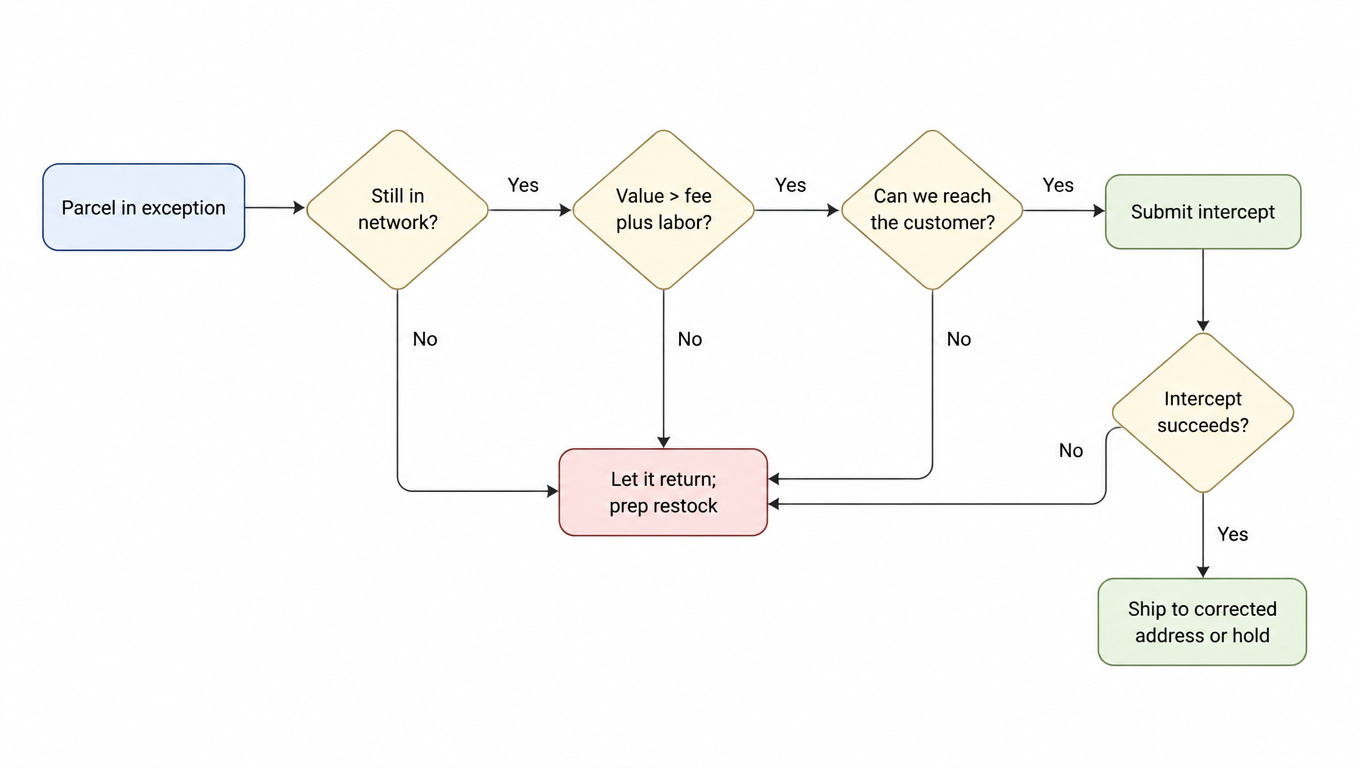
Use a simple filter before submitting any intercept. Is the parcel still in the network and interceptable? If not, let it return and prep the restock workflow. Is the item value plus the customer's lifetime value higher than the intercept fee plus labor? If not, let it return. Can you actually reach the customer and get a corrected address or a hold-for-pickup authorization? If not, an intercept that succeeds just sends the parcel to a second wrong location.

Decision flow: parcel in exception, still in network? no lets it return and preps restock, yes checks if value exceeds fee plus labor, no lets it return, yes checks if the customer can be reached, no lets it return, yes submits intercept, success ships to corrected address or hold, failure lets it return
Three filters: not in network, not worth it, unreachable, let it return

The failure reality: intercepts fail often enough that the workflow needs a fallback baked in. The default answer for a low-value parcel is no intercept at all, and the default answer for a parcel already moving back is to skip interception entirely and start the returns workflow. Teams that treat interception as the exception rather than the rule spend less money and fewer hours on the problem.

7. Reason Codes to Routing Rules

The return leg ends at your dock, and that is where most teams stop paying attention. The teams that actually fix their RTS problem use the returned parcel as data. The first step is standardizing how you record the reason. Map the carrier's UAA code to an internal reason taxonomy, and add your own fields: was the address verified at checkout, was the parcel insured, which carrier and service class carried it, did the customer respond when you reached out.

With standardized reason codes, you can build the rule table that prevents the same failure twice. The rule table maps reason code, carrier, and address history to the next action: block a specific address from being shipped to again, downgrade a carrier that failed the same neighborhood twice in a month, force a re-verification step for any address that produced a No Such Number, or switch the service class from ground to a signature product for recipients who refuse deliveries.

The rule that matters most is the reshipment rule. When a customer still wants the item, the natural instinct is to grab the address from the order record and send it again. That is exactly how you pay for the same failure twice. Before any reshipment, re-run the address through validation, check it against NCOA, and compare it against the carrier and address blocklist from your routing rules. If the same combination failed once, it will fail again.

Close the loop weekly. The exception team reviews the reason-code distribution, flags carriers and neighborhoods that are drifting, and updates the routing rules. The rules only stay accurate if they are fed by the data, and the data only gets captured if every returned parcel is coded before it is restocked.

8. Prevention: The Address-Quality Pipeline

Everything so far is response. The cheaper strategy is prevention: eliminate the return before the parcel enters the carrier network. The address-quality pipeline is the sequence of checks that runs from the moment a customer types an address to the moment the label prints.

At checkout, validate and autocomplete the address in real time, and require confirmation for ambiguous addresses. After the order, send a confirmation showing the exact address and give the customer a short window to correct it. Before label creation, run every order through CASS verification and flag anything that does not match. For repeat customers, subscribe to NCOA so a move is caught before the next shipment, not after a return. And for high-value orders, set up a delivery notification at the carrier so the customer knows when the parcel is coming.

The math is simple: catching one $28 return at the checkout step costs a fraction of a cent of compute and a few seconds of customer attention. The pipeline does not eliminate all returns, refusals will always exist, but it removes the largest and most predictable category: the address failure that never should have shipped.

9. The Ops SOP and Metrics

When a return does land, the team needs a repeatable process. The standard workflow runs: identify the exception (carrier notification or returned parcel), classify it (reason code, phase, customer reachability), decide intercept or let it return, receive and inspect the parcel at the dock, restock or dispose, and reconcile the costs against carrier bills and the RTS ledger.

Worker inspects a returned parcel and records it at a fulfillment receiving terminal.
Every returned parcel is coded before it is restocked

The metrics that matter: RTS rate as a percentage of outbound volume, cost per RTS incident, intercept success rate, reason-code distribution, and reshipment success rate. Track them weekly, not quarterly. A rising RTS rate with a stable reason-code mix means volume is growing; a changing mix means something broke in the pipeline.

Team ownership: support owns the customer conversation and the reachability question, the exception team owns carrier actions and reason coding, inventory owns receiving and restocking, and finance owns reconciliation. One owner should hold the RTS rate as a metric, or the loop never closes.

The improvement loop: weekly review of the reason-code distribution, routing-rule updates, checkout-page experiments, and carrier scorecards. The teams that drive RTS down treat it as a system with inputs, not as a pile of random accidents. The return is a signal. The job of operations is to read it, act on it, and stop shipping into the same wall twice.

FAQ

RTS is a delivery failure: the carrier could not complete the delivery, marked the parcel undeliverable, and sent it back to the origin. A customer return starts with the customer's decision to send an item back through a label you provided. Different causes, different costs, different fixes, so the two must be managed separately.
In the worked example in this guide, $28 per incident: $8 outbound leg, $6 return leg, $4 handling labor, $5 support and churn, $5 idle inventory, before the second label if the customer still wants the item. The cost climbs with the phase the parcel is in: about $1 to fix pre-induction, $28 to process once it lands back at the warehouse.
Often yes, if you act early. USPS Package Intercept, UPS Delivery Intercept, FedEx Delivery Manager, and DHL portal options can re-route parcels still in the network. Windows are short (hours to a few days) and fees are real (USPS charges nothing if the intercept fails, and $19.45 per piece on success, non-refundable). Run the three-filter value check in this guide before submitting.
USPS marks parcels undeliverable-as-addressed with codes such as No Such Number, Insufficient Address, Vacant, Deceased, Refused, and Unclaimed. Each code identifies exactly what failed, and mapping them to an internal reason taxonomy is the first step to preventing repeat failures.
Standardize the reason code on every returned parcel, then build a routing rule table: block failed addresses, downgrade carriers that fail the same neighborhood twice in a month, force re-verification after No Such Number, and always re-run address validation and NCOA before any reshipment. Review the reason-code distribution weekly and update the rules.
Often yes, and the earlier the better. FedEx supports in-transit address changes (roughly $24-25 per parcel), UPS can reroute through Delivery Intercept's deliver-to-another-address option (charged only on success), and USPS commercial Package Intercept can redirect to a new address (no charge if the intercept fails, $19.45 per piece on success, non-refundable). The window is short and closes before final delivery, so act the moment you spot the error; verify the new address first and write it back to the customer record so the next order does not ship to the old one.