1. Where is the parcel right now, and what is still possible
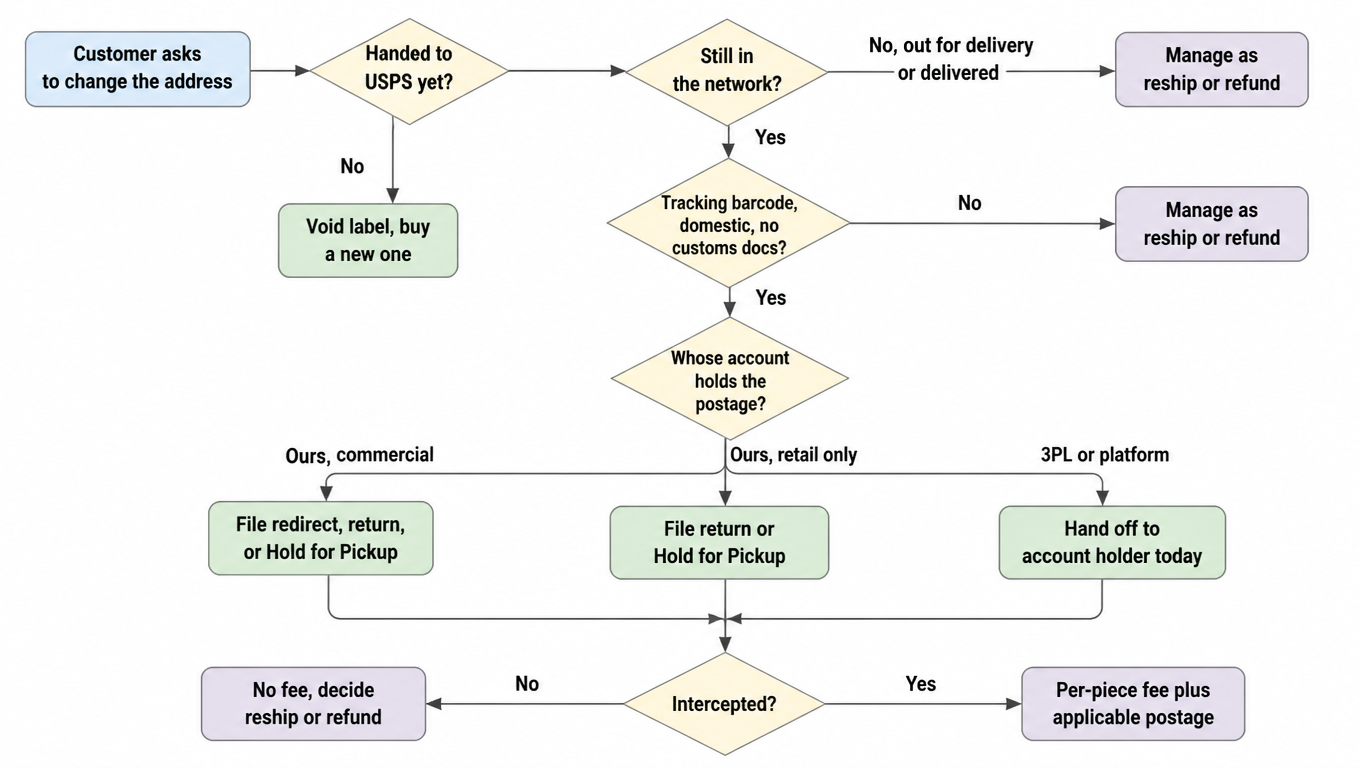
There are four states, and each one leaves exactly one useful move. Getting the state wrong is the most common reason a seller spends a morning on hold for nothing.
- Label created, not yet handed over. This is not a USPS problem at all. Void the label and buy a new one. It is the cheapest path available, and if the parcel is still in your warehouse, take it. The void and refund rules live in unused and voided shipping labels.
- In the network, but not yet out for delivery. Package Intercept is the only official lever. The request has to land while the piece is still sitting in a facility someone can walk to.
- Out for delivery, or sitting at the local delivery unit. Effectively too late. The piece is on a route in someone's hands, and success odds collapse.
- Delivered and scanned. Intercept no longer applies. From here you are managing a recovery, a reship, or a refund, and the delivery scan is the evidence base, whose formats are covered in the US proof of delivery guide.
The practical deadline is the moment the parcel goes out for delivery, and the terms state plainly that success is not guaranteed (Package Intercept terms and conditions). Everything upstream of that line is a window you can still act in. Everything downstream is customer service.
Read the tracking events before you contact anyone. The last scan event and its timestamp are the input to every later step: they tell you which facility holds the piece, whether the request is worth submitting, and what you can honestly tell the buyer. A label that was never scanned has no tracking event for an intercept request to attach to, so the "not found" you see there is not a rejection; the parcel simply has not started moving. What each scan state means is covered in USPS tracking status meanings.
Timing matters more than anything else you control. The earlier the request lands, the more likely the parcel is still sitting somewhere it can be pulled.
The request itself has a lifetime: a Package Intercept request stays active for 7 business days from the date it is filed, and during that time the Post Office makes every attempt to locate the piece (USPS Package Intercept FAQ). That leaves exactly two ways for the window to close: the parcel goes out for delivery first, or the 7 business days run out first. Neither can be extended by filing again.
That makes the latest scan event a triage input, because the right move changes as the parcel advances.
| Latest tracking event | What is still available | Action to take now | What to keep |
|---|---|---|---|
| Label created, not handed over | Void and rebuy | Fix the address and reprint at once rather than waiting for a second confirmation | Void confirmation and both label numbers |
| Accepted, or transit scans present | File the intercept, active 7 business days | File the same day and record the estimated total the tool shows on the order | Request reference, submission time, estimated total |
| At the local delivery unit, not yet out for delivery | Still filable, with the weakest odds | Ask whether the customer can collect it and run both paths at once | Scan timestamp, pickup location, customer reply |
| Out for delivery | Intercept is effectively closed | Stop waiting and move to the reship or refund decision | The out-for-delivery timestamp |
| Delivered | Only recovery, reship, or refund remain | Open a service request with the tracking number instead of refreshing tracking | Delivery scan and address evidence |
The third row is where sellers most often misread the situation. Once the parcel reaches the delivery unit it feels like there is still time, so another day passes, the out-for-delivery scan appears, and both paths close together. The right response there is not to choose between them, but to run the intercept and the customer pickup option in parallel.