This guide covers the lifecycle from order and quote to carrier invoice and client billing. For field-level controls and exceptions, continue to reconciliation best practices.
Reconciliation should not be a month-end repair task. It belongs to daily shipping operations. Teams can only evaluate carrier strategy correctly when order_id, shipment_code, charge breakdown, reversals, and exception records stay in one data chain.
This page works through six things in an executable order: what closing a shipment actually means, the four kinds of variance, the minimum field contract behind the ledger, the reason codes and targets that close each variance, an assumed split of one month of variance, and where reconciliation ends and claims or customer compensation begin.
What reconciliation looks like day to day: joining two records line by line, not comparing two totals.
What this stage resolves
Cost diagnosis, step 4: Reconcile the invoice. Keep the issue scope and original evidence, assign owners to open items, and continue after verification.
Shipping reconciliation is not a subtraction between two totals. It joins three shipment-level records: what the team planned and purchased, what the warehouse and carrier actually executed, and what the carrier invoice and customer or client billing finally recognized. A shipment can close when the records agree; otherwise the variance enters an exception queue with a reason, owner, and due date.
Was the parcel handed off, rerouted, relabeled, or returned?
Parcel attributes, scans, exceptions, voids, refunds, and reship links
Carrier and client billing
Are final charges, adjustments, and pass-through billing explainable?
Invoice row, charge type, net amount, currency, period, and client owner
Illustrative scenario: a label is purchased and then voided, and the warehouse buys a second label for the same order. If the replacement does not retain the original shipment relationship, finance sees two charges but cannot tell which one should be refunded and which one was handed to the carrier. The failure is not the report format; the record relationship broke during relabeling.
Key field layers for reconciliation-ready workflows
Field layer
Business value
Common risk
Order and label identifiers
Charge ownership traceability
Field mismatch breaks joins
Charge breakdown fields
Distinguish true cost components
Total-only view hides root cause
Reversal and refund fields
Explain net charge movement
Reversal cannot be traced to source shipment
Tracking and exception fields
Support billing dispute investigation
Ops and finance use disconnected context
The minimum field contract behind the ledger
The four layers above are only categories. Whether reconciliation is possible depends on whether those fields actually exist at shipment level. The table below is the suggested minimum set, and it belongs in a build requirement rather than a reporting preference: a missing field shows up two months later as an unexplainable charge instead of on the same day as an error.
Field
Typical source
Required
What breaks without it
Internal shipment key
Label purchase system
Yes
Only totals can be compared; the three records cannot be joined
Tracking number
Label purchase system
Yes
Invoice rows cannot be joined to internal records
Original-shipment link
Label purchase system
Required on reprint or reship
A duplicate charge cannot be traced back
Pricing basis version and purchase amount
Platform or contract
Yes
A basis change cannot be told apart from an error
Billable weight and dimension inputs
Packing and weighing step
Yes
A weight adjustment has no defence
Handoff and first scan timestamps
Warehouse system and tracking
Yes
A timing variance cannot be located
Void and credit reference
Label purchase system
Required whenever a label is voided
There is no way to confirm the credit arrived
Charge type
Invoice detail
Yes
A total-only view hides the root cause
Billing period and invoice number
Invoice detail
Yes
Period attribution blurs and the same item is claimed twice
Currency and exchange-rate basis
Invoice and finance system
Required for multi-currency accounts
Net amounts stop being comparable and noise enters the variance
Client or cost owner
Contract or platform
Yes
Pass-through billing becomes unexplainable and client questions stay open
Reason code and owner
Reconciliation workflow
Required on every open item
Items age in the queue with nobody responsible for recovery
What closing a shipment means, and when it is not allowed
Closing a shipment is a decision with four parts. The net amount is confirmed, the action that produced it is identified, the evidence is attached, and the root cause is coded. Miss any one of the four and the item stays in the aging queue. That is why matching totals are not proof of a clean ledger: offsets hide per-shipment errors.
Action
When it is the right choice
Who approves
Effect on the provider invoice
Effect on the client bill
Evidence to keep
Write in
The invoice line is real and the internal ledger never recorded it
Finance
No change
May change client attribution
Original invoice line and the ledger correction
Void or credit
The label was never used, or one shipment was purchased twice
Operations initiates, finance confirms receipt
Reduces the net amount
Usually not passed through
Void timestamp, credit confirmation, original-shipment link
File a dispute
The amount contradicts the agreed basis and the provider can verify it
Finance files, operations supplies evidence
May reduce the net amount
Attribution follows the outcome
Pricing basis in effect, weight and dimension inputs, tracking
Write off
The amount sits under an approved threshold and the trail is gone
Finance within an approved threshold
No change
Pass-through follows the same threshold
Approval record and reason code
Client adjustment
Attribution or basis was wrong on the client side
Client owner with finance
No change
Creates a debit or credit
Contract clause and the basis for the adjustment
Three situations should not be closed even when a number is available. An item that cannot be traced to a shipment, an item claimed in two queues at once, and an item whose reason code is still unknown. All three look finished while nothing was actually resolved.
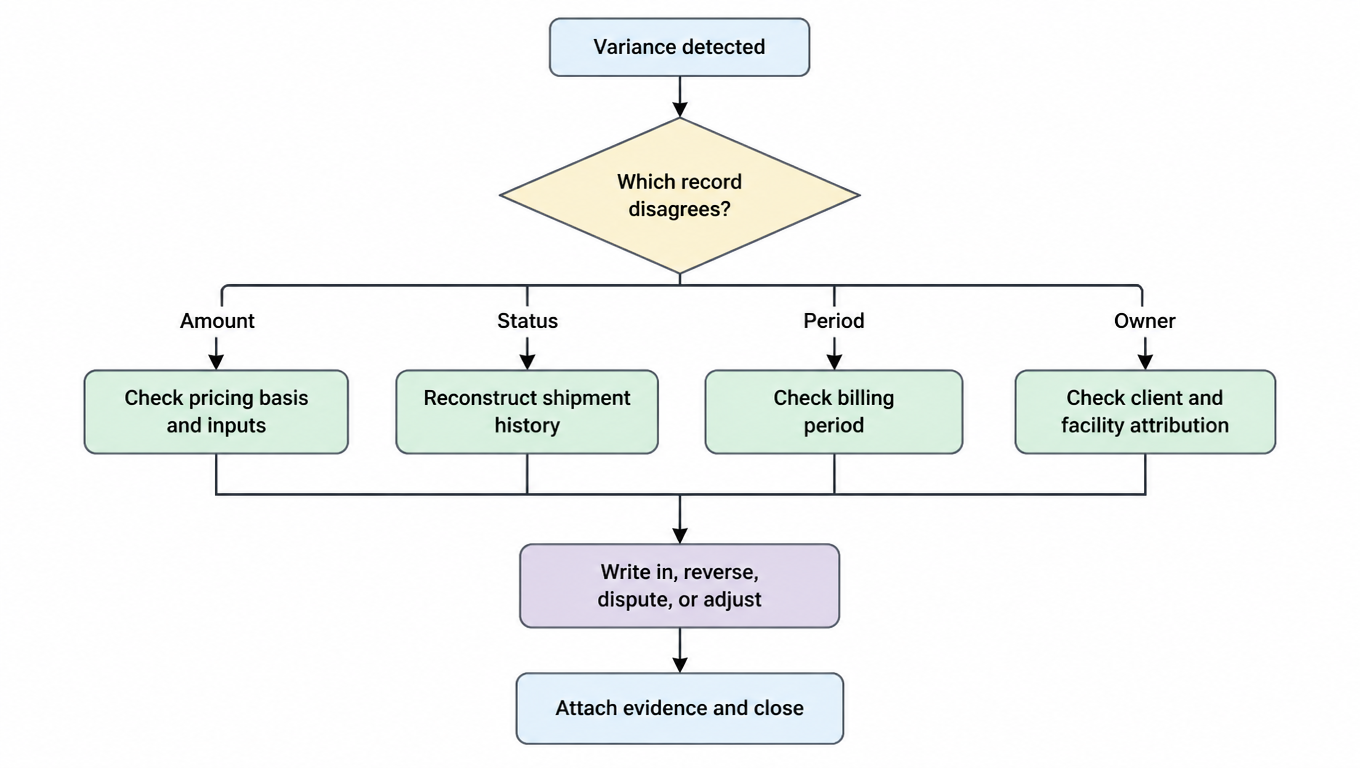
Four kinds of variance, four different paths
Classifying first avoids the most expensive mistake in reconciliation: treating a record problem as a pricing problem, then filing a dispute the internal data cannot support.
Variance routing: decide which record disagrees first, choose the action second, and discuss the amount last.
Category
How to recognize it
Common root cause
First action
Evidence needed to close
Amount variance
One shipment appears with two different amounts
A different basis in effect, different weight inputs, or an extra charge with no support
Pull the basis in effect and the weight and dimension inputs for that shipment
Basis in effect, label inputs, measurement record
Status variance
The ledger and the invoice disagree about what happened to the shipment
A void that never produced a credit, a reprinted label, a reshipment, or a missing scan
Reconstruct the history from purchase to the final event
Void timestamp, credit confirmation, original-shipment link
Period variance
The amount is right and it lands in a different billing period
Cut-off timing, a late adjustment, or a reissued invoice
Match on the shipment date as well as the invoice date
A written period definition and the item's first appearance on an invoice
Ownership variance
The amount is correct but belongs to another client, facility, or channel
Apply the attribution rule in the contract, not the screen that created the label
Contract clause and the routing record
A minimum reason-code set with targets
A variance only becomes manageable once it carries a code, an owner, and a target. The targets below are recommended thresholds for planning purposes, not contractual service levels.
Reason code
Meaning
Owner
Target (recommended threshold)
Closure evidence
duplicate-purchase
A timeout retry or a repeat click purchased the same shipment twice
Operations
Next business day
Both purchase records and the credit confirmation
void-pending
The label was voided but the credit has not appeared. Unused Click-N-Ship labels are eligible for a refund up to 60 days after the print date (USPS refund information); other channels set their own windows and conditions.
Operations and finance
Within one billing period
Void timestamp and credit confirmation
weight-adjustment
Weight or dimensions were re-measured
Operations and finance
Within one billing period
Measurement record or corrected inputs
address-correction
The address changed after the label was created
Support and operations
Next business day
Change request and the new label
unsupported-accessorial
An extra charge appears with no supporting record
Finance
Before the provider's window closes
Provider confirmation or a filed adjustment request
missing-invoice-row
An internal record exists and the invoice has no matching row
Finance
Within one billing period
Provider statement and the internal purchase record
ownership-mismatch
The charge belongs to another client, facility, or channel
Client owner
Within one billing period
Contract clause and the routing record
The shipment-to-close reconciliation lifecycle
Stage
Pass condition
Failure path
1. Capture
Every purchase, void, refund, and reship has stable identifiers
Quarantine missing or duplicate records
2. Normalize
Charges, statuses, currency, and timestamps use shared definitions
Map to a review reason code
3. Match
Operational, carrier, and client records join at shipment level
Enter unmatched or amount-variance queue
4. Resolve
Owner completes evidence, reversal, dispute, or client adjustment
Escalate and record the blocking party
5. Close and learn
Net cost is approved and root cause feeds packaging, routing, or workflow rules
Retain in aging queue; never silently close
Reconciliation data flow: capture → normalize → match → resolve → close and learn
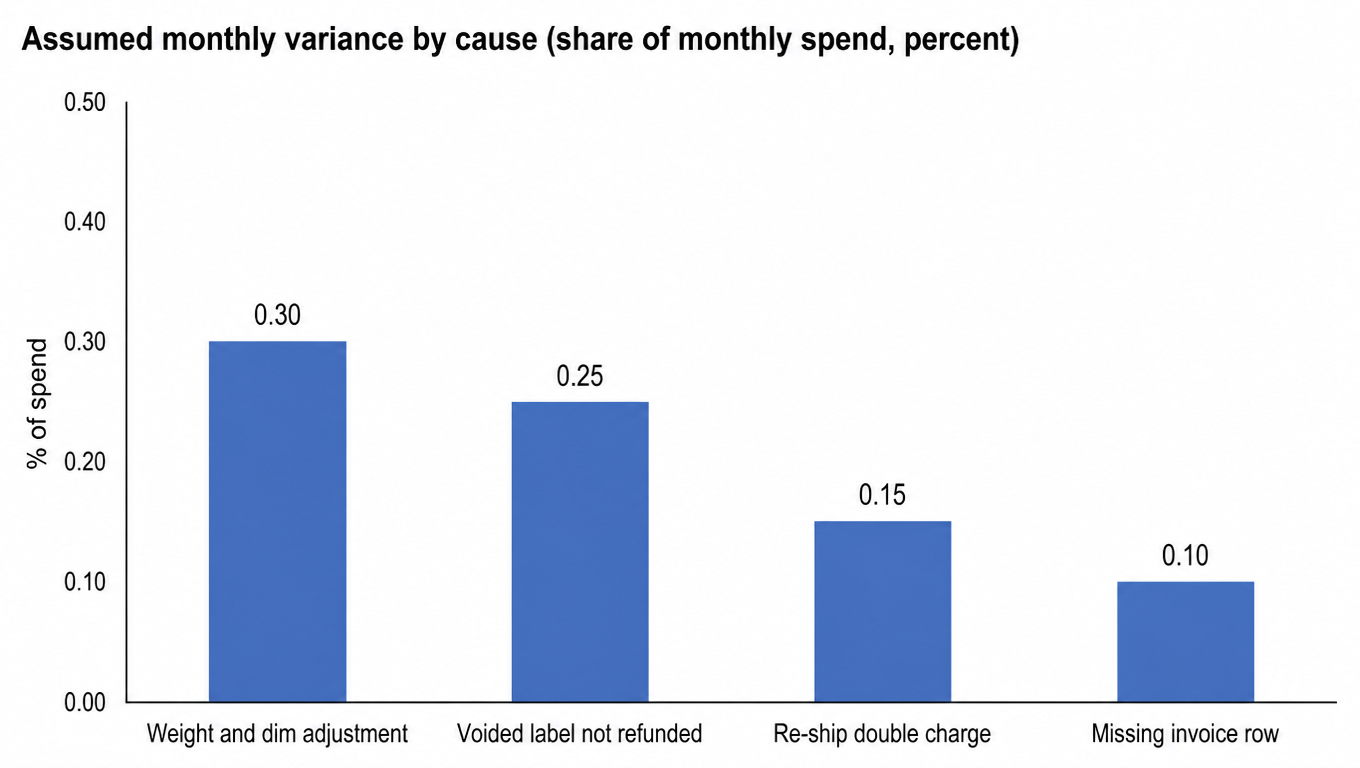
Assumed example: how one month of variance is composed and recovered
Assume a 3PL closes one billing period with a net variance equal to 0.8 percent of monthly spend, spread across four causes. Every number in this section is an assumed input used to show how the work is organised. None of it is a customer result, a quoted amount, or a savings promise.
Cause (assumed)
Share of monthly spend
Recovery action
Assumed recovery window
Reflected in the same period
Weight and dimension adjustment
0.30%
File an adjustment with the measurement record
10 to 20 days
No, usually a later credit
Voided label without a credit
0.25%
Check the void window and confirm the credit
5 to 10 days
Partly
Re-shipment double charge
0.15%
Block duplicate purchases, then request an adjustment
10 to 20 days
No
Missing invoice row
0.10%
Write in and confirm client attribution
1 to 3 days
Yes
Assumed example: the relative weight of four causes (assumed values, not a customer result, not a savings promise)
The split produces two conclusions. First, the largest cause is usually not the only one worth fixing: the smaller causes decide how much work the queue generates each month and whether the aging bucket keeps growing. Second, the amount requested in a period is not the amount received in that period, so a monthly recovery figure on its own overstates the result. Read it next to the aging queue.
A reconciliation cadence: what happens daily, weekly, per period, and quarterly
Reconciliation usually fails because everything is pushed to month end rather than because a process is missing. Distributing the work across four frequencies gives an exception a chance to be handled before it becomes a dispute.
Frequency
What happens
Output
Owner
Escalation trigger
On every purchase (automated)
Capture and quarantine: missing keys, duplicate requests, voids without a receipt
Quarantine list
Systems and engineering
The missing-key rate crosses the agreed threshold
Daily
Event alignment: whether purchase, void, credit, and reship appear in pairs
Working list
Operations
An unexplained void or credit sits unattended
Weekly
Matching and triage: variance and aging grouped by reason code
Where reconciliation ends and claims or compensation begin
One shipment can appear in three queues at once: a reconciliation variance, a claim against the provider for a loss or damage, and a customer refund or compensation. Each has its own owner and its own clock. Before opening any of them, assign one primary queue for that shipment. Without a primary owner the same recovery gets counted twice, or the same loss gets paid out twice.
Queue
What triggers it
Owner
Output
Handoff
Reconciliation variance
The internal ledger and the invoice disagree
Finance
Write-in, reversal, dispute, or client adjustment
Operations supplies shipment-level evidence
Provider claim
The promised service was not performed, or the parcel was lost or damaged
Operations
Settlement, denial, or an open claim
The settlement amount is written back to the ledger
Customer compensation
A customer disputes the outcome or the promise
Support
A refund or compensation decision
The cost is booked to the client owner and a reason code
One rule of thumb separates them: a variance answers whether the charge belongs in the ledger at all, a claim answers whether the service was performed, and customer compensation answers what the customer lost because of it. Each can supply evidence to the others, but they cannot share one closure standard.
Connect cost diagnosis to invoice and client-billing closure
Bring the diagnosis into the ledger by linking order, parcel, label, tracking, and invoice line. Retain separate records for multi-parcel orders, voided/replaced labels, returns/re-sends, and post-period adjustments. A tracking number or a similar amount can help locate a record but does not by itself prove that an invoice line should be closed.
Reconciliation item
Evidence before closure
Ownership
Reconciliation itemIdentity and amounts
Evidence before closureQuotes, purchased charges, adjustments, reversals, and net cost belong to an identified segment.
OwnershipEngineering owns identity/versioning; finance confirms the amounts.
Reconciliation itemValid charges and input errors
Evidence before closureEffective service rules and measurement records explain the charge change.
Evidence before closureError reason, evidence pack, submission, case ID, and deadline are recorded.
OwnershipThe account/platform owner submits; finance follows the actual credit.
Reconciliation itemClient charges and credits
Evidence before closureTerms, notifications/approvals, client invoices, and received credits align.
OwnershipFinance and the client owner confirm; adjustments are not automatically passed through.
Keep unexplained lines pending. A submitted dispute is not a received credit, and an approved refund is not yet recovered cash. Allocate late charges and reversals to the original segment, preserving the prior closure version and reason for reopening. Do not subtract an expected refund from current cost as if it had already arrived.
Inventory sources: document the system owner, refresh cadence, and retention period for orders, WMS events, label purchases, tracking, refunds, carrier invoices, and client billing.
Define the data dictionary: standardize order ID, shipment code, tracking number, original-shipment relationship, charge type, currency, and timestamps.
Write the field contract: put the minimum field set into requirements and acceptance criteria so it is clear which missing fields block a go-live, rather than fixing reporting later.
Set match and exception rules: handle one-to-one, one-to-many, duplicate, missing, amount-variance, and pending-refund states separately instead of hiding every issue under “unmatched.”
Assign reason codes, owners, and close conditions: map each reason code to operations, finance, engineering, or carrier ownership; state targets as recommended thresholds; close only when net cost, action, and evidence are complete.
Validate with a pilot: start with one facility, client, or carrier service and review shipment by shipment before scaling. Continue with shipping reconciliation best practices for control cadence and review methods.
FAQ
Because billing anomalies usually originate from fulfillment actions and data mapping behavior, not finance records alone.
Yes, if all three paths share the same field definitions and export standard.
Use charge breakdown, reversal traceability, and exception logs together to build an auditable explanation trail.
An invoice audit only checks whether the invoice itself contains a challengeable error. Reconciliation joins the invoice, the execution records, and client billing shipment by shipment, which is a wider scope and decides who eventually carries the cost.
No. Offsets hide per-shipment errors, so read the count of unmatched shipments, the variance by reason code, and the aging distribution instead of the monthly total alone.
Only when the amount sits under an approved threshold, the evidence is gone, and chasing it costs more than the amount. Keep the approval record. A write-off also gives up the chance to write the root cause back, so it should be the exception rather than the default.
A reversal cancels a charge that was raised, while a credit returns money that was already taken. The ledger needs a void timestamp and a receipt confirmation separately, or the two get counted twice as recovery.
Look at the category first. Amount and weight items usually need the provider's own records, while status and ownership items are almost always internal. Filing a dispute about an internal problem just produces a request nobody can defend.
Book in the invoice currency, fix and record the exchange-rate basis, then convert to the reporting currency before comparing. Otherwise rate noise enters the variance and real errors stop being visible.
Close once per billing period and review the basis once a quarter. Recalculate after a provider price change, a change in packaging or billable-weight inputs, or a shift in volume mix, because the earlier conclusion no longer holds.
Four cases: an item cannot be traced to a shipment, one shipment is claimed in two queues, a rate or basis change is not yet confirmed, or a dispute outcome has not been written back. Pausing costs less than closing and reversing later.
Can reconciliation be closed as soon as a dispute is submitted?
Not on submission alone. Track the case decision, credit memo, and actual receipt separately, and correct client billing under the agreed policy. Keep incomplete parts open.
Optimize carrier strategy from consistent reconciliation standards
Align billing fields and workflows first, then scale carrier strategy with lower operational and financial friction.
Next: carry the evidence into the appropriate workflow
Carry the evidence, open items, and owners to the next step. For valid but high charges, investigate execution or selection; do not default to a dispute without evidence of a specific error.
When billing cannot resolve to the source system, client, or label, use the system-onboarding path to review ownership/data and failure-path acceptance for duplicates, timeouts, missing events, and amount closure. A successful response does not replace finance’s confirmation.
Denominator: variance, exception, and aging metrics use parcels shipped or invoice lines shipped as the denominator, never delivered parcels, so failed or returned shipments do not disappear from the statistics.
Cost basis: the settled net invoice amount, including extra charges, adjustments, and credits, never the quoted amount. Reversals and credits are recorded separately so one recovery is not counted twice.
Time basis: every item is attributed by both shipment date and billing period, and aging runs from first appearance rather than from the date it was noticed.
Targets: every target on this page is a recommended threshold used for planning, not a contractual service level. Provider adjustment windows follow each provider's current terms.
Example status: the monthly variance split and recovery windows are assumed examples used to explain classification and sequencing. They are not a customer result and not a savings promise.
Review cadence: close once per billing period and review the basis quarterly, then again after a provider price change, a packaging or billable-weight change, or a shift in volume mix.
Each provider sets its own adjustment window and evidence requirements and updates its terms. Before relying on any deadline, confirm it against the current terms on your own account.