Finance Guide

Shipping reconciliation best practices for traceable charges, surcharges, and reversals

This page covers field controls, variance review, and exception closure. For the full lifecycle, see the shipping reconciliation guide.

Reconciliation best practice is not about reviewing invoices more carefully. It is about turning every variance into a record with a reason, an owner, evidence, and a deadline. Field continuity is only the starting condition. The real difference shows up after a variance is found: who classifies it, how fast it is submitted, what travels with it, and where the outcome is written back. The controls below follow that order.

Editorial illustration of a finance and warehouse team comparing a carrier invoice against a parcel record at a shared desk
Workflow illustration, not a client case or actual invoice figures.

Start with the fields you must retain

Fields set the ceiling for everything downstream. Once a field is lost, no report can bring it back. The three objects below are the ones most often pulled into a dispute and the least often stored completely.

Keep field-level controls tied to the responsibilities in the 3PL shipping operating model. Where a discrepancy concerns measured weight or dimensions, use the weight-adjustment dispute workflow to assemble and close the evidence chain.

Reconciliation itemFields to retainCommon risk
Label chargesorder_id, shipment id, carrier, service, purchase amount, quote versionNo order-level traceability
SurchargesCharge type, trigger, invoice source, parcel attributes at the timeDisputes found too late
Refunds and reversalsRequest record, result, event time, original-shipment linkNo shipment-level linkage

Turn best practices into executable controls

A control you can test answers five questions: what it prevents, what triggers it, who owns it, what proves it ran, and where a failure goes. “Review surcharges monthly” is not a control. “Finance reviews new adjustments by reason code each week, routes anything above the internal tolerance to operations the same day, and retains the invoice row with the parcel evidence” can be run, audited, and reviewed.

ControlPrevent / detectTriggerEvidenceFailure action
Pre-purchase field completeness and input versionPreventBefore shipment creationValidation result and input versionQuarantine the order, do not buy the label, notify the data owner
Duplicate label and void closurePrevent + detectAfter every relabel or voidOriginal-shipment link, void request, and result statusHold client billing and track the refund until it lands
Quote-to-final-charge varianceDetectWhen the invoice arrivesQuote snapshot, parcel attributes, invoice rowRoute by reason code to packaging, data, or dispute ownership
Unmatched-record agingDetectWeeklyFirst-seen time, owner, latest actionEscalate under the internal aging policy
Client pass-through approvalPreventBefore client billing is issuedContract basis and approval recordHold the charge or absorb it; never pass it through silently
Dispute outcome writebackDetectWhen a dispute closesOutcome, amount, timestamp, processorA record without writeback may not be closed

This table also explains why buying new software is not the same as improving control. A system can automate the first three rows. Pass-through approval and writeback discipline still belong to people, and those two are where client disputes and unreconciled balances usually begin.

Reason codes: classify first, dispatch second

A single “unmatched” bucket mixes five different problems and then ages them together. Reason codes are not cosmetic. Their job is to give every variance exactly one next step on the day it appears. Classify by asking who can actually fix it: the data, the process, the contract, or the carrier.

Reason-code familyTypical evidenceFirst ownerFirst actionTarget clock
Data error: address, weight, dimensions, box templateInput version, measurement record, address validation resultData or warehouseFix the data and freeze the failing sourceWithin two working days
Process error: duplicate label, failed void, wrong service, split shipmentOriginal-shipment link, void request, wave recordWarehouse operationsStop the charge and claim the refundWithin one working day
Adjustment raised by the delivery network: surcharge, dimension re-bill, address correctionInvoice row, parcel attributes, scan eventsFinanceSubmit the dispute inside the windowWithin three working days
Commercial terms: rate basis, missing discount, expired rate cardContract clause, quote snapshot, rate-card versionCommercial and financeReconcile the clause, pause settlement if neededWithin five working days
Ownership mapping: client code, cost center, currency, periodClient configuration, billing export, contractFinanceRemap and issue a corrected statementWithin three working days
Returns and reversals: refund not received, void not creditedRequest record, result status, balance or statement lineFinanceTrack until credited, otherwise escalateWithin one billing period

More reason codes are not better. Five to seven families are enough to start. What matters is distribution: if one family keeps taking more than about a fifth of new variances, the answer is a fix in the process or the data, not a longer queue. Treating the number of codes as a KPI is the most common form of self-deception here. The target clocks in the table are example internal settings; reset them from your own team size, carrier windows, and client contracts.

Tolerance: the part that may auto-clear needs a named approver

A tolerance is not an industry number. It is the ceiling this company is willing to pay in review effort for one variance, and it follows from charge size, client terms, dispute effort, and financial materiality. It needs an approver and an effective date. Exactly one case may auto-clear: the reason code is known, the amount sits inside the approved tolerance, and the evidence already exists because it was created when the event happened. Everything else goes to a human queue, including the ones that look close enough.

Charge familyCommon practiceMay auto-clearApprover
Small per-shipment adjustmentBatch review by reason code with samplingYesFinance lead
Dimension or weight re-billCompare parcel attributes against the invoice row, shipment by shipmentNoOperations and finance
Duplicate label and voidCheck the original-shipment link for every caseNoWarehouse operations
Client pass-through varianceConfirm clause by clause against the contractNoClient success and finance
Unmatched recordRepair the relationship first, do not judge the amountNoData owner

Once approved, the tolerance belongs in the control document with an effective date and a scope. Changing it is a change to the close conditions and needs its own record. An unowned “close enough” rule eventually becomes an audit finding, or worse, a leak nobody notices.

Deadlines: your cadence is set by the shortest window

A carrier window runs from the invoice date or the invoice due date, not from the day someone notices the problem. If a monthly review begins three weeks after the invoice arrives, some disputes are already past their window the first time anyone looks at them. The shortest published window, not the team's schedule, sets your review cadence.

ChannelWindow basisSubmission channelEvidence expectedSource
FedExInvoice-related disputes should be submitted by the sender within 30 days from the invoice date or the invoice due date[^1]FedEx Billing OnlineInvoice row, tracking number, parcel attributes, scan historyFedEx billing FAQ
UPSA written request follows the published invoice-adjustment procedure, covered by the Invoice Adjustment section of the current U.S. tariff[^2]UPS Billing Center, or the billing support number printed on the invoiceWritten request, invoice row, shipment and parcel evidenceUPS tariff terms
USPSPostage assessment and review follow USPS's own monthly process rather than a commercial invoice window[^3]Business Customer Gateway and the postage assessment review processAssessment report, manifest or documentation recordUSPS PostalPro

Treat the table as a starting point, not a permanent answer. Carriers revise terms, windows, and exceptions, so confirm each deadline in the contract or tariff you are billed under, and record the date and the person who confirmed it.

Evidence has to be created when the event happens

Disputes rarely fail because the argument was wrong. They fail because the evidence was assembled afterwards. Reconstructed evidence has three tells: timestamps that do not line up with the event, a missing input version, and no explanation of how the measurement was taken. Any one of them is easy to reject, and the variance becomes an unrecoverable cost. Define the evidence pack inside the workflow instead of hunting for it when a dispute needs to be filed.

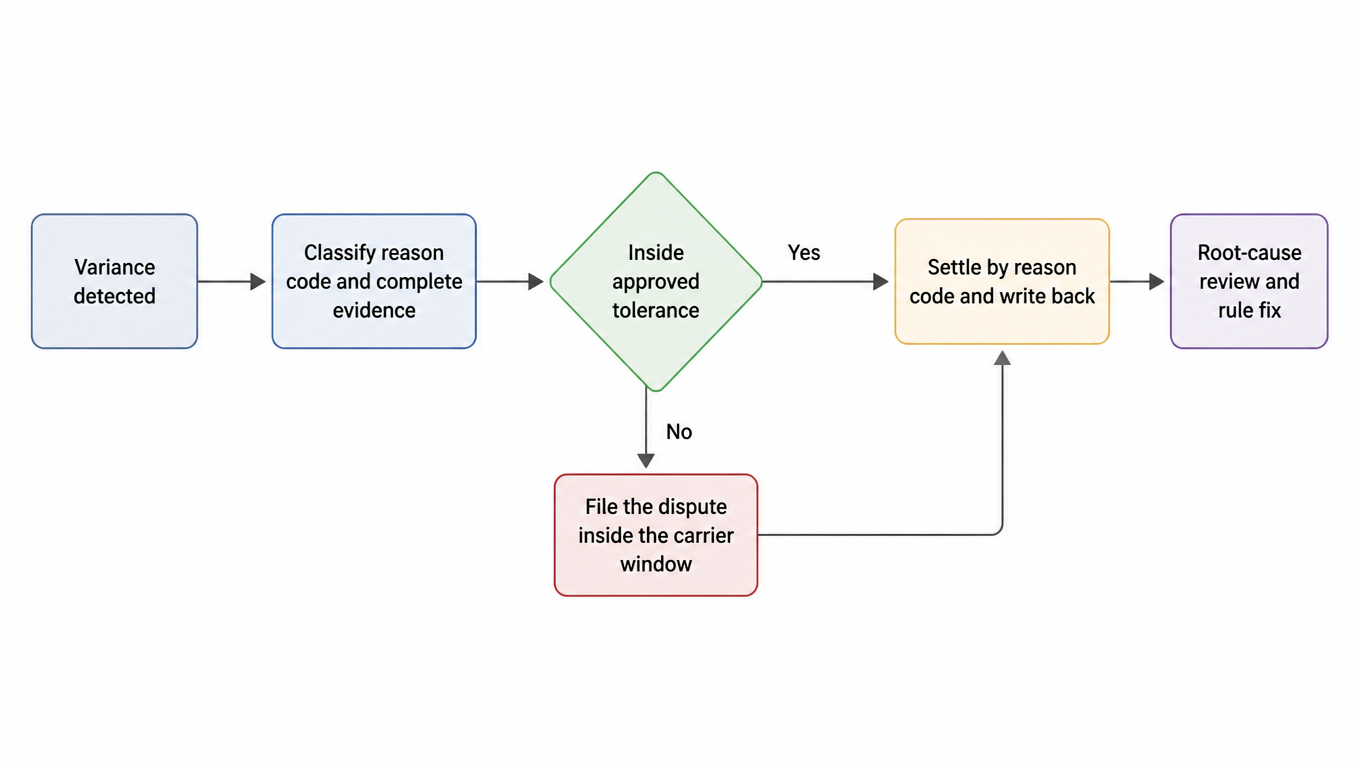
Variance loop diagram: detect the variance, classify the reason code and complete the evidence, decide whether it sits inside the approved tolerance, settle and write back, submit the dispute inside the carrier window, or review root cause and fix the rule
A variance has two exits: settle by reason code inside the approved tolerance, or carry the evidence into a dispute inside the window. Both exits end in a writeback and a root-cause review.

What one dispute has to carry

  • Invoice row: carrier, service, amount, currency, period, client owner.
  • Original shipment and quote snapshot: the service, weight, dimensions, and price used at purchase.
  • Parcel attributes: measured values, measurement method, timestamp, and who measured.
  • Event history: timestamps for first scan, transit, exception, reroute, and return.
  • Reversal record: the void or refund request, submission time, and result status.
  • Basis: the contract or tariff clause number, with the version it came from.
  • Decision log: who decided to submit, settle, or drop it, when, and why.

Daily, weekly, and monthly control cadence

CadencePrimary taskOutput
Real time / dailyBlock missing fields; detect duplicates, failed voids, missing first scans, pending refundsException queue with owner and due time
WeeklyReview new variance and aging by client, facility, carrier, and reason code, and file disputes inside the shortest windowDisputes, adjustments, system fixes, and process actions
Monthly / closeApprove net cost, open items, client pass-through, and repeat root causesSigned close pack and next-cycle control changes

What the close pack contains

  • Net cost for the period, split by carrier, service type, and client.
  • The open-item list: reason, estimated amount, next action, owner, and due date.
  • Tolerances and exceptions in force for the period, with their approver.
  • Adjustment and reversal summary: volumes submitted, amounts recovered, and why rejections happened.
  • The repeat root-cause list and the rules to change next cycle.

Period close is not the same as deleting unresolved records. Unresolved variance rolls into the next period with a reason, estimated amount, next action, and owner. If the business accrues, writes off, or passes an amount through, retain the approval. Finance can then explain net cost while operations can still see recurring packaging, address, relabeling, or integration failures.

Multi-client and multi-site: define the basis before the number

In a 3PL or a multi-client warehouse, the hard part is rarely the arithmetic. It is that the same charge lands in different accounts depending on who is reading it: the client sees freight, the warehouse sees consumables and labor, finance sees receivable and payable. None of those views is wrong, but if the mapping rule lives in one person's spreadsheet, the argument restarts the moment that person hands it over.

Basis questionCommon practiceWhat belongs in the contract or control document
Client ownershipClient code plus cost center, as two fieldsThe coding rule, the change process, and that history is not rewritten
Shared facility costAllocate by parcel count or volume and record the formulaThe allocation basis, its review frequency, and who approves a change
Currency and periodBook in the invoice currency and fix the conversion basisConversion source, booking time, and how cross-period differences are handled
Client-specific rulesOne mapping sheet per client, never a verbal memoryWhich fields may be overridden and what the default fallback is

Pass-through disputes should not be absorbed by finance alone. Charging a client for something the contract never named is the fastest way to damage the relationship, and naming it in advance costs a few clauses. Equally, once client-specific rules exist, they have to be verifiable in the export, or every close returns to the argument that “we have always calculated it this way.”

Metrics: how to know reconciliation is improving

Recovered amount alone leads to the wrong conclusion, because it rewards finding more problems rather than preventing them. A balanced set has to cover speed, scale, cost, and root cause at the same time.

MetricFormulaNumeratorDenominatorReview
First-pass match rateAuto-matched shipments divided by total shipmentsAuto-matchedAll shipmentsWeekly
Aging distributionUnmatched records by aging bucketCount per bucketAll unmatched recordsWeekly
Dispute recovery rateAmount recovered divided by amount disputedRecovered amountDisputed amountMonthly
Cost per closed varianceLabor hours times loaded hourly rate, divided by variances closedLabor costVariances closedMonthly
Writeback coverageVariances with a written-back outcome divided by variances flaggedWritten backFlaggedMonthly
Repeat root-cause shareRepeated reason codes divided by all reason codesRepeated codesAll codesMonthly

For average-style metrics such as cost per closed variance, the denominator must be variances closed, never variances found. With found as the denominator, abandoned, overdue, and written-off records drop out of the average, the metric looks better every month, and the work has simply moved somewhere invisible. The same logic applies to aging: when writeback coverage is below full, the aging distribution itself cannot be trusted.

A worked example: is the dispute worth filing at all

The example below is explicitly illustrative. The numbers exist to show the method. They are not industry averages and not any client's result. Replace the inputs with your own invoices.

Assume: a 3PL ships 40,000 parcels in one month across three clients. Assume 1.5 percent of parcels receive one adjustment line, so 600 lines. Split them by reason-code family, value them at a blended average of $1.50 per line, and the month's adjustment exposure is roughly $900.

Reason-code familyAssumed linesAssumed amountPreferred action
Dimension or weight re-bill240$360Fix the package data
Address correction120$180Tighten address validation at checkout
Duplicate label and failed void90$135Close the void and refund loop
Wrong service selected90$135Fix the routing rule and defaults
Client mapping60$90Fix the export mapping and reissue

Continue the assumption: estimate what filing costs. Assume eight minutes of work per line at a loaded rate of $30 per hour, which is about $4.00 per line. Filing only the dimension, duplicate, and service families means 420 lines and about $1,680 of review effort against a month of exposure worth $900. On these assumptions, disputing all 600 lines loses money.

The real conclusion: in this example the break-even point is about $4.00 per adjustment line. Above it, filing at scale is arithmetic rather than attitude. Below it, the only action that removes cost from the books is fixing the source. The right move that month was to chase the 240 dimension lines, which carry about 40 percent of the exposure, not to queue all 600. That is also why a reconciliation report should always show recovered amount next to cost per closed variance.

Six failure patterns worth naming

  1. Starting at month end. The shortest window closed mid-month. Those disputes were never rejected, they were never filed.
  2. One “unmatched” bucket. Records age together and nobody can say whose turn it is.
  3. A tolerance with no approver. At close nobody wants to sign, so records cycle in and out of the queue.
  4. Passing charges through before the dispute closes. The client sees a line they cannot reconcile, and trust costs more than the amount.
  5. Writing off instead of investigating. The books balance, the problem keeps happening, and it returns next quarter with a bigger number.
  6. Reconstructing the evidence. The argument is right, the timestamps and input version are not, and the dispute is rejected in minutes.

FAQ

Usually it is inconsistent field mapping across operations, finance, and technical systems, which breaks traceability for the same shipment. When fields do not join, disputes, reversals, and client pass-through all lose their basis.
No. Refunds and reversals should stay linked to the original shipment and billing context, otherwise finance sees an amount with no idea which shipment it belongs to.
Two reasons. Field continuity has to be preserved during shipment creation, tracking, refund handling, and export, and it cannot be rebuilt later. And carrier windows run from the invoice date, so a review that starts at month end finds some disputes already out of time.
Use shared order_id, shipment, charge, and refund fields, classify variance with one reason-code set, and keep exports aligned with the execution workflow. Write the definitions into the control document instead of leaving them in one person's spreadsheet.
Set it from charge size, client terms, dispute effort, and financial materiality, not from a supposed industry number. Finance and operations approve it together, the value goes into the control document with an effective date, and changing it is a change to the close conditions that must be recorded.
The invoice row, the original shipment and quote snapshot, parcel attributes with the measurement method, event timestamps, the void or refund record, the clause number being cited, and a decision log entry. The point is that these exist from the moment the event happened instead of being assembled afterwards.