Multi-Carrier Operations

Carrier Handoff Checklist for Multi-Carrier Warehouses

The handoff between your warehouse and the carrier is where shipping either works or silently breaks. A package can be packed perfectly, labeled correctly, and still vanish from the record: it goes into the wrong cart, the manifest is built from yesterday's data, or the driver collects the batch without a single per-package scan. None of this shows up on the dashboard. It shows up three weeks later, as a customer ticket, a denied claim, or an invoice line nobody can explain.

This checklist gives you the operational answer to that problem: six control gates between label generation and first scan, each producing evidence and a decision. Warehouse supervisors can execute it step by step. 3PL and operations owners can use it to set the handoff policy. Every gate is deliberately cheap to run, because a handoff control that requires a spreadsheet and a committee will not survive a Tuesday afternoon at peak volume. To see how the multi-carrier strategy decides who you hand off to in the first place, start with the multi-carrier shipping strategy.

Warehouse supervisor watches a driver scan parcels at dusk, beside carts sorted by carrier.
The handoff happens on the dock; the responsibility transfers at the first scan

This diagram illustrates operational controls and evidence. Confirm timing thresholds and liability against the product, account arrangement, and transport agreement.

Second-carrier evaluation: stage 2

You are at stage 2 of a second-carrier evaluation. Connect the coverage decision to each facility’s tender conditions, count evidence, and first-scan ownership. Mark missing evidence as pending and assign an owner to collect it.

Why "Label Created" ≠ "Shipped"

Label Created indicates a label or barcode record; payment depends on the account and billing workflow. It does not establish carrier acceptance of an individual parcel. Record warehouse release, physical tender, acceptance acknowledgement, and later processing scans separately to find gaps between data and parcels.

Two misunderstandings cause most of the damage. First, "Label Created" does not mean shipped; a printed label is an intention, not a custody event. Second, that a pickup happened does not mean every package completed responsibility transfer. A pickup is a cart-level event: the driver collects five carts, and nobody has verified that the 400 packages on them match the manifests. The package that was never scanned onto its cart is the package that cannot be found later, no matter how clean the pickup looked.

A valid acceptance or processing scan is important operational evidence, but is not a universal legal transfer of responsibility. Liability, claim eligibility, and evidence requirements depend on the product, transport agreement, and carrier terms. Retain warehouse release, count reconciliation, signed or driver acknowledgement, and later scans; escalate missing scans to the agreed owner. The diagram describes controls and evidence, not one liability-transfer rule.

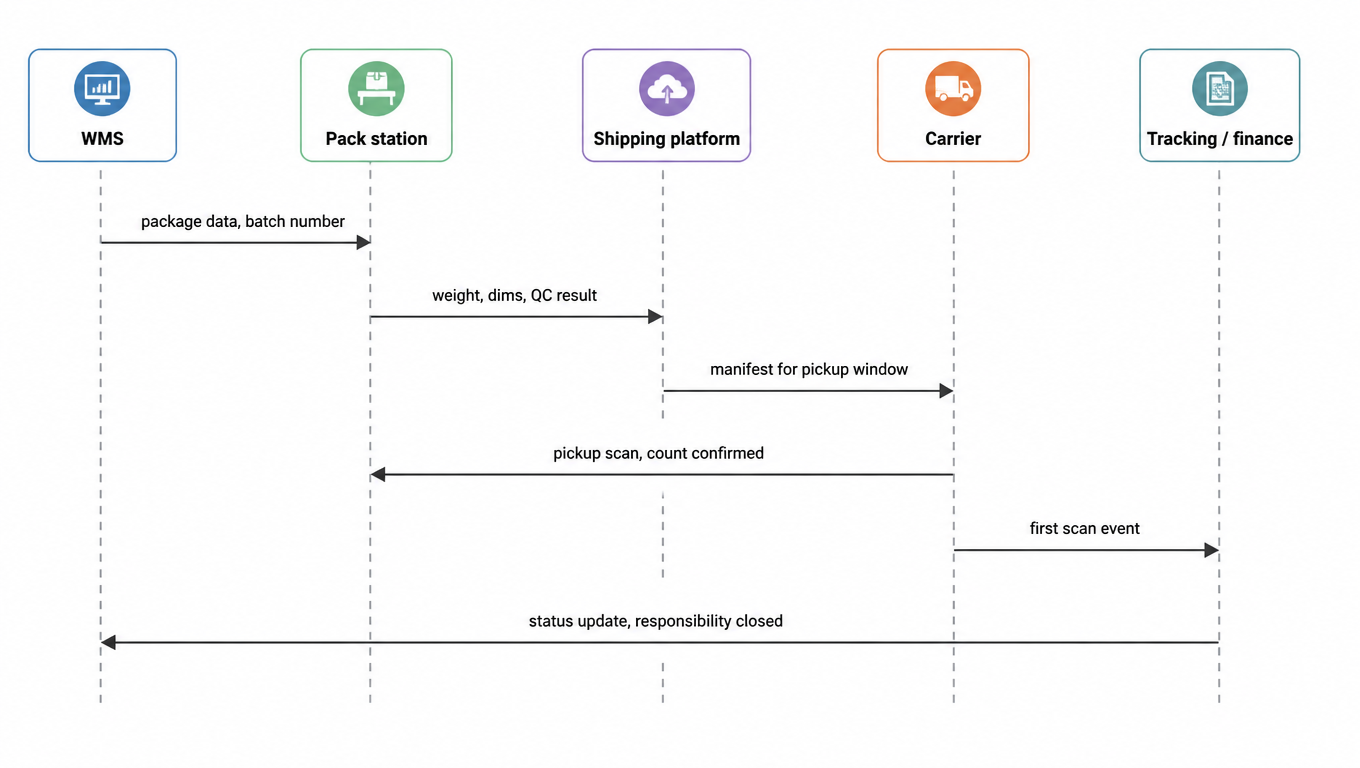
Five-lane sequence diagram: WMS passes package data and batch number to the pack station, pack station returns weight, dims and QC result to the shipping platform, shipping platform submits the manifest for the pickup window to the carrier, carrier performs pickup scan and count confirmation at the pack station, carrier sends the first scan event to tracking and finance, then the status update returns to WMS and responsibility closes
Where data moves, where custody moves, and where the loop closes: a responsible party at every step

This diagram illustrates operational controls and evidence. Confirm timing thresholds and liability against the product, account arrangement, and transport agreement.

The six gates in this checklist sit on that lane. Each gate has a stage, a check, and a failure signature:

GateStageWhat it checksWhat failing looks like
1. Shipment identity & data freezeOrder to labelOrder-package-label relationship, live label state, batch, cutoffReprint ambiguity, wrong service charged, batch untraceable
2. Pack-station QCPack stationWeight, dims, service code, label integrityScale and label disagree; DIM surprise on the invoice
3. Carrier / service segregationStagingCart-to-carrier mapping, batch isolation, injection pointsWrong cart to wrong carrier; mixed services in one manifest
4. Manifest & physical reconciliationPre-pickupManifest count vs physical count vs cart countMissing or extra packages; SCAN form misbuild
5. Handover evidencePickupSigned receipt, count confirmation, timestamp vs cutoffDriver no-show, refused count, partial pickup
6. First-scan monitoringPost-pickupFirst scan within SLA, exception ownershipSilent packages, claims without evidence

Ten variables are tracked across all six gates: order-package-label relationship, weight and dimensions, service code, reprint and void state, batch number, cart count, pickup cutoff, handover receipt, first-scan status, and exception owner. If a variable can change without being logged, the gate that depends on it is fiction. Keep that list on the ops wall; it is the data contract for the whole handoff.

Who runs this: warehouse supervisors execute the gates, and 3PL and operations owners turn them into policy. For the broader context on how the warehouse layer fits into the rest of the shipping operation, see Warehouse Shipping Operations and the US Ecommerce Shipping Stack.

Gate 1: Shipment Identity & Data Freeze

Lock the order-package-label relationship before packing starts. One order maps to one package, except for intentional splits, which are recorded at creation, not discovered at the dock. Every package gets a package ID, a label ID, and a batch number before it reaches a pack station. If you cannot state, for a package sitting in front of you, which order it belongs to and which label is live, the rest of the gates are theater.

Freeze label data after generation. The service code, weight, dimensions, and destination printed on the label are the terms of the shipment; they must not silently change after the fact. The single most common leak here is the reprint: when a label is reprinted, the old instance is dead, and the dead label must be voided in the platform. Otherwise the dead copy can be scanned into the wrong cart, appear twice in a manifest, or pass QC as if it were live. Every order has exactly one live label, always.

The batch number aligns the batch to a pickup cutoff, so staging and manifest trace back to a single pickup window. A batch that spans two cutoffs cannot be reconciled against one manifest, and a manifest that spans two cutoffs cannot be verified against one pickup. One batch, one cutoff, one manifest, one pickup: that is the unit of truth.

Pre-close checklist for Gate 1: order ID, package ID, label ID, batch number, cutoff, and freeze timestamp are all recorded before the batch opens. If data mismatches, the rule is simple: the shipping platform is the source of truth, warehouse edits after freeze are exceptions, not routine, and every exception is logged with a reason and an approver. Nobody changes a frozen label field over a radio call.

Gate 2: Pack-Station QC

The pack station is where the label meets reality, and reality is a scale and a tape measure. Check the scale weight against the label weight, and the measured dimensions against the DIM rules of the service. A 4 lb label on a 6 lb package is not a packing error; it is a billing error that surfaces weeks later as an adjustment, and it is undisputable only in the carrier's favor. The reverse, paying for 6 lb and shipping 4 lb, is margin you gave away.

Check the service code against what was actually packed and paid for. Packing to a cheaper service than the customer paid for is a service failure; packing to a pricier one is a margin leak. Both start with the same root cause: the packer assumed instead of scanning. The scan of the label, not the memory of the order, is the source of truth at this gate.

Check label integrity before the package leaves the station: scannable, unblocked, not folded or torn, with the barcode free of tape glare and the address readable. A label that fails to scan at the carrier's first opportunity resets the first-scan clock for the whole package, and nobody will know until the SLA is already missed.

Pre-close checklist before a cart leaves the pack station: item count, weight, dimensions, label scan, service code, and exception flags all confirmed. Fail actions are four and only four: return to repack, flag as exception, re-weigh, or void and reprint. The fields that must match reality are defined in the label itself; see Shipping Label API for the label fields your stack should be producing and validating.

Gate 3: Carrier / Service Segregation

Every carrier and service gets a defined zone. UPS Ground, FedEx Express, USPS Priority, regional carriers, and DHL eCommerce do not share a staging lane, because their manifests, injection points, and scan behavior all differ. The zone rule is the cheapest control in this checklist: it costs tape, a marker, and a sign, and it prevents the most expensive error in the pipeline, which is a package handed to the wrong network.

Set unit rules per cart, cage, or pallet: capacity, weight limit, and batch isolation. Never mix two batches in one cart, because the moment you do, the manifest reconciliation in Gate 4 breaks and you are back to hunting for a package inside a cart you can describe only vaguely. One cart, one batch, one carrier, one service: the same unit of truth as Gate 1, expressed physically.

Make the zoning visible. Lane labels, cart tags, and color coding cost almost nothing and survive shift changes, which is exactly when segregation fails. Regional carriers and DHL eCommerce need a dedicated injection staging area, because their packages are injected at partner facilities rather than scanned at your dock; a mis-sorted package there does not get caught by a driver; it simply enters the wrong network and disappears from your SLA math.

Run a cross-contamination checkpoint at each zone boundary: cart count versus batch manifest count. The failure modes are predictable: the wrong cart goes to the wrong carrier, or two services ride in one manifest run. Both are caught by the same habit, counting at the boundary instead of at the end of the shift.

Gate 4: Manifest & Physical Reconciliation

The manifest is the carrier's view of what you are handing over: one export from the shipping platform, tied to one batch and one pickup window. It is also the document that converts a package from "printed" to "declared", which is why it must match the physical carts at the moment of handover, not at the moment of export.

Reconcile three numbers: the manifest count, the physical count, and the cart count. Each comes from an independent source, the platform, the dock, and the staging area, and they must agree to the package. A three-way match takes minutes per batch and turns the manifest from a formality into a control.

Discrepancies get the stop-and-resolve rule: missing packages, extra packages, and cross-batch packages all halt the handover until resolved. No driver leaves with a cart whose manifest does not match, because the driver's signature will not fix a manifest error; it will just certify it. The resolution is logged before the batch moves on, so the same discrepancy cannot recur silently tomorrow.

USPS deserves its own line here, because its acceptance flow differs: the SCAN form and the manifest are separate artifacts[^2], and misbuilds surface at induction, not at your dock. The failure modes and the checks that catch them are covered in detail in USPS Manifest Problems. Whatever the carrier, the reconciliation result is logged and signed before the driver takes the carts, because that signature is the last control you own.

Gate 5: Handover Evidence & Count Confirmation

The handover receipt is the first document a claims dispute asks for, and the last one anyone thinks to create. It records the driver's signature or scan confirmation, the count double-signed by both sides, and the timestamp. The timestamp matters as much as the count: it is the evidence that the handover met the pickup cutoff, and the cutoff is the evidence that the first-scan SLA clock started on time.

Warehouse supervisor and carrier driver sign a handoff checklist on a parcel cart.
The moment the pen lands, the clock on responsibility transfer starts

This diagram illustrates operational controls and evidence. Confirm timing thresholds and liability against the product, account arrangement, and transport agreement.

Watch the handover timing against the pickup cutoff. When the handover slips past the cutoff, the package does not fail loudly; it simply waits for the next pickup window, the first-scan SLA shifts a day, and the customer's delivery promise quietly erodes. A handover that misses cutoff is an exception with an owner and a customer communication plan, not a shrug.

At tender, retain signed or driver acknowledgement, pickup records, and later valid scans, reconciling parcels to the batch. The transport agreement determines liability and claim conditions; one tracking status does not establish them. Predefine escalation for a refused signature, count mismatch, or partial pickup rather than replacing records with a verbal agreement.

Archive the receipt, paper or electronic, with the batch, and retain it past the carrier's claims deadline[^4][^5]. When in doubt, keep the batch archive for at least a year; the cost of storage is trivial compared with a claim that fails for lack of proof of induction.

Gate 6: First-Scan Monitoring & Escalation

The first scan is the event that closes the loop: it is the first evidence the carrier's system recorded the package. Every carrier and service should have a first-scan SLA defined at onboarding, before a package ever goes silent, because the SLA is what makes silence detectable. National carriers typically scan at the origin sort shortly after pickup, while regional and injected networks[^7], such as DHL eCommerce parcels handed to a partner for last mile[^6], may not scan until the partner facility receives the parcel, so their window is longer. Define the window per lane, not per carrier in general.

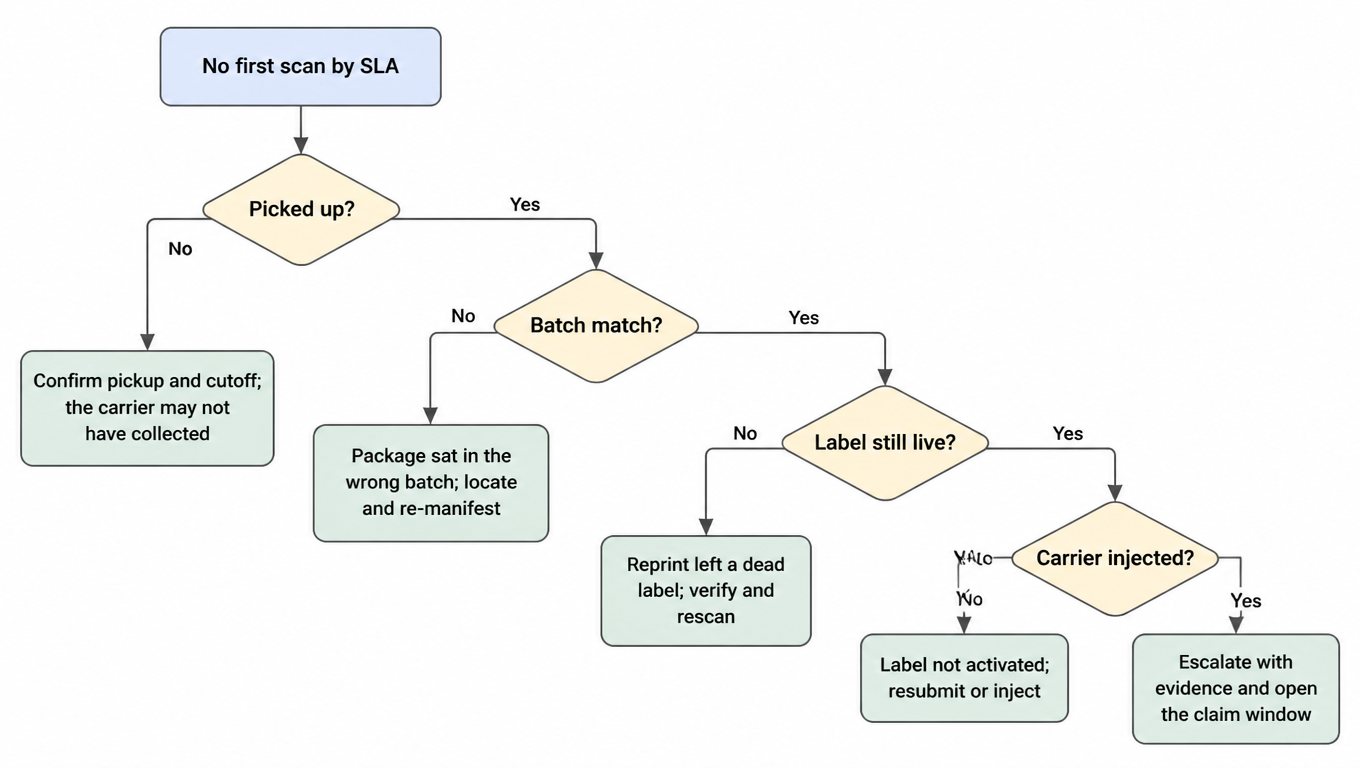
When the first scan does not appear within the SLA, run the decision tree, not the waiting game:

Decision tree: no first scan by SLA, first ask picked up: if no, confirm pickup and cutoff, the carrier may not have collected; if yes, ask batch match: if no, package sat in the wrong batch, locate and re-manifest; if yes, ask label still live: if no, a reprint left a dead label, verify and rescan; if yes, ask carrier injected: if no, label not activated, resubmit or inject; if yes, escalate with evidence and open the claim window
Eliminate your own batch and label problems first, then approach the carrier with evidence

This diagram illustrates operational controls and evidence. Confirm timing thresholds and liability against the product, account arrangement, and transport agreement.

Every exception gets one owner and one due time at creation: the owner, the due time, and the next action are named before the escalation meeting, not during it. The escalation matrix is the anti-pattern antidote, because a silent package with no owner is a package that becomes a claim with no evidence.

Monitoring is implemented with tracking polling or webhooks; see Tracking API for the event stream your stack should expose. Escalated exceptions flow into your Shipment Exception Management process, and the first-scan completion rate feeds Shipping Reconciliation, where a package that never scanned becomes a postage adjustment or a claim line instead of a mystery.

Document each facility’s handoff arrangement before adding a second carrier

U.S. inventory orders and parcels released from customs both need an identified tender owner. After customers or partners handle transport, clearance, and warehousing, a 3PL/4PL tenders under the account-approved product, receiving facility, appointment, and cutoff. Link parcel identifiers, manifest counts, receipts, first scans, and exception owners to client orders. Labels, vehicle departure, and first scans are different evidence and should not substitute for one another.

Include tender arrangements with samples when you request a rate review. Automation teams can use the API product and onboarding evaluation to verify available states and manual recovery paths.

Before validating handoff, confirm coverage and service eligibility for the segment. A facility’s ability to tender parcels does not resolve pending destination eligibility.

The six gates above control each outbound batch. Before adding a carrier, also document how each participating facility will tender parcels. The items below are recommended checks; pickup eligibility, service rules, and responsibility boundaries must come from the effective arrangement for that service. Pickup for Client A at an East Coast facility does not establish the same conditions for Client B at another facility.

Item to confirmHandoff recordOwner
Pickup or drop-off conditionsService and facility address, tender method, agreed frequency, and minimum-volume or preparation conditions where applicable.Warehouse operations and carrier contact
Timing and batchesConfirmed cutoff/time zone, late-batch handling, service segregation, and manifest submission rules.Shift lead
Counts and evidenceDifferences among physical parcels, purchased labels, and manifest counts; handoff time, batch, confirmer, and proof.Handoff owner
First scan and exceptionsAgreed first-scan observation window, missing-scan list, escalation contact, and resolution feedback.Exception owner

A test handoff validates physical execution as well as the integration

Use the shifts that will actually participate in the pilot and record whether packing, segregation, manifesting, loading, and carrier confirmation connect. Verify a normal batch and rehearse count discrepancies, delayed pickup, and missing first scans with named owners. A label response or a warehouse shipped status does not replace handoff evidence. Do not impose one service’s observation window on every carrier.

If handoff conditions are unconfirmed, record the pending items and retain a validated original path. Once confirmed, include added pickup/drop-off, segregation, and exception work in the complete regional-carrier cost comparison before piloting. Additional warehouse work is not free.

Carrier Differences at a Glance

The gates are carrier-agnostic, but the details are not. Manifest method, injection flow, first-scan timing, handover requirements, and claims evidence differ enough between carriers that the same gate runs differently for each. The table below is a starting point; treat every row as "confirm against the carrier's onboarding documentation" before go-live, because these flows change.

CarrierManifest methodInjection flowFirst-scan timingHandover requirementsClaims evidence
UPSEnd-of-day close / pickup manifest via platform or UPS systemDriver pickup with handheld scan at your dockOrigin facility scan after pickup, typically same day or next morningDriver scans cart or stops; count confirmed at pickupPickup and scan evidence; file within the carrier's claims window[^5]
FedExClose batch via FedEx Ship Manager or APICourier pickup with handheld scanOrigin scan after pickup, typically same dayCourier confirms count at pickupProof of pickup and scan history[^4]
USPSSCAN form[^2] (eVS for high volume[^1])Drop-off at origin facility or scheduled pickup"Accepted at USPS Origin Facility" after induction[^3]SCAN barcode scanned by clerk at inductionSCAN form and acceptance scan as proof of induction
Regional (OnTrac, GSO, LSO, etc.)Flat-file or EDI manifest upload per carrierHub injection or scheduled pickup; some require dedicated drop-offHub scan after injection, often in the eveningManifest plus injection receiptHub scan evidence; verify per carrier[^7]
DHL eCommerceDaily manifest per service classHandoff to partner network (often USPS last mile) at an injection facilityScan appears after injection at the partner facility, not at originInjection scan plus manifestInjection scan and partner acceptance[^6]

A regional carrier or postal-injection product may separate pickup from later processing scans, but actual milestones and timing depend on the product, facility, and account arrangement. The table windows are monitoring examples, not SLAs for all regional networks or DHL eCommerce. Obtain current receiving and scan commitments before configuring Gate 3 segregation and Gate 6 escalation thresholds.

Operationally, read the table by asking which gate changes for which carrier. USPS moves the weight of the check into Gate 4, the SCAN form. Regional carriers move the risk into Gate 3, injection segregation, and Gate 6, a longer scan window. DHL eCommerce moves the evidence chain into Gate 6, because the first scan is produced by a partner, not by the carrier you handed the package to. The gates stay the same; the emphasis moves.

RACI & Audit Cadence

The gates run on the dock, but they are owned by five groups, and an unowned gate is a gate that fails on Friday night. The matrix below assigns who does the work (R), who answers for the outcome (A), who gets consulted (C), and who gets informed (I), for each gate and for the two activities that follow every batch.

ActivityWarehouseShipping platformCarrierCustomer supportFinance
Gate 1: data freeze & label stateRAIII
Gate 2: pack-station QCACIII
Gate 3: carrier / service segregationACIII
Gate 4: manifest & reconciliationARCII
Gate 5: handover evidenceAIRII
Gate 6: first-scan monitoringARRCI
Exception resolutionRCRAC
Claims & billing disputesCCRCA

Read the pattern: the warehouse answers for the physical gates, the shipping platform answers for data integrity, the carrier answers for scans, customer support answers for the customer when an exception happens, and finance answers for claims and billing. Exactly one A per row, which is the whole point: when a package goes silent, the question "who answers?" has one answer, not a meeting.

Run a daily handoff audit: yesterday's batches, first-scan completion rate, and the no-first-scan list with owners. Ten minutes, one sheet, and the output is the escalation list for the day. The daily audit catches the package that did not scan; the weekly audit catches the pattern.

Run a weekly handoff audit: error rate trend by gate, carrier SLA attainment by lane, and claims-to-evidence mapping, which means checking that every open claim still has its receipt, manifest, and scan history attached. The audit template is fixed: one row per batch, with date, batch number, carrier, service, manifest count, physical count, handover time, cutoff, first-scan time, SLA met, exception owner, and notes. Fixed fields mean the Friday review compares apples to apples, and the output goes to the escalation owner, not into a drawer.

Wiring Control Points into Your Systems

Start from the control points and the data the warehouse needs, not from software features. The six gates define exactly what your stack must produce: frozen label data, controlled reprints, batch manifests, scan events, and reconciliation output. A tool that does not produce those five things does not close a gate, no matter how nice its dashboard is.

Evaluate whether label, tracking, and reconciliation sit on one chain. The cleanest setup is one shipping layer that prints the label, receives the scan, and reconciles the invoice against the same package identity, so the seams between tools never become gates you did not design. If your label tool, tracking tool, and reconciliation tool are from three vendors, the handoff between them is now your seventh gate, and you did not plan it. The pieces of that chain are covered in Shipping Label API, Tracking API, and Shipping Reconciliation.

Before buying or keeping a shipping stack, check five capabilities: label freeze and reprint control, batch and manifest export, scan webhooks, reconciliation reports, and an audit trail of every edit to a shipped record. A stack that cannot reprint without voiding, or cannot export a batch manifest, or cannot deliver a scan event, is not a stack; it is a printer with a login page. Walk each item with the API readiness checklist.

Then roll out one lane at a time. Week one: pick a single carrier lane, run all six gates on it, and audit daily for five days. The first lane teaches you where your exceptions actually live, and the daily audit turns the checklist from paper into habit. Then expand to the next carrier. Instrumenting every carrier at once hides exceptions in noise; instrumenting one lane makes them visible.

The goal of this checklist is not more software. It is provable handoffs. When every batch has a frozen identity, a QC record, a segregated cart, a reconciled manifest, a signed receipt, and a first scan, "we shipped it" becomes a statement with evidence, and that evidence is what survives a customer ticket, a claims dispute, and a peak-season Tuesday.

Sources

USPS distinguishes label-created/awaiting-item, possession, and shipment-received/acceptance-pending states. Claims also require review of mailing, insurance, and value evidence. See USPS status definitions and DMM 609 claims rules. Evidence-method review: 2026-10-10; verify the specific account agreement separately.

  1. Electronic Verification System (eVS) - USPS Gateway
  2. USPS Enhanced Click-N-Ship: SCAN Forms User Guide
  3. Product Tracking and Reporting (PTR) - PostalPro USPS
  4. File a Claim - FedEx
  5. File a Claim - UPS United States
  6. DHL eCommerce and USPS enter $10 billion-plus long-term exclusive agreement - USPS Newsroom
  7. FAQ - OnTrac

FAQ

Retain signed or driver acknowledgement, pickup records, and later valid acceptance/processing scans, reconciling parcels to batch counts. Batch acknowledgement, individual acceptance, and processing scans mean different things by product; the three records do not universally establish acceptance of every parcel or transfer of legal liability. Set retention against actual claims, contract, and privacy requirements.
Do not use a first scan as a universal liability-transfer point. The product, transport agreement, and carrier terms govern liability and claims. Receipts, driver acknowledgement, manifest counts, and later scans form the evidence chain; label creation or vehicle departure alone does not prove individual acceptance.
Run the decision tree: first confirm the package was actually picked up (check pickup records and cutoff), then check the batch matches (did it sit in the wrong batch), then check the label is still live (did a reprint leave a dead label), then check the carrier injected it (was the label activated). Only after eliminating your own problems do you escalate to the carrier with evidence and open the claim window.
Set retention to cover applicable product claims, disputes, and contract requirements while respecting data minimization and internal retention policy. Damage, loss, domestic, and international services may have different notice and filing deadlines; do not apply one 60-day rule. One year can be an internal archive-planning assumption, subject to actual terms and privacy requirements.
Some products or facilities separate pickup from later processing scans, but do not assume one workflow, partner, or time window for all regional carriers or DHL eCommerce. Confirm receiving milestones, scan owners, committed windows, and escalation per product. Table thresholds are monitoring examples, not contract SLAs.
Does a returned label prove that this facility is ready to tender to the new carrier?

No. Confirm pickup/drop-off conditions, cutoff, manifest rules, count evidence, and first-scan exception ownership. A successful label does not replace physical handoff evidence.

Continue after this stage

Continue after reviewing this stage’s evidence and open items. If the conclusion is unresolved, retain the original path or assign manual verification.