Where the Eight Problems Live in the Pipeline
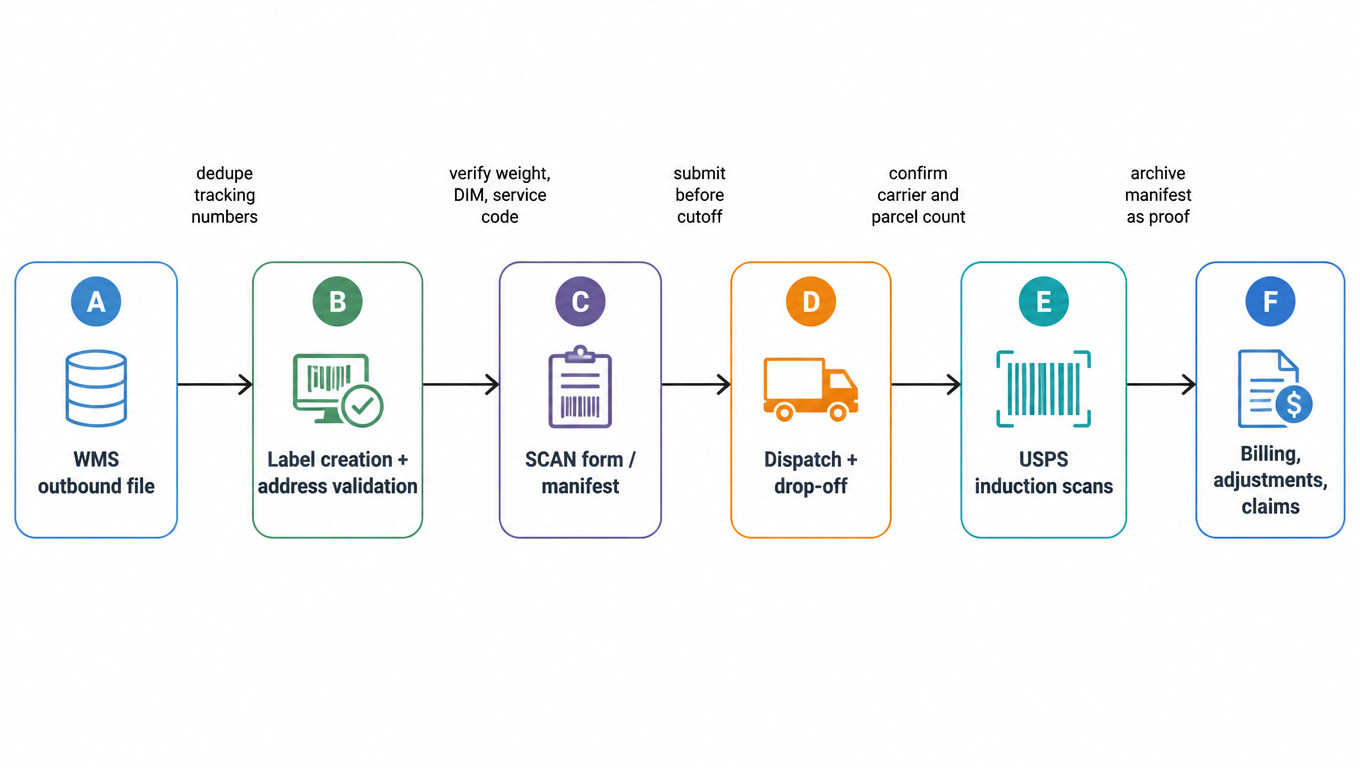
From the WMS outbound file to billing and claims, every stage has a matching check. The label on each edge is the check that is easiest to skip at that stage.
When you ship a hundred parcels a day, a manifest mistake costs a little. When you ship a thousand, the same mistake costs a lot. That is the arithmetic behind manifest quality for US 3PLs and fulfillment centers. Every error in a SCAN form or eVS submission is multiplied by daily volume before it surfaces as a refused drop-off, an untracked parcel, a postage adjustment, or a denied claim.
A manifest looks like a simple document: the list of tracking numbers, weights, dimensions, and service codes for every parcel in a batch, plus the batch-level SCAN form that proves induction. In practice it is the most fragile handoff in the outbound pipeline, because it must match physical reality at the moment of drop-off, and reality changes constantly during a shift. Carts get swapped, labels get reprinted, parcels get pulled for quality checks, and nobody tells the manifest.
This article covers the eight manifest problems that actually burn ops managers at high-volume shipping operations. For each one: what it is, why it happens, how it shows up in your operation, and the check that catches it before the truck leaves. The map below shows where each problem lives in the pipeline.

From the WMS outbound file to billing and claims, every stage has a matching check. The label on each edge is the check that is easiest to skip at that stage.
The SCAN form is the face of your manifest: one barcode that lets a clerk induct an entire batch with a single scan. A mismatch happens when the form lists N tracking numbers and the cart physically holds fewer, more, or different ones. The usual causes are mundane. Labels get generated but never packed because an order was canceled mid-shift. A parcel gets swapped between carts during a break. A manifest file contains duplicate tracking numbers. None of these feels like a big deal at the moment; each one turns the manifest into fiction.
The failure shows up in one of two ways. If the clerk catches it, the batch is refused and you rebuild the drop-off under time pressure, with a line of trucks behind you. If the clerk does not catch it, USPS inducts the batch anyway, and the parcels that were never in the cart never receive a scan event. They are invisible: no acceptance scan, no delivery scan, no claim coverage. The customer opens a ticket a week later, and your team re-forensics an entire batch to find one cart.

The check is reconciliation before you close the batch. Count labels against scanned-into-cart parcels, then diff the SCAN form's tracking list against the WMS outbound file. Make the diff a standing report, not an occasional audit: at high volume, mismatch is a daily event, not a rare one. The strongest shipping platforms run this diff automatically at label-print time, so a discrepancy is caught before the manifest is even built.
A duplicate manifest is the same tracking number appearing on two batches. It usually comes from retry logic: a shipping API call times out, the software re-sends it, and both submissions land. The same thing happens when an operator re-runs a batch that showed as failed, or when a manual counter manifest is created after an eVS or API submission already fired. Duplicates rarely look like duplicates at the moment they are created.
The result is double postage debits on the monthly invoice and duplicate scan events that confuse tracking pages and customer support alike. At scale, a small percentage of double-submitted volume is easy to miss until finance flags an invoice that will not tie out to shipped counts. The fix is tedious after the fact: every duplicate has to be traced back to its batch, and the overcharge has to be fought line by line.
The check is idempotency. Batch IDs must be unique, tracking numbers should be deduped across manifests before upload, and your software should alert the moment the same tracking number appears in two consecutive SCAN forms. If your stack cannot guarantee idempotent submission, build a dedupe step into the export itself, because the retry that created the duplicate will fire again next week.
Every manifest carries addresses, and every address is a bet that the recipient still exists at that location. CASS certification and NCOALink are the tools that make address validation reliable,[^2][^3] but if you skip them at label creation, the bad address ships all the way to a failed delivery attempt. The manifest does not create the address problem; it just gives it a ride.
Return-to-sender cycles are among the most expensive mistakes on this list, because you pay twice: the outbound postage is gone, and the return leg is billed on top. Add angry customers, claim disputes over undeliverable items, and a per-ZIP RTS pattern that quietly identifies your worst data sources. A fulfillment center with clean manifests but dirty addresses looks, to the customer, exactly like one with sloppy operations.
The check is to validate at the point of data entry. Run CASS-certified validation at label creation, apply NCOA before manifesting, and report RTS rates by ZIP so bad data gets fixed at the source rather than at the dock. Address hygiene is a data problem, and data problems should be solved upstream, not at the manifest station.
Manifesting a parcel at a lower weight or smaller DIM than reality is the quietest leak in the pipeline, because it does not surface at drop-off at all. The causes are boring: stale dimension fields in the WMS, a box override that never got applied, or weights averaged by SKU instead of measured per parcel. Nothing rejects the batch, nothing scans wrong, and the parcel sails through induction.
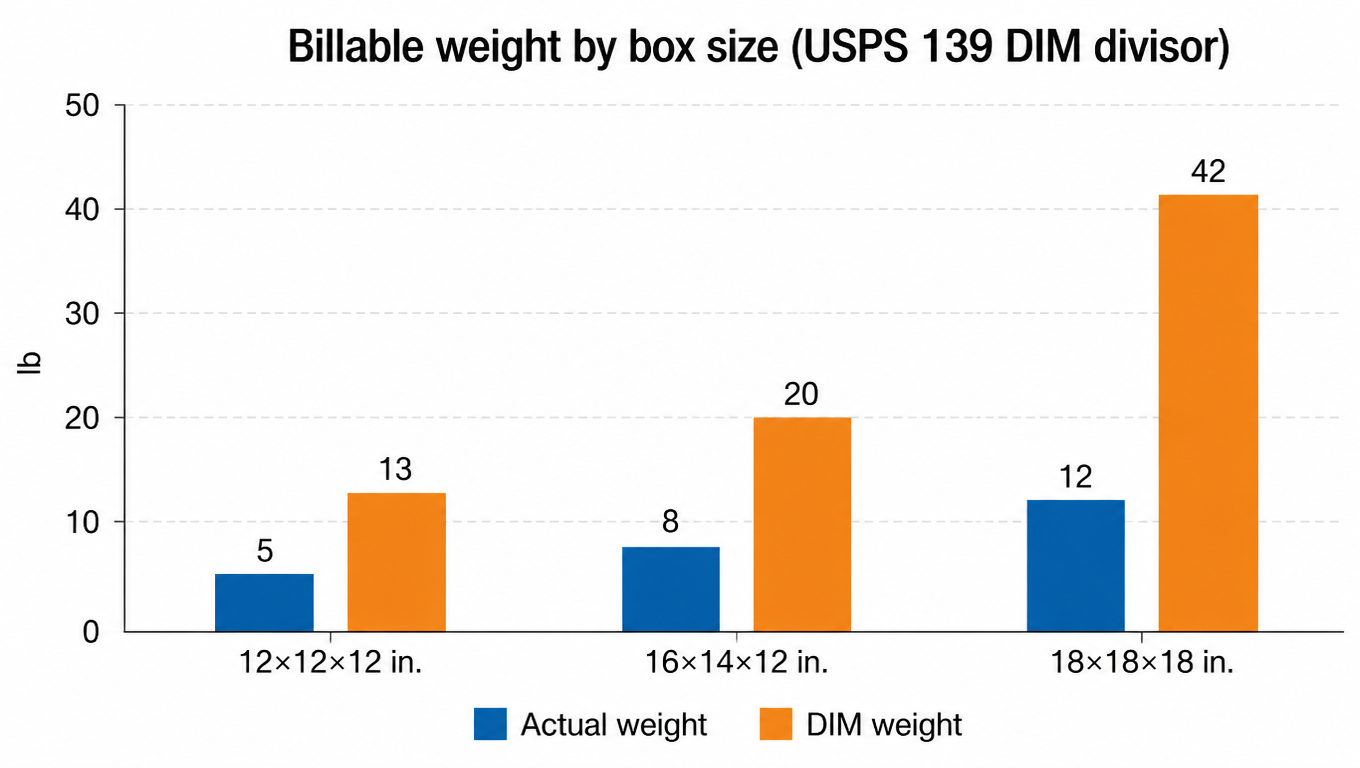
USPS revenue assurance audits batches and adjusts postage after the fact.[^5] The adjustment lands on your monthly invoice with little detail, and repeat offenders get flagged for closer review, which slows every future drop-off. The gap is easy to underestimate. With the 139 DIM divisor that took effect in July 2026, a 12×12×12 in. box weighing 5 lb bills at 13 lb, a 16×14×12 in. box at 8 lb bills at 20 lb, and an 18×18×18 in. box at 12 lb bills at 42 lb. Manifest those at actual weight and you are underpaying on every single one.[^1]
The check is a weekly sample audit: pull a random set of parcels, weigh and measure them, and compare against the weight and DIM fields on the manifest. Reconcile postage adjustment lines line by line; adjustments are disputable, but only if you have the data to dispute them. Weighing and measuring at the pack station beats trusting SKU masters, every time.
The manifest declares a service level, the IMPB barcode carries a service code, and when the two disagree, nobody notices until the parcel is in transit. The causes are configuration drift: a per-client default service that was misconfigured when the account was set up, a rate-shopping tool that picks a service the manifest layer does not carry, or an IMPB service code that drifted from the manifest entry.
The cost is subtle and compounding. The parcel is held to the wrong delivery commitment, postage is misapplied, and if the parcel misses its SLA, the service credit is denied because the barcode and the manifest disagree about what was promised. Customers hold you to the service you sold them; USPS holds you to the barcode. When the two do not match, you lose the argument twice.
The check is a two-line comparison. The service code on the IMPB must match the manifest entry, and per-client default services must be audited after every rate table update and every software version bump. Both are cheap to automate, and both fail silently when nobody looks.
The manifest is time-sensitive. Every plant has a batch cutoff, and a manifest submitted after it does not fail, it simply waits. Parcels sit in the cage overnight while the delivery commitment quietly expires. The manifest software is not at fault; the clock is.
The visible cost is missed commitments and silent tracking, plus clients asking why a Ground parcel did not move for 24 hours. The hidden cost is detention at the plant and a dispatch that has to be re-planned for the morning, which ripples into the next day's volume. A cutoff missed by ten minutes is a full day of delivery SLAs burned.
The check is knowing the real cutoff, which is not always the published one: ask the plant manager. Build slack into the manifest run, alert when a batch crosses the deadline, and keep an exception queue for parcels that arrive after the cart is sealed, so a handful of stragglers never drag a whole batch into tomorrow.
A USPS manifest should contain only USPS parcels, and a batch that violates that rule fails in the most disruptive way possible: after the cart is at the dock. The causes are procedural. A multi-carrier WMS exports the wrong carrier's outbound file, a carrier-agnostic label gets packed into the wrong cart, or a batch is assembled by hand under time pressure.
The manifest fails validation, or the mixed parcel scans as unknown at the plant and derails the entire batch, delaying every legitimate parcel behind it. One wrong label can cost the whole dispatch its slot, and the delay lands on parcels that had nothing to do with the mistake.
The check is carrier filtering at three points. Filter the manifest export by carrier before upload, scan cart labels to confirm the carrier prefix, and train dock staff on what a USPS label looks like. A 9-series tracking number belongs in the batch; a 1Z prefix does not.
The manifest is the proof of induction, the document that converts a parcel from shipped to the carrier's responsibility. When it is incomplete, unarchived, or unreconciled, the failure shows up later, in finance and in claims, long after the dock is calm. The manifest does its physical job at drop-off; its paper job comes due a month later.
Claims get denied for lack of proof of induction,[^4] postage adjustments go unchallenged because nobody can match invoice lines to shipments, and finance burns days each month tying out numbers that a manifest archive would settle in minutes. The manifest you did not keep is the one you will need.
The check is archival hygiene. Keep every SCAN form with its batch, store the manifest file and the WMS outbound file in one place, and file claims against the manifest reference, not the label number. If a claim is the only time you look at the archive, the archive is already too late.
Print this and stick it next to the manifest station. Each line is one operator action, in order, before the cart leaves.
None of these checks is exotic. They are the difference between a batch that inducts cleanly and a batch that burns a shift. For a high-volume shipper, a manifest that matches reality is the cheapest insurance on the dock.
EasyShippingX automatically dedupes tracking numbers, validates addresses, cross-checks weight and dimensions, and reconciles manifests against outbound files at label time, so SCAN form and eVS submissions match reality and errors are caught at the dock, not on the invoice.