Warehouse Guide

Warehouse shipping operations: batch labels, exception handling, and low-risk rollout

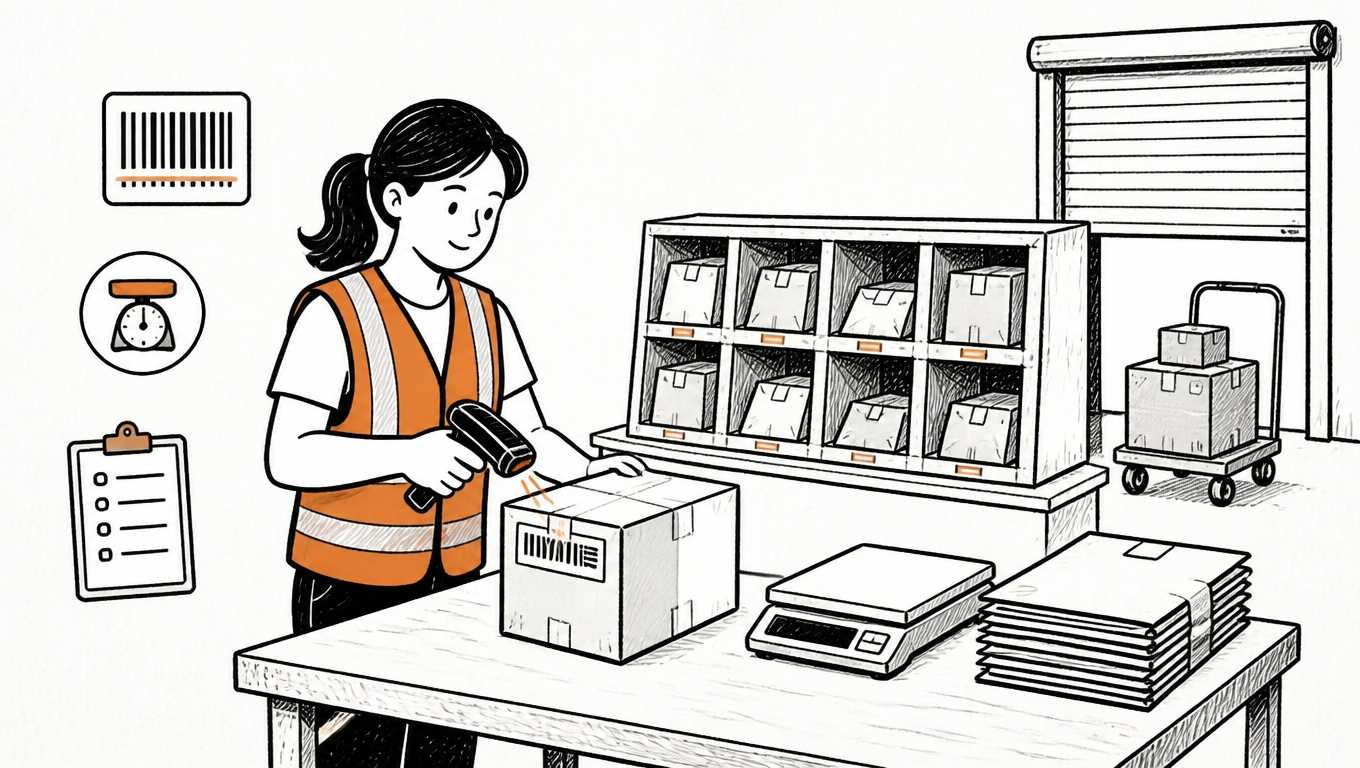
Illustration of a warehouse outbound line where operators scan, weigh, and hand off parcels
Workflow illustration, not a customer case and not an actual quote.

Warehouse teams care less about product claims than about operational continuity: labels that batch cleanly, less rework, exceptions closed before the next pickup, and new processes that do not disturb daily throughput. This guide starts after the parcel is already packed. It covers the six control points on the outbound line, the three verification scans, when weight and dimensions must be measured rather than assumed, manifest and dock handoff, the order to investigate a missing first scan, shift handover, and the day-close board.

Six control points on the outbound line

Turning a releasable order into a parcel accepted by a carrier needs three handoffs at once: data, physical goods, and responsibility. Each one has to leave evidence someone else can re-check, or the problem compounds downstream. Bad weight or dimensions become a billing adjustment. A label-to-parcel mismatch becomes a tracking and support problem. A missing manifest or handoff record makes “left the warehouse” impossible to distinguish from “accepted by the carrier.”

Align outbound control points with the client and billing responsibilities in the 3PL shipping operating model. Use the carrier handoff checklist to carry those controls through manifests and physical carrier acceptance.

StageOperating controlEvidence producedFailure path
1. Order releaseClient, address, SKU, promise, and handling fields completeRelease batch ID and field validation resultData quarantine queue
2. Pick and packScan SKU; record package and substitution reasonSKU scan record, package code, operatorShortage, mismatch, or packaging review
3. Weigh, measure, and routeBind device readings to the parcel; compare eligible services onlyMeasured weight and dimensions, device ID, timestampParcel-data or no-service queue
4. Buy and verify the labelOrder, carton, shipment, label, and physical scan agreeVerification scan record and void recordStop flow; void the incorrect label
5. Sort, manifest, and hand offStage by service lane; close the batch; record container, dock, and handoffContainer ID, manifest number, handoff time and signatureUnhanded or missing-first-scan investigation
6. Day closeReconcile released, labeled, voided, handed-off, and leftover parcelsDay-close board and open-parcel statesAssign an overnight owner and next action
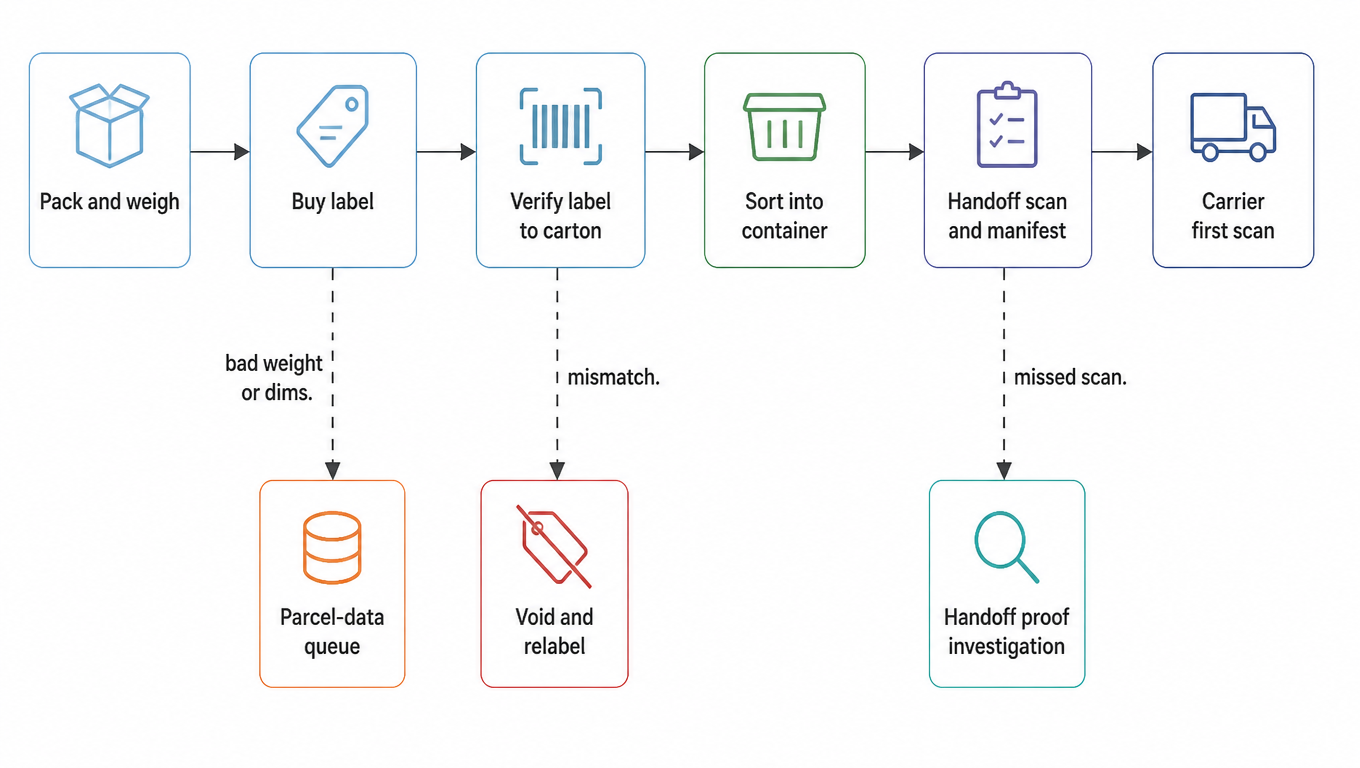
Warehouse outbound control flow: release → pick/pack → weigh/measure → route/label → manifest/handoff → close. Every failure path on the right needs an owner inside the same shift.
Outbound control flow with three verification gates: pack and weigh, buy label, verify label to carton, sort into container, handoff scan and manifest, carrier first scan; dashed branches lead to the parcel-data queue, void and relabel, and handoff proof investigation
The three verification gates catch the three failure families: bad weight or dimensions before the label is bought, a label mismatch before it is applied, and a missed scan or handoff before the carrier arrives.

Picking, scanning, and packing boundaries are covered in the pick-and-pack fulfillment guide. This page continues after the parcel is ready and stays with routing, handoff, and exception closure.

Three scan points: where the label-to-parcel binding is proven

A scan is not quality control for the person doing the work. It hands one stage’s conclusion to the next stage. If only one scan can survive, keep the sort-and-handoff scan, because it is the only action that proves who received the parcels. Scan only that one, though, and the first two error types instead surface after handoff, where they cost far more to resolve.

Scan pointWhat it provesWhat it catchesWhen a miss surfaces
Pack verification scan (SKU to carton)This carton holds the released SKUs and quantitiesWrong item, missing item, mixed cartonAt delivery, or later at return
Label verification scan (carton to shipment and label)The printed label and this carton are the same shipmentMisapplied label, duplicate label, old label reusedSame-shift sorting, or a first-scan exception
Sort and handoff scan (parcel to container, batch, or manifest)Which container this parcel entered, which batch it belongs to, who took itMissed handoff, mixed container, batch left openMissing first scan, or tracking that never moves

Cost rises across the three scan points while value falls: the pack verification scan is cheapest and surfaces latest, the handoff scan is the most disruptive and closes the same day. The peak-season rule follows from that: temporary staff should only perform scan-constrained actions, and any “scan it after this wave” shortcut must be completed before the shift ends, or it becomes a missing-first-scan investigation the next morning.

Weight and dimensions: what must be measured and what can reuse the record

Parcel data is the one warehouse input that changes both cost and routing. USPS dimensional weight pricing applies to domestic Priority Mail Express, Priority Mail, USPS Ground Advantage, and Parcel Select parcels larger than 1 cubic foot (1,728 cubic inches) destined for zones 1 through 9, which means light but bulky cartons are priced on volume, as described in USPS postage verification. Carriers also re-measure inside their network and adjust accordingly; UPS asks shippers to weigh the parcel and round any fraction of a pound up to the next whole pound in its package dimensions and weight guide. So the warehouse question is not whether to measure, but which parcels must be measured and which can reuse a record.

Must be measuredCan reuse the record
First run of a SKU, or first use of a packaging optionRepeat SKU with the same package, measured in a previous shift
Package change, substituted carton, or a size change after adding fillerMeasured value inside the record tolerance (example: 1 ounce or 0.25 inch)
Multi-item carton, gift, or insert addedThe same SKU combination running at one station
Near or above 1 cubic foot, or sitting exactly on a service weight thresholdSmall single-SKU parcels whose package matches the record exactly
Over-length, over-weight, non-machinable, or handling-sensitive—
A previous measurement disagreed with the declared value, or an adjustment appeared—

Four execution details that get skipped

  • Bind the measured value to the parcel, not to the SKU master record. Record the timestamp, device ID, and operator, otherwise nobody can explain later where the number came from.
  • Allow one unit system end to end. Mixing pounds and ounces, or inches and centimeters, is the classic silent warehouse error, and the interface should only ever show one.
  • Calibrate scales daily against a check weight and log it at shift change. Drift never raises an alarm, it just bends the cost of a whole batch slowly.
  • Round the way the carrier rounds, not the way the station is used to. Rounding a fraction of a pound up versus rounding to nearest creates a persistent gap that shows up most when you compare services.

Estimate the gap between dimensional and actual weight with the dimensional weight calculator, then check whether surcharge rules apply with the package size checker. Unit conversion and rounding details are covered in the dimensional weight and cm/kg conversion guide.

Manifest and dock handoff: making “shipped” a provable state

After sorting, the job is to turn a heap of labeled parcels into evidence that a carrier received a batch. The USPS Shipment Confirmation Acceptance Notice (SCAN) form is exactly that kind of batch proof: one master barcode scanned by the carrier creates an acceptance event for the whole group instead of scanning every parcel, as described in the USPS SCAN form notice. One boundary gets confused constantly: submitting a manifest is not carrier acceptance. Only a batch scan or the first parcel-level scan event turns “handed off” into “received.”

Handoff typeWhat to recordUsual gap
Scheduled carrier pickupPickup time, driver or reference, piece count, the completed scanCount is verbal with no signature; an early or late pickup is never recorded
Drop-off at a carrier facility or access pointLocation, submission time, receipt or batch scan referenceReceipt lost; no scan event is ever generated after submission
Third-party line-haul or consolidated truckingHandoff list, plate and driver, seal numberSeal number not recorded, so a mid-route truck change is untraceable
Held in the facility for the next dayStorage location, reason, owner, and next-day planParcels sit on the dock overnight and nobody owns them the next day

Cutoff time and pickup time are two different things. The cutoff inside the system decides whether an order can ship to promise; the carrier pickup decides when the parcel physically leaves the building. Without a buffer between them, an order arriving ten minutes late rolls to the next day while still being reported as shipped today. Putting both clocks on the shift board fixes more than overtime at the label printer does.

Missing first scan: investigate in order instead of declaring a loss

A missing first scan is the most expensive warehouse exception, because it can be three completely different situations at once: the parcel is still in the building, it left but nobody scanned it, or it is genuinely lost. Those outcomes cost very different amounts, so the first step is always to prove whether a handoff happened, never to reship.

  1. Step 1: trace the container and batch. Look up which container and batch the parcel entered, and whether that batch was closed.
  2. Step 2: line up the timestamps. Match the parcel’s last scan against dock footage and container seal times to see whether it was inside the handoff at all.
  3. Step 3: check the manifest. Confirm the batch manifest was submitted, when, and whether the piece count matched.
  4. Step 4: look for the batch scan. Check whether a batch scan or a first parcel-level scan already exists, so a scan delay is not mistaken for a failed handoff.
  5. Step 5: check the shift boundary. If pickup happened on the next shift, yesterday’s “missing” may just be a timing gap.
  6. Step 6: only then choose the action. If it never left, hand it off again. If it left unscanned, reconstruct the proof. Only after ruling those out does the case move into the remedy ladder described in shipment exception management.

Turn that order into a threshold, for example, “handed off without a first scan for more than 24 hours becomes an investigation” (an example threshold), and assign it to one role. The investigation then closes inside the day instead of turning into a support escalation. Set the threshold from your own pickup frequency and promise, not from a fixed number.

Why warehouse priorities differ from seller-facing decisions

The warehouse-side priority is rarely the theoretically best carrier. It is whether execution stays stable during operational peaks. If systems and workflows cannot carry high-frequency batch labeling, review, and exception closure, even an attractive rate is offset by rework and manual intervention. Warehouse teams usually care more about throughput stability, batch consistency, and whether exceptions are found and handled inside one operational path.

Stabilize batch actions first

For most warehouses, portal workflows and Excel bulk upload are the lower-risk starting point. Their value is not that data can be imported, but that the team can quickly validate whether fields, labels, tracking, and export structure stay consistent. Template versions, whole-file failure, and row-level retry rules are covered in the Excel bulk upload guide.

Then bring exception handling into the main workflow

When exceptions sit outside the main workflow, warehouses quickly fall into manual follow-up and repeated messages. A stronger model keeps exceptions, tracking, and billing records inside one execution path instead of splitting label creation from exception handling. Outcomes eventually have to be written back to billing and claim fields, and the shipping reconciliation best practices guide covers that vocabulary.

Roles and shift handover: one name per action, one owner per open parcel

The most common warehouse failure is not a lack of effort, it is an action without a named owner, or a critical action resting on one person. Naming labeling, verification, handoff, exceptions, and day close separately, and keeping those duties apart during peak, reduces rework more than extra headcount does. The point of separation of duties is not paperwork, it is that the person executing cannot also be the only approver.

RoleOwnsMust not also beHands over
Label operatorBulk import, label purchase, printingThe only void approverOrders not labeled this shift, with the reason
Label verifierSecond scan, voids, relabelsCarried alone by the label operatorVoid list and relabel reason codes
Sort and handoff leadContainers, manifests, dock handoffChanging address or service levelContainer IDs, counts, handoff type, batch scan proof
Exception clerkMissing scans, address and service exceptions, claim prepPromising a refund or reship on their ownCase IDs, aging, next action, and due time
Shift leadDay close, open-parcel board, escalation, staffingEvery other station at onceThe open-parcel list and each owner
  • Coverage rule: every role has at least two people who can cover it, with the substitute list set before holidays and peak.
  • Temporary staff boundary: scan-constrained actions only, never labeling, voiding, or handoff on their own.
  • Single-person shift rule: if one person really is on shift, voids and handoffs must leave a system trail and reach the next shift for review.

Day close: one open-parcel board ends the shift

Day close is not a count of printed labels. At shift end, separate labeled-not-packed, packed-not-labeled, labeled-not-sorted, containerized-not-handed-off, handed-off-without-first-scan, pending-void, and pending-relabel parcels. Every open parcel needs a physical location, a system state, an owner, and a next review time. The thresholds in the table below are examples built around a two-shift day and should be replaced with your own pickup frequency.

StateWhere it physically isSystem stateThreshold and next action (example)
Labeled, not packedPick face or pack benchLabel purchasedReturn to packing in the same shift
Packed, not labeledPack bench waiting areaNo label yetEscalate to the shift lead 60 minutes before cutoff
Labeled, not sortedSorting bufferLabel appliedFinish sorting and container assignment in the shift
In a container, not handed offDock or container stagingManifest not submittedComplete and record the handoff before pickup
Handed off, no first scanPossibly already in the carrier networkManifest submittedPast 24 hours it becomes a missing-scan investigation
Pending void or relabelVoid bin or relabel stationOriginal label still activeClose within 24 hours or the charge stays on the invoice

The last action of the shift is handing the board to a named person: who owns the night, and when each open parcel gets checked again. Replacing “we will look tomorrow” with “reviewed at 07:30 by this person” removes most missing-scan and duplicate-label charges before they ever land on an invoice.

Metrics: unclear denominators make numbers contradict each other

The usual warehouse metrics mistake is not arithmetic, it is an unstated denominator. The same “exception rate” produces two different conclusions depending on whether the base is cases discovered or cases closed, and using completed returns as the base makes failed attempts disappear from the average. Write the numerator, denominator, time window, and drill-down into the definition so the team argues in one language.

MetricDefinition (numerator / denominator)What it revealsDrill-down
On-time handoff to promiseParcels handed off before cutoff / parcels due to ship that dayWave, packing, routing, or cutoff problemsClient, facility, shift, service
First-pass yieldParcels passing the first verification scan / all parcels scannedOverall level of review, relabel, and manual interventionShift, client, SKU, package
Relabel and void rateLabels voided or reprinted / labels purchasedAddress, parcel data, printing, or operator errorsReason code, station, SKU, package
Delayed first-scan rateParcels whose first scan came after the agreed window / parcels handed offManifest, dock, pickup, or missed-scan problemsCarrier, handoff batch, date
Exception aging and rework timeOpen case age and average handling minutes per caseUnclear ownership or cross-system search costException family, owner, client
Open parcels at closeParcels open at day close / parcels handed off that dayClose discipline and the load pushed onto the next shiftState, owner, client, shift
Throughput per labor hourParcels handed off / billable labor hoursWhether staffing matches the process, and where peak needs peopleWave, shift, zone, service

Metrics are not there to prove the operation is fine, they are there to point at the next action. When on-time handoff drops, the next question is whether waves released late, the pack bench backed up, or the pickup time moved. The answer usually sits at one station or in one client’s fields, not in “overall efficiency.”

Failure plans for equipment and consumables

What actually creates a backlog in a warehouse is rarely the system. It is one printer, one roll of label stock, or one scanner. Writing the six most common failures and their immediate action at the workstation saves more time than a postmortem does, while the permanent fix belongs to the asset log and the purchasing cycle.

FailureImmediate actionPermanent fix
Label printer downSwitch to the spare printer and reprint the same batch, keeping the original queue to avoid duplicatesLog a self-test page each shift; keep the spare the same model with the same stock
Wrong label stock or typeQuarantine the roll and void the labels already printed from itPut thermal versus laser, size, and gap into the purchase spec and spot-check on receipt
Scanner or scan station failsUse the backup scanner, log the offline window, and upload after recoveryAt least two working scanners per zone, with manual entry as the fallback path
Scale drift or missing calibrationCheck against a test weight, then switch to manual entry with a flag while the scale is outDaily check log, repair on out-of-tolerance, and retro-review that shift’s parcels
Network or system interruptionKeep working from the approved offline list, then reconstruct handoff proof firstPut pre-print buffer and maintenance windows into the shift plan
Print queue stalls or duplicatesReprint by batch ID, reconcile the printed list, and void the duplicatesCheck the carton ID before reprinting so nothing gets labeled twice

A worked example (assumed values): where rework cost lands

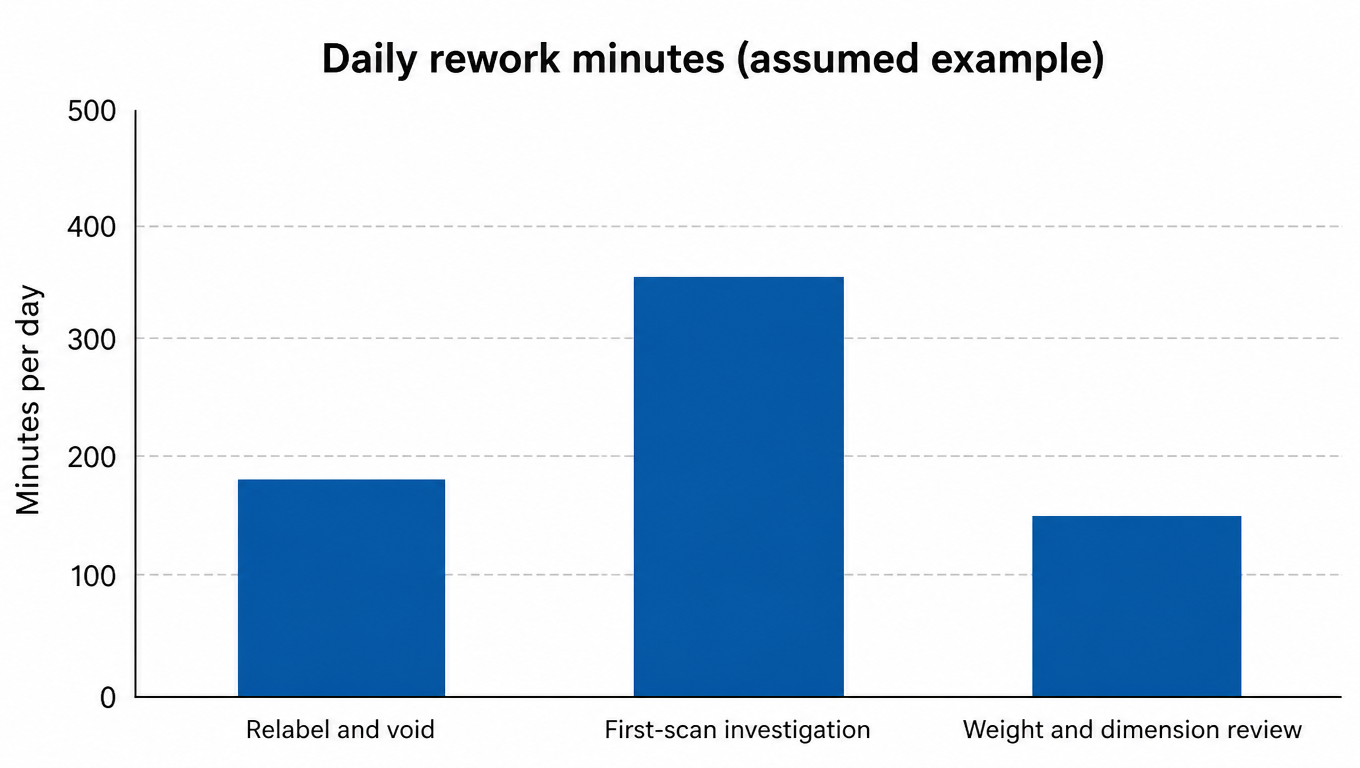
This is a hypothetical single-facility day used to show how rework time turns into money. It is not an industry benchmark and not anyone’s customer data. Assume 3,000 parcels handed off per day, of which 45 need a relabel or void, 30 have a delayed first scan that needs investigation, and 25 need a weight or dimension review. Handling time is assumed at 4, 12, and 6 minutes respectively.

Rework sourceCases (assumed)Minutes each (assumed)Minutes per day
Relabel and void454180
Delayed first-scan investigation3012360
Weight and dimension review256150
Total100—690 (about 11.5 labor hours, 3.3% of volume)
Bar chart of rework minutes in the assumed example: relabel and void 180 minutes, delayed first-scan investigation 360 minutes, weight and dimension review 150 minutes
Daily rework minutes in the assumed example: delayed first-scan investigation is more than half the total, so fixing handoff and manifest discipline pays back first.

At an assumed loaded cost of 25 dollars per hour, 690 minutes is about 172 dollars a day, or roughly 4,472 dollars over 26 working days (all assumed values). The point is not the total, it is the ranking. The 360 minutes of delayed first-scan investigation usually traces back to the pickup window, manifest close time, or container handoff records, not to the printer. Fix that line first, then consider equipment or headcount. Set an explicit target for total rework (for example, holding it under 400 minutes) and review the trend weekly instead of only after an incident.

Bulk upload or API, and the order to roll out

Bulk upload stays efficient when batches are clear, fields are stable, and human review still adds value. API earns its place when orders arrive continuously from several sources, serviceability or routing must run in real time, or duplicate entry has become the main risk. Base the decision on workflow and error cost rather than treating API as a maturity badge, and run the API readiness checklist before committing.

StagePrimary actionReadiness check
Stage 1Validate portal and Excel batch workflows, then freeze fields and template versionAre import, label output, and exports stable, with one field definition?
Stage 2Stand up the three scan points, role split, and the missing-scan investigation orderDo review and exceptions close in one path and leave evidence?
Stage 3Expand carrier routing or API, changing one thing at a timeHave throughput and rework baselines already proven stable?

Entry criteria, exit evidence, and rollback triggers live in the low-risk shipping rollout guide, which is about turning “more stable” into something provable. This page does not repeat it.

FAQ

Not always. Many teams are better served by validating throughput and execution in portal and Excel first, fixing fields, scan points, and exception paths, then moving into API expansion.
Because warehouse efficiency depends more on repeatable batch handling than on isolated per-order optimization. Once batch actions are stable, rework and manual intervention fall.
Ideally three: pack verification, label verification, and sort-and-handoff. If only one can survive, keep the sort-and-handoff scan, because it is the only action that proves who received the parcel.
Common causes are dimensions that were never updated after a package change, dimensional weight exceeding actual weight, units or rounding that differ from the carrier’s rule, or mixing a measured value with the SKU record. Carriers re-measure inside their network, so the measured value has to be bound to the parcel with device and time.
No. A manifest only proves the warehouse declared the batch. Acceptance is proven by a batch scan or the first parcel-level scan event. The gap between the two is exactly where a missing-scan investigation starts.
Connect exceptions to role ownership, tracking review, and an escalation path before choosing a remedy. A missing first scan starts with proving whether a handoff happened, not with a reship or refund.
Once batch labeling, the three scan points, exception closure, and export structure are stable, and a comparable throughput and rework baseline exists, expanding carrier mix or API carries lower risk.

Run outbound execution in one path

Use EasyShippingX to keep batch labeling, label verification, manifest handoff, and tracking records in one workflow, so fewer people reconcile systems by hand.