物流诊断Shipping Diagnostics

运费时效出问题,到底怪承运商、仓库还是软件?一套诊断框架Is Your Shipping Problem Caused by the Carrier, Warehouse, or Software? A Diagnostic Framework

每一件物流异常的开头都一样:客户问包裹到哪了,你打开追踪页,包裹看起来卡住了,总得有个人背锅。多数团队跳过诊断,直接开骂。这篇文章给你一套两步框架,用你已经有的数据,一个小时内找到真正的元凶。Every shipping incident starts the same way: a customer asks where their order is, you open the tracking page, the package looks stalled, and somebody has to be at fault. Most teams skip the diagnosis and go straight to blame. This article gives you a two-step framework that finds the real culprit in under an hour, using data you already have.

三个嫌疑人分别是软件、仓库和承运商。软件层管订单周围的一切数字化环节:地址校验、费率、面单、追踪号、系统之间的数据交接。仓库层管交接之前的一切实体环节:拣货、打包、扫描、截单、库存。承运商层管交接之后的一切:取件、转运、派送、异常。几乎每一件物流问题,指纹都只落在其中一层,框架教你把它读出来。The three suspects are the software, the warehouse, and the carrier. The software layer owns everything digital around the order: address validation, rates, labels, tracking numbers, and data handoffs between systems. The warehouse layer owns everything physical before handoff: picking, packing, scanning, cutoffs, and inventory. The carrier layer owns everything after handoff: pickup, transit, delivery, and exceptions. Almost every shipping problem has a fingerprint in exactly one of them, and the framework shows you how to read it.

你最终会拿到:一套在时间线上定位断点的方法、三份分层的自查清单、三个让方法跑起来的匿名真实案例,以及让异常越来越少发生的监控习惯。What you get at the end: a timeline method that finds the broken timestamp, three layer-specific checklists, three anonymized real-world diagnoses that show the method working, and the monitoring habits that keep incidents rare.

放大镜下的仓库传送带包裹,背景是配送路线图
诊断的第一原则:永远别猜,让时间戳说话The first rule of diagnosis: never guess, let the timestamps point

为什么物流问题总被误诊Why Shipping Problems Get Misdiagnosed

物流问题被误诊的第一个原因是甩锅三角。客户看到包裹迟到,怪店铺;店铺看着追踪页显示包裹「已在承运商手里」,怪承运商;承运商查自己的扫描记录,看到取件来晚了或者面单生成错了,怪仓库或软件。每一方都有干净的数据证明自己这一步没问题,每一方都有把手指向外的动机,因为没人想让退款从自己的利润里出。The first reason shipping problems get misdiagnosed is the blame triangle. The customer sees a late package and blames the store. The store looks at the tracking page, sees the package "with carrier," and blames the carrier. The carrier checks its own scans, sees a pickup that happened late or a label that was generated wrong, and blames the warehouse or the software. Every party has clean data showing its own step was fine, and every party has an incentive to point outward, because nobody wants the refund to come out of their margin.

第二个原因是那套经典打法:退款、道歉、怪承运商、等下一个事故、再来一遍。退款保住了这一单的客户,但根因没动,下周同一个故障还会重演。这套打法永远修不好任何东西,因为它从不定位断点,只是为症状买单然后继续。The second reason is the classic playbook: refund the customer, apologize, blame the carrier, wait for the next incident, repeat. A refund keeps the customer for this one order, but the root cause is untouched, so the same failure resurfaces next week. The playbook never fixes anything because it never locates the breakpoint; it just pays for the symptom and moves on.

误诊的成本会快速复利。每一起事故都等于一笔退款,加上分摊在邮件、在线聊天和升级流程上的客服工时。一部分受影响的客户会留下差评,或者干脆流失。对一个月发几千单的品牌来说,2% 的迟到率就是每周几十起事故,每一起都要把同一个甩锅三角重新吵一遍。更糟的是,误诊会拖延真正的修复:一个软件改一行配置就能解决、一天就能修完的问题,会悄悄跑上好几个月。The cost of misdiagnosis compounds quickly. Each incident costs a refund plus support hours spread across email, chat, and escalation. A percentage of affected customers leave a bad review or churn entirely. For a brand doing a few thousand orders a month, a late rate of even 2 percent means dozens of incidents every week, and each one re-litigates the same blame triangle. Worse, misdiagnosis delays the real fix: a problem that a one-day software configuration change would solve quietly runs for months.

这也是「干脆换承运商」经常失灵的原因。如果断点在软件层,比如一个会把追踪号弄坏的面单生成器,或者在仓库层,比如一个跳过扫描的打包团队,那么新承运商继承的是同一套坏输入。追踪页换了个颜色,问题一个没少。你只是换了箱子上的标签,没有修那台造标签的机器。This is also why "just switch carriers" usually fails. If the breakpoint lives in the software layer, like a label generator that mangles tracking numbers, or in the warehouse, like a pack team that skips scans, the new carrier inherits the exact same broken inputs. The tracking page changes color, the problem does not. You only fixed the label on the box, not the machine that makes the label.
框架概览:两步,不靠猜The Framework in Two Steps

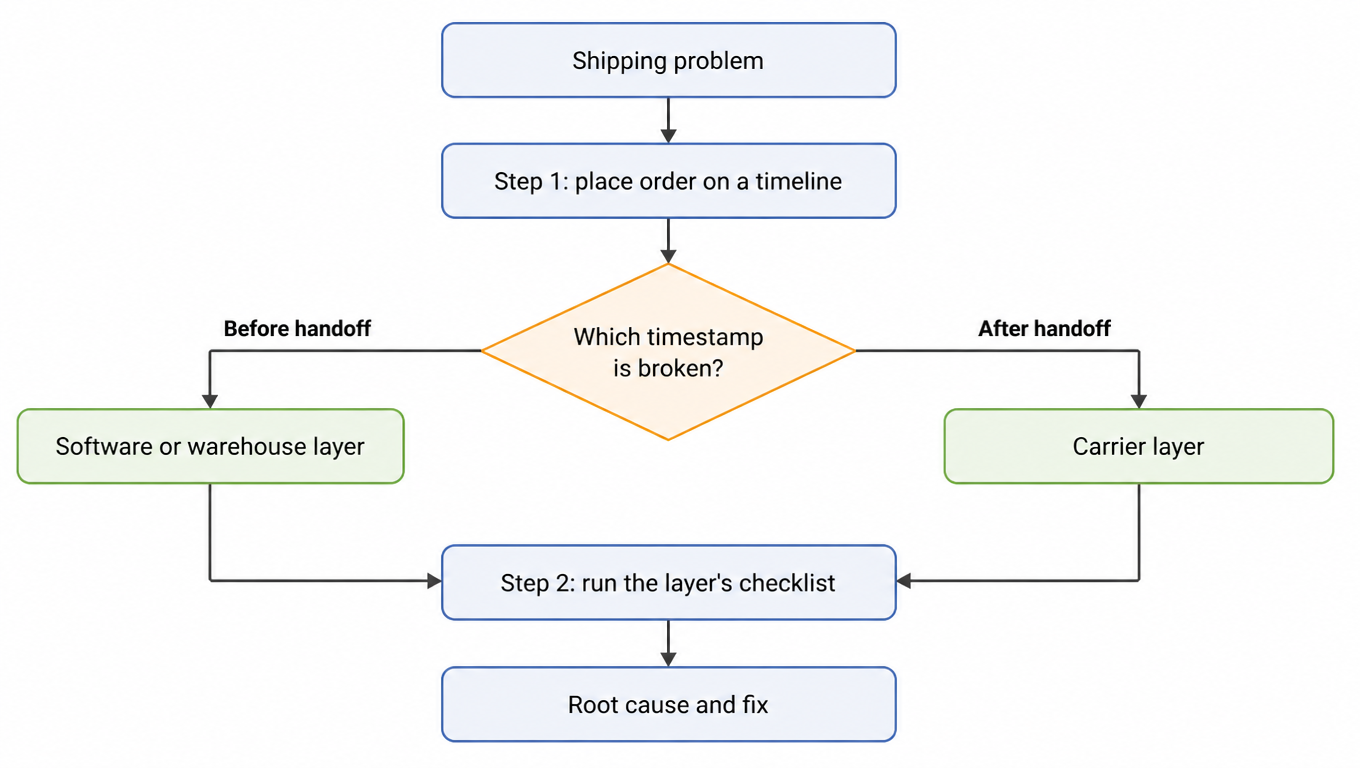
把物流问题当成网络工程师处理故障:先定位是哪一段,再修那一台设备。第一步把受影响的订单放上时间线、找到断掉的时间戳,把问题收窄到三层中的一层;第二步跑该层的自查清单,隔离出根因。两步,不靠猜。Treat a shipping problem the way a network engineer treats an outage: first locate the segment, then repair the device. Step 1 narrows the problem to one of three layers by placing the affected order on a timeline and finding the broken timestamp. Step 2 runs that layer's self-check checklist to isolate the root cause. Two steps, no guessing.

三层很简单。软件层拥有所有数字环节:订单、地址校验、费率报价、面单、追踪号,以及系统之间的数据交接。仓库层拥有交接前的一切实体环节:拣货、打包、扫描纪律、截单处理、库存分配。承运商层拥有交接后的一切:取件、转运扫描、派送、异常。几乎每一件物流问题,指纹都只落在其中一层。The three layers are simple. The software layer owns everything digital: the order, the address validation, the rate quote, the label, the tracking number, and the data handoffs between systems. The warehouse layer owns everything physical before the carrier: picking, packing, scanning discipline, cutoff handling, and inventory allocation. The carrier layer owns everything after handoff: pickup, transit scans, delivery, and exceptions. Almost every shipping problem has a fingerprint in exactly one of them.

整个框架只有一条铁律:永远别猜。把你手上每一个数据源里这单订单的真实数据拉出来,OMS、WMS、承运商 API、公开追踪页,让时间戳指路。靠猜会把三十分钟的诊断变成一个月的小白鼠实验,而你的竞争对手的客户正在为这些实验买单。One rule governs the whole framework: never guess. Pull the order's actual data from every source you have, the OMS, the WMS, the carrier API, the public tracking page, and let the timestamps point. Guessing turns a thirty-minute diagnosis into a month of experiments, and experiments are what your competitors' customers are already paying for.

两步框架流程图:物流问题放到时间线上,根据断掉的时间戳在交接前还是交接后,进入软件/仓库层或承运商层,再跑该层自查清单,最终定位根因并修复Two-step framework flow: place the order on a timeline, split by whether the broken timestamp is before or after handoff into software/warehouse or carrier, run the layer's checklist, reach root cause and fix
断点在哪一层,决定你查哪一层The layer the breakpoint sits in decides which layer you check

第一步:在时间线上定位断点Step 1: Find the Breakpoint on the Timeline

每一单订单都有六个有意义的时间戳:下单、打包、交接承运商、来件扫描、转运中、签收。每一个都有明确归属。「下单」属于软件。「打包」和「交接承运商」属于仓库。「来件扫描」「转运中」「签收」属于承运商。Every order has six meaningful timestamps: placed, packed, handed to carrier, scanned at origin, in transit, and delivered. Each one has a clear owner. "Placed" belongs to the software. "Packed" and "handed to carrier" belong to the warehouse. "Scanned at origin," "in transit," and "delivered" belong to the carrier.

健康的时间线是一串间隔小而可预测的时间戳。断掉的时间线会露出一个缺口:某个时间戳永远不出现,或者远晚于它该出现的时间。两条经验法则搞定大部分情况。第一,一个一直不出现的时间戳,指向本该产生它的那一方:没有来件扫描,说明承运商从没扫过这个包裹;没有交接扫描,说明仓库从没记录这次交接。第二,一个姗姗来迟的时间戳,指向负责它前面那一段的人:如果交接到来件扫描正常要四个小时、这次用了二十六个小时,那承运商的取件和前端网络处理就是嫌疑段。A healthy timeline is a chain of timestamps with small, predictable gaps. A broken timeline shows a gap where a timestamp never arrives, or arrives far later than it should. Two rules of thumb do most of the work. First, a timestamp that never arrives points to the party that should have produced it: no origin scan means the carrier never scanned the package, no handoff scan means the warehouse never recorded the handoff. Second, a timestamp that arrives late points to whoever was responsible for the stretch between the last two timestamps: if the handoff to origin scan normally takes four hours and took twenty-six, the carrier's pickup and early network handling are the suspect segment.

数据从哪来?OMS 给你下单和出单时间戳,WMS 给你打包和交接扫描,承运商 API 和公开追踪页给你取件、转运和派送事件。关键动作是拿同一单订单跨数据源对比,因为不一致就是指纹。如果承运商 API 显示包裹已被物理签收,而 WMS 说它从没被打包,你已经找到那一层了。Where do you get the data? The OMS gives you order and label timestamps. The WMS gives you pack and handoff scans. The carrier API and the public tracking page give you pickup, transit, and delivery events. The key move is to compare the same order across sources, because discrepancies are the fingerprint. If the carrier API shows a package physically accepted but the WMS says it was never packed, you have already found the layer.

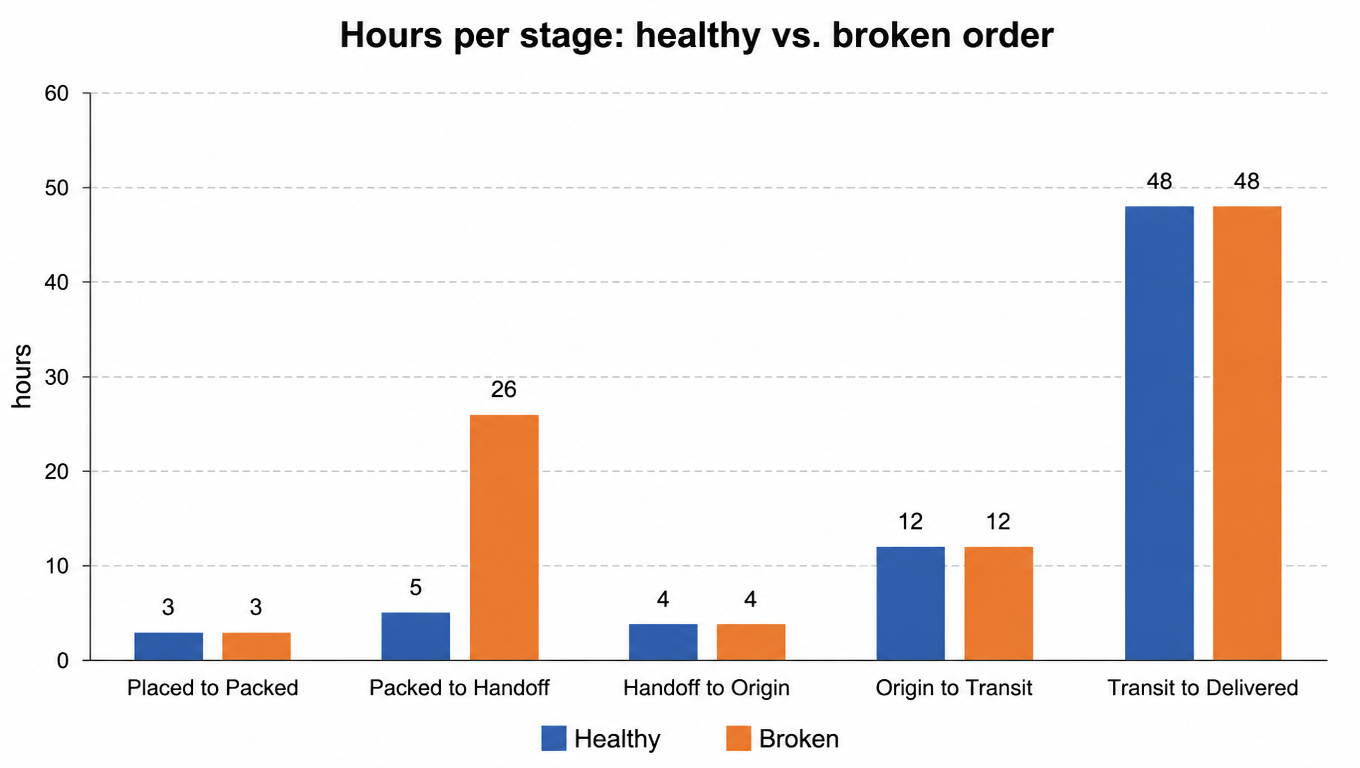
这是一条典型两日线路的健康基线:下单到打包 3 小时,打包到交接 5 小时,交接到来件扫描 4 小时,来件扫描到转运 12 小时,转运到签收 48 小时。现在拿同一线路的一单异常订单对比:下单到打包还是 3 小时,但打包到交接用了 26 小时而不是 5 小时。断点坐在仓库和承运商之间,还没读任何一个异常代码,嫌疑池就已经收窄到两层了。Here is a concrete healthy baseline for a typical two-day lane: placed to packed in 3 hours, packed to handoff in 5 hours, handoff to origin scan in 4 hours, origin to transit in 12 hours, and transit to delivered in 48 hours. Now compare a broken order from the same lane. Placed to packed is still 3 hours, but packed to handoff took 26 hours instead of 5. The breakpoint sits between the warehouse and the carrier, which narrows the suspect pool to two layers before you have even read a single exception code.

各环节耗时对比柱状图:健康订单与异常订单,异常订单在打包到交接环节从 5 小时拉到 26 小时,其余环节一致Bar chart of hours per stage for a healthy vs broken order: the broken order stretches packed-to-handoff from 5 to 26 hours while every other stage matches
同一条线路,只有一段被拉长,断点就在那一段Same lane, one stretch stretched; the breakpoint lives in that stretch

一个提醒:永远不要拿一单下结论。拉十到二十单受影响的订单,看同一个断点是不是反复出现。孤立的一单是噪音,反复出现的模式才是 bug。如果缺口在样本里大多数订单的同一个时间戳出现,那个时间戳就是你的断点。One caution: never diagnose from a single order. Pull ten to twenty affected orders and look for the same breakpoint across all of them. A single outlier is noise, a repeated pattern is a bug. If the gap appears at the same timestamp on most of the sample, that timestamp is your breakpoint.

第二步:隔离软件层Step 2: Isolate the Layer: Software

软件层管结账时的地址校验、费率报价、面单生成、追踪号分配与到承运商 API 的同步,以及告诉仓库该打包什么的 webhook。软件故障是最阴险的一类,因为包裹本身没问题,是包裹周围的数据错了。The software layer owns address validation at checkout, rate quotes, label generation, tracking number assignment and the sync to the carrier API, and the webhooks that tell the warehouse what to pack. Software failures are the sneakiest class because the package itself is fine; the data around it is wrong.

常见故障在不同品牌间反复重演。过期的费率表打出的面单,价格和报价、账单都对不上。用错时区算的截单时间,把订单整批晚一天入批,而仓库其实按时打包了。面单重生成循环造出重复面单,其中一张被取消,追踪号直接作废。webhook 静默失败,仓库根本不知道有这单,包裹一直躺到客户来问。追踪号没同步到承运商 API,你的系统里有这张面单,承运商那边毫无记录。The common failures repeat across brands. Stale rate tables produce labels whose rates differ from the quote and the invoice. Cutoff-time math computed in the wrong timezone batches orders a full day late even though the warehouse packed them on time. Label regeneration loops create duplicate labels and one gets cancelled, killing the tracking number. Silent webhook failures mean the warehouse is never told an order exists, so the package sits until the customer asks. And tracking numbers that never reach the carrier API leave you with a label that exists in your system and no record in the carrier's.

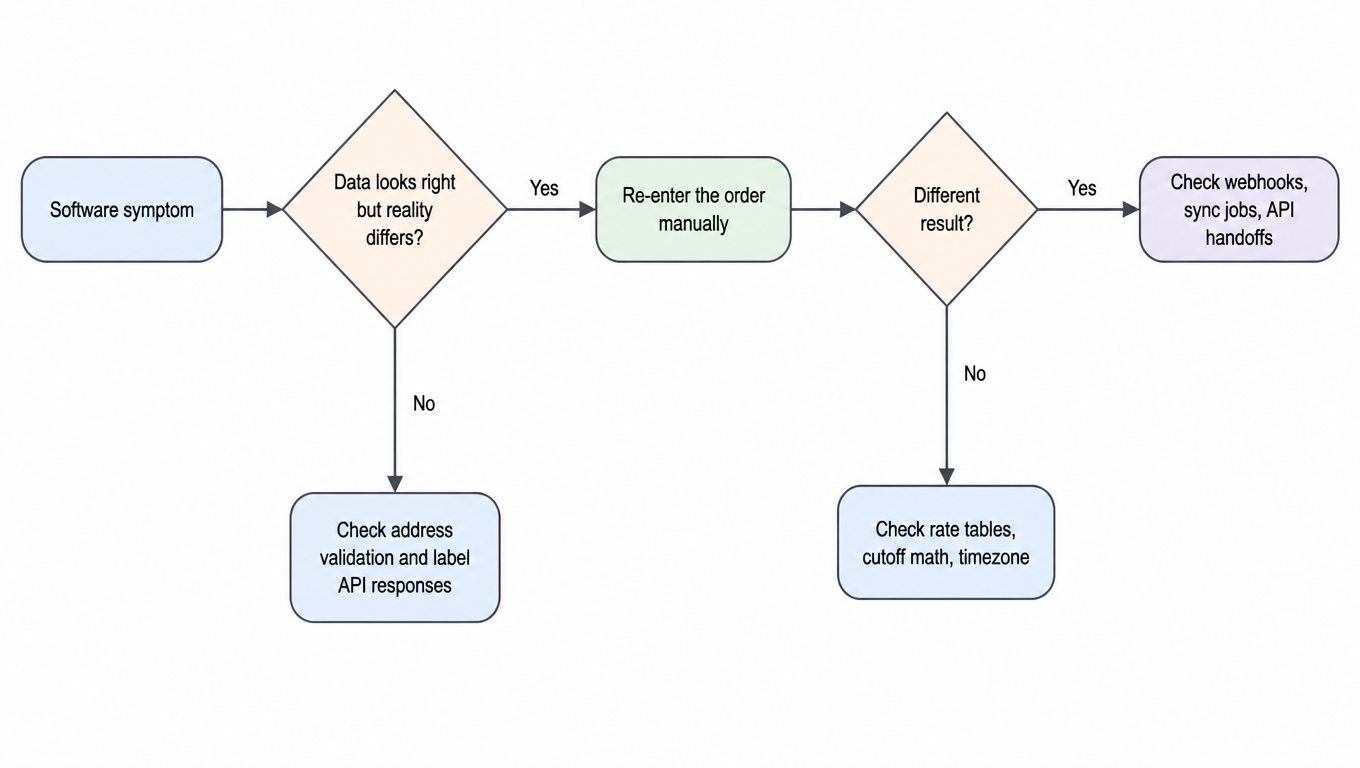
怎么判断是软件?两个信号。第一,数据看着正常但现实对不上:订单、面单、费率在你的后台里一切正常,承运商却查无此件。第二,同一单订单手动重录一遍,表现不一样。如果你把订单手打进承运商门户一切正常,软件层就是嫌疑人,因为你刚刚绕过了它。How do you tell it is software? Two signals. First, the data looks right but reality does not match: the order, label, and rate all look normal in your dashboard, yet the carrier has no record of the package. Second, the same order behaves differently when re-entered manually. If you type the order into the carrier's portal by hand and everything works, the software layer is your suspect, because you just bypassed it.

断点落在交接之前的订单,跑这份清单:Run this checklist for any order whose breakpoint landed before handoff:

  • 把面单上的费率对当前的费率表和最终账单。对不上,指向费率表过期。Compare the rate on the label against the current rate table and the final invoice. A mismatch points to stale tables.
  • 拿一单受影响的订单,在承运商门户里手动重录一遍。表现不同,说明你的软件管线有问题。Re-enter one affected order manually in the carrier portal. Different behavior means your software pipeline is the problem.
  • 把面单生成时间戳对配置的截单时间,注意用仓库时区换算,不是总部时区。Check label generation timestamps against the configured cutoff, converted to the warehouse's timezone, not your headquarters timezone.
  • 在承运商门户里按参考号查这单,确认追踪号真的到了承运商 API。Confirm the tracking number reached the carrier API by looking up the order by reference in the carrier portal.
  • 查 webhook 和同步日志,看受影响订单前后有没有静默失败。Check webhook and sync logs for silent failures around the affected orders.
软件层决策树:数据异常但现实正常时手动重录订单,结果不同则查 webhook 与同步,结果相同则查费率表、截单与时区,数据正常则查地址校验与面单 APISoftware layer decision tree: if data looks right but reality differs, re-enter manually; different result means check webhooks and sync jobs, same result means check rate tables, cutoff math, timezone; otherwise check address validation and label API responses
手动重录是软件层最便宜的探针Manual re-entry is the cheapest probe for the software layer

第二步:隔离仓库层Step 2: Isolate the Layer: Warehouse

仓库层管拣货、打包、扫描纪律、截单处理、库存分配和多仓路由。仓库故障通常伪装成承运商故障,因为客户只看到包裹迟到、追踪变黑,从来看不到打包线。这正是这一层被误诊最多的地方。The warehouse layer owns picking, packing, scanning discipline, cutoff handling, inventory allocation, and multi-warehouse routing. Warehouse failures usually present as carrier failures, because the customer sees a late package or dark tracking and never sees the pack line. That is exactly why this layer gets misdiagnosed the most.

常见故障一旦知道就很好认。漏扫打断追踪链:包裹正常在走,但系统从没记录交接,承运商 API 上露出一个看起来像承运商责任的缺口。截单后打包的批次赶不上当天的取件,平白多出一整天的时效。分配 bug 把订单路由到没有库存的仓,多出一段谁都没预算的调拨运输。旺季人手缺口拉长打包 SLA,却没有任何一个单独可见的错误。The common failures are recognizable once you know them. Missed scans break the tracking chain: the package travels fine, but the system never records the handoff, so the carrier API shows a gap that looks like the carrier's fault. Pack-after-cutoff batches miss the day's pickup and add a full day of transit. Allocation bugs route orders to a warehouse that does not hold the inventory, adding a cross-ship that nobody budgeted for. And staffing gaps at peak stretch the pack SLA without any single visible error.

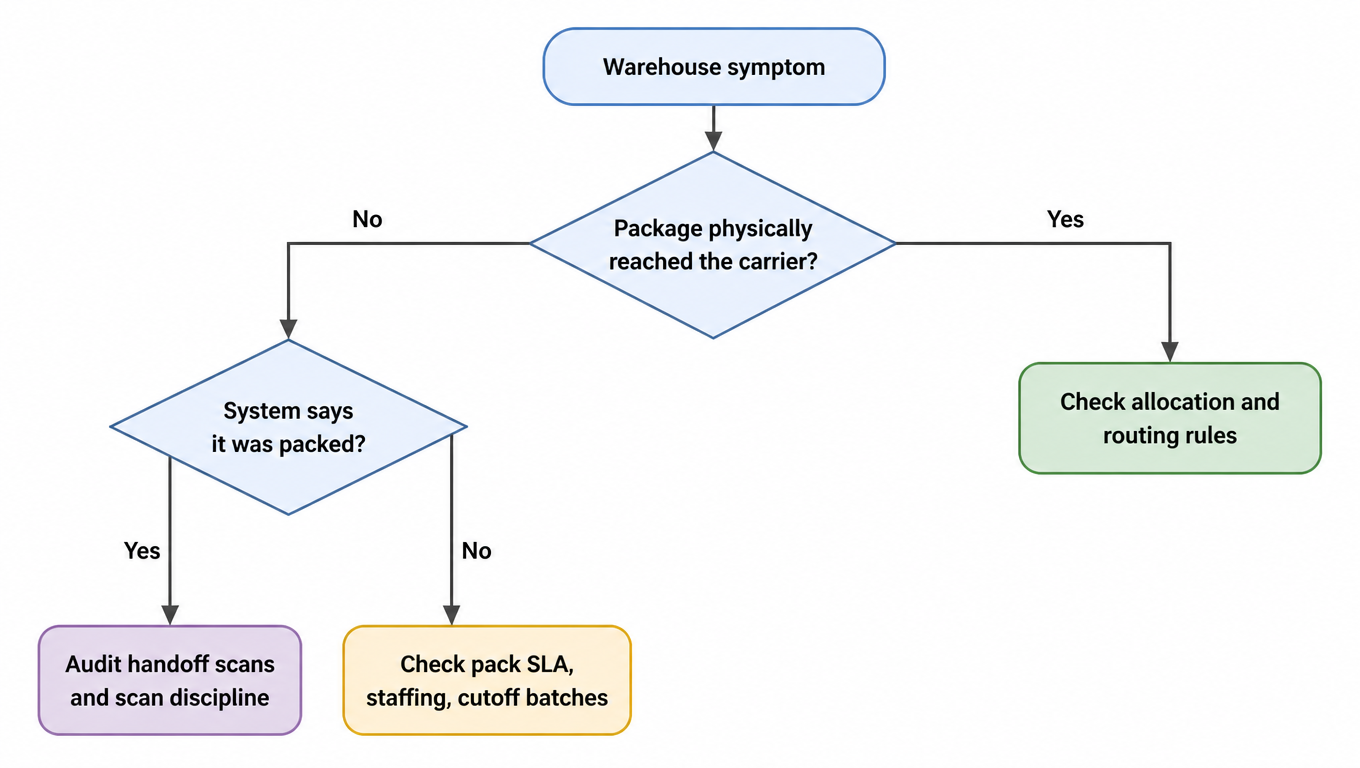
怎么判断是仓库?物理现实和系统互相矛盾。承运商 API 显示包裹已被始发枢纽签收,WMS 却显示它从没被打包,这个矛盾只可能来自仓库层。第二,故障成簇:同一个断点在同一个班次、同一个打包工位、同一批条码上反复出现。成簇是流程问题,不是运气差。How do you tell it is the warehouse? Physical reality contradicts the system. The carrier API shows a package accepted at the origin hub, but the WMS says it was never packed; that contradiction can only come from the warehouse layer. Second, failures cluster: the same breakpoint on the same shift, the same pack station, or the same batch of barcodes. A cluster is a process problem, not bad luck.

断点落在交接或交接之前的订单,跑这份清单:Run this checklist for any order whose breakpoint landed at or before handoff:

  • 每一单受影响的订单都有打包时间戳吗?拉当班次的扫描率报告。Does a pack timestamp exist for every affected order? Pull the scan-rate report for the shift in question.
  • 交接扫描是否在打包时间戳之后、你的 SLA 之内?健康间隔是几个小时。Was the handoff scan recorded within your SLA of the pack timestamp? A healthy gap is a couple of hours.
  • 订单分配到的仓库,真的有这批库存吗?查分配规则和库位数据。Was the order allocated to the warehouse that actually holds the inventory? Check the allocation rules and the bin data.
  • 这批货赶上取件了吗?把批次关闭时间对承运商的实际取件时间。Did the batch make the pickup? Compare the batch close time against the carrier's actual pickup time.
  • 故障是不是围绕同一个班次、工位或面单批次成簇?成簇告诉你先查哪里。Do the failures cluster around a shift, a station, or a label batch? A cluster tells you where to look first.
仓库层决策树:包裹没到承运商手里时,系统显示已打包则审计交接扫描,未打包则查打包 SLA 与排班;包裹到了承运商手里则查库存分配与路由规则Warehouse layer decision tree: if the package did not physically reach the carrier, audit handoff scans when the system says packed, check pack SLA and staffing when not; if it did reach the carrier, check allocation and routing rules
物理现实和系统矛盾,就是仓库层的指纹A contradiction between physical reality and the system is the warehouse layer's fingerprint

第二步:隔离承运商层Step 2: Isolate the Layer: Carrier

承运商层管取件安排、服务等级与承诺时效的匹配、网络事件、派送异常、破损和丢件。它是最后一个该被怪罪的,却总是第一个被怪罪,所以必须用数据证明,而不是用假设定罪。The carrier layer owns the pickup schedule, the service level versus the promised transit time, network events, delivery exceptions, damage, and loss. It is the last layer to blame and the first to be blamed, so you must prove it with data rather than assumption.

常见故障是客服团队早就烂熟于心的那些。取件被跳过或迟到,悄悄多出一天时效。服务降级,两日承诺的货走了地面。天气和网络中断拖垮整个区域。误扫把包裹送到错误的目的地枢纽。派送到错误地址,还附上一张无比自信的错误门廊派送照片。The common failures are the ones customer support already knows by heart. Skipped or late pickups that silently add a day. Service downgrades where a two-day promise ships ground. Weather and network disruptions that stall whole regions. Mis-scans that move a package to the wrong destination hub. And delivery to the wrong address, complete with a confident delivery photo of the wrong doorstep.

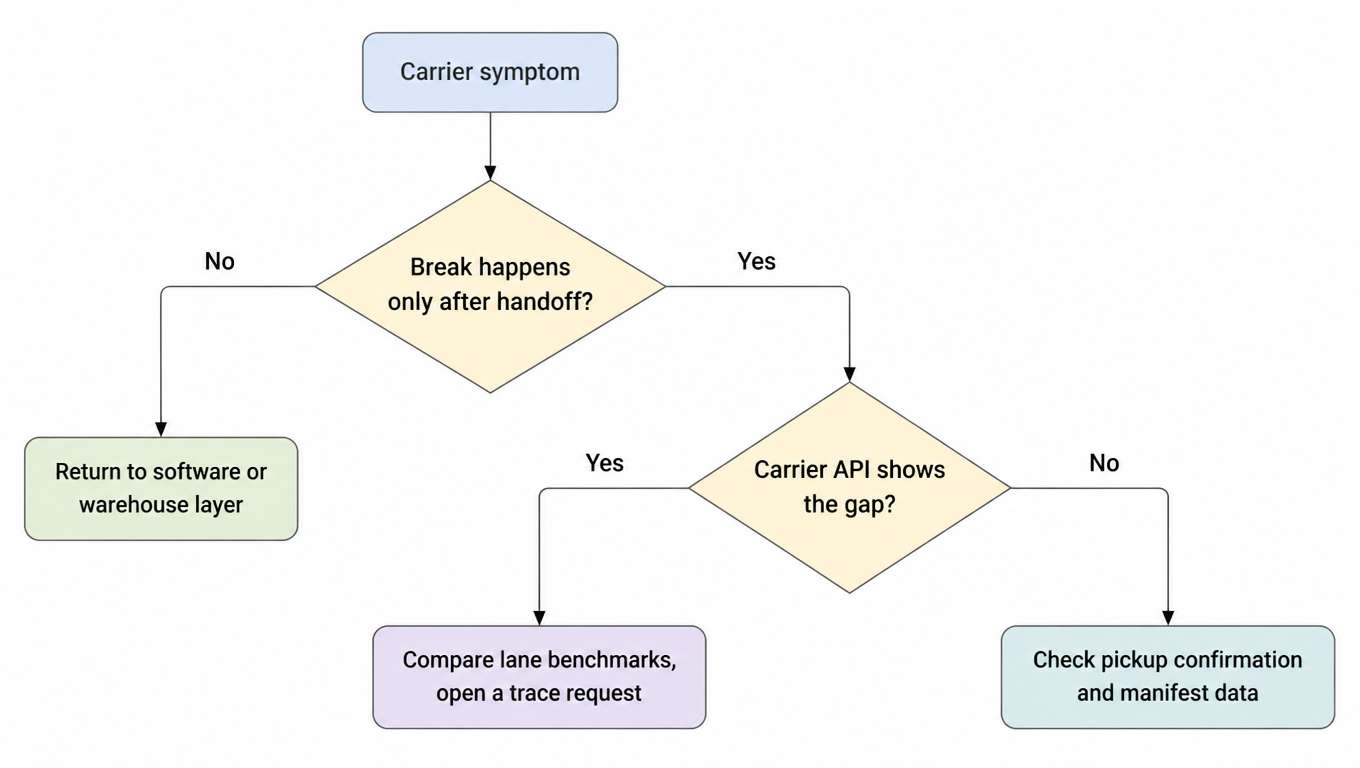
怎么判断是承运商?时间线只在交接之后断,而且承运商自己的 API 显示了这个缺口。包裹有了来件扫描,然后三十小时没有任何动静,而你的仓库时间戳全部健康,这一段就是承运商的。第二个交叉验证是跨承运商对比:拿同一条线路用第二家承运商跑一个月。如果两家都慢,问题在线路本身或者你买的服务等级,而不是某一家承运商。How do you tell it is the carrier? The timeline breaks only after handoff, and the carrier's own API shows the gap. If the package was scanned at origin and then nothing for thirty hours while the warehouse timestamps are all healthy, the carrier owns that stretch. A second check is cross-carrier comparison: run the same lane with a second carrier for a month. If both are slow, the problem is the lane or the service level you bought, not the specific carrier.

承运商开放的数据通常够用:取件确认、扫描事件流、异常代码、派送照片。打电话之前,把受影响订单的这些数据全部拉出来,和你的时间戳排在一起。The data carriers expose is usually enough on its own: pickup confirmation, a scan event feed, exception codes, and the delivery photo. Pull all of them for the affected orders and line them up against your own timestamps before you call anyone.

断点落在交接之后的订单,跑这份清单:Run this checklist for any order whose breakpoint landed after handoff:

  • 受影响的批次有取件确认吗?没有,或者来晚了,指向取件流程。Does a pickup confirmation exist for the affected batch? No confirmation, or a late one, points at the pickup process.
  • 追踪链断在哪?承运商 API 在这个点之后还有没有扫描?Where does the tracking chain stop, and does the carrier API show any scan after that point?
  • 异常代码说了什么?天气、地址问题、清关扣留、派送异常,各自的归属方不同。What does the exception code say? Weather, address issue, customs hold, and delivery exception each have different owners.
  • 面单上打印的服务等级,是客户被承诺的那个吗?降级是面单问题,不是网络问题。Is the service level printed on the label the one the customer was promised? A downgrade is a label problem, not a network problem.
  • 这家承运商在这条线路上最近一个月的准时表现,和第二家比怎么样?How does this carrier's on-time performance on this lane compare with a second carrier's over the last month?
承运商层决策树:只在交接后断链时,承运商 API 显示断档则对比线路基准并发起 trace,无断档则查取件确认与清单数据;交接前就断链则回到软件层或仓库层Carrier layer decision tree: if the break happens only after handoff and the carrier API shows the gap, compare lane benchmarks and open a trace; if the API shows no gap, check pickup confirmation and manifest data; if the break starts before handoff, return to the software or warehouse layer
承运商要有罪,先让它的 API 作证For the carrier to be guilty, let its own API testify first

三个真实诊断案例Three Real-World Diagnoses

看着框架跑起来,你会更容易信任它。下面三个案例做了匿名化处理,但都是真的,而且每一个都遵循同样的形状:症状、时间线、定位层、根因、修复、教训。The framework is easier to trust after you have watched it work. These three cases are anonymized but real, and each one follows the same shape: symptom, timeline, layer, root cause, fix, lesson.

案例 1:看起来像承运商责任的延误。Case 1: the delay that looked like the carrier's fault.一个 DTC 品牌的准时率三周内从 96% 掉到 81%。时间线显示打包时间戳全部在 SLA 内,但打包到交接从 5 小时拉长到 26 小时。定位层是软件,因为断点坐在打包扫描和清单之间。根因是一个截单 bug:发货软件的截单字段配置为下午 4 点,却按 UTC 存储和比较。对太平洋时区的仓库来说,UTC 下午 4 点是本地早上 8 点,所以上午过半之后每一单都被划进「明天的批次」,等一整天才有面单。修复是一行时区修正,一周内准时率恢复。教训:截单计算属于软件层,而一个时区 bug 穿着承运商的制服。A DTC brand's on-time delivery dropped from 96 percent to 81 percent over three weeks. The timeline showed pack timestamps within SLA across the board, but packed to handoff stretched from 5 hours to 26. The layer was the software, because the breakpoint sat between the pack scan and the manifest. The root cause was a cutoff bug: the shipping software's cutoff field was configured as 4:00 PM but stored and compared in UTC. For the warehouse on Pacific time, 4:00 PM UTC is 8:00 AM local, so by mid-morning every order fell into "tomorrow's batch" and waited a full day for a label. The fix was a one-line timezone correction, and on-time delivery recovered within a week. The lesson: cutoff math belongs to the software layer, and a timezone bug wears a carrier's uniform.

案例 2:取件后追踪变黑。Case 2: tracking that went dark after pickup.一个卖家的追踪显示「已取件」,然后 36 小时毫无动静,直到一条签收扫描出现。时间线显示来件扫描在、签收扫描在,中间唯独没有交接扫描。定位层是仓库。根因:品牌换了一批新面单,条码格式 WMS 扫描枪读不出来,交接扫描被静默跳过。承运商始终没对上清单,枢纽一天半之后才手工重处理这批货。修复是升级扫描枪固件、一次性补扫,并给任何扫描率下降加告警。教训:交接扫描是仓库和承运商之间的数据契约。它断了,追踪就变黑,哪怕承运商完全无辜。A seller's tracking showed "picked up" and then nothing for 36 hours, before a delivery scan appeared. The timeline showed the origin scan present and the delivery scan present, with no handoff scan in between. The layer was the warehouse. The root cause: the brand had switched to a new label batch whose barcode format the WMS scanners could not read, so handoff scans were silently skipped. The carrier never matched the manifest, and its hub had to reprocess the batch by hand a day and a half later. The fix was a scanner firmware update, a one-time rescan, and an alert on any drop in the scan rate. The lesson: the handoff scan is the data contract between the warehouse and the carrier. When it breaks, tracking goes dark even though the carrier is blameless.

案例 3:运费账单跳涨 22%。Case 3: the freight bill that jumped 22 percent.一个品牌看到月度运费账单飙升,费率却没变。这里的时间线不讲延误,讲重量:整条新产品线,面单重量和计费重量差了 1.8 倍。定位层是仓库,在打包工位。根因:新产品更轻,打包团队却继续用旧的大箱子,承运商在枢纽用体积测量仪重测了体积重。面单带着实际重量,账单带着体积重。修复是换合适的箱子、修正面单尺寸,并加一份每周面单对账单重量差异报告。教训:成本问题藏在尺寸数据里,不在费率表里,而一份差异报告能在账单惊吓之前几周就抓住它。A brand saw its monthly freight bill spike while rates were unchanged. The timeline here is not about delay but about weight: the label weight and the billed weight differed by 1.8 times on the entire new product line. The layer was the warehouse, at the pack station. The root cause: the new product was lighter, but the pack team kept using the old oversized box, and the carrier's dimensioner re-measured dimensional weight at the hub. The label carried the actual weight; the invoice carried the dimensional weight. The fix was right-sizing the box, correcting the dimensions on the label, and adding a weekly label-versus-invoice weight variance report. The lesson: cost problems hide in the dimension data, not the rate sheet, and a variance report catches them weeks before invoice shock does.

从诊断到预防:建立监控习惯From Diagnosis to Prevention: Build the Monitoring Habit

只在事故发生时拿出来用的框架,是一支灭火器。最后一步是把它变成习惯,让事故本身变少。A framework you only run during incidents is a fire extinguisher. The last step is turning it into a habit so the incidents get rarer.

先建一张每周 SLA 看板。盯三个数:准时率、追踪断档率(超过 24 小时没有扫描的订单占比)、异常率,每一个都按层拆解。每周三十分钟,把事故变成趋势,而趋势会在事故到来之前告诉你下一个事故会从哪来。Start with a weekly SLA dashboard. Track three numbers: on-time rate, tracking gap rate (orders with no scan for more than 24 hours), and exception rate, each broken down by layer. Thirty minutes a week turns incidents into trends, and trends tell you where the next incident will come from before it arrives.

设好在客户投诉之前就响的告警:到计划取件时间没有取件确认、24 小时没有扫描、高价值订单出现派送异常。先告警,再退款。大多数客户只是想让你知道你已经注意到了,一条主动的消息胜过一张退款回执。Set alerts that fire before customers complain: no pickup confirmation by the scheduled pickup time, no scan for 24 hours, a delivery exception on a high-value order. Alert on the exception first, refund later. Most customers only want to know that you noticed, and a proactive message beats a refund receipt every time.

在看板旁边放审计日志和变更控制,因为上个月修好的问题会悄悄复发。有人回滚了一个配置、一个供应商更新了 API、仓库经理改了排班,你修好的指标又爬回去了。当某个数字回退时,先 diff 变更记录;回退通常是你自己已经做过的某个改动。Keep audit logs and change control next to the dashboard, because the fix that worked last month can silently regress. Someone reverts a configuration, a vendor updates an API, a warehouse manager changes a shift pattern, and the metric you fixed creeps back. When a number regresses, diff the changes first; the regression is usually a change you already made.

在需要之前就摸清升级路径。承运商问题,在承运商的申诉窗口内开案,附上你的时间线证据,窗口关得很快。软件问题,用手动重录测试复现 bug,把准确的订单和时间戳交给供应商。仓库问题,带着扫描率报告找你的 3PL 客户经理,如果纪律没有改善,重新谈 SLA 或者迁移货量。Know your escalation paths before you need them. For carrier issues, open a claim inside the carrier's filing window and attach your timeline evidence; the window closes fast. For software issues, reproduce the bug with the manual re-entry test and hand your vendor the exact order and timestamp. For warehouse issues, escalate through your 3PL account manager with the scan-rate report in hand, and renegotiate the SLA or move volume if discipline does not improve.

最后,给仓库运营者的镜像视角。当你成为被指控的一方,把同一套框架倒过来跑:拉你的扫描日志和交接时间戳,精确展示你的流程在哪里结束、承运商的流程从哪里开始。用数据辩护:准时打包率、扫描率、清单匹配率。框架双向可用,最后拍板的是数据,不是嗓门最大的人。Finally, the mirror view for warehouse operators. When you are the accused party, run the same framework in reverse: pull your scan logs and handoff timestamps, and show exactly where your process ended and the carrier's began. Defend with data: on-time pack rate, scan rate, and manifest matching. The framework works in both directions, and the data decides, not the loudest voice.

下次订单延误,别问是哪家承运商,问是哪个时间戳。时间戳指向层,层指向修复。The next time an order is late, do not ask "which carrier." Ask "which timestamp." The timestamp points to the layer, and the layer points to the fix.

常见问题FAQ

把订单放上时间线。六个时间戳(下单、打包、交接承运商、来件扫描、转运中、签收)各有归属:一个一直不出现的时间戳,指向本该产生它的那一方;一个姗姗来迟的时间戳,指向两个时间戳之间负责的那一段。然后再跑那一层的自查清单。断点是指纹,不是观点。Place the order on a timeline. Each of the six timestamps (placed, packed, handed to carrier, origin scan, in transit, delivered) has an owner. A timestamp that never arrives points at the party that should have produced it; a timestamp that arrives late points at whoever was responsible for the stretch between the two timestamps. Then run that layer's checklist. The breakpoint is a fingerprint, not an opinion.
因为断点可能根本不在承运商。如果面单生成器弄坏了追踪号,或者打包团队漏扫,新承运商继承的是同一套坏输入。先跑时间线方法:如果断掉的时间戳在交接之前,修复在你的软件或仓库里,换承运商没用。Because the breakpoint may not live in the carrier. If a label generator mangles tracking numbers or the pack team skips scans, the new carrier inherits the exact same broken inputs. Run the timeline method first: if the broken timestamp sits before handoff, the fix is in your software or warehouse, and no carrier change will help.
不一定。追踪断档有三个常见归属:仓库漏扫交接(包裹正常在走,但系统没记录交接)、软件同步静默失败(追踪号根本没到承运商 API)、或者承运商网络真的断档。下结论之前,交叉核对 WMS 扫描日志、承运商 API 和你的面单时间戳。No. Tracking gaps have three common owners: a missed handoff scan in the warehouse (the package travels fine but the system never records the handoff), a silent sync failure in the software (the tracking number never reached the carrier API), or a real network gap at the carrier. Cross-check the WMS scan log, the carrier API, and your label timestamps before assigning blame.
拉十到二十单受影响的订单,绝不要只看一单。一个孤立异常是噪音,反复出现的模式才是 bug。如果同一缺口在样本里大多数订单的同一个时间戳出现,那个时间戳就是断点,修复方向随之变得明显。Ten to twenty affected orders, never one. A single outlier is noise; a repeated pattern is a bug. If the same gap appears at the same timestamp across most of the sample, that timestamp is your breakpoint and the fix becomes obvious.
事件诊断是被动的,监控才是习惯。每周跑一次 SLA 看板:准时率、追踪断档率、异常率,按层拆解;再设好抢在客户投诉之前的告警:到取件时间没有取件确认、24 小时没有扫描、高价值订单出现派送异常。每周三十分钟,把事故变成趋势。Incident diagnosis is reactive; monitoring is the habit. Run a weekly SLA dashboard tracking on-time rate, tracking-gap rate, and exception rate by layer, and set alerts that fire before customers complain: no pickup confirmation by pickup time, no scan for 24 hours, a delivery exception on a high-value order. Thirty minutes a week turns incidents into trends.
技术上可能,但诊断时不要把“系统允许生成事件”和“操作符合规则”混为一谈。免签包裹投放到获准位置后即可扫描,不需要当面交给收件人;若扫描早于实际投放,或地理位置不在目的地,就是提前或错误扫描。USPS 要求在实际送达点完成终止计时扫描,USPS 监察长办公室也记录过在投递局内生成的错误送达扫描。先排除时区显示、通知延迟和家人代收,再调取原始事件类型、设备时间、扫描坐标、照片或签名以及派送路线记录。公开追踪页的一行“已送达”只是线索,不是完整交接证据。Technically yes, but diagnosis must separate “the system accepted an event” from “the operation followed policy.” A signature-released parcel can be scanned after it is left at an authorized location; no face-to-face handoff is required. A scan made before the actual drop or away from the destination is premature or improper. USPS requires stop-the-clock scans at the delivery point, and the USPS Office of Inspector General has documented improper delivery-unit scans. Rule out time-zone display, notification lag, and household receipt, then obtain the raw event type, device time, scan geolocation, photo or signature, and route record. One “delivered” line on the public page is a clue, not a complete handoff record.
因为清单关闭、批量接受和单件实物交接是不同事件。发货系统完成日结或上传电子清单后,标签可以进入“已生成清单”状态;以 USPS 为例,一张批量交接表单的主条码可关联多票标签,扫描主条码会为每个关联标签生成接受事件,具体机制见 USPS 批量交接表单说明。如果纸箱漏装、仍在打包台,或者标签被错误纳入清单,它就可能有批量事件,却没有完成实物交接。按四层日志核对:清单版本及标签列表、仓库最后一次单件扫描、笼车或拖车装载与取件交接记录、承运商后续单件来件或处理中心扫描。最后一项通常才是实物进入网络的强证据。Because manifest closeout, batch acceptance, and item-level physical handoff are different events. A shipping system may mark a label manifested after end-of-day closeout or electronic transmission. With USPS, one SCAN Form master barcode links many labels, and its scan creates an acceptance event for each linked label, according to the USPS SCAN Forms documentation. A carton omitted from the cage, left at a pack station, or linked by mistake can therefore have the batch event without physical induction. Reconcile four logs: manifest version and label list, the last item-level warehouse scan, cage or trailer loading and pickup receipt, and the carrier's later item-level origin or facility scan. That last event is usually the strongest evidence of entry into the physical network.
建立一条同时包含承运商事件和现场事件的分钟级时间线。扫描坐标在投递局或错误地址、照片不是本门牌、签名不符,而且门铃录像在扫描前后连续显示司机从未到达,支持“虚假扫描或错投”。照片与地址和包裹相符、扫描时间地点合理,门铃或门禁先记录司机投放、之后又记录另一人拿走,才支持“送达后失窃”。照片、签名、坐标都不是单独定案的证据;还要核对通知延迟、设备时区、共用收发室和家庭成员代收。缺少投放或拿走的关键证据时,把根因标为“未能确定”,继续调查,不要为了结案硬分责任。Build a minute-level timeline containing both carrier and premises events. A scan at the delivery unit or wrong address, a different doorway in the photo, a mismatched signer, and continuous doorbell video showing no driver support a phantom scan or misdelivery. Theft after delivery is supported when the image matches the address and parcel, the scan time and place cohere, and video or access logs first show the driver depositing it and then another person removing it. Photo, signature, and geolocation are not independently conclusive; also check notification latency, device time zone, shared mailroom receipt, and household pickup. If the chain lacks proof of the drop or removal, code the root cause as undetermined and keep investigating.
Get Rate Comparison
Get Rate Comparison