Pick and Pack Fulfillment

Pick and Pack Fulfillment: What Online Sellers Need to Know

Every online order ends in the same place: a warehouse worker walks to a shelf, scans an item, drops it into a tote, and later a box full of that order lands on a customer's doorstep. That two-step operation, picking and packing, is the quiet core of ecommerce fulfillment. This guide walks you through what pick and pack fulfillment is, how it works inside a warehouse, how 3PLs price it, and how to decide whether to buy the service or build the capability yourself. The first half is written for sellers who are new to outsourcing; the second half goes deeper for sellers who are already comparing 3PLs and want to negotiate like an operator.

This guide is written for 3PL and overseas warehouse operators too: the picking, packing, and labeling you do every day is a black box to your clients. When the black box is opened and explained, clients trust you with their inventory and pay for quality. Whichever side you sit on, you will be able to speak the same language of metrics after reading it.

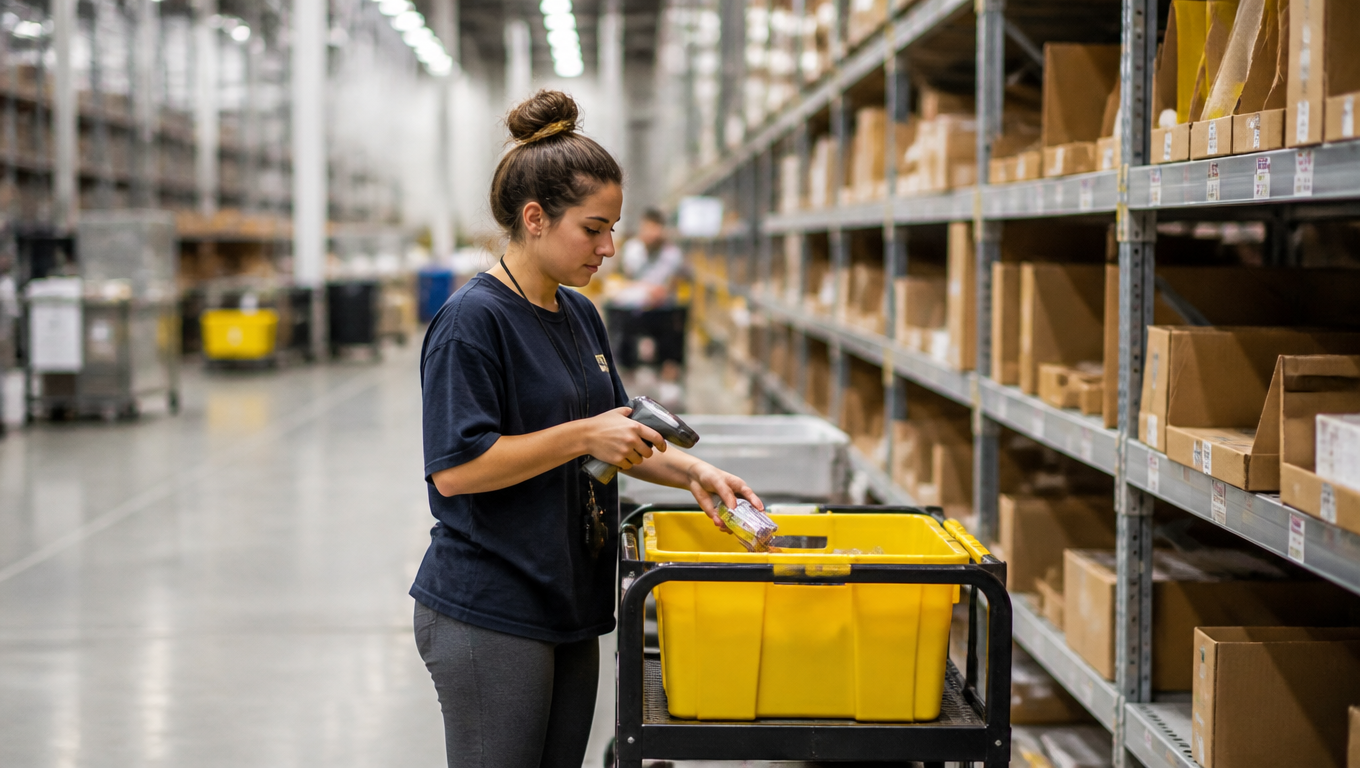
Warehouse picker places scanned items into a yellow tote beside stocked shelves.
Picking and packing is where an order goes from data to a physical parcel

What Is Pick and Pack Fulfillment?

Pick and pack is the warehouse process of retrieving the exact items a customer ordered from storage, then packing them into a shipment. It sits in the middle of the fulfillment chain: receiving, storage, picking, packing, and shipping. Everything before picking is about getting inventory in and keeping it organized; everything after packing is about getting the box out the door. The pick and pack step is where an order goes from data to a physical parcel, which is why it carries most of the accuracy risk in the whole chain.

Pick and pack is distinct from the two alternatives sellers usually compare it against. Drop shipping means you never hold inventory at all: a supplier receives your order and ships it directly to your customer, and you pay per order. Self-fulfillment means you do the picking and packing yourself, in your garage, office, or a rented unit. Pick and pack fulfillment through a 3PL sits between the two: you keep ownership of your inventory, but a warehouse operator does the physical work of storing, picking, packing, and shipping it for you.

The customers of pick and pack services are diverse: DTC brands shipping from their own storefronts, marketplace sellers on Amazon, eBay, and Etsy, subscription box companies, and crowdfunded products that suddenly need to ship thousands of units. The reason it matters to all of them is the same: the parcel is often the only physical thing a customer ever touches. Pick accuracy and dispatch speed directly shape reviews, return rates, and whether that customer orders again.
How Pick and Pack Works Inside a Warehouse

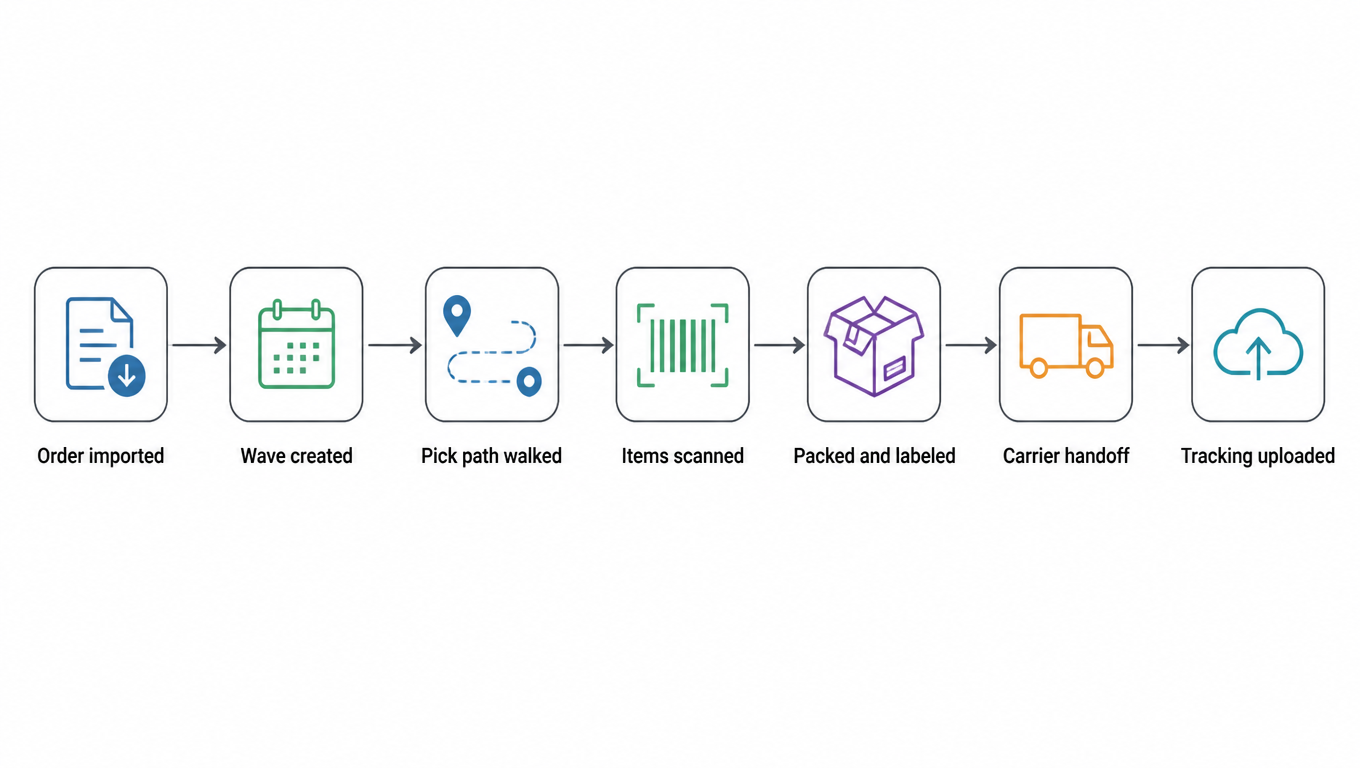
A pick and pack operation follows a repeatable flow. The order enters through an integration with your sales channel, the warehouse management system (WMS) assigns it to a picking wave, a worker walks a pick path and confirms every item with a barcode scan, the items move to a pack station, get boxed with dunnage and labels, and are handed to a carrier. Each step is logged in the WMS, so the entire journey is traceable.

Pick and pack flow: order imported, wave created, pick path walked, items scanned, packed and labeled, carrier handoff, tracking uploaded
The full flow of an order, from import to tracking upload

Warehouses differ in how they organize the picking step. In zone picking, each worker stays in one area and picks only the items assigned to that zone; in zone-to-zone picking, the tote travels between zones until the order is complete. Single-order picking means one worker completes one order at a time, while batch or multi-order picking groups several orders into one walk so a worker picks, say, twelve orders in a single pass and sorts the items later. Batch picking is more efficient for high volumes of small orders, which is why most modern warehouses use it.

The pack station is where accuracy and presentation meet. The worker selects the right box size, adds dunnage so nothing rattles or breaks, includes inserts such as flyers, samples, or branded packing slips, and applies the shipping label. Some sellers treat this as a marketing moment: a well-packed box with a thank-you note drives unboxing photos and repeat purchases. On the shipping side, the warehouse rate-shops across carriers or follows your routing rules, prints the label, and uploads the tracking number back to your platform so the customer sees a real delivery date.

Timing is governed by cut-off times and service level agreements (SLAs). A common setup is "orders by 3 PM ship the same day", with a dispatch SLA of 24 or 48 hours for slower tiers. Transit time then depends on the carrier and the distance between warehouse and customer, which is why warehouse location matters as much as the picking itself.

Pick and Pack Pricing: How 3PLs Charge

The core of a 3PL quote is the pick and pack fee, usually quoted per order, per line, or per unit. A per-order fee covers the labor and materials for the first item; extra lines or units add per-line or per-unit charges on top. Some 3PLs bundle everything into a single per-order price, others unbundle every step, so comparing quotes means comparing the same activity, not just the headline number.

Storage and receiving are charged separately. Storage is billed monthly, typically per cubic foot or per pallet position, and seasonal spikes in your inventory will raise the bill. Receiving covers the work of checking in your inbound shipment: per pallet, per carton, or per SKU, and sometimes per hour for unusual freight. Value-added services (VAS) such as kitting, custom labeling, inserts, gift wrapping, and returns processing are quoted per unit or per hour.

Then come the charges nobody puts on the front page: monthly minimums, long-term storage fees for inventory that sits too long, reconfiguration when you change SKUs or layouts, address correction fees when your customer data is dirty, and pick and pack surcharges for oversized or fragile items. Ask for a full fee schedule before signing, and model your bill at your actual order mix, not at the demo volume in the sales deck.

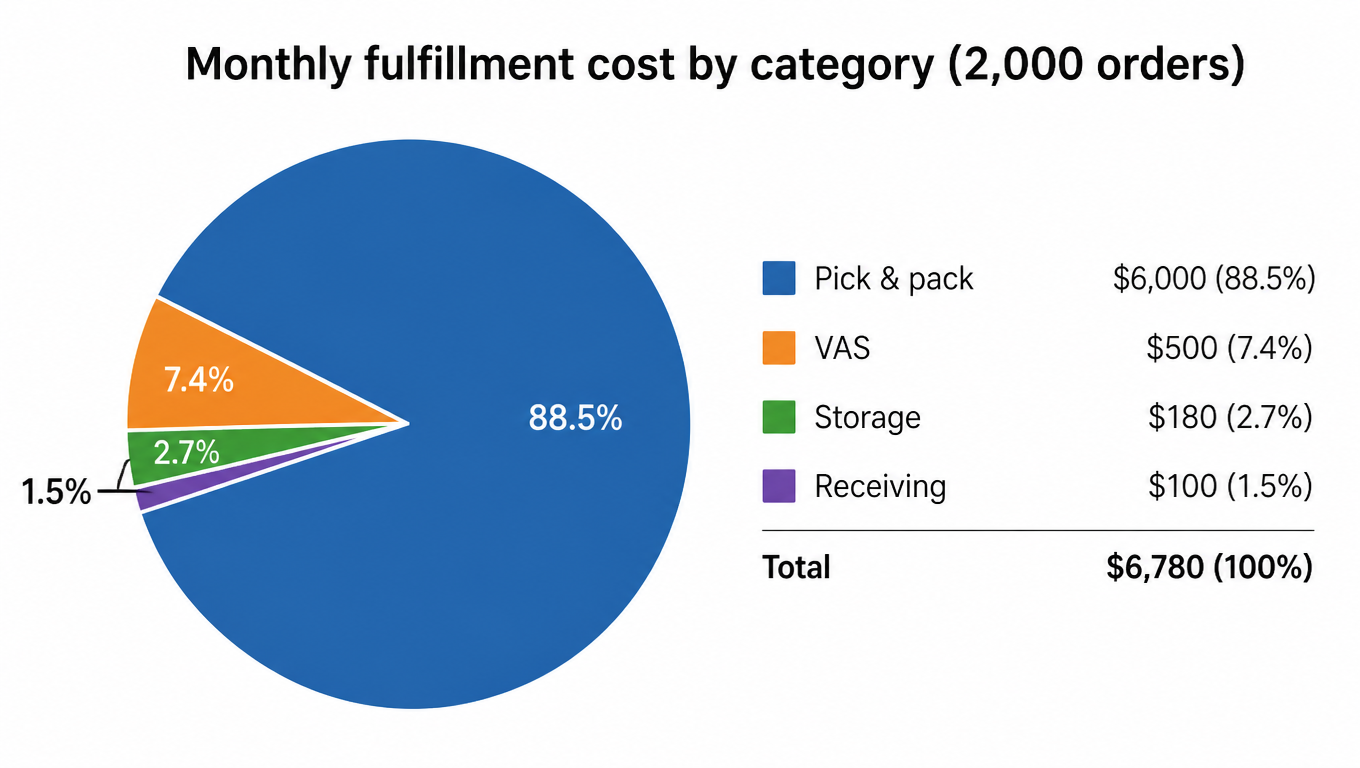
Here is a realistic worked example for a mid-size seller shipping 2,000 orders per month with an average of 1.8 units per order. The 3PL quotes $3.00 per order for pick and pack (market range is roughly $2 to $5), $0.45 per cubic foot per month for storage of 400 cubic feet, $25 per pallet for receiving 4 pallets, and $0.25 per order for inserts and custom packing slips. That gives $6,000 in pick and pack, $180 in storage, $100 in receiving, and $500 in VAS, for a total of about $6,780 per month, or roughly $3.39 per order all-in.

Monthly fulfillment cost pie chart: pick and pack $6,000, VAS $500, storage $180, receiving $100 (2,000 orders)
Pick and pack usually dominates the monthly fulfillment bill

The KPIs That Matter

Pick accuracy is the number to watch first: the share of orders shipped without errors such as the wrong item, wrong quantity, damaged goods, or a missing insert. Good 3PLs run between 99.5% and 99.9% accuracy. Because the difference between 99.5% and 99.9% is only visible in the complaint queue, ask for the raw error count per month, not just the percentage.

On-time dispatch measures the share of orders shipped within the agreed SLA window, which is a direct test of whether the warehouse honors your cut-off times. Inventory accuracy compares what the system says you have with what a physical count finds; the standard tool is the cycle count, where a subset of SKUs is counted every week instead of a full annual inventory. Shrinkage and damage rates round out the picture, since they quietly eat margin.

Productivity metrics such as picks per hour and orders per labor hour matter less to you directly, but they explain the price you pay: a more productive warehouse turns over labor faster and quotes lower per-order fees. When you review a monthly scorecard, look for trend lines rather than single months, and negotiate the right to an annual audit where you walk the floor, watch a pick wave, and reconcile your own inventory counts.

Choosing a 3PL: Questions to Ask

Integration comes first. The 3PL should natively integrate with your sales channels: Shopify, Amazon, eBay, WooCommerce, or whichever stack you run, plus an API for anything custom. Ask how long onboarding takes, whether there is a test mode, and whether order, inventory, and tracking data flow both ways in near real time.

Location strategy is the second filter. Warehouses should sit near your customers so transit zones stay short; a seller whose buyers cluster on the West Coast gets little value from an East Coast warehouse. Location also creates sales tax nexus in states where the warehouse operates, so the tax conversation belongs in the evaluation, not in the surprise after the first filing.

SLAs and contract terms deserve a lawyer's eye. Push for dispatch windows, accuracy guarantees, and remedy clauses that spell out what happens when the 3PL misses them, such as crediting the pick and pack fee on affected orders. Watch for auto-renewal clauses, exit fees, minimum volume commitments that outlive your actual volume, and storage release timing that forces you to ship everything out before you can leave.

Finally, do a site visit or a live video walkthrough. Check cleanliness, aisle width, how picking waves are organized, and whether workers have proper equipment and breaks. Ask to see a live dashboard, not a polished slide deck, and run a batch of test orders through the full flow before you commit real inventory.

Should You Outsource or Fulfill In-House?

The economics come down to cost structure. In-house fulfillment is mostly fixed: rent, equipment, software, and a base of labor that you pay whether you ship 10 or 1,000 orders a day, plus a variable share for packing materials and extra hours. A 3PL converts nearly all of that into a variable per-order cost. You trade predictability of process for predictability of expense, and the crossover point is where the decision gets made.

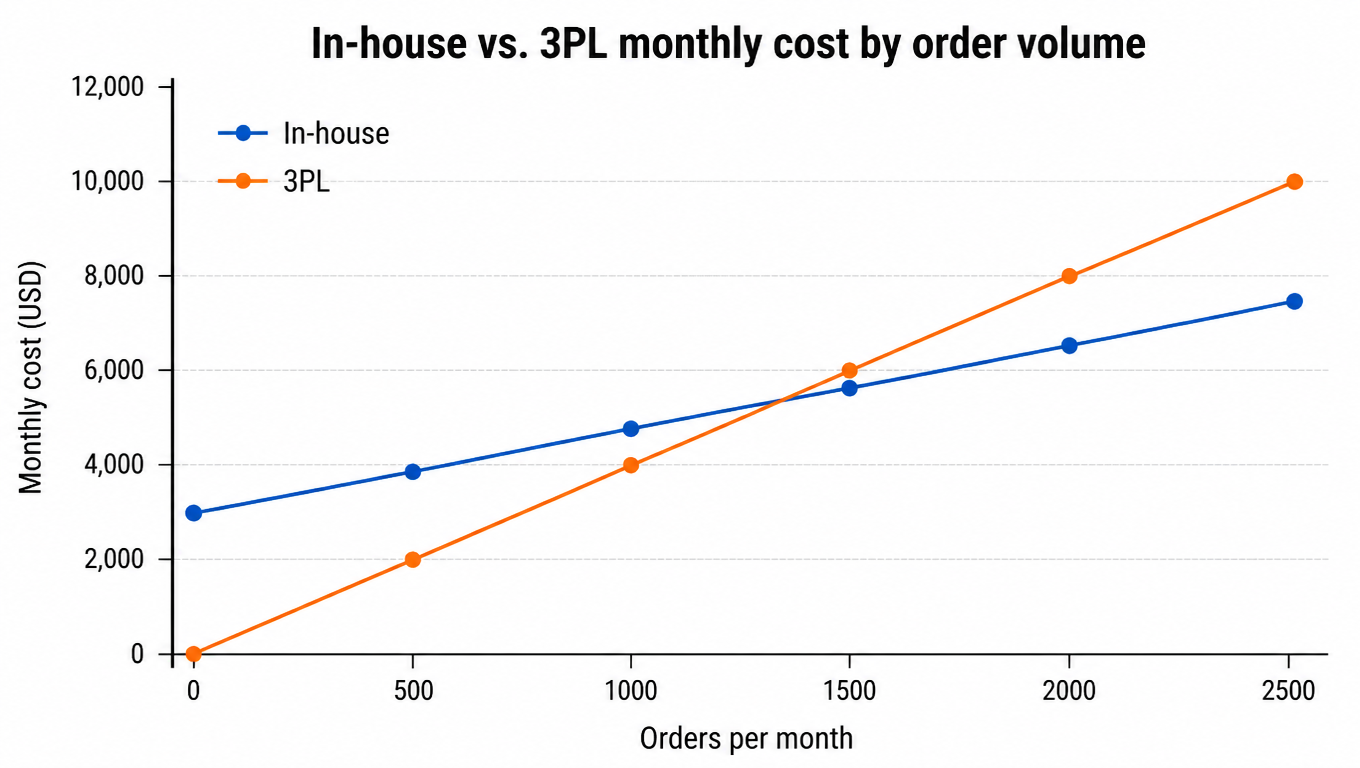
Here is a simple break-even model. Suppose in-house fulfillment costs $3,000 per month in fixed overhead plus $1.80 per order in variable costs, while a 3PL charges $4.00 per order all-in. Below about 1,364 orders per month the 3PL is cheaper, because you are not paying for idle capacity. Above that volume, in-house wins on cost, because the fixed overhead spreads thinner and your variable cost per order is lower. The crossover shows clearly when you plot both cost curves side by side: at 0, 500, 1,000, 1,500, 2,000, and 2,500 orders, the in-house cost runs $3,000, $3,900, $4,800, $5,700, $6,600, and $7,500, while the 3PL runs $0, $2,000, $4,000, $6,000, $8,000, and $10,000.

In-house vs 3PL monthly cost line chart: in-house is $3,000 fixed plus $1.80 per order, 3PL is $4.00 per order, crossover at about 1,364 orders
Outsource below the crossover, bring it in-house above it

The model omits the hidden costs on both sides. DIY fulfillment hides labor turnover, the value of your own time, space that could be used for something else, and the weaker carrier discounts a small shipper negotiates. Outsourcing hides loss of control over the customer experience, onboarding friction when you switch, and minimums that keep you paying for capacity you do not use. A hybrid often makes sense: keep your best-selling SKUs in-house where you control quality, and outsource the long tail, or the reverse if your best-sellers need scale. Revisit the decision quarterly, because volume, margin, and seasonality all move the crossover point.

Advanced: How 3PLs Optimize Pick and Pack

Slotting is the quiet science behind fast fulfillment. Using ABC analysis, the warehouse ranks SKUs by pick frequency and places fast movers close to the pack stations, with slower movers in deeper storage. Velocity-based placement cuts walking time dramatically, and it is one of the main levers between a $3.00 per-order quote and a $4.50 one.

Batch and wave picking compound the effect. Orders are grouped into waves by zone, carrier, or cut-off time, so a worker picks many orders in one pass instead of walking the same aisles dozens of times. Pick paths are then optimized to minimize distance, and the whole sequence is orchestrated by the WMS, which decides what gets picked, in what order, and by whom.

Automation arrives in tiers, and each tier only pays off past a volume threshold. Barcode scanning is the baseline that eliminates most human error. Put-to-light and voice picking replace paper with directed workflows and boost picks per hour. Goods-to-person robots bring shelves to a stationary picker, removing the walking entirely. Automated packing lines size the box, insert dunnage, and seal it without human hands. A mid-size seller does not need robots, but understanding the ladder helps you judge which 3PLs are investing for the future and which are running on paper and hope.

The data layer ties it together. Warehouses profile your orders: units per order, SKU mix, seasonal spikes, and destination geography, then use that to plan labor schedules and storage reservations. When a 3PL talks about optimization, what they are really describing is a machine that turns your order history into lower cost per order and better SLA performance. Ask which of these practices they run, and which apply to your SKU mix specifically.

Common Mistakes to Avoid

The most expensive mistake is choosing on price alone. A 3PL that is 30 cents cheaper per order but 0.2% less accurate and one transit zone farther away will cost you more in refunds, reviews, and lost repeat purchases than the 30 cents ever saved. Model total cost per delivered, satisfied customer, not cost per shipped order.

Sellers also ignore exit terms until they want to leave. Read the contract's auto-renewal, notice period, and inventory release terms before you sign, not during the exit. And when inventory transfers to the 3PL, audit it: count what arrived against what was shipped, and reconcile discrepancies within the first weeks, because disputes get much harder six months later.

Treating pick and pack as a black box is another common failure. No monthly scorecards, no reviews, no site visits means you will not notice a slow decline until customers do. At the same time, over-ordering storage space or underestimating seasonal spikes inflates the bill, so right-size storage against your actual forecast and negotiate spike clauses in advance.

Finally, plan returns before they happen. A 3PL with weak reverse logistics will leave returned inventory unprocessed, unlisted, and unsellable, quietly turning a customer return into a total loss. And when something does go wrong, resist switching 3PLs on a bad month alone: make the move on data-backed, repeated failures, not on one expensive October.

Summary and Next Steps

Pick and pack fulfillment is a core competency you can rent. The mechanics are simple, the pricing is transparent once you read the whole fee schedule, and the decision to outsource is a math problem with a crossover point, not a matter of taste. What separates a good outcome from a bad one is diligence: model the cost, verify the integration, audit the inbound inventory, and keep reviewing the scorecard.

Before you sign with a 3PL, do these five things. One, build a total cost model at your actual monthly volume, including storage and VAS, not just the pick and pack headline. Two, verify native integrations with every channel you sell on, and test the data flow with real orders. Three, agree on SLAs with remedies, and get the fee schedule including minimums and exit terms in writing. Four, audit your inventory on arrival and reconcile within two weeks. Five, run a batch of test orders through the full flow, then visit or video-walk the floor and watch a live pick wave.

The tools are simple to build: a KPI scorecard template with accuracy, on-time dispatch, and inventory accuracy; a contract question list covering SLAs, minimums, and exit terms; and the cost model from this guide, which you can re-run whenever your volume, margin, or seasonality changes. If you get those three in place, pick and pack stops being a black box and becomes the dependable, measured backbone of your shipping operation.

Want to go deeper? This guide pairs with the 15 questions to ask a 3PL, the fulfillment cost calculator, and the 3PL team management playbook.