Fulfillment Cost Guide

Fulfillment Cost Calculator for Ecommerce: How to Calculate Your True Per-Order Cost (Including Every Hidden Fee)

For many sellers, fulfillment cost means shipping. You glance at the carrier quote, decide "$6 a package sounds fine," and set your price. But shipping is only the tip of the iceberg. From the moment your goods reach the warehouse until they are delivered, or sent back, every step charges you: receiving fees, storage fees, pick and pack fees, delivery fees, return fees, plus fixed overhead like monthly software subscriptions. This article breaks fulfillment costs into five categories and walks through each one: what it is, how it is billed, typical price ranges, and the traps people most often miss. At the end you get a complete formula and a worked example.

A modern ecommerce warehouse: a worker at a packing station boxing products and labeling parcels, with shelves and a conveyor belt behind, warm tones

Why Your Fulfillment Costs Never Add Up

Let us start with the conclusion: most sellers only watch shipping and ignore storage, picking, and returns. A common rule of thumb is that fulfillment costs run 15%-20% of net sales. On a $60 product, if your true cost per order is just over $10, a sixth of your margin is gone. Miss a dollar or two per order and your pricing, ad spend, and gross margin are all quietly wrong.

Keep the fulfillment model connected to the shipping-cost optimization overview so that warehouse and parcel charges remain distinguishable. Use the cost-per-successful-delivery method when comparing the model with completed delivery outcomes.

What makes it worse is that these fees sit on different lines of your 3PL quote. Receiving might be buried under "other charges," storage shows up as a separate monthly bill, and return fees only appear when a return actually happens. Without one table that folds all five categories into a single per-order number, you cannot see your true cost.

The diagram below maps the full journey of a product from arrival to delivery (or return). Every stop generates a fee. Keep it in mind, because each section that follows covers one of those steps.
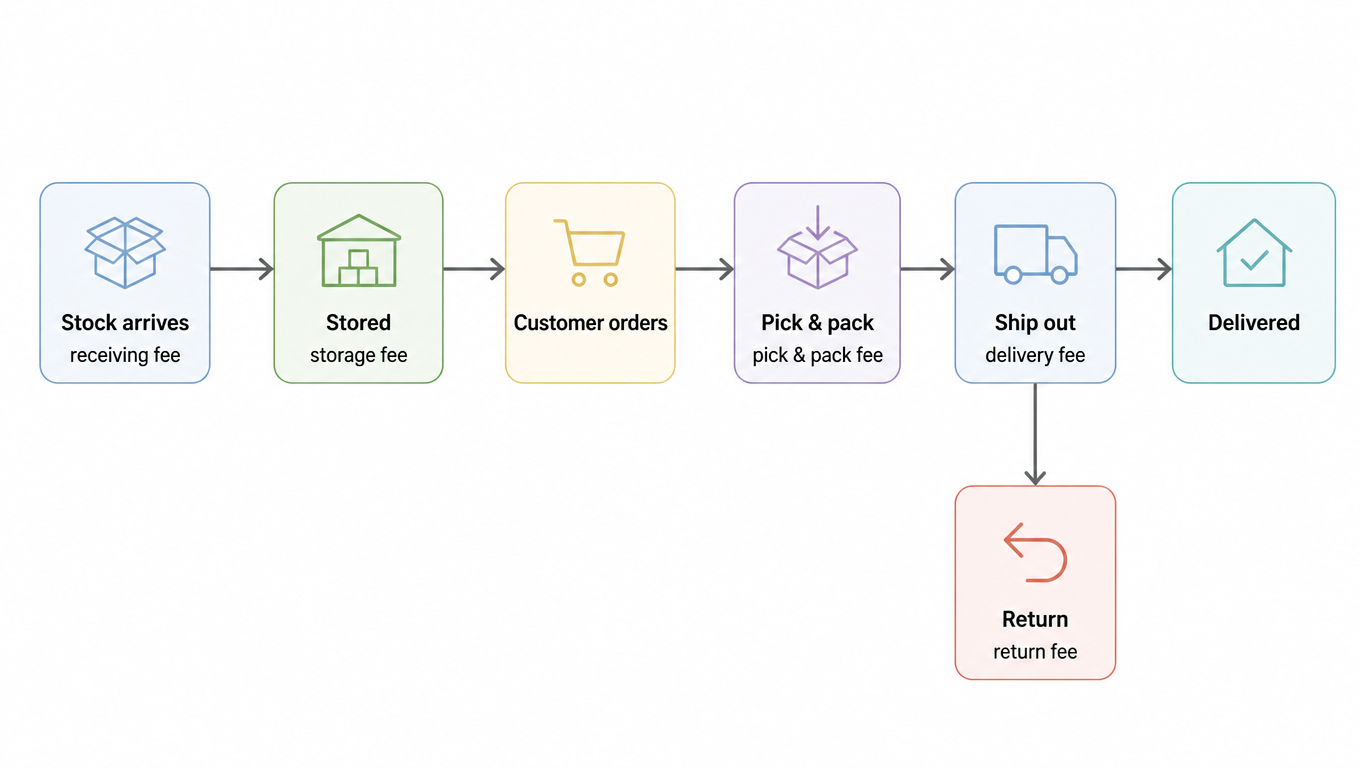
Fulfillment journey: receiving, storage, pick and pack, delivery, and returns

Receiving Fees: The First Bill When Your Stock Arrives

The receiving fee is the labor charge for unloading, counting, and putting away your goods when they reach the warehouse. Per-piece pricing commonly runs $0.10-$0.50 per item; per-pallet runs $25-$50. A few warehouses also charge a one-time setup fee or per-carton inspection. With China direct shipping, goods never touch a warehouse, so there is basically no receiving fee; but the moment you use a US 3PL, every restock triggers one.

The most common trap here is small, frequent restocks. Reorder only two weeks of inventory at a time and the per-piece receiving fee becomes a real drag on each order; some warehouses will even tell you after the truck arrives that "this batch needs extra put-away fees." The fix is the opposite: consolidate two to three months of sales into one bulk shipment so the receiving fee spreads across more orders. Restock batch size and frequency are among the most overlooked items on a 3PL quote, and among the easiest places to save real money.

Storage Fees: Quietly Adding Up Every Month

Storage is billed by volume, in cubic feet per month. US warehouses commonly charge $0.50-$1.50 per cubic foot per month, more in popular hubs and peak season. Take a product that is 0.3 cubic feet at $0.80 per cubic foot per month: about $0.24 for a month of storage. If inventory sits an average of two months before selling, storage alone adds $0.48 per order.

The real trap is long-term storage surcharges. Many warehouses add fees for stock held past 90 or 180 days, and rates can double past six months of slow sales, or worse, the stock gets disposed. Q4 rates also typically rise, so budget for it before you stock up for the holidays.

The per-order storage math is: average inventory × unit volume × monthly rate × average months in storage ÷ monthly orders. There is only one variable you can control in that equation: inventory turnover. The faster your stock turns, the lower your storage per order. There is no shortcut around it.

Pick and Pack Fees: Charged on Every Single Order

Pick and pack is the labor of picking your goods, boxing them, and slapping on the label. It is billed per order or per piece and commonly runs $2-$4 per order. It is the biggest variable cost after shipping, and almost every order pays it. If your product needs secondary packaging, a custom gift box, or is fragile, expect extra handling fees on top.

Another easy way to overspend: multi-item orders. If a warehouse splits one three-item order into three packages, you pay pick and pack three times. Consolidate it into a single box and you pay once. Order consolidation meaningfully lowers your per-order cost, and it is worth spelling out in your 3PL contract.

Shipping Fees: The Most Visible, and the Most Full of Traps

Shipping is what the carrier charges to move the package from warehouse to customer. For a 0.5 kg small parcel with 2-5 day domestic delivery in the US, $5-$8 is common. It is the most prominent line on the quote, and usually the only one sellers actually read. But beyond the base rate, there are three surcharges:

  • DIM weight surcharges: billed on dimensional weight, they hit bulky, light items hardest;
  • Remote area surcharges: some carriers add fees for Alaska, Hawaii, or remote ZIP codes;
  • Fuel surcharges: a percentage added on top when oil prices move, typically 5%-15%.

When the quote says "$6 shipping" and the month-end bill says $8.50, the gap usually comes from these three. Asking up front whether the quote includes surcharges beats reconciling bills later.

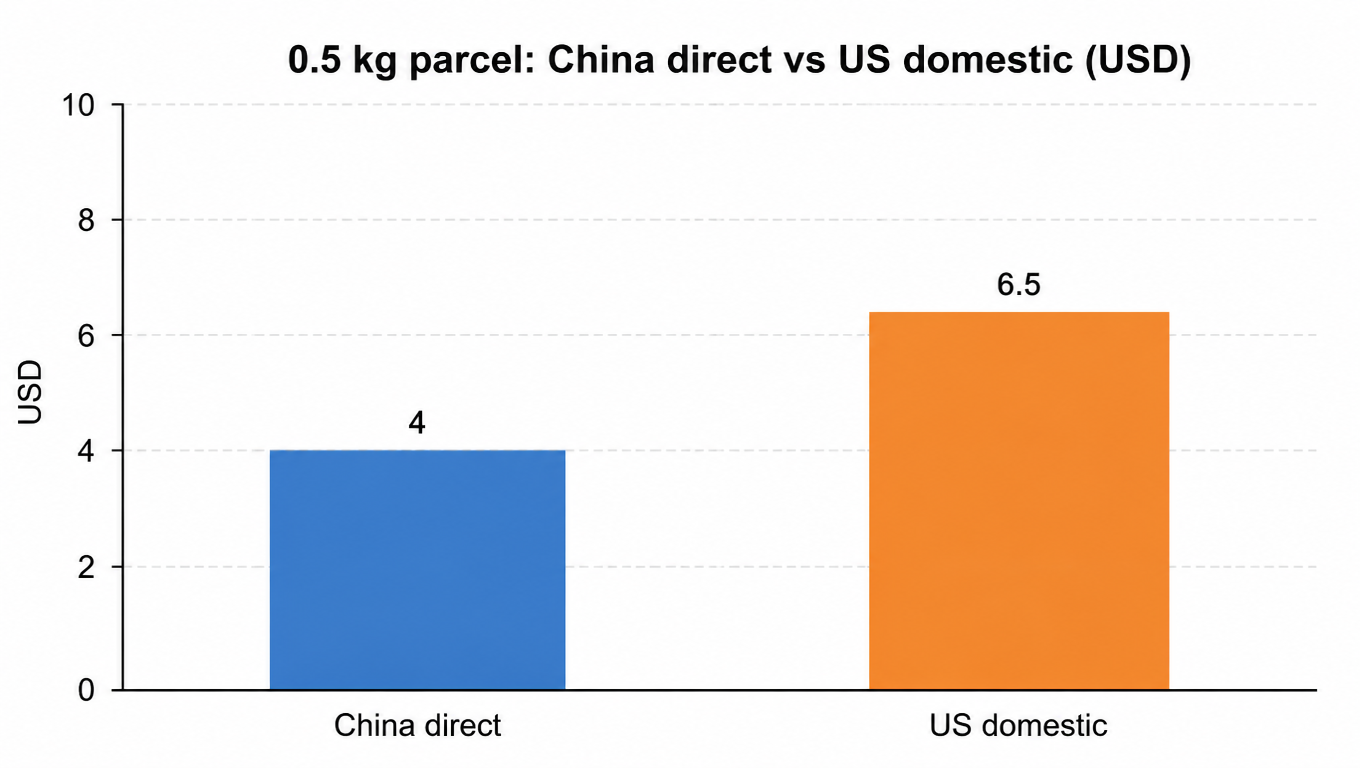
This is also where China direct and US domestic shipping diverge in structure. For the same 0.5 kg parcel, a China direct small packet runs about $4 with 10-20 day delivery; a US 3PL local delivery runs about $6.50 with 2-5 day delivery. On the surface direct is $2.50 cheaper, but if slow delivery costs you refunds, bad reviews, and lost repeat purchases, the savings rarely cover the damage. Do not compare shipping on price alone; weigh delivery speed against repeat purchases and reputation.

0.5 kg parcel: China direct vs US domestic delivery (USD)

Returns and Hidden Fees: The Neglected 5%-10%

Return rates for general goods run about 5%-15%, and 20%-30% for apparel and shoes. Every return triggers a return processing fee ($2-$5), the returned item gets re-received and inspected (another charge), and items that cannot be resold cost you disposal fees. A $40 piece of clothing can burn $8-$10 on a single return, more than the profit on the sale itself.

An open return parcel on a desk with a barcode scanner and refund labels, minimal illustration

Hidden fees are just as easy to miss: 3PL platform subscriptions (commonly $50-$300/month), monthly minimums (for example, $500 even if you only used $300), address correction fees, refused delivery fees, label printing fees. None of these show up in the per-order quote; they appear in the corners of your month-end bill, and they add up fast over a year. Read the quote to the bottom and ask one question before signing: "What else is not on this sheet?" It will dodge most surprise bills.

The Complete Formula and a Worked Example: Turning Five Categories Into Your True Per-Order Cost

Put the five categories together and you get one formula:

True per-order cost = receiving amortized + storage amortized + pick and pack + shipping + returns amortized + fixed costs amortized

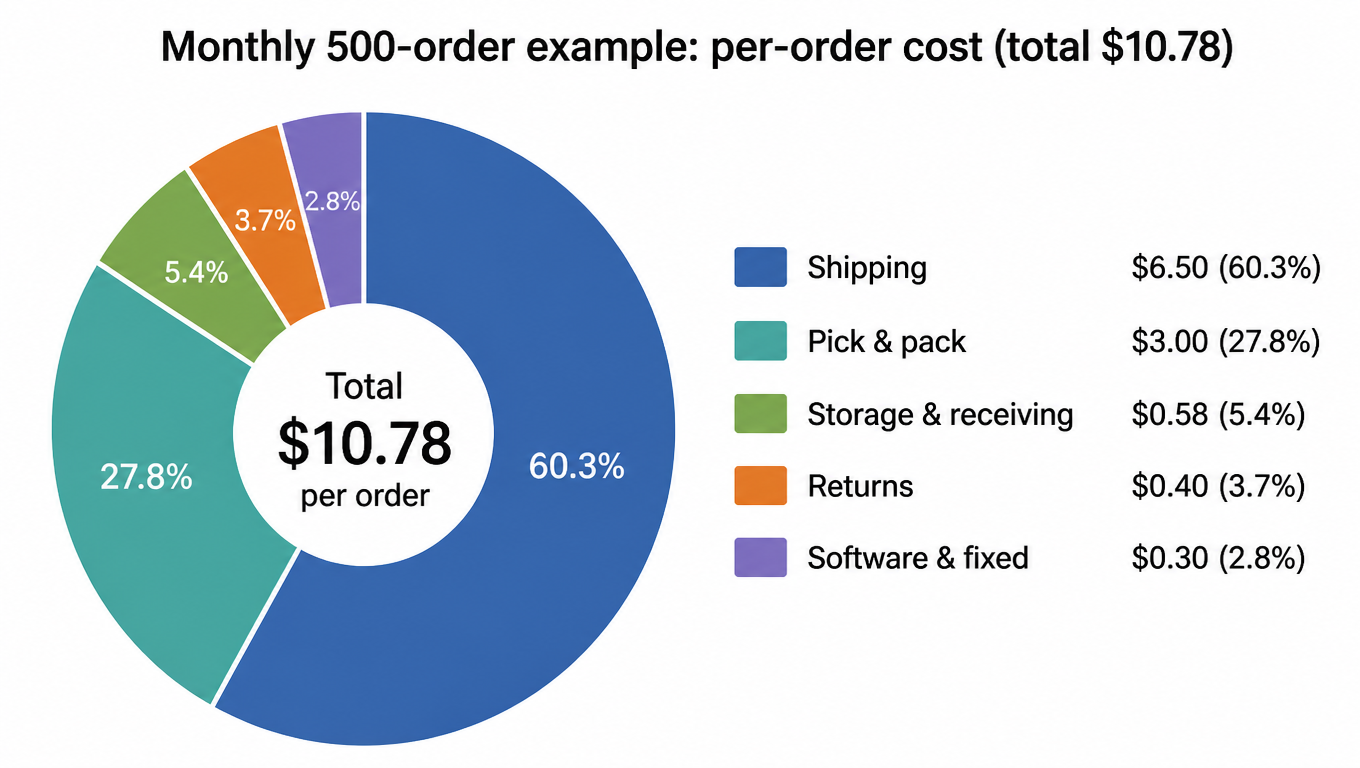
Let us run it through an example. Say you are a DTC brand doing 500 orders a month, $60 average order value, one item per order, each item 0.3 cubic feet, with inventory averaging two months in storage:

  • Receiving amortized: $0.10 per item
  • Storage amortized: $0.24 per month × 2 months = $0.48
  • Pick and pack: $3.00
  • Shipping: $6.50
  • Returns amortized: 8% return rate × $5 return handling = $0.40
  • Fixed costs amortized: $150 monthly software ÷ 500 orders = $0.30

That comes to roughly $10.78 per order, about 18% of the $60 order value. If you only watched shipping and thought fulfillment cost $6.50, the real number is 66% higher than you assumed. That gap is the part of pricing and margin that is easiest to miss.

Monthly 500-order example: per-order cost breakdown (total $10.78)

Plug your own five numbers into the formula and you will have your true per-order cost. If you would rather not do the math by hand, use our free fulfillment cost calculator: enter a few parameters and get the full picture in 30 seconds, all five categories at once.

For Shopify-heavy operations, include platform fees, app fees, promotional promises, and return handling in the same per-order model. Use the Shopify fulfillment and hidden-cost guide to complete the channel-level review.

Frequently Asked Questions

What fees are included in fulfillment cost?

Full fulfillment cost covers five categories: receiving, storage, pick and pack, shipping, and returns, plus fixed overhead like software subscriptions and monthly minimums. A common benchmark is 15%-20% of net sales.

Why is my actual per-order cost always higher than the quote?

Quotes usually only show shipping; DIM weight, remote area, fuel, return handling, and address correction fees sit outside the sheet. In the example, a $6.50 shipping quote became a $10.78 true per-order cost, 66% higher.

China direct or US 3PL, which saves more money?

For the same 0.5 kg parcel, China direct runs about $4 with 10-20 day delivery; US domestic runs about $6.50 with 2-5 days. Direct looks $2.50 cheaper, but slow delivery costs refunds, reviews, and repeat purchases.

How do I lower my per-order fulfillment cost?

Three levers: consolidate restocks to spread receiving fees, speed up inventory turnover to cut storage amortization, and consolidate multi-item orders so pick and pack is charged once.

Ready to Stop Guessing on Fulfillment Costs?

Use the free fulfillment cost calculator to get your true per-order cost in 30 seconds, and talk to easyshippingx for discounted multi-carrier shipping rates.