Shipping Guide

How to lower shipping costs without chasing only the cheapest label

Editorial illustration of a worker measuring a carton with a tape measure beside differently sized boxes, a bench scale, and a laptop
Workflow illustration, not a customer case or an actual quote.

Shipping cost optimization is not a one-time pricing exercise. It is a combined result of rate structure, packaging control, carrier mix, batch efficiency, and reconciliation discipline. This guide gives sellers, 3PLs, and warehouse teams a more durable cost-reduction framework.

Classify the cost problem before choosing a saving action

This guide provides the broader framework for ongoing cost control. When shipping cost rises, first distinguish an expensive quote from a post-purchase charge difference or higher costs from failed deliveries and manual handling. These issues need different evidence and actions; another rate request cannot resolve them all.

Evidence to prepare
Join warehouse, ZIP, parcel attributes, and delivery promises to the quote version, label purchase, final invoice, adjustments, returns, and credits for the same shipments. Fulfillment-cost issues also need handling time and delivery outcomes.
If evidence is incomplete
Without a final invoice, review projected cost without claiming savings or a billing error. Repair shipment matching and cost definitions when records are incomplete. Keep an unreceived credit pending rather than deducting it from settled cost.
Next decision
Enter the six-stage diagnostic path to triage, identify charges, reconcile, and resolve evidenced disputes. Return to this cost framework after a change and compare the same warehouse, segment, and delivery promise.

Start by separating controllable shipping cost drivers

Use the shipping-cost estimation method when the starting point is a forecast, and the shipping-cost and profit-margin framework when the decision concerns order profitability. Keep those planning questions separate from invoice reconciliation.

Many teams reduce shipping cost to label price alone. In practice, package dimensions, surcharges, address correction, exception handling, reversals, and manual review all shape total shipping cost. Without looking at these factors together, teams often replace one visible problem with another invisible one.

Cost driverTypical leakageOptimization move
Label chargesOne public-rate baselineRun a rate comparison and review discount access
Packaging and weightIgnoring dimensional impactAdd dimensional-weight review checkpoints
Surcharges and exceptionsFinding issues at month endUse shared tracking and reconciliation fields

The 2026 billing rules changed, so last year's savings math is stale

Several carriers rewrote their billing inputs and surcharge structures in 2026, and USPS moved the most. Effective July 12, 2026, the dimensional-weight divisor for competitive parcel services changed from 166 to 139, every fractional inch now rounds up, and the longest-side ceiling for Ground Advantage Cubic widened from 18 to 22 inches (USPS July 2026 price change announcement). The divisor is the denominator, so a smaller denominator produces a larger billable weight for the same carton. Annual carrier adjustments deserve the same recalculation (FedEx rate and surcharge changes).

Rule changeEffectiveEffect on cost per parcelWhat to re-check now
USPS dimensional-weight divisor 166 → 139, fractions round up2026-07-12Bulky, light parcels bill at a higher weightRe-measure cartons and find SKUs where billable weight now exceeds actual weight
Ground Advantage Cubic longest side 18 inches → 22 inches2026-07-12More small, dense parcels qualify for cubic tiersRe-test cubic eligibility on the top ten SKUs
USPS nonstandard charges: longest side over 22 inches, volume over 2 cubic feetCurrent scheduleA carton sitting just past a threshold picks up a flat chargeCheck whether any carton sits just over a threshold
USPS transportation-related temporary increase (Priority Mail, Priority Mail Express, Ground Advantage, Parcel Select)2026-04-26 to 2027-01-17A percentage layered on the label price, with an expiry dateDo not write a temporary increase into a permanent free-shipping promise
UPS and FedEx annual increases, peak and residential chargesFrom 2026-01-05, with peak elements from late SeptemberThe ground baseline for home delivery risesRe-compare both paths on the same parcel set

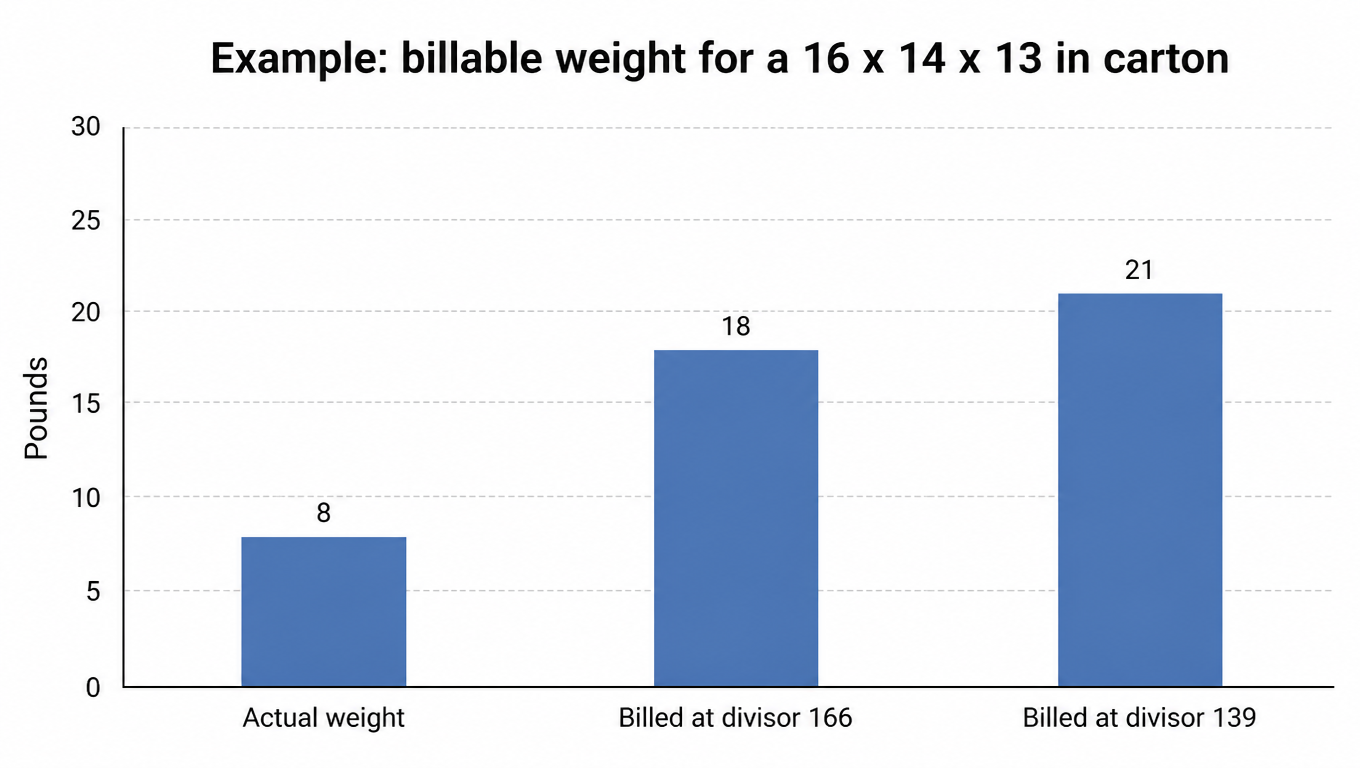
Take one example carton measuring 16 by 14 by 13 inches with an actual weight of 8 pounds. Volume is 2,912 cubic inches, about 1.69 cubic feet, which clears the 1-cubic-foot threshold, so dimensional weight applies. Under the old divisor of 166 that works out to about 17.5 pounds, billed as 18. Under the new divisor of 139 it works out to about 21 pounds. The product and the carton did not change, yet the same parcel bills three pounds heavier (USPS Ground Advantage service page).

Billable weight for one example carton: 8 pounds actual, about 18 pounds billed under the old divisor of 166, about 21 pounds under the new divisor of 139
Same carton, different denominator, different billable weight. A worked example, not a quote.

The sequencing implication is direct: fix packaging and dimension data first, then compare quotes. For dimension data, see the dimensional-weight tool and how USPS Ground Advantage pricing works; if peak volume is close, bring in the peak-season plan.

Break cost per successful delivery into six diagnosable layers

The fulfillment-center client savings method connects these cost layers to a client proposal. Use the shipping investment model when deciding whether the internal operating change is worth the investment.

The quote is only the first layer. A useful cost view also includes packaging and billable weight, service and destination, surcharges, exception rework, and final invoice adjustments. Comparing these layers on the same shipment and segment shows whether the next change belongs in packaging, data, routing, or reconciliation.

Total-cost diagnostic: trace pre-purchase inputs through successful delivery and invoice close
Cost layerEvidence to retainFirst diagnostic
Transportation baseCarrier, service, zone, and purchase chargeWrong service or shipment segment
Packaging and billable weightActual weight, outer dimensions, and packaging typeScan values versus packaging baseline
Surcharges and adjustmentsCharge code, reason, timestamp, and amountAddress, eligibility, or input variance
Exceptions and reworkReprints, voids, returns, and manual actionsProcess gap or isolated exception
Delivery outcomeFirst scan, promise, final status, and returnWhether savings harmed delivery performance
Final closeFinal invoice, refund, dispute, and attributionQuote, purchase, and final-invoice variance

For example, if quoted cost falls for one segment while returns, reprints, and support cases rise, the saving is not yet validated; it is still a pilot result. Check package inputs with the dimensional-weight tool, then use the shipping reconciliation workflow to confirm whether the variance survives final billing.

Pull four numbers before you change anything

The usual mistake is changing something first and looking for evidence afterwards. All four numbers below can be pulled from your own data: label records, carrier invoices, or a 3PL settlement file, with no new system required. Reading your own distribution first is more useful than hearing another round of quotes.

Number to pullWhere it livesA high value meansFirst place to act
Actual weight versus billable weight, by SKU or size tierLabel records plus outbound dataPackaging or dimension capture drifts from what is scannedPackaging baseline and dimension data
Adjustment lines and amounts per thousand parcelsMonthly invoice or 3PL settlement fileAddress quality, eligibility, or input rules are leakingPre-label field review
Correction, undeliverable, and return ratesTracking events plus support ticketsThe problem is address data, not provider selectionAddress validation at order import
Void, reprint, and manual-touch ratesLabel system activity logProcess gaps, with labour hiding inside freight costBatch workflow and exception closure

Two example patterns show why order matters. Assume one packaging group runs at 6 pounds actual but settles at 9 to 10 pounds billable: the carton is pushing billable weight above actual, so changing the carton pays back faster than changing providers. The opposite case, where the gap is near zero but adjustment lines are frequent, points at address and eligibility data, and switching providers would only move the same errors into a new account.

These four measures establish the baseline. Before choosing the first improvement, use the cost-problem triage table to separate high pricing, invoice differences, and fulfillment cost. Repair unmatched records before treating an unexplained difference as a carrier billing error.

Four practical moves that reduce cost more reliably

Run rate comparison instead of trusting one carrier baseline

When destination mix and parcel profile vary, one carrier rarely wins everywhere. Establish a baseline for the main segment, then put candidate carrier paths through the same serviceability, handoff, promise, exception, and billing tests. Only a path validated against current ZIP and facility conditions should enter a pilot.

Treat portal, Excel, and API as staged operating modes

Teams often rush into API before the workflow is stable, which shifts cost into engineering too early. A safer pattern is to validate in portal first, use Excel bulk upload for batch efficiency, and then move into API when fields and billing logic are already stable.

Reduce the manual cost of exception handling

Exceptions are not always high-volume, but they are usually labor-heavy. Shared tracking, refund, export, and proof-of-charge paths reduce cross-team search and repeated explanation work.

Use reconciliation review to confirm savings are real

Real cost reduction should be provable in billing output, not only in a rate comparison spreadsheet. Label charges, surcharges, reversals, and carrier invoices should be traceable through the same field structure.

Rank the moves by payback and risk, not by quoted price

This table is for planning sequence, not for comparing prices. It answers which move to make first, when the result reaches the invoice, and what evidence justifies expanding it. Within each row, faster payback and lower risk mean earlier placement.

MoveSetup effortTime to invoiceMain riskEvidence before expanding
Packaging and carton dimension baselineLowNext outbound batchA carton change can move damage ratesThe weight gap narrows in that segment
Address validation at importMediumOne to two weeksOver-flagging pushes work back to humansCorrection and return rates fall
Service-level rules by shipment segmentLow to mediumImmediatelyPromise windows quietly get worseSegment on-time outcomes hold steady
A second path for one shipment segmentMedium to highOne to two billing cycles after a pilotHandoff and first-scan timing wobbleBoth settled cost and failure rate improve
Compare label sources and discount accountsLowNext billing cycleWeak provenance and unclear recourseEvery provenance and recourse check passes
Reconciliation and dispute workflowMediumOne to two billing cyclesDispute windows close before you fileRecovered amount exceeds the hours spent
Automated rate comparisonHighAfter go-liveAutomating rules that were never validatedFields and rules are already stable

In practice the first two rows come first: packaging and dimension data, then address validation. Both are cheap to set up, and the invoice gets cleaner even if nothing else changes. Service levels and a second path belong to phase two, because their payoff depends on whether the earlier data can be trusted. For label sources, see the label source comparison; for recovering adjustments, see weight adjustment disputes; for deciding whether automation pays, see the rate shopping automation break-even framework.

What to change first so cost reduction does not create new friction

One of the most common mistakes in cost reduction is changing too many variables at once: switching carriers, changing fields, changing upload workflows, and changing support logic in the same phase. That creates noise instead of clarity. A more reliable order is to confirm shipment profile first, run a rate comparison second, validate a low-risk rollout third, and only then expand into a more complex carrier mix or API integration path.

Stage 1: identify the largest cost driver

Start by determining whether the main cost pressure comes from label charges, surcharges, dimensional weight, or repeated manual rework. Each cost source requires a different response. Many teams do not actually have the wrong carrier first. They have packaging, data-quality, or reconciliation problems first.

Stage 2: validate a lower-risk alternative path

Once the main cost source is clear, decide whether you should optimize the current baseline or add a second path. For many operations, the practical answer is not a full replacement. It is a complementary route for a specific weight band, destination region, or peak-period segment.

Stage 3: prove the result in billing output

If the result only looks cheaper on paper, it is not durable. Effective cost optimization should be visible in label charges, surcharges, reversals, and carrier billing output.

What different team types should optimize first

For imported inventory, connect the parcel decision to the landed-cost and delivered-cost model. Teams considering their own delivery operation can apply the owned-fleet and parcel-carrier comparison to a separately defined local order segment.

Team typeFirst moveWhy it matters
SellersStart with rate comparisonIt clarifies whether a second carrier is actually needed
3PLsStandardize fields and billing exports firstIn multi-client environments, structure matters more than isolated rate wins
Warehouse teamsStabilize batch workflows and exception closure firstIt prevents savings initiatives from disrupting throughput

Build a cost loop from quote to final invoice

Use the USPS and regional-carrier rate comparison method to build the quotation comparison on matching shipment inputs, then keep the later invoice and operating adjustments in this cost loop.

Reducing shipping cost requires three aligned amounts: the pre-purchase estimate, the label-purchase charge, and the final carrier invoice. Recording all three lets the team determine whether variance came from bad inputs, packaging changes, address problems, extra services, billing adjustments, or an incomplete refund.

Cost layerVariables to controlAction
ParcelOuter dimensions, actual weight, billable weight, and packagingCreate packaging baselines for common order combinations
Address and serviceAddress quality, zone, promise, and extra servicesValidate eligibility and retain rejection reasons
ExecutionReprints, voids, returns, support, and warehouse reworkInclude manual work in cost per successful delivery
InvoiceAdjustments, surcharges, refunds, and duplicatesClassify variance and feed it back into rules

Build cost baselines by shipment segment

Do not rely on one sitewide average. Segment by weight band, dimensional tier, destination region, service level, facility, and common order combination to find where leakage concentrates. Packaging changes address dimensional variance, address validation addresses corrections and returns, and a carrier mix addresses clear regional or service segmentation.

Make every monthly review produce the next rule

Prioritize only one or two high-variance shipment segments per review, with an owner, pilot scope, success criteria, and rollback condition. Compare the next cycle’s final invoices and delivery outcomes before expanding, revising, or withdrawing the change. This prevents savings from coming at the expense of throughput, on-time performance, or customer experience.

Six ways cost reduction gets cancelled out

  • Deciding on the quote alone: once accessorials, corrections, returns, and rework are counted, a lower quote is not a lower settled cost. See cost per successful delivery for the accounting.
  • Changing several variables at once: swap the carton, the routing rule, and the upload method in the same week and no result can be attributed to any one of them.
  • Writing a temporary increase into a permanent promise: the USPS temporary increase carries an explicit expiry date (USPS temporary price change announcement), while a free-shipping threshold has none.
  • Comparing discount percentages instead of settled cost: a deeper discount taken off a higher baseline can still land higher.
  • Treating a pilot as validated saving: if the saving only exists on the quote screen and never reaches the closed invoice, it is not a saving yet.
  • Letting the saving reappear somewhere else: cheaper labels with more exceptions, more manual rework, or weaker on-time outcomes is a transfer, not a reduction.

One metric decides whether the saving is real

Use cost per successful delivery rather than an average label price: put total spend for the period in the numerator, and the number of shipments you initiated in the denominator. Count initiated shipments, not completed ones, or orders that failed, came back, or had to be resent will vanish from the average and make the saving look better than it is. The gap between the two readings on the same order set is the signal worth reviewing.

Review one or two high-variance segments at a time, with an owner, a pilot scope, success criteria, and a rollback condition. Compare the next cycle's closed invoices before expanding or withdrawing. This keeps savings from being paid for with on-time outcomes or customer experience.

FAQ

No. Many teams reduce cost first through routing rules, packaging control, or one secondary carrier instead of replacing the whole setup.
Yes. portal and Excel workflows can validate account fit and operational discipline before deeper engineering work begins.
Because real savings should be visible in exported billing, reversals, and carrier invoices, not only in a quote table.
When destinations, weight bands, or service expectations are clearly segmented and a single path keeps creating cost or workflow friction.
Packaging and dimension changes appear in the next outbound batch, but only a closed invoice confirms they are real savings. Address and eligibility changes usually take one to two weeks to move correction and adjustment lines.
No. A discount is applied to a baseline, and a deeper discount off a higher baseline can still settle higher. Compare settled total cost on the same parcel set instead of comparing discount figures.
No. Most adjustments are industry-wide cost movement. What deserves a reaction is a change in your own cost structure: a persistent gap in one weight band or region, or a rule change that invalidated your packaging baseline. Check your own data before touching routing.
Fix it first. Dimensions and weight are inputs to the quote, so a comparison made while those inputs are still moving goes stale as soon as the carton changes. Settle the carton and actual-weight baseline first, then the comparison stays usable.

Sources and how these figures were checked

The rules and charges on this page are drawn from public references: the USPS July 2026 competitive price change announcement, the USPS March 2026 transportation-related price change announcement, USPS parcel size, weight, and fee standards, the USPS Ground Advantage service page, the USPS Notice 123 price list, and FedEx rate and surcharge changes. The 16 by 14 by 13 inch worked example exists only to show how a divisor change moves billable weight. It is not a quote and not a customer case, and your own closed invoices are the deciding evidence.

Ready to review a lower-cost shipping path by shipment profile?

Share your shipment profile and we can review carrier mix, onboarding path, and reconciliation impact with more precision.