Ecommerce Guide

How Shipping Costs Affect Ecommerce Profit Margins

Every ecommerce founder has run the same play: pick a price, add a shipping fee, hope the margin holds. Most of them never actually compute what the shipping fee does to the bottom line. That is the quiet way shipping eats a business: not in one dramatic line item, but in a thousand small orders where the math was never done.

This guide walks through the real accounting of a single shipment, shows you the formula that tells you exactly where your free shipping threshold should sit, and ends with seven strategies you can apply this week. It is written for small DTC brands and Shopify stores shipping in the US, whether you fulfill from a domestic 3PL or ship direct from overseas.

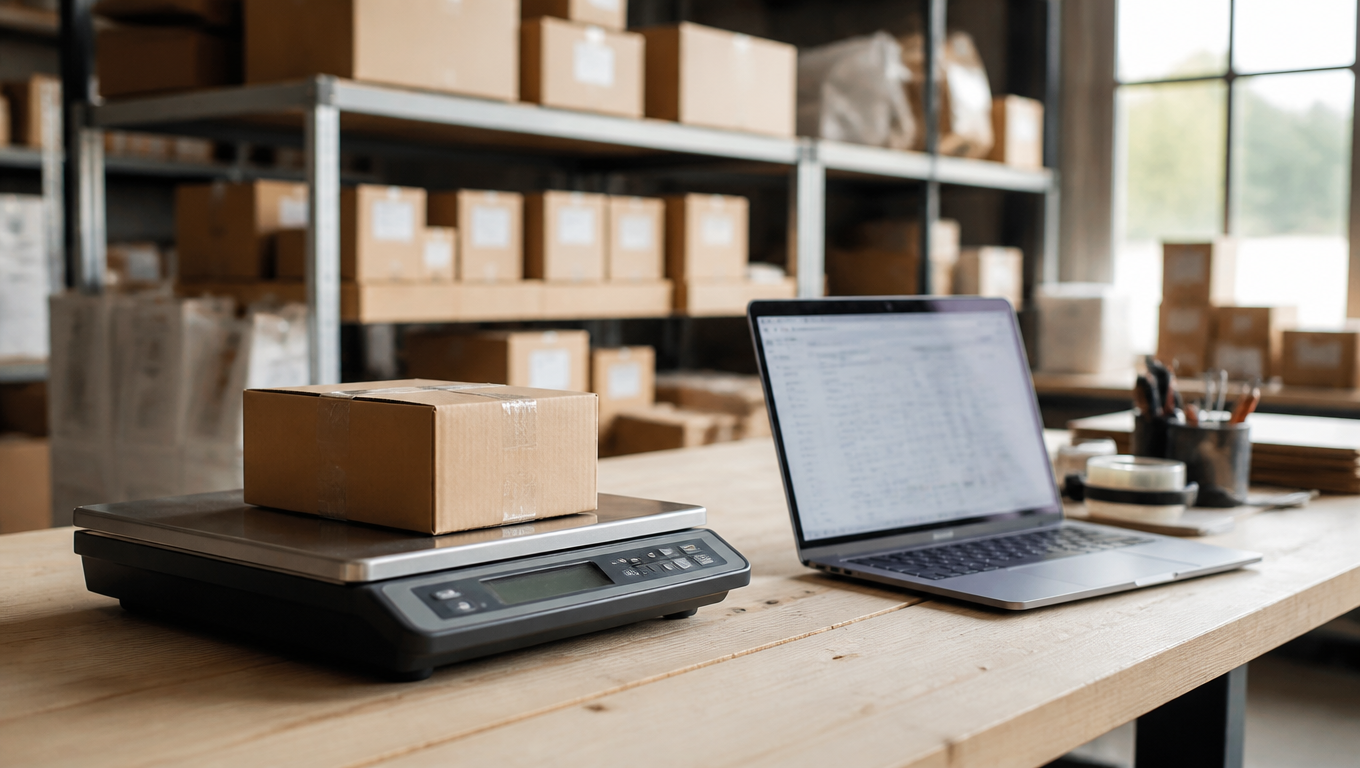
A small cardboard parcel on a warehouse scale beside a laptop showing an order dashboard, soft daylight on a packing bench
Every order eventually crosses this scale: shipping is the most overlooked and most controllable line on the P&L

Why Shipping Is the Quiet Margin Killer

Shipping is typically the second-largest cost line after cost of goods sold (COGS), yet it is the one most often set by guesswork. Founders will spend hours negotiating a 2% discount with a supplier, then set a flat $8 checkout fee or a "$50 for free shipping" badge without ever calculating whether that number is safe.

Use the shipping-cost optimization overview to connect the margin model to operational changes. The cost-per-successful-delivery method adds the delivery outcome when comparing whether those changes improved the economics.

Two mistakes are responsible for most of the damage. First, the free shipping threshold is picked from instinct, not from margin math, so it either gives away money on every order or sits so high that it never moves average order value. Second, shipping is silently bundled into product prices, which hides the true per-order cost and makes every future pricing decision a guess layered on top of a guess.

The good news is that shipping is the most controllable profit lever in ecommerce. You cannot easily change what your supplier charges for goods, but you can change carriers, packaging, thresholds, and pricing. Every percentage point of shipping cost you remove from an order drops straight to the bottom line, and the rest of this guide shows you exactly how to find those points.
The True Cost of One Shipment

Before you can set a threshold or a price, you need the real cost of getting one order out the door. That number has five parts, and most sellers only ever look at the first one.

Carrier base rate. The published rate from USPS, UPS, or FedEx for the service and zone. Fuel and accessorial surcharges. UPS and FedEx add a fuel surcharge that is republished weekly on their rate pages; USPS does not. Dimensional weight. If the box is big relative to its weight, you are billed for the space it occupies, not the pounds it weighs. Packaging and supplies. Box, tape, label, inserts, often $0.60 to $1.10 per order. Returns provision. Online orders return at roughly 20% on average, and apparel-heavy categories run closer to 30% to 40%, and someone pays for that return leg. A blended $0.50 to $1.00 per shipped order is a reasonable reserve.

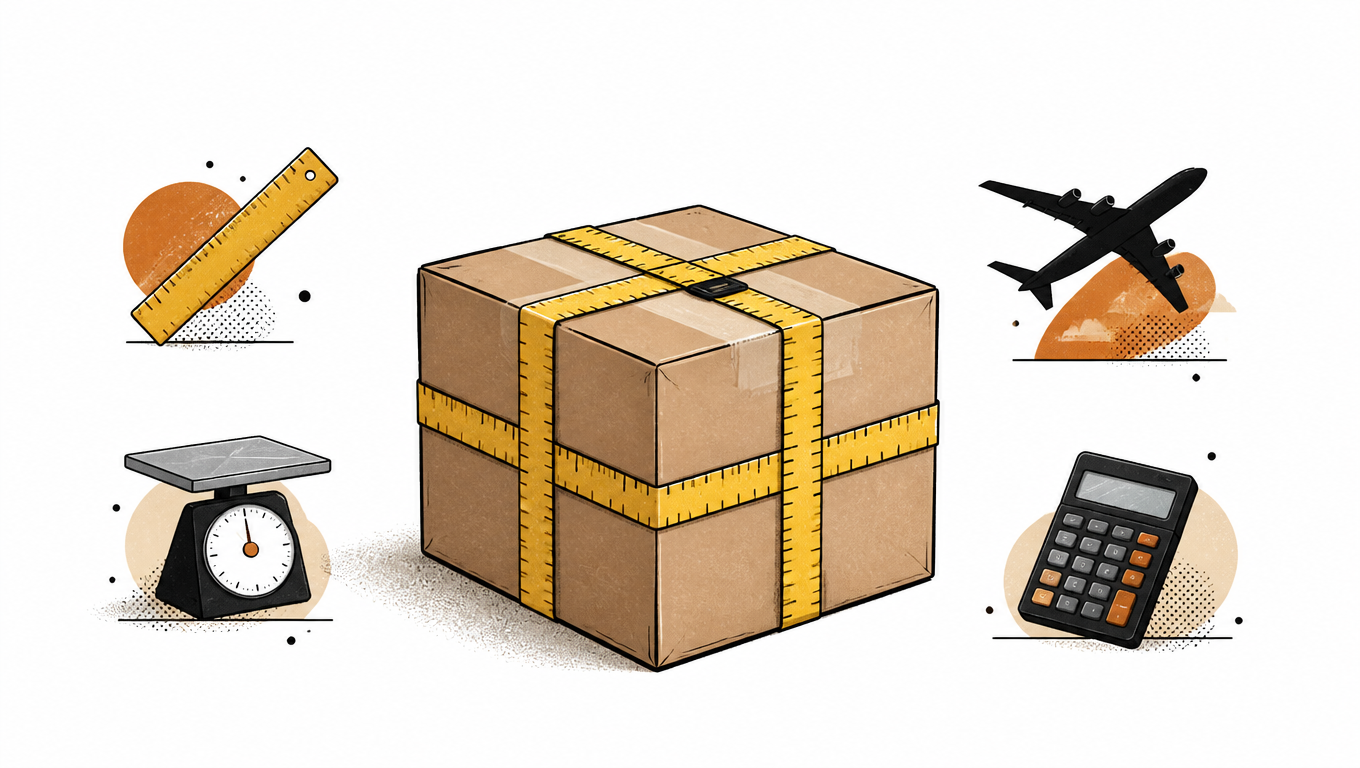
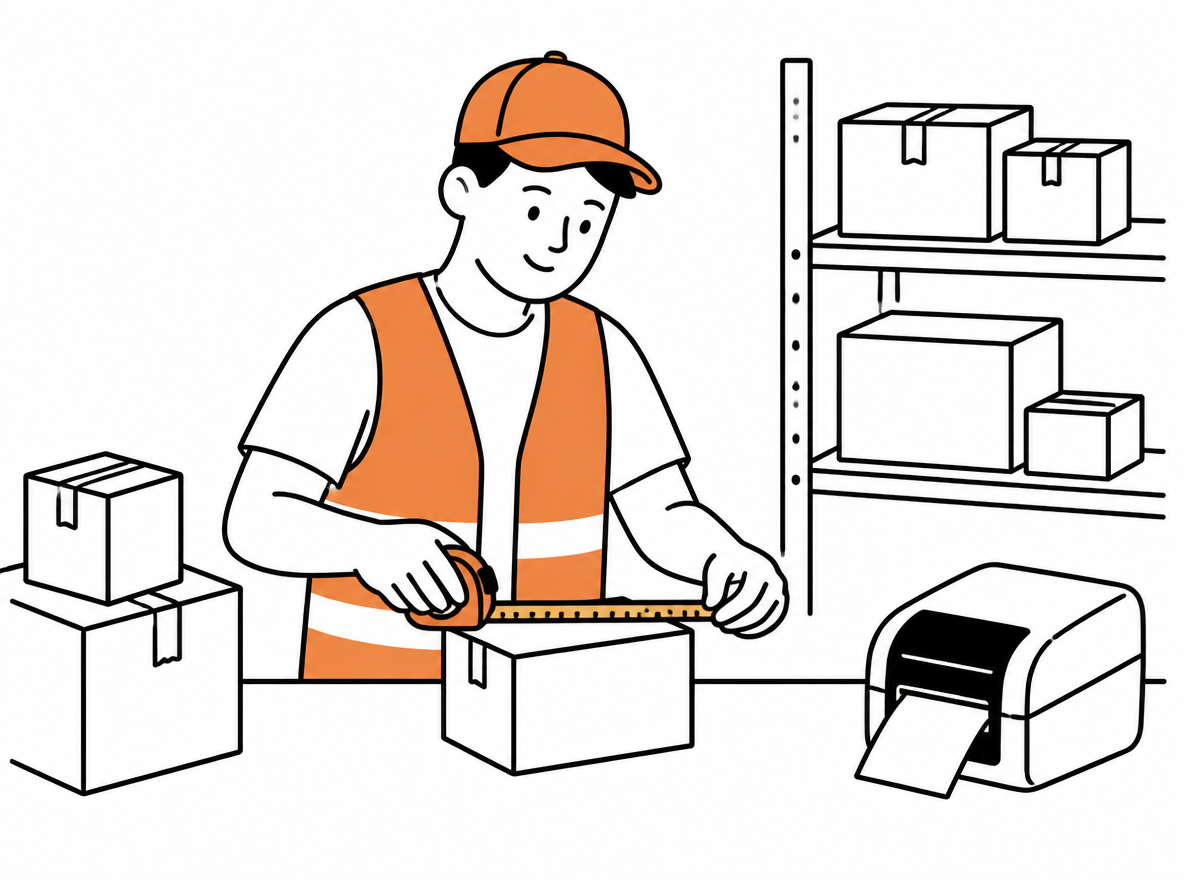
A warehouse worker measuring a small parcel with a tape measure on a packing bench, boxes and a label printer nearby
The act of measuring decides whether you pay for true weight or for air

Dimensional weight is the part that sneaks up on people. Carriers bill the greater of actual weight and dimensional weight, computed as length × width × height divided by a divisor (139 for UPS and FedEx ground, and, since July 2026, for USPS Priority Mail as well). A 1 lb product in a 10 × 8 × 6 inch box is 480 cubic inches. UPS and FedEx divide by 139, which gives 3.45, so the parcel is billed as 4 lb even though it weighs one. The same box through USPS Priority, where dimensional weight only applies above 1 cubic foot, is billed at its actual 1 lb.

Worked example: a 1 lb parcel in a 10 × 8 × 6 inch box, shipping from a Midwest 3PL via USPS Priority Mail at commercial rates. The base rate is about $6.30 for a mid-range zone. Packaging adds $0.75, label and supplies add $0.30, and a $0.50 returns reserve brings the true cost to roughly $7.85. Ship that same parcel via UPS Ground and the dimensional weight rule turns it into a 4 lb shipment, pushing the total toward $11 to $12. Same product, same box, 50% more cost, purely because of how the box is measured.

How Shipping Math Eats Your Margin

The single most useful number in this whole guide is the contribution margin: what actually remains after shipping. The formula is simple.

Contribution margin = gross margin − shipping cost as a % of AOV

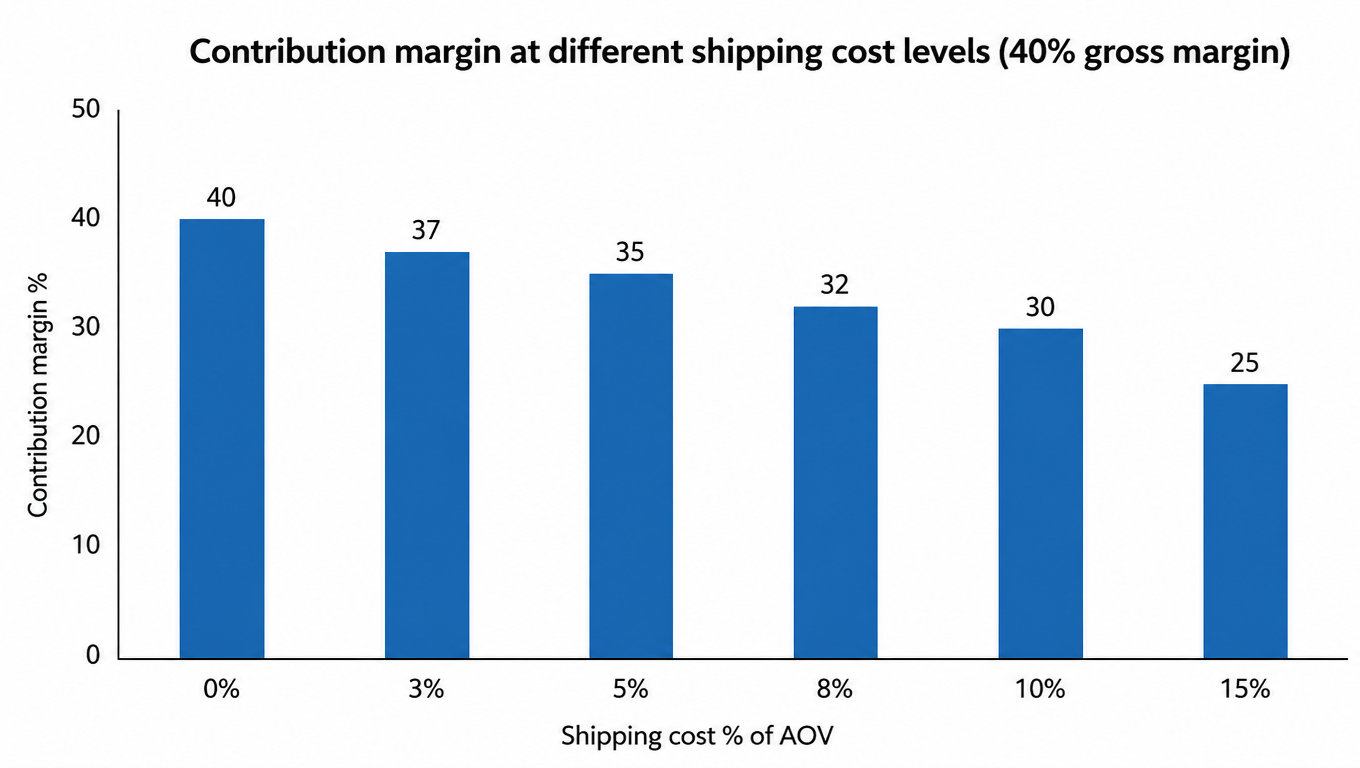
If your gross margin is 40% and shipping eats 8% of average order value, your contribution margin is 32%. Every point of shipping cost is one point of margin gone, and the chart below shows how quickly the slide happens on a 40% gross margin.

Bar chart of contribution margin at shipping cost levels from 0% to 15% of AOV, sliding from 40% to 25% on a 40% gross margin
Every point of shipping cost as a share of AOV is one point of contribution margin gone

Where is the health line? As a rough guide, shipping should stay within 5% to 8% of AOV for most DTC categories. The number depends on your gross margin: a commodity business running a 25% gross margin can only afford shipping at 3% to 4% of AOV, while a high-margin accessories brand at 60% gross margin can absorb 10% or more and still come out ahead. The rule is not a fixed percentage, it is a ratio: shipping as a share of AOV must sit comfortably below gross margin, and the gap between the two is the profit.

"Free shipping" is never free. Either the customer pays for it inside the price, or the margin pays for it. The brands that win are the ones who know exactly which one is happening on every order.

The Free-Shipping Threshold Formula

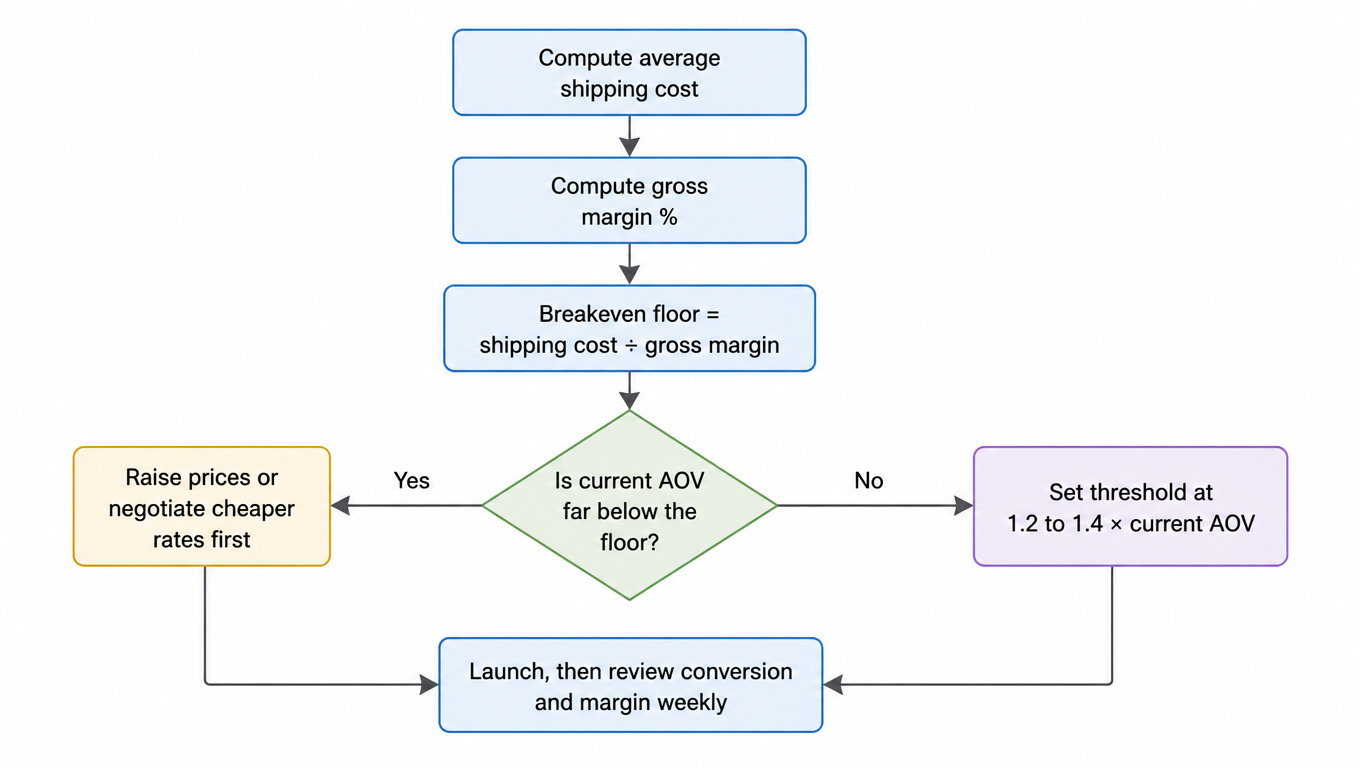
Now the part you came for: where should the free shipping threshold actually sit? The answer starts with a breakeven floor, then moves up for psychology.

Breakeven floor = average shipping cost ÷ gross margin %

The floor is the order value at which the gross profit on the order exactly covers the shipping cost. Below the floor, free shipping loses money on every order. Above it, free shipping is profitable by construction. For a brand with $6.50 average shipping cost and 40% gross margin, the floor is $6.50 ÷ 0.40 = $16.25. Any order above $16.25 can absorb free shipping and still beat the breakeven line.

The floor is where the math lives, but the floor is rarely where you set the threshold. Thresholds also do a job in the customer's head: they pull average order value up, with well-set minimums lifting AOV by roughly 25%. The sweet spot for most DTC brands is a threshold 20% to 40% above the current AOV, set where the margin math still holds. If your AOV is $45, test the threshold at $55 to $60, not at $25. A threshold below your AOV does nothing but give away margin, and a threshold far above it kills conversions.

Flowchart of the free shipping threshold decision: compute average shipping cost and gross margin, find the breakeven floor, if AOV is far below it fix prices or rates first, otherwise set the threshold at 1.2 to 1.4x AOV, then review weekly
Find the breakeven floor first, then decide where the threshold sits

If your current AOV is below the breakeven floor, a free shipping threshold cannot save you, because almost no order covers its own shipping. Fix the price or the rate first, then set the threshold. And once it is live, treat it as a live experiment: raise it, lower it, and watch both conversion rate and contribution margin, because the two move against each other and the optimum is where they cross.

Domestic vs Cross-Border: Two Cost Structures

US sellers now run two very different shipping economics, and the strategies that work for one break the other.

Domestic fulfillment (3PL or your own warehouse). You pay commercial USPS, UPS, or FedEx rates, delivery takes 2 to 5 days, tracking is reliable, and returns are cheap to process. The cost is zone-based and dimensional weight is always lurking, but the total is predictable. Free shipping thresholds in the $50 to $75 range are realistic because margin can carry the freight.

Cross-border direct (China or elsewhere to the US). Lightweight parcels under 2 lb often cost $4 to $7 with tracking via consolidated lines, which looks cheaper than domestic, and heavy parcels are where the deal dies: 2 to 4 lb parcels run $9 to $14 and take 7 to 20 days, with tracking gaps and customs friction along the way. Those delivery times quietly drag on conversion, and return logistics are painful enough that many sellers simply write the item off.

Two rules of thumb for cross-border sellers. First, the $800 de minimis exemption, which once let low-value shipments from China and Hong Kong enter the US duty-free, has been eliminated: parcels under $800 from these regions now need a formal customs entry and pay duties, so build that into your landed-cost math instead of assuming duty-free entry. Second, do not offer free shipping the way domestic brands do. With a $20 AOV and $5 shipping, free shipping burns a quarter of revenue, so either bake the freight into a slightly higher price and show free shipping as the default, or set a high threshold ($60 to $75) that pushes the order value into a weight band where the math works.

Seven Strategies to Protect Margins

  1. Reprice to include shipping, don't add it on. A $5 product with an $8 shipping fee at checkout is a conversion killer and a margin lie. Price the product so shipping can be free or cheap at checkout, then use the threshold to guard the low end.
  2. Use tiered thresholds. Instead of one threshold for the whole store, set per-product or per-category thresholds. Light, high-margin accessories can absorb free shipping at $35; heavy or low-margin items should sit behind a $75 threshold or a small surcharge.
  3. Attack dimensional weight with packaging. The 1 lb parcel in a 10 × 8 × 6 box became a 4 lb UPS shipment in the example above. Right-sizing boxes, switching to poly mailers for soft goods, and dropping inserts can take a parcel from the 4 lb billing tier to the 1 lb tier, a swing worth several dollars per order.
  4. Compare carriers and route at checkout. USPS, UPS, and FedEx all price differently by zone, weight, and service. Multi-carrier software that picks the cheapest option per order, or even per box in a multi-item order, routinely saves up to 20% without changing the service the customer feels.
  5. Negotiate and consolidate. Once you pass a few hundred parcels a month, commercial and negotiated rates beat retail counters by a wide margin. Consolidating volume through one platform or a 3PL with negotiated carrier contracts unlocks discounts a small brand cannot get alone.
  6. Charge for the heavy stuff honestly. Large or heavy items deserve a visible surcharge or a weight-based shipping calculator, not a blended flat fee that the light orders subsidize. Customers accept honest shipping math; they resent hidden cross-subsidies.
  7. Cross-border sellers: pre-position inventory in the US. Moving fast-moving SKUs into a US 3PL converts cross-border economics into domestic economics: 2-day delivery, reliable tracking, easy returns, and free-shipping thresholds that actually work. It costs inventory capital, so start with your top 10% of SKUs by revenue.

Worked Example: One Product, End to End

Put it all together. A brand sells a product at $45 average order value with 40% gross margin and $6.50 average shipping cost.

The naive play: charge a flat $8 shipping fee at checkout, which shoppers see as a tax, and quietly lose conversions on every order under the free shipping badge threshold that was set at $30, which is below the AOV and therefore does nothing. Contribution per order is $18 gross profit minus $6.50 shipping, or $11.50, and the checkout friction suppresses order count.

The formula play: breakeven floor is $6.50 ÷ 0.40 = $16.25, well below the $45 AOV, so free shipping can be offered safely. Set the threshold at $60, about 33% above the current AOV. A $60 order earns $24 gross profit, pays about $7 in shipping on the heavier box, and contributes $17. Orders below $60 pay shipping, orders above it feel the free shipping win, and average order value drifts upward while contribution per order rises by nearly 50%.

Same product, same costs, two different P&L outcomes. The difference is purely the threshold math and the pricing structure around it.

Key Takeaways

  • Measure shipping as a percentage of average order value, not as a dollar figure per order, because only the ratio tells you how much margin is left.
  • Set the free shipping threshold with the formula, breakeven floor equals average shipping cost divided by gross margin, then test 20% to 40% above your current AOV. Never set it by feel.
  • Revisit the numbers quarterly. Carrier rates change every January, fuel surcharges move weekly, your AOV drifts as your catalog changes, and your box sizes creep. The math that was safe in Q1 can be quietly leaking margin by Q3.

FAQ

Start from the breakeven floor: average shipping cost divided by gross margin. That is the order value where free shipping stops losing money. Then test 20% to 40% above your current average order value, because the threshold also works as a psychology lever that pulls order values up. For a typical DTC store with 40% gross margin and $6.50 average shipping, the floor is about $16, so a $55 to $60 threshold on a $45 AOV is a reasonable starting point.
As a rough guide, keep shipping within 5% to 8% of average order value for most DTC categories. The safe number depends on your gross margin: a 25% margin business can afford 3% to 4%, a 60% margin accessories brand can absorb 10% or more. The real rule is that shipping as a share of AOV must sit comfortably below gross margin, and the gap is your profit.
Only when the threshold math holds. If your average order value sits above the breakeven floor, free shipping at a threshold 20% to 40% above current AOV typically lifts order value enough to more than cover the freight. If your AOV is below the floor, free shipping loses money on most orders, and the fix is pricing or carrier rates first, not a badge.

Ready to put the threshold math into your label workflow?

EasyShippingX bakes commercial carrier rates, dimensional weight logic, and automatic per-parcel routing into your order flow, so every label is priced by the rules and shipping never quietly eats your margin.