This guide is for brand operations and finance teams that estimate parcel shipping for budgets, checkout, label purchase, or margin analysis. A useful estimate is not an average unit cost. It identifies the decision it supports, the charges it includes, the current rule set behind it, and the uncertainty that remains before the final charge.
A reliable estimate starts with the final parcel, measured dimensions and weight, and a current purchasable quote.
Define the use case and tolerance first
One shipment can have several valid cost numbers. Annual planning needs a stable baseline. Checkout needs a fast amount with guardrails. Label purchase needs a current purchasable quote. Margin review needs a reconciled final charge. Define the use case before choosing data precision and refresh cadence.
Order cohorts, packaging profile, lane, and historical final charge
Label it as non-purchasable
Checkout display
Current fulfillment origin, address, cart, and packing rule
Fallback when confidence is low
Label purchase
Final parcel, current account, and eligible service
Persist quote time and request inputs
Margin review
Label, adjustments, refunds, taxes, and final charges
Compare on a consistent cost scope
Build a reproducible shipment input record
Another operator should be able to recreate the quote from saved inputs. At minimum record: estimate use, origin and fulfillment node, complete destination, final packaging, external dimensions, actual weight, piece count, contents and restriction attributes, required delivery promise, account or purchase path, selected extra services, quote time, and units.
Measure the final sealed parcel, not the bare product or empty box.
Model common multi-item combinations; single-SKU packaging does not represent a cart.
Store original units and converted values to prevent silent mixing of inches, centimeters, pounds, and kilograms.
Invalidate and remeasure after packaging, warehouse, or product-combination changes.
Estimate parcel shipping cost in six steps
01Measure the final parcelSealed dimensions, actual weight, and source units
02Filter eligible servicesDestination, contents, restrictions, and promise
03Determine the billing basisApply the current service rule for weight, DIM, or another basis
04Request a current quoteUse the real account or authorized purchase path
05Mark the cost boundaryAdd known charges and disclose unknown items
06Save the quote snapshotRetain use, time, rule version, and confidence
Six-step estimation chain: preserve inputs, source, and time at each step so later variance can be explained.
Measure sealed external dimensions and actual weight, and record how they were measured.
Exclude ineligible services by destination, contents, packaging, limits, and delivery promise.
Use the current carrier, service, account, and rules to determine actual weight, dimensional weight, cubic, flat-rate, or another basis. Do not copy one carrier’s divisor or rounding rule across services.
Request a current purchasable quote from the account or authorized purchase path and retain the full response.
Add known extra services, handling charges, and tax scope. Mark unknowns explicitly instead of hiding them under an unsupported blanket percentage.
Save the use case, scope, time, price version, and confidence level before using the estimate for checkout, planning, or label decisions.
Dimensional weight is a service rule—not a universal constant
A common method divides parcel volume by a stated divisor and compares the result with actual weight. But applicability, rounding, divisor, and exceptions depend on carrier, service, rate type, and effective date. An estimation system should retain rule source and version—not one global DIM factor.
For example, FedEx currently publishes its U.S. dimensional-weight method and divisor. UPS says dimensional weight may apply to domestic and international package services and notes that the divisor varies by rate type. USPS lists separate conditions for specified large domestic package services. Return to the relevant official rule and current quote before purchase.
Shipping method differences: express vs air freight vs ocean freight
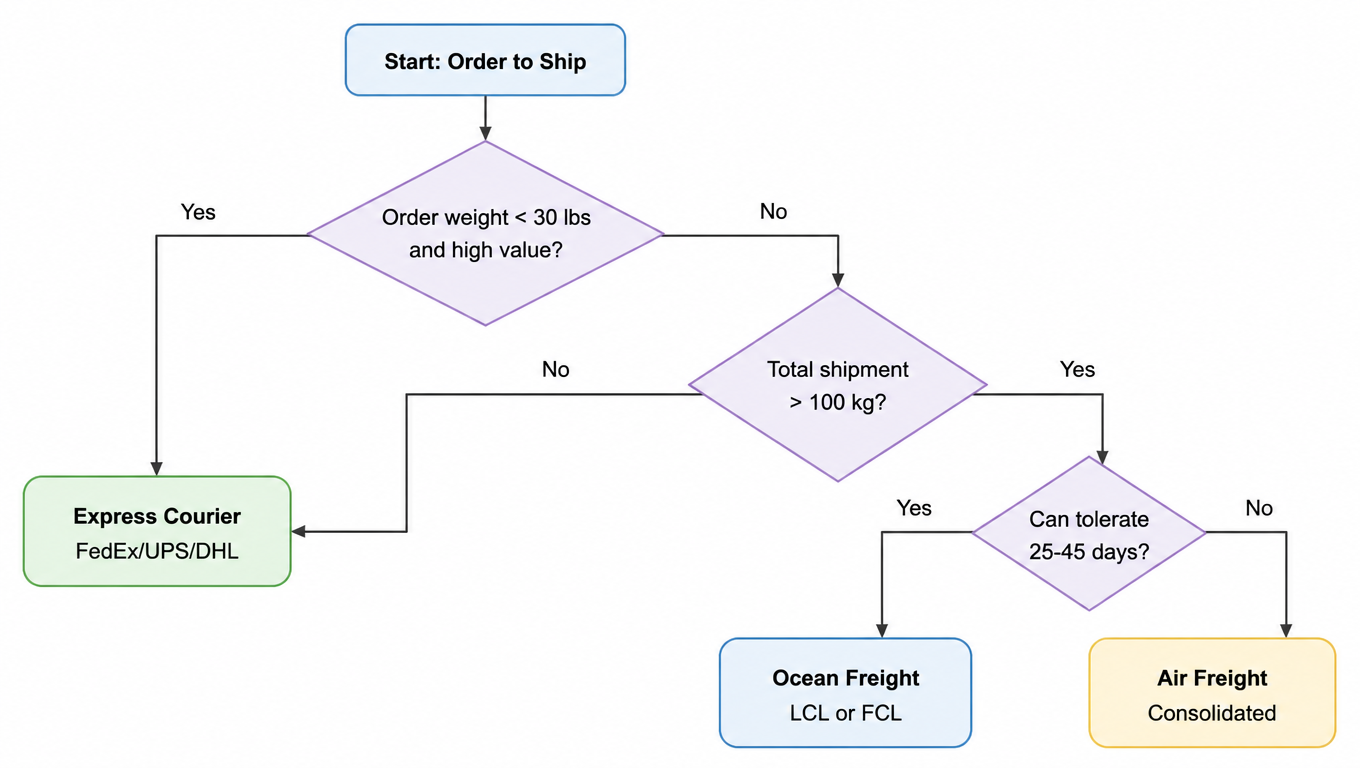
Changing the mode changes the billing unit, minimum charge, quote boundary, and downstream costs. Heuristics such as considering express below 30 lb, comparing air freight around 50–300 kg, and evaluating ocean for larger non-urgent replenishment can start a screen, but they are not carrier rules. Decide with current volume, lane, promise, and an all-in quote.
Express: priced by parcel and service rules
Express services such as FedEx, UPS, and DHL generally quote each parcel using origin, destination, packaging, actual weight, dimensions, account, and service. The current service rule determines billable weight before applicable fuel, residential, remote-area, size, or optional-service charges. Express fits individually fulfilled ecommerce orders with a defined delivery promise, but an all-in cost cannot be reconstructed from a per-kilogram headline alone.
Air freight: chargeable-weight pricing with minimums
Air freight generally compares gross and volumetric weight and rates the higher chargeable weight. The conversion, minimum chargeable weight, and weight breaks depend on the forwarder, lane, and product. Beyond the airport-to-airport rate, confirm whether origin handling, security, air waybill, destination handling, clearance, and final delivery are included. It often fits consolidated replenishment that cannot tolerate ocean transit.
Ocean freight: LCL by volume or revenue ton, FCL by equipment and lane
Less-than-container-load ocean freight is commonly quoted by cubic meter or revenue ton, while full-container-load pricing depends on equipment such as 20-foot or 40-foot containers, ports, capacity, and season. Weight may not dominate light bulky cargo, but dense cargo, dangerous goods, and equipment limits still affect price and eligibility. Ocean generally fits planned multi-pallet or container replenishment, with port-to-port and door-to-door scopes kept distinct.
Use the flowchart only for initial screening. Compare current all-in quotes on the same cost boundary for borderline shipments.
Hidden costs by method
Mode
Often-missed costs
How to estimate them
Express
Fuel, residential delivery, remote or extended area, oversize or additional handling, address correction, signature, and demand surcharges
Request a current account quote with the full address and final parcel, and retain charge details
Air freight
Origin and destination handling, security, air waybill, clearance, storage, pickup, and final delivery
Request a leg-by-leg or door-to-door quote that states minimums, chargeable weight, and exclusions
Ocean freight
Origin and destination terminal charges, documentation, customs, drayage, inspection, storage, detention, and demurrage
State LCL or FCL, free time, equipment, port scope, inland legs, and ownership of exception costs
Some teams add a blanket 25%–40% buffer to a base rate. That range may support an early sensitivity scenario, but it should not become a label-purchase rule. Itemize known charges, disclose unknowns, and calibrate with final charges from comparable shipments.
Surcharge checklist: the charges that erode margin
Base transportation is only one layer of cost. Surcharges vary by carrier, service, contract, address, packaging, and effective date, so estimation should test triggers rather than preserve one fixed amount indefinitely.
Check
Common trigger
Evidence to retain
Fuel surcharge
Changes by carrier index, service, and shipment week or month
Ship date, applicable index table, charge base, and percentage
Residential delivery
Carrier classifies the destination as residential
Address classification and quote charge code
Remote, extended, or delivery-area surcharge
Destination postal code or area appears on the current list
Full address, list version, and match result
Oversize, overweight, or additional handling
A side, length plus girth, weight, shape, packaging, or conveyability crosses a service threshold
Sealed dimensions and weight, parcel image, threshold version, and carrier scan
Address correction
Label address is incomplete, inaccurate, or corrected in transit
Original address, normalized address, validation response, and change time
Signature, Saturday delivery, and coverage
An optional service is selected or triggered by value and promise rules
Order option, declared value, service code, and quoted amount
Demand or peak surcharge
Specific dates, lanes, parcel traits, or account volume
Effective date, services, shipment traits, and account terms
Clearance, disbursement, and import-related charges
Trade terms, classification, declaration, tax responsibility, and brokerage setup
Trade terms, declaration data, responsible party, and quote inclusion scope
Classify each item as included, billed separately, currently unknown, or not applicable. This creates an actionable checklist without letting stale fixed amounts drive a current decision.
Use four confidence levels for estimates
01Planning baselineHistorical final charges and order cohortsBudgeting and scenarios
02Rules-based estimatePackaging, lane, and current rules; no live account quoteEarly product and logistics design
03Current quoteComplete inputs and purchasable account responseCheckout, service choice, and label purchase
04Final chargeLabel, adjustments, refunds, and settled chargesMargin review and calibration
Confidence levels are not a simple ranking. Each level supports a different decision.
Show level, timestamp, and unknowns in the interface and exports. “Current quote; unconfirmed import charges excluded” is more decision-useful than an amount alone.
Define the landed-cost boundary for cross-border parcels
A transportation quote does not automatically equal total landed cost. Duties, import taxes, clearance services, disbursement, brokerage, and return costs depend on trade terms, destination, classification, declaration, and service arrangement. A general shipping-cost page should not apply a fixed percentage or imply automatic coverage.
Separate transportation, known import-related costs, unknowns, and responsible party.
When classification or duties are uncertain, use a current compliance or landed-cost process rather than extrapolating from an old order.
If checkout collects estimated import charges, retain the calculation version and the rule for handling final variance.
A complete manual shipping estimate walkthrough
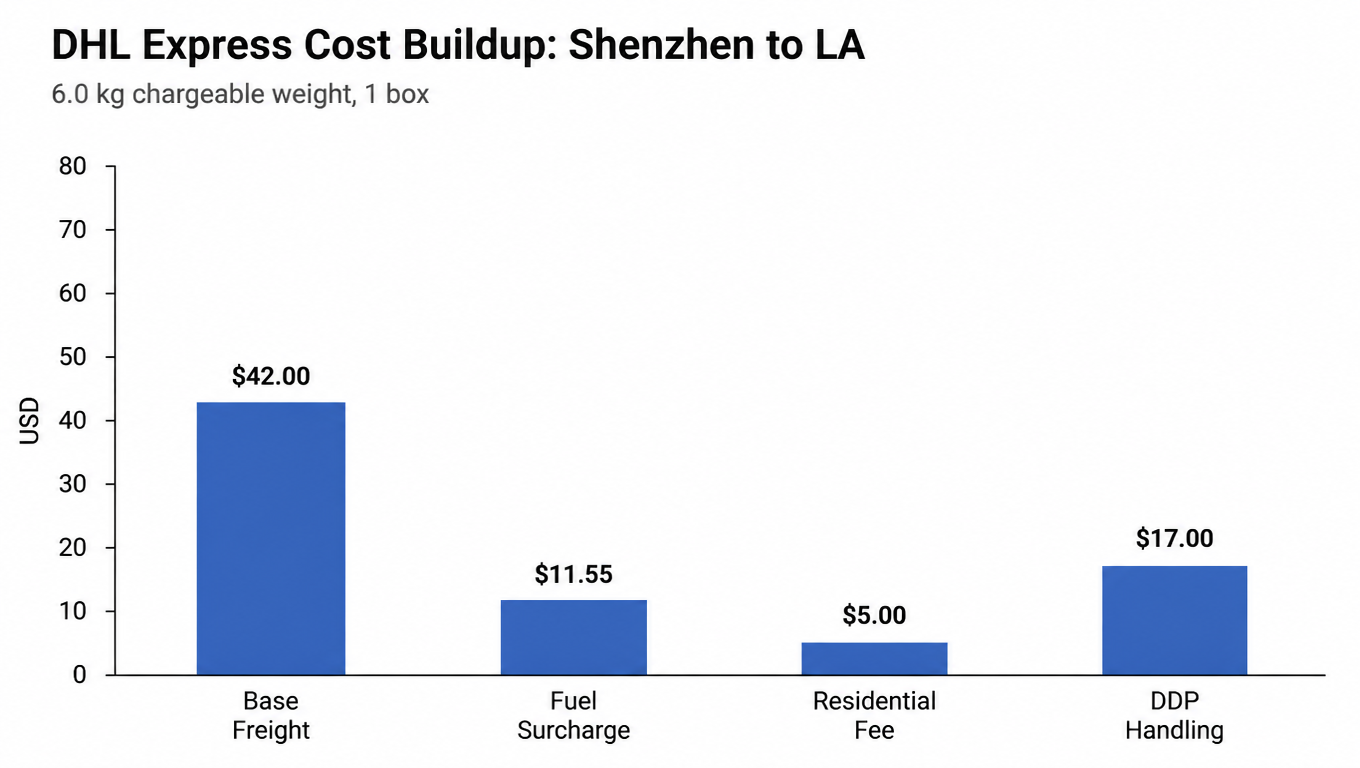
The following Shenzhen-to-Los Angeles example walks through the auditable workflow. The sealed parcel measures 40 × 30 × 25 cm and weighs 3.2 kg, with DHL Express Worldwide as the candidate service. The $42.00 base transportation amount and additional charges below are an illustrative quote snapshot for the arithmetic—not a current public rate or a substitute for an account quote.
Step 1: Record inputs and confirm service eligibility
Retain origin, complete destination, contents, declared value, trade terms, final packaging, dimensions and weight, account, and quote time. Confirm that the contents, parcel, and destination are eligible for the candidate service before doing the cost calculation.
Step 2: Calculate dimensional weight under the current rule
If the current service and account confirm a 5,000 cm/kg divisor, dimensional weight is (40 × 30 × 25) ÷ 5,000 = 6.0 kg. The divisor, applicability, and rounding must match the rule used by the quote request.
Step 3: Determine the billing basis and request the quote
Actual weight is 3.2 kg and illustrative dimensional weight is 6.0 kg, so this rule uses 6.0 kg as billable weight. Submit the same inputs through the real account or authorized purchase path and retain the full response. This example uses a $42.00 base transportation amount as an illustrative snapshot.
Step 4: Add each known charge
Charge
Illustrative basis
Illustrative amount
Base transportation
Illustrative quote snapshot
$42.00
Fuel surcharge
Illustrative 27.5% of base transportation
$11.55
Residential delivery
Illustrative fixed charge
$5.00
Remote area
Illustrative address does not trigger it
$0.00
DDP handling
Illustrative fixed charge
$17.00
Every line should trace to a quote response, contract term, or current official table. Unconfirmed duties, import taxes, brokerage, and exception costs remain disclosed unknowns rather than assumed zero.
Step 5: Total the estimate and label confidence
The illustrative total is $42.00 + $11.55 + $5.00 + $0.00 + $17.00 = $75.55, or $33.55 above base transportation. If checkout collected only $42.00 across 500 identical orders, the illustrative gross gap would be $33.55 × 500 = $16,775. The arithmetic shows why charge layers matter; it is not a real savings or loss forecast. Label the result as a historical illustrative snapshot, not a current purchasable quote.
The chart is an illustrative worked example. Replace every amount with a complete quote from the same account and time in production.
How EasyShippingX automates this workflow
The manual walkthrough makes every cost layer visible. Automation applies the same inputs, rules, and evidence consistently to each shipment instead of hiding key decisions in personal spreadsheets.
Enter once and compare current quotes from connected carriers
After origin, destination, packaging, weight, dimensions, and service requirements enter through the portal, bulk upload, or API, EasyShippingX can compare eligible connected-carrier services in one workflow. Compare purchasable quotes with the same delivery promise and cost boundary—not PDF rate cards from different dates.
Apply billing rules automatically while preserving unknowns
The system can use shipment inputs and quote responses to handle billable weight, service eligibility, and returned charge items. Costs not returned by the carrier, dependent on customs review, or subject to final remeasurement remain explicit unknowns rather than silent assumptions made to display a complete-looking total.
Connect quote, label, and final charge in one record
Automation should not stop at selecting the lowest quote. Retaining request inputs, quote time, service, label amount, tracking identifier, and later invoice charges lets teams locate variance in packaging, service changes, surcharges, carrier remeasurement, or refund adjustments and update the next baseline from final cost.
Available carriers, services, store connections, charge fields, and automation scope depend on the account and integration. Confirm them through a rate comparison or demo before launch.
Calibrate through estimate, label, and final-charge reconciliation
01EstimateSave inputs and rule version
→
02LabelRetain purchase amount and service
→
03Final chargeMerge adjustments, refunds, and settlement
→
04CalibrateUpdate the next cohort baseline
Do not overwrite final cost with the quote. Retain all three amounts to locate where variance entered.
Check
Segment by
Possible action
Estimate-to-label variance
Packing rule, service, account, warehouse
Update quote cache or packaging input
Label-to-final variance
Charge code, size band, operator, carrier
Fix measurement, dispute, or accept rule change
Checkout-to-final variance
Order cohort, region, promotion, free-shipping rule
Adjust subsidy, threshold, or guardrail
Review variance distribution by cohort before changing the model. One outlier deserves investigation, not an immediate global rule change. Version every update with an effective date and rollback path.
Data sources
The following sources support the billing structures, dimensional-weight logic, surcharge categories, and mode boundaries in this guide and were verified on 2026-08-22. Public guidance does not replace contracted pricing; monetary decisions still require the account quote, effective contract, official rate table, and final invoice at shipment time.
An average can support planning but hides destination, packaging, and service differences. Checkout should use current order and fulfillment inputs; a model needs defined cohorts and a low-confidence fallback.
No. Add known charges, disclose unknowns, and calibrate from final charges for comparable cohorts. One percentage hides the actual trigger.
Do not assume it does. Check trade terms, service arrangement, destination, and quote components, and label unknown landed costs separately.
Update when prices, services, packaging, warehouses, or purchase paths change, and review variance against final charges on a regular cadence determined by change rate and risk.
Start with a current quote you can audit
Use real origin, destination, final packaging, and service requirements, then save the quote snapshot and reconcile it to final cost.