物流指南Logistics Guide

如何制定旺季承运商作战计划How to Build a Peak Season Carrier Plan

一年中的大部分时间,发货人按公布的价格购买包裹运力,承运商为了货量而竞争。旺季把这种关系彻底颠倒过来:从 11 月到 12 月,承运商开始限量配给运力、层层叠加附加费、放宽时效承诺,而任何单一发货人都改变不了这一切。你能改变的,是带着计划走进旺季,还是在危机中临时抱佛脚。这篇指南带你走完从 8 月到 1 月的完整旺季周期:摸数据、锁运力、算附加费、建溢出预案、守住 1 月对账,最后附一张可以直接贴墙上的逐月作战表。For most of the year, shippers buy parcel capacity at a published price and carriers compete for the volume. Peak season flips that relationship. From November through December the carriers ration capacity, layer on surcharges, and loosen their transit time commitments, and no single shipper can change any of it. What you can change is whether you walked into peak with a plan or improvised it in the middle of the crisis. This guide walks through the full peak cycle, August to January: knowing your data, locking capacity, pricing the surcharge stack, building the overflow plan, and holding the January wind-down, and it ends with a month-by-month playbook you can put on the wall.

11 月底繁忙的物流仓库:传送带旁堆满小包裹托盘,工人在明亮灯光下扫描包裹
旺季是承运商定规则的时候,你能决定的是自己有没有计划Peak season is when carriers set the rules; you decide whether you walk in with a plan

为什么旺季承运商计划如此重要Why a Peak Season Carrier Plan Matters

旺季是一年中唯一承运商说了算的时候。运力是配给而不是出售的,附加费在基础费率之上层层叠加,时效承诺被拉长。一个假设网络还像三月那样运转的发货人,不是在制定计划,而是在下注,而庄家几乎每年都赢。Peak season is the only time of year when the carriers set the rules. Capacity is allocated rather than sold, surcharges multiply on top of base rates, and transit time guarantees stretch. A shipper who assumes the network will behave as it does in March is not making a plan, they are making a bet, and the house wins that bet almost every year.

失败的方式因角色而异。对 3PL 和仓储方来说,风险是有限的运力要分给多个客户,货量一冲高就违约 SLA。对电商品牌来说,风险是附加费转嫁导致成本超支,再加上一年中最大销售周里错过派送窗口、侵蚀客户信任。两种失败都可预测,因此都可计划。The failure modes differ depending on who you are. For 3PLs and warehouses, the risk is spreading limited capacity across clients and then breaking SLA promises when volumes spike. For ecommerce brands, the risk is cost overruns as surcharges pass through, plus missed delivery windows that erode customer trust during the biggest sales weeks of the year. Both failure modes are predictable, which means both are plannable.

8 月就建好的计划,而不是 11 月才补的,才是区分盈利旺季和救火演习的东西。8 月是承运商合约谈判开启、附加费表公布、还有时间建模、测试和修补的时候。窗口在 10 月货量开始爬升的那一刻就关上了。A plan built in August, not November, is what separates a profitable peak from a fire drill. August is when carrier contract negotiations open, when surcharge schedules are published, and when there is still time to model, test, and fix. The window closes the moment volumes start climbing in October.
旺季日历:8 月到 1 月到底发生了什么The Peak Season Calendar: What Actually Happens, August to January

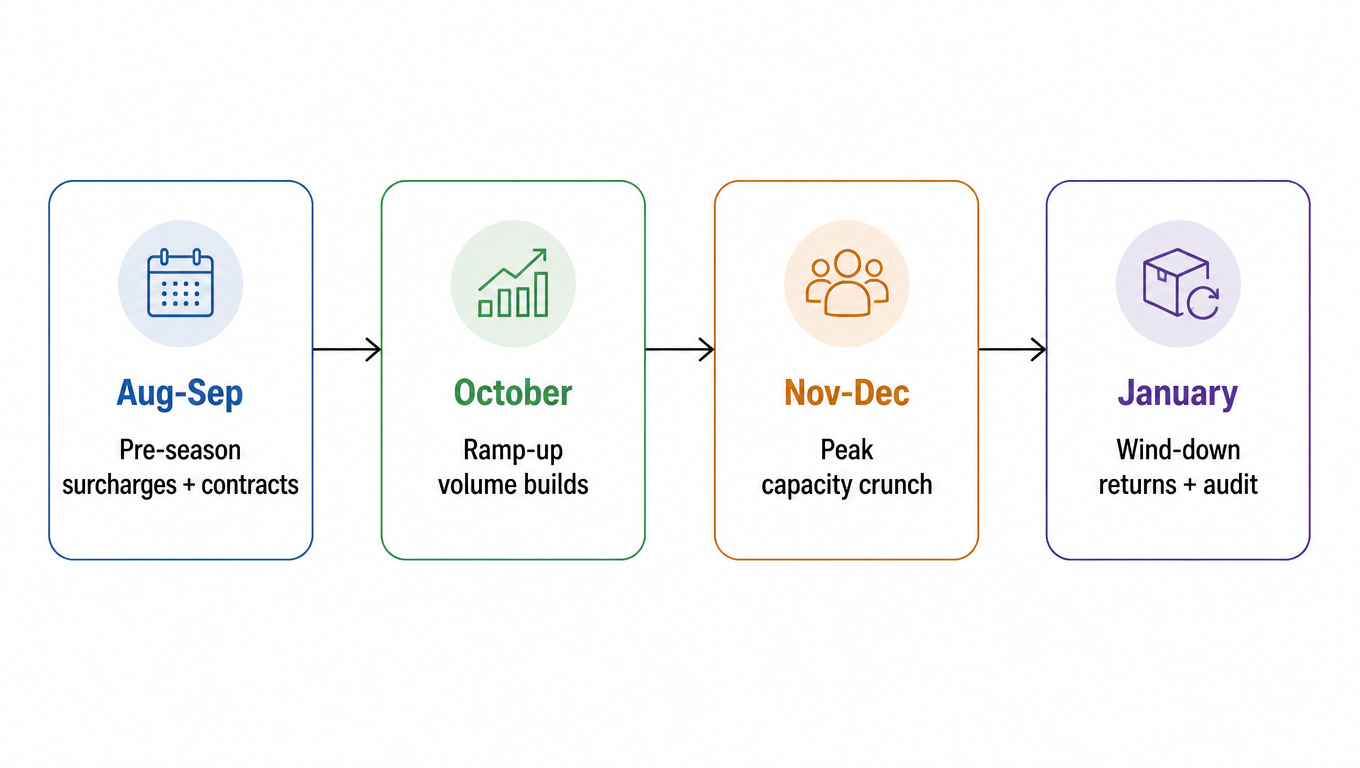
美国包裹旺季并不是第四季度。对发货人和仓储方来说,它从 8 月一直持续到 1 月,分为四个阶段:预季准备、爬坡、峰值和收尾。每个阶段都有自己的工作与失败模式,而一个阶段的工作正是下一个阶段能活下来的原因。The US parcel peak is not the Q4 quarter. For shippers and warehouses it runs from August to January, and it has four distinct phases: pre-season preparation, ramp-up, peak, and wind-down. Each phase has its own work and its own failure modes, and the work of one phase is what makes the next one survivable.

8 月和 9 月,承运商公布运力展望和旺季附加费表,合同续约谈判开启。10 月,万圣节和早期大促之前货量开始积累,第一批带着附加费的账单开始咬人。11 月和 12 月是真正的峰值窗口,从黑色星期五到圣诞,运力吃紧,最后一公里网络以设计容量甚至超容量运转,时效被拉长。In August and September, carriers publish their capacity outlooks and peak surcharge schedules, and contract renewal talks open. In October, volume builds ahead of Halloween and the early sales events, and the first surcharge-laden invoices start to bite. In November and December, the peak window itself, Black Friday through Christmas, is the capacity crunch, and last-mile networks run at or above design capacity while transit times stretch.

1 月货量暴跌,退货潮涌回,工作转向对账和复盘。多数团队把 1 月当闲月,其实不是。它是旺季利润被确认或悄悄流失的地方,因为没在承运商审计窗口内争议的账单错误和多收费,就永远拿不回来了。In January, volumes collapse, returns flood back, and the job turns to reconciliation and review. Most teams treat January as a quiet month. It is not. It is where the season's profit gets confirmed or quietly lost, because billing errors and overcharges that are not disputed within the carrier's audit window are gone for good.

旺季四阶段流程图:8-9 月预季准备(附加费与合同)到 10 月爬坡(货量上升),再到 11-12 月峰值(运力吃紧),最后 1 月收尾(退货与审计)Flow diagram of the four peak phases: Aug-Sep pre-season (surcharges and contracts), October ramp-up (volume builds), Nov-Dec peak (capacity crunch), January wind-down (returns and audit)
旺季的四个阶段:每一阶段的功课决定下一阶段能否活下来The four phases of peak: the work of each phase is what makes the next one survivable

先摸清数据和承运商组合Know Your Data and Your Carrier Portfolio First

计划从数据开始,而不是从跟承运商对话开始。拉出你的历史货量:按周的票数、线路构成、区域分布、重量段,以及去年同期的数据。目标是一个基线,展示你的业务旺季到底是什么样,而不是你希望它是什么样。如果去年 11 月的实际数字让你吃惊,先修数据问题,再在上面盖任何东西。The plan starts with data, not with the carrier conversation. Pull your historical volume: ship counts by week, lane mix, zone distribution, weight bands, and the same period last year. The goal is a baseline that shows what peak actually looks like for your book of business, not what you hope it looks like. If last November's actuals surprise you, fix the data problem before you build anything on top of it.

然后把业务切分。哪些客户或 SKU 驱动峰值冲高,哪些全年平稳?大多数运营里,一小撮账户驱动了 11 月的大部分冲量。这个切分决定你把稀缺运力放在哪、在哪里争取货量折扣、在哪里谈更宽松的服务承诺。Then segment the book. Which clients or SKUs drive the peak spike, and which are steady all year? In most operations a handful of accounts drive most of the November surge. That segmentation decides where you put your scarce capacity, where you push for volume discounts, and where you negotiate softer service commitments.

最后审查承运商组合。USPS、UPS、FedEx 和各区域最后一公里网络在旺季的运力、附加费和服务特征各不相同。全国性承运商限流时,区域网络往往还在接货,附加费结构也不同。组合摸清后做缺口分析:预计旺季货量会在哪里超过签约运力,超出多少?这个缺口才是你真正要计划对付的问题。Finally, review the carrier portfolio. USPS, UPS, FedEx, and the regional last-mile networks each have different capacity, surcharge, and service characteristics in peak. Regional networks often keep accepting volume when the national carriers cap it, and their surcharge structures differ. Once the portfolio is mapped, run the gap analysis: where will projected peak volume exceed contracted capacity, and by how much? That gap is the actual problem you are planning against.

提前锁定运力与合同(8 月到 9 月)Lock In Capacity and Contracts Early (August-September)

承运商把旺季运力分配给那些在夏末就做出承诺的发货人。这就是整个游戏的规则:在费率飙升之前,用承诺货量换有保障的运力和一张旺季附加费表。你越早开口,承运商越能把网络围着你规划,而对一个正面对运力短缺的承运商来说,可预测性值真金白银。Carriers allocate peak capacity to shippers who made commitments in late summer. That is the whole game: negotiate committed volume against guaranteed capacity and a peak surcharge table before rates spike. The earlier you open the conversation, the more the carrier can plan its network around you, and predictability is worth real money to a carrier staring at a capacity shortage.

搞懂你要签的承诺。最低货量承诺带着不对称的惩罚:承运商强制执行你承诺的最低量,却不保证你期望的最高量。读清楚未达量罚款、超量配额,以及承运商自己没达到服务承诺时会怎样。如果合同只保护一边,谈判就还没结束。Understand the commitments you are signing. Minimum volume commitments come with penalty asymmetry: carriers enforce the minimum you promised, but they do not guarantee the maximum you hoped for. Read the under-shipment penalty, the over-shipment allowance, and what happens if a carrier misses its own service commitment. If the contract only protects one side, the negotiation is not finished.

你的谈判货币是可预测性。分线路的货量预测、取件节奏、对溢出货量的明确计划,都能换更硬气的运力保障和更好的附加费条款。签约前把组合里每家承运商公布的旺季附加费表都收齐,再用你的历史线路构成去建模。附加费表是合同的一部分,不是事后才想到的,而它本来就该待在合同里。Your negotiation currency is predictability. Volume forecasts by lane, pickup cadence, and a stated plan for overflow volume all trade for firmer capacity guarantees and better surcharge terms. And collect the published peak surcharge table for every carrier in the portfolio before you sign, then model it against your historical lane mix. The surcharge table is part of the contract, not an afterthought, and the contract is where it belongs.

把附加费算进你的运营成本Price the Surcharges Into Your Operation

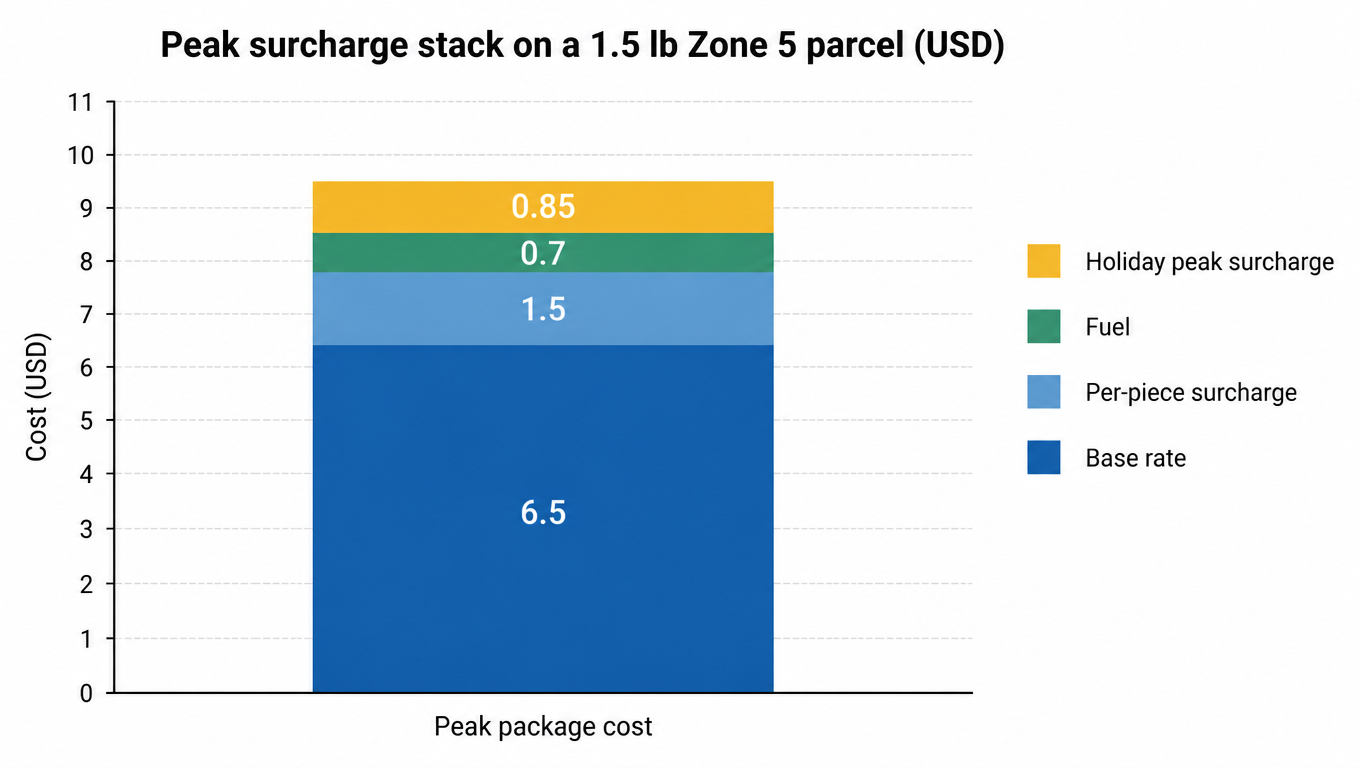
附加费是叠出来的。每件附加费、燃油调整、体积重和节日旺季附加费全部压在基础费率之上,加在一起能让一票包裹的成本涨 40% 甚至更多。举个具体例子:一票 1.5 磅发 Zone 5 的包裹,基础费率大约 6.50 美元。旺季时,1.50 美元的每件附加费、约 0.70 美元的燃油抬升、0.85 美元的节日旺季附加费层层叠上去。7 月只要 6.50 美元的同一票包裹,11 月大约要 9.55 美元,涨了 47%。Surcharges stack. Per-piece fees, fuel adjustments, dimensional weight, and holiday peak surcharges all land on top of base rates, and together they can add 40% or more to the cost of a single parcel. Take a concrete example: a 1.5 lb parcel to Zone 5 moves for about $6.50 at base rates. In peak, a $1.50 per-piece surcharge, roughly $0.70 in elevated fuel, and a $0.85 holiday peak surcharge stack on top. The same package that cost $6.50 in July costs about $9.55 in November, a 47% increase.

堆叠柱状图:一票 1.5 磅 Zone 5 包裹的旺季成本构成,基础费率 6.50 美元、每件附加费 1.50 美元、燃油 0.70 美元、节日旺季附加费 0.85 美元,合计 9.55 美元Stacked bar chart of the peak surcharge stack on a 1.5 lb Zone 5 parcel: base rate $6.50, per-piece surcharge $1.50, fuel $0.70, holiday peak surcharge $0.85, totaling $9.55
同一票包裹:7 月 6.50 美元,11 月 9.55 美元The same parcel: $6.50 in July, $9.55 in November

按线路建模,而不是按包裹。你的区域构成和重量段决定旺季平均包裹的真实成本,而这个平均值才是你的定价要覆盖的。一个往邻近区域发轻包裹的品牌,跟一个跨州发重包裹的仓库,看到的涨幅完全不同,两者都需要在 11 月之前拿到自己的数字,而不是之后。Model the stack per lane, not per package. Your zone mix and weight bands determine what the average peak package actually costs, and that average is what your pricing needs to cover. A brand shipping light parcels to nearby zones sees a different increase than a warehouse shipping heavy parcels cross-country, and both need their own number before November, not after.

然后决定谁来买单。对 3PL,这意味着客户的计费规则:发票上的附加费细项、写进合同、从明确日期开始执行。对品牌,意味着决定哪些作为客户体验成本吸收、哪些体现在运费里。11 月之前定好计费规则并讲清楚。最糟的结果是 12 月才发现你收不了合同里约定的钱。Then decide who pays. For 3PLs, that means billing rules for clients: surcharge line items on invoices, stated in the contract, applied from a defined date. For brands, it means deciding what to absorb as a customer experience cost and what to reflect in shipping charges. Set the billing rules before November and communicate them clearly. The worst possible outcome is discovering in December that you cannot bill what you contracted.

为失败做计划:运力短缺、中断与客户预期Plan for Failure: Capacity Shortfalls, Disruptions, and Customer Expectations

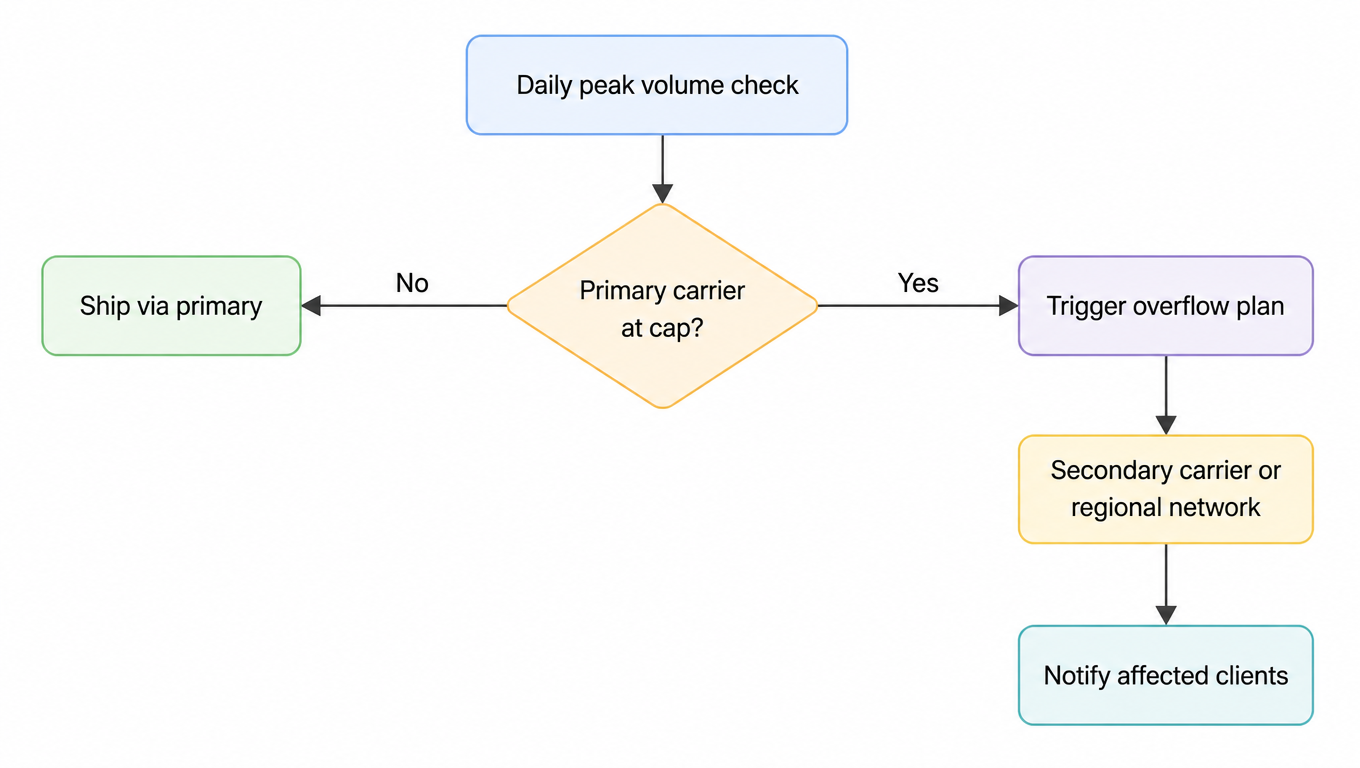
计划的职责不是假设一切顺利。现在就建溢出计划:备用承运商、区域网络,以及主承运商限流时触发的改道条件。提前定义触发点,例如主承运商达到某个公布的每日上限,或时效跌破某个阈值,让决策变成机械动作,而不是 11 月晚上 9 点顶着压力做决定。The plan's job is not to assume everything goes right. Build the overflow plan now: secondary carriers, regional networks, and the re-routing triggers that fire when the primary carrier caps volume. Define the trigger in advance, for example when the primary hits a stated daily cap or when transit time slips past a threshold, so the decision is mechanical and not made under pressure at 9 pm in November.

体积重是大多数团队用不足的杠杆。当包裹大到网络没法便宜地搬动时,重新打包、合并发货、按体积特征选承运商都能转移成本。还要知道你的截单日期:每家承运商每个服务层级都会公布节日截单日期,过了之后选择就只剩二选一:多花钱用更快的服务,或者提前设定「圣诞后到货」的预期。在截单日期逼到你面前之前,把两个答案都定好。DIM weight is a lever most teams underuse. When packages get too big for the network to move cheaply, repackaging, consolidation, and carrier selection by dimensional profile all shift cost. And know your shipment cutoffs: every carrier and service level publishes holiday cutoff dates, and after they pass the choice is binary, spend up for a faster service or set the expectation that the package arrives after Christmas. Decide both answers before the cutoff is in front of you.

溢出决策流程图:每日峰值货量检查,主承运商达到上限时触发溢出计划,改道次级承运商或区域网络并通知受影响客户Flowchart of the overflow decision: daily peak volume check, if the primary carrier is at cap trigger the overflow plan, reroute to secondary carrier or regional network, notify affected clients
把溢出决策变成机械动作:提前定义触发点Make the overflow decision mechanical: define the trigger in advance

客户沟通是你最便宜的运力。提前设定延长的派送预期、公布截单日历、用主动的追踪通知。客户会原谅一个提前打过招呼的晚到包裹,不会原谅沉默。对 3PL 这是对客户端的义务,对品牌这是对消费者端的义务,两种情况里,消息都要在旺季之前发出去,而不是旺季之中。Customer communication is the cheapest capacity you have. Set extended delivery expectations early, publish the cutoff calendar, and use proactive tracking notifications. Customers forgive a late package that was announced in advance; they do not forgive silence. For 3PLs this is a client-facing obligation, for brands it is a customer-facing one, and in both cases the message needs to go out before the peak, not during it.

1 月收尾:退货、对账与复盘The January Wind-Down: Returns, Reconciliation, Post-Mortem

退货潮紧随峰值而来,它需要自己的运力和人力。在同一个合同周期里规划它:退货标签、上架人力,以及为入向货量预留的第二份承运商配额。只为出向安排旺季人手的团队,会在 1 月发现站台堆满退货,却没人负责处理。The returns surge hits right after the peak, and it needs capacity and labor of its own. Plan for it in the same contract cycle: return labels, restock labor, and a second carrier allocation for inbound volume. Teams that staff peak for outbound only find themselves in January with a dock full of returns and no one assigned to process them.

发票对账才是旺季利润真正被确认的地方。把旺季附加费账单和合同逐行核对,因为承运商靠自动化系统开票,错误很常见。在多收费过期之前提出争议,通常是 90 到 120 天的窗口,过了这个窗口钱就没了。Invoice reconciliation is where the season's margin is actually confirmed. Audit the peak surcharge billing against what was contracted, line by line, because carriers bill from automated systems and errors are common. Dispute overcharges before they age out, typically within a 90 to 120 day window, after which the money is gone.

用复盘和数据交接收尾。预测漏了什么、哪条线路崩了、明年该改什么?然后把本季的实际数字锁进明年的基线计划。这个 1 月最有价值的产出不是复盘报告,而是明年 8 月的起点,它建立在现实之上,而不是记忆之上。Close with the post-mortem and the data handoff. What did the forecasts miss, which lanes broke, what should change next year? Then lock the season's actuals into next year's baseline plan. The most valuable output of this January is not the post-mortem report, it is next year's August starting point, built from reality instead of memory.

总作战时间表:8 月到 1 月的逐月打法The Master Timeline: Your August-to-January Playbook

整个计划一张表看全。每个月一个重点和一组必办事项。如果别的都不做,至少踩住这张表里的时间点。Here is the whole plan in one view. Each month has a single focus and a short list of must-complete actions. If you do nothing else, hit the deadlines in this table.

月份Month重点Focus必办事项Must-complete actions
8 月August数据与合同Data and contracts拉取历史货量数据;切分业务构成;开启承运商合同谈判;按线路建模附加费叠加Pull historical volume data; segment the book of business; open carrier contract talks; model the surcharge stack per lane
9 月September锁定Lock in签署含运力与附加费条款的合同;公布内部截单日历;向客户和顾客通报旺季预期Sign contracts with capacity and surcharge terms; publish the internal cutoff calendar; brief clients and customers on peak expectations
10 月October上线Go-live启动旺季计费规则;压力测试溢出计划;监控爬坡并修正预测Activate peak billing rules; stress-test the overflow plan; monitor the ramp and adjust forecasts
11 月November执行Execute每日监控运力;按需触发溢出计划;守住截单纪律Monitor capacity daily; trigger the overflow plan as needed; hold cutoff discipline
12 月December守线Hold the line应对最后一公里冲刺;持续告知客户与顾客;执行截单与预期Manage the last-mile rush; keep clients and customers informed; enforce cutoffs and expectations
1 月January收尾Wind down处理退货潮;对账并争议发票;复盘;为明年计划供数Process the returns surge; reconcile and dispute invoices; run the post-mortem; feed next year's plan

旺季不会完全按计划走,这没关系。计划的价值不在于预测峰值,而在于提前决定好,当峰值让你意外时你要做什么。The season will not go exactly as planned, and that is fine. A plan's value is not predicting the peak. It is having decided in advance what you will do when the peak surprises you.

要点清单Key Takeaways

  • 旺季是承运商定规则的时候:8 月开始计划,而不是 11 月。Peak season is when carriers set the rules: start planning in August, not November.
  • 计划从数据开始:历史货量、线路、区域、重量段,先摸清再谈判。The plan starts with data: historical volume, lanes, zones, and weight bands, before any carrier conversation.
  • 用承诺货量换运力与附加费条款,8 到 9 月的窗口一过就没了。Trade committed volume for capacity and surcharge terms; the August-September window closes fast.
  • 附加费按线路建模,11 月之前定好谁买单并讲清楚。Model the surcharge stack per lane and decide who pays before November.
  • 溢出计划要提前定义触发点,让决策变成机械动作,而不是晚上 9 点的救火。Pre-define overflow triggers so decisions are mechanical, not fire drills at 9 pm.
  • 1 月的对账窗口过期不候:90 到 120 天内争议多收费,否则钱就没了。January's audit window is unforgiving: dispute overcharges within 90 to 120 days, or the money is gone.

常见问题FAQ

8 月。那是承运商合同谈判开启、附加费表公布的时候,也是 10 月货量爬升前唯一还有空间建模、测试和修补的时间。等到 11 月再动手,你能做的只剩下救火。August. That is when carrier contract negotiations open and surcharge schedules are published, and the only time there is still room to model, test, and fix before volume climbs in October. Start in November and all that is left is firefighting.
不是严格必须,但承运商把旺季运力优先分配给夏末就做出承诺的发货人。承诺货量能换更硬气的运力保障和更好的附加费条款;没有承诺的发货人排在最后。Not strictly, but carriers allocate peak capacity to shippers who made late-summer commitments. Committed volume trades for firmer capacity guarantees and better surcharge terms; shippers without commitments are last in line.
对 3PL,答案写在客户合同里:从明确日期起按附加费细项收费。对品牌,这是一个定价决策:吸收那些保护客户体验的部分,其余体现在运费里。无论哪种,都要在 11 月之前定好并讲清楚。For 3PLs, the answer is defined in client contracts: surcharge line items billed from a defined date. For brands, it is a pricing decision: absorb what protects the customer experience, reflect the rest in shipping charges. Either way, decide and communicate before November.
触发你提前建好的溢出计划:改道次级承运商或区域网络,并通知受影响的客户。触发条件(公布的每日上限或时效阈值)应该在 9 月就定义好,而不是 11 月才发现。Trigger the overflow plan you built in advance: reroute to secondary carriers or regional networks, and notify affected clients. The trigger (a stated daily cap or a transit time threshold) should be defined in September, not discovered in November.
通常从发票日期起 90 到 120 天,过了承运商就不退。1 月把旺季附加费账单逐行对账,并在窗口内提出争议,这是旺季利润真正落袋的地方。Typically 90 to 120 days from the invoice date, after which carriers will not refund. Reconcile the peak surcharge billing line by line in January and dispute within the window; that is where the season's margin actually lands.
Get Rate Comparison
Get Rate Comparison