物流指南Logistics Guide

如何谈判包裹快递费率How to Negotiate Parcel Shipping Rates

如果你靠发包裹为生,承运商账户里的那张费率卡,就是你从未谈判过的最贵文件。大多数卖家打开报价单、皱皱眉、照单全付,默认运费是某个地方定死的价格。其实不是:从基础折扣到燃油附加费再到体积重系数,费率卡上的每一个数字都是起点,而不是终点。这篇指南就是那场谈判的完整手册,先破除让费率居高不下的误区,再教你准备数据包、像承运商一样读报价单、建立筹码、实战谈判、锁定合同条款,并在签约后持续把省下来的钱留在账上。无论你每月发几百票还是几十万票,打法都一样。If you ship parcels for a living, the rate card sitting in your carrier account is the most expensive document you never negotiated. Most sellers open a quote, wince, and pay it, assuming shipping prices are set in stone somewhere. They are not: every number on that card, from the base discount to the fuel surcharge to the dimensional factor, is a starting position, not a final answer. This guide is the complete playbook for that conversation. We start with the myth that keeps rates high, build your negotiation-ready data pack, read a quote the way a carrier rep does, assemble leverage, run the negotiation, lock the terms into a contract, and keep the savings after the ink dries. Whether you ship a few hundred parcels a month or a few hundred thousand, the mechanics are the same.

仓库装卸区:货主与承运商销售代表一起审阅运输合同,背景是包裹推车和码放的纸箱,柔和日光从高窗洒入
费率卡是一道可以推动的天花板,而不是定死的价格Your rate card is a ceiling you can move, not a fixed price

为什么你的费率卡是一道可以推动的天花板Why Your Rate Card Is a Ceiling You Can Move

第一个心态转变最重要:你的费率卡不是价目表,是一道天花板。承运商公布高高的挂牌价,然后给每个开口要的账户打折。销售员「给你打了一个折」之后你看到的数字,仍然远高于他们被授权能给的数字。把低运费卖家和高运费卖家区分开的,通常不是货量,而是谁开口问了。The first mental shift is the most important one: your rate card is not a price list, it is a ceiling. Carriers publish sky-high list rates, then discount them for every account that asks. The number you see after a sales rep "applies a discount" is still far above the number they are authorized to give. What separates a low shipper cost from a high one is usually not volume, it is who bothered to ask.

承运商销售手里有真实的折扣权限。标准账户折扣通常是挂牌价的 7 折到 5 折,而销售对想拿下或想留住的账户,有权给得更深。他们还有年度配额和季度目标,这意味着一年里存在几个时刻,销售比平时更想按你的条件成交。你要做的,就是在这些时刻带着一个他能向上汇报的故事出现。Carrier sales reps carry real discretion. Standard account discounts run 30 to 50 percent off list, and reps hold authority to go deeper for accounts they want to win or keep. They also carry annual quotas and quarterly targets, which means there are moments in the year when a rep is far more motivated to close a deal on your terms. Your job is to show up at those moments with a story they can sell upward.

这个故事一旦算过账就变得紧迫。对 DTC 品牌来说,运费通常是产品和市场之后的第三大可变成本。一个月在包裹上花 5 万美元的品牌,有效费率降 10%,一年就省下 6 万美元。这不是四舍五入的误差,这是利润决策。而且因为承运商几乎每年一月都上调挂牌价,秋季的综合涨价(GRI)公告不是一张让你照付的账单,而是重谈季节开始的日历提醒。That story becomes urgent once you look at the math. Shipping is routinely one of the three largest variable costs for a direct-to-consumer brand, after product and marketing. A brand spending $50,000 a month on parcels saves $60,000 a year with a 10 percent reduction in effective rates. That is not a rounding error, it is a margin decision. And because carriers raise list rates almost every January, the fall general rate increase (GRI) announcement is not a bill you accept, it is the calendar reminder that renegotiation season has begun.
摸清你的数字:准备一份能上谈判桌的数据包Know Your Numbers: Build a Negotiation-Ready Data Pack

承运商用数据谈判,你也该如此。带着「我们觉得运费有点高」走进会议,销售什么也做不了。带着过去 12 个月的货量、重量、区域和成本走进去,你就是个正经账户。准备工作很枯燥,而这正是大多数卖家从不做的原因,也是大多数卖家多付钱的原因。Carriers negotiate with data, and so should you. Walking into a conversation with "our rates feel high" gives the rep nothing to work with. Walking in with a 12-month history of volume, weight, zone, and cost makes you a serious account. The preparation is boring, and it is exactly why most sellers never do it, which is why most sellers overpay.

从承运商账单和平台报表里拉出 6 到 12 个月的发货历史。你需要总票数、服务结构(Ground、2nd Day、Next Day、SurePost 或 Mail Innovations)、重量分布和区域构成。如果你用多承运商路由平台,把每家承运商的数据都导出来,才能同口径比较。多数承运商甚至会主动给你一份「你的账户运费分析」,收下它,但要核对,因为它是为了显得他们的报价很慷慨而做的。Pull six to twelve months of shipping history from your carrier invoices and platform reports. You need total parcel count, the mix of services (Ground, 2nd Day, Next Day, SurePost or Mail Innovations), the weight distribution, and the zone mix. If you use a multi-carrier routing platform, export the same data for every carrier so you can compare like for like. Most carriers will even hand you a "shipping analysis" of your own account; take it, but verify it, because it is built to make their offer look generous.

然后计算你真实的单票成本,而不是基础费率。公式是:基础费率加燃油附加费加住宅派送费,再加上每一笔真正落到你账户上的附加费,例如超尺寸费、体积重重估、地址更正和额外操作。混合后的结果才是你谈判的起点数字,因为出现在你信用卡账单上的就是它。Then compute your true per-parcel cost, not the base rate. The formula is base rate plus fuel surcharge plus residential delivery fee plus every accessorial that actually hits your account, such as oversize fees, dimensional re-ratings, address corrections, and additional handling. The blended result is the number you negotiate from, because it is the number that shows up on your credit card.

跟任何人谈之前,先搞懂体积重。承运商按实际重量和体积重中较大者计费,体积重是长乘宽乘高除以一个除数,美国境内包裹通常是 139,国际是 166。你发的每个有空隙的箱子都在被向上重估,而重估是整个行业最常见的账单错误之一。要知道你的哪些 SKU 是体积重敏感型,因为改进包装往往比你正要谈的折扣更值钱。Understand dimensional weight before you talk to anyone. Carriers charge by the greater of actual weight and dimensional weight, which is length times width times height divided by a divisor, typically 139 for domestic parcels and 166 for international. Every box you ship with empty space is being re-rated upward, and the re-rating is one of the most common billing errors in the industry. Know which of your SKUs are DIM-heavy, because fixing your packaging is often worth more than the discount you are about to negotiate.

最后,按重量段和区域切分数据。承运商的利润集中在某些线路上,你的支出也是。如果 60% 的货量集中在两个重量段、三个区域里,这就是销售可以定价的故事。你还会看到当前承运商在哪条线路上定价差,而那些线路恰恰是竞争对手报价最能伤到他们的地方。Finally, segment the data by weight band and zone. Shipping profit for a carrier is concentrated in certain lanes, and so is your spend. If 60 percent of your volume sits in two weight bands across three zones, that is a story the rep can price against. You will also see which lanes your current carrier prices badly, and those lanes are exactly where a competitor's quote will hurt them most.

像承运商销售一样读报价单:利润藏在哪里Read the Quote Like a Carrier Rep: Where the Margin Hides

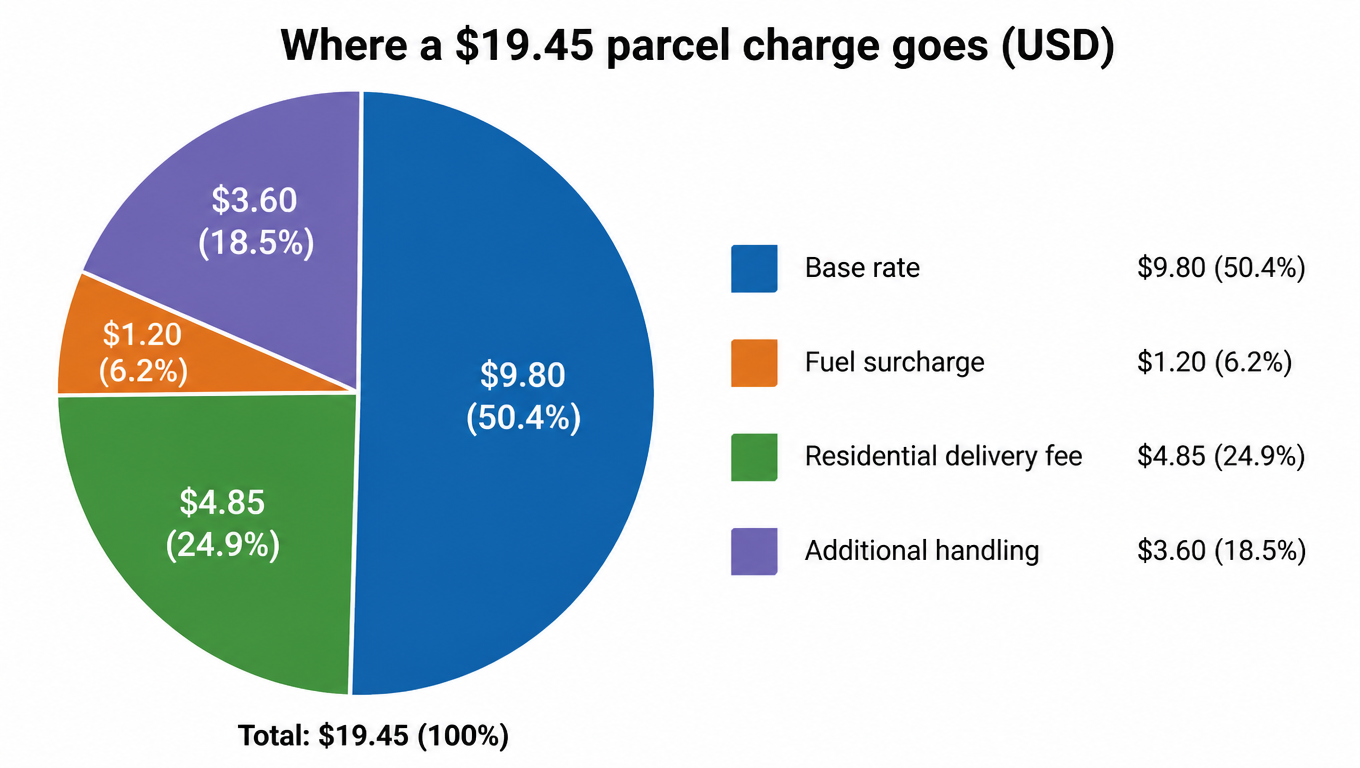
拿一张样张账单,按销售的方式去读。以一个典型的住宅 Ground 包裹为例(说明性数字):基础费率 9.80 美元,燃油附加费 1.20 美元,住宅派送费 4.85 美元,附加操作 3.60 美元。合计 19.45 美元,而基础费率连一半都不到。Take a sample invoice and read it the way the rep does. Consider a typical residential Ground parcel with illustrative numbers: a base rate of $9.80, a fuel surcharge of $1.20, a residential delivery fee of $4.85, and $3.60 of additional handling. The total is $19.45, and the base rate is barely half of it.

饼图:一票 19.45 美元包裹费用的构成,基础费率 9.80 美元、燃油附加费 1.20 美元、住宅派送费 4.85 美元、附加操作 3.60 美元Pie chart of where a $19.45 parcel charge goes: base rate $9.80, fuel surcharge $1.20, residential delivery fee $4.85, additional handling $3.60
一票 19.45 美元包裹费用的去向Where a $19.45 parcel charge goes

然后把这笔账单在脑子里拆成可谈和不可谈两部分。基础折扣百分比可谈,这也是大多数人停下的地方。住宅派送费可谈,货量够大时常能降低甚至豁免。燃油附加费以封顶的形式可谈:如果指数在 9%,销售可以同意把你的燃油封顶在 7%。体积重系数可谈:承运商可以用 139,也可以同意用 166,这个差别会悄悄重新定价你的一部分货量。附加费处理方式,也就是你的折扣是在附加费之前还是之后计算,也是一条值得争取的合同条款。Now split that invoice into negotiable and non-negotiable in your head. The base discount percentage is negotiable, and it is where most people stop. The residential delivery fee is negotiable, often reducible or waivable at enough volume. The fuel surcharge is negotiable in the form of a cap: if the index is running at 9 percent, a rep can agree to cap your fuel at 7 percent. The dimensional factor is negotiable: a carrier can apply 139, or agree to 166, and the difference quietly reprices a chunk of your volume. Surcharge treatment, meaning whether your discount applies before or after surcharges, is a contract line you can fight for.

陷阱是镜子的另一面。留意阶梯式重量档,跨过一磅门槛就跳进下一个计费档,涨幅和重量完全不成比例。留意轻包裹上的最低收费,留意签约几个月后才出现在账单上的、从未谈过的附加费,以及一张折扣百分比很漂亮、却悄悄把实际支出的一半排除在外的费率表。如果燃油、住宅费和附加费才是成本大头,那么基础费率打 4 折就是一场表演。The traps are the mirror image. Watch for stepped weight breaks, where crossing a one-pound threshold jumps you into the next billing band and the increase is far out of proportion to the weight. Watch for minimum charges that kick in on light parcels, for non-negotiated surcharges that appear on the invoice months after you signed, and for a rate sheet that shows a beautiful discount percentage while quietly excluding half of what you actually pay. A 40 percent discount on base rates is theater if fuel, residential, and accessorials carry the real cost.

承运商按利润定价,不按挂牌价定价。他们的成本是取件、干线运输、分拣,以及你所在区域的最后一公里派送密度。一旦你理解了这一点,你就理解了他们能让什么:在货量能填满他们网络的线路上,他们永远让得起利润;在货量是负担的线路上,他们永远会守住。谈判就是找到两者的交集。Carriers price to margin, not to list. Their costs are pickup, linehaul, sortation, and the last-mile delivery density of your zones. When you understand that, you understand what they can concede: they can always afford to give up margin in lanes where your volume fills their network, and they will always protect the lanes where your volume is a burden. The negotiation is about finding the overlap.

拨电话之前,先建立筹码Build Leverage Before You Dial

货量是最明显的杠杆,但不是唯一的,甚至不是最强的。承运商看重稳定性胜过规模。一个每周稳定发 2000 票的卖家,比一个在节日高峰混乱地发 8000 票的卖家更有吸引力,因为稳定账户让承运商能规划运力、便宜定价。增长轨迹同样重要:票数年增 40% 是一个销售能拿去跟经理讲故事、要更深折扣的素材。季节性是把双刃剑,这正是销售推年度合同的原因:他们想要你的旺季,而你可以拿旺季换一个全年更好的费率。Volume is the obvious lever, but it is not the only one, and it is not even the strongest one. Carriers value consistency more than size. A seller shipping 2,000 parcels a week on a predictable schedule is more attractive than a seller shipping 8,000 in a chaotic holiday spike, because the consistent account lets the carrier plan capacity and price it cheaply. Growth trajectory matters too: a 40 percent year-over-year increase in parcel count is a story the rep can take to their manager to justify a deeper discount. And seasonality cuts both ways, which is why reps push annual contracts: they want your peak, and you can trade your peak for a better year-round rate.

拨电话之前,先收集备选。向另一家全国承运商要报价,向 OnTrac、Veho 这类覆盖你所在区域的区域承运商要报价,也问问 USPS 系的服务,它们能把你的轻包裹以几分之一的价格带走。区域承运商在本土区域通常比全国巨头低 10% 到 20%,而拿到这些报价只花你一个下午。重点不是换掉谁,而是手里有一张纸上的数字,让你的现任承运商感到紧张。Before you dial, collect alternatives. Get quotes from the other national carrier, from regional carriers like OnTrac and Veho where they cover your zones, and from USPS-backed services that carry your lighter parcels for a fraction of the cost. Regional carriers routinely undercut nationals by 10 to 20 percent in their home regions, and the quotes cost you nothing but an afternoon. The point is not to switch, it is to have a number on paper that makes your incumbent nervous.

多承运商路由是所有杠杆里最强的一招,因为它让「走人」变得真实。当你真的可以在明天把 30% 的货量分给更便宜的区域承运商时,现任销售不是在跟你谈判,而是在跟你的路由逻辑谈判。你不需要威胁;文件夹里那份报价本身就是威胁,有经验的销售都懂。Multi-carrier routing is the strongest leverage of all, because it makes the walk-away real. When you can genuinely split 30 percent of your volume to a cheaper regional carrier tomorrow, the incumbent rep is not negotiating with you, they are negotiating with your routing logic. You do not need to threaten; the quote sitting in your folder is threat enough, and experienced reps know it.

挑时机。在承运商财季末、销售冲配额的时候打;在年度合同续约日之前打;在涨价公告刚发布后打,那时销售正接各家账户的抱怨电话,而「什么都不做」的客户经理会被人注意到。别等到一月涨价已经落在账单上,到那时预算已经花掉,筹码也没了。Time the conversation. Call at the end of the carrier's fiscal quarter when reps are chasing quota, before your annual contract renewal date, and immediately after a rate increase announcement, when the rep is fielding angry calls from every account and the account managers who "do nothing" get noticed. Do not wait until the January increase is already on your invoice, because by then the budget is spent and the leverage is gone.

实战打法:有效的战术与话术The Playbook: Tactics and Scripts That Work

对话开始就锚定你的数据,而不是他们的报价。开口就报你的混合单票成本,让他们去做算术。一套有效的话术:「我们全服务的混合成本是每票 12.60 美元,比去年涨了 6%。你能给到什么位置?」销售现在必须打败一个你控制的数字,而不是防守一个他们控制的数字。When the conversation starts, anchor with your data, not their quote. Open with your blended cost per parcel and let them do the arithmetic. A script that works: "Our blended cost across all services is $12.60 per parcel, up 6 percent from last year. Where can you get us?" The rep now has to beat a number you control, instead of defending a number they control.

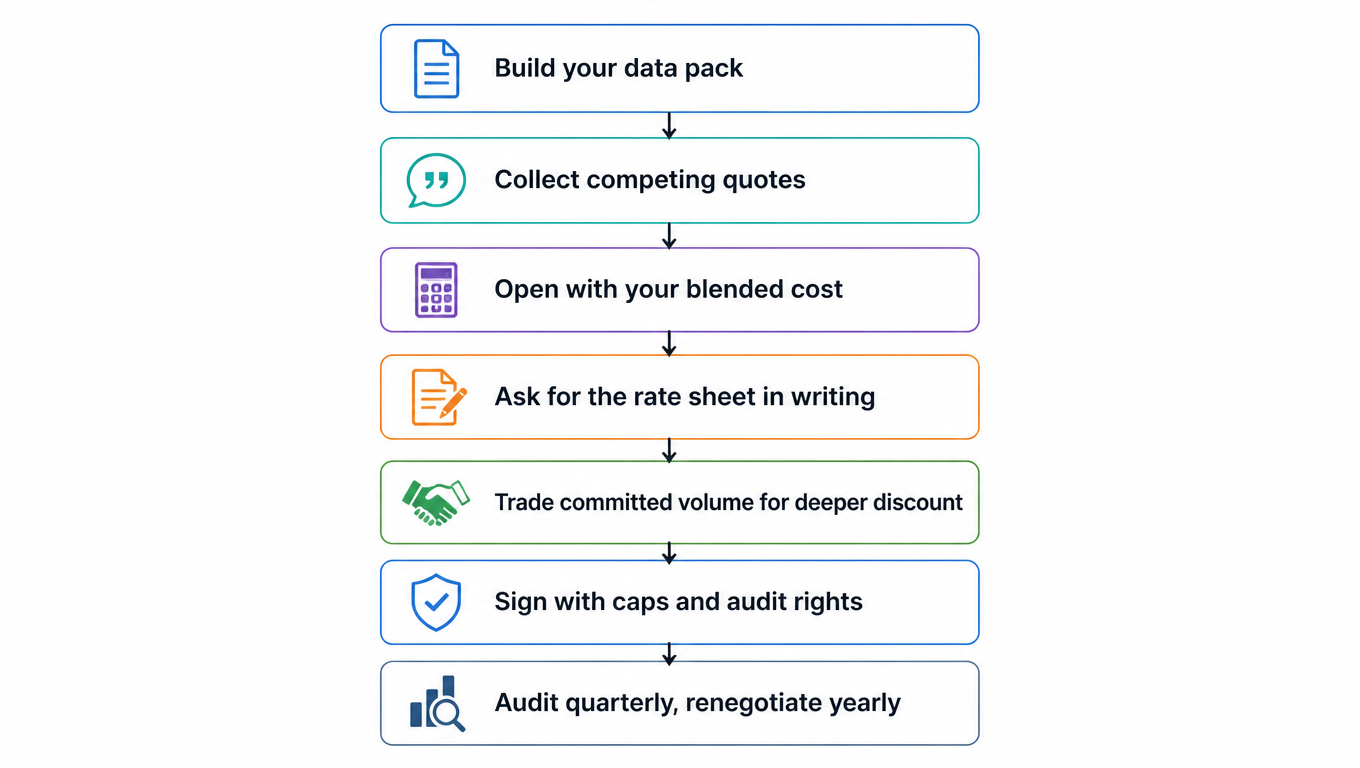
谈判流程图:准备数据包、收集竞争报价、亮出混合成本、索取书面费率表、承诺货量换取深度折扣、签约(含上限与审计权)、季度审计与年度重谈Flowchart of the negotiation playbook: build the data pack, collect competing quotes, open with your blended cost, ask for the rate sheet in writing, trade committed volume for deeper discount, sign with caps and audit rights, audit quarterly and renegotiate yearly
谈判全流程:从数据准备到审计The negotiation flow: from data pack to audit

永远不要只问「能不能便宜点」。要一份书面的折扣明细:给我看费率表,给我看折扣到底算在什么上面,给我看附加费表。这个差别极其重要。销售可以免费送你基础费率上的 5 个点,也可以用货量承诺换你实际支出上的 5 个点,后者比前者值好几倍。让他们把结构摆出来,然后谈结构,而不是谈头条数字。Never ask for "a lower price". Ask for a discount breakdown in writing: show me the rate sheet, show me what the discount applies to, show me the surcharge schedule. The difference matters enormously. A rep can hand you 5 points on base rates for free, or 5 points on your actual spend for a volume commitment, and the second one is worth several times the first. Make them show you the structure, then negotiate the structure, not the headline.

用货量换费率,但诚实地换。承诺是打开深度折扣的货币:固定周最低量、货量增长条款、把旺季货量留在该承运商的承诺。只承诺你真能达成的数字,因为完不成承诺的惩罚往往是追溯性涨价,比你想买的折扣还糟。如果你的货量不可预测,就明说,用一个更软的承诺换一个小一点的折扣。承诺的稳定性本身就是一种货量。Trade volume for rate, but trade honestly. Commitments are the currency that unlocks deep discounts: a fixed weekly minimum, a volume growth clause, a commitment to keep peak volume with the carrier. Only commit to numbers you can actually hit, because the penalty for missing a commitment is often a retroactive rate increase, which is worse than the discount you bought. If your volume is unpredictable, say so, and negotiate a softer commitment in exchange for a smaller discount. Consistency of commitment is a form of volume.

所有事情落到书面,包括销售在电话里答应的一切。附加费处理方式、燃油封顶、旺季附加费处理、最低收费、折扣百分比以及它算在什么上面。口头承诺在续约时蒸发,而当初答应你的人到那时通常已经离职。如果销售对把某个条款写进书面犹豫不决,那就是答案:这个条款从来就不是真的。Get everything in writing, including the things the rep promises over the phone. Surcharge treatment, fuel caps, peak surcharge handling, minimums, the discount percentage and what it applies to. Verbal promises evaporate at renewal, and the person who promised you is usually gone by then anyway. If the rep hesitates to put a term in writing, that is the answer: the term was never real.

敢于走开,让沉默去干活。当销售卡壳时,回应是:「我手里有一份区域承运商报价,我 30% 的货量比你的报价低 18%。如果你能匹配结构我今天就签,否则我就拆分路由,续约时再谈。」然后闭嘴。可信的备选是整本手册里最强的工具,听到具体数字的销售知道你不是在虚张声势。Be willing to walk away, and let the silence do the work. When a rep stalls, the response is: "I have a regional quote at 18 percent below your offer on 30 percent of my volume. If you can match the structure I'll sign today, otherwise I'll split the routing and we can revisit at renewal." Then stop talking. The credible alternative is the strongest tool in this entire playbook, and reps who hear a specific number know you are not bluffing.

锁定合同:值得争取的条款Lock It In: Contract Terms Worth Fighting For

谈判赢在合同语言,而不是电话里。先从费率保证期开始。十二个月保证期是最低要求,如果你承诺了货量,更长的保证期应该摆上桌。保证期重要,因为如果折扣每季度重置一次,它就一文不值。The negotiation is won or lost in the contract language, not the phone call. Start with the rate guarantee period. A twelve-month guarantee is the minimum you should accept, and a longer guarantee should be on the table if you are committing volume. The guarantee matters because the discount is worthless if it resets every quarter.

给年度涨价设上限。承运商每年秋季宣布综合涨价,你的合同可以把你的涨幅封在公告之下。如果承运商宣布 5.9%,一份把你涨幅封在 4.9% 的合同,三年下来是实打实的钱,而且这条很多销售不用你费劲就会给,因为很少有人提。Cap the annual increase. Carriers announce general rate increases every fall, and your contract can cap yours below the announcement. If the carrier announces 5.9 percent, a contract that caps your increase at 4.9 percent is worth real money over three years, and it is a line item many reps will grant without a fight because it rarely gets asked for.

争取附加费条款,因为利润就藏在那里。燃油附加费封顶或固定燃油百分比,取代跟随市场波动的无上限指数。旺季附加费(PSS)封顶或豁免,保护你的节日毛利,那通常是你最好的毛利。合同里写死体积重系数,阻止承运商日后重新评级你的体积重敏感 SKU。每一项都只是合同里一句话,实践里却是每年几千美元。Fight for the surcharge terms, because that is where the margin hides. A fuel surcharge cap or a fixed fuel percentage replaces an uncapped index that tracks the market. A peak season surcharge (PSS) cap or exclusion protects your holiday margin, which is usually your best margin. A fixed dimensional factor in the contract stops the carrier from re-rating your DIM-heavy SKUs later. Each of these is one sentence in the contract and thousands of dollars a year in practice.

要求账单审计权。标准语言是:错评包裹、错误的体积重重估、附加费错误、延误派送的退款索赔,配一个明确的追溯窗口和争议处理流程。承运商的意外多收费以总支出个位数百分比的速度发生,审计权就是你把钱拿回来的方式。最后,坚持干净的退出条款:没有自动续约锁定、由你控制的书面通知期,以及货量下降时可以提前退出的货量条款。一份你走不掉的合同不是交易,是牢笼。Demand billing audit rights. The standard language is refund claims for mis-rated packages, incorrect dimensional re-ratings, accessorial errors, and late deliveries, with a defined look-back window and a dispute process. Carriers overcharge by accident at a rate that is measured in single-digit percentages of total spend, and audit rights are how you get that money back. Finally, insist on clean exit terms: no auto-renewal lock-in, a written notice period you control, and a volume-out clause that lets you exit early if your volume drops. A contract you cannot leave is not a deal, it is a cage.

签约之后:账单审计与年度重谈After the Ink Dries: Audits and the Annual Re-negotiation

签约只是中点,不是终点。每季度做一次账单审计:核对谈好的折扣是否真的被应用,检查每一次体积重重估,通过写进合同的流程去争议错误。错误就在那里,悄悄地,在你不会去查的线路上。Signing the contract is the midpoint, not the finish line. Run a billing audit quarterly: verify that the negotiated discounts were actually applied, check every dimensional re-rating, and dispute errors through the process you wrote into the contract. The errors will be there, quietly, in the lanes you do not check.

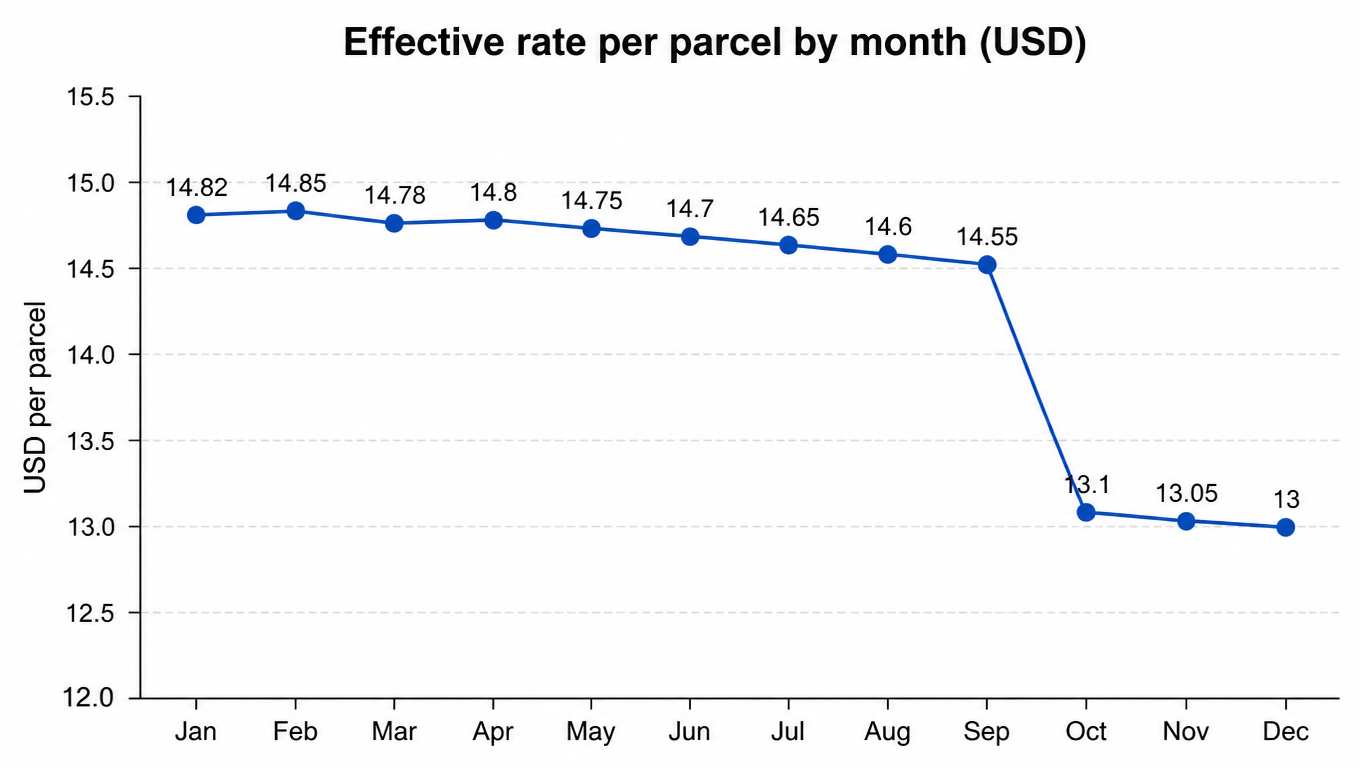
逐月追踪你的单票有效费率,盯着漂移。一个典型账户的轨迹是:有效费率从 1 月的 14.82 美元缓步走到 9 月的 14.55 美元,附加费和重估不断累积,然后在重谈合同生效的那个月掉到 13.10 美元。Track your effective rate per parcel month over month and watch for drift. A typical account shows a pattern: the effective rate creeps from $14.82 in January to $14.55 by September as surcharges and re-ratings accumulate, then drops to $13.10 the month a renegotiated contract goes live.

折线图:每月单票有效费率,1 月 14.82 美元缓步走到 9 月 14.55 美元,10 月新合同生效后降至 13.10 美元并继续走低Line chart of effective rate per parcel by month: $14.82 in January drifting to $14.55 by September, then dropping to $13.10 in October when a renegotiated contract goes live
单票有效费率:重谈合同生效后跳水Effective rate per parcel: the drop when a renegotiated contract goes live

这种漂移是不上心的沉默税,唯一的防御是一个你每个月真会看一眼的数字。如果有效费率连续两个月爬升,在它变成习惯之前找出原因。That drift is the silent tax of inattention, and the only defense is a monthly number you actually look at. If the effective rate climbs two months in a row, find out why before it becomes a habit.

把重谈当成年度仪式,对齐 GRI 季节。去年签的合同是今年的起点,不是答案。承运商每年秋天都等着重谈,而不开口的账户就是全额支付公告涨价的账户。带着你的审计结果、新的货量故事和今年的竞争报价来。Treat renegotiation as an annual ritual, timed to the GRI season. The contract you signed last year is the starting point for this year, not the answer. Carriers expect to renegotiate every fall, and the account that does not ask is the account paying the announced increase in full. Come prepared with your audit results, your new volume story, and this year's competing quotes.

撞墙就升级。销售动不了,就找他的经理;经理也动不了,就问做到多少货量才行。承运商组织的每一层都有不同的预算,销售说「我权力有限」通常只关于他自己的权限,无关其他。每个周期都要多份报价,每年秋天跑同一套打法,把每一年当成一场全新的谈判而不是一次续约。付得最少的卖家不是最大的,而是那些每年都带着数据、备选方案和走人的意愿出现的人。Escalate when you hit a wall. If the rep cannot move, ask for their manager, and if the manager cannot move, ask what volume it would take. Every level of the carrier organization has a different budget, and the rep who says "my hands are tied" is usually telling the truth about their own authority and nothing else. Get multiple quotes every cycle, run the same playbook every fall, and treat each year as a fresh negotiation rather than a renewal. The sellers who pay the least are not the biggest, they are the ones who show up every year with data, alternatives, and the willingness to walk.

要点清单Key Takeaways

  • 你的费率卡是一道天花板,谈判从你的数据开始,而不是他们的报价。Your rate card is a ceiling, and the negotiation starts from your data, not their quote.
  • 开口之前先搞清承运商的利润藏在哪:基础费率连一半都不到。Understand where carrier margin hides before you ask for anything: base rates are barely half the story.
  • 筹码就是备选方案:竞争报价和多承运商路由给你真实的走人权力。Leverage is alternatives: competing quotes and multi-carrier routing give you real walk-away power.
  • 谈结构,不谈头条:实际支出上的折扣、燃油封顶、固定的体积重系数,胜过漂亮的百分比。Negotiate structure, not headline: discounts on your actual spend, fuel caps, and a fixed DIM factor beat a pretty percentage.
  • 把封顶、审计权和干净的退出条款写进合同,永远不要依赖口头承诺。Lock caps, audit rights, and clean exit terms into the contract, and never rely on verbal promises.
  • 把谈判当成年度仪式,中间每季度审计,而不是一次性事件。Treat negotiation as an annual ritual with a quarterly audit in between, not a one-time event.

常见问题FAQ

不需要。承运商看重稳定性和增长轨迹胜过规模,而且销售手里有真实的折扣权限。关键是把数据准备齐(票数、服务结构、重量段、区域、混合单票成本),并拿到至少一份竞争报价做筹码。小账户谈下来的折扣可能不如大账户深,但费率表上的每一个点都直接进利润。No. Carriers value consistency and growth trajectory over raw size, and reps carry real discount authority. What matters is showing up with a data pack (parcel count, service mix, weight bands, zones, blended cost per parcel) and at least one competing quote as leverage. A smaller account may not win as deep a discount, but every point on the rate card goes straight to your margin.
能,谈的是封顶而不是取消。如果燃油指数在 9%,销售可以同意把你封在 7%,或干脆固定一个百分比。把封顶写进合同,并确认你的折扣是在附加费之前还是之后计算。Yes, you negotiate a cap rather than an elimination. If the index runs at 9 percent, a rep can agree to cap you at 7 percent, or fix a percentage outright. Get the cap in the contract, and confirm whether your discount applies before or after surcharges.
三个窗口:承运商财季末(销售冲配额)、年度合同续约日之前、秋季 GRI 涨价公告刚发布之后。避开一月涨价已经生效之后,那时预算已花、筹码已失。Three windows: the end of the carrier's fiscal quarter when reps chase quota, before your annual renewal date, and right after the fall GRI announcement, when reps are fielding angry calls from every account. Avoid negotiating after the January increase is already on your invoice, when the budget is spent and the leverage is gone.
每年一次,对齐 GRI 季节;中间每季度做一次账单审计。年度重谈以去年合同为起点,带上审计结果、新的货量数据和当年的竞争报价。不开口的账户就是全额支付涨价的账户。Once a year, timed to GRI season, with a quarterly billing audit in between. Treat last year's contract as the starting point, not the answer, and arrive with audit results, your new volume story, and this year's competing quotes. The account that does not ask is the account paying the announced increase in full.
Get Rate Comparison
Get Rate Comparison