
Cost Optimization

How to Audit 3PL Shipping Rates: Markups, Carrier Adjustments, and Pass-Through Fees

The quote looked fine. The bill does not. Every ecommerce brand that outsources fulfillment knows the moment: you pull last month's 3PL invoice, the line items do not match the rate card, the carrier adjustment column is a mystery, and the total runs 5 to 15 percent above what the quote suggested[^1]. This article is a practical audit: the specific fees to hunt for, the chain of numbers to align, and a decision framework for what to do with what you find. It is written for both sides of the table: brands auditing their 3PL, and 3PLs that want to be the provider customers can audit.

The output of an audit is not a report, it is a decision about who owns the shipping layer. To see how the whole 3PL operating model fits together, start with the 3PL shipping operations model; for a quick check of quote versus final charge, use our billing checklist.

Warehouse supervisor and ecommerce founder examine shipping invoices and rate cards with a magnifying glass.
An audit turns "I think we are overcharged" into "every gap has a name and an owner"

Why Your 3PL Bill Never Matches the Quote

The symptoms repeat across brands. The quote at booking differs from the final charge. The 3PL's markup is nowhere in writing. Carrier adjustments (fuel, residential, delivery area, peak) get passed through wholesale with no detail[^2]. Voids, refunds, and claims leave no paper trail. The same parcel costs different amounts depending on which warehouse node it shipped from. And the cheapest service option on paper misses its delivery promise often enough that refunds and support tickets quietly eat the savings.

Each symptom alone is a small leak. Together they make shipping cost structurally unpredictable, which is worse than expensive.

The hidden costs are bigger than the line items. Every refunded order, every support ticket about a late parcel, every customer who quietly stops buying after a bad delivery is part of the true cost of shipping. A bill that cannot be explained forces you to spend time auditing instead of selling, and a 3PL that cannot or will not explain its numbers hands you a negotiation with no leverage.

Most sellers react the same way: they suspect the 3PL of overcharging, but with no evidence the renegotiation stalls. The audit below fixes that. It turns suspicion into a classified list of differences, which is exactly the leverage you need.
Why Discount Percentages and Pick-and-Pack Fees Don't Tell the Truth

The most common way to compare 3PLs is by discount percentage against a carrier's published rate card. It feels precise, and it is close to meaningless. A 15 percent discount off an inflated base rate can cost you more than a 5 percent discount off a properly negotiated base rate, because the discount applies to a number you may never see.

The same is true of the pick-and-pack fee and the label unit price. Those cover a narrow slice of fulfillment cost, the part that happens inside the warehouse. They say nothing about what happens after the parcel leaves: carrier adjustments, refunds, claims, and the 3PL's fees on top of them.

To understand real cost you need answers to five ownership questions:

  1. Whose carrier account is used, yours or the 3PL's?
  2. Who owns the rate card the labels are priced against?
  3. Who receives the carrier invoice and the settlement files?
  4. How does the 3PL calculate its markup: fixed per label, percentage, or cost-plus with an undefined base?
  5. Who carries carrier adjustments, refunds, and claims: the 3PL or you?

Then two process questions: who handles voids, refunds, claims, and disputes when they happen, and can you get shipment-level data or only aggregates? If you cannot answer those, you cannot audit. Everything downstream depends on them.

The Quote-to-Settled-Cost Audit Chain

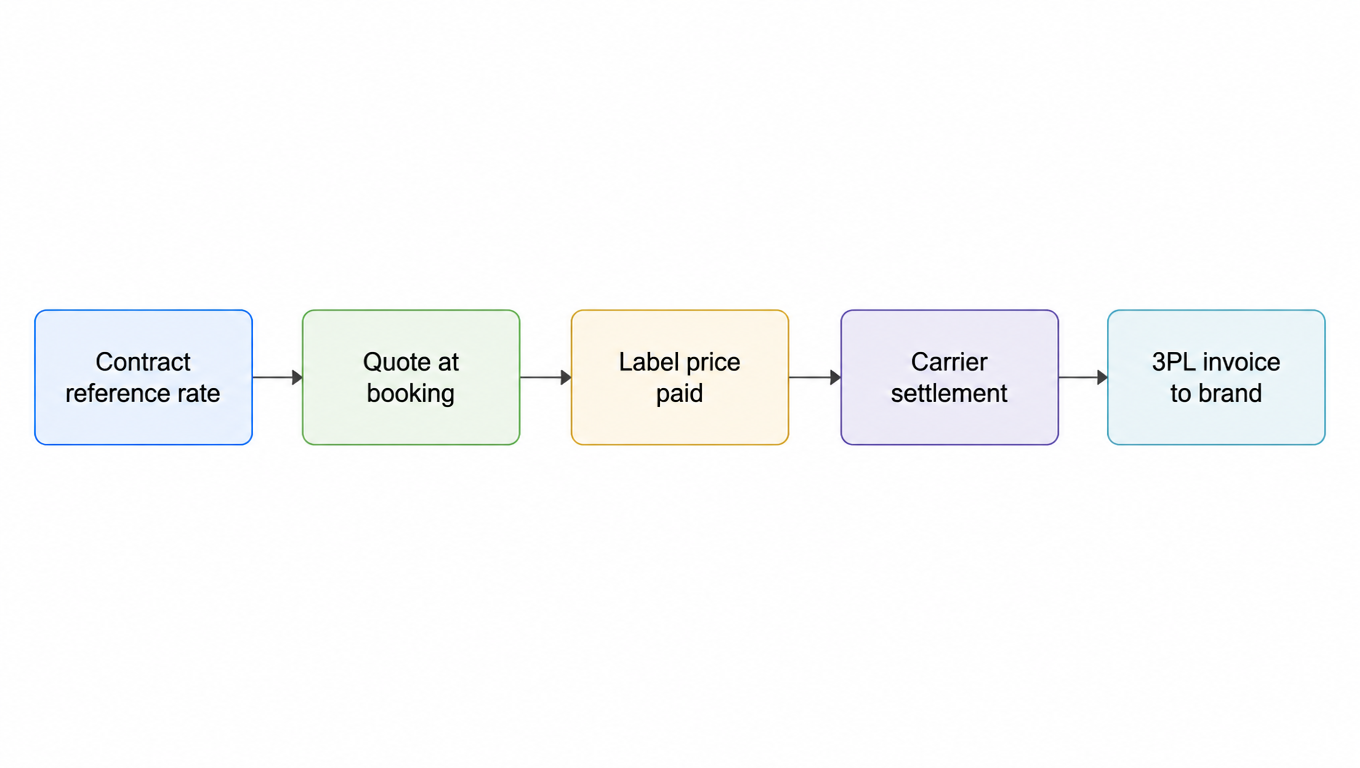
The fix is to stop comparing one number to another and instead track a single shipment through every price it touches. That is the Quote-to-Settled-Cost Audit Chain, five links long:

Quote-to-Settled-Cost audit chain flowchart: contract reference rate, quote at booking, label price paid, carrier settlement, 3PL invoice to brand, five links in sequence
Five prices for the same shipment, and every gap between adjacent links needs a name
  1. Contract reference rate: the rate card or contract rate you negotiated, or the 3PL's stated base.
  2. Quote at booking: what the system quoted when the order was created.
  3. Label price paid: what the label actually cost at purchase.
  4. Carrier settlement: what the carrier charged after adjustments, surcharges, and corrections.
  5. 3PL invoice to brand: what the 3PL finally bills you.

Every difference between adjacent links must fall into exactly one of four buckets: a legitimate carrier adjustment (fuel, DAS, residential, dimensional corrections); a markup the contract allows (stated margin, admin fee, minimums); a data or operational error (wrong weight, wrong zone, wrong service, double charge); or an unexplained charge with no supporting evidence.

The goal of an audit is simple: classify every gap into one of the four buckets, and drive the fourth bucket, the unexplained charges, to zero. You do not need perfect pricing, you need explainable pricing. And you do not need to prove intent, only that the gap exists.

Ten Variables That Drive the Gap

Between the contract rate and the settled cost, ten variables do most of the work. Each one is a place where a gap can appear, and each one needs a policy, not an assumption.

VariableThe question to answer
Weight and DIM weightWhose dims, whose rounding? A 14x10x6 in box at 4.2 lb actual bills at 6.1 lb dimensional[^3].
Origin and destination ZIPs and the resulting zoneA zone error on a single label can cost more than a markup.
SurchargesResidential, delivery area (DAS), fuel, peak: applied by whom, at what rate, on what base[^2]?
Carrier and service selectionWho picks the service, and is the cheapest service the one that actually arrives?
Promised versus actual deliveryA service that misses its promise generates refunds and support costs that never appear on the shipping invoice.
Adjustments, voids, refunds, claimsWho processes them, who owns them, and are they itemized?
Markup, admin fees, and minimumsFixed, percentage, or cost-plus, and is the base defined?
The warehouse nodeThe same parcel can cost different amounts from different facilities of the same 3PL.
Cost per label versus cost per successful deliveryThe second one includes the failures.
Data linkageOrder, shipment, tracking, and invoice records must join on a shipment ID; if they do not, you are auditing by hand.

Each variable is an answerable question, and the audit chain gives you a place to answer it.

The Six-Step Audit: From Invoice to Decision

Here is the whole audit as six steps.

Step 1: pick a representative shipment group. Choose a sample that reflects your real mix: a few hundred labels across your top SKUs, zones, services, and warehouse nodes over 60 to 90 days. Do not audit the average, audit the spread. Averages hide the outliers that cost you the most.

Step 2: ask for the rules in writing. Request the rate rules, the markup policy, the surcharge schedule, and the stated process for adjustments, voids, refunds, and claims. If the 3PL cannot produce these, that is your first finding.

Step 3: align the chain by shipment ID. For each shipment in the group, pull the quote, the label price, the carrier settlement, and the 3PL invoice line. Join them on the shipment ID and compute each adjacent gap.

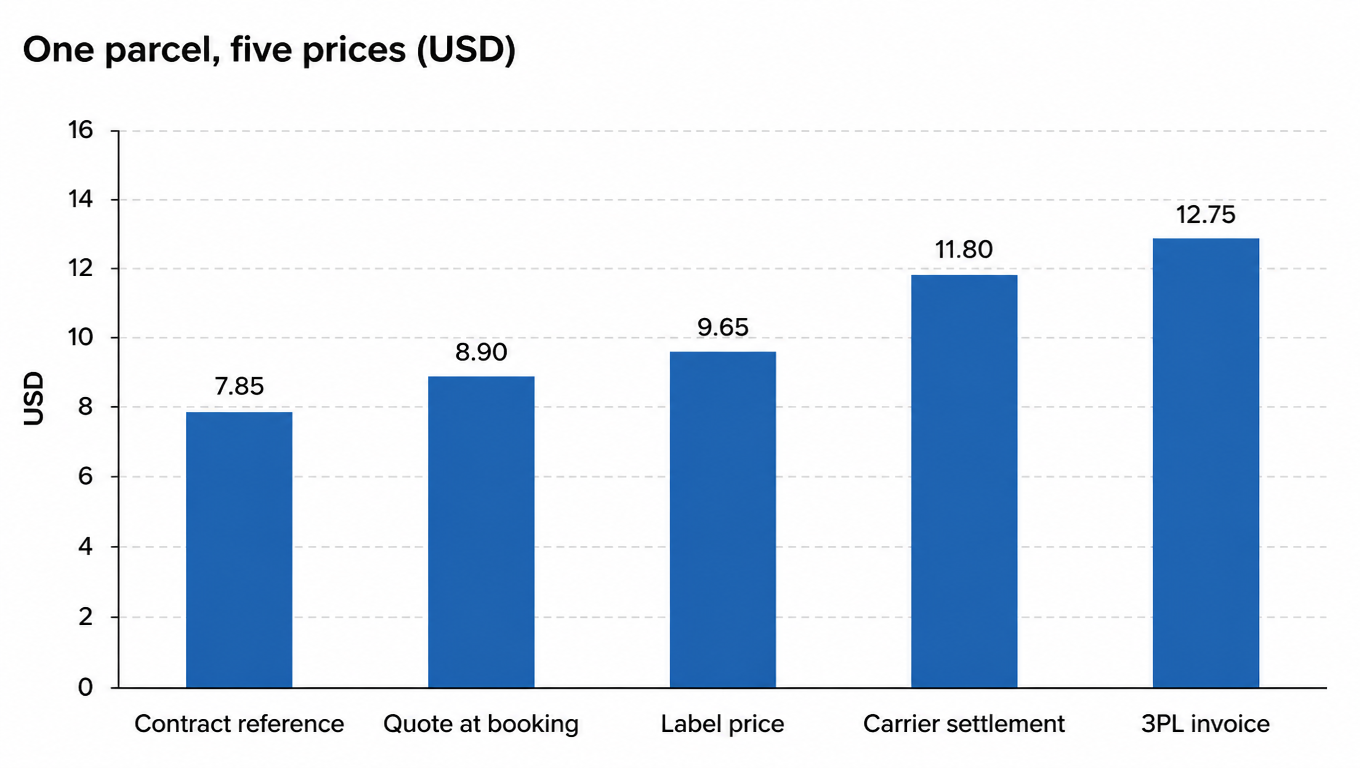
Step 4: classify every gap. Label each gap as carrier, 3PL markup, data or operational error, or unexplained, and keep a running total per bucket. A worked example: one parcel, 4.2 lb actual, 6.1 lb dimensional, zone 8, residential address with a delivery area surcharge. The chain looks like this:

Bar chart of one parcel's five prices in USD: contract reference 7.85, quote at booking 8.90, label price 9.65, carrier settlement 11.80, 3PL invoice 12.75
The same parcel priced five ways: of the 4.90 USD gap, 2.15 is legitimate carrier adjustment, 2.00 is contractual markup, 0.75 is a data error, and nothing is unexplained

Contract reference $7.85, quote at booking $8.90, label price $9.65, carrier settlement $11.80, 3PL invoice $12.75. Total $4.90 above reference. Classified: $2.00 is contractual markup ($1.05 quote markup plus $0.95 admin on the adjusted amount), $2.15 is legitimate carrier adjustment (fuel, residential, DAS), and $0.75 is a data error (the label was priced on 5.9 lb; the carrier reweighed at 6.2 lb). Nothing is unexplained, which makes this bill audit-clean even though it runs well above the quoted number. If the same 3PL cannot explain a similar gap elsewhere, that is the finding.

Step 5: compare cost and delivery performance together. A service that is $1.20 cheaper per label but misses its delivery promise 6 percent of the time is not cheaper. Include refunds, reshipments, and support tickets in the comparison. The metric that matters is cost per successful delivery, not cost per label.

Step 6: decide. With the classified gaps in hand, pick a path: keep the current setup with better reporting; renegotiate specific line items such as markup structure and adjustment pass-through caps; move to your own carrier account; bring platform or negotiated rates; split the shipping layer from the 3PL; or switch providers. For the trade-offs on each path, see our parcel RFP process and the 3PL performance scorecard.

What a Transparent 3PL Looks Like

The same audit looks different from the 3PL side, and the honest ones welcome it. A transparent 3PL publishes its markup policy in the contract, defines what "cost" means when it passes carrier costs through, and shares the carrier invoice and settlement files behind its charges. It offers shipment-level data rather than monthly totals, and it produces a monthly reconciliation report that classifies its own gaps for you.

Transparency is a retention weapon. A customer who can audit your numbers and finds them clean has no reason to leave and no negotiating leverage against you. A customer who cannot audit your numbers leaves as soon as a cheaper quote appears, and disputes every invoice on the way out. For a 3PL, making yourself auditable is cheaper than any discount you will offer to keep a suspicious account. Which is why the natural next step after an audit is taking the classified gap list straight into a conversation about markup structure and adjustment pass-through caps; see verifying shipping rate claims for the playbook.

Your Audit Output: The Shipping Layer Decision

The output of a rate audit is not a report. It is a decision about who owns your shipping layer: the function that compares carrier options, buys labels, and settles the difference between a quote and a final cost.

Three common shapes. Fully managed: the 3PL owns the shipping layer and you audit its outputs. Own account plus fulfillment: you hold the carrier account and rate card while the 3PL executes labels under your rules. Channel-neutral shipping layer: comparison and execution are separated from any single warehouse, so you can compare carriers and services on equal footing across nodes and re-route without re-contracting.

EasyShippingX is built as that third shape: a channel-neutral shipping layer that compares US domestic carrier options and executes through the Portal, Excel, or API, regardless of which 3PL handles the boxes. The audit chain in this article is exactly the kind of thing a neutral layer makes visible by default: quote, label, settlement, and invoice aligned on the same shipment ID.

Run the audit. Classify the gaps. Then decide who should own the layer, because that decision, not the discount percentage, is what your shipping cost actually depends on. To understand how to claw gaps back from the bill, see the weight adjustment dispute process and the carrier contract audit.

FAQ

A markup is legal and common; the question is whether it is in writing and whether the base is defined. An audit does not chase zero markup, it chases explainability: every gap falls into one of four buckets, contractual markup, legitimate carrier adjustment, data or operational error, or unexplained. The markup must be stated in the contract as fixed per label, percentage, or cost-plus, with the base defined.
Use the audit chain. Get the carrier settlement file and the 3PL invoice: fuel, residential, DAS and dimensional corrections that appear in the settlement are carrier adjustments; the difference between the 3PL invoice and the settlement is the 3PL's markup. Any charge line with no basis in the carrier settlement file needs evidence from the 3PL.
Do not audit the average, audit the spread. Take a few hundred labels over 60 to 90 days covering your top SKUs, several zones, main services and warehouse nodes, and make sure the sample includes the exception types: weight adjustments, residential addresses, delivery areas. The sample only classifies well when each gap type appears several times.
Do not rush to switch. Send the classified gap list to the 3PL and demand line-by-line explanations: gaps they can explain and correct are data or operational errors, ask for refunds and process fixes; contractual markups become specific renegotiation line items; unexplained charges, once they accumulate, are your evidence for switching or splitting the shipping layer.
When the 3PL cannot explain the gaps, refuses to share carrier settlement files, or the markup structure makes cost unpredictable. Either an own account with 3PL execution, or a separate channel-neutral shipping layer, gets quote, label, settlement and invoice aligned on the same shipment ID.

Identify the account and rate owner

Before comparing quotes, identify who owns the carrier account and who handles handoff and billing disputes. Own carrier account versus 3PL or platform rates provides responsibility and cost checks for the same parcel profile.